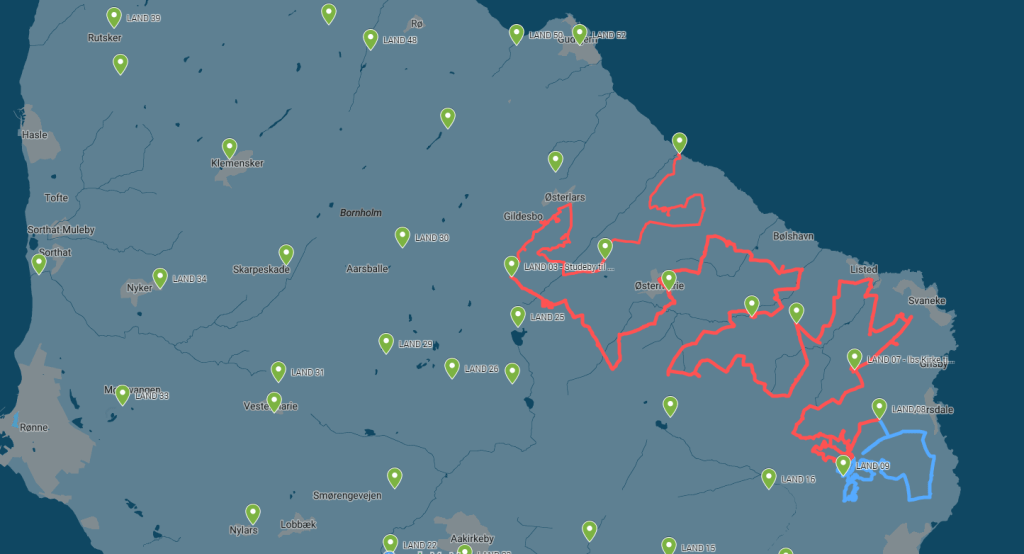
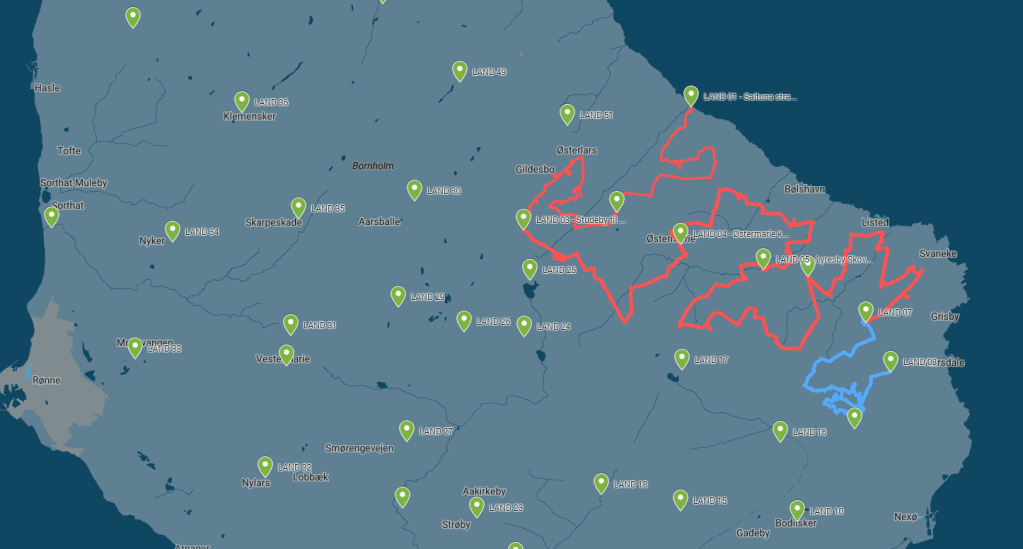
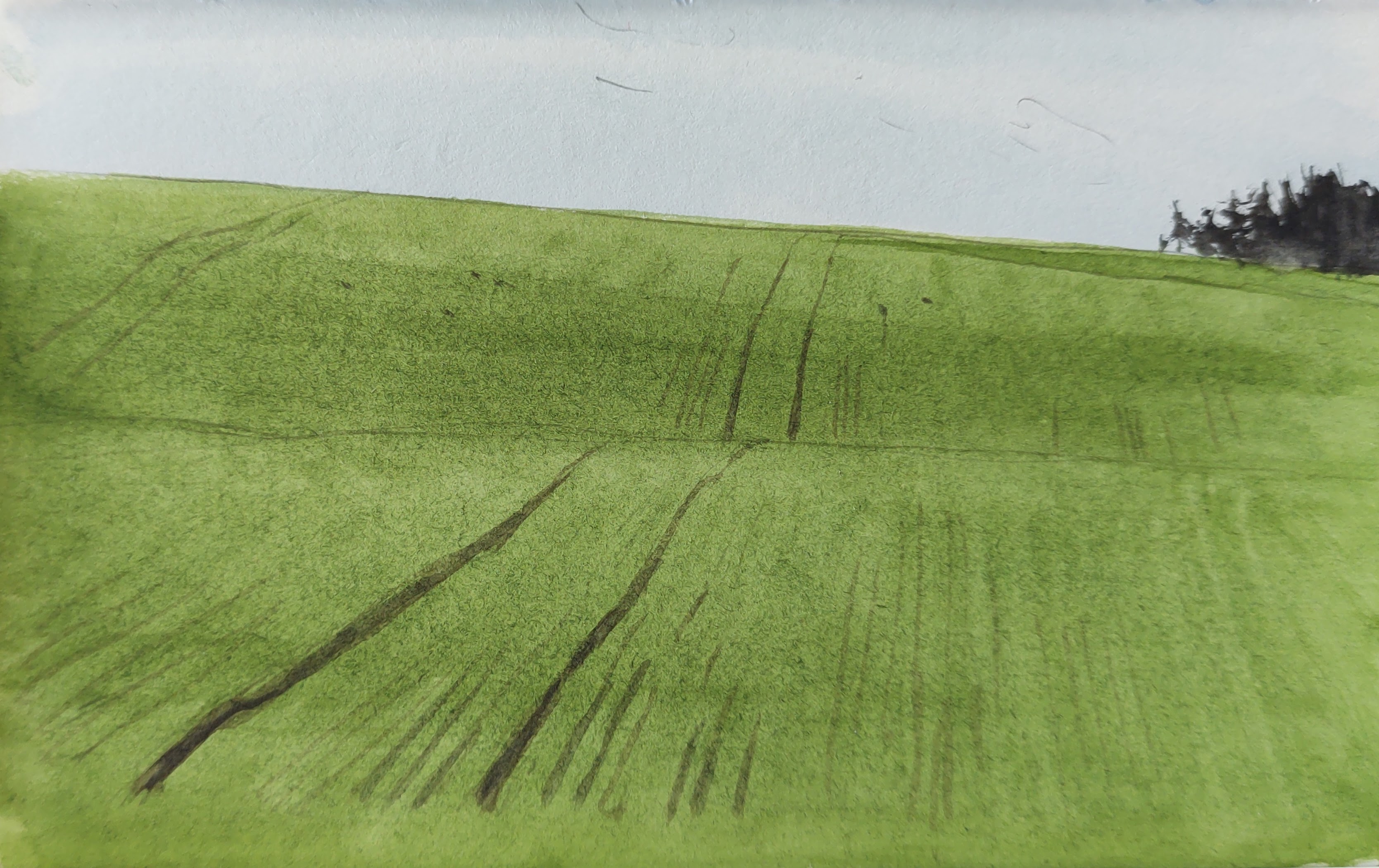
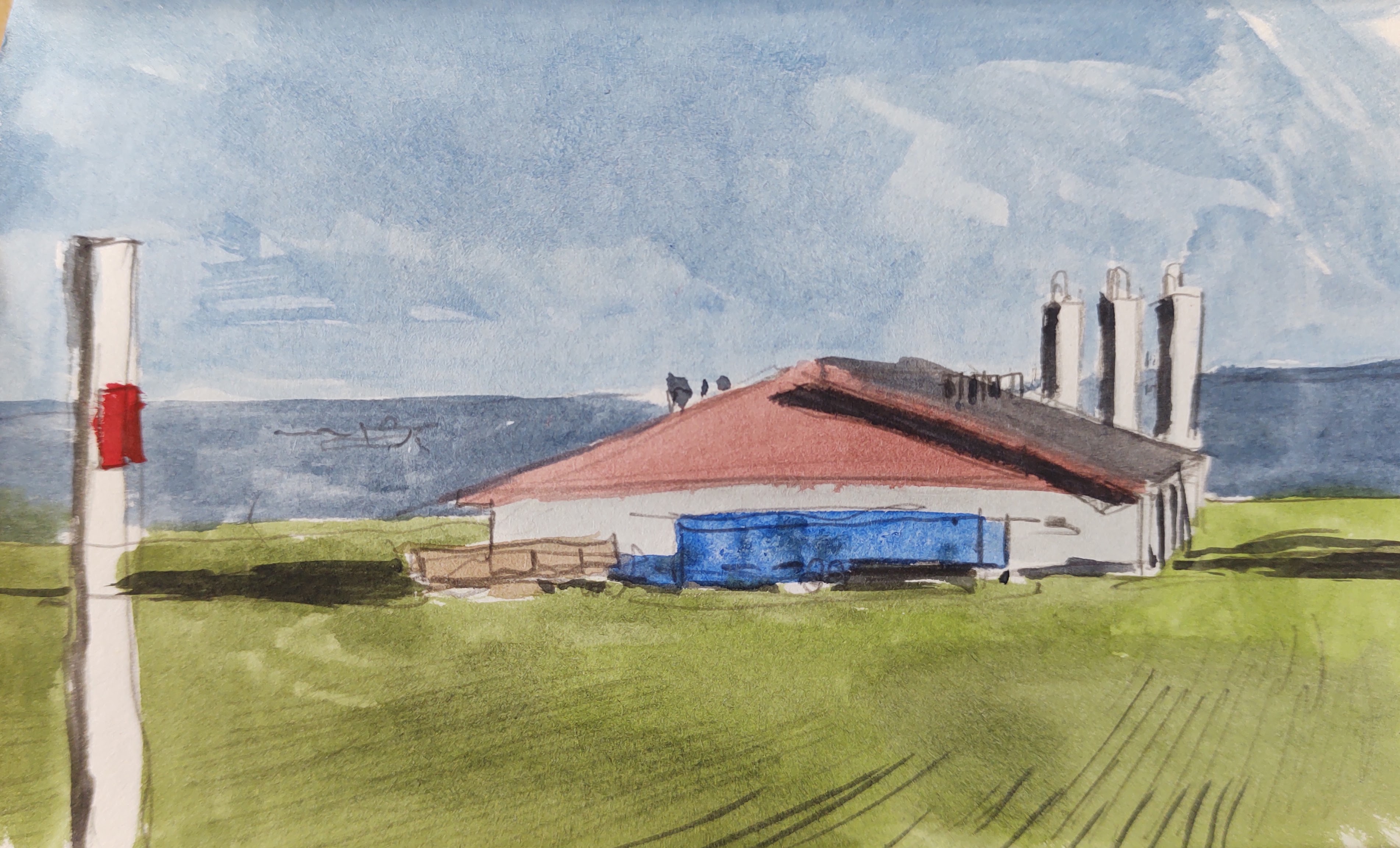
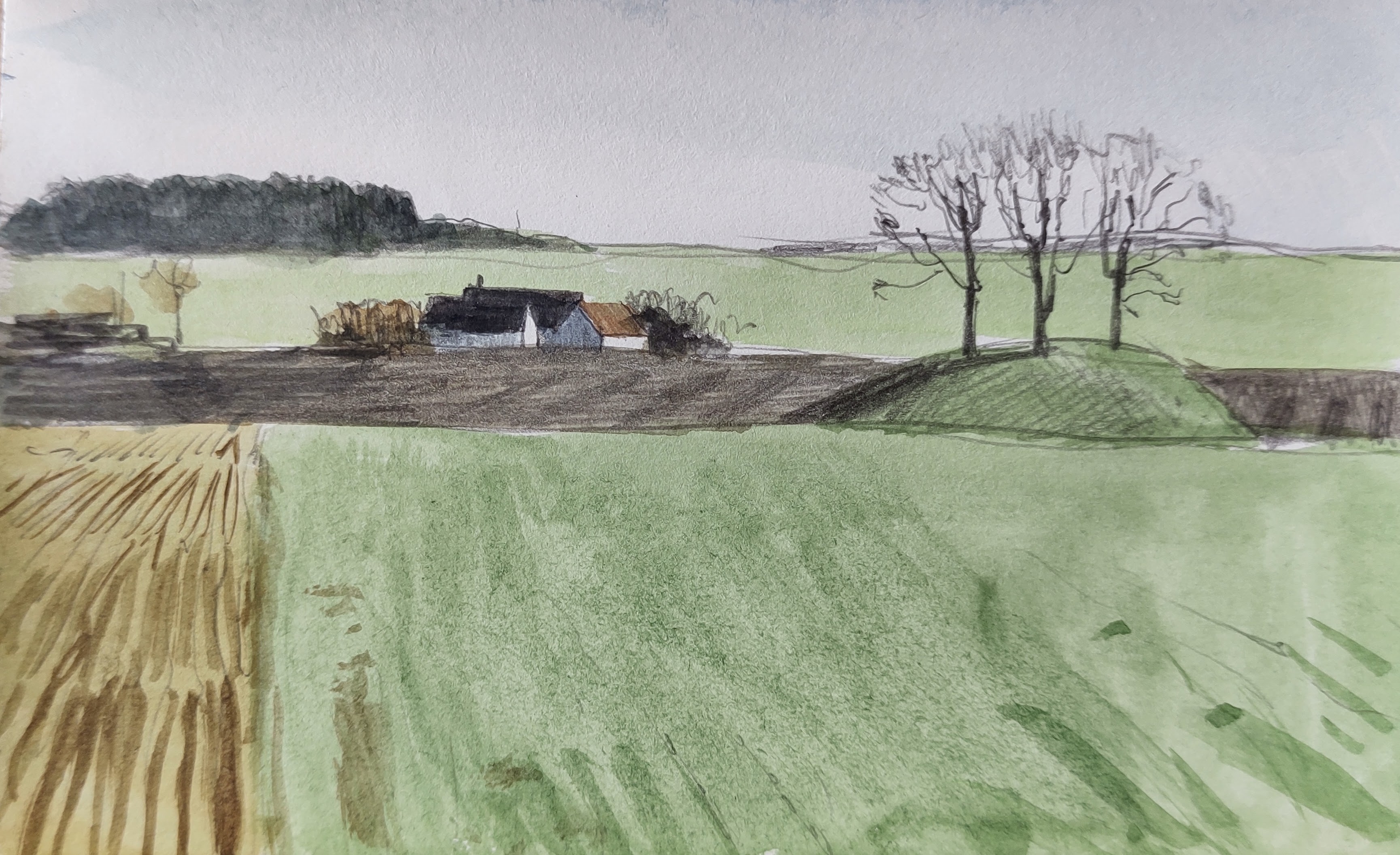
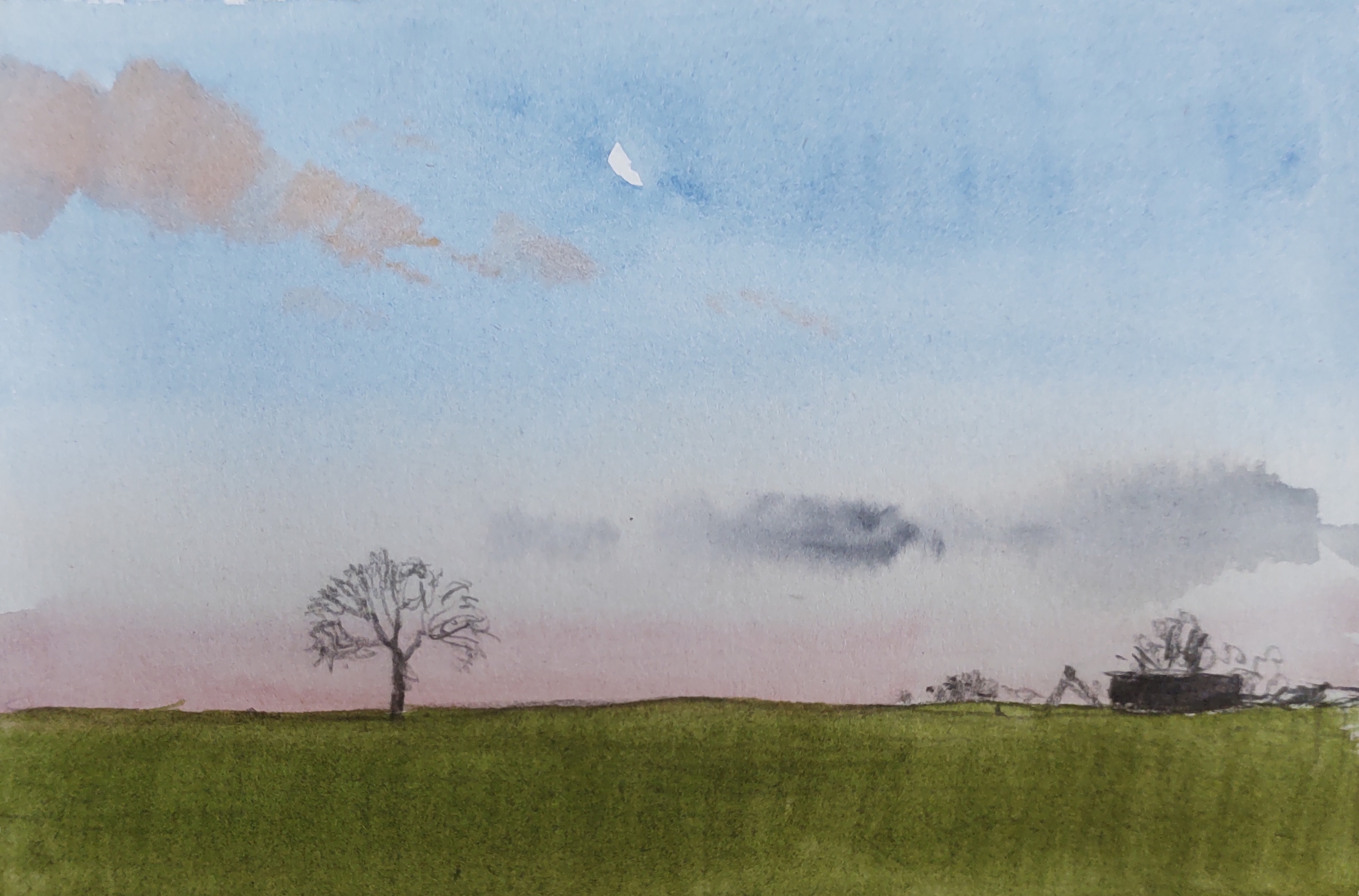
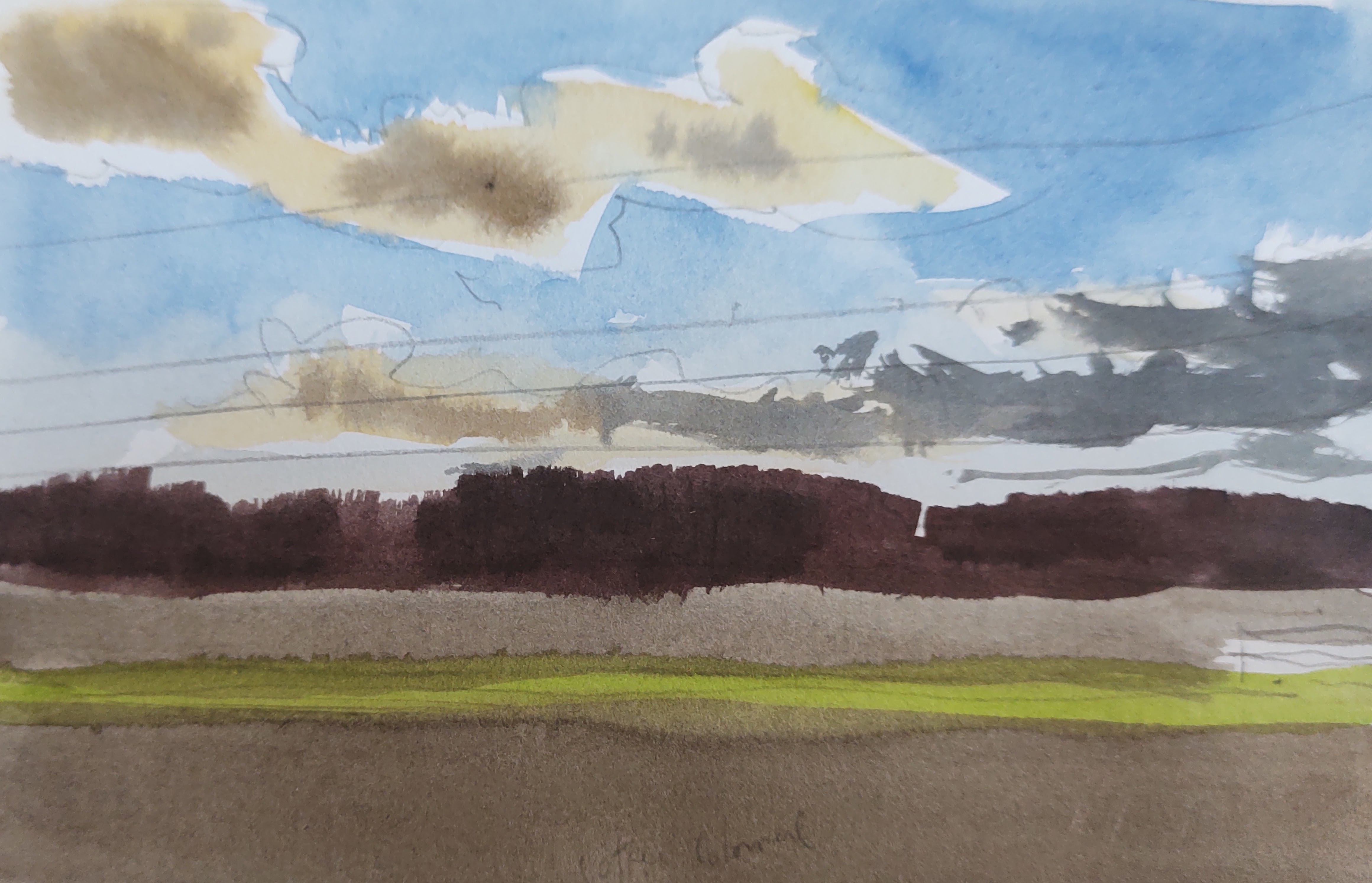
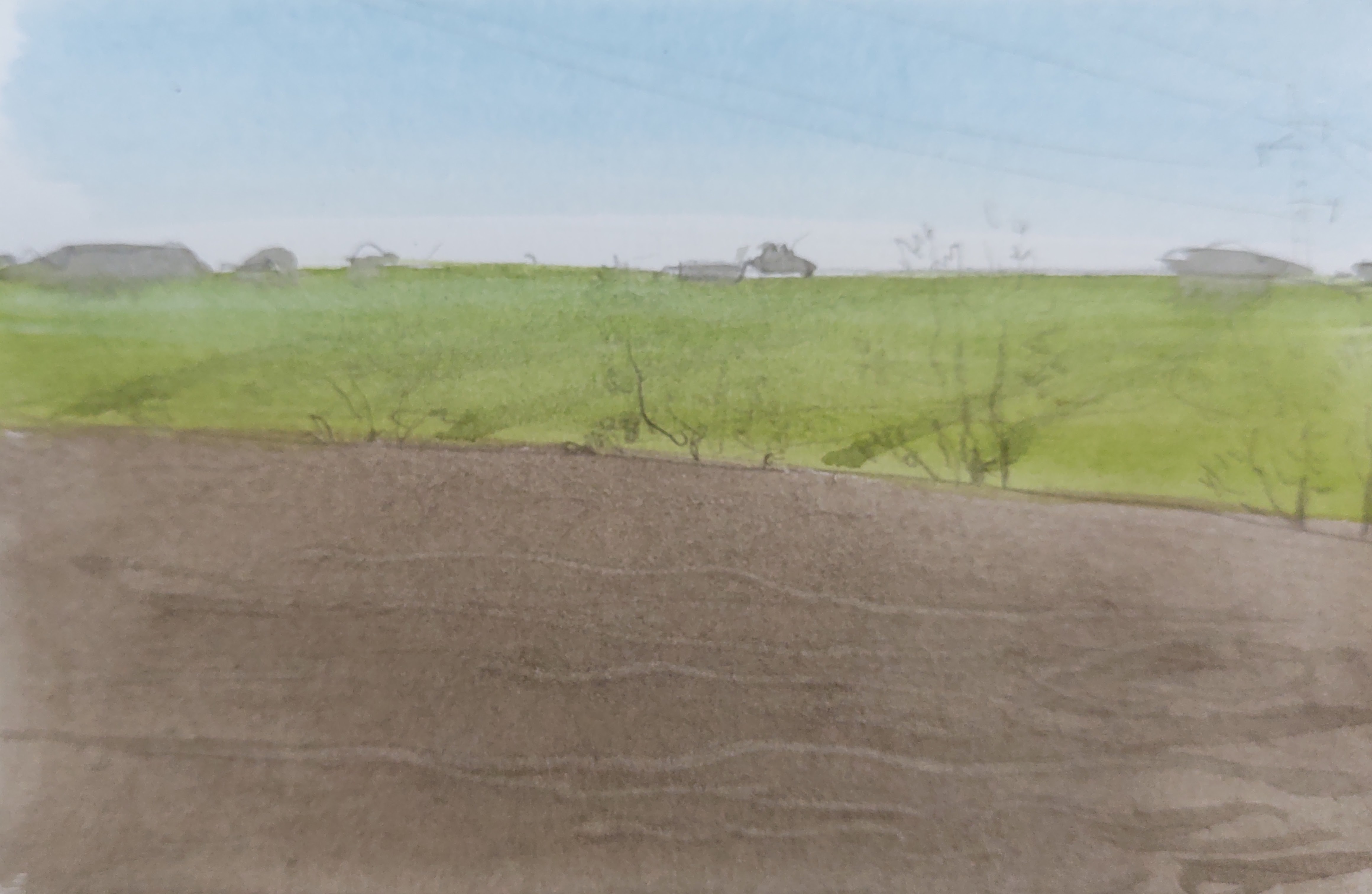
LAND 07 – Ibsker Church to Paradisbakkevejen, 16.02.23

Denne blog på dansk her

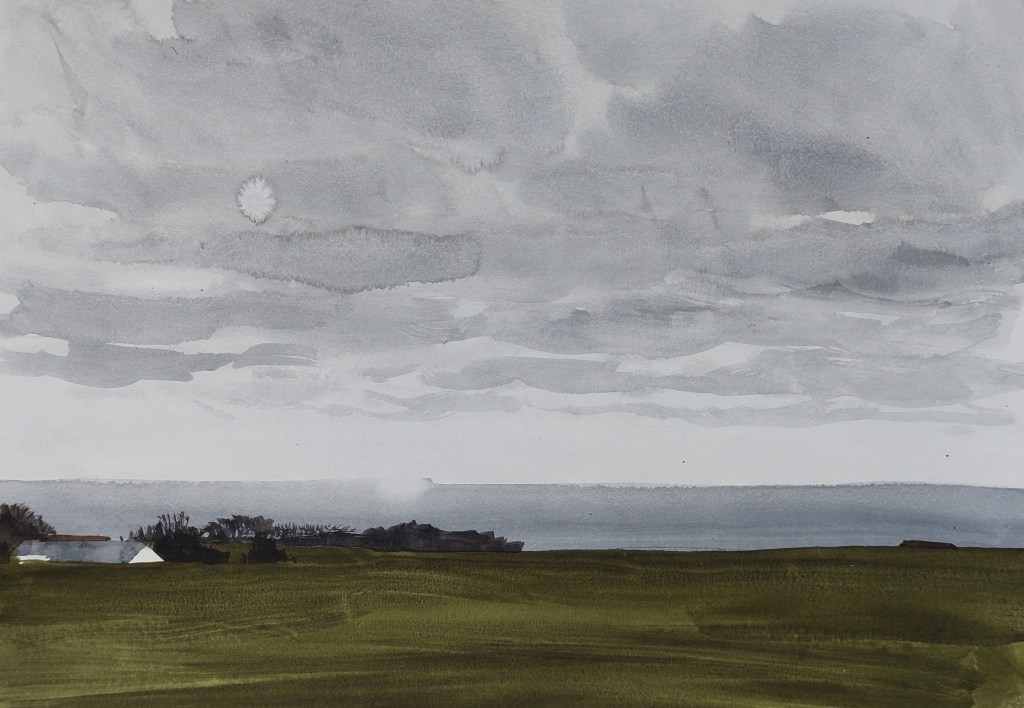
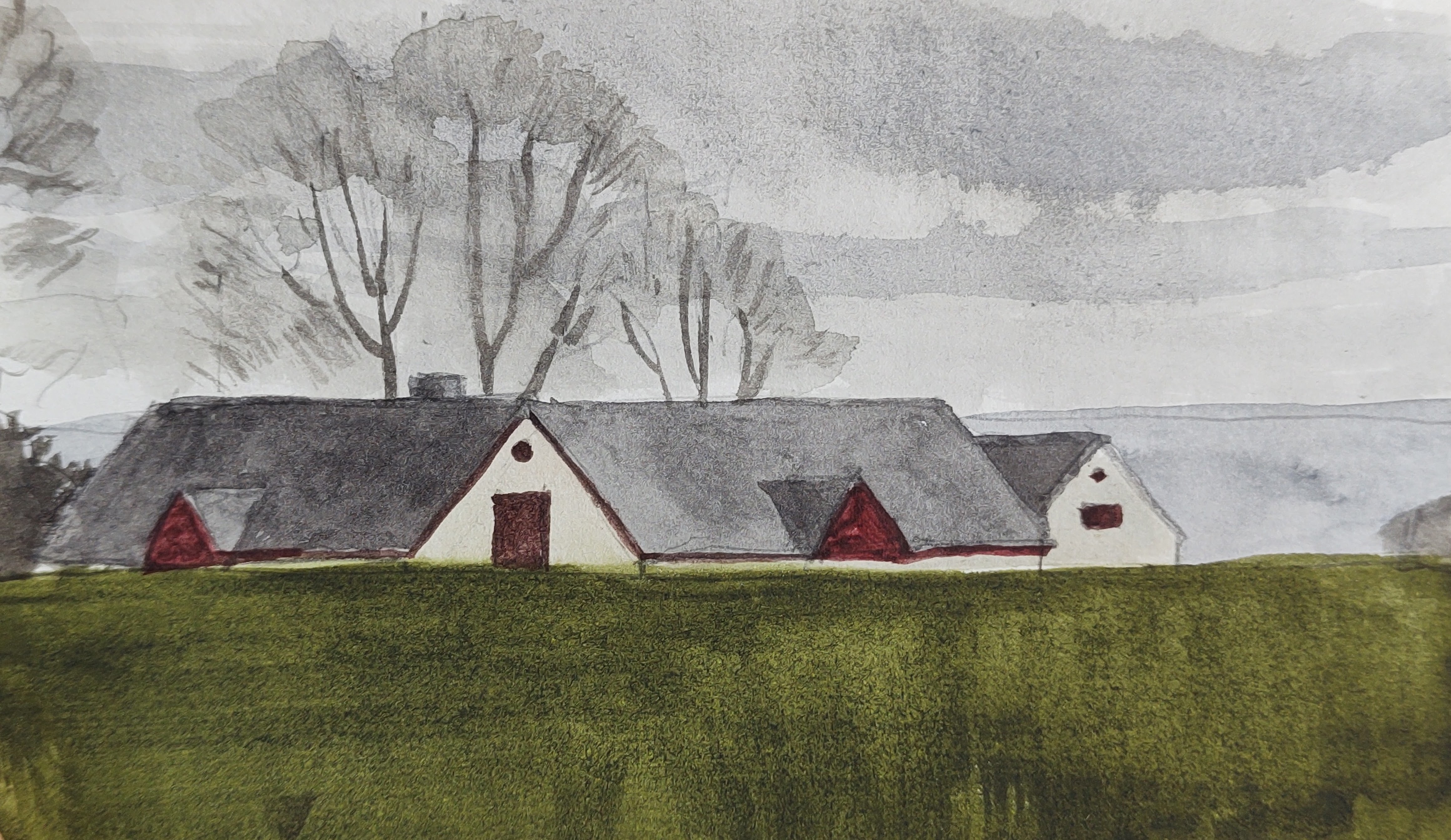
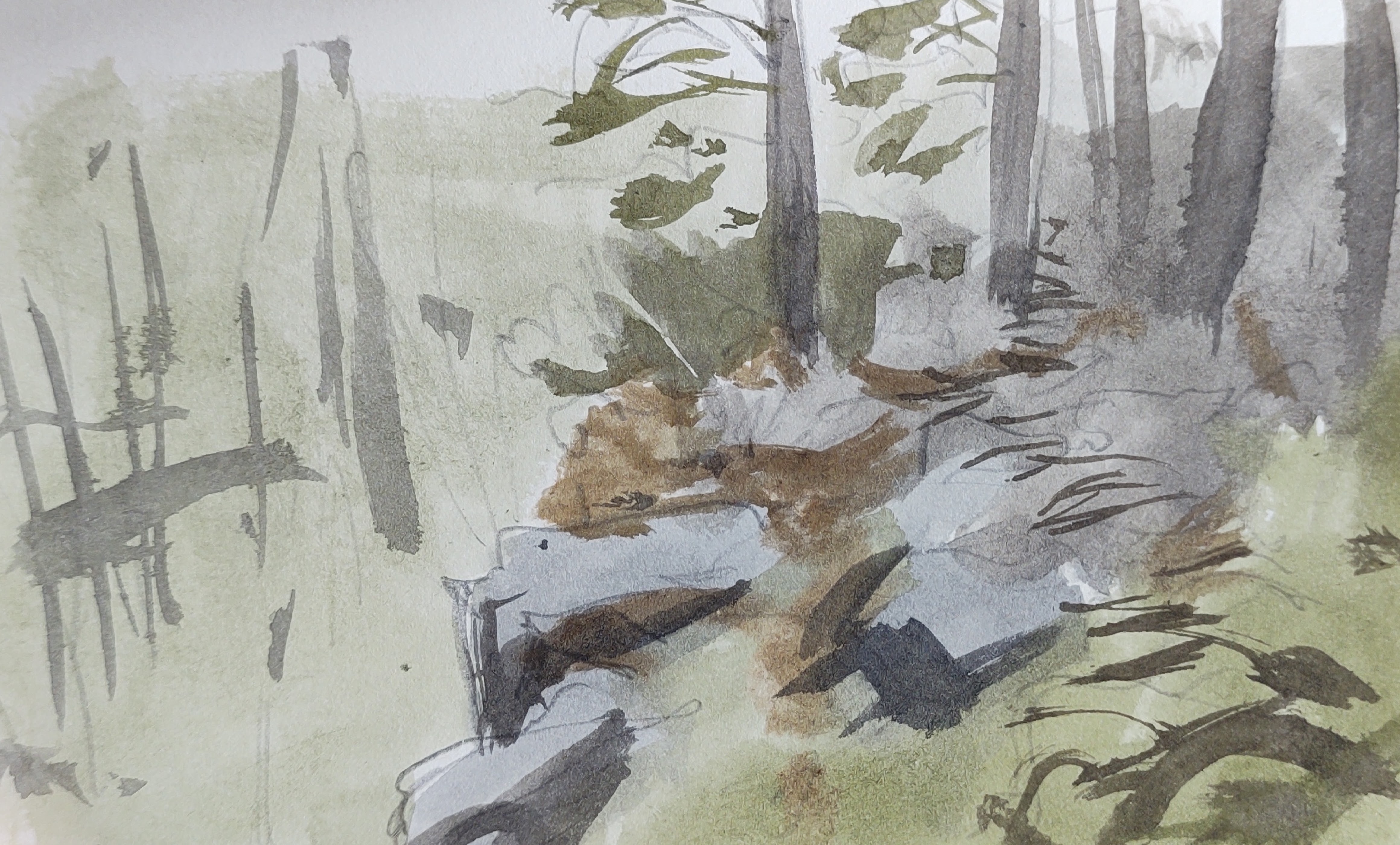
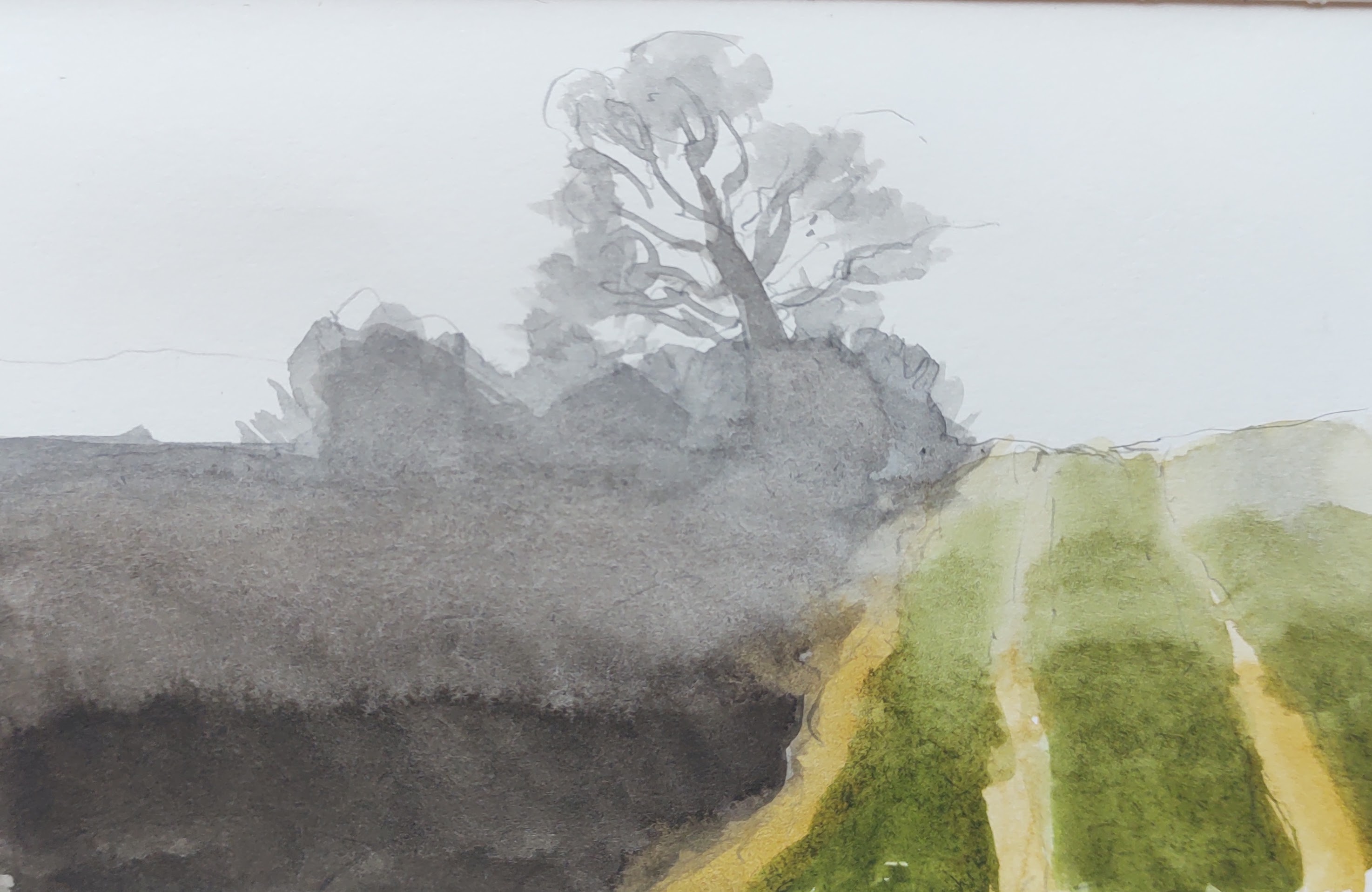
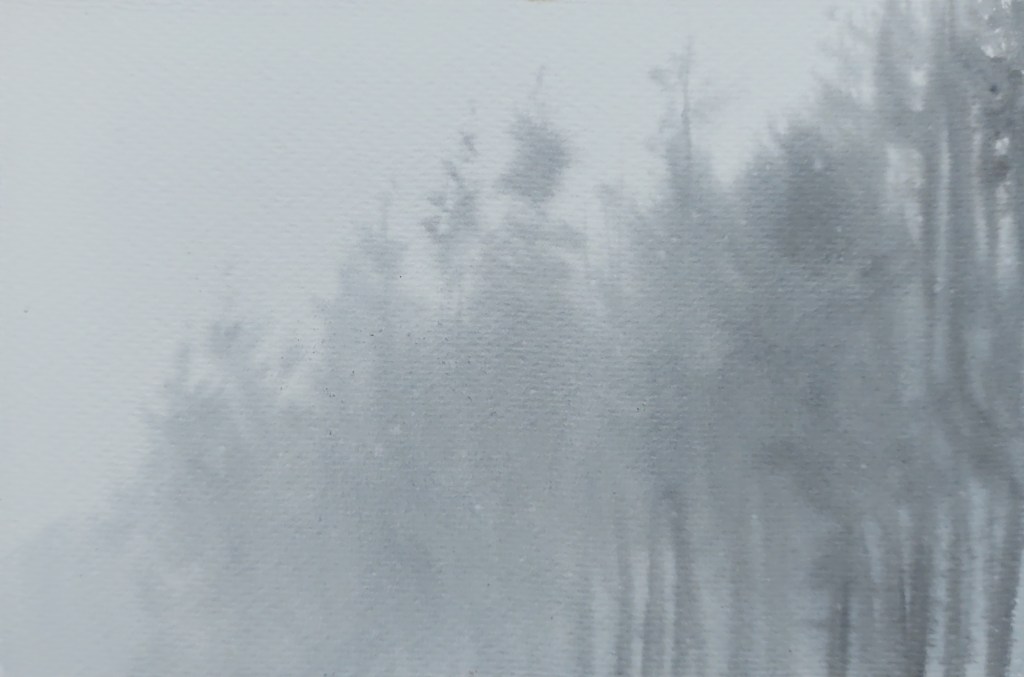
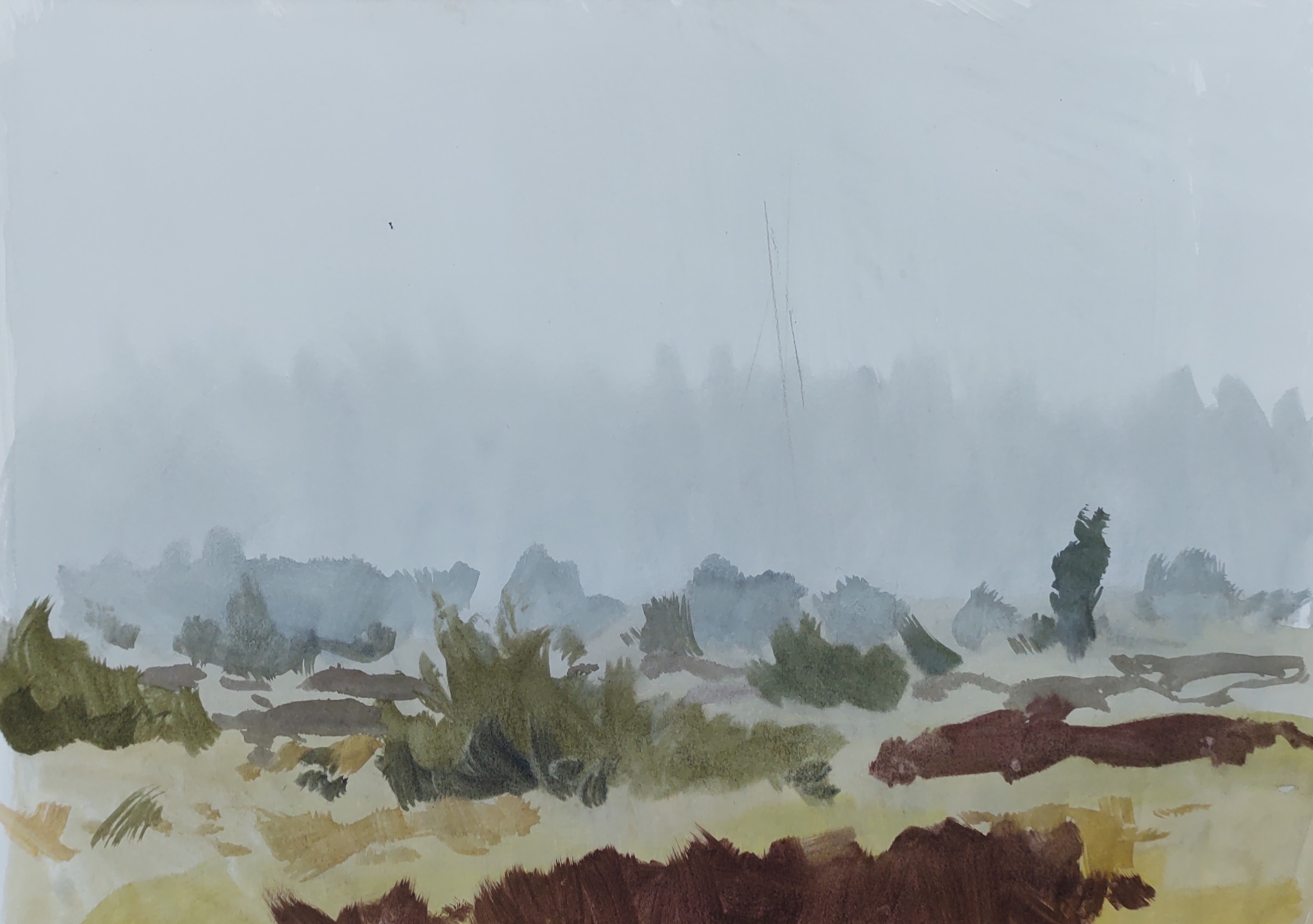
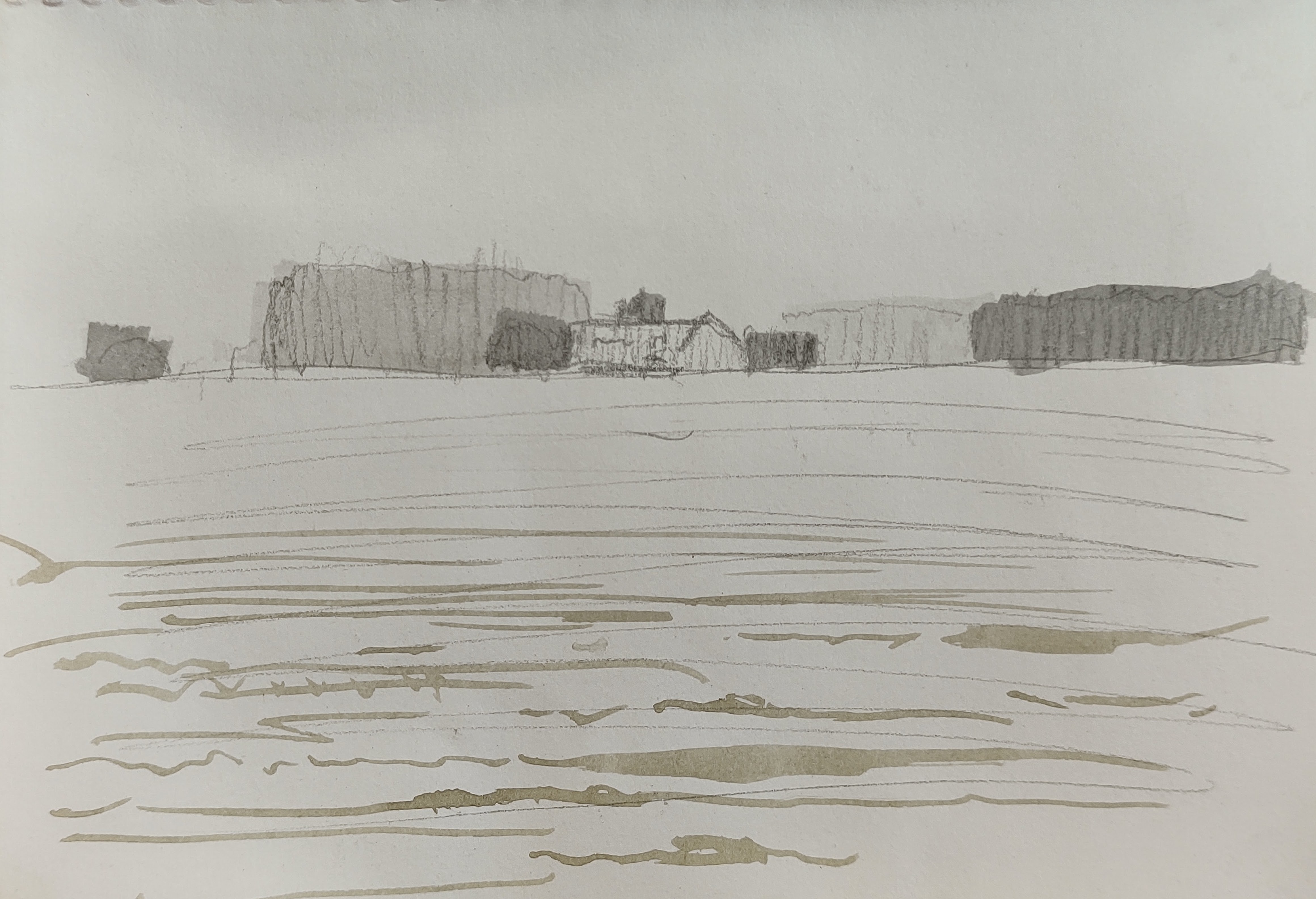
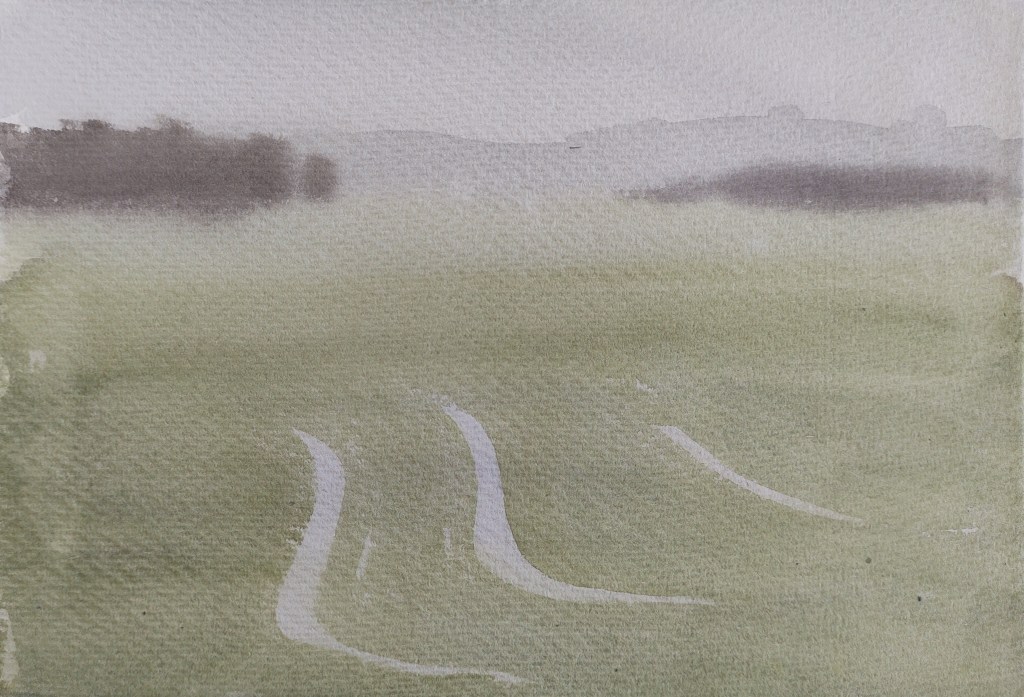
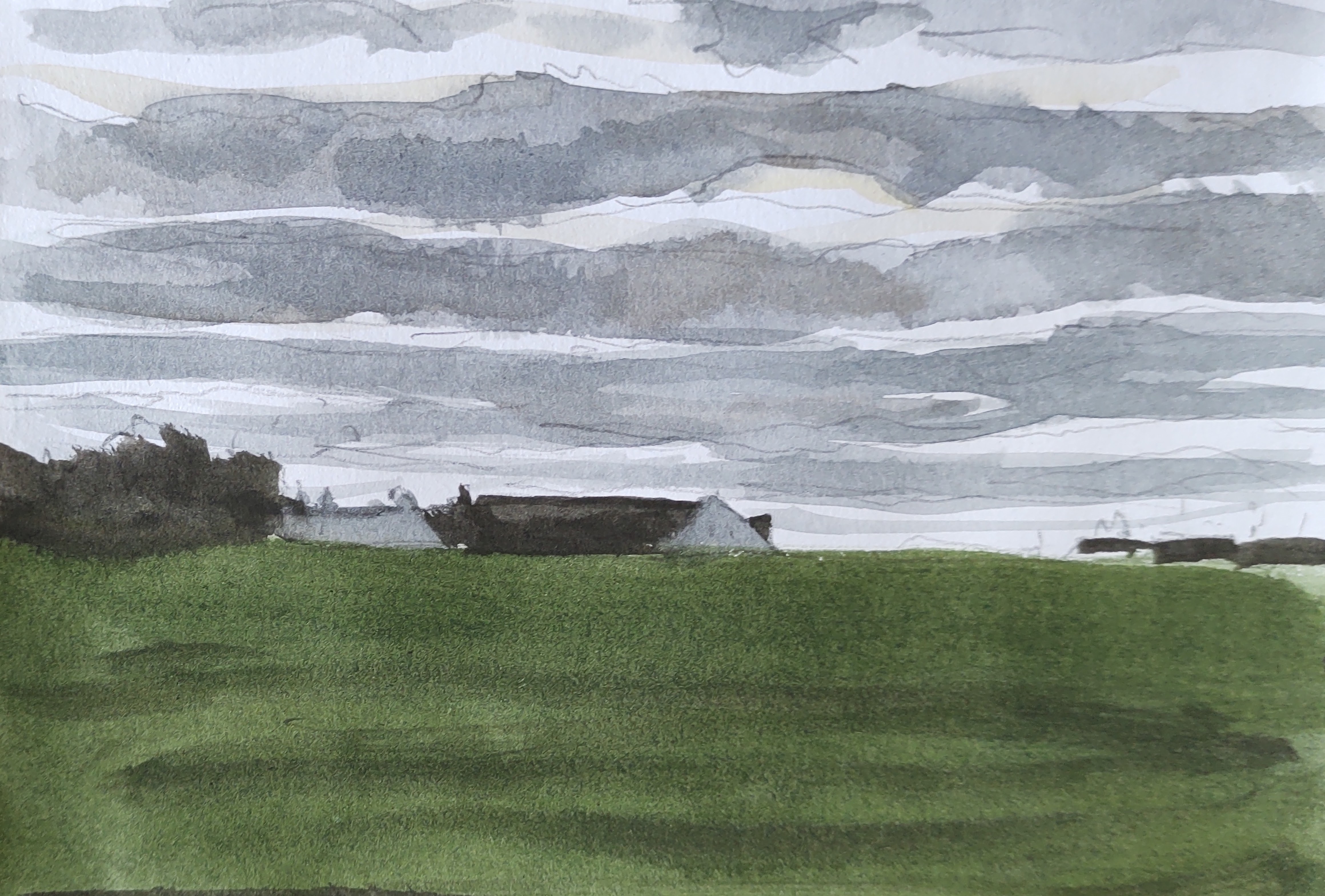
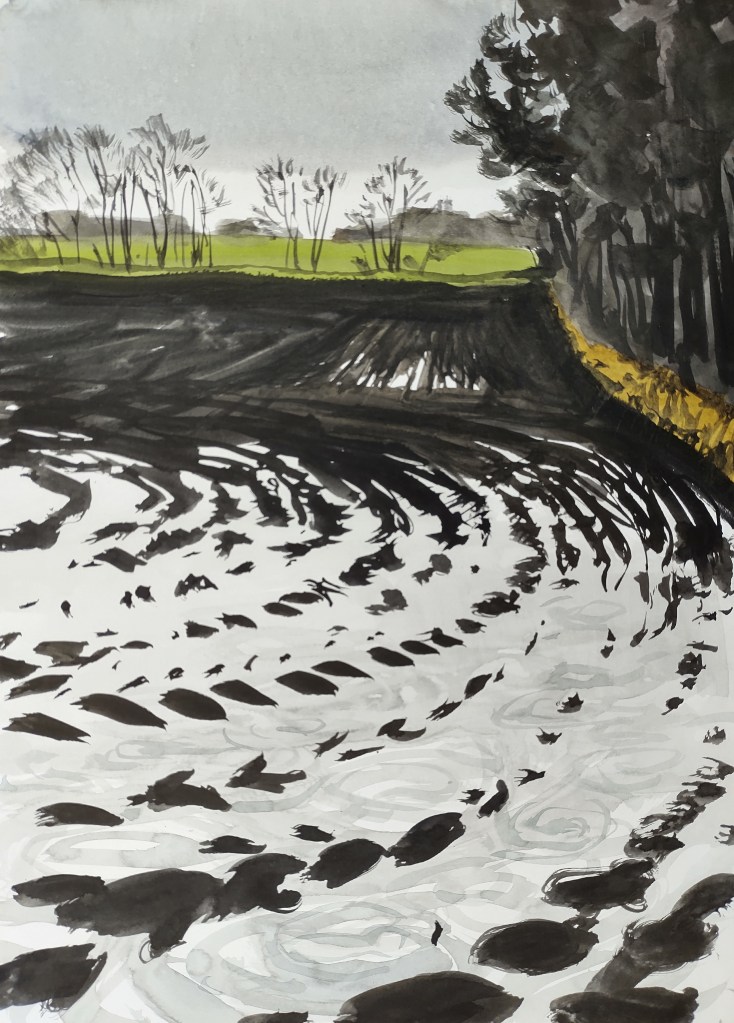
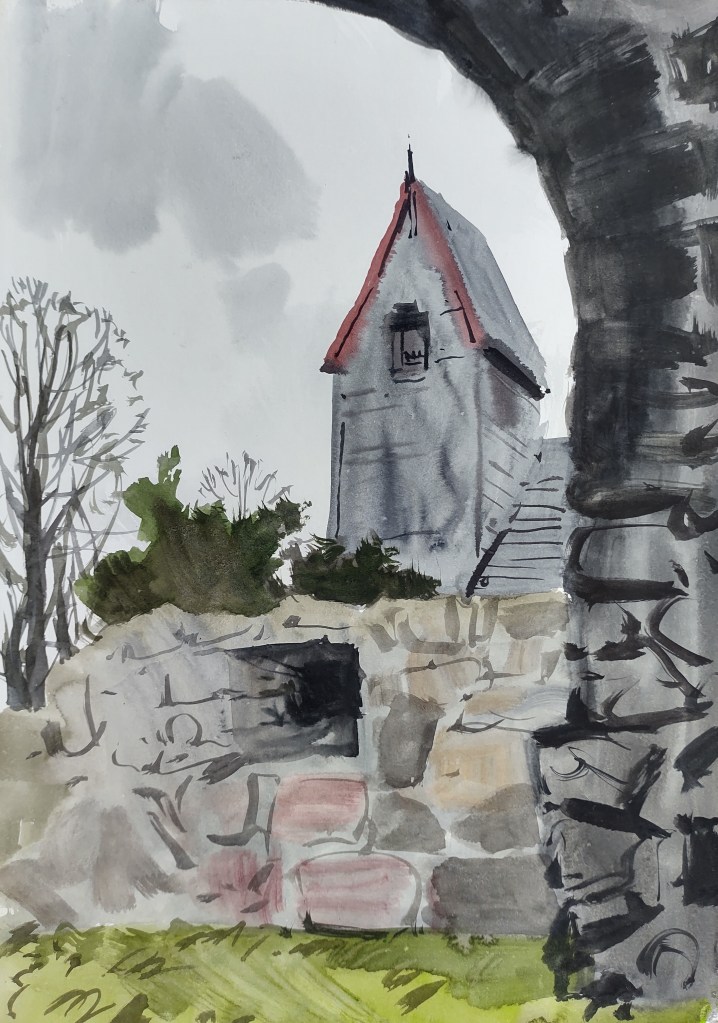
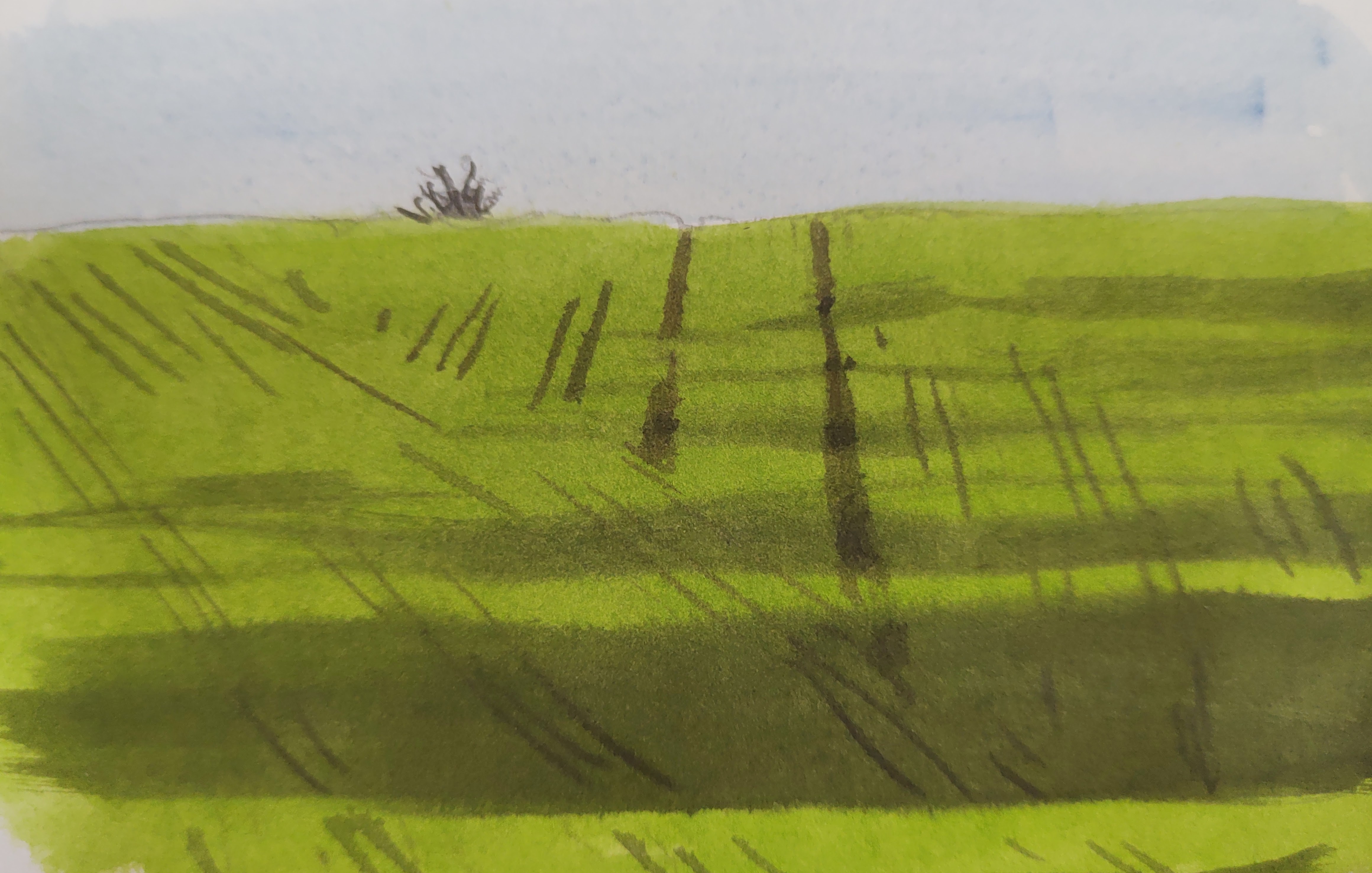
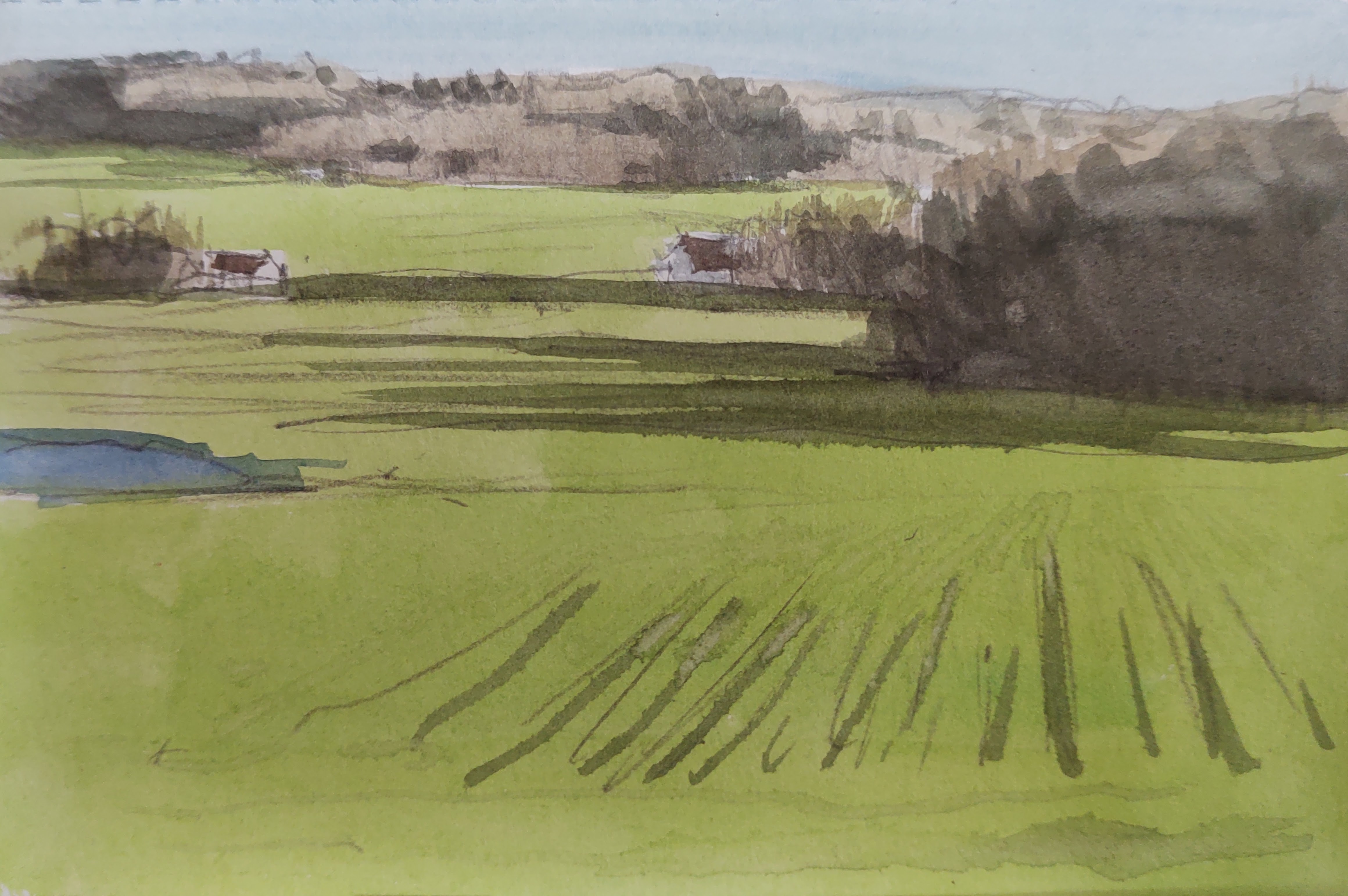
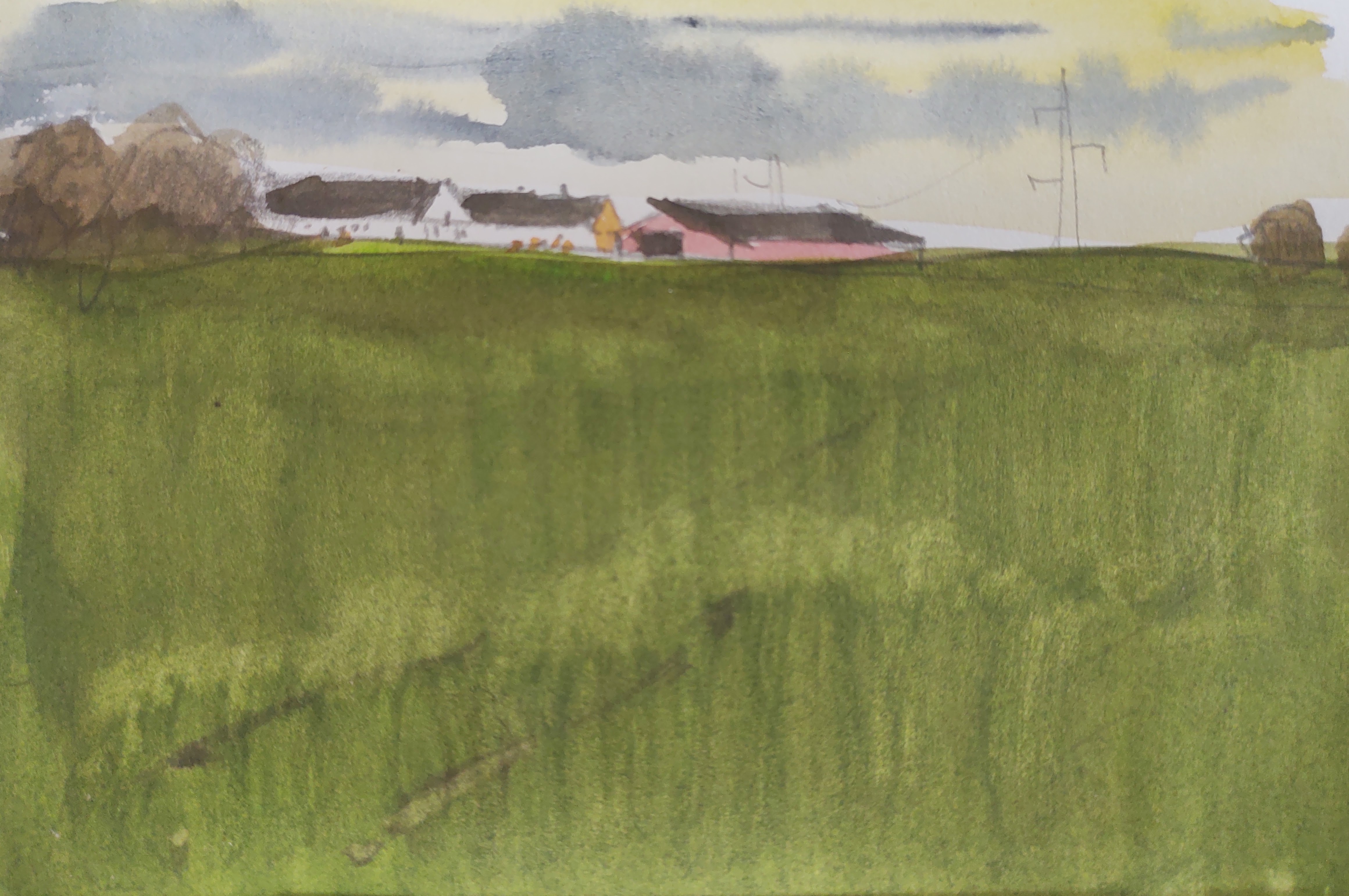
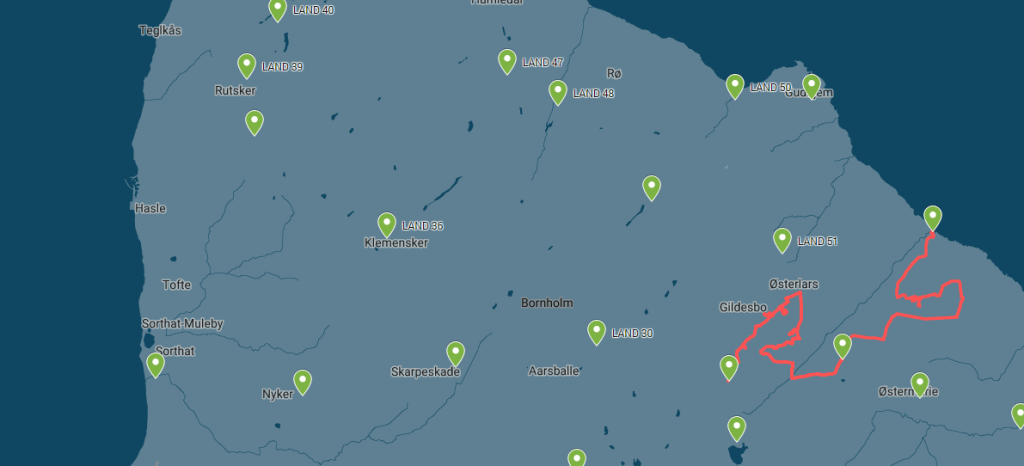
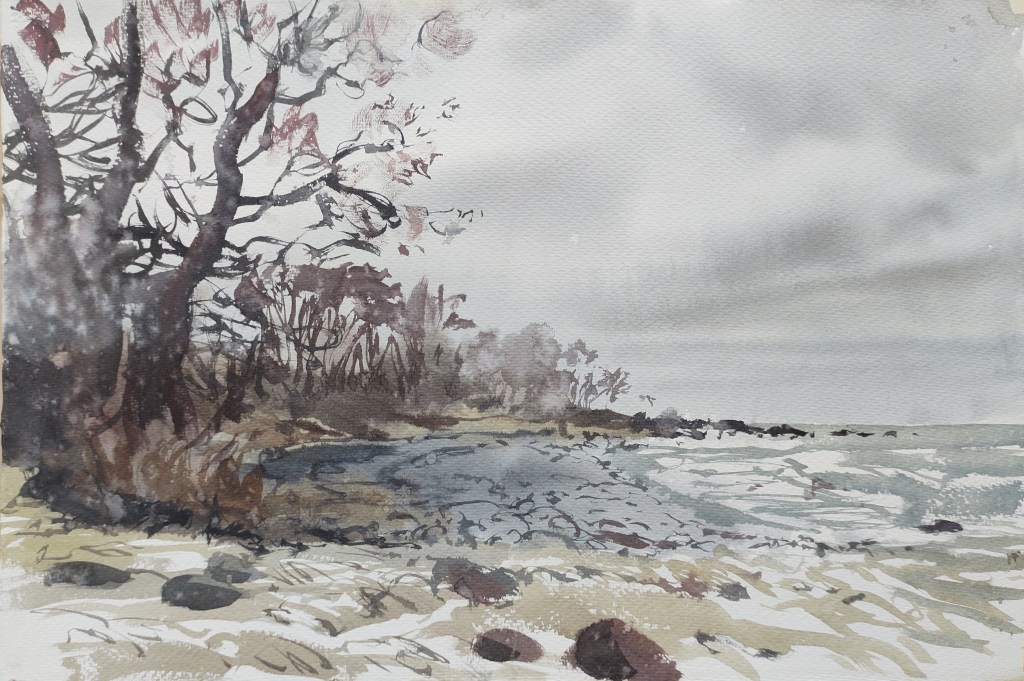
LAND 07 I sat on a bench in the immaculately maintained graveyard, the white church in front of me almost completely obscured by the heavy fog. Behind me two men were already at work, repointing the outer stone wall. I finished my painting, packed up, and walked off into the landscape, and for a long while, I could still hear their tools tapping away through the whiteness.

Ibs Kirke

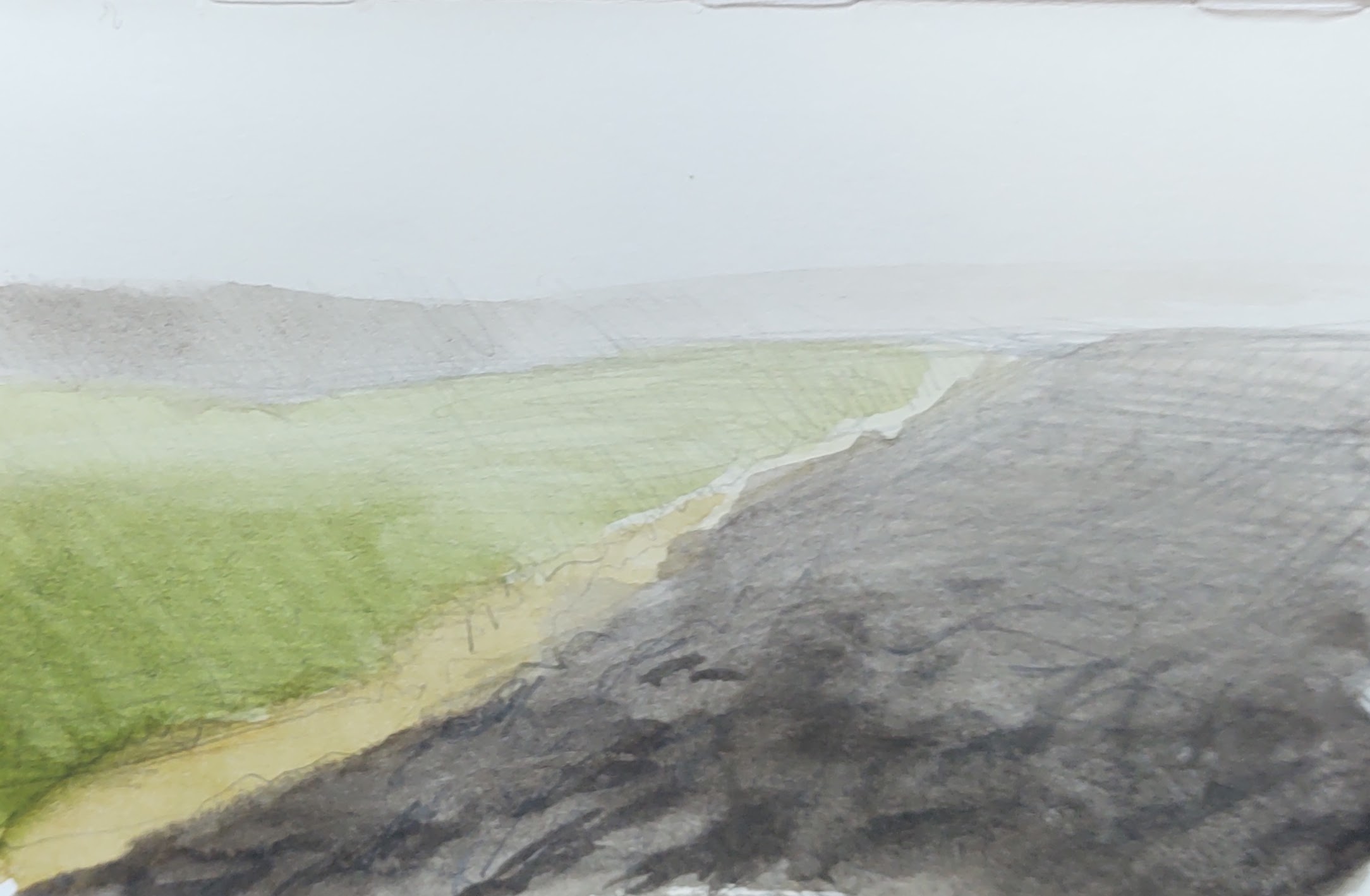
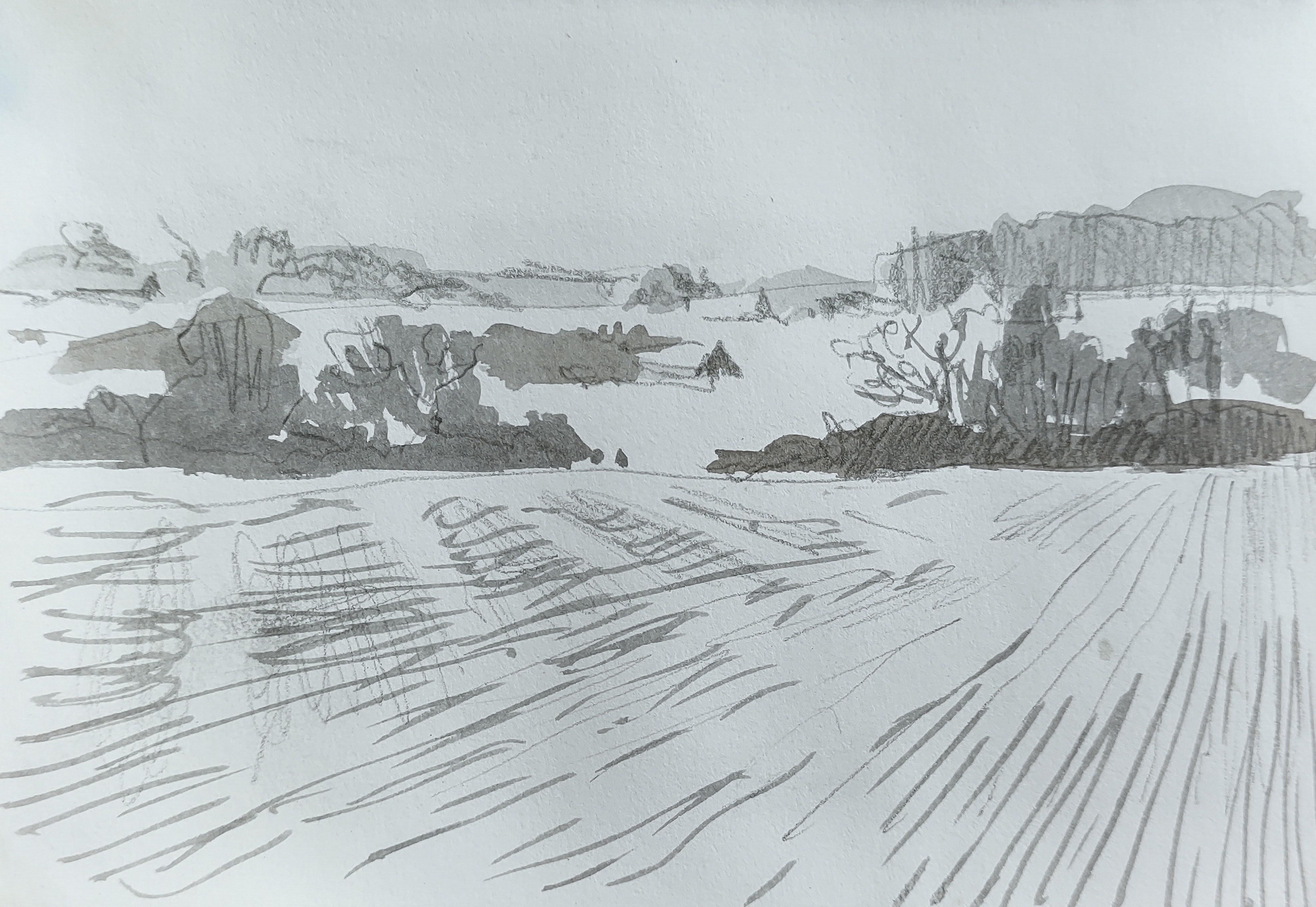
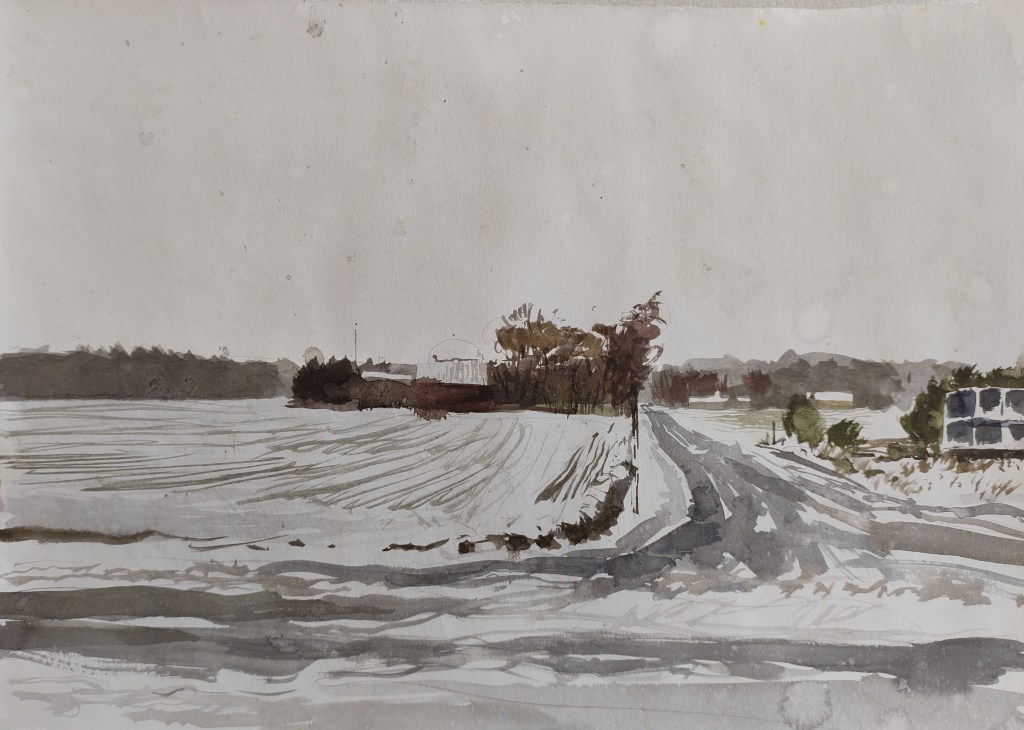
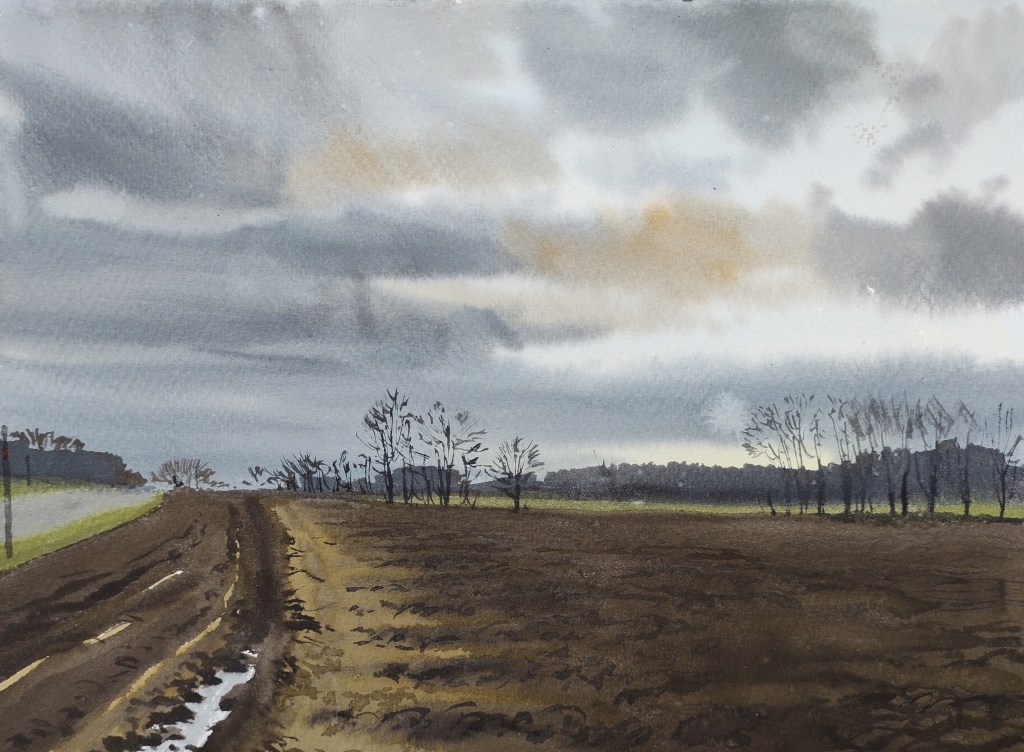
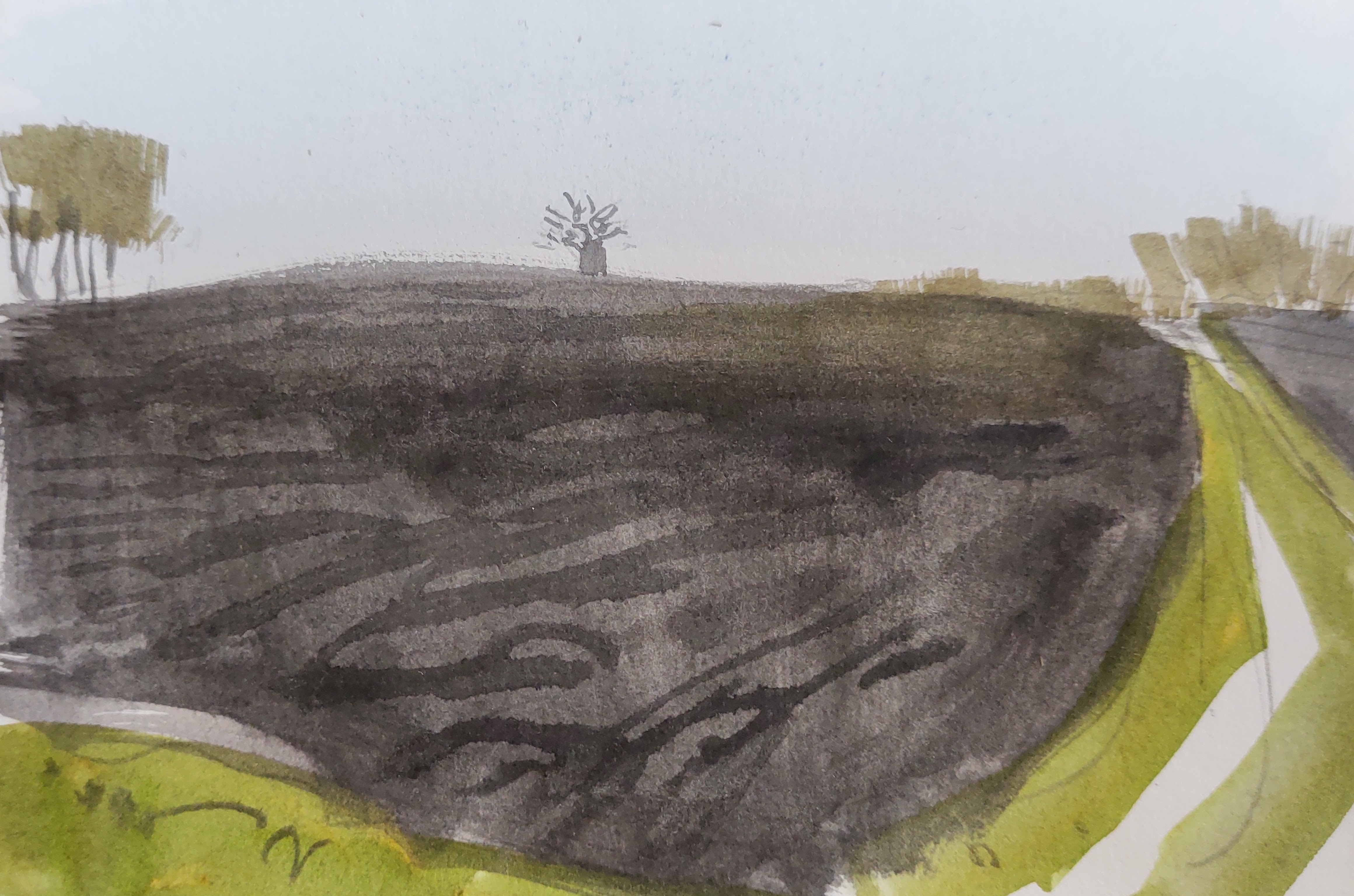
I walked on small roads and tracks between recently ploughed fields. The fog an oppressive blanket removing me from any sense of time and place.

Sortehølsvejen

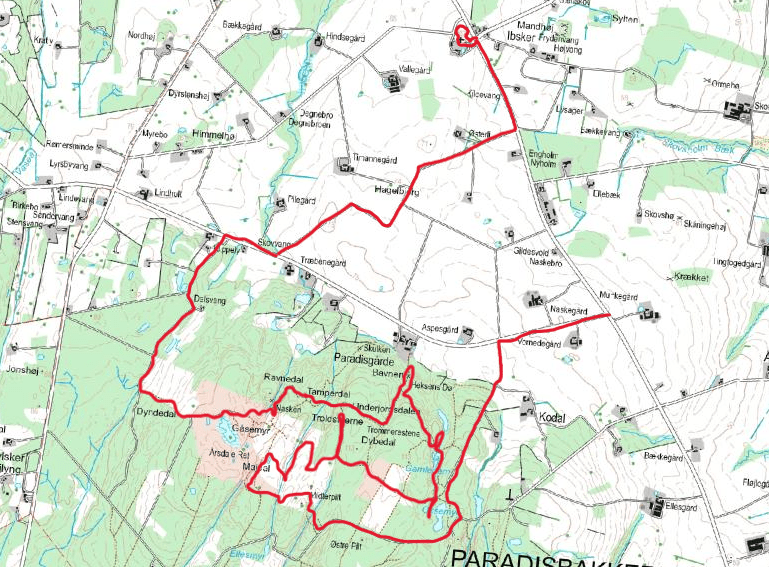
Eventually I reached the edge of Paradisbakkerne – The Paradise Hills – a large area of plantations, mixed woodlands, and heathland that I will be meandering in and out of for the next three weeks. The whiteness hung in the trees and extinguished almost all sound.

Dynedal

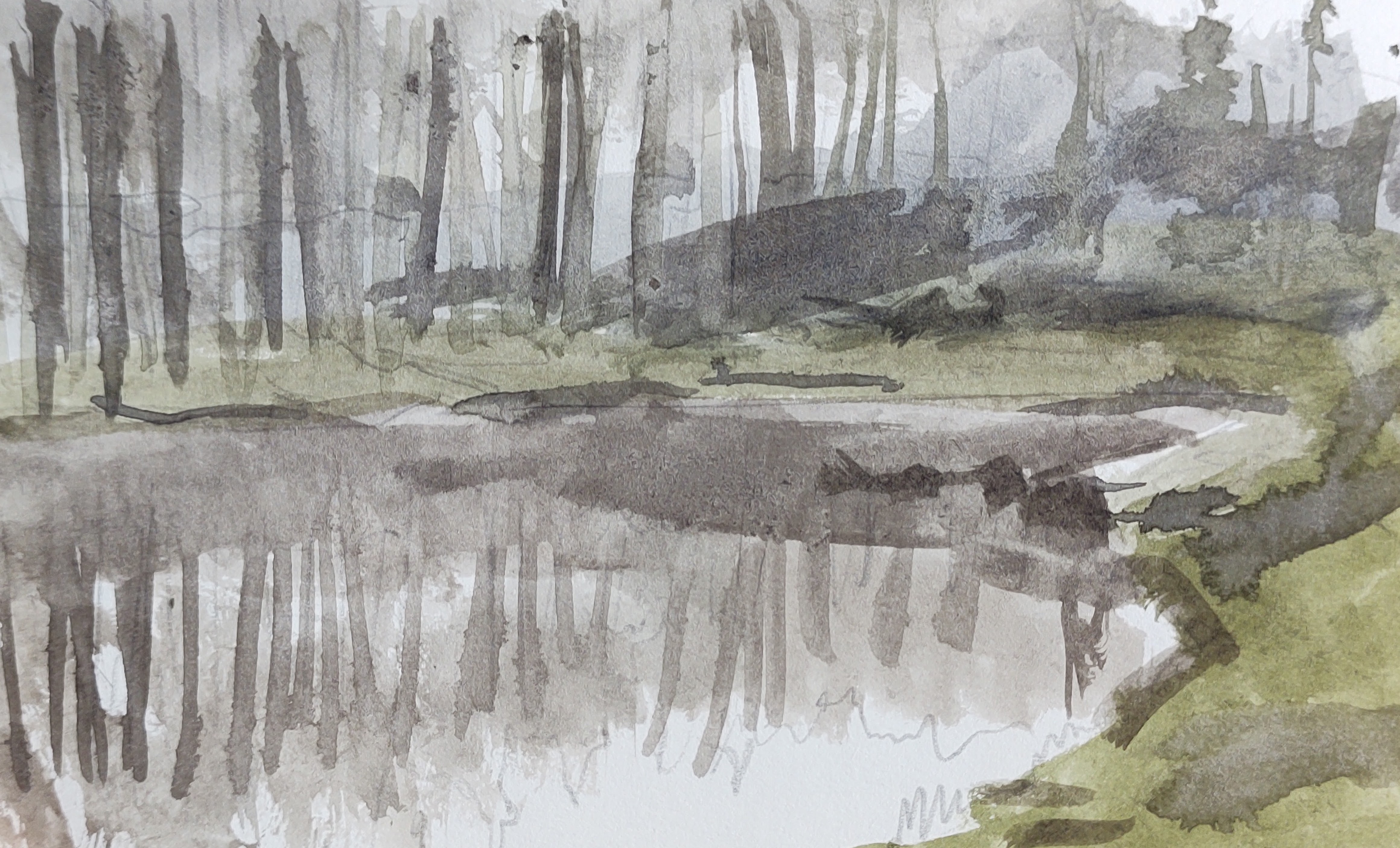
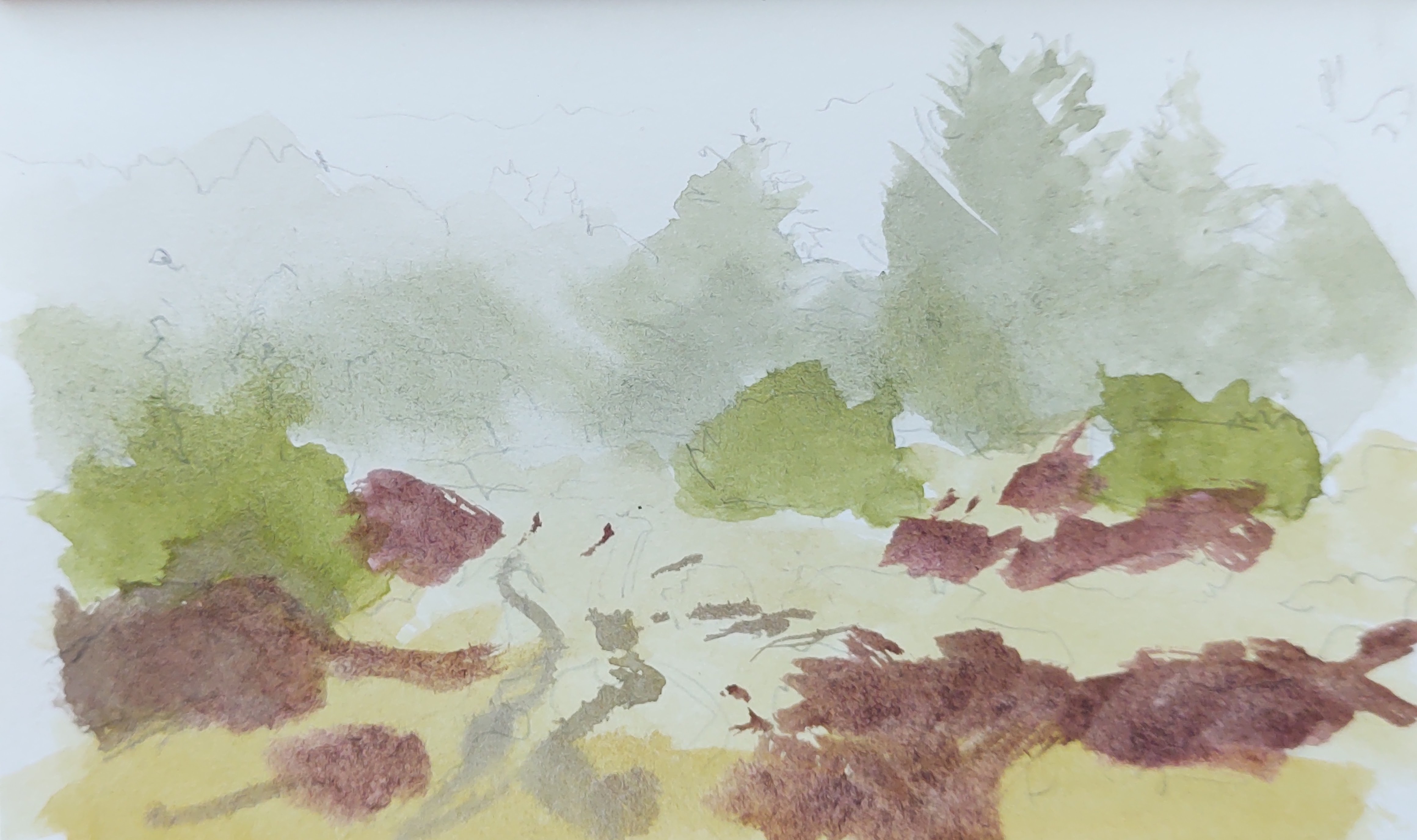
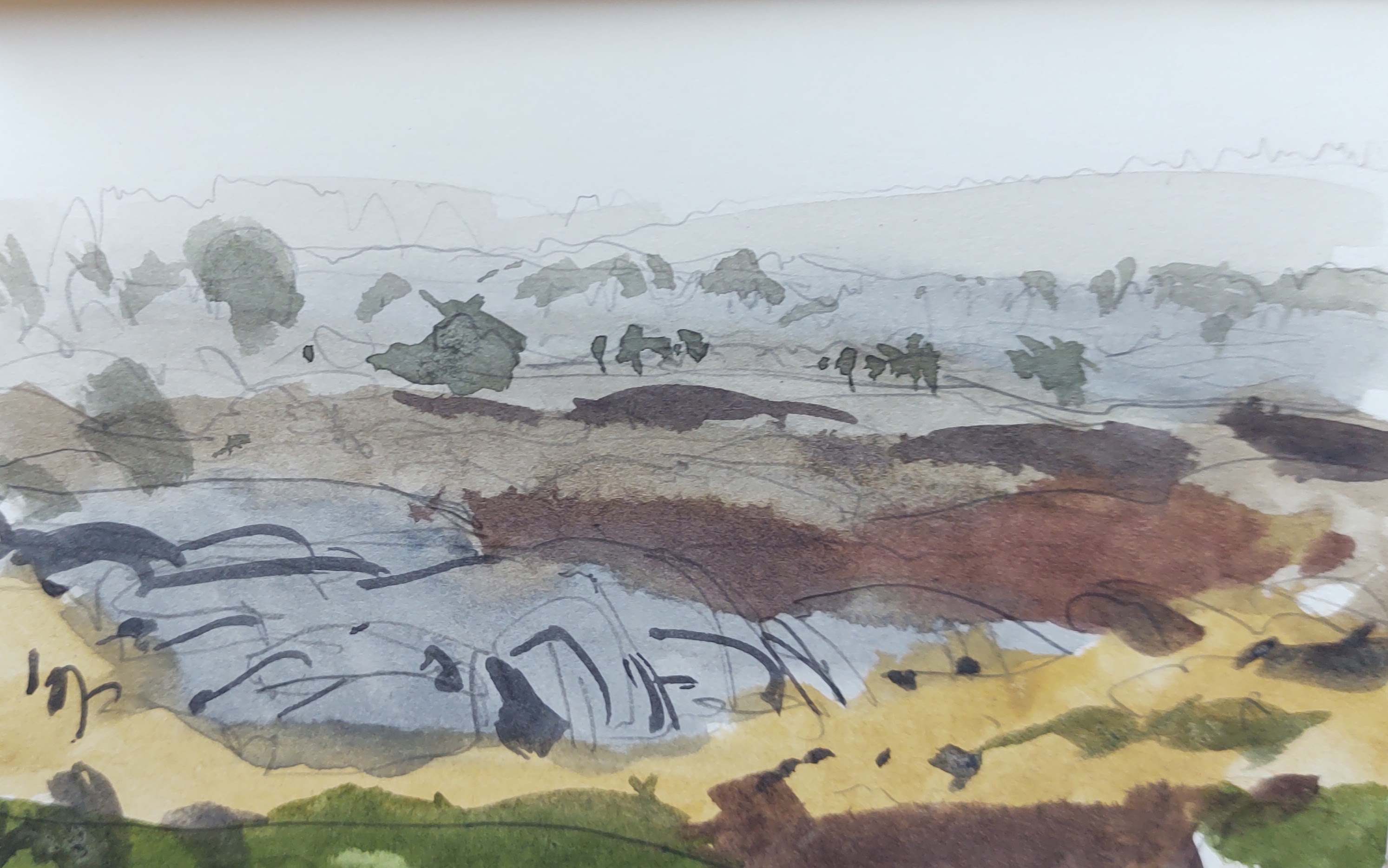
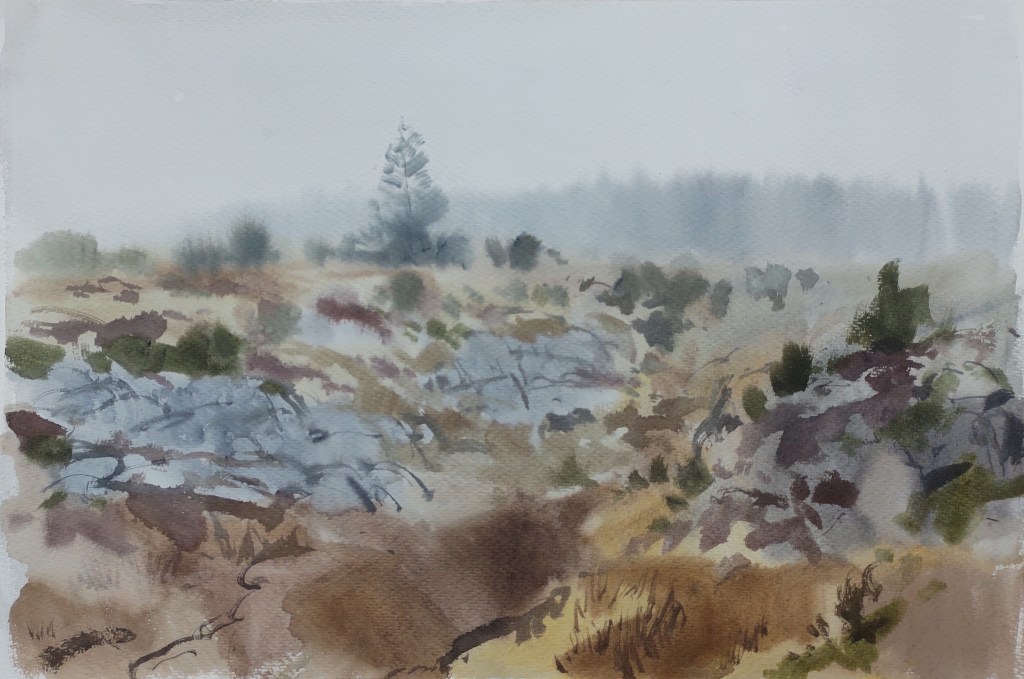
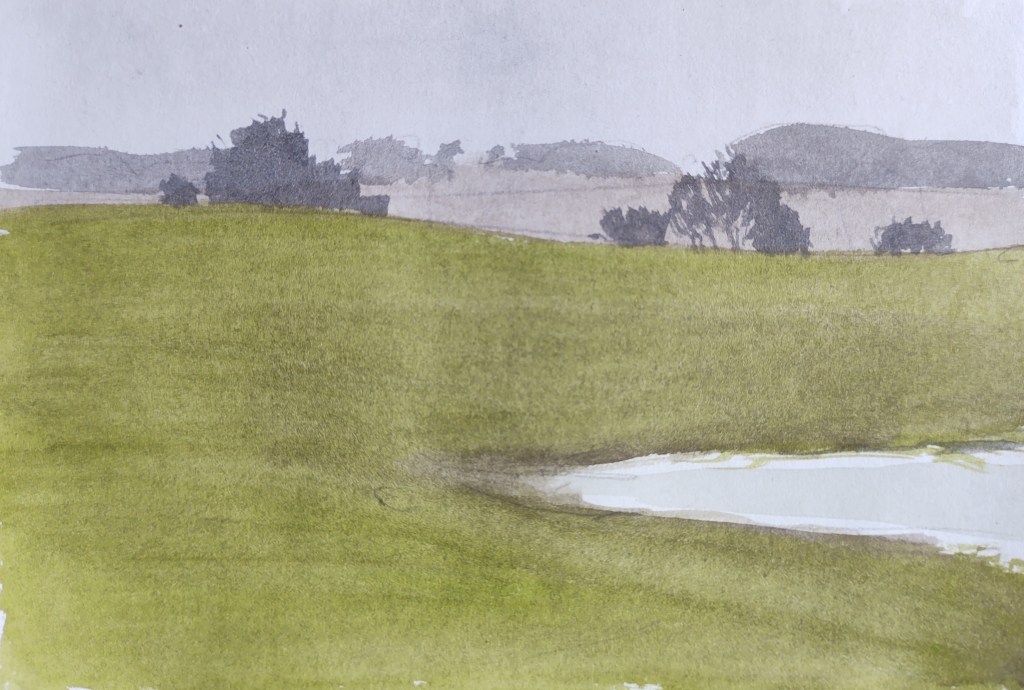
I followed a path through the forest and into ‘Gåsemyrfredningen’, a large open heathland and a taste of how much of the island would have looked in the past, when the central part of Bornholm was a common area for grazing and heather collection – before it was closed off and planted with fir plantations. The fog created an ethereal dream-like landscape, with the twisted shapes of juniper trees fading into the mist, and the heavens melting imperceptibly into the still waters of the bog.

Gåsemyr

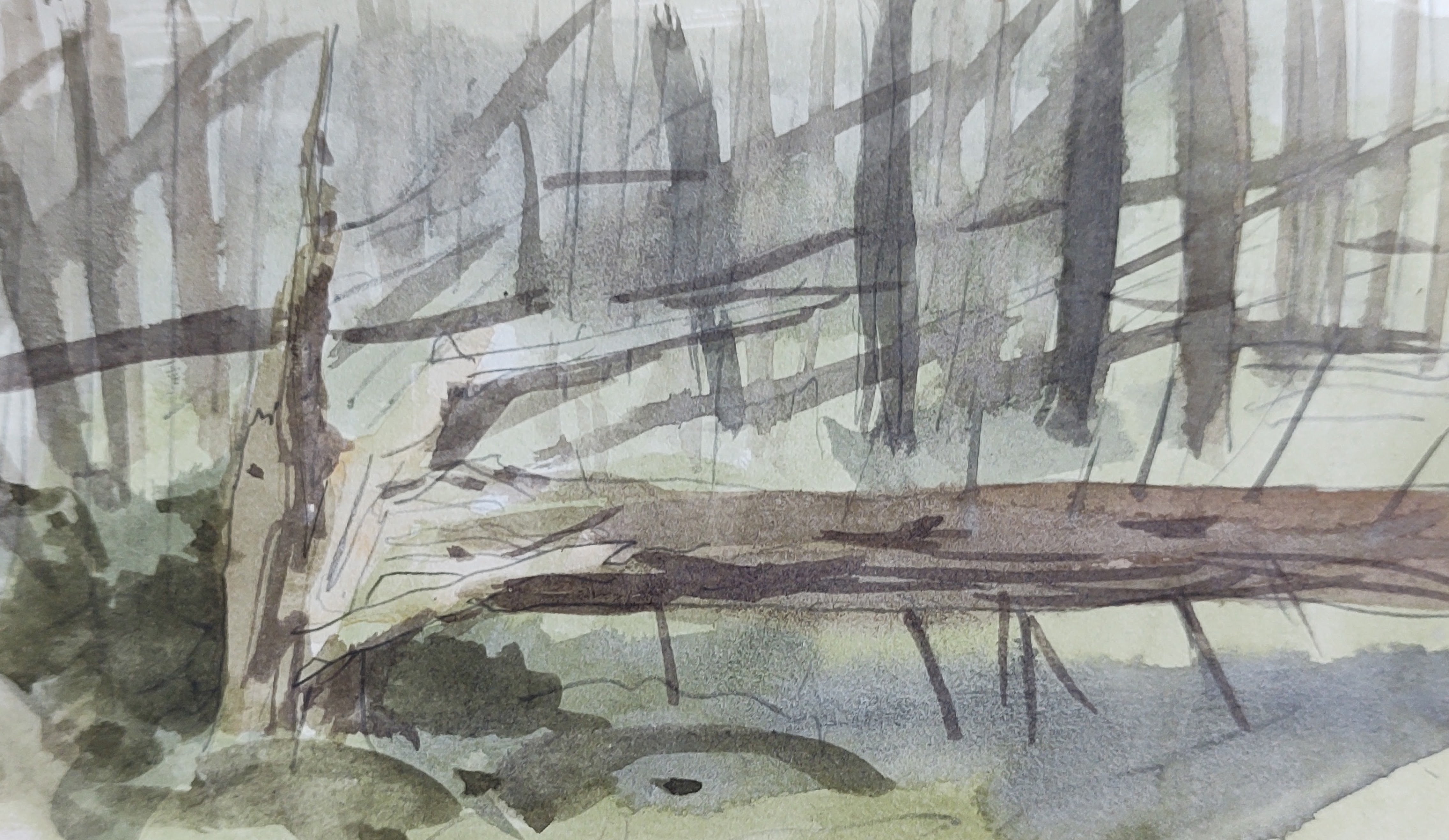
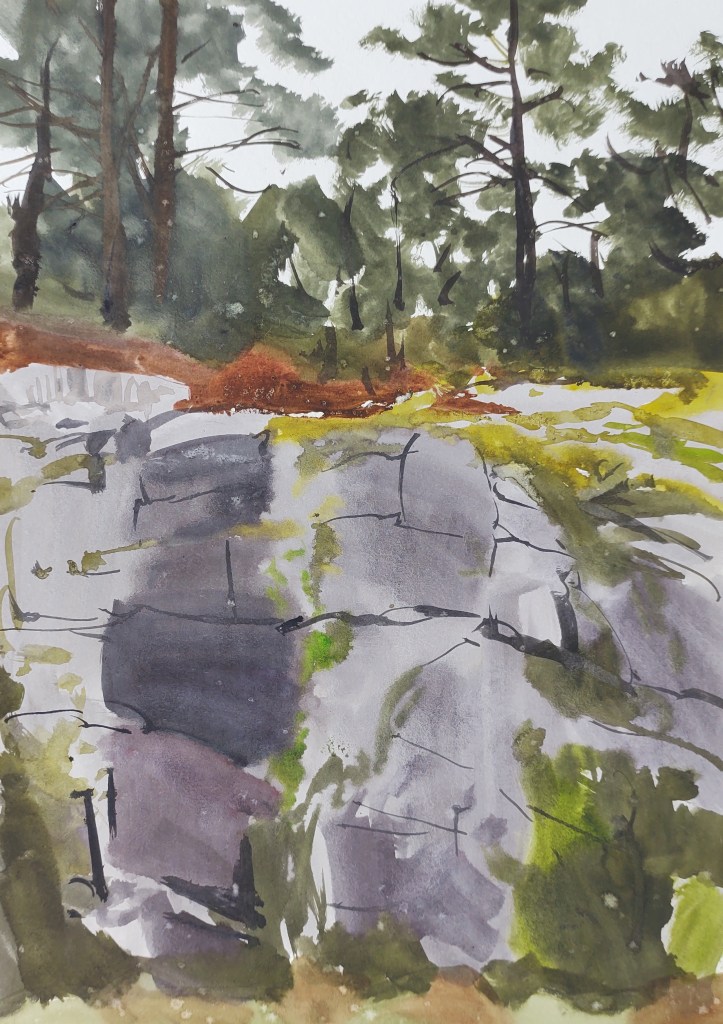
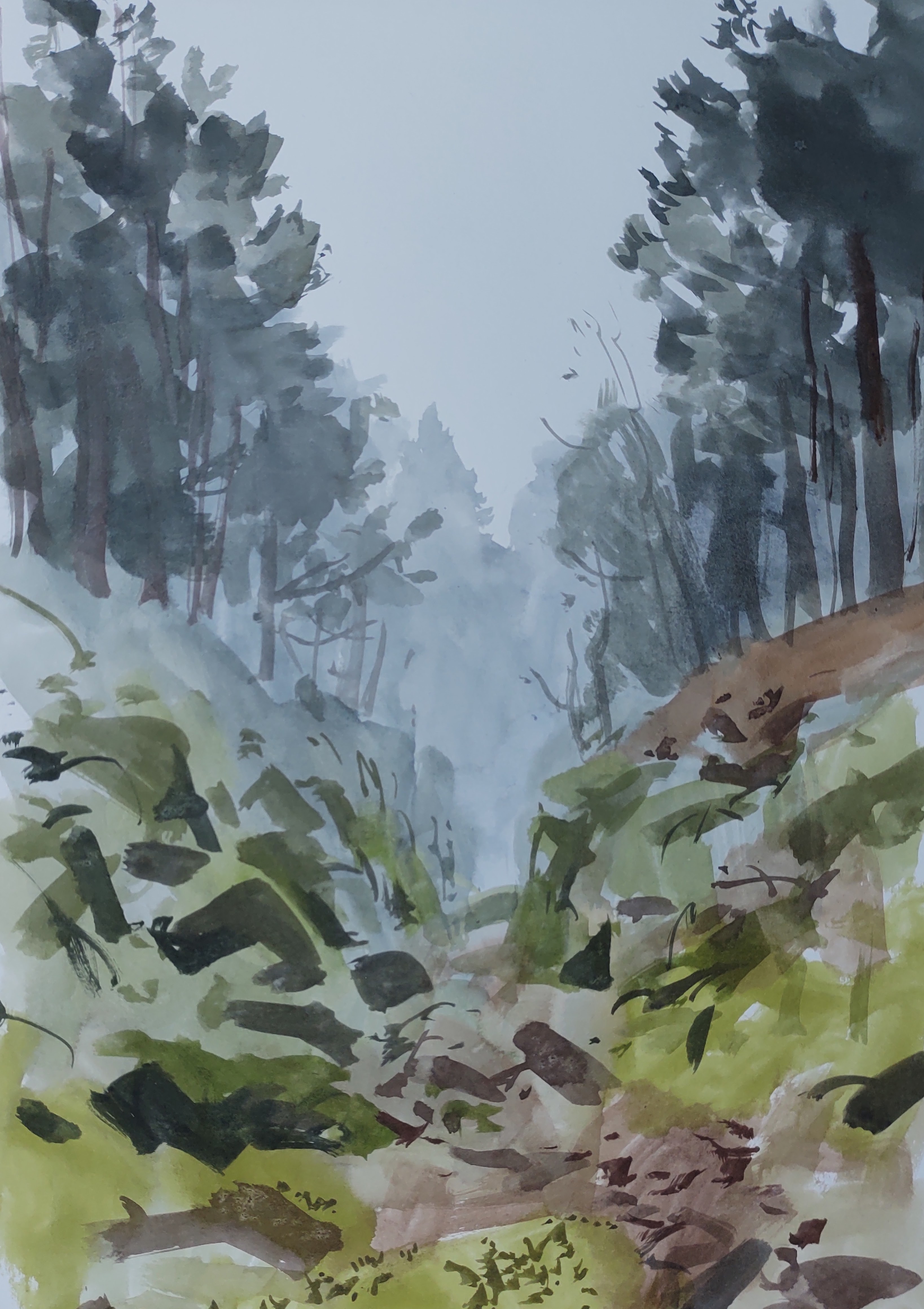
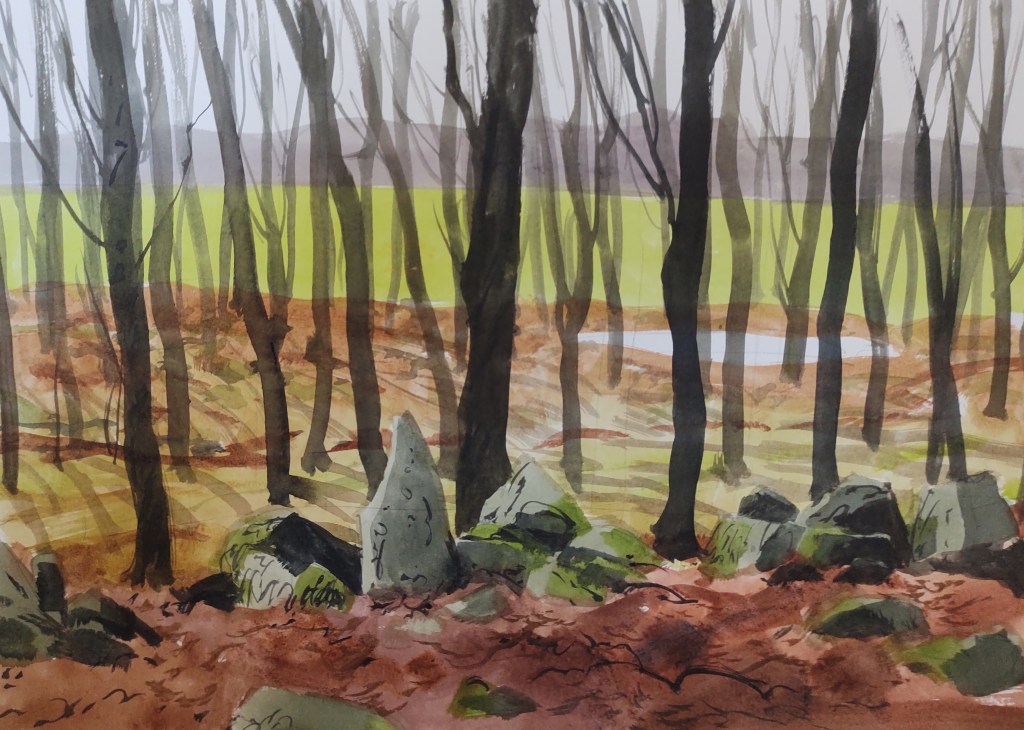
I walked onwards and followed a well-worn path back into the forest, past huge boulders, and alongside deep fern-clad dells. The Paradise Hills are scarred by a series of parallel rift valleys cut into the granite bedrock – some wide and rather smooth, others narrow with near vertical sides.

Dybedal

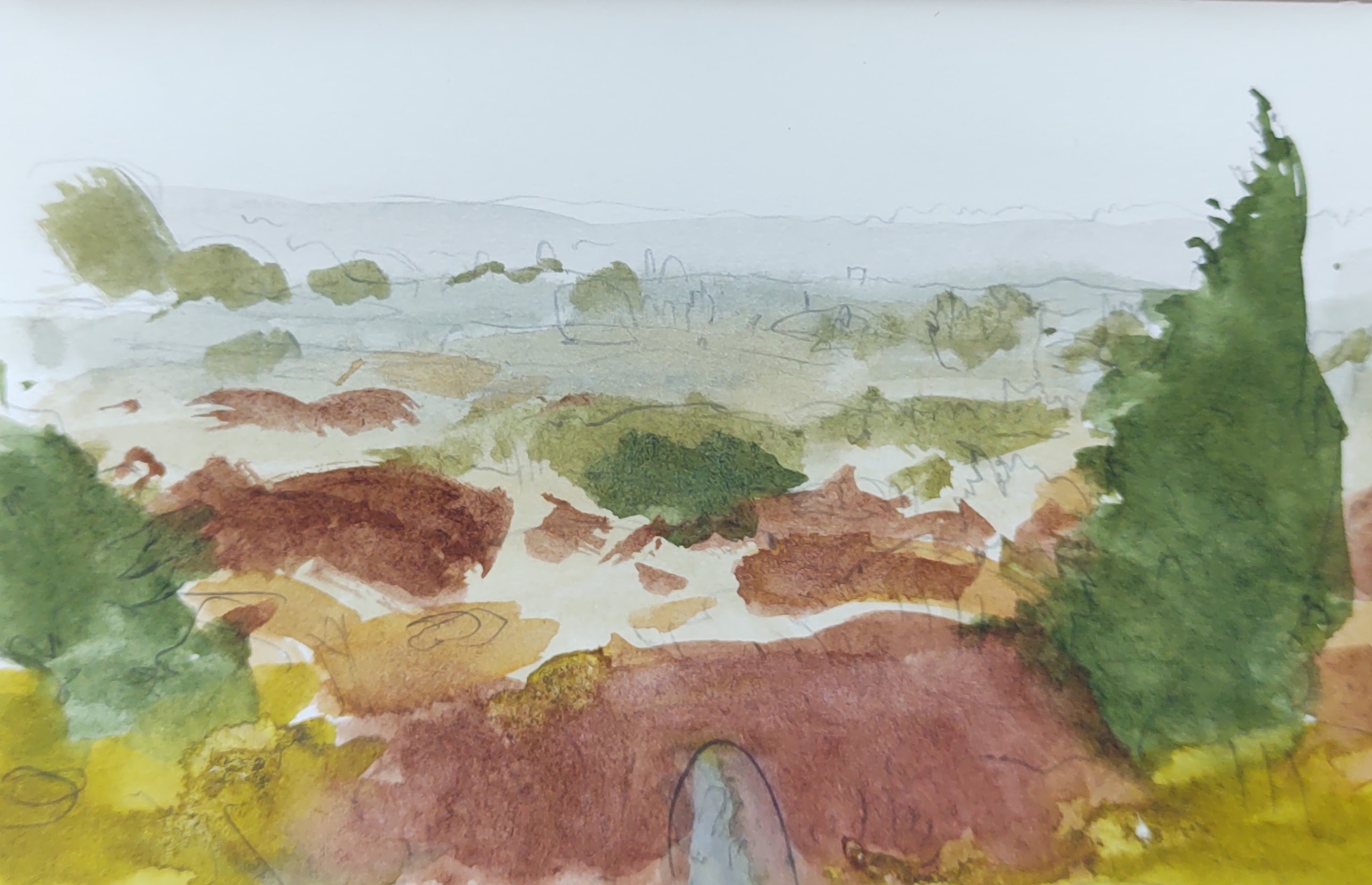
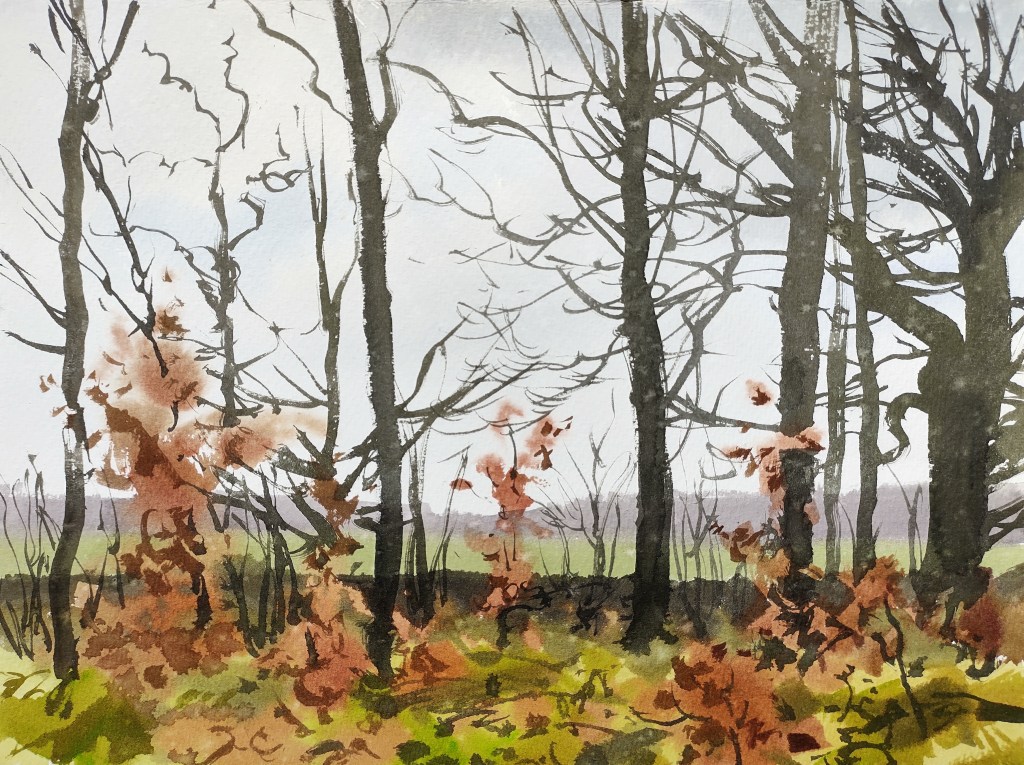
All day I wandered through the fog, past lakes, bogs, and through an ever-changing woodland – often wild and diverse, other times more orderly and homogenous. I arrived in the heathland again – visibility had improved a little by now, and I admired the purple-grey granite against the burgundy of the heath, the deep racing-green of the juniper, and the burnt ochre of the dead grass. I was glad to be away from the monotonous cultivated fieldscapes of the previous weeks.

Tamperdal

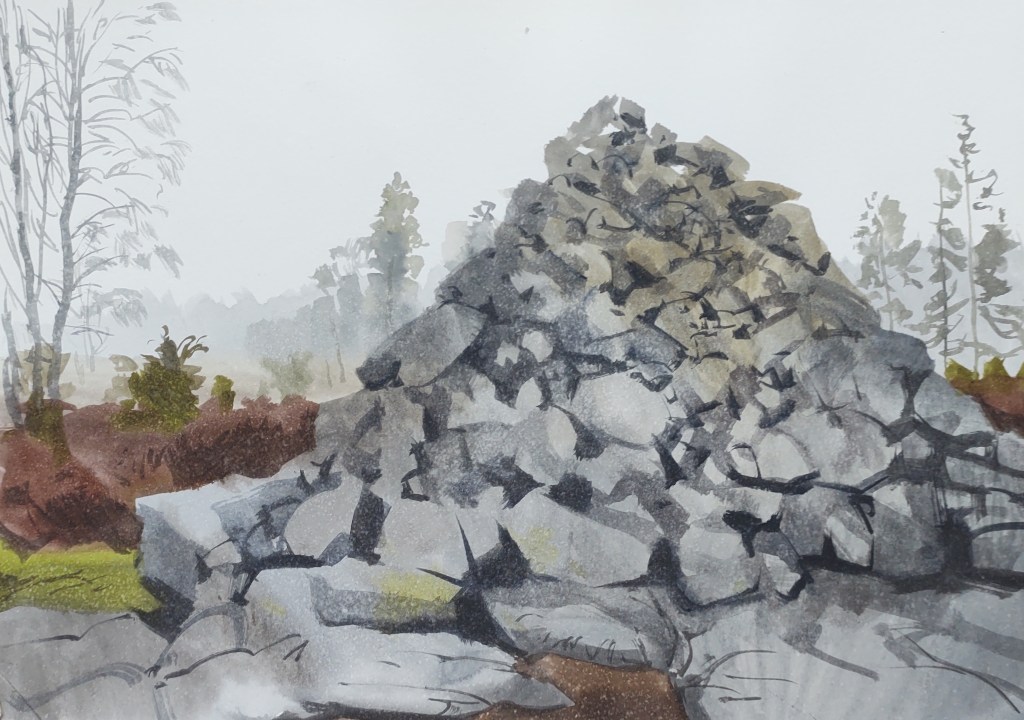
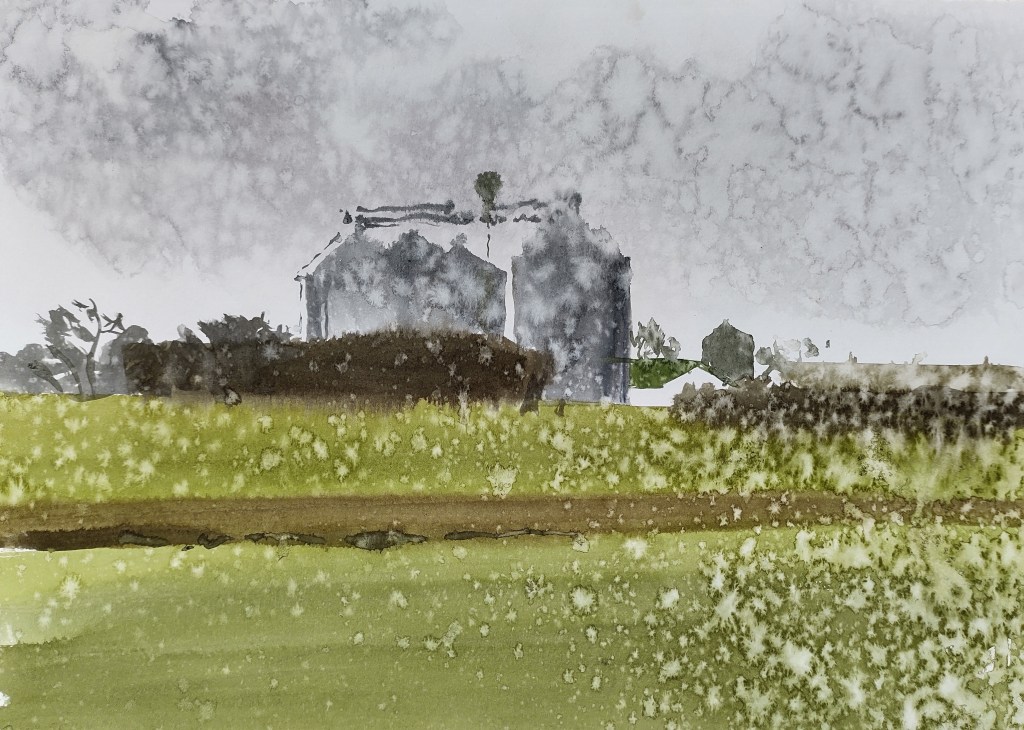
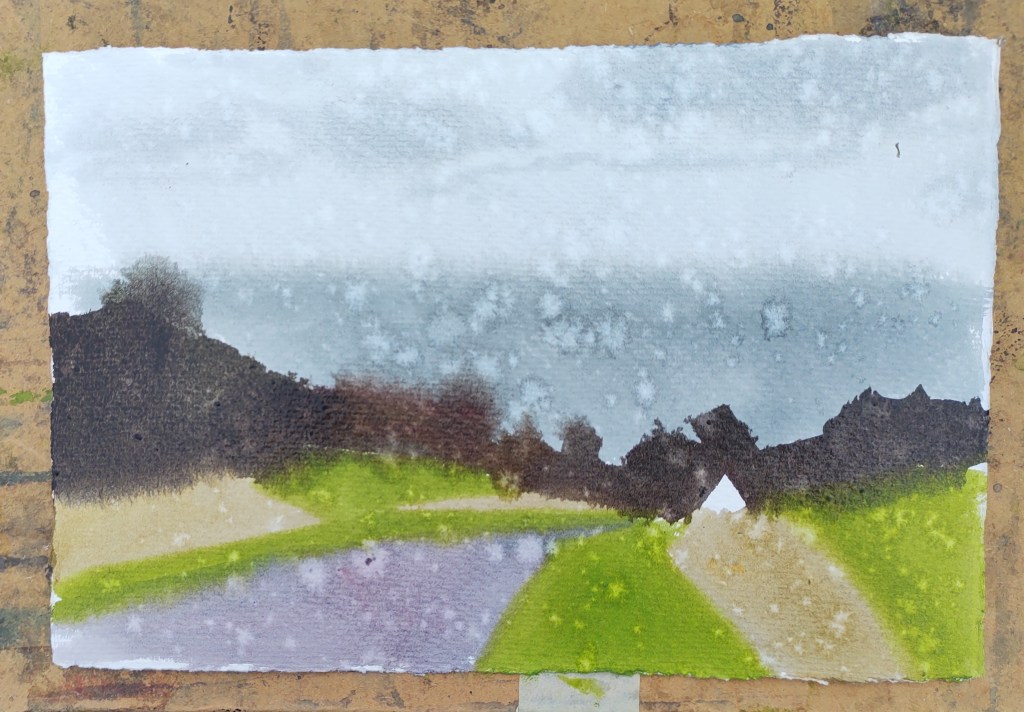
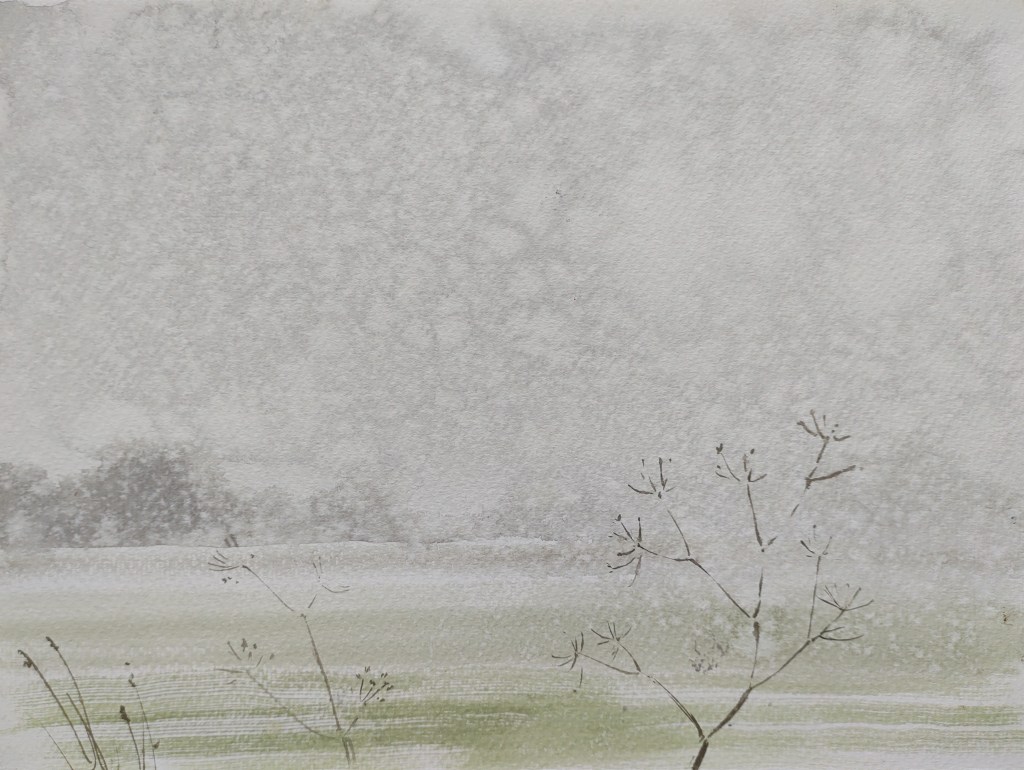
Eventually I arrived at Midterpilt, and then Østerpilt – small triangular stone navigation markers built on exposed areas and used in days gone past to guide people across the moors, but now rather hidden in the woods. The fine mist left a delicate pattern on my painting. I walked on, through the forest and then back across the fields, and the day was over.

Midterpilt

LAND 07

WEATHER REPORT – Thick fog, thinning to a fine mist in the afternoon. Temperature 3 degrees. Wind 4 – 6 m/s from the west. Hours of precipitation: 0 hours. Hours of sunshine: 0 hours.

STOPS with the BIVVY – 0

KILOMETRES WALKED – 14.34 km

DAY LASTED – 9h and 44 m

PEOPLE TALKED TO – 1, (…also said ‘hi’ to a few walkers)

BIRDS SEEN and HEARD – 22 species: two new (coal tit, crossbill, running total = 49 species)

LESSONS LEARNED – how to take apart my stool in the easiest way – a minor, boring detail, but I’ll be doing it hundreds of times through the year…

IN MY HEAD – Mostly I was thinking about the passing of my father-in-law, peacefully on Sunday. A kind, warm, humble, and tolerant family man who will be sorely missed by many. I thought a lot about life and death. I thought about the role of the church in Denmark today  – as a site for ritual assembly, rather than for Christian worship.

LAND 06 – Lyrehøj to ibsker church – 10.02.23

Denne blog på dansk her

LAND 06 From my vantage point at the bend of the road I counted no less than seven hares together in one field – first resting, then energetically chasing each other across the stubble and disturbing the feeding rooks and wood pigeons. Not quite a sign of spring, but certainly a sign of late winter and longer days.

Dawn an hour or so earlier had started with the sunrise hidden behind the clouds, but now the sun was shining, and I was excited to see what the day would bring. I headed north and then east, firstly making some small sketches of interesting geometric shapes, then spending far too long trying to capture the tonal and chromatic relationships between the sky, the sea and the fields.

A well-mown dog walkers’ path took me to the Vasa stream, which I followed upstream for a while, soon arriving at the mighty ‘Great Oak’ of Vasa – in whose company I spent several devotional hours, marveling at the deeply rutted bark and expansive crooked limbs. Well over 300 years old, this is officially Bornholm’s thickest tree and well deserving of its title.

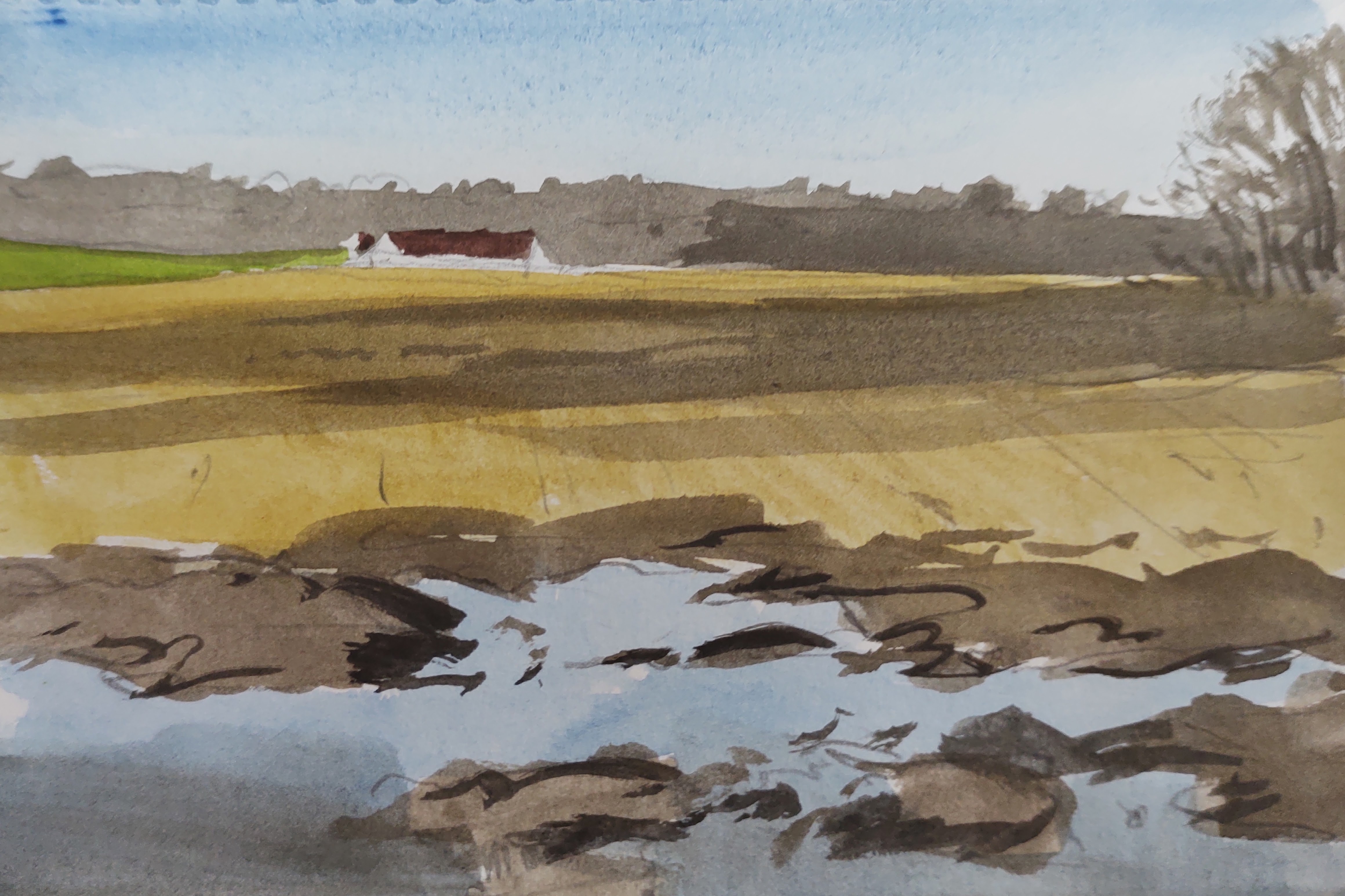
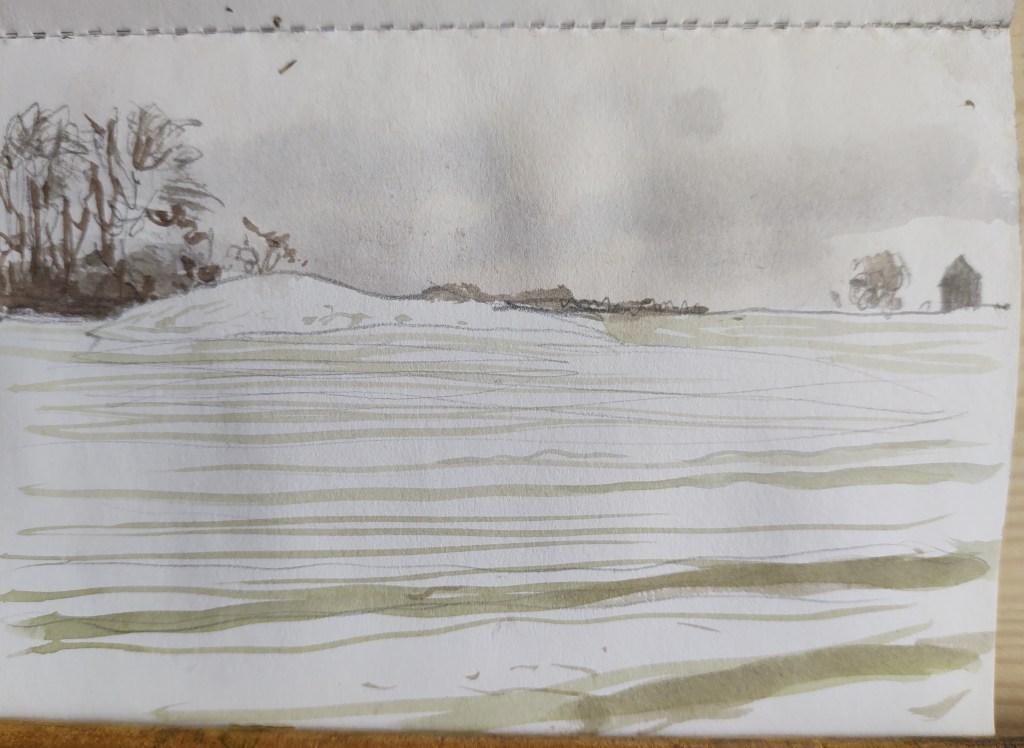
Feeling energised and positive, I headed south again, up into an expansive and gently undulating landscape, cloaked in a patchwork of ochres, umbers and greens and framed by the steely blue of the Baltic Sea. I stopped to sketch one of the many ‘høje’ – burial mounds – that were scattered across the landscape. This area had been the site of ‘Sorte Muld’ an important religious centre in the years 300 – 600 AD and is today an important archaeological location where thousands of tiny gold amulets have been discovered.

As I stood sketching, I became aware of a very distant high-pitched sound. My first thought was lapwings, but it was much too early in the year, and the sound was much more insistent and melodic. Perhaps it was the wind blowing through overhead cables – but again, far too melodious, and intricate. Perhaps it was the chanting of iron-age druids carried through time? Then suddenly it dawned on me – the noise I was hearing was the singing of the gibbons that lived in ‘Brændegaardshaven’ a nearby zoo/amusement park. The wind was blowing their incredible and mournful song across the valley right to where I was standing. It was unsettling and enormously incongruous to hear their calls carried across the freezing Baltic wind, so far from their steamy rainforest home in Southeast Asia. But it was also incredibly moving and beautiful.

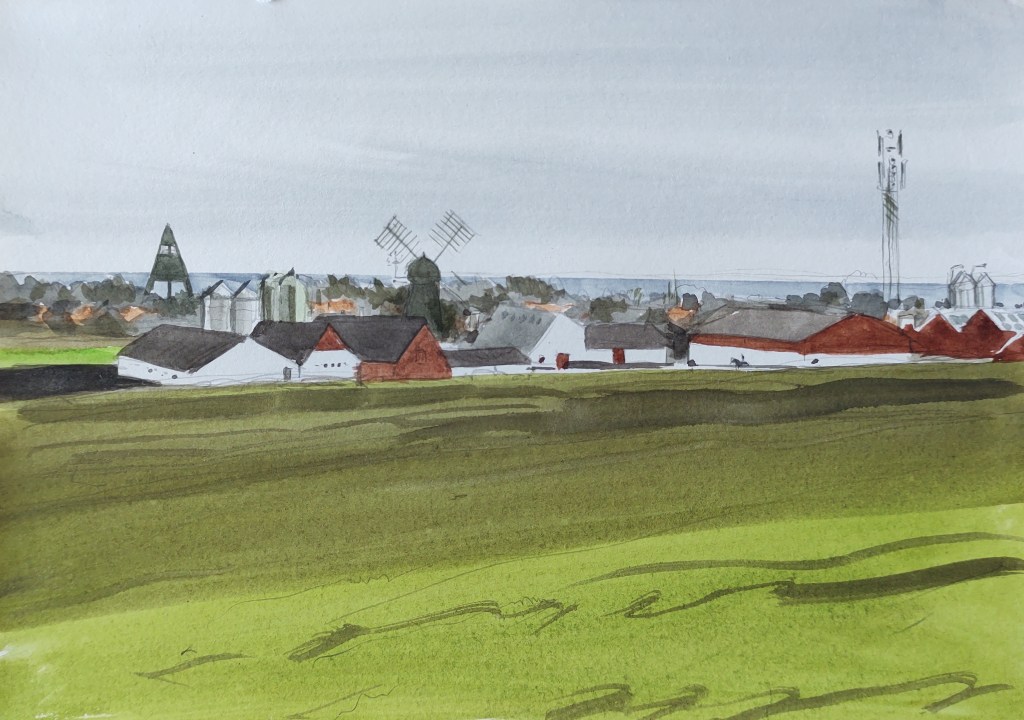
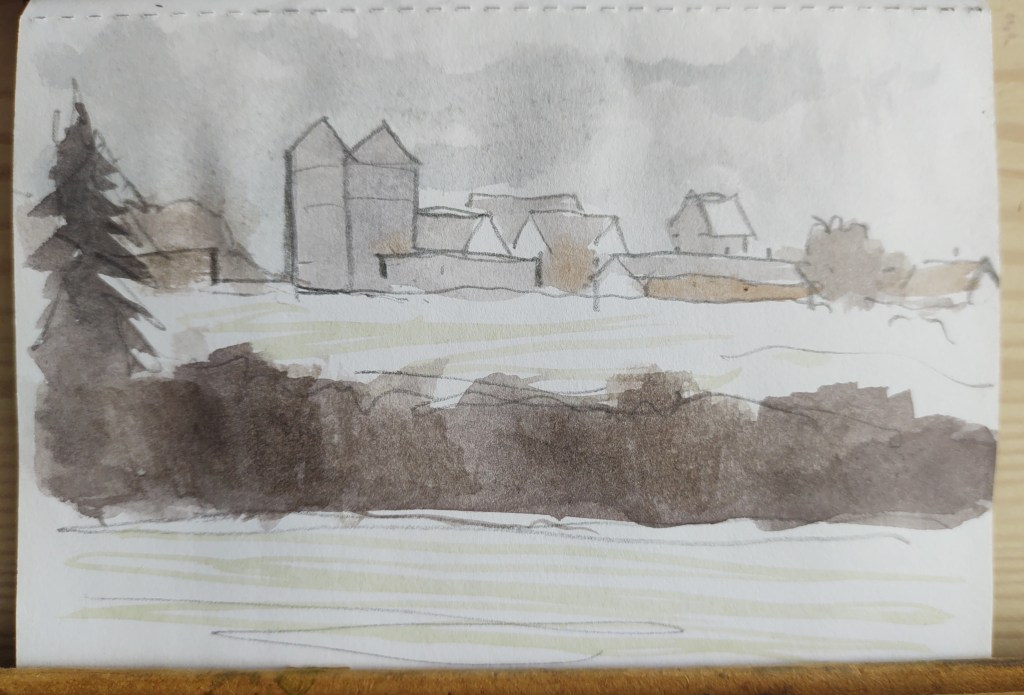
I walked on. Down and closer to Svaneke again, where I was attracted by the jumbled skyline of sheds, silos, the windmill and farms.

Svaneke seen from Korshøje

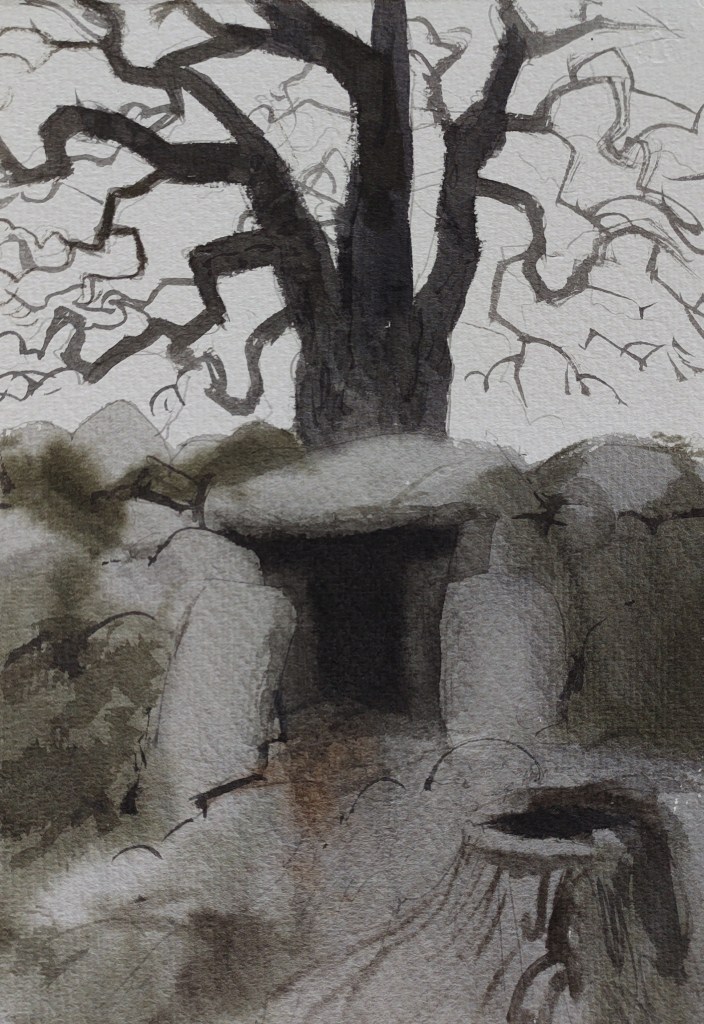
For the last time, I doubled back and headed southwest again. Soon I arrived at Hallebrøndshøj passage grave. Long before Sorte Muld emerged as a power, this area had been settled, and some time around 5.500 years ago the local farming community had constructed this burial site. Incredibly I could crawl into the grave chamber where, on a bed of dry leaves and protected from the burgeoning winds, I sat and enjoyed a warm coffee and got to work.

From the inside looking out
From the outside looking in

A few hours later a fine mist descended, and the day was over. I trudged all the way back to where I had left the car as dusk fell, exhausted but full of extraordinary memories and experiences.

LAND 06

WEATHER REPORT – cloudy start, then some hazy sunshine, then cloudy in the afternoon. Temperature between 4 and 6 degrees. Wind 8 – 10 m/s from the southwest and northwest. Hours of precipitation: 0 hours. Hours of sunshine: 5 hours.

STOPS with the BIVVY – 0

KILOMETRES WALKED – 12.46 km

DAY LASTED – 9h and 28 m

PEOPLE TALKED TO – 1 (while sitting in the passage grave, I heard voices – a man and his young son were visiting. They got quite a shock when they saw me inside. They were the only people I saw all day).

BIRDS SEEN and HEARD – 24 species: two new (grey heron and starling, running total = 47 species)

LESSONS LEARNED – er…

IN MY HEAD – I was thinking of how different LAND is from my KYST trip, in so many ways. I feel like I’m starting to get a feel for rural Bornholm – the fields, valleys, woods and farms – and the LAND project has completely taken over my life.

LAND 05 – Lyrsby Wood to Lyrehøj, 03.02.23

Denne blog på dansk her

LAND 05 Snow had fallen overnight, and I was ten minutes late for the start of the day. I headed west at daybreak, the sleeting snow together with the strong wind made any attempts at sketching almost impossible.

I walked across an open and gently undulating terrain, the snow and sleet settled in intersecting lines across the fields. Visibility was poor and all colour and contrast was obliterated by the stinging sleet.

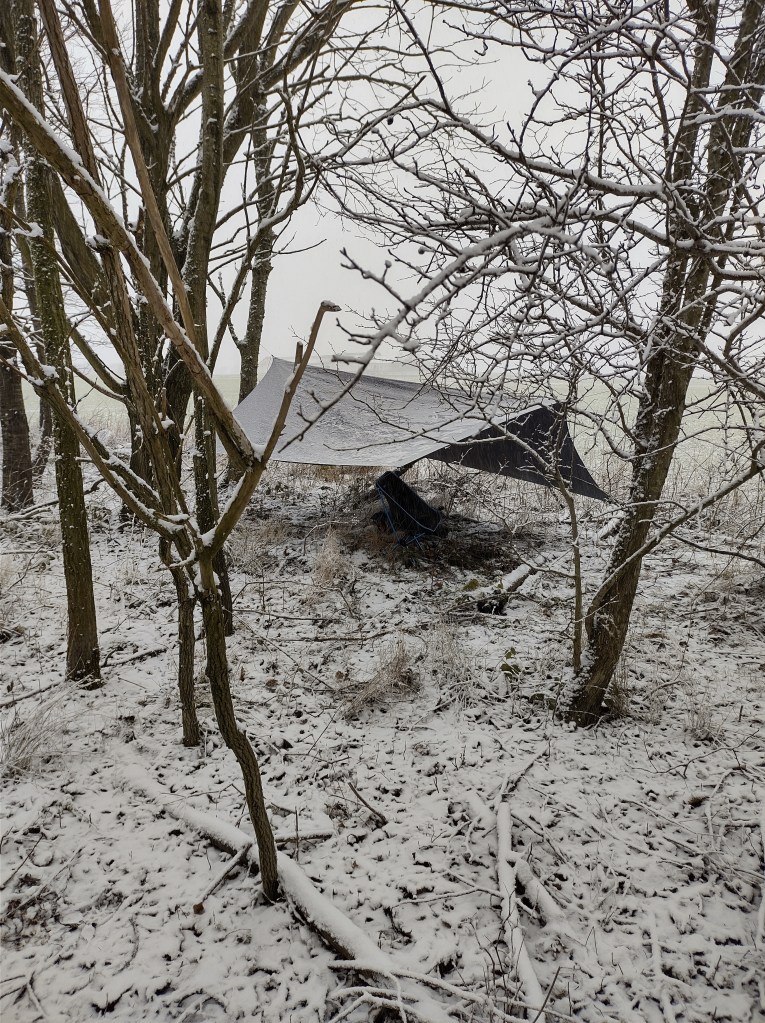
By chance I stumbled across a wooden bus shelter with its back to the wind. I settled within, thankful for the cover. Here I waited for several long hours, as the snow turned to sleet and then driving rain. Quite suddenly the wind changed direction and the rain came in and soaked my gear – I had no choice but to pack up again and keep moving.

Corner of Myregårdsvej and Ølenevej, The first one…
The second one, after the sleet turned to rain

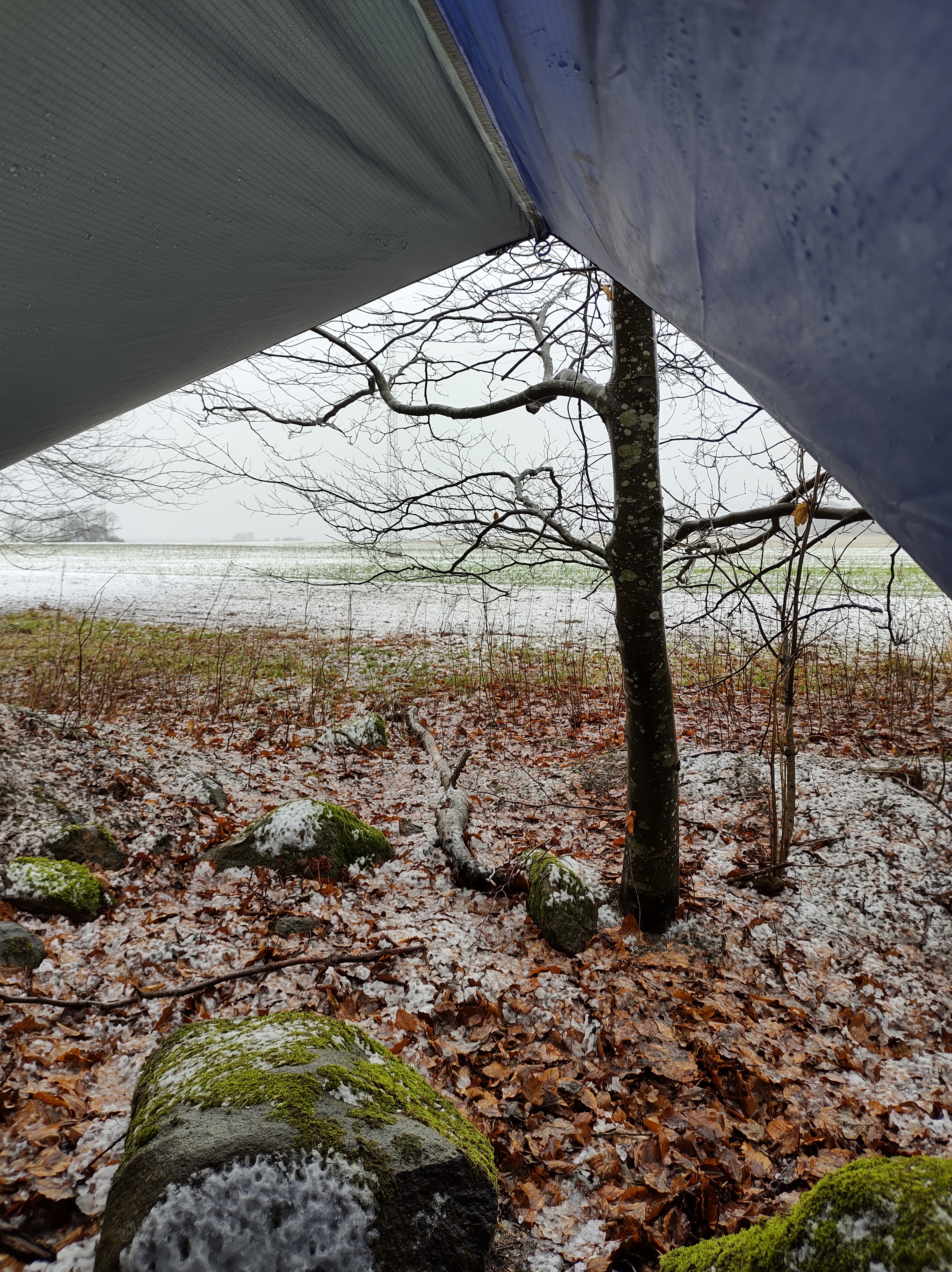
I walked onwards and turned into a farm track which took me past a small wood where I sheltered under my ‘tarp’ and cooked up some warm food. This was definitely off the beaten track and I felt far removed from everything. Eventually, the rain stopped and I packed up and walked onwards through the thick muddy slush.

With the clearer weather, deep browns, ochres and greens flooded back into the landscape. I walked along another small track past some old farms and through an old wood where some antique farm implements lay forgotten on the leafy mulch. Continuing past a wonderful old ash tree I crossed the Vasa stream in full spate and headed north again.

The edge of a field had been left uncultivated and suddenly there were yellowhammers, finches and sparrows feeding on the deadheads of thistles and other wildflowers. Overhead a white-tailed sea eagle soared majestically past and lifted my mood immeasurably. A chance conversation with an artist friend whose house I passed confirmed my faith in nature’s ability to rebound from our worst efforts to mess it up. I made some more quick sketches.
View of Ibsker from Lindholmsvej

The day regrettably not to end on a high – the rain returned and I trudged damp and exhausted on to my destination as the light faded.

LAND 05

WEATHER REPORT – Snow, sleet and rain clearing for a few hours in the afternoon. Temperature between 1 and 4 degrees. Wind 8 m/s from the southwest and northwest. Hours of precipitation:  6 hours. Hours of sunshine: 0 hours.

STOPS with the BIVVY – 1

KILOMETRES WALKED – 12.95 km

DAY LASTED – 8h and 40 m

PEOPLE TALKED TO – 1

BIRDS SEEN and HEARD – 24 species: two new (robin, white-tailed sea eagle, running total = 45 species)

LESSONS LEARNED – Put your pencil THEN your sketchbook in your pocket, not the other way round.

IN MY HEAD – how fast trees grow and provide cover

LAND 04 – Østermarie Church to Lyrsby Wood, 27.01.23

Denne blog på dansk her

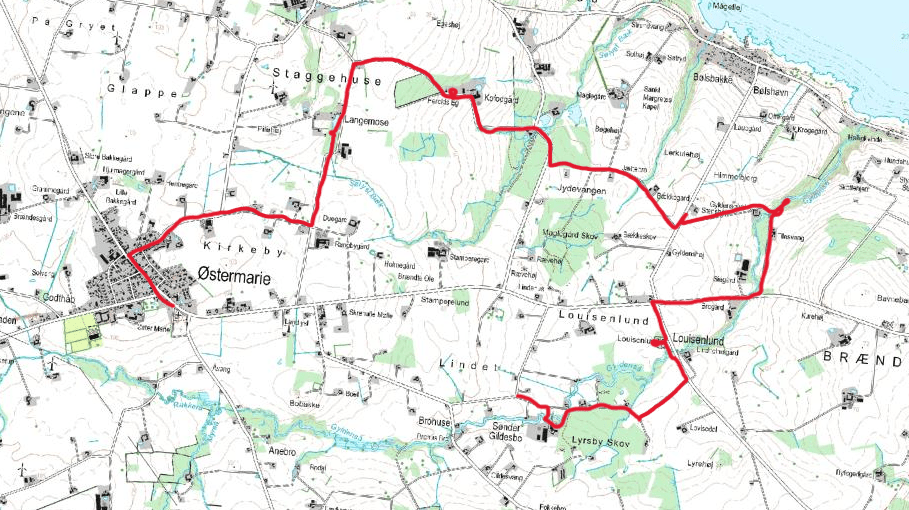
LAND 04 The church clock struck eight. Behind the clouds the sun had rose above the horizon and I started my journey. I walked through the village of Østermarie, before heading east again out over the fields and towards the sea. Perhaps it was the weather, or the time of the day, but I was struck by a sort of frontier independent spirit in the village and in the surrounding homes and farms. There were small art galleries and quirky second-hand shops, old-fashioned farmhouses, and huge industrial pig factories. Everyone seemed to be doing their own thing and getting on with it.

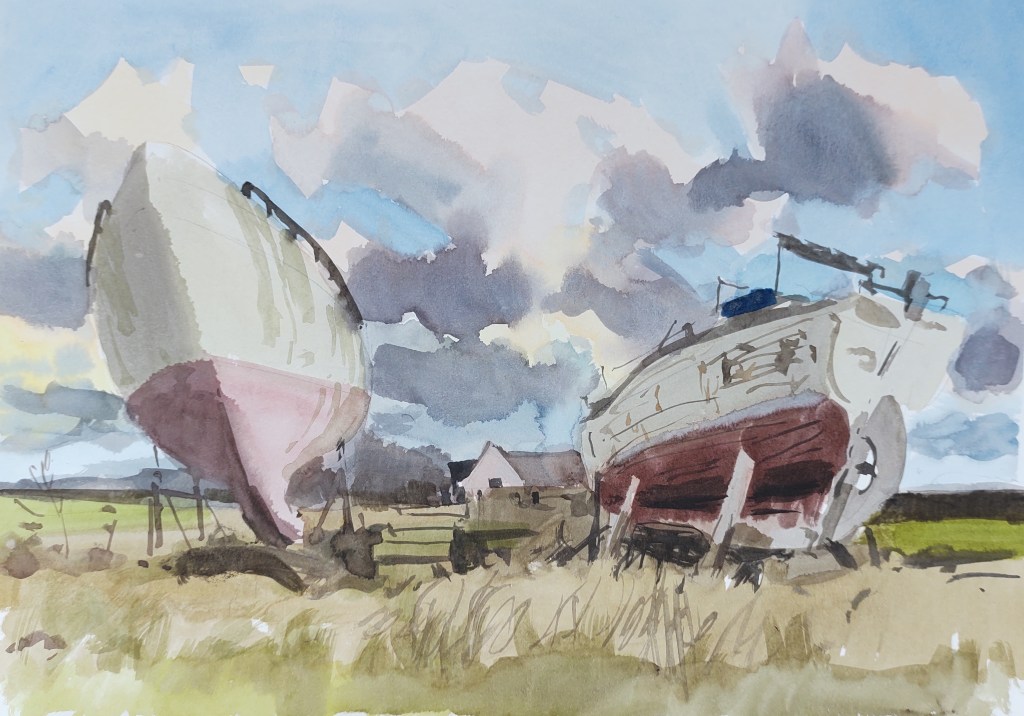
Some boats, just outside of Østermarie

The sun was struggling to emerge behind horizontal bands of thick and low clouds. The north-easterly wind felt very bitterly cold. I made several small sketches trying to record the spatial and tonal relationships between the fields, the rows of trees, the sky, and the distant sea. Every now and then the sun would break through, casting slivers of dazzling light onto the landscape.

I walked through a small wood, in the lee of which I rested for a while. An immature goshawk shot past overhead, quickly followed by the startled clattering of wood pigeons flying off in panic. I sat on an old bench beside a huge stately oak tree ‘Herold’s Oak’ or ‘the Key Oak’, with a fantastic view over the surrounding landscape. According to tradition, within this tree lies the key that guards the happiness of the adjacent farm.

View from the bench, Herolds Oak

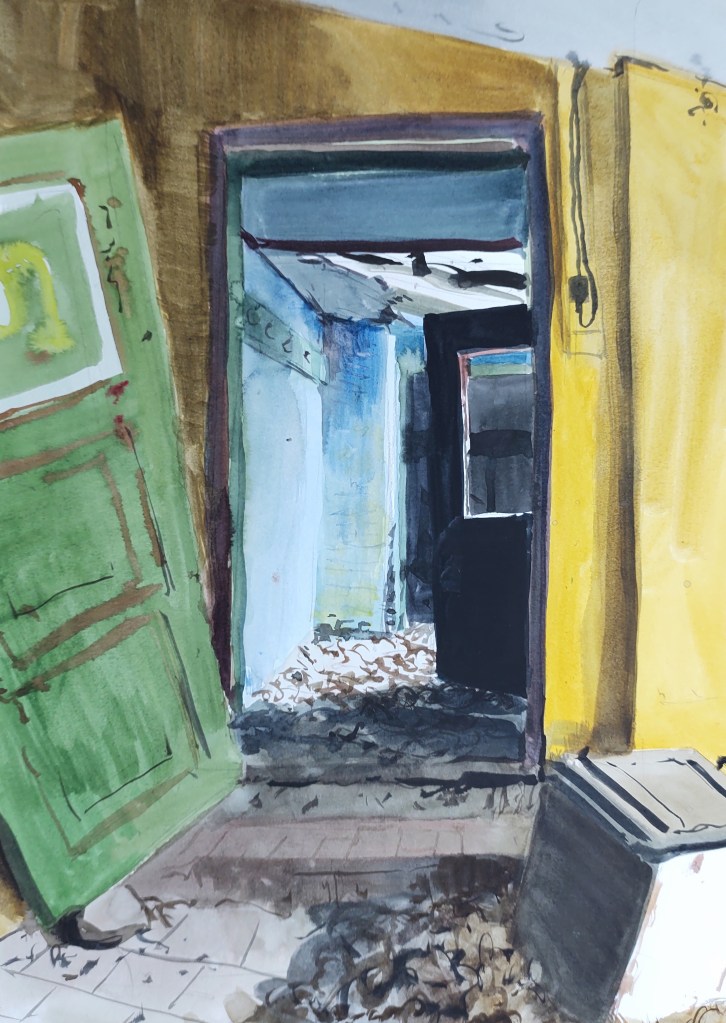
Next to the tree was a small derelict house. The surrounding garden was completely overgrown, and several trees had fallen and destroyed the roof, but it was still possible to walk around inside. Piles of dead leaves, bird’s nests and mummified rodents littered the rotten floor and the windowsills. It was a wonderfully evocative and peaceful place where I couldn’t help but imagine the life of its former inhabitants and marvel at the passing of time.

View from the kitchen

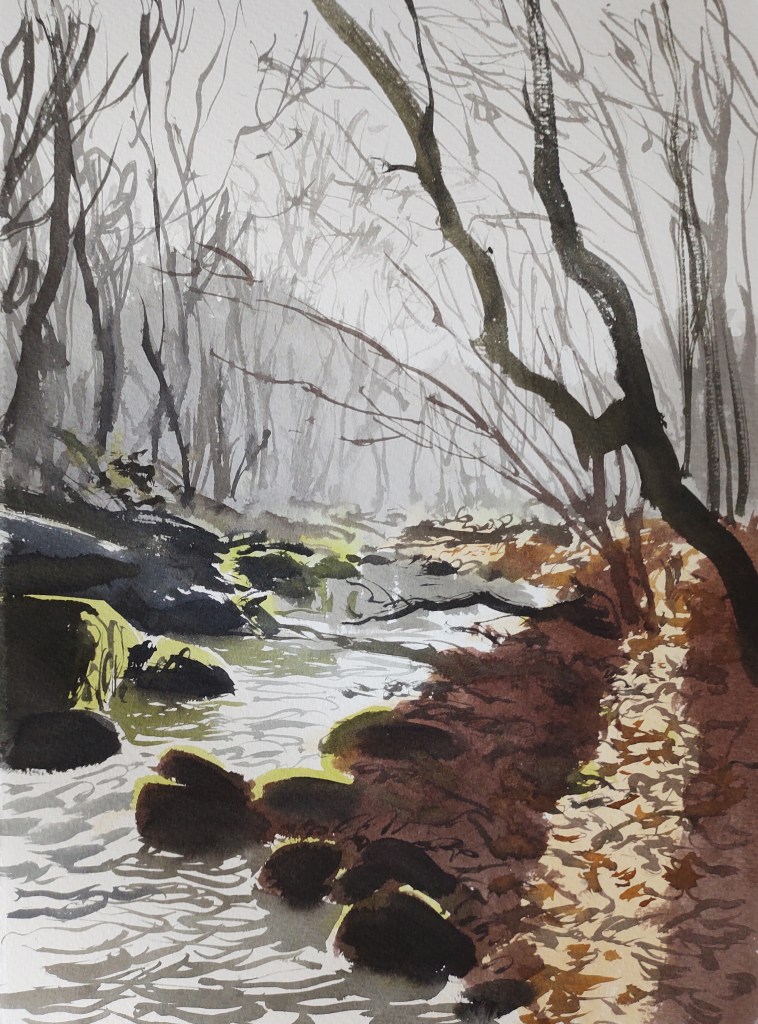
In what must have been the house’s front garden I saw my first snowdrops. I walked on through the landscape, glad to be outside and on the move. Eventually I came to the bridge over Gyldens Stream, which cut a deep and narrow valley into the landscape. I had heard that a dipper, one of my favourite birds, had taken up residence by the bridge recently but it was nowhere to be seen. I walked along the stream for a while and found a fantastic, secluded spot where I tried to capture the water as it flew over the granite boulders. My first attempt became much too fussy, my second, done in a fraction of the time, was a little more successful.

First one
Second one

The day was drawing to a close and I still had a way to go. Heading west again, firstly on the main road, I visited Louiselund where over 50 menhirs stand in an open beech wood. I had no time to really appreciate the attractiveness or gravity of the site and trudged regrettably onwards – through Lyresby Wood and onwards to the setting of the sun and my wife and dog waiting in the car.

LAND 04

WEATHER REPORT – Mostly overcast with sunny periods. Temperature between 1 and 3 degrees. Wind 8 m/s from the northeast. Hours of precipitation: 0 hours. Hours of sunshine: 1 hour.

STOPS with the BIVVY – 0

KILOMETRES WALKED – 13.36 km

DAY LASTED – 8h and 31 m

PEOPLE TALKED TO – 1 (I met a fellow walker and we chatted for a while)

BIRDS SEEN and HEARD – 32 species: eight new (House sparrow, Goldfinch, Redwing, Fieldfare, Collared dove, Feral pigeon, Goshawk, Redpoll, running total = 43 species)

LESSONS LEARNED – I tried some different gloves out – a mistake, my hands froze: back to the mittens next week.

IN MY HEAD –Downton Abbey, ‘Over and over’ by Hot Chip, my father-in-law, my children, worms, and – constantly banging on the edges of my consciousness – Biogas.

LAND 03 – Studeby to Østermarie church, 20.01.23

Denne blog på dansk her

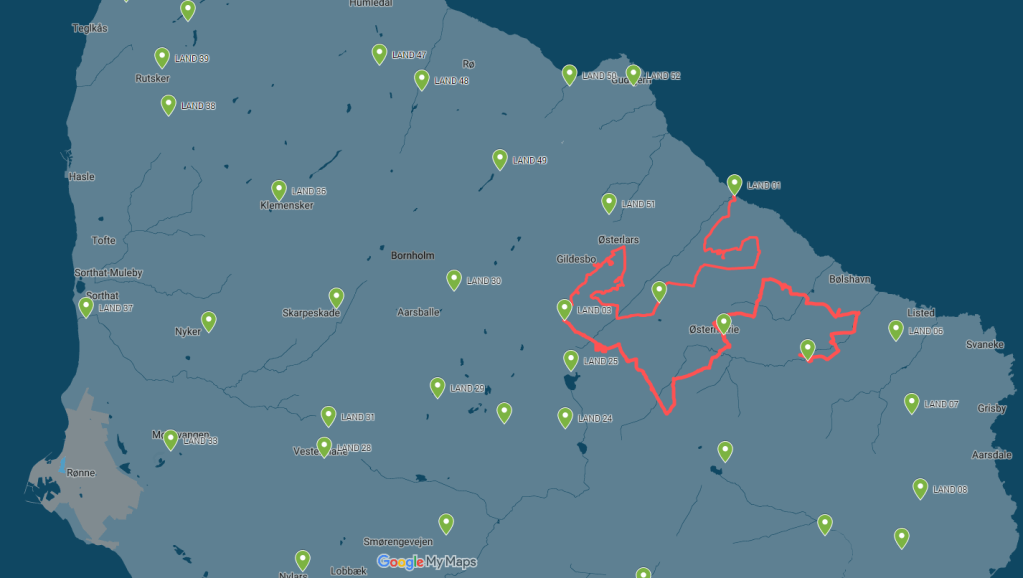
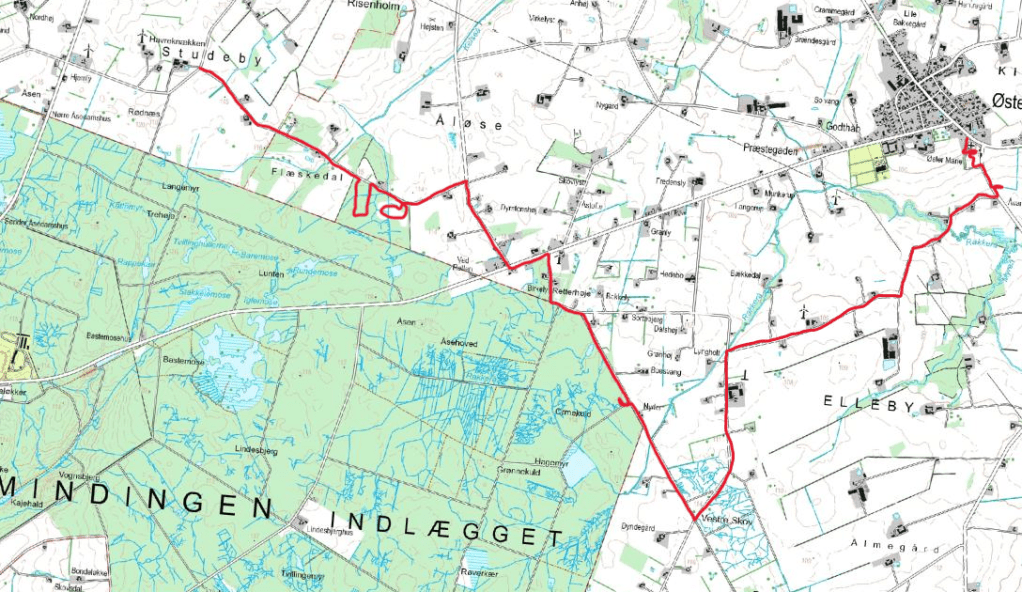
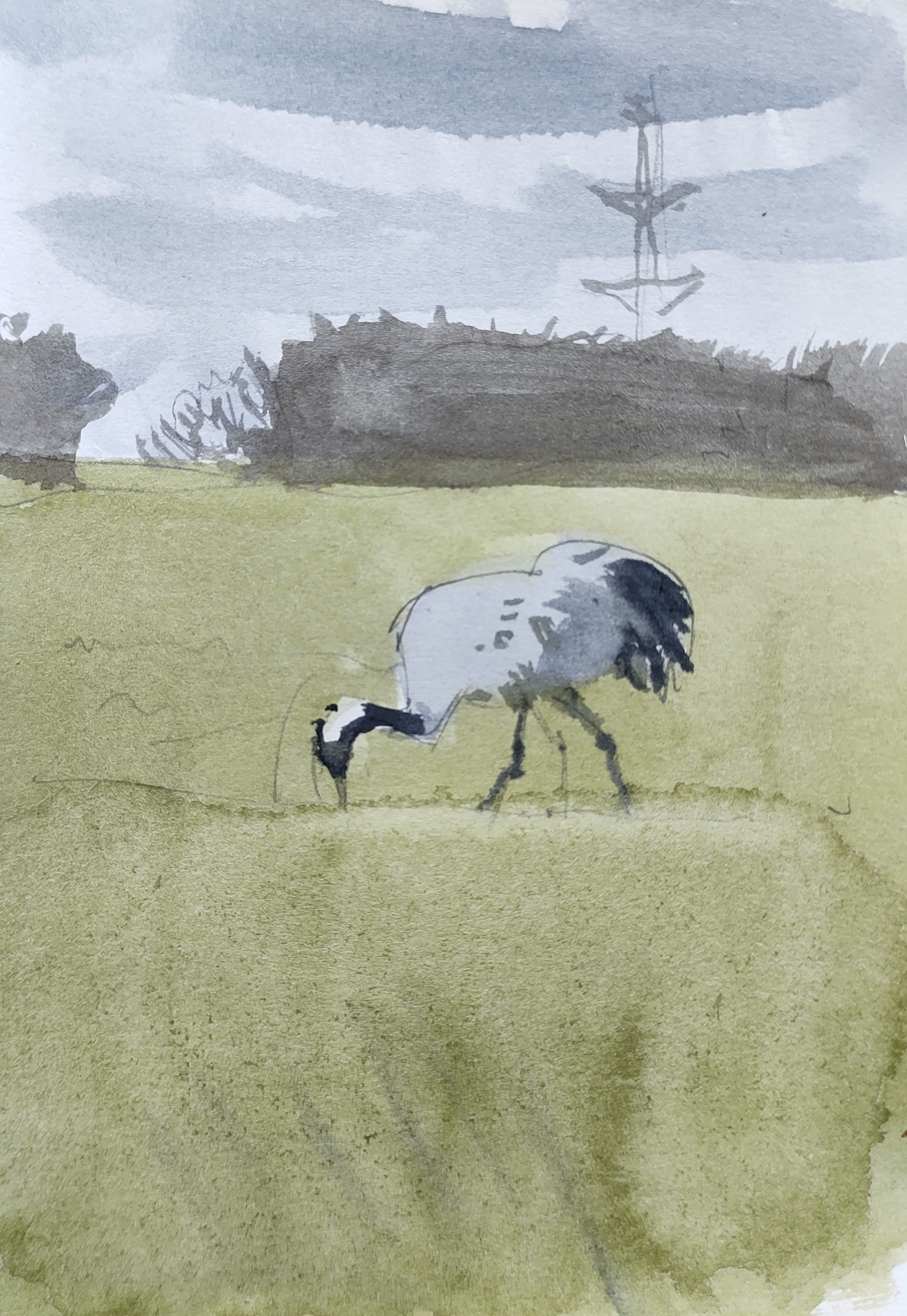
LAND 03 In the frigid dawn, as I unpacked my gear on the corner of Studebyvej and Flæskedalsvej, I heard the evocative call of a crane for the first time this year. A hundred metres or so away, the crane paced slowly around a field, pausing periodically to trumpet into the grey sky. The crane’s mournful and haunting call would follow me for several hours as I wandered slowly eastward, echoing over the frozen fields and through the cold, still air.

There was no wind, it was dry and just over 0 degrees – perfect weather for a day painting in the field. All week I had been struggling with oil paintings in the studio, so I was looking forward to watercolours and being in the landscape. The sky was a heavy pewter grey, the sodden fields were umber, ochre, and green. The previous week’s rainfall had collected and frozen in the fields.

Flæskedalsvej, looking North
Studebyvej, looking North

I headed east on Flæskedalsvej, a narrow and very quiet road with a patchwork of small farms, cottages, woods, and fields. I walked into a small private woodland that felt very seldom visited. I focused on the sounds – the Cretaceous screech of a jay, the ‘chup…chup’ of the Greater Spotted Woodpecker, the distant mewing of a buzzard – but there were long periods of silence, and it was incredibly peaceful.

Looking North from the corner of Åløsevej and Flæskedalsvej

Later I crossed the main road and headed south again, skirting ‘Almindingen’ the large forest in the centre of the island which I will be visiting several times during the course of this year. I made camp and watched the fields from inside the shelter of the woods.

From the wood, looking East

Despite the dry forecast, there had been periodic snow and sheet showers all morning, and now a fine misty rain set in. I headed east again over a more flat and open landscape – less shelter and larger fields. As the weather worsened my mood darkened and my eye was dragged repeatedly towards the huge industrial silos, mobile phone masts, and gigantic pig sheds that dominated the horizon.

Ellebygård, from Kirkeskolevej

Eventually I arrived at my destination – Østermarie Church. I drifted around the beautifully maintained graveyard before settling within the shelter of the womb-like apse of the original, ruined, church, dating from the 12th century. From here I was able to see the tower of the new church, built at the end of the 19th century. Soon after the clock struck 4 pm, the sun slipped imperceptibly behind the horizon and my day was done.

From the apse of the ruined church

LAND 03

WEATHER REPORT – Overcast with snow, sleet and rainy periods. Temperature between 0 and 2 degrees. Wind 4 m/s from the southwest and west. Hours of precipitation: 3 hours. Hours of sunshine: 0 hours.

STOPS with the BIVVY – 1

KILOMETRES WALKED – 10.30 km

DAY LASTED – 8h and 6 m

PEOPLE TALKED TO – 0 (I don’t think I even saw a living person the whole day, apart from a few motorists and couple of mountain bikers)

BIRDS SEEN and HEARD – 26 species: Six new (Canada goose, Common crane, Woodcock, Siskin, Goldcrest, Treecreeper, running total = 35 species)

LESSONS LEARNED – If your tracksuit bottoms get knotted, untie the knot there and then – instead of waiting until you need to go to the loo again.

IN MY HEAD – In the morning, when not painting, my thoughts drifted to Downton Abbey (aaagh!), ‘Song 1’ by Superbandet, and my children in Nepal, Paris and Copenhagen – and in the afternoon, Biogas, intensive agriculture, environmental pollution, the power and interests of the individual, business, the state, compensation, greenwashing, capitalism, growth, equitable society, and a lot more…

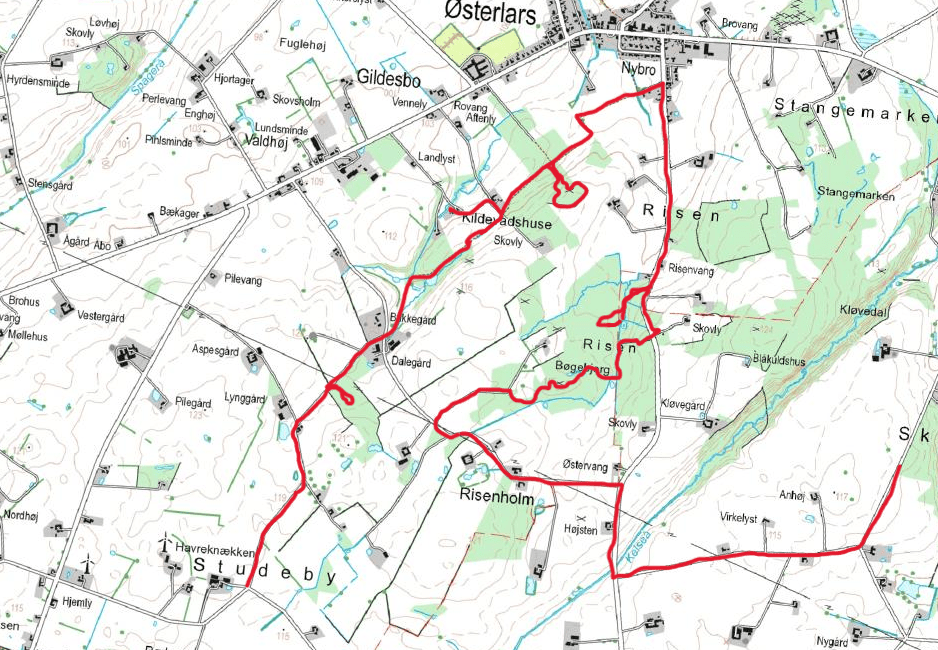
LAND 02 – Skrullevej to Studeby, 13.01.23

Denne blog på dansk her

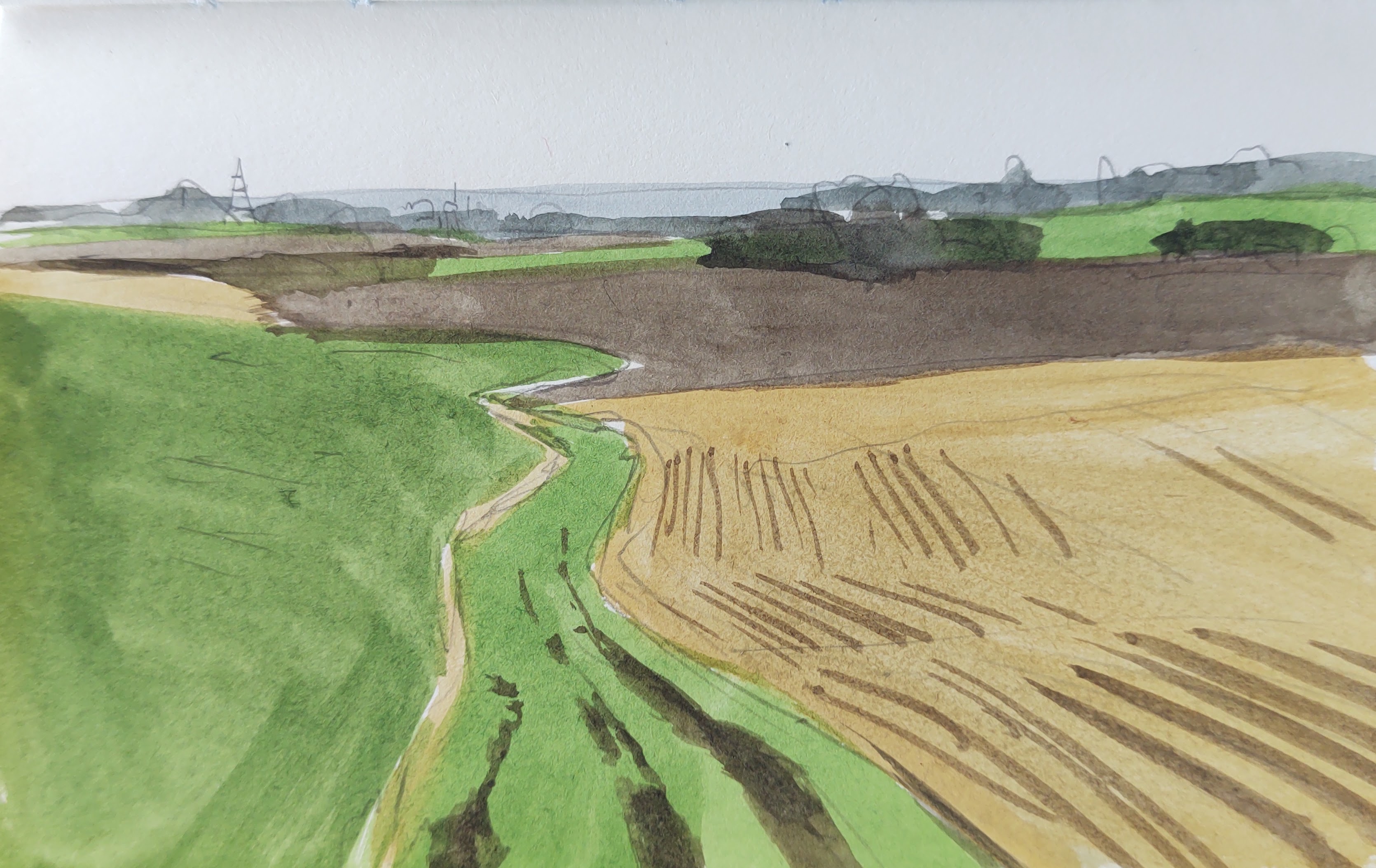
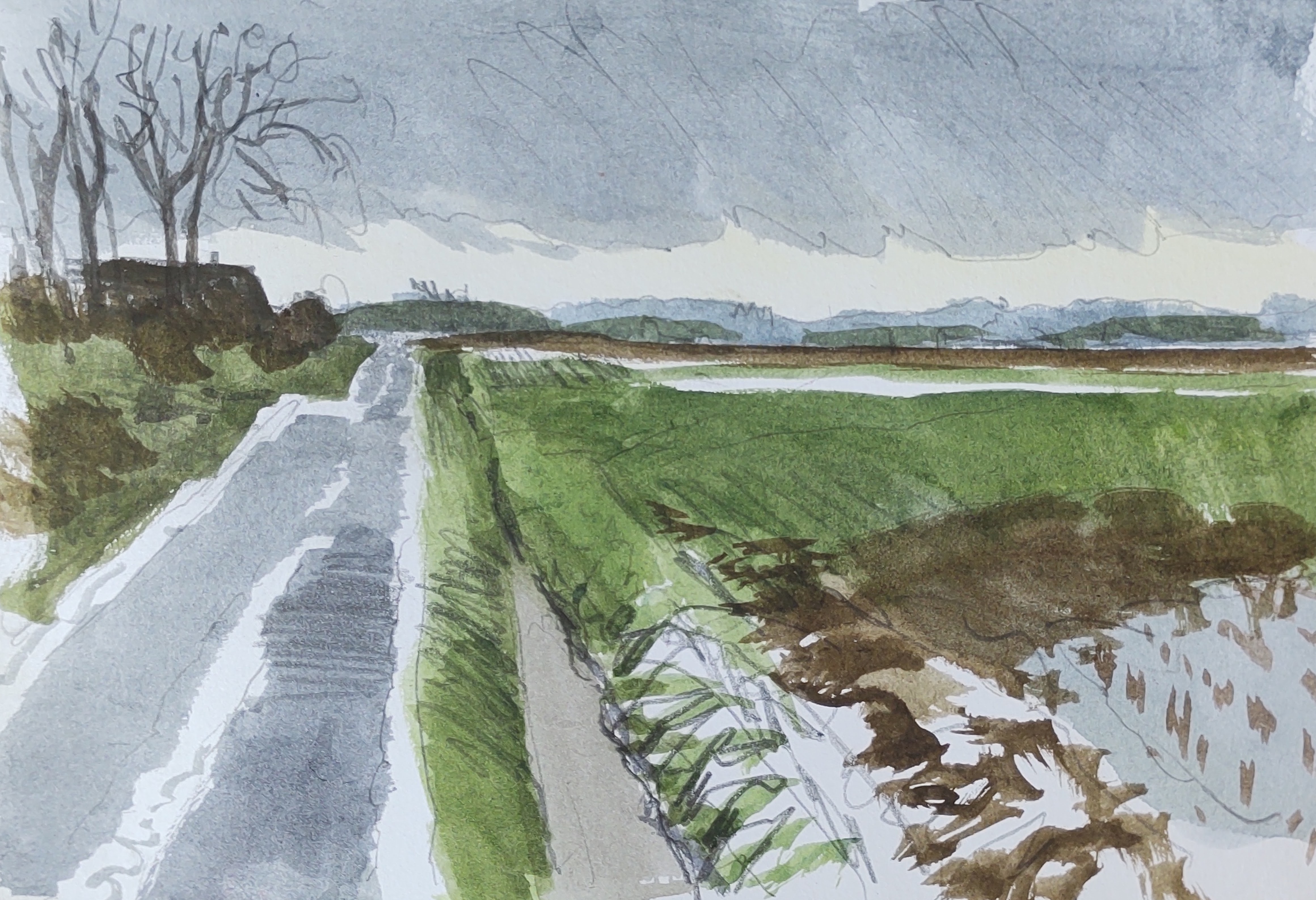
LAND 02 After last week’s frigid baptism, I was relieved to see that a dry day with sunny spells was forecast. As I walked along the empty country road the sun eventually rose above the clouds and cast a golden light across the waterlogged fields.

Skrullevej mod syd

Turning left at Risenholmvej I found myself in a more sheltered area with some fine old Black Poplar trees bordering the meandering road. I walked along a track towards Risen, a small, forested remnant of a once much larger network of woodlands that stretched along the eastern side of Bornholm. Deep in the wood I came across Bøgebjerg, a burial mound dating from the Bronze age. On top of the mound some small stone graves were not particularly impressive in themselves, but nevertheless the area felt wonderfully ancient and peaceful. I still had not seen a living person.

View from the top of Bøgebjerg

Coming out of the wood at Åløsevej, I had hoped to continue into Kløvedal, but the area was closed for hunting. Instead, I headed back into the wood and stopped by a small stream. I had never been there before, much less known of its existence, and I made a mental note to return in the Spring.

Small stream in Risen

I continued northwards along the empty country road. I’m beginning to recognize the rhythms of the agricultural landscape – the fields: ploughed and unploughed, browns and greens, the small woods, the distant gables of the scattered houses and the industrial farms with huge sheds and silo towers. I thought about how the agricultural landscape has always been changing and our relationship with the land. I thought about how different LAND is to KYST.

Eventually I doubled back on myself and walked along the cycle path across some fields and into a wooded area, where the recent rain had flooded some meadows. I ambled along. Very few birds were about, and none sang. It was deep winter. As I approached my pickup point at Studeby I was rewarded with a brief but intense sunset.

Some strange fungi growing on an old tree stump

LAND 02

WEATHER REPORT – Windy and mostly sunny. Temperature around 6 degrees. Wind 10 – 15 m/s from the southwest and west. Hours of precipitation: 0 hours. Hours of sunshine: 5 hours.

STOPS with the BIVVY – 1

KILOMETRES WALKED – 11.14 km

DAY LASTED – 7h and 45 m

PEOPLE TALKED TO – 1

BIRDS SEEN and HEARD – 23 species: Five new (Long-tailed tit, Greater spotted woodpecker, Hawfinch, Tree Sparrow, Red kite, Greylag goose) running total = 28 species

LESSONS LEARNED – My fold-out chair has pointed feet that sink into the mud as soon as I sit on it. I need to sort that out.

IN MY HEAD – Biogas. And I was thinking and worrying about my youngest daughter’s imminent departure to Nepal – alone.

Hit the ‘follow’ button below to receive weekly LAND blogs through 2023

LAND 01 – The beach at Saltuna to Skrullevej, 06.01.23

Denne blog på DANSK her

LAND 01 I walked from the main road down to the beach. As I unpacked my gear and looked around at the boiling waves and leaden sky, a lone sparrowhawk suddenly flew low and fast across the beach before disappearing into a nearby wood. I took that as a good omen and the official start of the LAND project.

The Kelse stream emptying out onto the beach at Saltuna

Packing up my gear I started walking inland up a small road, not along the coastline as I had done during the KYST project – this felt very strange and significant. The road climbed quite steeply, and I turned often and looked back at the horizon and the sea. It was cold and windy and soon started sleeting.

Looking down Saltunavej towards the sea

I managed to make a few small sketches, but soon found myself in the middle of a sleety blizzard. I walked through a dull grey landscape of fields and farms, the sea no longer visible. The road continued to rise, eventually flattening out into an undulating terrain divided by the deep and narrow forested dells of the Kelse and Rise streams. Through the curtains of sleet and rain I could intermittently make out huge industrial agricultural buildings and silos silhouetted against the sky.

Risegaard seen from Kirkebyvej
Risegaard seen from Risevej

The weather conditions were brutal, and the visibility was poor. I eventually made camp with my new ‘bivvy’ in a small wood where I heated up some food. Though I was glad for some shelter I struggled to keep dry, warm, and positive. I thought about the landscape and how it has been transformed by industrial agriculture – my negative thoughts doubtlessly influenced by the news that the huge biogas plant right next to my home is planning to expand.

my new ‘Bivvy’ shelter and chair – much lighter than the old M60…
The view from the edge of the wood

I walked over slushy waterlogged fields and found myself at Solhøj, an old ‘Bavnehøj’ where in times gone by people would light fires to warn of each other of impending danger.

Risehøj

I trudged on, my walking boots waterlogged now, and made camp again in a small wood on Skrullevej, where I had arranged to be picked up. A single male bullfinch perched nearby, his brilliant carmine breast shockingly pink against all the whites, browns and greys. Of course, no sunset or indeed any sign that the day was over, other than a gradual darkening of the gunmetal sky.

View from the edge of the wood

LAND 01

WEATHER REPORT – Snow, sleet and rain for most of the day. Temperature between 2 and 4 degrees. Wind 10 – 15 m/s from the south and then south west. Hours of precipitation: 6.5 hours. Hours of sunshine: 0 hours.

STOPS with the BIVVY – 2

KILOMETRES WALKED – 11.34 km

DAY LASTED – 7h and 35 m

PEOPLE TALKED TO – 1

BIRDS SEEN and HEARD – 22 species

LESSONS LEARNED – I was trying out loads of new gear, so learned loads. Most of all, however, I learned that my gloves, boots and waterproof trousers, are not as waterproof as I thought.

IN MY HEAD – mostly I was struggling to keep my spirits up: on the one hand happy to be out, but on the other hand wishing to be home and dry. I thought often about the Biogas expansion plans and what I was going to do about it.

Hit the ‘follow’ button below to receive weekly LAND blogs through 2023

ERTHOLMENE

(denne blog på dansk se her)

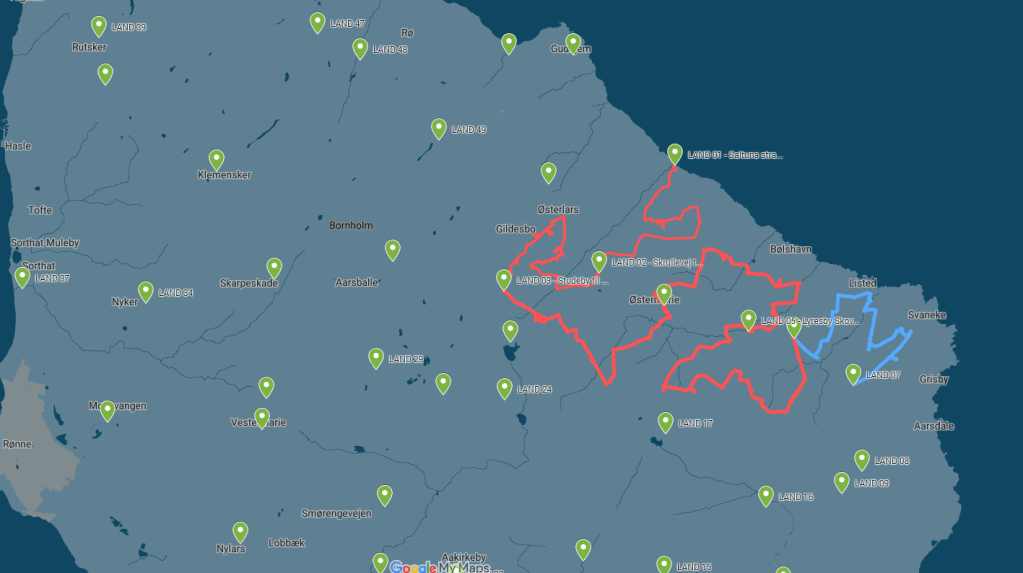
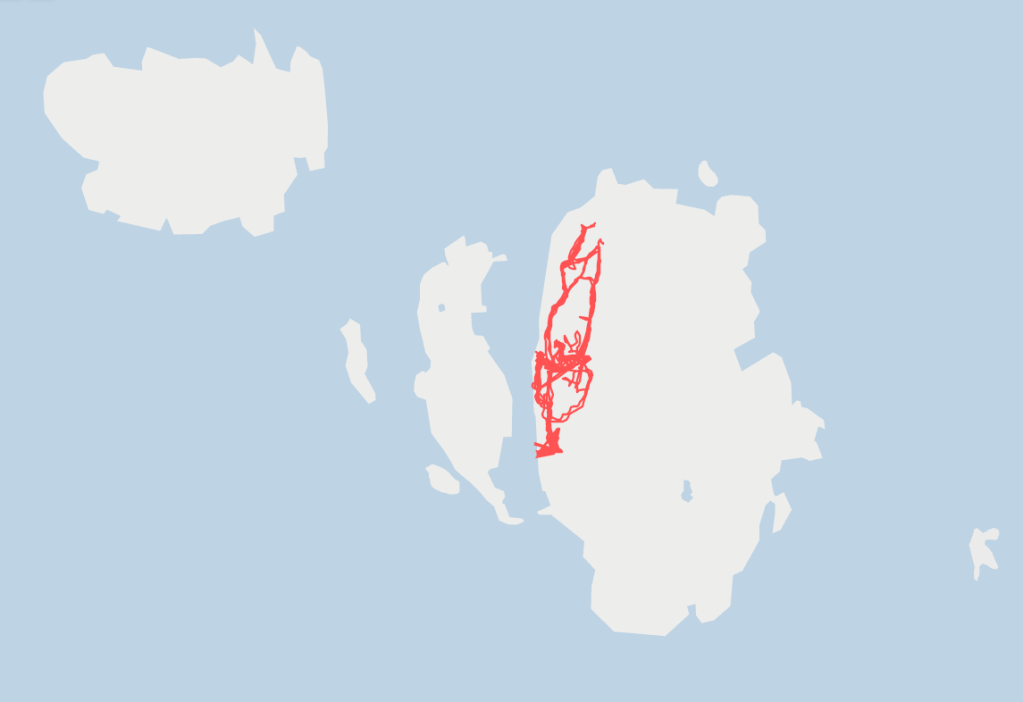
In May this year, I spent seven wonderful days painting and drawing on the ‘Pea Islands’ (Ertholmene), more commonly known as Christiansø. The project was inspired by my 2018 KYST project, and I started each day at sunrise and stopped with the sunset – outside in all weathers, trying to make a physical and emotional connection to the islands by watching, looking, painting and recording. Once again, all the artwork was completed on the day, but whereas for the KYST project I stayed as close to the coast as possible, here I divided the islands into seven consecutive ‘zones’, one for each day, and allowed myself to wander and explore within these areas as much as I liked.

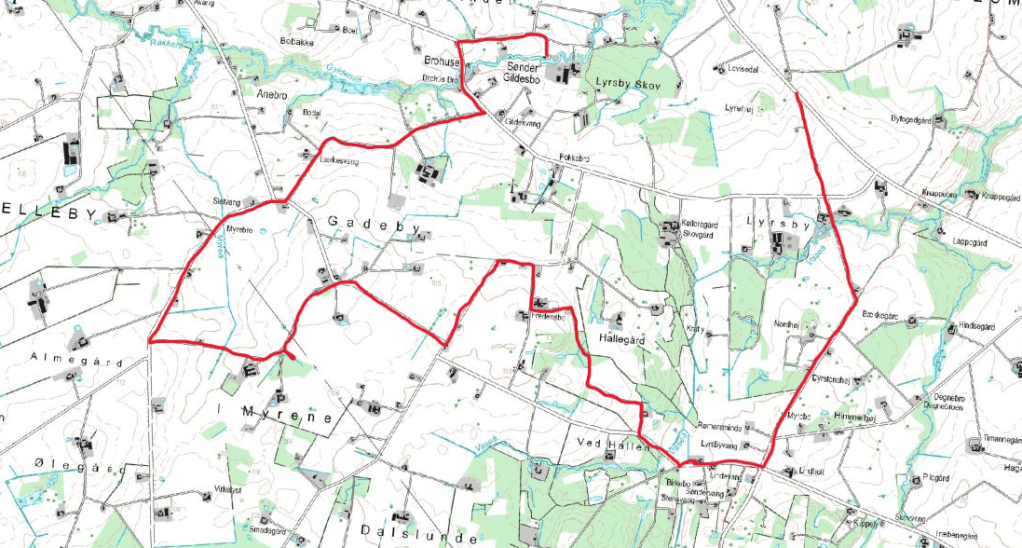
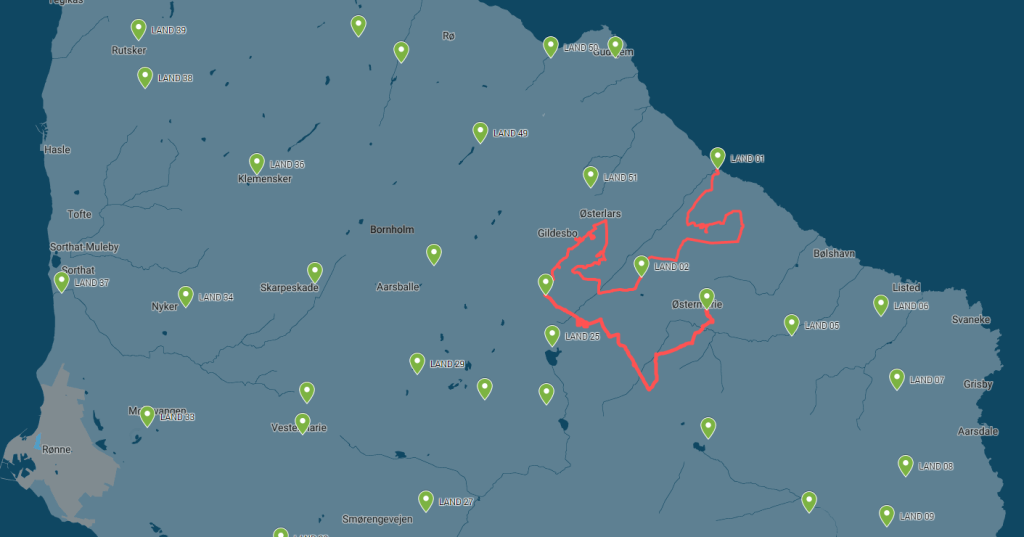
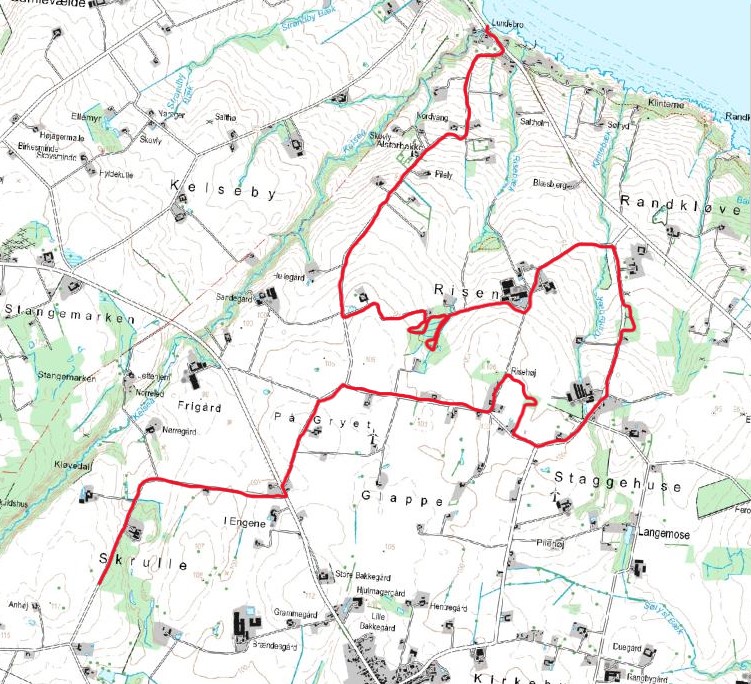
A GPS record of my wanderings on the first day

Situated about 12 miles northeast of my home island of Bornholm in the Baltic Sea, Christiansø is home to about 90 residents, as well huge numbers of eider ducks, auks, seals, frogs and toads. The islands share a fascinating cultural history, and during the 17th and 18th centuries were converted into a huge naval fortress, which has remained largely unchanged since it was decommissioned in 1855.

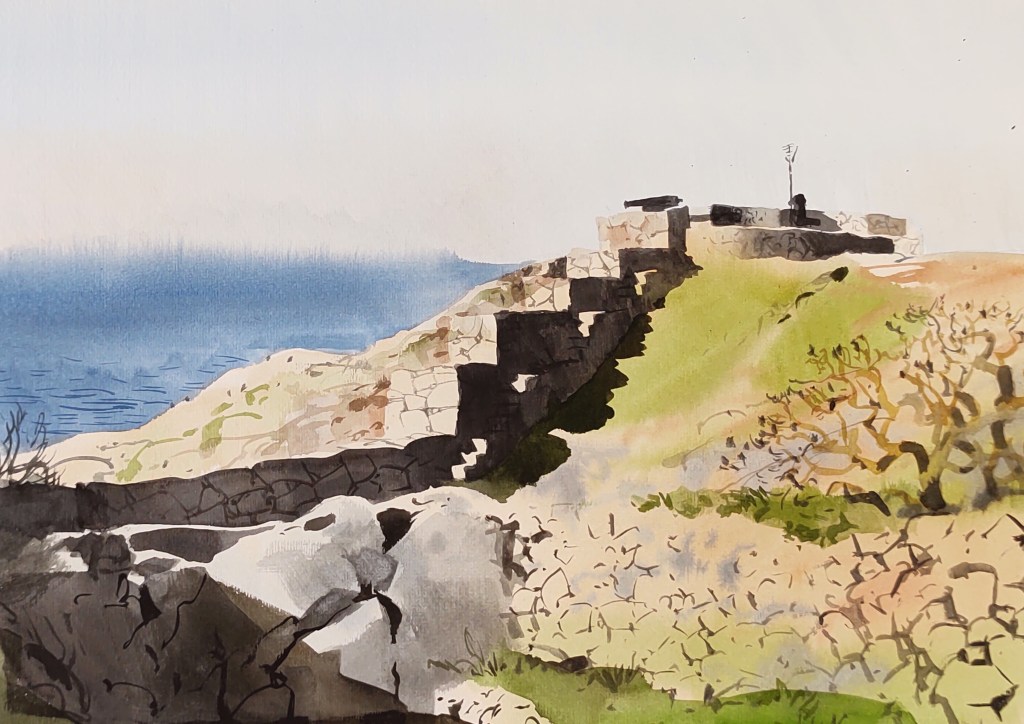
ERTHOLMENE 04.02 Udsigt mod Coucherons Bastion

In the summer, Christiansø is a popular tourist destination from Bornholm, and hundreds of visitors take the ferry from Gudhjem each day, returning after spending three or four hours traipsing around the islands. In May, however, there were few tourists, and I was lucky enough to experience a taste of the sensations and experiences that the islands offer. My biggest challenge was the incredible richness of the flora and fauna and the overwhelming amount of things I wanted to paint. Add to this the ever changing light and weather conditions, and I had a very intense seven days that left me quite exhausted.

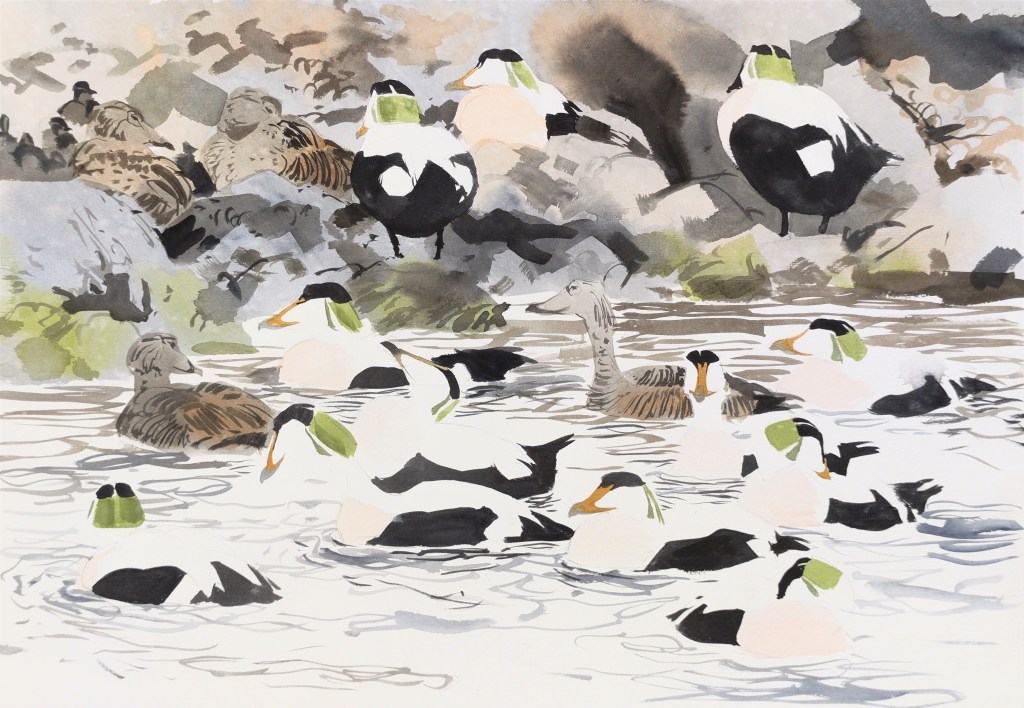
ERTHOLMENE 01.05 Ederfulge ved Frederiksø

On my return, I shifted my focus to the exhibition and book I had already planned. In the beginning of July I returned to the islands with my paintings and enjoyed another incredible week – this time showing my work at the tiny gallery Palivaren on Christiansø.

Just in time for the exhibition’s opening I managed to write and publish the book ERTHOLMENE, once again with the help of the designer Nye Hughes from Dalrymple in Scotland, with whom I had worked with for the KYST book. The ERTHOLMENE book is smaller (60 pp), softback and follows the same layout and narrative style of its big brother.

At the time of writing, the book is available to purchase in many of Bornholm’s bookshops and galleries. The price is 150kr (£15 Pounds Sterling). If you are not able to visit Bornholm, drop me an email stating your address and how many copies you would like, and whether you’d like it signed – and I’ll let you know how much the postage and packing costs. Payment can be made by Mobilpay, Paypal or bank transfer.

LATEST NEWS 24/04/25 – ERTHOLMENE is sold out – I’m looking into a reprint, and will announce on my instagram, Facebook, and this website if this happens!

The paintings are also for sale – many are sold, but not all – so let me know if you’re interested in any of them.

Screenshots from the book

FIRKANT 06

From the very beginning of this project, I really liked the idea of creating the illusion of a square/firkant of ‘Spring/green/non-snow’ surrounded by ‘Winter/white/snow’. In my mind, I saw a green grassy square surrounded by virgin snow – I would shovel the snow out of the firkant and create a perfect square of non-snow. The other Fire Kanter I had made were created on a level plane, but I also liked the idea of playing a bit with the perspective and creating a firkant partly on a non-level plane. That was the plan anyway.

Although we had already had light snow and minus temperatures since the New Year, we hadn’t yet had real deep snow – so I was very glad when the forecasters promised a proper snowfall in the first week of February. I settled on a small local quarry, Bjergebakke Stenbrud, as the venue for Firkant 06 – I knew I would be undisturbed and would have the ability to project the firkant onto the sloping sides of the quarry. I have worked and painted there before, and I find it a very inspirational place. Once all the snow had fallen, I made a preparatory recce and looked at the snow quality, the direction of the sun and shadows and where I could locate the firkant. I needed a day without further snow, and when that was promised I was ready to start – everything was perfect.

The first mistake I made related to the positioning of the firkant. The smallest adjustments of the angle and direction of the camera eye result in potentially huge changes in the form and size of the firkant (as it is on the floor, rather than as it is as seen from the point). I made the firkant much too large, which meant a lot of shovelling. In some places the snow was over 50 cm high, and I only had a old shovel. I could have saved myself an awful lot of time and effort if I had adjusted the angle of the camera a few milimetres up.

Another problem I hadn’t really recognised, was that – in order to keep the snow surrounding the firkant untouched, I would need to leap from the edge of the ‘picture’ into the firkant, where I could then begin shovelling. This meant that all the snow I cleared needed to be transported ‘out’ of the firkant and then out of the ‘picture frame’. I did this by filling IKEA bags with snow, then chucking them out over the ‘picture edges’, leaping out of the firkant making sure not to damage the virgin snow, emptying the bags and then leaping back again and repeating the process. Many times.

It didn’t take me long to realise that it would take me more than one day to clear the firkant. Other problems: the ground I was clearing was in turns grassy, stony, or rocky. In some places small bushes lay under the snow, which also needed to be cleared. My snow shovel – and my sanity – started to crack. Then, despite the weather forecasts, it started snowing and blowing quite heavily. The parts of the firkant I had cleared started to fill up with snow again. I had taken a dustpan and brush, with the naïve hope of eliminating all the snow completely, but it soon became clear that it would be impossible. By the end of the day I had hardly made any impact and was very close to giving up.

The next day was indeed sunny, which unfortunately meant that the snow developed an icy crust, which made it even more difficult to shovel. The south facing edge of the firkant started melting and drooping in the sun, despite the air temperature remaining well below freezing. I had to enlarge the firkant in order to maintain the illusion of a square, but even the tiniest change meant IKEA bags and IKEA bags of new snow to be cleared.

Returning for the third day I noticed how the cleared square had been visited by the local fauna. Hare and deer tracks led into the square, and raven wings had left beautiful imprints in the snow. I cleared as much as I could and then decided enough was enough. I never managed to clear the square completely of snow as I had imagined, but I decided I would let nature take its course. The forecasters promised warmer weather, and I imagined the snow and ice remaining in the square would soon be melted completely away.

Returning again and again, the thaw has indeed melted nearly all the snow in the firkant, but it has also completely melted one of the sides, destroying the illusion of a square. I will return sporadically and keep documenting the firkant as it slowly disappears and is consumed again by the landscape. Perhaps the fact that I scraped the snow with the shovel will leave some sort of shadow on the new growth of grasses in the Spring. In many ways Firkant 06 has been a failure, in that I never achieved the sharp distinction between the virgin snow and green grass that I envisaged. However, it was an interesting and unforgettable experience and I have really enjoyed seeing it change over time. I also may have saved the lives of a few birds and mice by exposing all that grass.

For me, the Fire Kanter project is all about physically getting to grips with the landscape, and learning more deeply about the place that I find myself in.