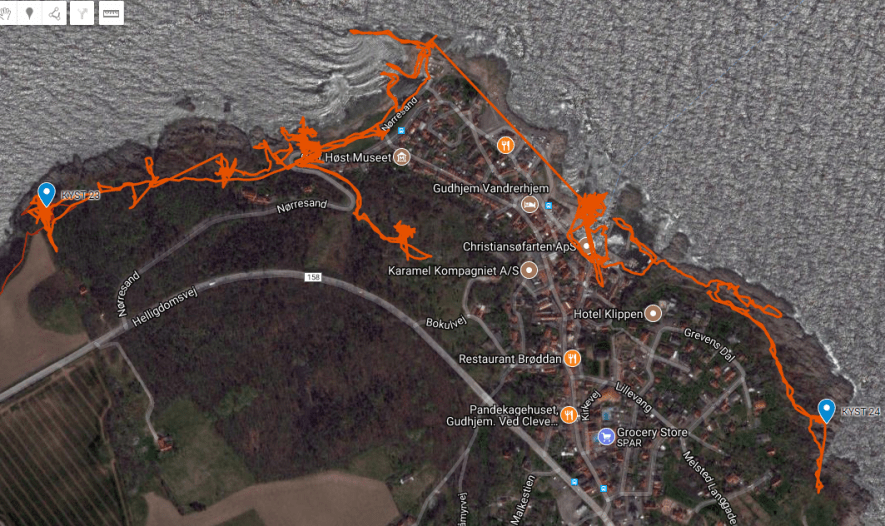
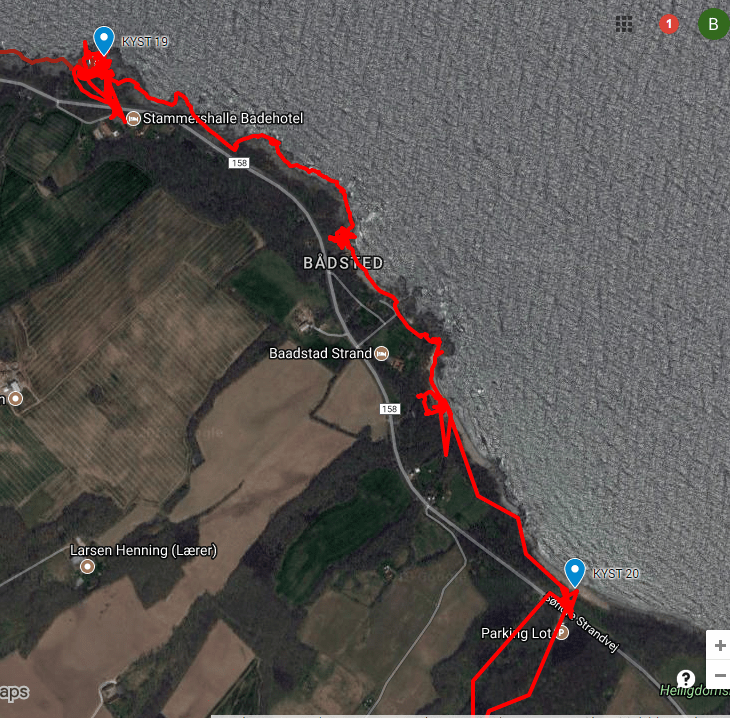
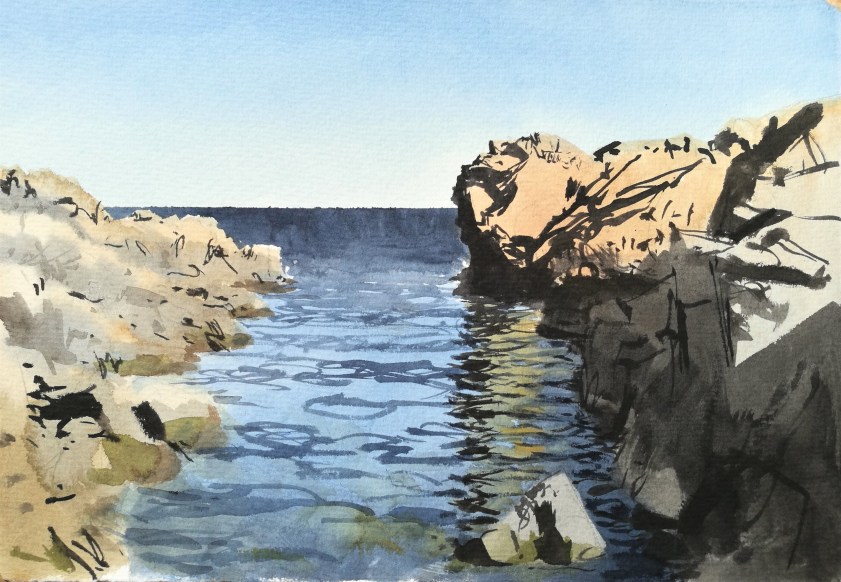
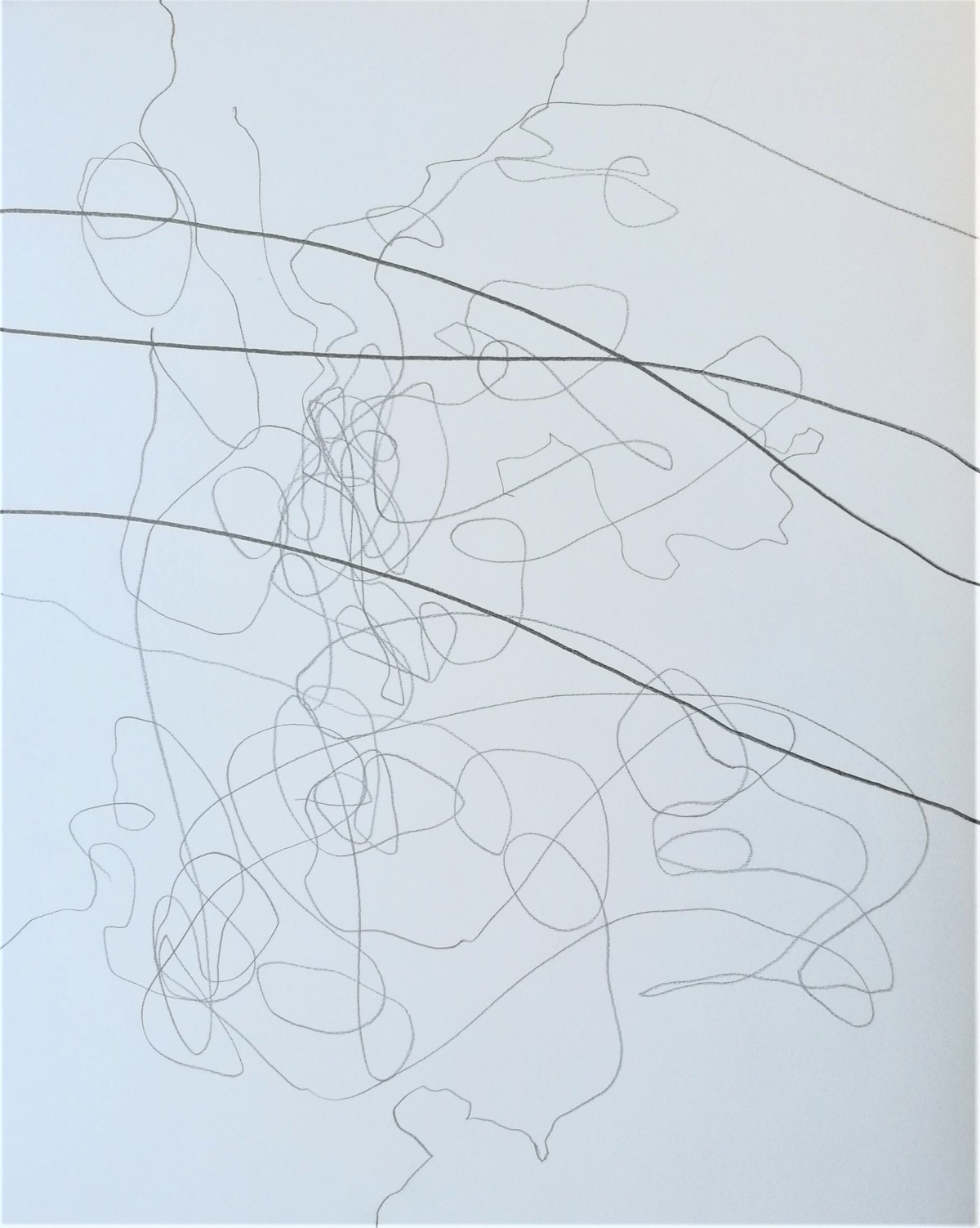
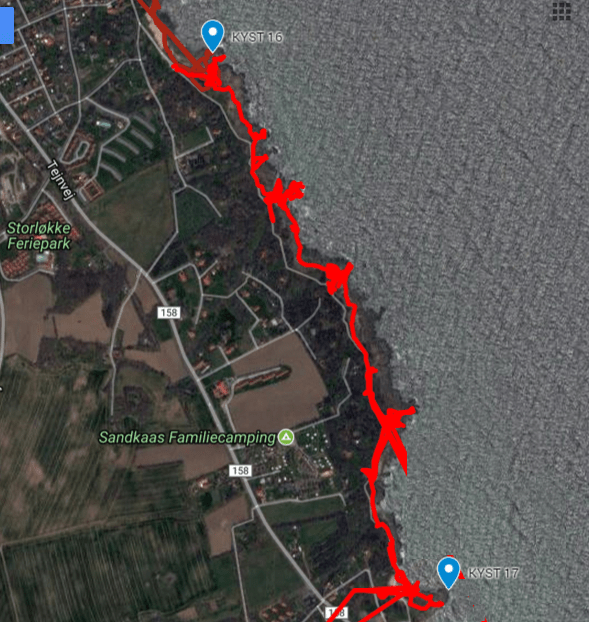
KYST 23 – from Hestestene to Tuleknald (Gudhjem), 11.06.18

For at læse denne KYST 23 blog på Dansk, se her…

See here for an introduction to the KYST project

KYST 23 Two days later than originally planned, I set up my gear at the day’s start point, Hestestene, ready for the sunrise. A layer of cloud over the sea to the east obscured sun as it crept over the horizon, but otherwise the sky was blue and the day was already warm.

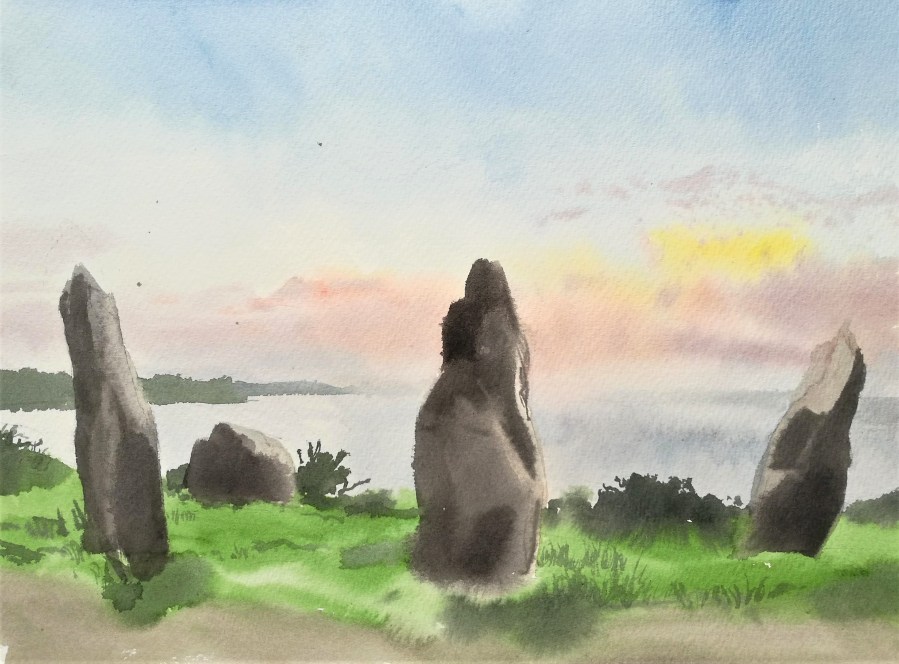
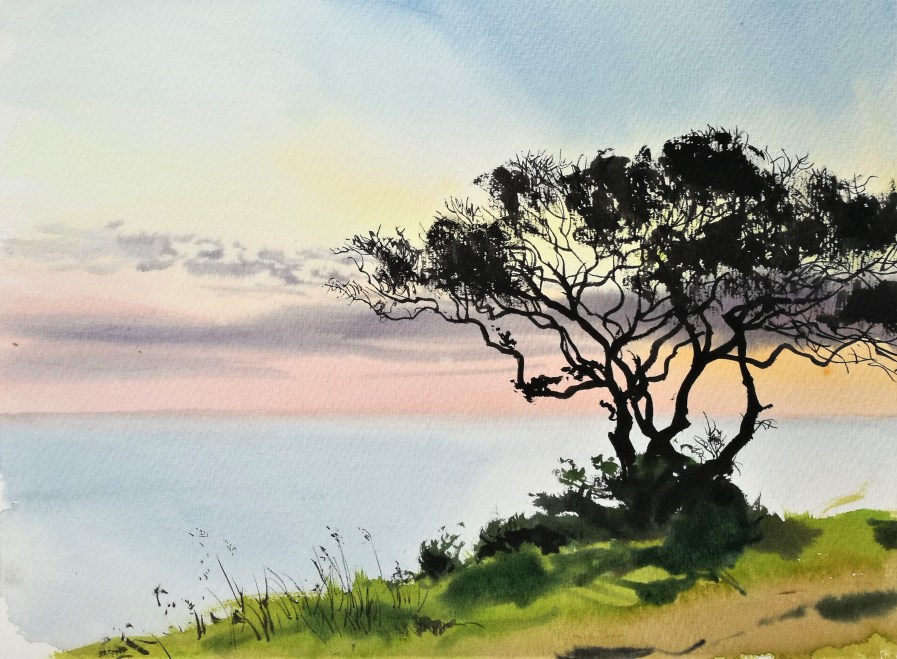
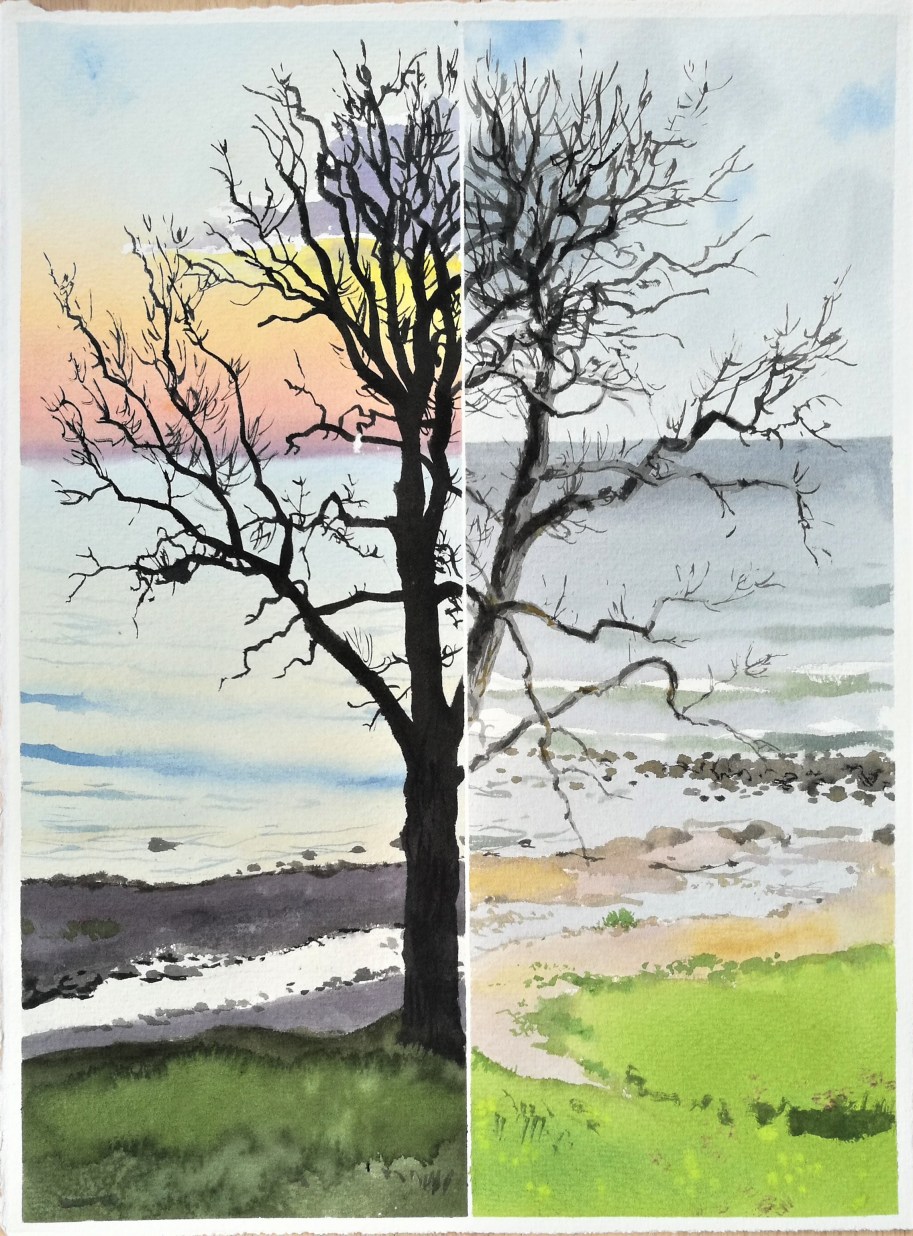
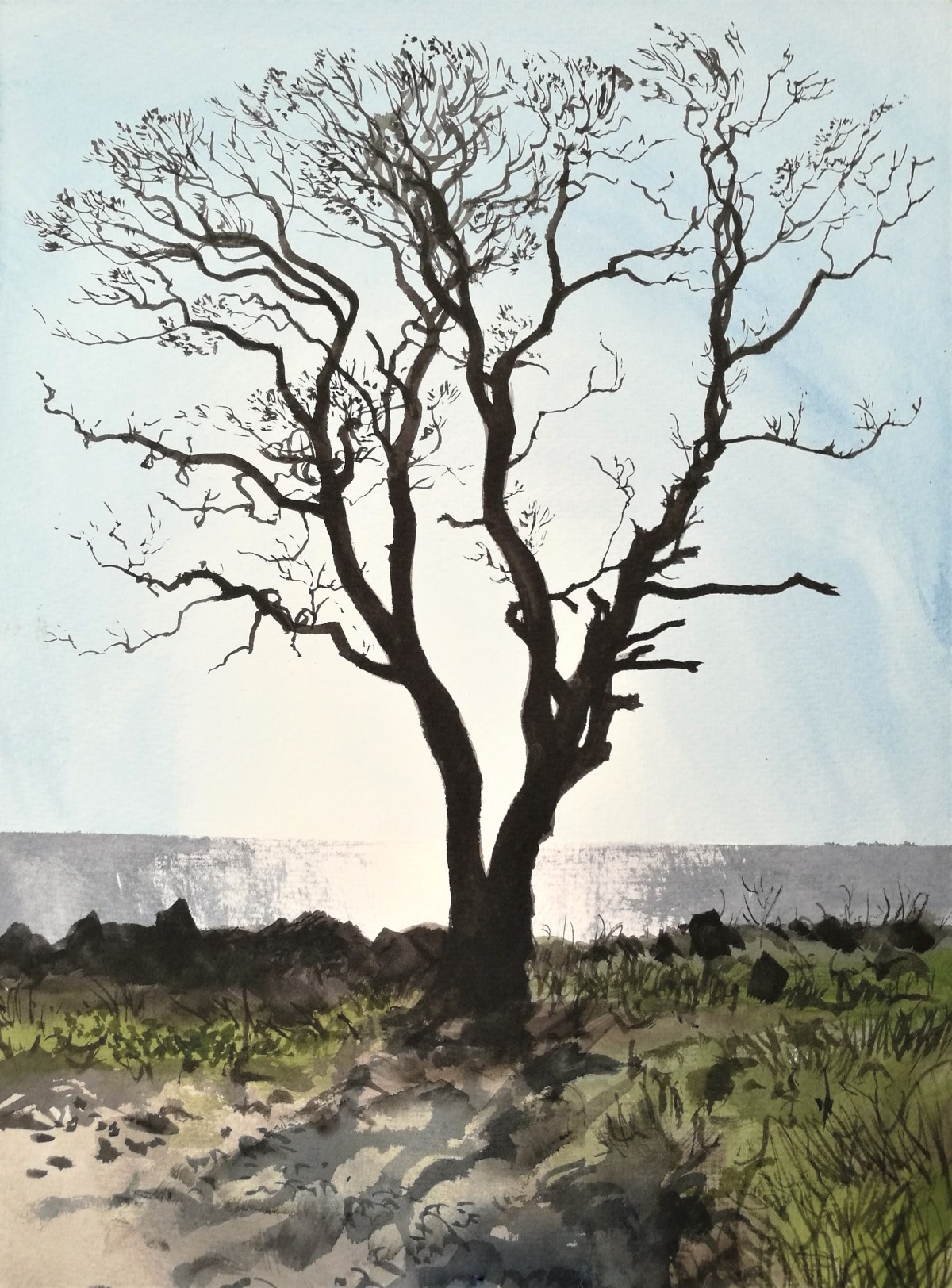
Suddenly – ’Pleased to meet you!’ – the four note song of the scarlet rosefinch, a real treat which immediately put me in a positive frame of mind. Over the next couple of hours as I explored the area, the rosefinch was my companion, flitting back and forth though never showing. Just down the path from the standing stones a twisted hawthorn framed the sunrise.

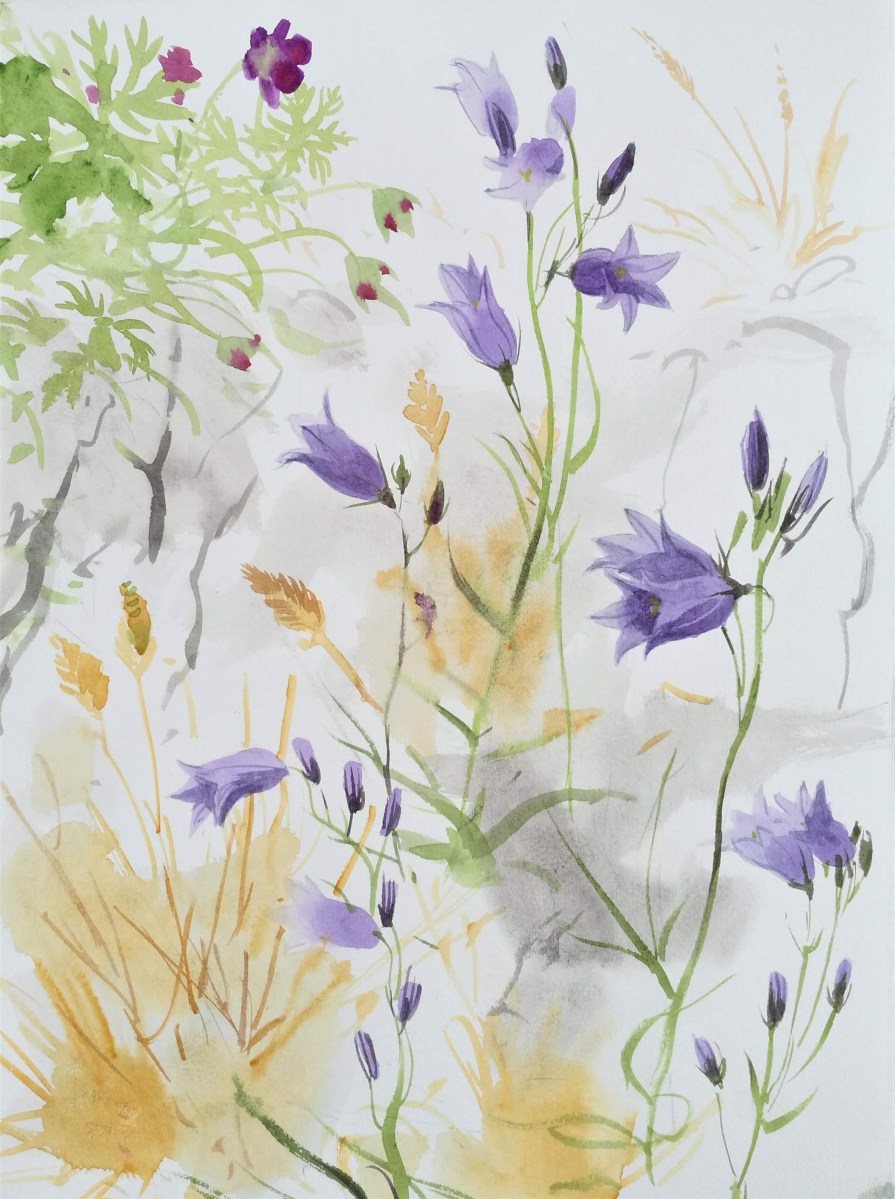
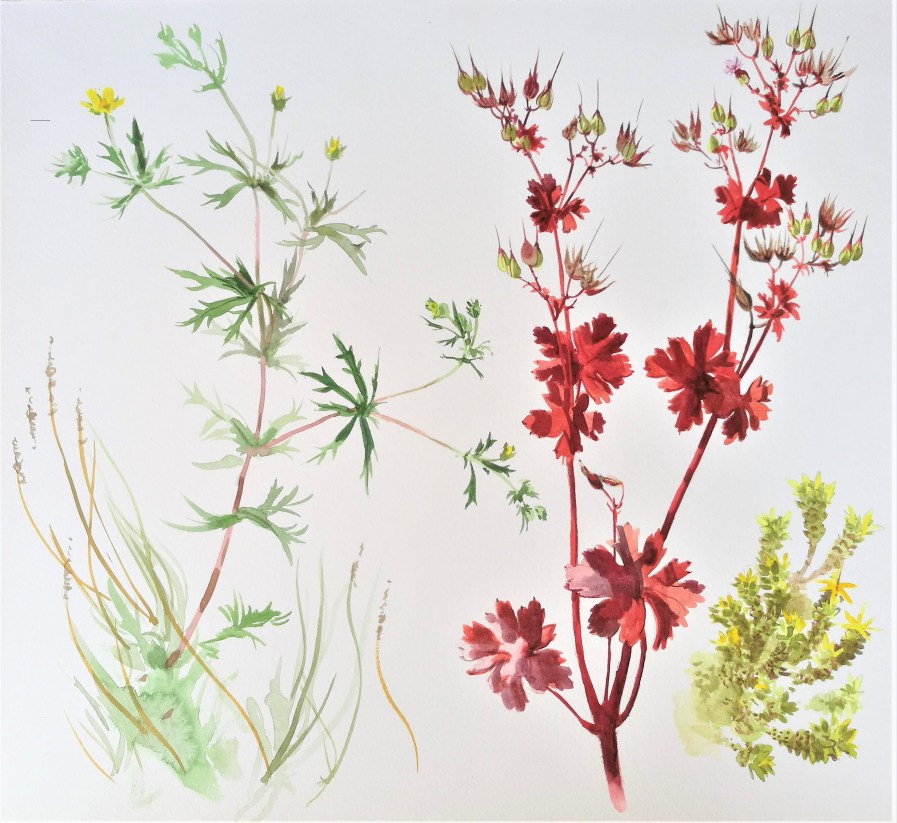
The week before I had observed a hawk moth (broad bordered bee hawk moth) feeding on some sticky catchfly flowers, and was hoping for a repeat performance – but the flora had changed markedly in the intervening days and some harebell and cranesbill were flowering in their stead, amongst patches of dead ochre grass resulting from Bornholm’s deepening drought.

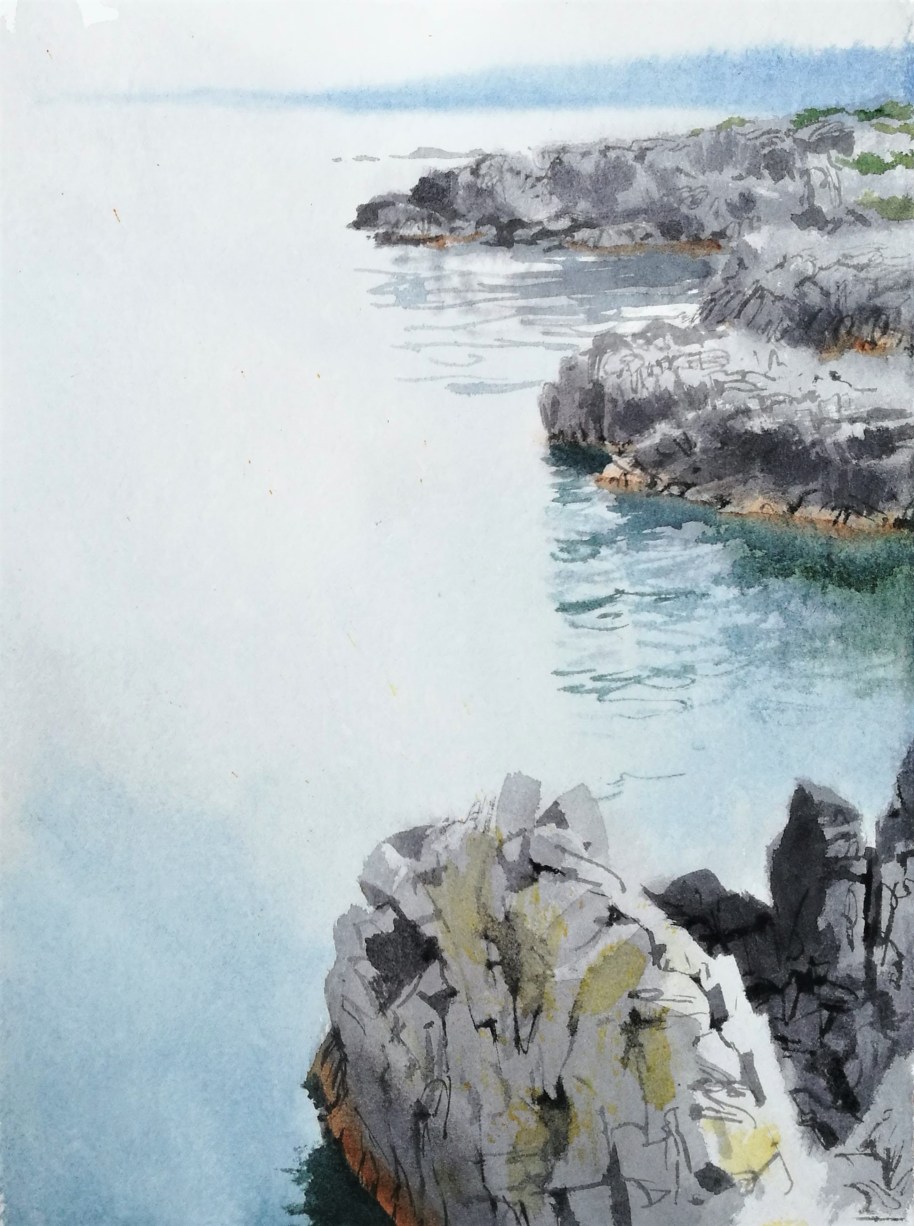
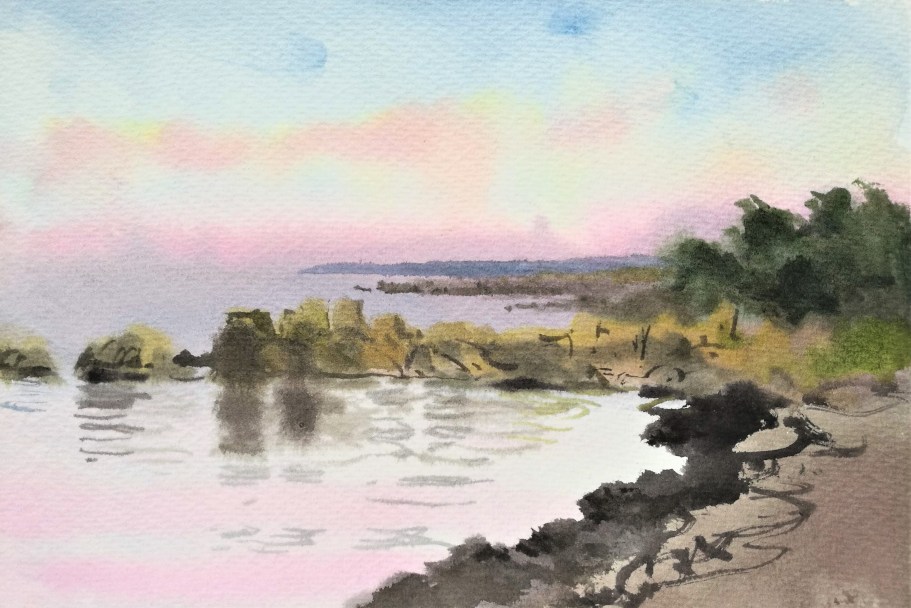
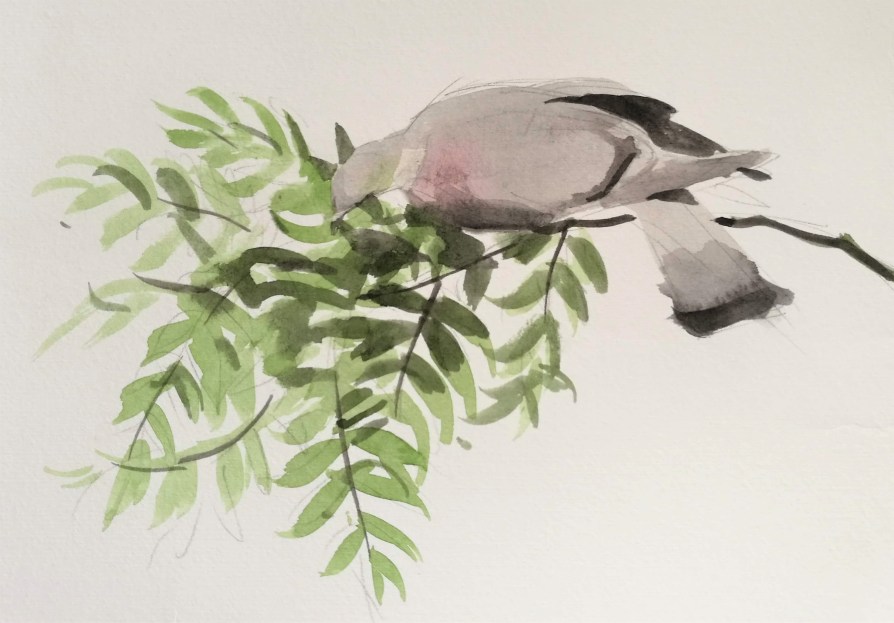
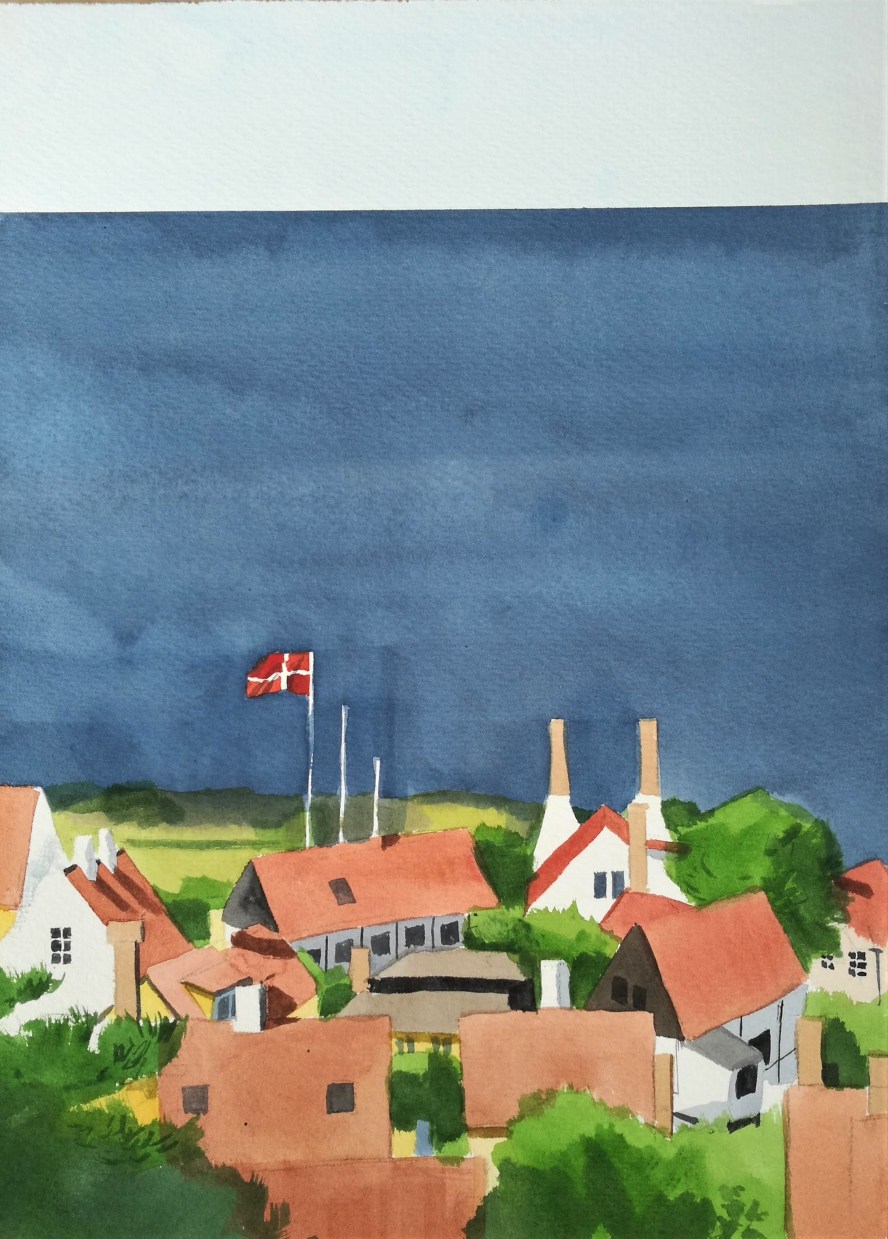
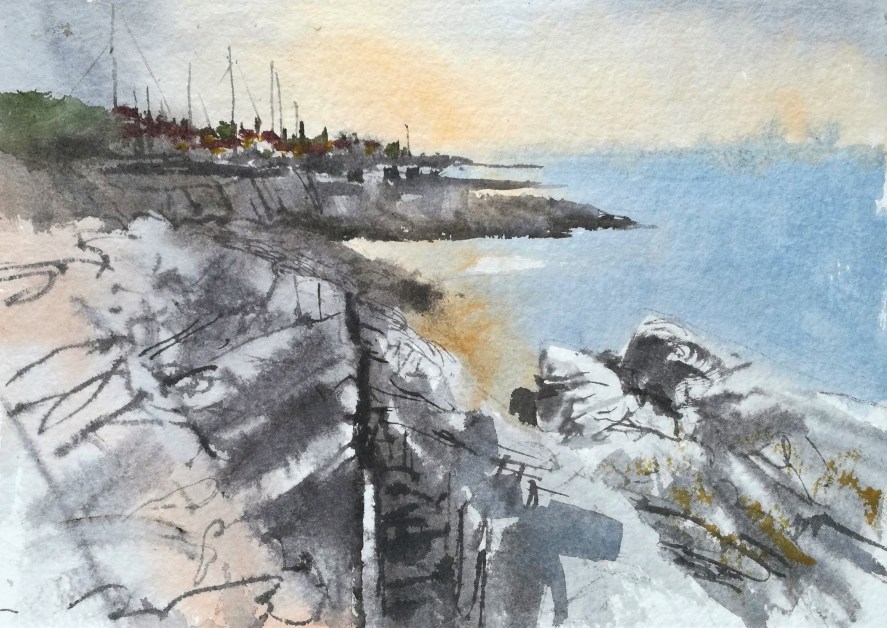
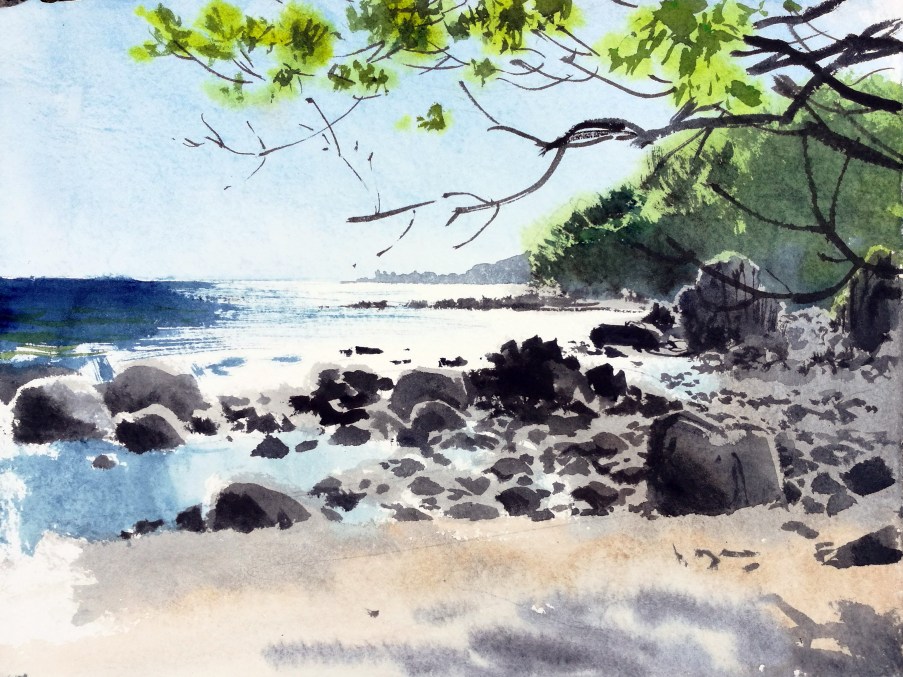
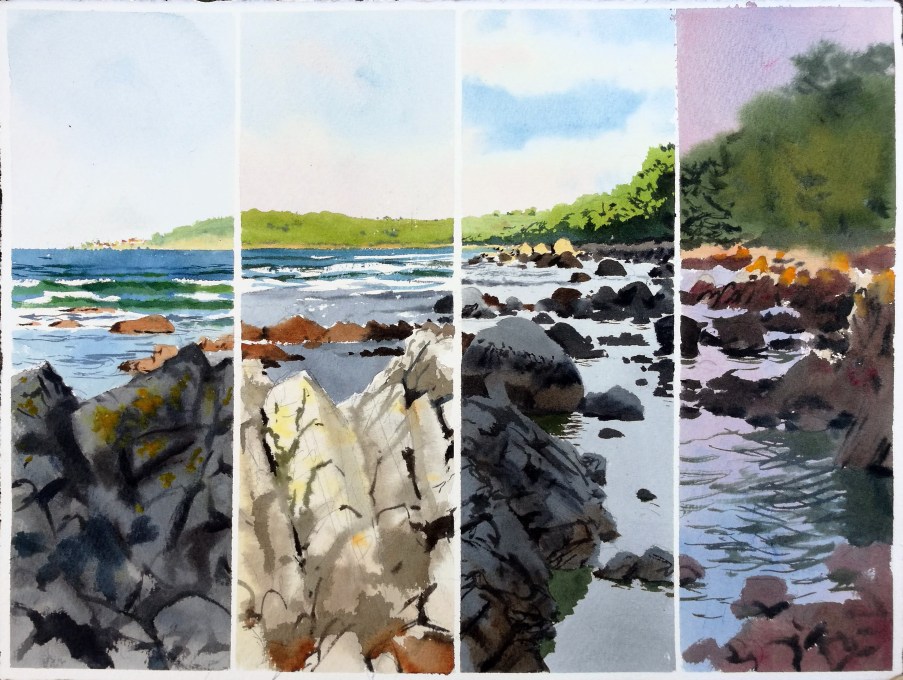
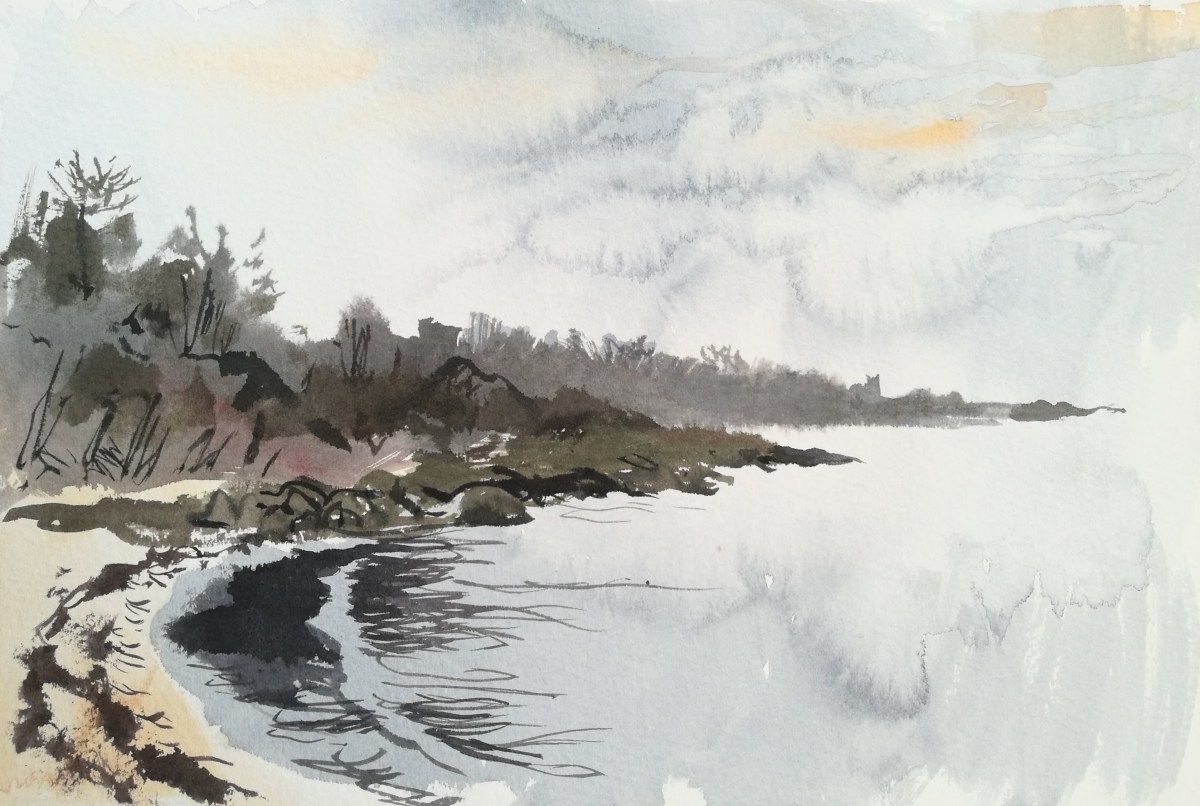
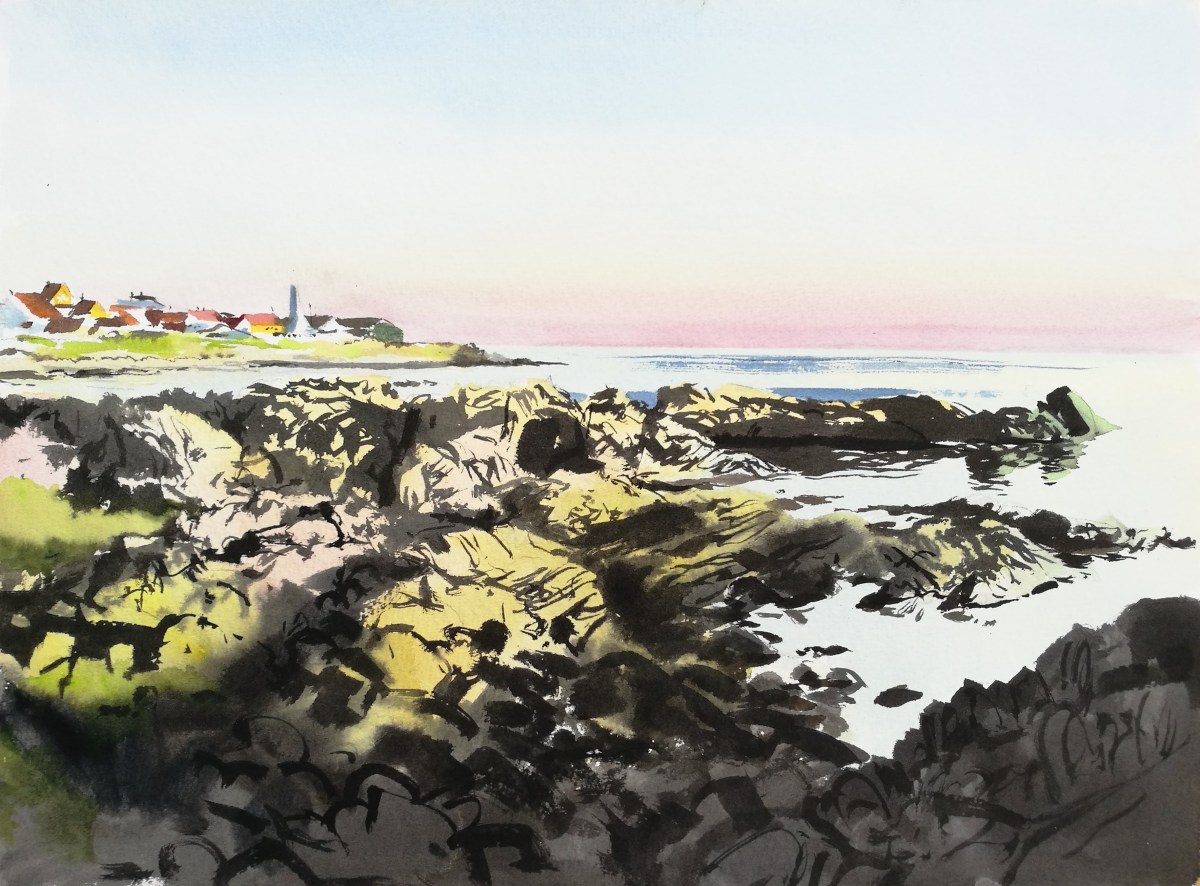
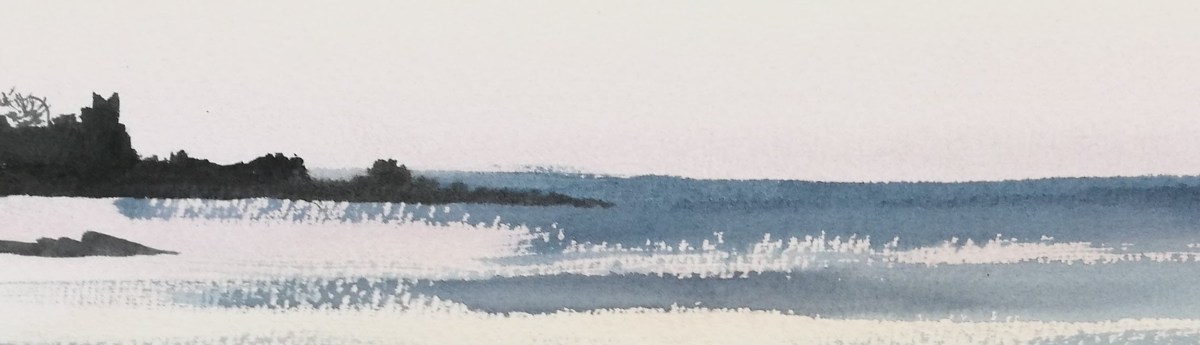
Eventually I walked on towards the historic town of Gudhjem, through a coastal path bordered by a thick and unkempt wood on one side and cliffs with bracken and wild flowers on the other. The elder bushes were now flowering, and once again I thought about how quickly the Bornholm flora evolved and transformed week by week. Walking around the cape, I could see the smokeries and red roofs of Nørresand in the distance (see top). A little further on, I came across the idyllic scene of some locals, gathered at the base of the rocks for their morning swim and enjoying a coffee together in the sunshine. I continued on to the beach at Nørresand, and set up my M60 on the raised platform where not long ago fisherman used to sort their nets. Here I ate, rested and slept. A wood pigeon settled in small ash tree just metres from me and started to delicately eat the tips of the youngest leaves.

All along the raised beach area, the yellow mist of Turkish Rocket mixed with the incredible blue-violet of Viper’s Bugloss.

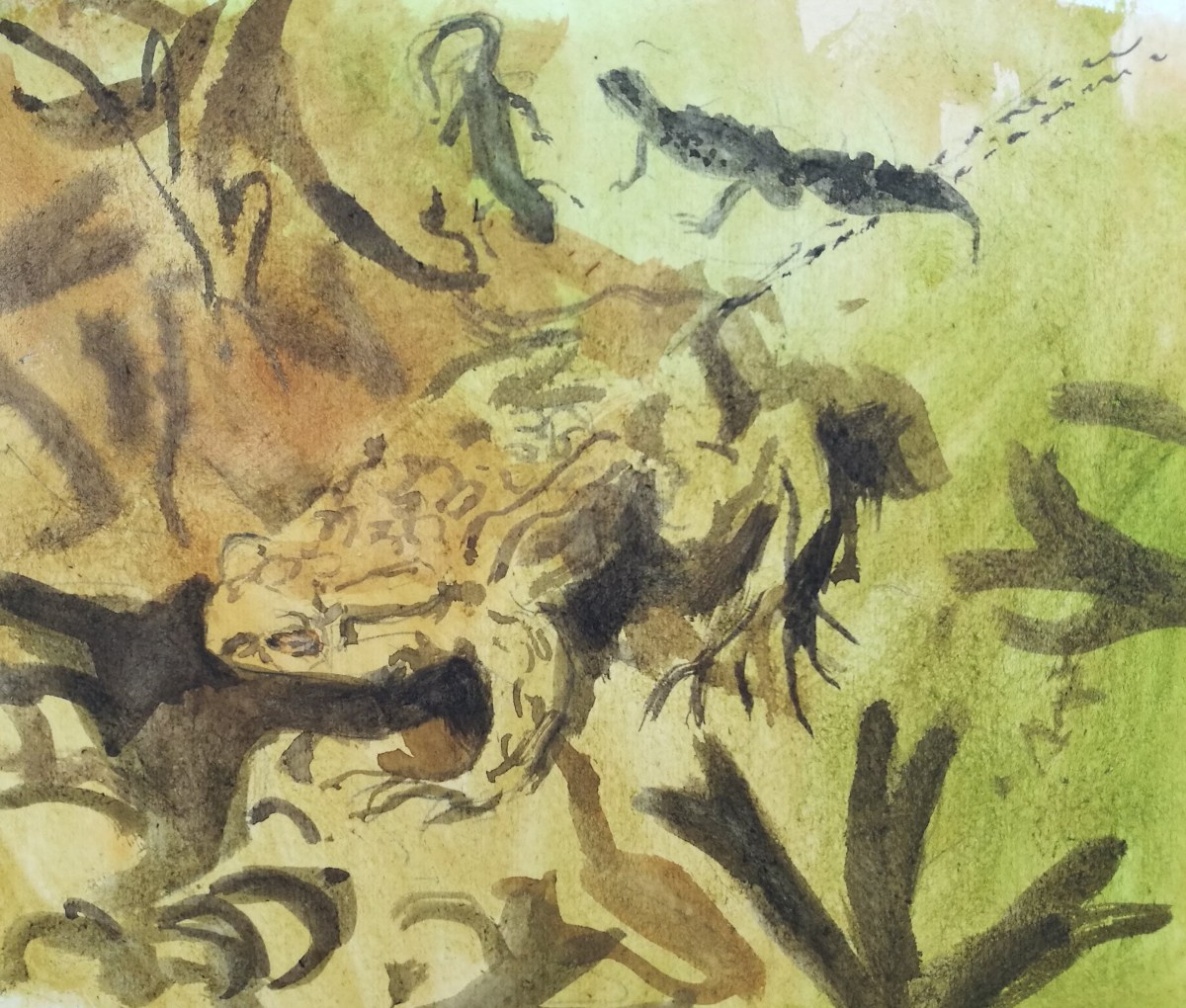
Down by the rocky shore I wandered around looking for tadpoles and newts. The fierce sun and lack of rain meant that many pools were in the process of drying out, while others were turning toxic and green with algae. In one, a soup of thousands of wriggling black tadpoles gathered at the edges of the pool, struggling and desperate for oxygen, while their deceased companions floated on the surface. It was a grim portent of an ecological Armageddon, and in sharp contrast to the idyllic and tranquil scene unfolding around me on the beach. A little further on, I found a mummified smooth newt that had obviously taken a wrong turn when leaving the pool and been literally fried and dried by the sun.

I walked up to ‘Bokul’ the ancient hill overlooking the town. Here many of Bornholm and Denmark’s most well-known artists have painted the red roofs of Gudhjem (‘God’s Home’) and the high blue horizon. The Danish flag fluttered proudly in the breeze.

Down on the coast at Nørresand again, I stopped for a wonderful lunch in the small café by the shore. People milled around and enjoyed the sun. After chatting for a while with a friend I walked around Nørresand harbour and its strange bent harbour-arm. A group of locals sat and sang together in the sun. There was an incredible peaceful and almost utopian atmosphere, and I quickly forgot about the suffocating tadpoles in their ever-shrinking hellish confinement.

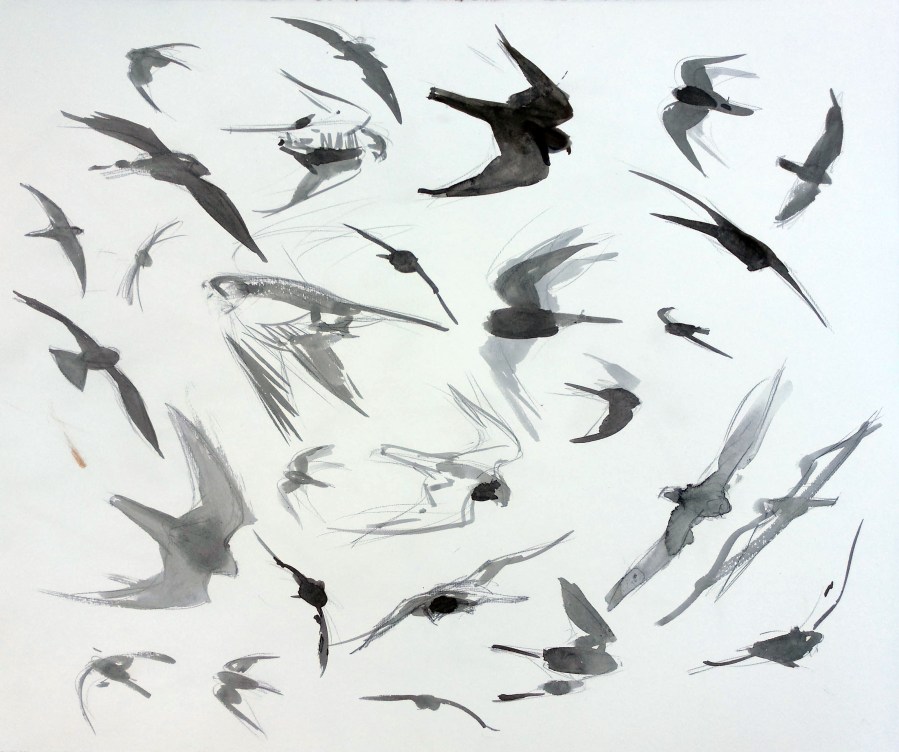
Eventually I carried on, past Nørresand and on to Gudhjem proper. Filled with tourists in the summer season, the town was still relatively quiet and relaxed. I sat in the harbour for hours, a little dazed and exhausted, and drank in the tranquil atmosphere. Swifts swooped overhead and the local ferry seemed to merge into the town itself.

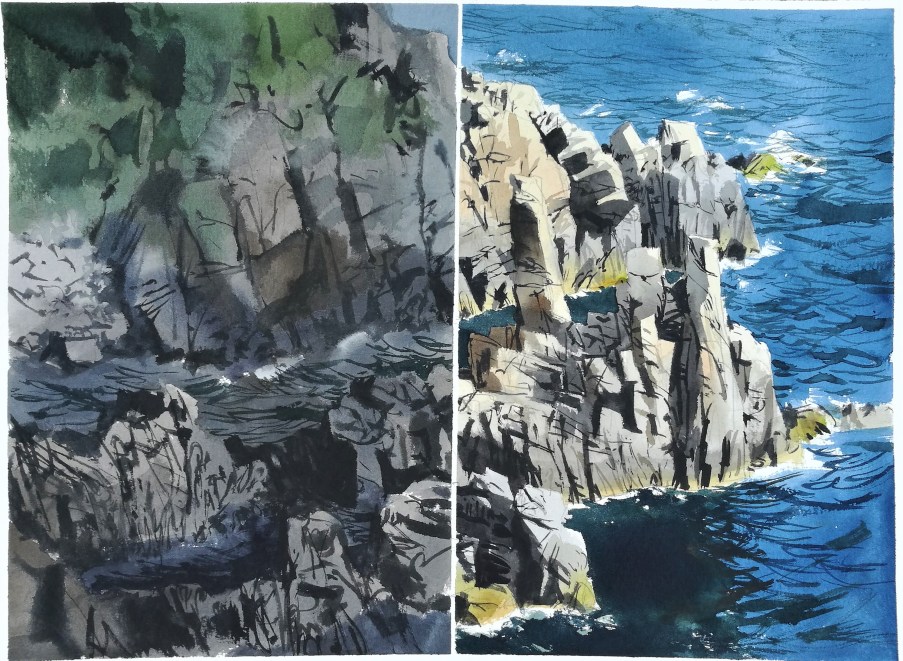
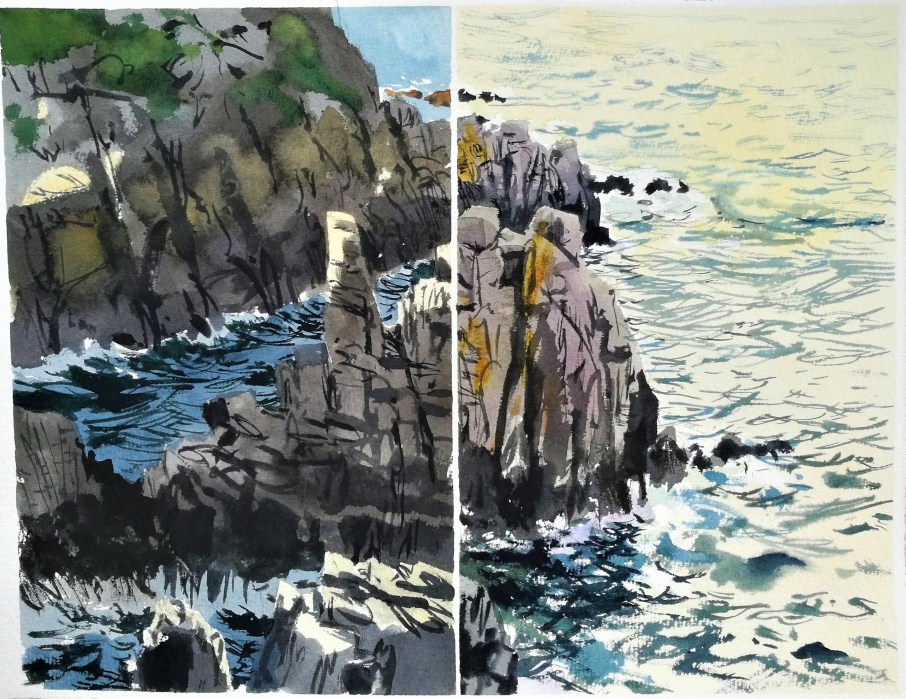
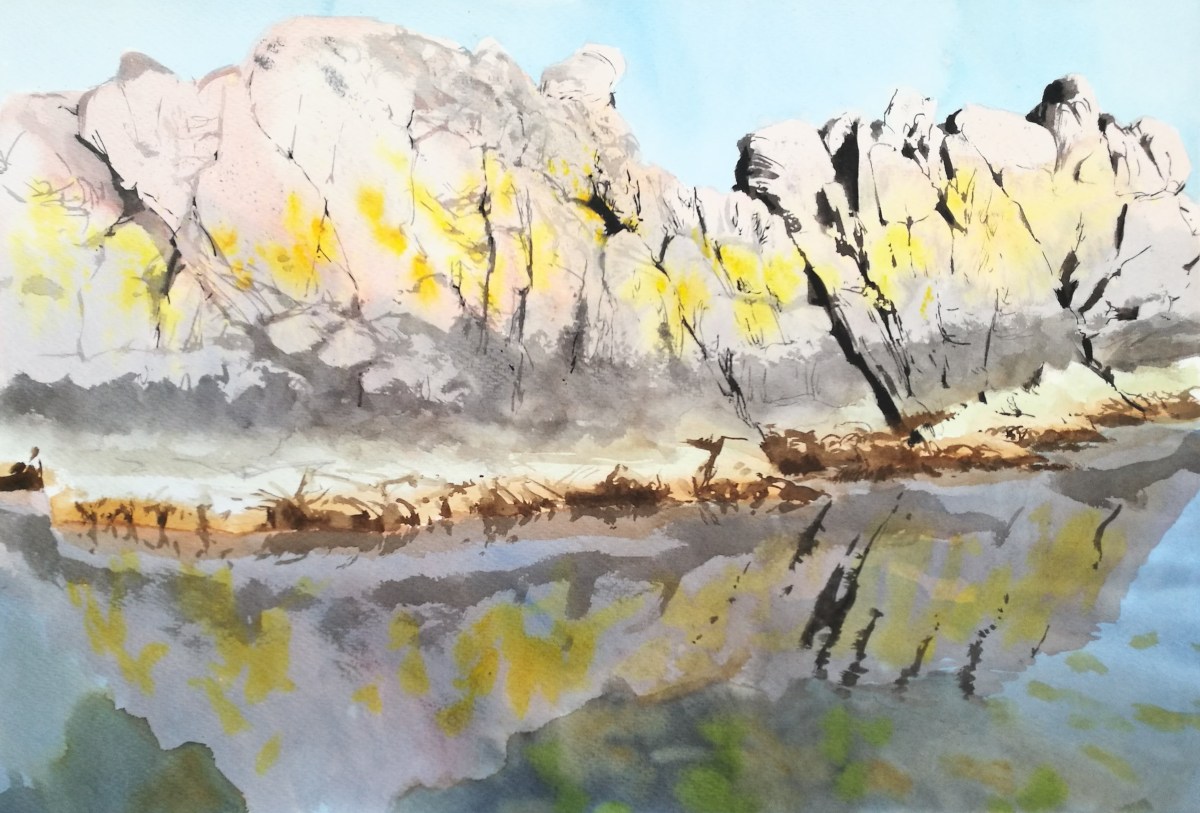
After another fantastic café stop (what luxury!) I ambled on, out of Gudhjem and into the rocky cape of Randkløve Odde, the gneiss bedrock cracked and riven with deep fissures and crevices.  Looking back towards the masts and chimneys of Gudhjem the sky was already turning orange.

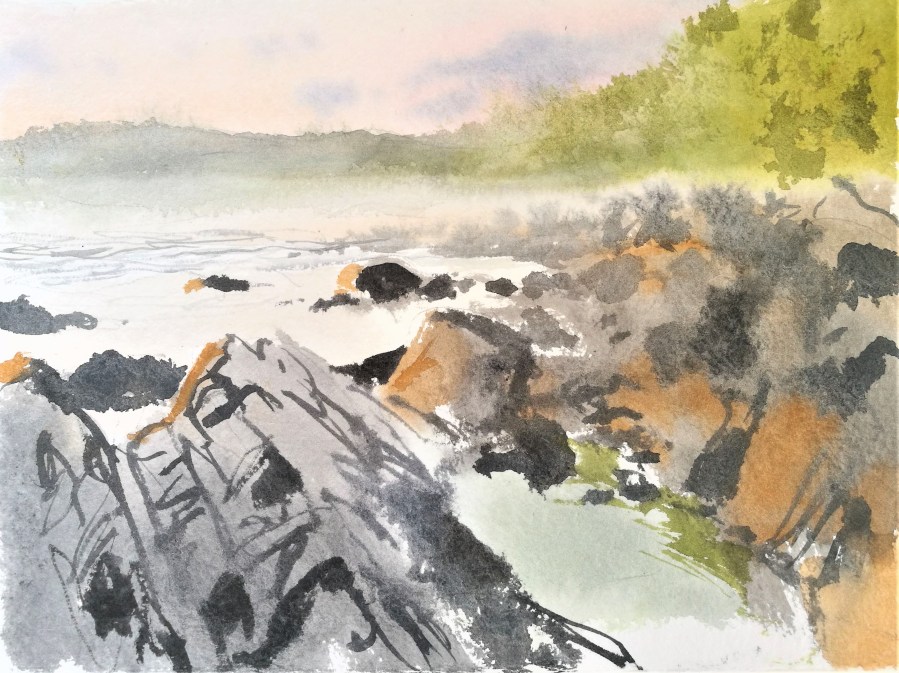
Incredibly, considering the length of the day, I was running out of time and I walked quickly through the harsh landscape towards my destination. Linnets and whitethroats flitted around, but still no nightingales. I perched on the edge of a cliff and looked south towards the distant town of Svaneke.  The combination of my fatigue and the quickly setting sun lent a welcome looseness and vitality to my brush strokes. It had been a truly fantastic day, and I walked back to the car buzzing with exhaustion to the screams of the courting swifts.

KYST 23

Weather report = Mostly sunny all day clouding over in the late afternoon. Temperature between 17 °C in the early morning and evening and 25 °C in the afternoon. Wind between 3 and 5 m/s from the east. Visibility: fantastic. Hours of sunshine: 13.5 hours. The hot and dry weather continues.

Lessons learned – learning about flowers the whole time, love it…

Stops with the M60 = 2

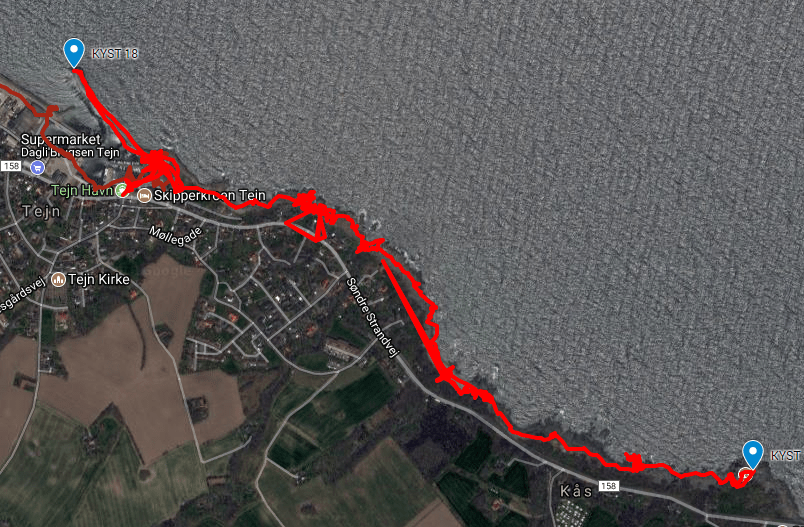
Kilometers walked = 12.32 km

Day lasted = 17 hours, 28 minutes

Birds seen and heard = 41 species (1 new one = scarlet rosefinch  = running total 95)

Other stuff = despite only sleeping three hours the night before, I had loads of energy through the whole day. The weather could not have been more comfortable (tho’ maybe not so good for watercolour painting).

People talked to = 15 (single and pairs)

In my head = … Exhibition opening at Gudhjem museum. The Patrick Melrose novels. Teenagers. UFC 225. Muse ’Starlight’


KYST 22 – from Stevelen to Hestestene, 01.06.18

For at læse denne KYST 22 blog på Dansk, se her…

See here for an introduction to the KYST project

KYST 22 I arrived in good time; underslept but looking forward to the day.  There was little wind, and the low mist that I had driven through on my way across the island had all but disappeared by the time I parked the car and walked down the path to the water’s edge. In utter solitude I witnessed the sun break through the horizon and sail into the cloudless sky.

Very soon I realized I had forgotten quite a lot of kit, most importantly my tape (for masking off ‘timeslice’ pictures) and my bedroll. I immediately descended into a bad mood, annoyed that my busyness and lack of sleep had impacted the KYST project. I wandered around and looked at the tinder-dry vegetation clinging to the side of the cliff. One strange plant, with one tiny flower remaining, had the most incredible red leaves.

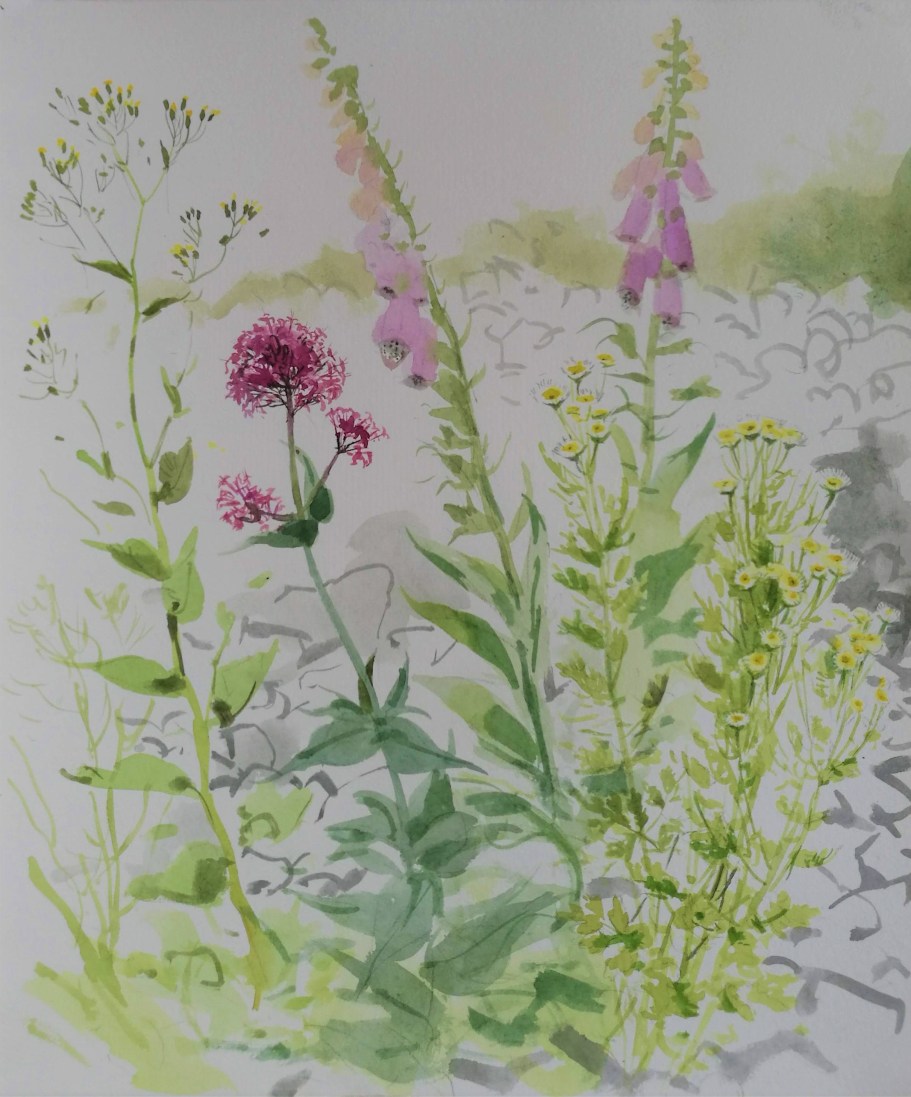
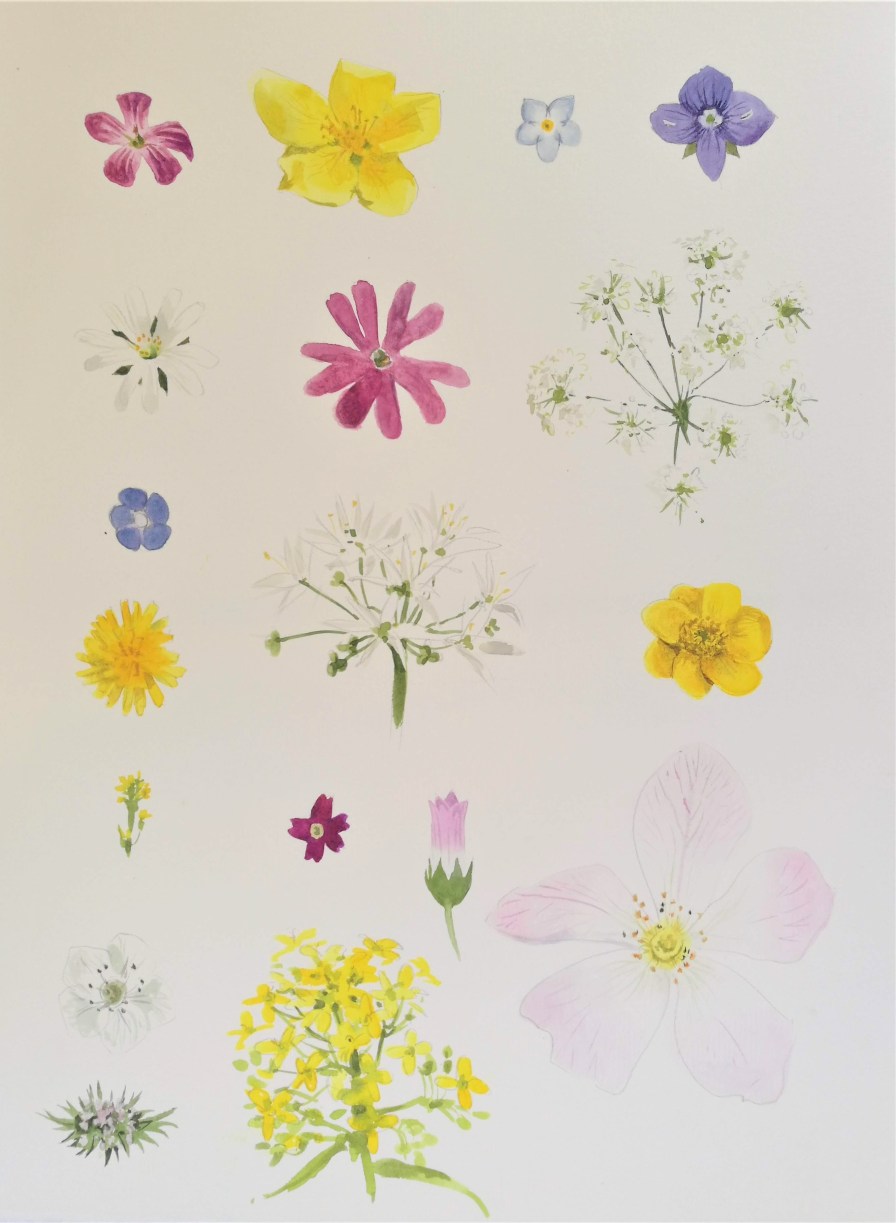
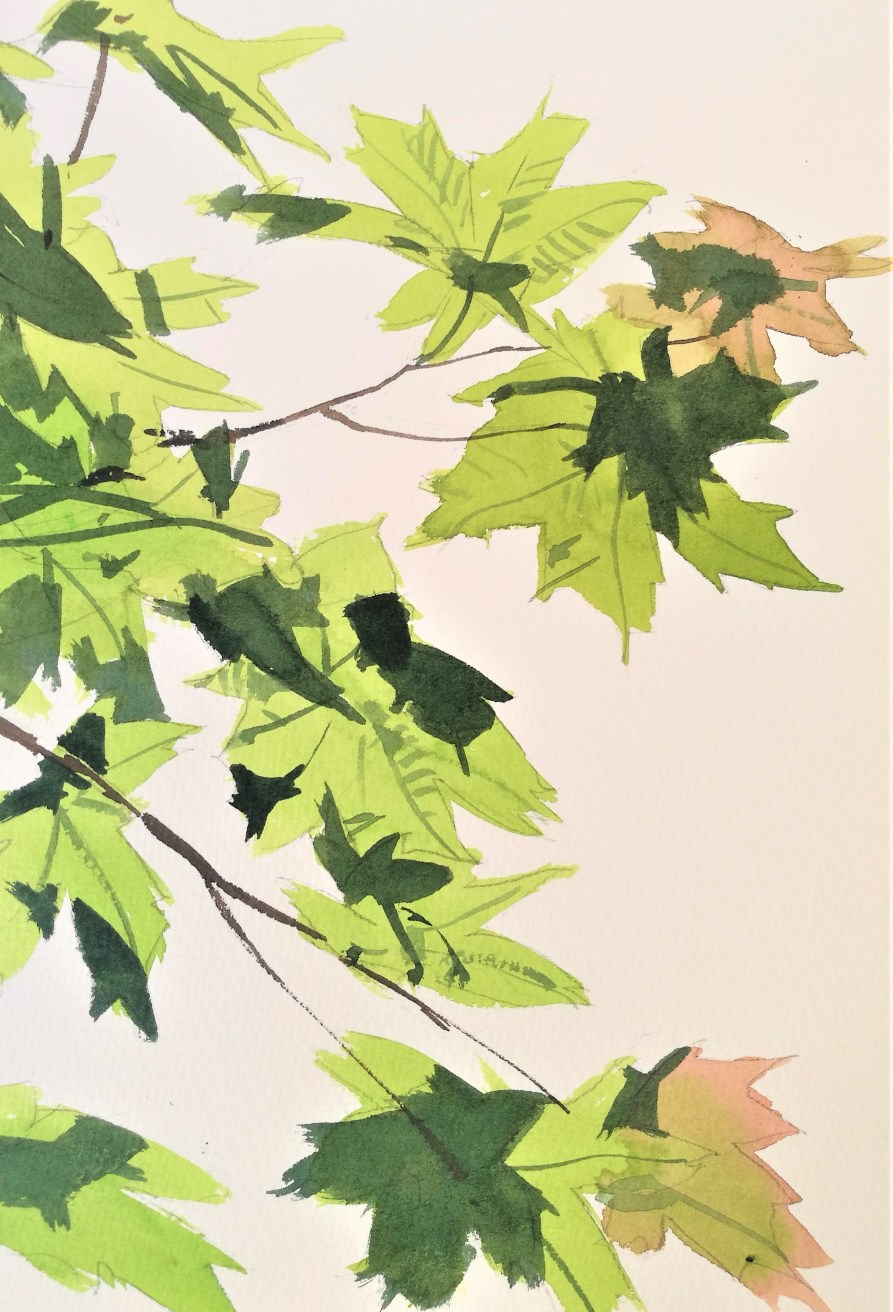
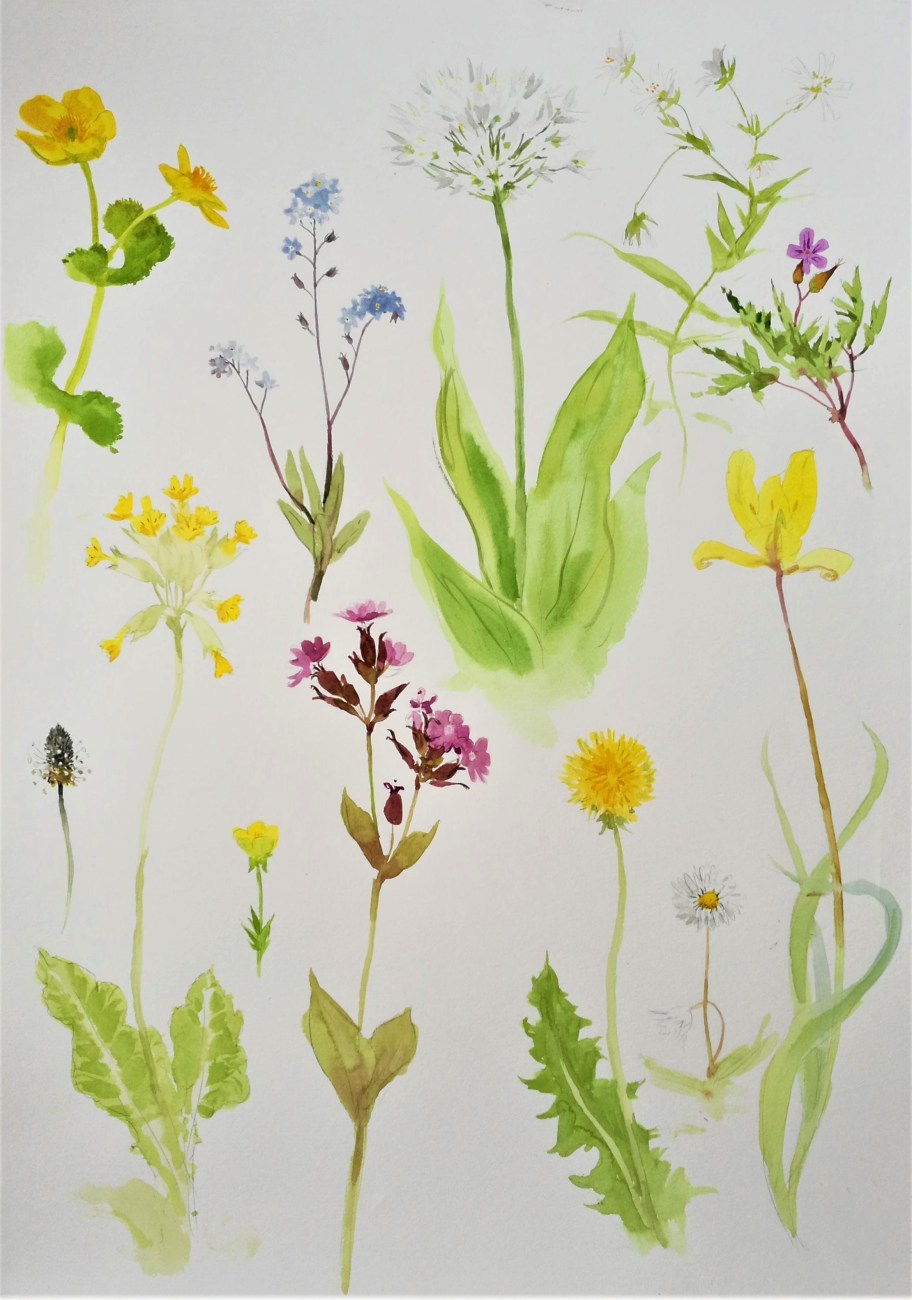
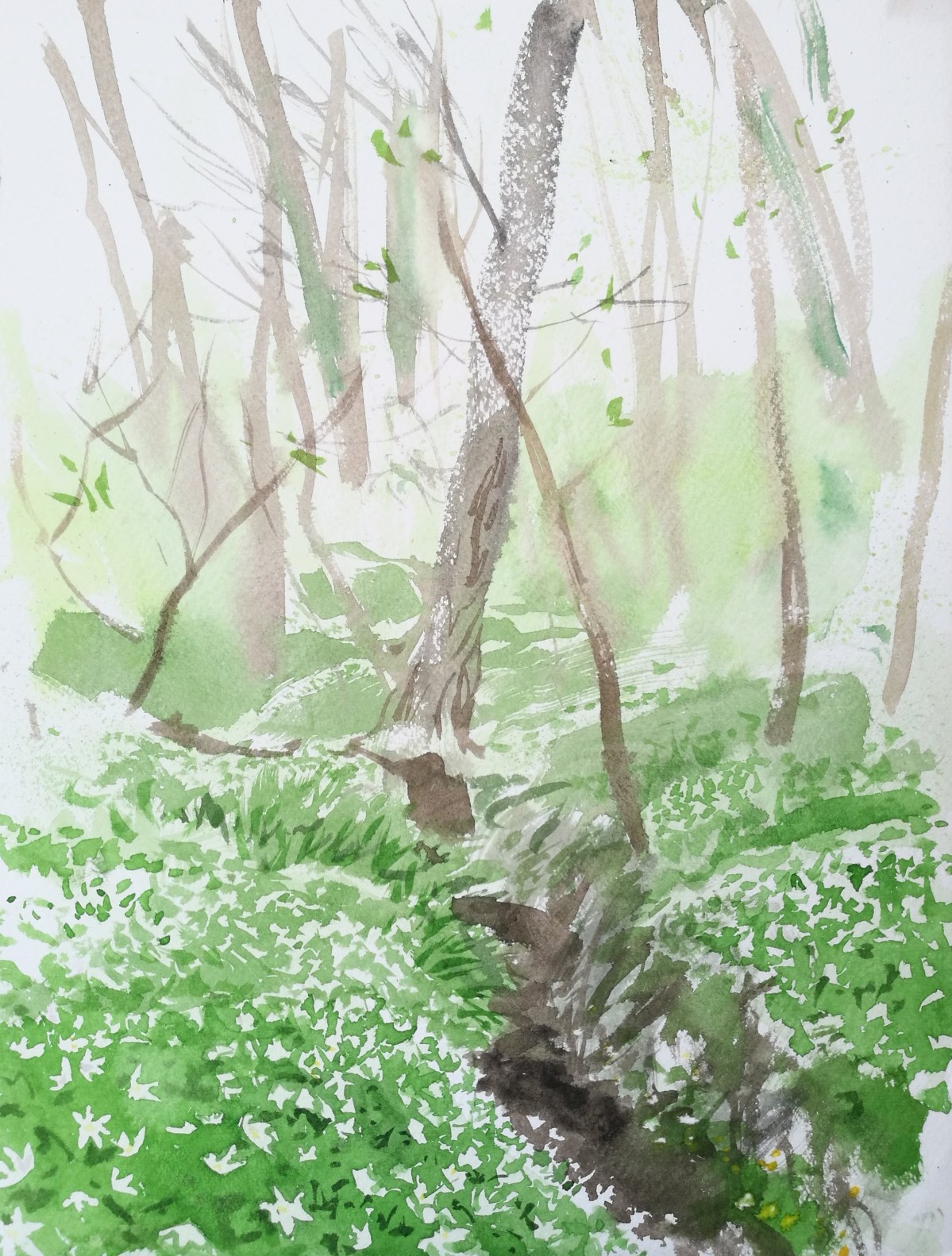
I wandered along the beach a little, and came to one of the many small streams that emptied into the bay. In the cool shade of the forest I listened out for singing birds and painted unsuccesfully the fresh foliage lit by the rising sun. I was tired and walked back up to the car for some much needed breakfast and strong coffee. Rejuvenated a little, I walked back along the path through the shaded forest clinging to the side of the cliffs for a while, before I came back out on to a small beach. I looked for wild flowers, marveling at how many different sorts there were. I decided to make a painting recording all the flowers of the day. Yet another mink slinked silently between the rocks.

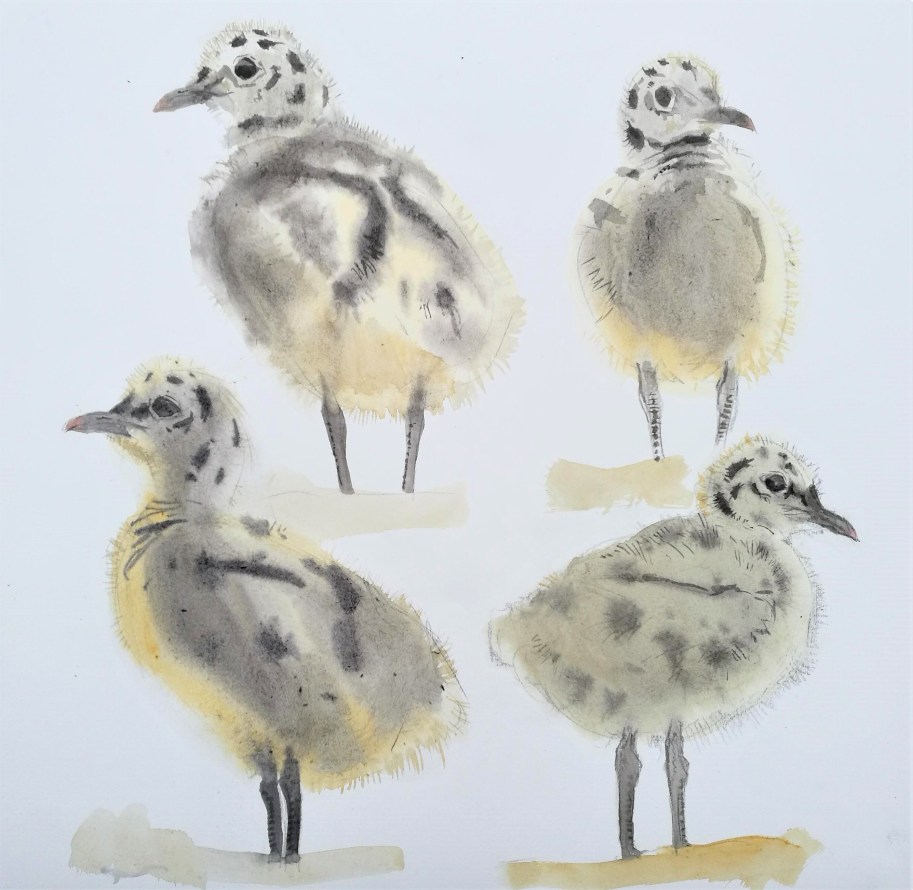
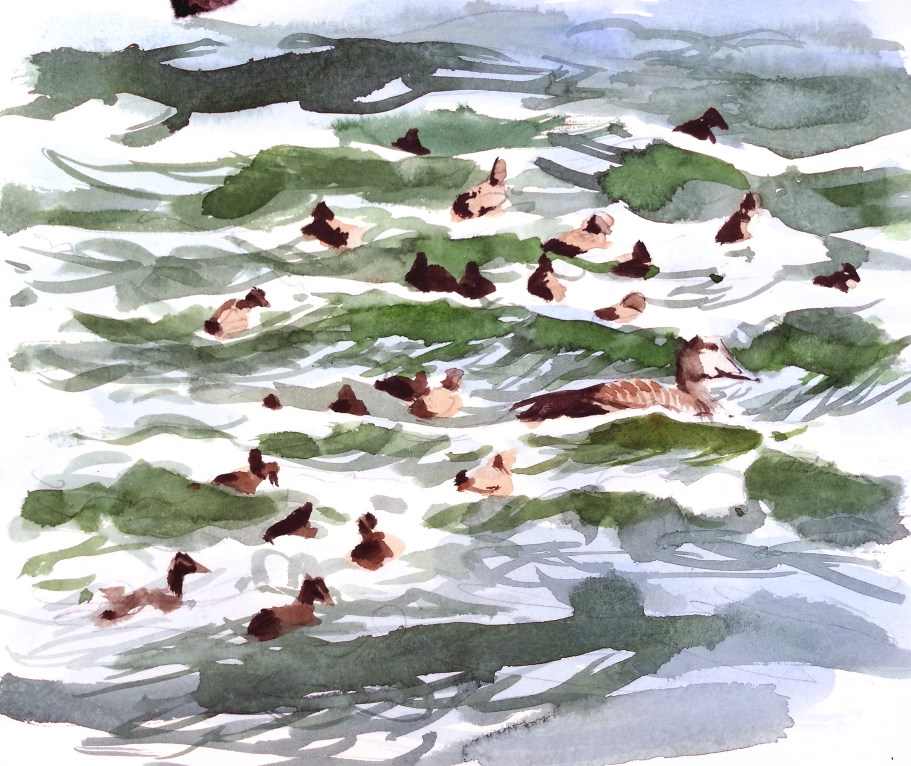
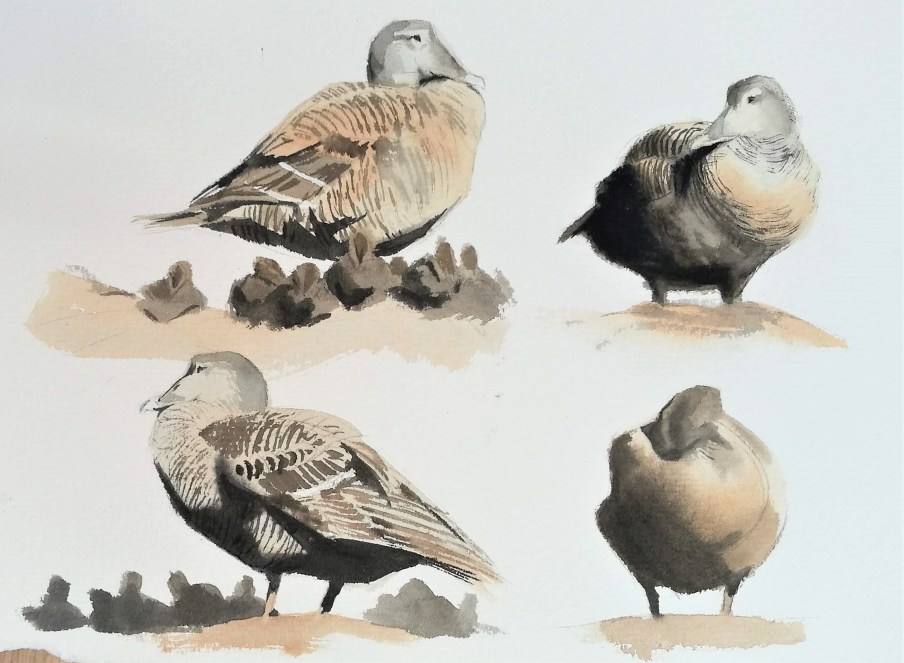
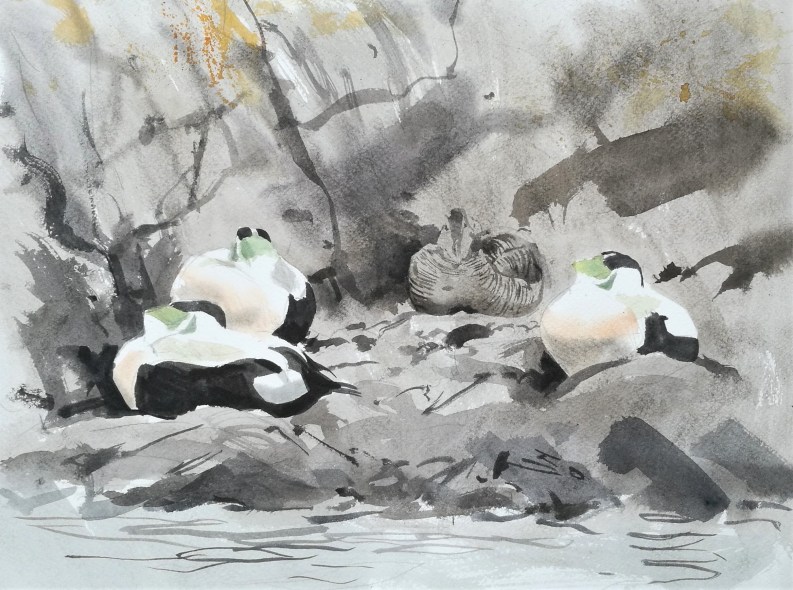
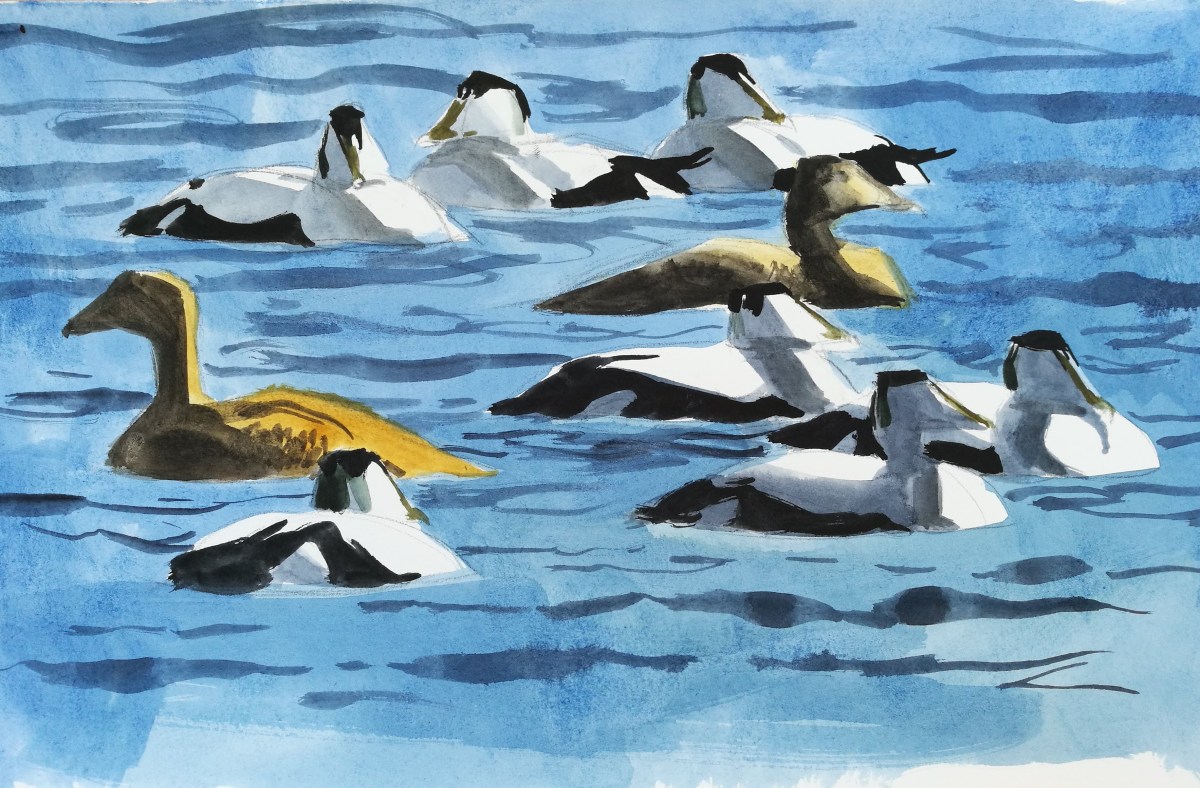
After an uncomfortable 20 minutes or so trying to sleep on the gravelly beach, I packed up again. Instead of walking on the rocky shore in the now considerable heat, I took the shaded path in the wood. Soon I came to the mouth of Bobbe Stream, roughly situated in the middle of the bay and half way between my start point and the day’s destination. Here I unpacked and settled, and tried to connect to the day and my physical environment. In front groups of eiders and their ducklings milled around, the males now long departed. On a cluster of rocks in front of me, one female rested surrounded by mountains of ducklings, who struggled to maintain balance and position on the slippery rocks (see top). This one duck was in charge of more than 70 ducklings.

A friend arrived suddenly with juice and cake, but it took me a while to shake myself loose from the intensity of my solitary headspace. I took a detour into the wooded slopes of the Bobbe river valley, nearly all the way up to the main road. The wood felt heavy and oppressive – there was little birdsong and most of the wild garlic had mostly died back. The heat and the buzz of insects contributed to the summery atmosphere.

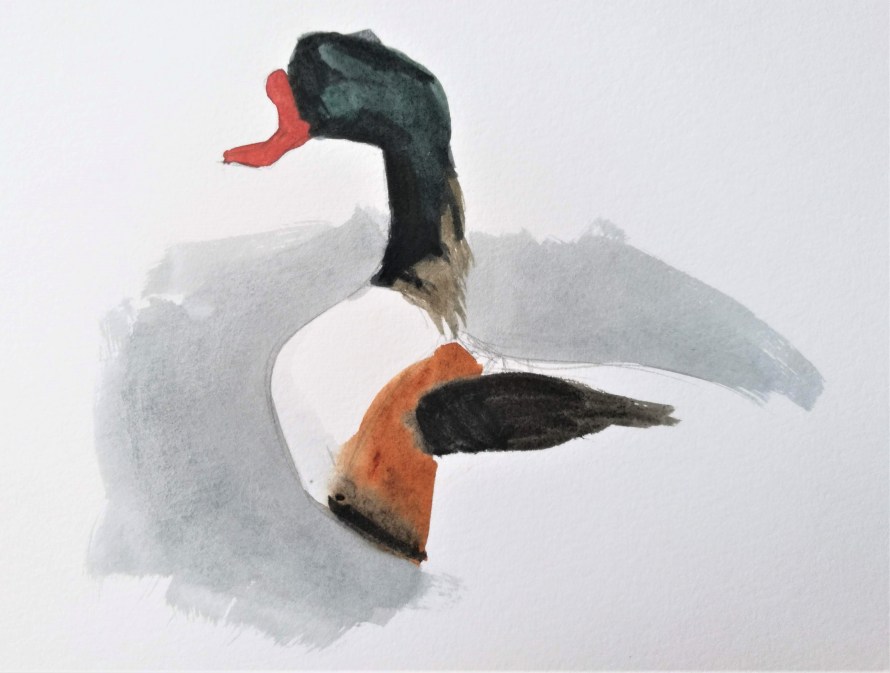
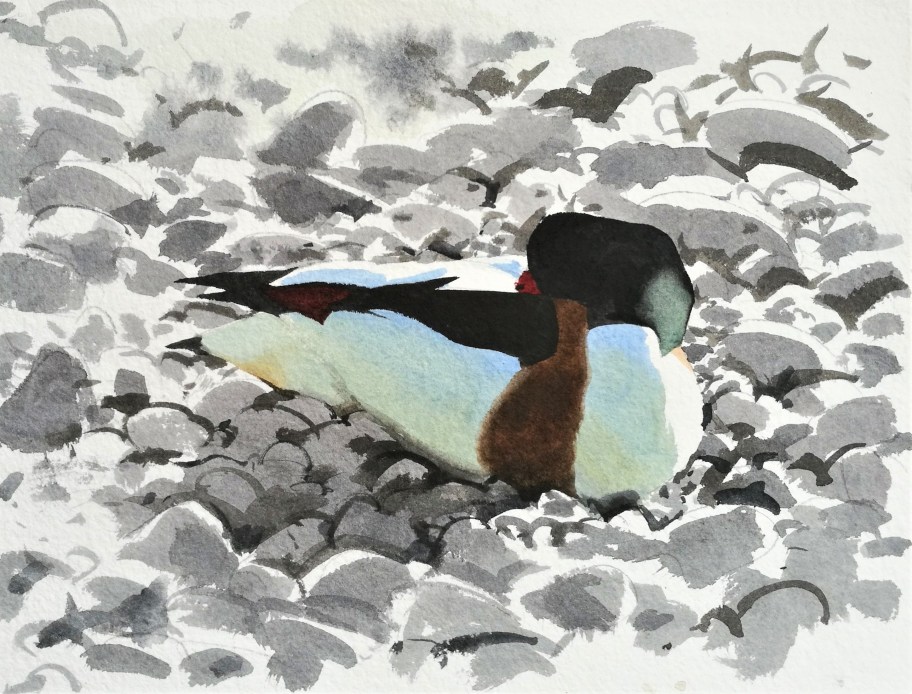
Back on the coast, the molting neck feathers on a male shelduck contributed to the sense of endless seasonal change and rotation.

My friend returned again unexpectedly, this time with tape and accompanied by one of the small children I had taught during a recent art project. She explained how, more than fifty years earlier, the beach was covered in sand and was one of Bornholm’s most popular bathing beaches.  As I watched them forage amongst the rocks and pebbles, looking for dead birds for the child to take home, I marveled at how things can change in such a short time.

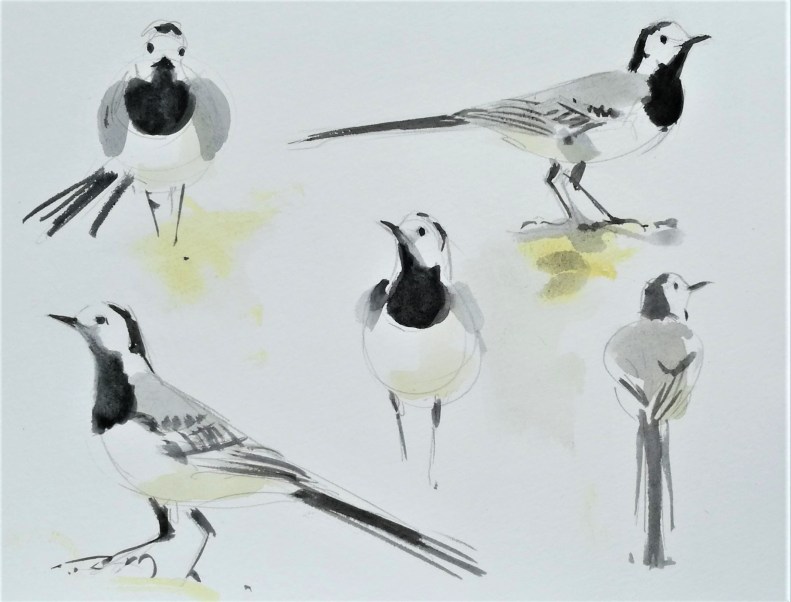
After they had left again I sat still and watched the birds return to the beach. A hooded crow strutted purposefully amongst the rocks, looking for morsels, sometimes disappearing between the boulders. A hawfinch, not what I was expecting to see, sat by the edge of the wood on the pebbles and seemed stunned by the view of the ocean. A gull paddled in the water and repeatedly picked off tiny specks (of what?) off the surface of the water. A white wagtail bathed vigorously in the fresh water of the stream. A young cormorant dried its wings in the sun, then twisted its neck and looked up, drawing my attention to a red kite being harried by a hooded crow, far overhead.

Eventually I packed up and walked on, trying to keep to the rocky shore instead of the path in the woods. Soon I came to Heksesten (the Witch’s Rock) one of Bornholm’s largest erratic boulders. The shore here was filled with small pools and ponds, wriggling with tadpoles.

I walked along the shore as far as I could, over rocks and bluffs and eventually to a strange isolated beach where iron-age graves have been found. I walked further along the rocks, until I was forced to climb into the forest cladding the cliffs. With all my gear and with no path through the thick and overgrown wood, it was hard going and I arrived at the cliff top coastal path exhausted and covered in sweat. I walked on further until I arrived at ‘Hestestene’ (the horse stones) a group of four ancient standing stones with a commanding view over the bay and onward on to the Hammer peninsula and the day’s destination.

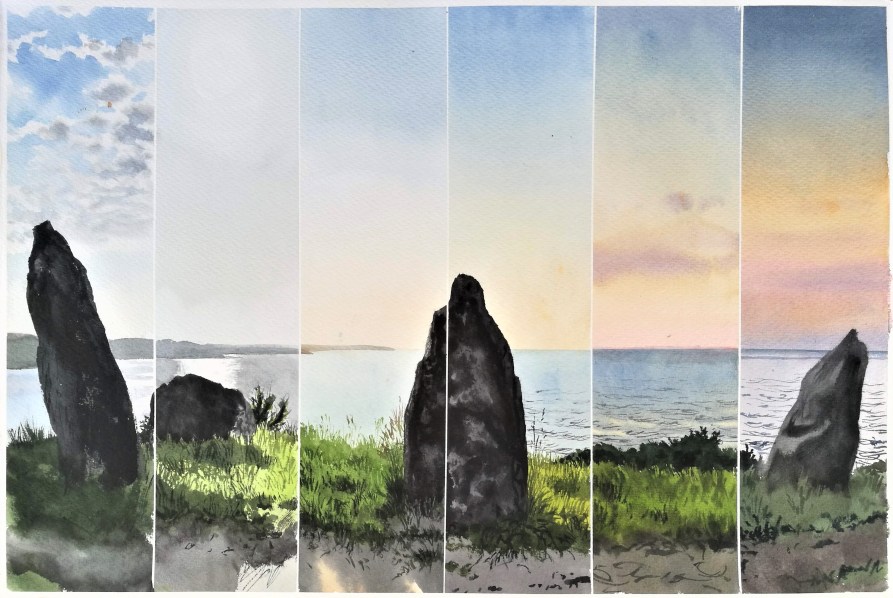
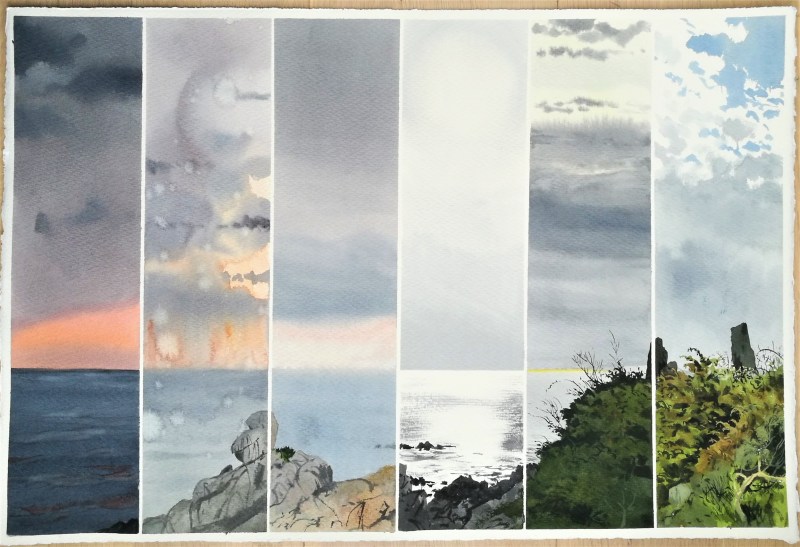
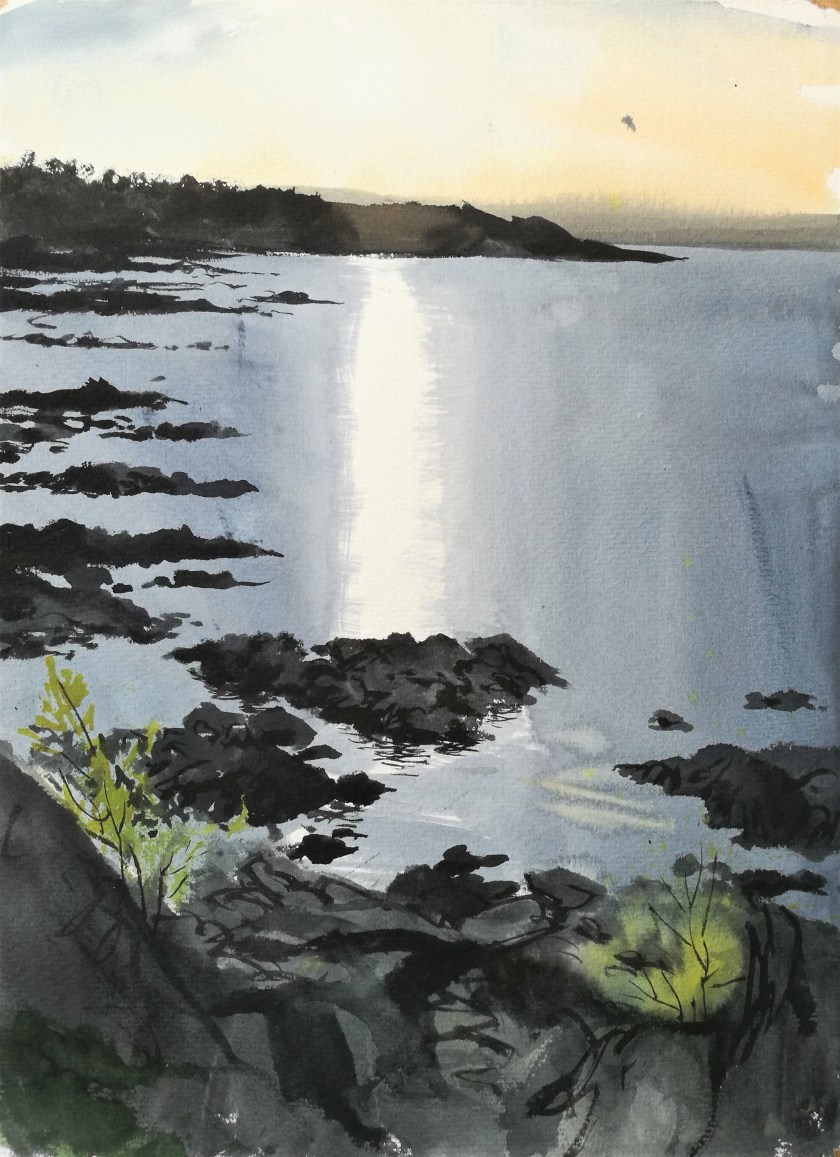
Here I recorded the sun as it swept over the stones and dropped into the sea, lingering and flattening for a while, before it was finally extinguished by the water like a glowing ember. I had been lucky enough to see both the sunrise and the sunset over the water, in one long and eventful day, and I was absolutely exhausted, hallucinating almost. I hauled my things back up to the main road where I hoped to be able to hitch a ride back to my car. There was no traffic and I ran all the way back, accompanied by a roding woodcock on its nocturnal territorial flight.

KYST 22

Weather report = Mostly sunny all day with a few cloudy periods in the afternoon. Temperature between 15 °C in the early morning and evening and 24 °C in the afternoon. Wind between 3 and 7 m/s from the northeast. Visibility: fantastic. Hours of sunshine: 16 hours. The hot and dry weather continues. Six weeks without rain now and 379 hours of sun in May.

Lessons learned – I can will a slow worm to existence. Walking along the path I thought to myself …‘well, I haven’t seen a slow worm yet for the whole KYST trip, I wonder if I’ll see one…’ Thirty seconds later, a slow worm appeared on the path…

Stops with the M60 = 2

Kilometers walked = 8.53 km

Day lasted = 17 hours, 24 minutes

Birds seen and heard = 39 species (2 new ones = red kite ands swift  = running total 95)

Other stuff = these long days are really taking their toll. I’m spending over thirty hours a week on the KYST project at the moment, as well as all the other exhibitions, teaching and so on, and I am beginning to feel the strain. Whilst pushing oneself often increases creativity and makes interesting things happen, there comes a point where it all turns to mud.

People talked to = 4 (2 + 2)

In my head = … I’ve never been happy with the whole concept of four seasons. Rather it seems to me as a series of waves – and endless cycle of expansion and contraction. Whilst in early June some flowers are still yet to bloom, some male ducks have already begun to molt, their work done, and soon waders will be returning back south, their spring and summer already finished. Two seasons makes more sense to me – one of exhalation (growing, breeding, flowering) and one of inhalation (seeding, rest, decay).

KYST 21 – from Helligdomsklipperne to Stevelen, 26.05.18

For at læse denne KYST 21 blog på Dansk, se her

See here for an introduction to the KYST project

KYST 21 For once I was actually in good time – unpacked and ready and armed with a strong coffee, waiting for the sun to break the horizon. Perched high on a rocky outcrop I had a fantastic view of the ocean and the surrounding cliffs and crags. I had heard that a pair of peregrines was nesting somewhere in the area, and I was hoping that I might be lucky enough to get a view of the birds, or even the nest if I could find it. As I gazed out over the sea, I saw the blood-orange light of the sun rise out of the sea, just to the left of the islands of Christiansø, 18km to the north east. At that very moment – at that very moment! – I heard the familiar yikkering call of the peregrine, as if welcoming the new day. Minutes later a huge female peregrine flew out from the cliffs below and sailed back and forth right in front of me, all the time energetically calling. It was a magical and unforgettable moment and I quickly got to work…

For at least ten minutes she powered back and forth, wing tips beating through the still air. A massive and muscular bird, she was silhouetted against the rising sun. I struggled to depict the unusual shape and the sense of weight and power of the bird. It seems almost sacrilegious to say it, but at times, peregrines – especially the much larger females – can seem musclebound, overweight even, and at times she reminded me of a huge and bulky wood pigeon. Every now and then, however, she would turn and stoop, instantly transforming into a jet-powered streamlined and menacing projectile.

When the show was over, and once I had calmed down, I continued working on a painting of the ‘Lyseklippen’ rocks, the same view that I had finished up with last week. There was a cooling onshore wind and the water was agitated, but otherwise the conditions were perfect and I looked forward to the unfolding of the day.

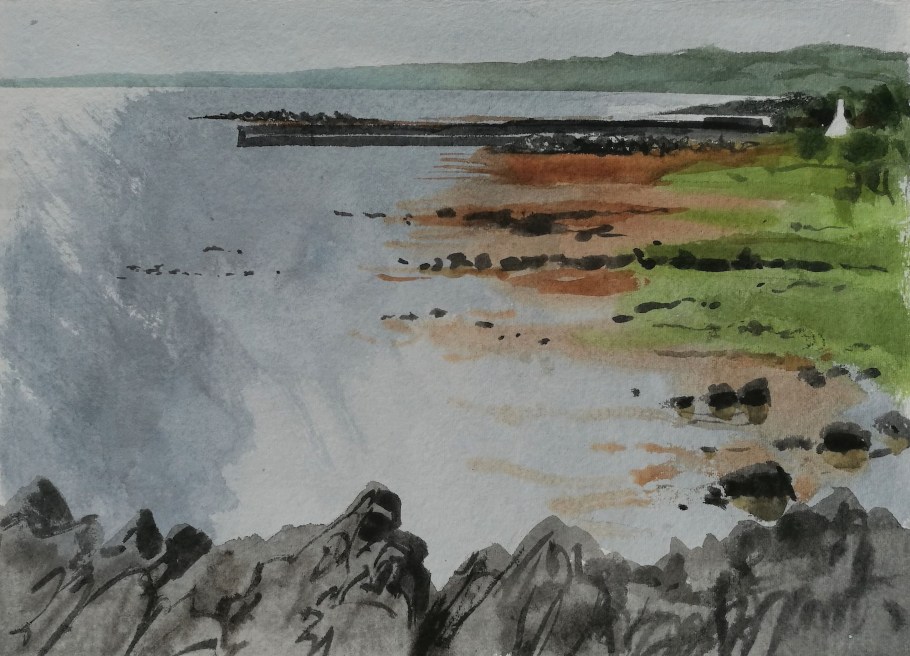
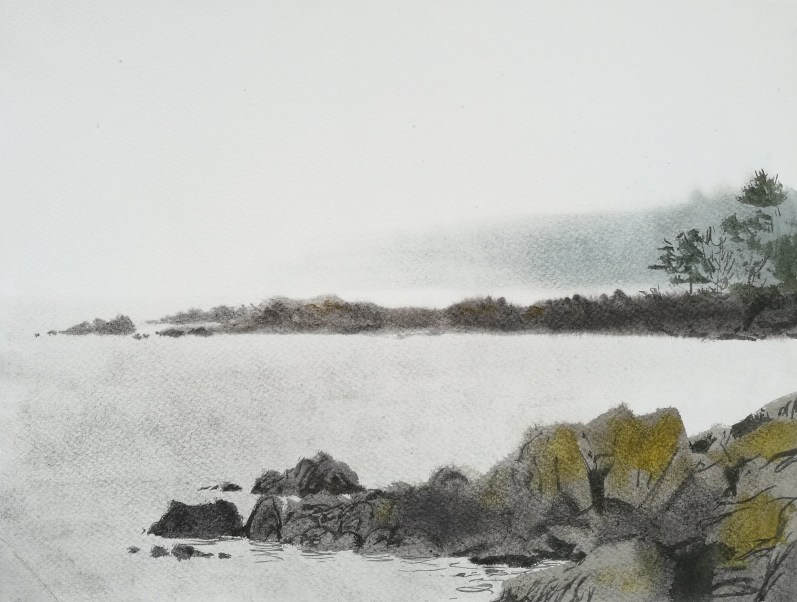
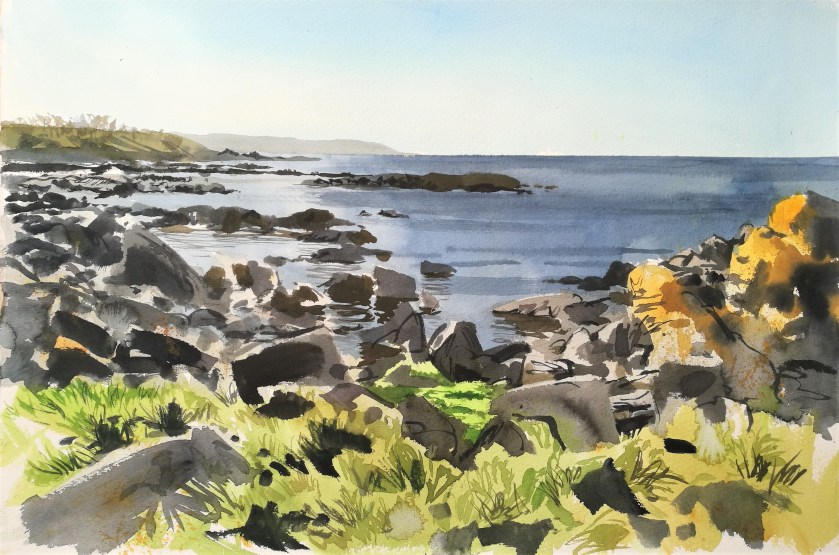
After a quick breakfast in an open-sided barn back at the car-park, where I enjoyed watching swallows building their nests at very close quarters, I continued along the cliff-top path towards my destination. After a short while the path came down and skirted the shore and I walked out on to a stony and secluded beach. Looking south I could see the town of Gudhjem in the distance (see top). I tried to find the peregrine nest, but it was well hidden. Eider ducks with their young were strung out along the shore. Female eider ducks often join forces and raise their young in a communal crèche and I saw one rather harassed looking female in the surf surrounded by no less than 36 fluffy ducklings.

One group of females resting on the shore seemed to be enjoying the better side of the bargain.

I walked on. Unable to continue along the shore because of rocky outcrops, I continued back up along the coastal clifftop path. In the shade of the trees hugging the cliff top there was a constant gurgle and bubble of garden warblers and blackcaps, but little else. There were many lime and sycamore trees, along with the usual ash, wild cherry and rowan. To my right there was farmland, and the clifftop walk felt divorced from the coast down below. I was glad when the path descended again, down to another stony beach. Here I wandered around and had some lunch, and tried to take a small nap. On waking I made some studies of some of the wild flowers (dragon’s teeth and birds-foot trefoil, apparently)  growing amongst the rock pools and grass tussocks flanking the rocky shore.

Another group of three eider ducks were almost invisible on the jagged rocks.

Leaving the beach, but unable to progress further along the shore, I walked back on to the path and round the rocky promonotory called Stevelen, passing through the charming little café where I enjoyed a fantastic coffee with wonderful views of the ocean. It felt luxurious and perhaps a little decadent, and I wandered onwards past Stevelen and down to the shore where the huge sweep of the Salene Bay opened up before me, with the red roofs of Gudhjem clearly visible in the early evening light. I made a timed slice painting, recording the changing light and colours, as the sun set behind me.

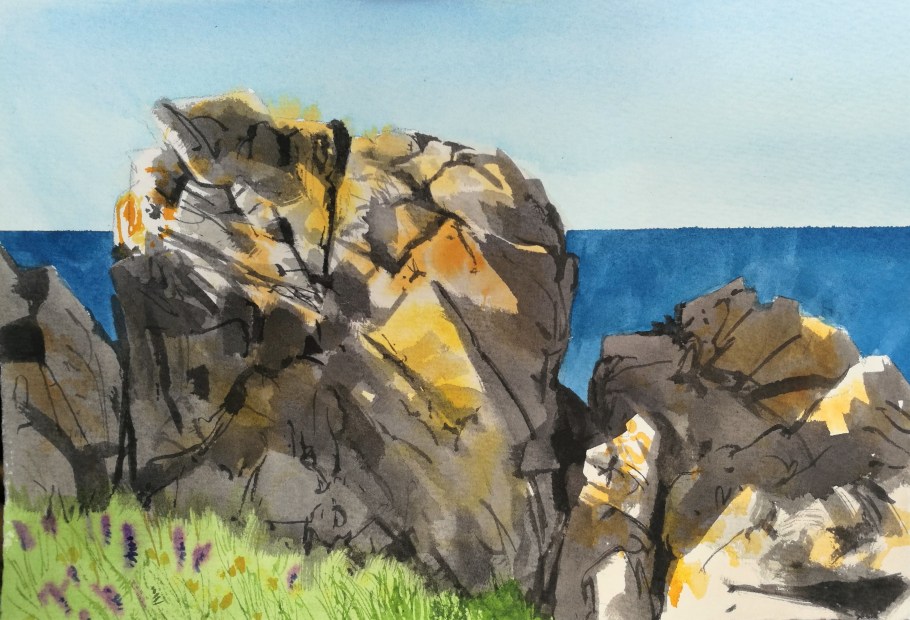
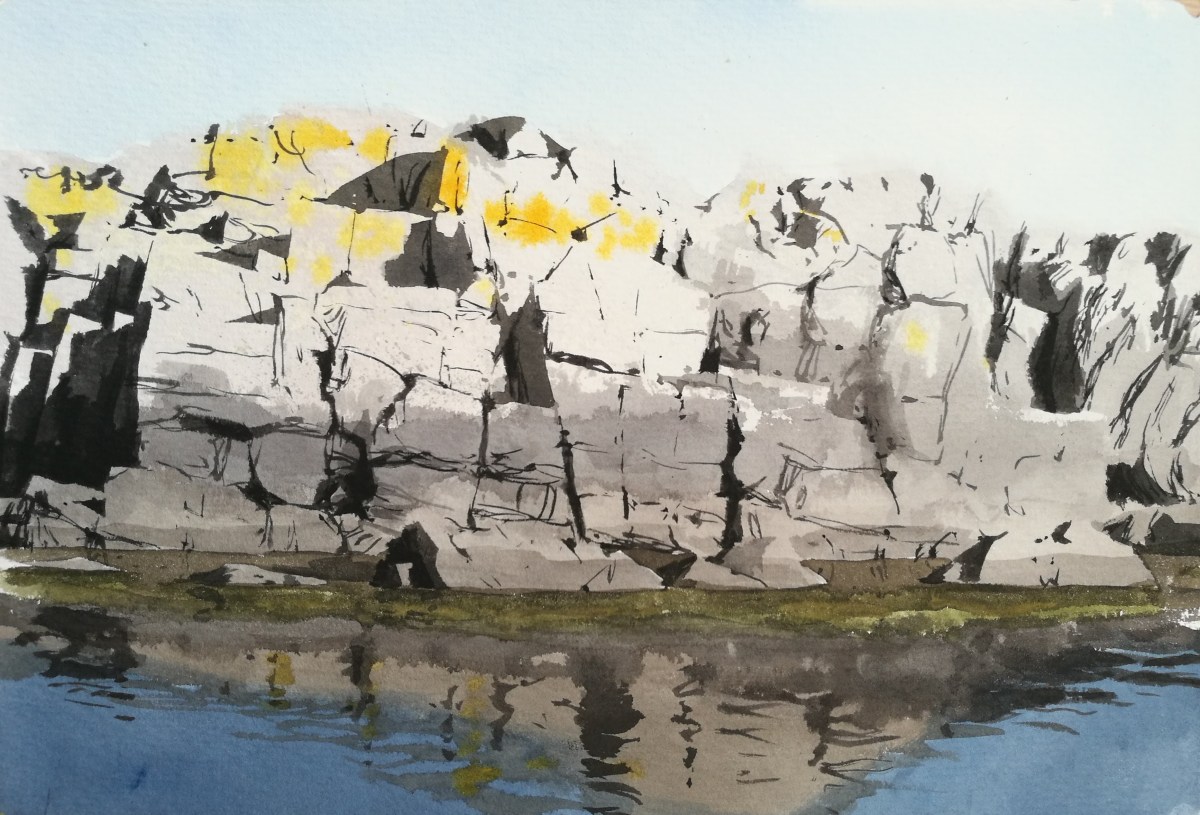
When not occupied with the slice painting, I painted the incredibly complex and intricate face of Stevelen. I was struck by how it somewhat mirrored the Jons Kapel rock face I had painted all those weeks ago, during KYST 07.

During a break between ‘stripes’ I had jogged back to the day’s start point and collected my car. A genius move I was very glad for, as I wearily climbed back up to the cliff top path with all my gear and into my waiting car. It had been a fantastic day under a warm sun and as I drove back to my home I could still recall the yikkering peregrine falcon I had witnessed over seventeen hours earlier.

KYST 21

Weather report = Mostly sunny all day with a few cloudy periods in the mid-afternoon. Temperature between 11 °C in the early morning and evening and 19 °C in the afternoon (though it felt cooler with an onshore wind). Wind between 4 and 6 m/s from the west and north west. Visibility: fantastic. Hours of sunshine: 16 hours . Officially the hottest and sunniest May since records began, Bornholm is a tinderbox and drought beckons…

Lessons learned – good idea to run back and collect the car before the sunset, so I was ready to leave after the day finished.

Stops with the M60 = 1

Kilometers walked = 16.04 km (KYST record)

Day lasted = 17 hours, 13 minutes

Birds seen and heard = 38 species (2 new ones = peregrine falcon, dunnock  = running total 93)

Other stuff = when watching the nesting swallows in the barn by the car park, I was struck by how confiding they were. I thought about how much joy these swallows are going to give all the other people and tourists that are going to sit there, like me, and watch them over the next couple of months.

People talked to = 1

In my head = … I couldn’t forget the article I read on Guardian.com about the biomass of life on Earth. Whilst at first I felt reassured that humans only make up 0,01% of the world’s total biomass, I was horrified to read that, out of the total biomass of animals, humans and livestock (domestic animals) make up 96%, with the remaining 4% – FOUR percent!  – wild animals. In another words, in the space of 10,000 years or so (an instant), wild animals have gone from 99,9% to 4%. I can’t get it out of my head.

KYST 20 – from Døndalen to Helligdomsklipperne, 18.05.18

For at læse denne KYST 20 blog på Dansk, se her…

See here for an introduction to the KYST project

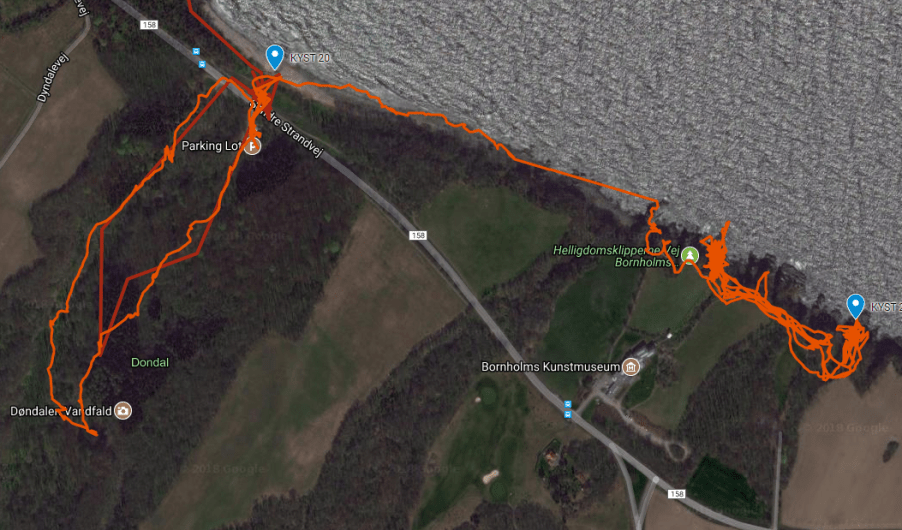
KYST 20 The noisy frogs in the pond next to our house had robbed me of the sleep I desperately needed, and I arrived back at Døndalen groggy and a little irritable. The spectacular sunrise and cacophony of bird song emanating from the forest, however, quickly improved my mood and I soon settled back into the reflective and contemplative frame of mind that the day demanded. I started off by revisiting the tree that I had painted at the end of KYST 20. I had hoped that there would be more of a difference in the leaves but the tree (an ash?) was either dead or a late developer.

Between the first and second ‘slice’ of the tree painting I wandered into the forest at Døndalen and walked all the way up to the waterfall, Denmark’s second largest. The weeks of dry weather meant that the falls themselves were somewhat unspectacular, but the atmosphere in the forest so early in the morning was intoxicating, with the soundscape dominated by blackcap, wren, chaffinch, song thrush and wood warbler.

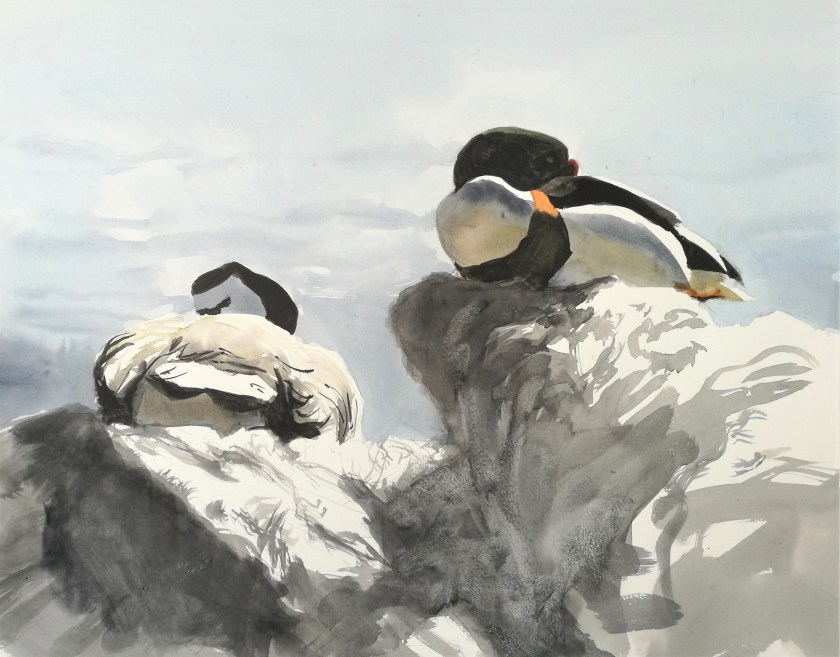
I wandered back to the coast and observed a pair of goosander resting on the shore. Incredible birds, goosander are strange reptilian fish-eating ducks with serrated bills, beautifully marked and often quite flighty, so I was glad for the opportunity to sketch them as they slumbered, stretched  and preened (see above). For the first time this year I saw a raft of eiders with young, 26 newly hatched fluffballs, with three females and a male. A pair of bossy shelduck waddled up on to the shore and the more polite goosander yielded immediately. Even the eiders moved off grudgingly and the drake shelduck settled down for a quick nap on the pebbles.

The area around the mouth of the stream was a meadow filled with various wild flowers and I wandered around to see how many different sorts I could find. I regretted my lack of botanical knowledge, but also enjoyed drawing something new and unknown. I thought of the escaped parrot I had seen in the forest last week, and how exciting and different it had been to try to record something when you don’t know how it is supposed to look.

The weather was glorious – unbroken sunshine and little wind, neither too hot nor too cold. For the first time I had ditched my big and heavy chair and I felt almost nimble as I clambered over the rocky shore towards Helligdomsklipperne (the Cliffs of the Sanctuary/the Holy Cliffs). The forest skirting the shoreline was thick and almost impenetrable, but I noted the many goosander nesting boxes in the trees, put there by local bird-lovers.

By lunchtime I had reached the first of the tall and impressive rocky outcrops that form Helligdomsklipperne and one of Denmark’s most famous natural tourist attractions. In times past, there were a chapel and a holy spring, and pilgrims would visit from near and far. More recently, the area was a favourite motif for Denmark’s Golden Age artists. Today, tourists come to visit the new Art Museum perched on the cliffs, and wander amongst the caves and grottos and perch on the viewpoints and take selfies. I had arranged a rendezvous point with a local TV station (Øens TV), who had come to interview me about the KYST project and we sat on the cliffs and enjoyed some chocolate croissants and coffee in the sunshine. I sat on Libertsklippen, named after an artist, and sketched the strange rocky formations.

Eventually I walked back on to the coastal path, where I searched for a good vantage point to make a timed ‘slice painting’ of the shadows moving over the face of the cliffs. I found a fantastic spot jutting out over the cliffs with a fine view of Helligdomsklippen. Over the next seven or eight hours I returned periodically to update the passage of the sun and the shifting colours.

A little further along, I found another vantage point and started another slice painting of Lyseklippen (‘Torch cliff’). When I wasn’t shuttling back and forth between these two pints, I walked down to the vertiginous steps to the Sorte Gryde (The Black Pot), a deep cavern in the face of the cliffs. The Sorte Gryde and other caves in the region were formed by wave action eroding the diabase magma that had filled cracks in the gneiss bedrock, and testify to the fact that Bornholm’s coastline was higher than that it is today.
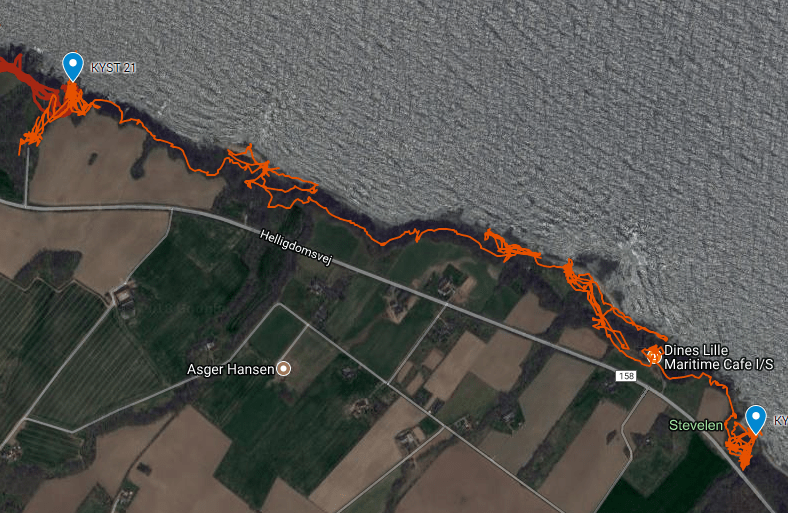
As the day reached its end, I paused to watch the sun set just behind the headland to the north-west. I had not managed to sleep and was absolutely shattered. I packed my things and walked back to the main road and back to my waiting car at Døndalen.

KYST 20

Weather report = Mostly sunny all day with a few cloudy periods in the late afternoon. Temperature between 9 °C in the early morning and evening and 17 °C in the afternoon. Wind between 1 and 3 m/s from all directions. Visibility: fantastic. Hours of sunshine: 13 hours .

Lessons learned – it was good to be free from carrying my chair, but my back was messed up when I got home form not being supported for over 16 hours. I need to find a lighter chair. Next time, I NEED to take a longer break.

Stops with the M60 = 0

Kilometers walked = 9.7  km

Day lasted = 16 hours, 17 minutes

Birds seen and heard = 39 species (2 new ones = hawfinch, redstart  = running total 91)

Other stuff = Strange lack of birds around the cliffs. Not a single nightingale heard.

People talked to = 2

In my head = …Luck and our awareness of it. How often have I looked up at JUST the right time and had the good fortune to see a rare bird passing by? But how many times have birds passed me by without me knowing? When I have been in the wrong place at the wrong time? This got me thinking about the link between good luck (=bird watching) and car accidents (=bad luck). How with birds you are aware of your good luck, but not the ones you missed. Where with bad luck, you are only aware of the times you ‘crashed’, not all the innumerable ‘close shaves’ (…at the time, gazing out over the sea, it all made sense and seemed quite profound…). Teenagers, Trust. Forgiveness. Parenting. Being involved.


KYST 19 – from Stammershalle to Døndalen, 11.05.18

For at læse denne KYST 19 blog på Dansk, se her

See here for an introduction to the KYST project


KYST 19 As I arrived back at Stammershalle, I could still see distant flashes and rumblings in the leaden sky from the huge thunderstorm that had kept me awake a few hours previously. There was no wind and the dawn air was mild, but there were intermittent light showers and the dark sky threatened. There was a peculiar rose-orange glow where the rising sun was hidden by the thick cloud layer. The smell of the rain and the cool air felt rejuvenating and I was keen to get started. Instead of painting from the same place where I had finished the week before, I decided to break with tradition and concentrate on the sky.

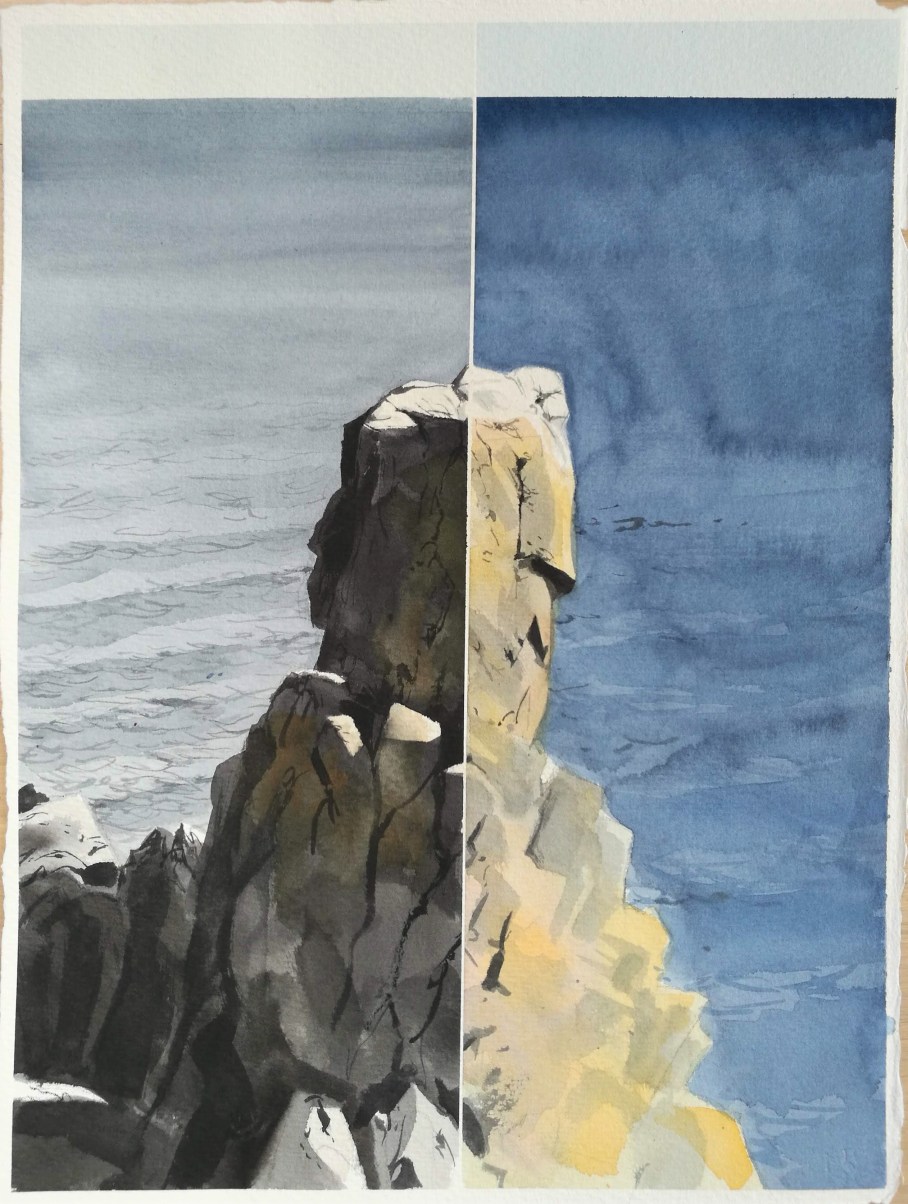
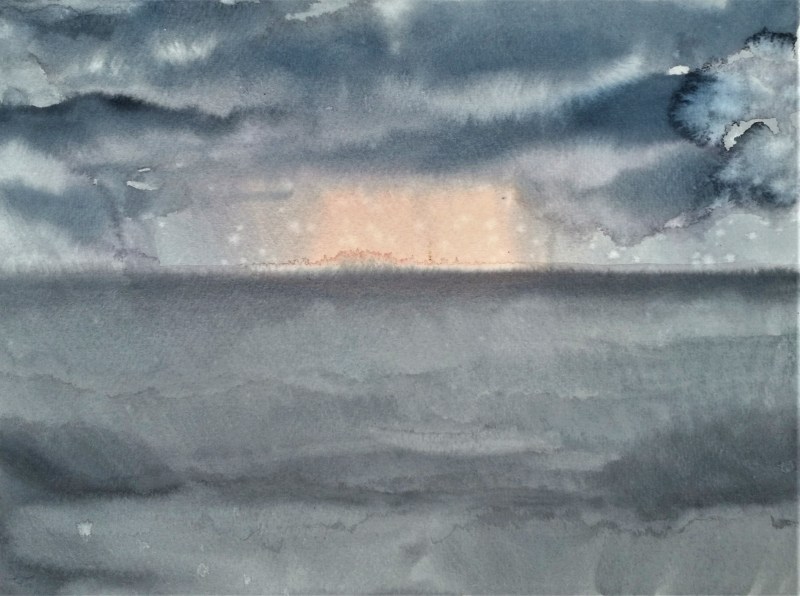
Stammershalle is a huge gneiss promontory with commanding views of the eastern coastline of Bornholm between Sandvig and Gudhjem. No wonder then that the site is riddled with graves, standing stones and other archaeological artefacts all the way from Bornholm’s first Paleolithic settlers to the Iron Age. I wandered around and soaked up the atmosphere, to a constant twittering of linnets, whitethroats and yellowhammers. To the west I could see changes in the weather and I quickly set up a ‘slice painting’, recording the changes in the sky and light over a period of several hours (see top).

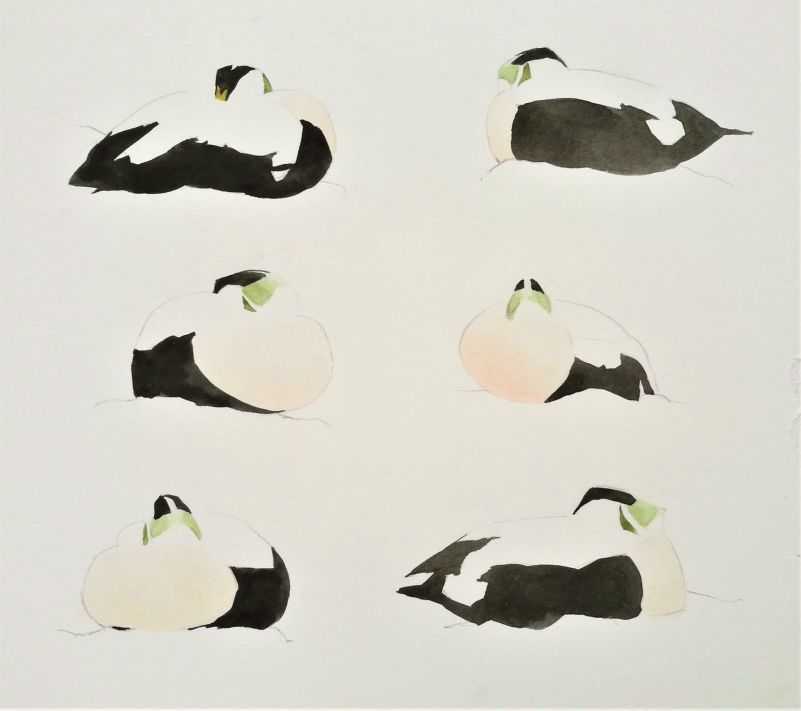
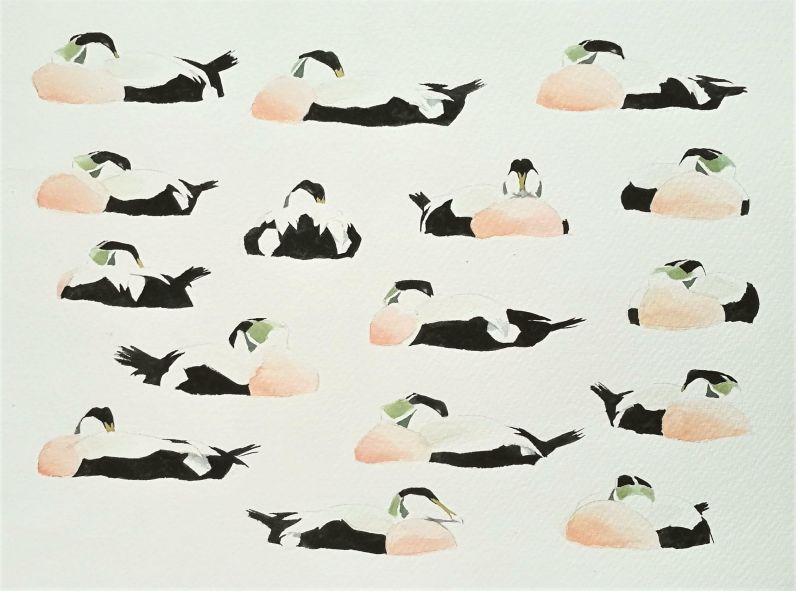
Looking north back towards Tejn, groups of eider ducks were hauling out in the sheltered bays between the rocks. With my telescope I admired the crisp graphic shapes of the dumpy eider drakes.

A little closer, a pair rested on the rocks, the drake preening vigorously while the duck looked on admiringly.

Eventually I packed my things and walked on through the drizzle. Heading south east I kept to the rocky shore away from the coastal path close to the road. Again, this part of the coast felt little-visited and I took it slowly, taking frequent rests and gazing at the rich and undisturbed habitat, the wild orchids and tadpole-filled rock pools. Eventually I came to a small pebbly beach where I set up my M60 and made some lunch. The weather was changing all the time and a fog rolled in, obscuring the Helligdom cliffs from view, to the south.

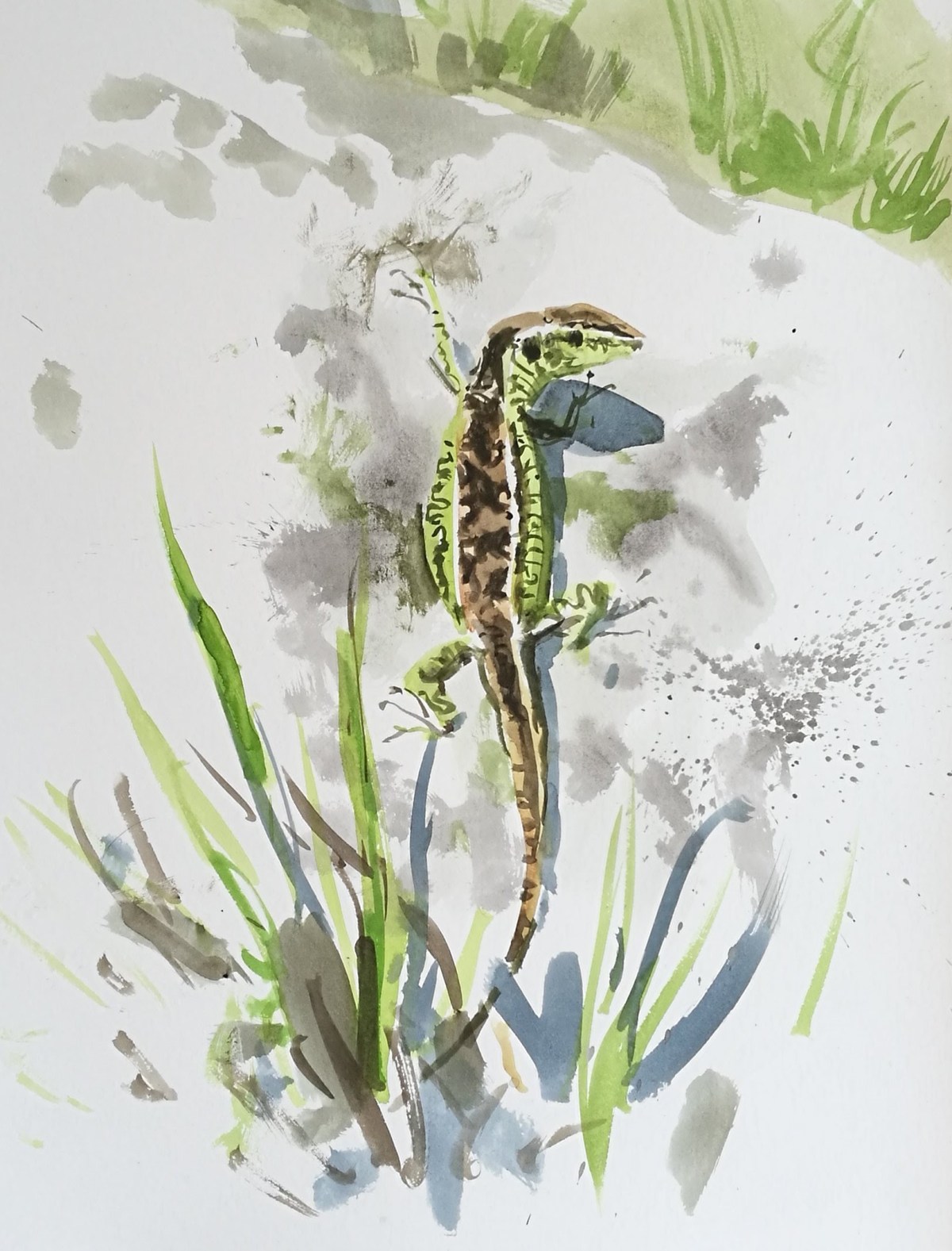
Completely and wonderfully alone I ambled in the sprawling woodland skirting the beach and watched a pair of sand lizards engaged in some strange courtship dance – the female’s jerking her arms in a curious way before darting suddenly off, only to be tracked down by the persistent male in his emerald finery. A group of resting eider drakes bobbed around in front of me oblivious to my presence.

The fog dissipated and the sun broke through the clouds for a few moments. I couldn’t stop myself painting more eiders, one of my favourite subjects.

I painted to the chack and rattle of the thrush nightingales that were just setting up their territories all the way around Bornholm’s coast. A more visible KYST companion are the white wagtails constantly flitting between the rocks on the shore

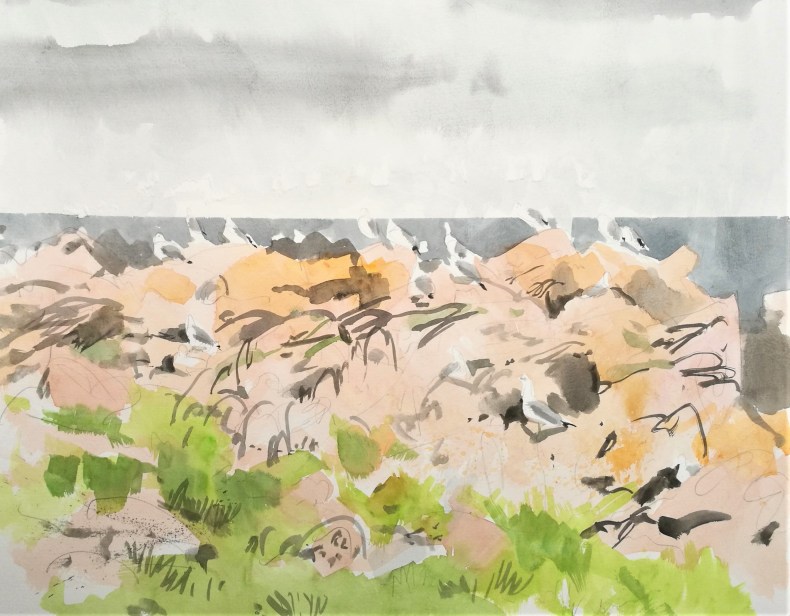
I was tired and had already been going for nearly eight hours – and yet the day was only half started. I couldn’t sleep and ambled onwards. The going was tough over the rocky and pebbly shore and I cursed all my equipment. I walked past the tiny harbour at Bådsted, a little-known jewel of a place, and through wild growth of nettles, to arrive at another rocky headline. Here a colony of common gulls screamed and yelped at my arrival.

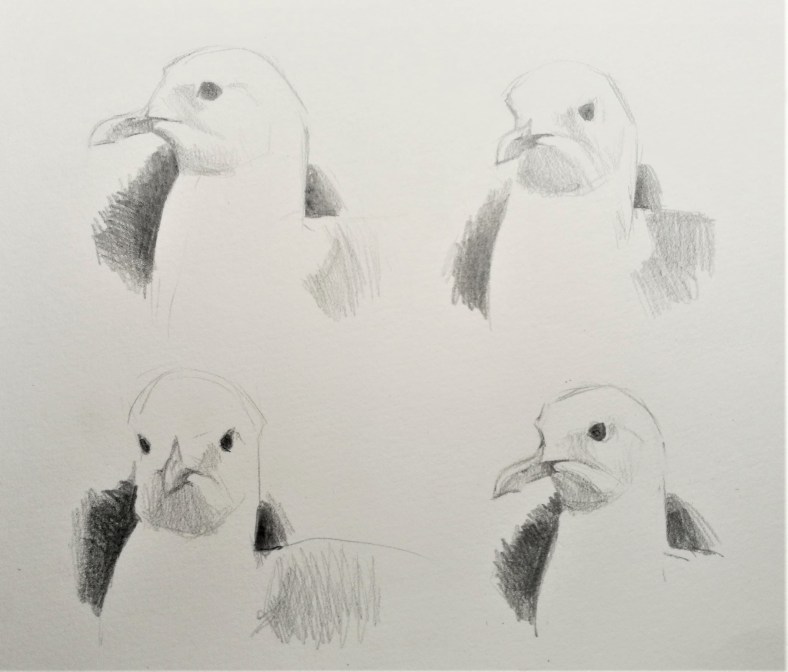
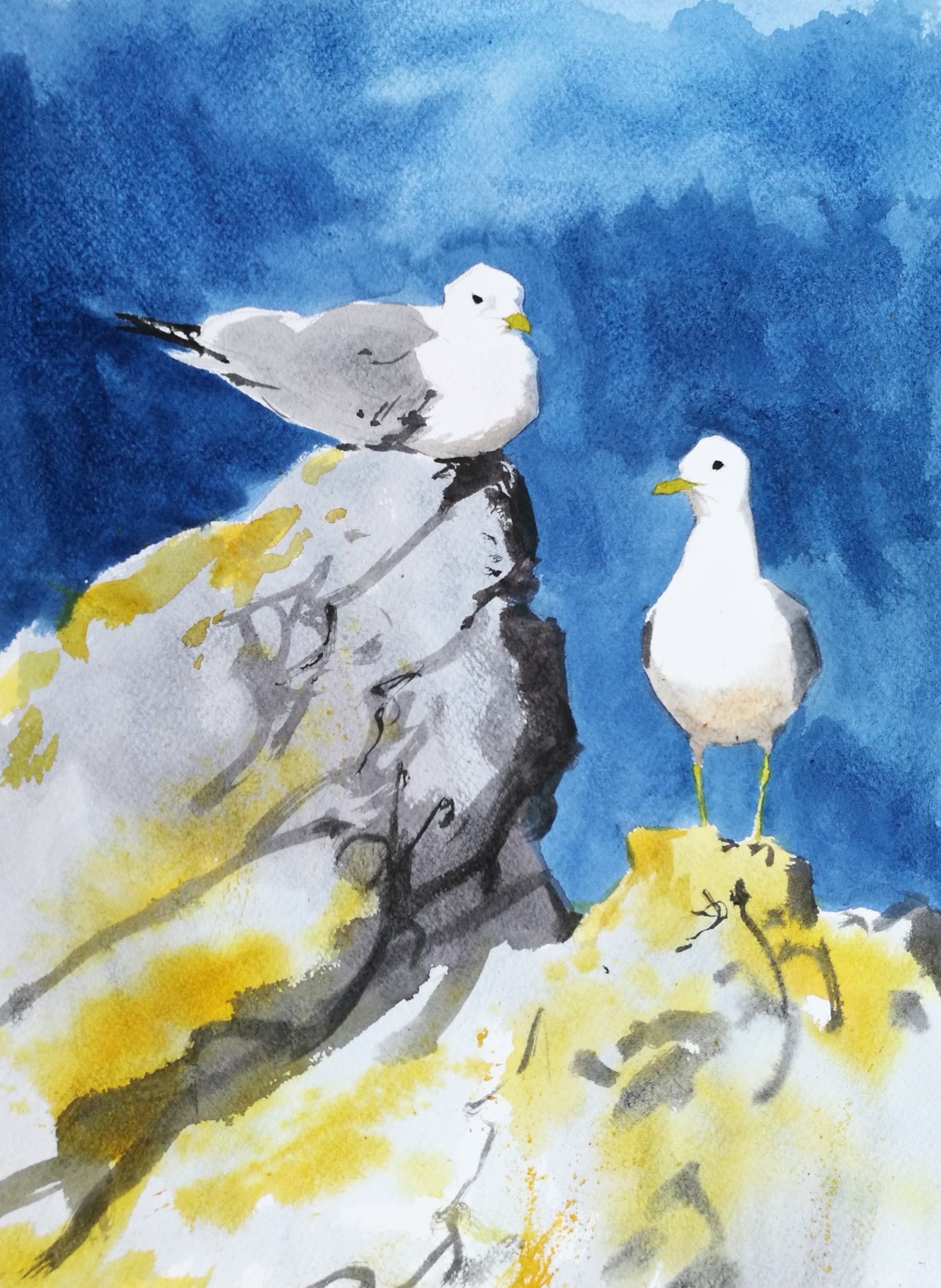
With time, however, the gulls settled down and returned to their nests. I sat and drew portraits of one gull who sat not three metres from me, her button-like eye staring at me reproachfully.

Eventually I continued on to a large stony beach, hidden from the busy road by a thick and overgrown wood. Birdsong and the wonderful smell of cherry blossom and wild garlic emanated from the trees. I wandered along the woodland path and marveled at it all. The white anemone and cherry blossom had now peaked and had been replaced by the constellations of wild garlic flowers. The elm and wild cherry trees wore fresh new leaves, with the alder and ash not far behind. I partly felt the need to record this floral abundance for the KYST project, and felt almost guilty that I had concentrated so heavily on eiders. But I was tired and was content looking.

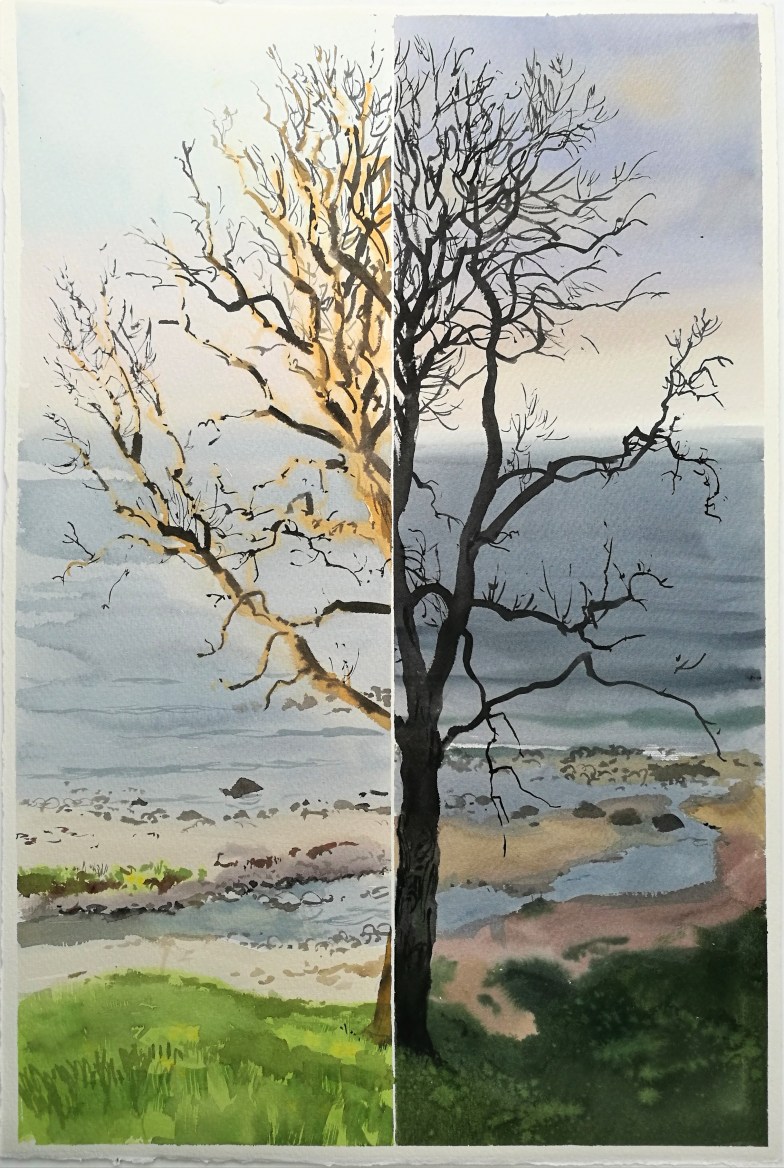
I walked on, over rocky capes and pebbly beaches, until I eventually made it to the mouth of the Døn stream. Here a valley cloaked in thick forest carries the stream in to the heart of Bornholm, so I made a detour and wandered around the woods, hoping I might spot a dipper. I didn’t and returned to the coast, where I painted a large tree in two sections. I was dead tired now and finished off just as the sun was setting behind some thin clouds, momentarily casting a golden light over the nearby Helligdom cliffs, next week’s destination.

KYST 19

Weather report = Overcast with scattered showers in the early morning and early afternoon. Foggy periods with the sun breaking periodically through. Temperature between 10 and 15 °C. Wind between 2 and 3 m/s from the northwest. Visibility: good to poor. Hours of sunshine: 2 hours .

Lessons learned – if you see something that really catches your eye (a flower for instance) don’t think, ‘I’ll stop and find another one later’, ‘cos you won’t.

Stops with the M60 = 3

Kilometers walked = 9.81  km

Day lasted = 15 hours, 55 minutes

Birds seen and heard = 45 species (8 new ones = osprey, hobby, black throated divers, tree creeper, whitethroat, thrush nightingale, wood warbler, garden warbler = running total 89)

Other stuff = perfect weather conditions for the whole day really…. The smell of a seabird colony is such a special odor – unlike any other I know – and one that always fills me with excitement and reminds me of Scotland, Bass Rock and the Seabird Drawing Course

People talked to = 0

In my head = …driving over to the island to Stammershalle at 4.30 in the morning, I took the ‘bumpy road’ skirting the Rø forest. Just as I crested one of the small hills a car (another car – at 4.30!) shot over the hill in the opposite direction. We were both towards the middle of the road, and possibly a little over the speed limit, and we must have missed each other by a matter of inches. It was so close and so sudden that I was completely shook up, heart pounding, and for the rest of the day I was plagued by ‘what if’ thoughts. Just one metre to the left and it would have been game over. Crazy.

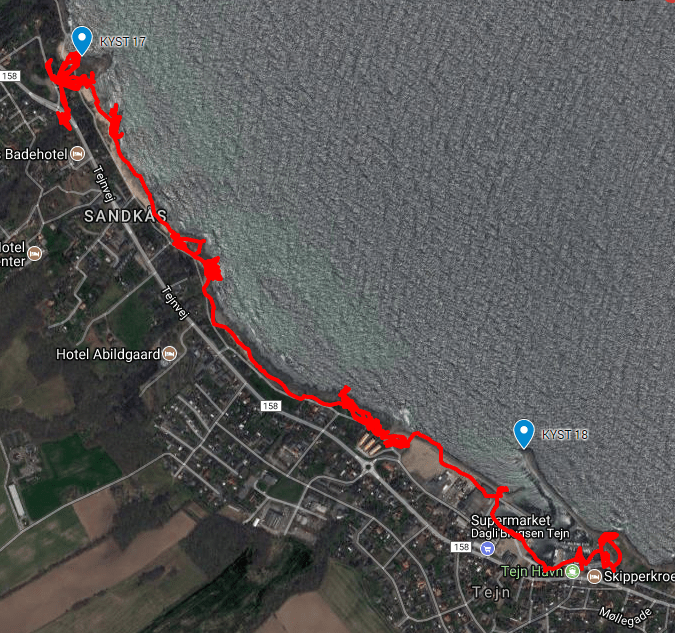
KYST 18 – from Tejn Harbour to Stammershalle, 04.05.18

For at læse denne KYST 18 blog på Dansk, se her…

See here for an introduction to the KYST project

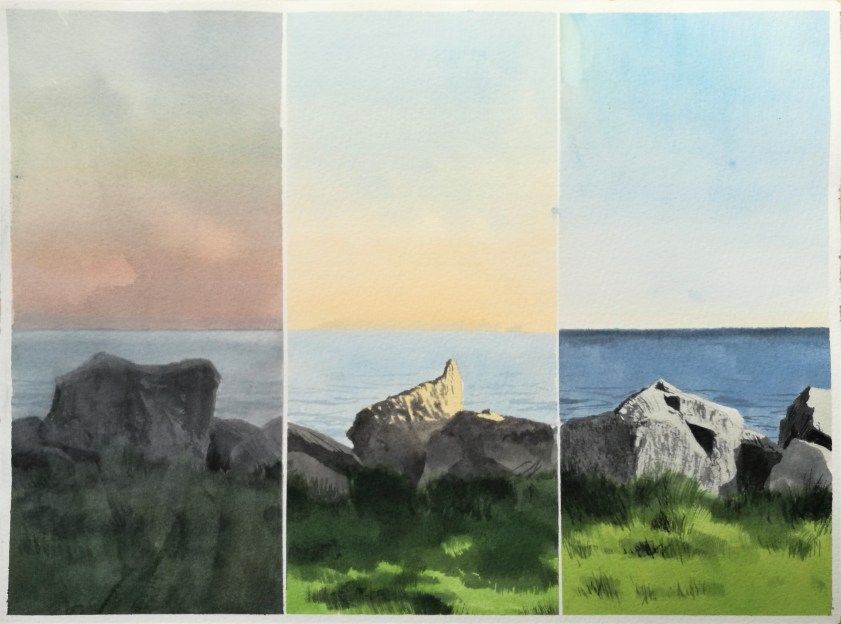
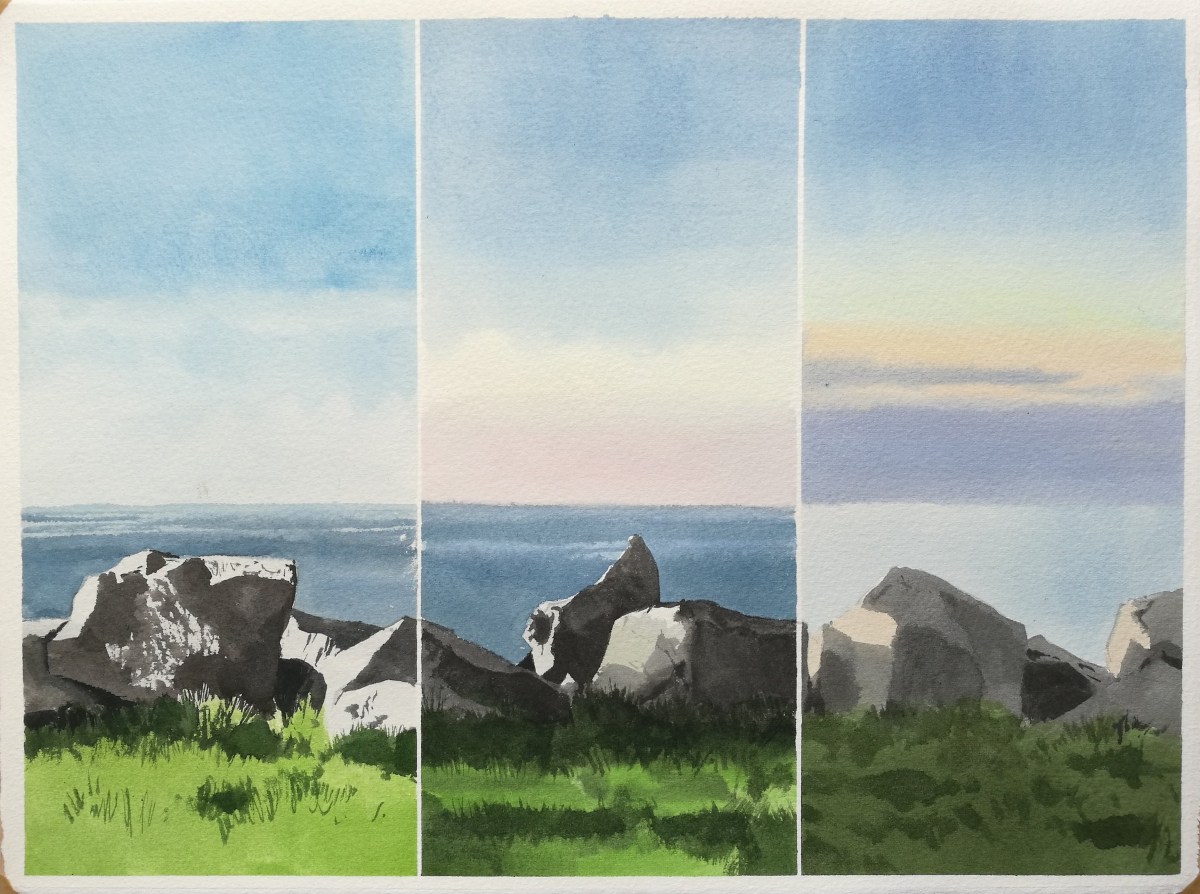
KYST 18 Once again I was greeted by a clear blue sky, a dead calm sea, and the miraculous sight of the blood orange sun breaking the horizon. I quickly set myself up back at the bench where I had watched the sunset only five days previously. I made an identical picture, split into three sections.

Soon after I arrived, the first groups of sailors started turning up for the ‘Trolling Master Bornholm 2018’, a five-day sports fishing race to land the largest salmon. The atmosphere of the harbor slowly became almost festival-like, as groups of people clad in matching suits unloaded their gear prepared their equipment and boats in the fresh morning light. A drone flew overhead filming and a voice on the Tannoy assembled the competitors.  Slowly the first group of boats chugged out of the harbour and positioned themselves in formation by the mouth of the harbour arm in a huge semi-cirlce. With the sounding of a klaxon there was a colossal roar of engines and the boats sped off in all directions. It was an impressive sight and it was fantastic to see the harbour heaving with activity, but I couldn’t help wondering how, in the space of a generation, a thriving fishing industry had been replaced by this.

I walked on, away from the town and along the rocky and uneven coast. Between the rocks and the gardens of the fantastic houses facing the sea, there was a coastal meadow, with sea rush, tussocks of grass and countless pools wriggling with tadpoles and newts. Every now and then I would cross a small stream. I looked around for grass snakes, but found none. A dead herring gull, beautifully lit, caught my attention (see top)

I clambered over and across rocks and gullies, capes and bays. A little further I came to Dybe Rende, a fault or crack in the bedrock, forming a narrow natural harbour.

Further along the coast, I could see with my telescope an odd couple resting together on the rocks. A shelduck and a barnacle goose, I remembered them from last week’s walk. Actually I’ve seen shelduck/barnacle goose pairings before in other places; there must be some sort of mutual attraction. Strange as they don’t resemble each other at all and are not even that closely related.

I walked on, over a larger stream and on to a deserted pebbly beach, where on a small sandy clearing I set up the M60, had some lunch and took a nap in the warm sun. On waking I walked around and explored the small unkempt woodland facing the beach. The coast between Tejn and Stammershalle is rarely visited and quite inaccessible with no coastal path, and it was all new to me. I made some studies of the leaves and flowers I found – I know next to nothing of botany and drawing is the best way I know of learning. There was succulent growth and bird song.

Eventually I packed up and trudged onwards, over the folded bedrock that hugged most of the coast. The coastal meadow was dominated by lumpy hillocks of grass and the going was no easier. With my binoculars I could see groups of eider ducks cavorting around, and further out the Trolling boats speeding back to Tejn Harbour. I looked back up towards Tejn, with Allinge visible in the distance.

cof

As I approached my journey’s destination a couple of friends dropped by with fortifying refreshments and we sat and chatted for a while on the rocks. I was glad for the company, but there was a chilly wind now and I braced myself for a final session on the day’s destination Stammershalle, a huge rocky outcrop jutting out into the sea. Despite the long day I was running out of time and I settled down and looked northwest at the setting sun. It had been a fantastic walk along an unspoiled and little-known part of Bornholm’s coast in wonderful weather, but there was a niggling feeling that I had not made the most of it. As I jogged all the way back to the car, I made copious mental notes of things to change for next time.

KYST 17

Weather report = Sunny for almost all of the day. Temperature between 6 and 12 °C. Wind between 2 and 5 m/s from the northwest. Visibility: good. Hours of sunshine: 13 hours .

Lessons learned – With my present palette I am unable to produce or mix a really good purple. Need to find one and add it for next time.

Stops with the M60 = 2

Kilometers walked = 10.3  km

Day lasted = 15 hours, 15 minutes

Birds seen and heard = 40 species (2 new ones = oystercatcher and raven = running total 81)

Other stuff = need to shake it up a bit. The coast and weather has been broadly similar for three weeks in a row.

People talked to = 2

In my head = glad to be feeling more healthy again…but still feeling so run down


KYST 17 – from Store Sandkås to Tejn Harbour, 29.04.18

For at læse denne KYST 17 blog på Dansk, se her…

detail.jpg

See here for an introduction to the KYST project

KYST 17 Two days later than planned, thanks to a nasty and never ending cold, I finally made it back to Store Sandkås in time for the sunrise. It was mild and still but overcast.

dav

Before carrying on along the coast, I made a short detour to the mouth of Store Dal, one of Bornholm’s many nearby ‘sprækkedale’ (a narrow and deep valley formed by a fault line in the granite bedrock). Here I sat in the hidden wood and enjoyed a carpet of white anemones and a rather muted dawn chorus.

dav

I returned to the coast and my parked car where I had my breakfast and a flask of coffee waiting for me. There were no people around, and only a few birds. The day seemed different to my other walks, it really felt like a Sunday. The clouds had by now vanished and the monotonous lilting trill of the willow warblers and distant cawing from a rookery made me drowsy. I packed up my things and walked along the sandy beach for a while. To my right the hotels and summer houses of Sandkås. Eventually I stopped by a fine and well situated Alder tree. I painted the tree from the trunk upwards, as it grows, my paintbrush following the twisted branches and ending with the first shoots budding on some of the outermost twigs.

dav

I walked on and found a spot on the beach where I set up the M60 brolly and tried to sleep. I was still unwell and exhausted. I couldn’t sleep and was drawn in by the strong sunlight on the granite outcrops.

dav

I slept a little, woke and walked over to the water’s edge.  A huge mink emerged between some boulders not three metres from me. Instead of rushing off in fear, he slowly slinked off unconcernedly, with me cursing under my breath my lack of paper and pencils. A little later I spotted a stunning sand lizard basking in the sun. This time I was prepared and inched slowly closer until I was near enough to really study him.

cof

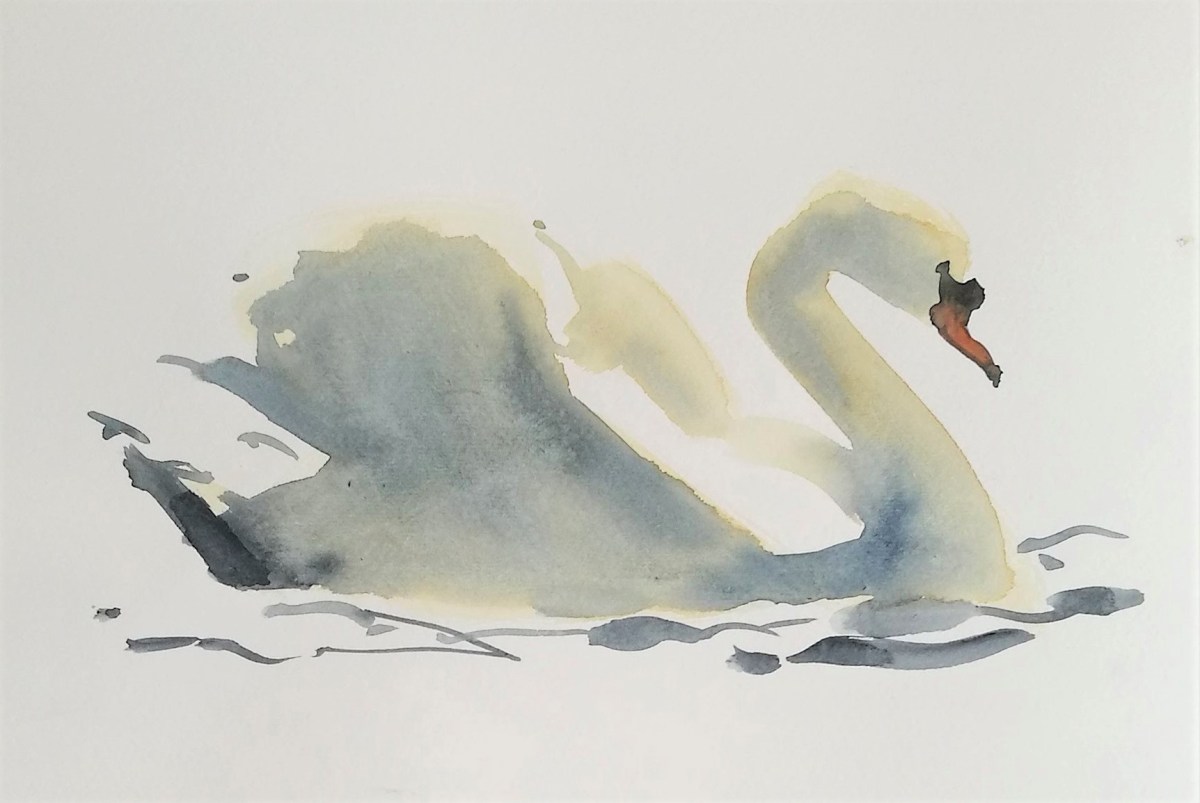
I continued along the shore. The granite here was veined and coloured differently. There were pools and meadows with flowers and green growth between the granite shore and the coastal path. The day was hot and tranquil. I found an exposed spot where the wind was more invigorating and watched a group of swans milling about by the shore. It was a peaceful enough scene but one cob was feeling aggressive and territorial and spent the whole time posturing and blustering.

I carried on and tried to paint the reflections in a rock pool, but the hot sun dried the paints too quickly.

cof

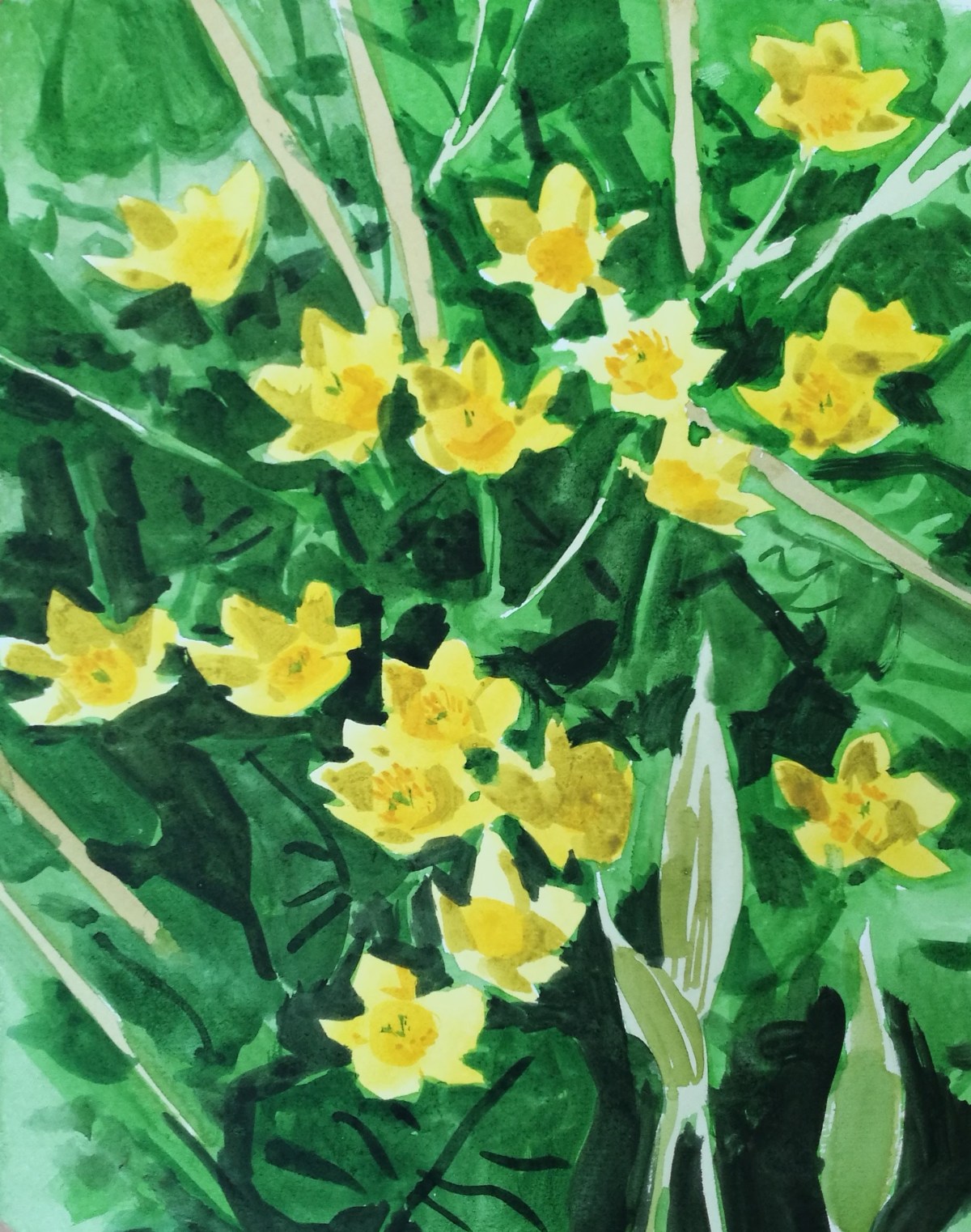
As I continued towards Tejn Harbour I could see ships and boats of all sizes entering the harbor. The shore became less sandy and more rocky, crossed with small streams and swampy marshes. In one of these I hid between stands of sea rush and drew some ridiculously yellow marsh marigolds.

cof

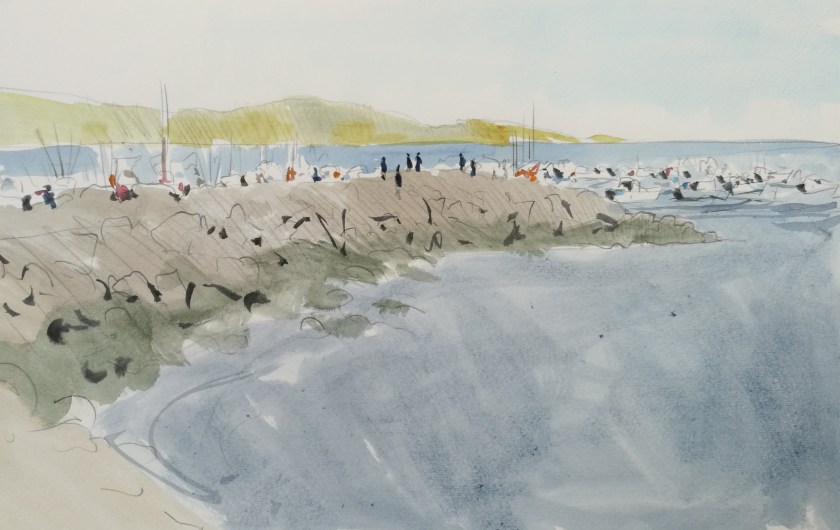
I finally made it to the harbor, cursing my heavy pack, the unwieldy M60 brolly, and the awkward camp chair. Tejn harbor is large and industrial and was busy with groups of sport fisherman returning back with huge rod-caught salmon. Together with the locals, clusters of hale and hearty Germans, Norwegians and Swedes set up barbeques and drank beer in the late afternoon sun. I was a little jealous and must have cut a somewhat forlorn figure, traipsing past with all my gear. By now my resolve was fading fast as I walked all the way to the harbor arm. Instead of looking at the harbor, the fisherman, or the fine town of Tejn, I turned my back on it all and watched the shadows move and the colours transform on a group of boulders on the pier arm in the fading light of the day.

cof

KYST 17

Weather report = Sunny for almost all of the day. Temperature between 10 and 14 °C. Wind between 1 and 4 m/s from the northwest. Visibility: moderate. Hours of sunshine: 13 hours 30 minutes.

Lessons learned – it is definitely worth putting up the M60 and painting in the shade rather than painting in direct sunlight.

Stops with the M60 = 2

Kilometers walked = 8.98  km

Day lasted = 14 hours, 59 minutes

Birds seen and heard = 43 species (3 new ones = barnacle goose, house martin, gadwall = running total 79)

Other stuff = an amazing aerial show by four white wagtails zipping, diving and plunging after each other. Insanely fast and maneuverable, almost beyond comprehension.

People talked to = 2

In my head = Incredible changes in the 9 days since my last trip – this really is the most dynamic time of the year. Funny how the coast is probably NOT the best place to be at the moment. Endless internal moanings about how shit I felt. Realization that I have been so lucky with three sunny days on the trot. Fear that I am owed some rain and wind. Hope that I will be healthy on Friday.

2018-04-30


KYST 16 – from Knuds Næs to Store Sandkås, 20.04.18

For at læse denne KYST 16 blog på Dansk, se her…

cof

See here for an introduction to the KYST project

KYST 16 A little delayed, Tina and I drove north, leaving behind the thick fog that covered the southern half of the island. As we crested the hill and continued down to Allinge, with the sea to our right, we could see a crimson sun had already broken through the horizon, its reflection mirrored in the dead calm sea. I quickly unpacked my things, annoyed at arriving so late, and got to work.  The lilting trill of willow warblers, newly arrived from the south, carried across the bay to the rocky outcrop where I sat and painted. Over the bay by the smokery, I could see a group of bathers take a short dip in the water. The sun rose, the bird chorus slowly abated, some joggers ambled by and I drank it all in, blessed to be able to witness the awakening day.

cof

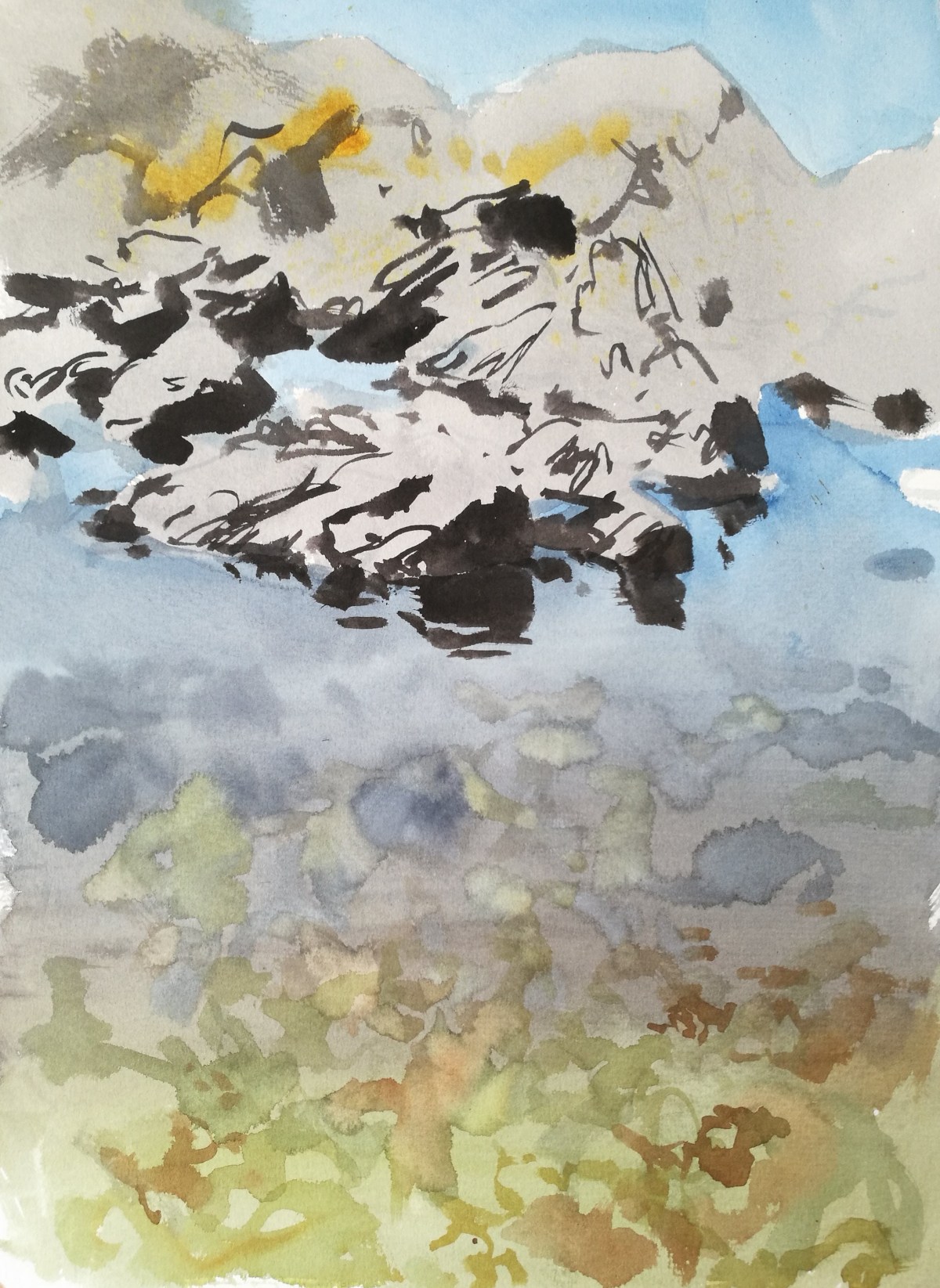
I had been checking the weather forecast all week, and I looked forward to a sunny and warm day. Already I had jettisoned my gloves, wooly hat and thermal flying suit, and still I felt overdressed and bogged down by all my bags and gear. I had been battling a cold all week and still felt a little under the weather. I found a small sandy beach between some rocks and set up my M60 brolly, under which – for the first and definitely not the last time – I took a nap. Woken quickly by a phone call, and cursing modern technology, I started a large painting of a large pinkinsh granite outcrop covered in splodges of mustard lichen. I struggled with paints drying too quickly and felt too tired to be able to concentrate for long periods.

cof

I started a smaller painting looking south, where fresh green shoots of grass dominated the beach. It was rubbish and I cursed myself for starting it in the first place. Returning once again to familiar ground I grabbed my telescope and watched some eiders, wonderfully lit in the deep blue sea.

cof

Eventually I wandered onwards, clambering over the rocky coast, between and over the endless granite outcrops streaked with basalt and splattered with lichen. Between some of these outcrops were tiny sandy beaches and in other places the granite had crumbled into crunchy pinkish gravel.  Further from the sea, there were rock pools surrounded by tussocks of tough grass and sea sedge, some of which were fed by small streams and springs – and in one of these pools, I found scores of smooth newts.

cof

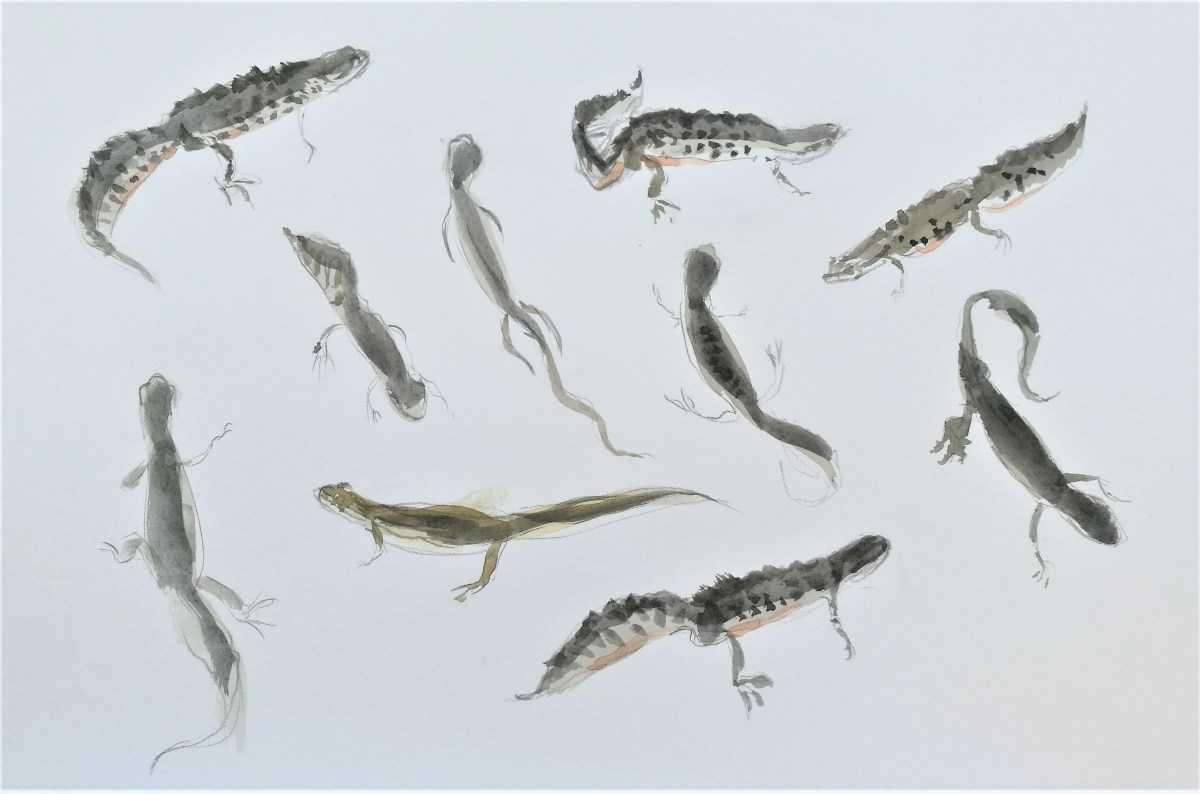
Discovering these pools immediately lifted my spirits, as I had spent a good portion of my childhood gazing at newts. I set up my chair by the edge of the pool and in no time at all I was transported back to that wonderful state where my contemplative non-thinking gaze somehow inhabits and occupies their amphibian universe. The newts were feisty and full of the joys of spring, and they cavorted and danced and mated and nosed about, as only newts can. There were common toads as well, one female somehow tethered by her string of eggs, as if she was unable to cut herself loose. Each time she moved off she was pulled back, her movements attracting the excitable newts who surrounded her like miniature crocodiles, pausing a while, before moving on.

cof

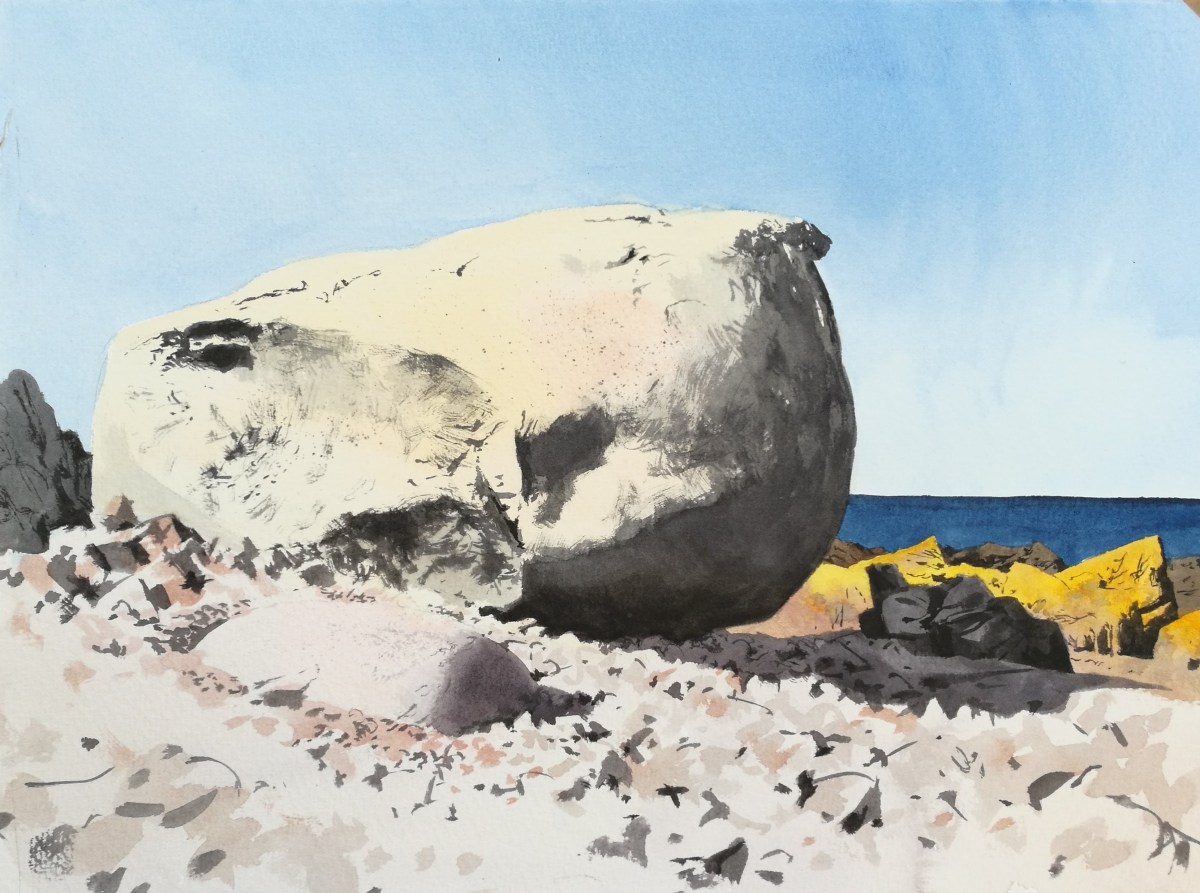
I walked onwards over and around the bays and outcrops until I arrived at ‘Æggehønen’, a huge erratic boulder deposited by a retreating glacier – or thrown by an angry troll Kjestena on Chritiansø, who had apparently aimed for St. Ole’s Church but missed (see top).

By now I had completely run out of water and was feeling decidedly peaky. This section of the coast is unpopulated, save for some wonderfully situated but unoccupied summerhouses, and I was thinking I might have to walk all the way back to Allinge to get some water.  Just then, however, I bumped into a friend, who, as luck would have it had a summer house just around the corner. I stayed a while and listened to some local stories, before walking back a little and painting some common gulls, whose yelping cries were constantly in my ears as I walked around.

cof

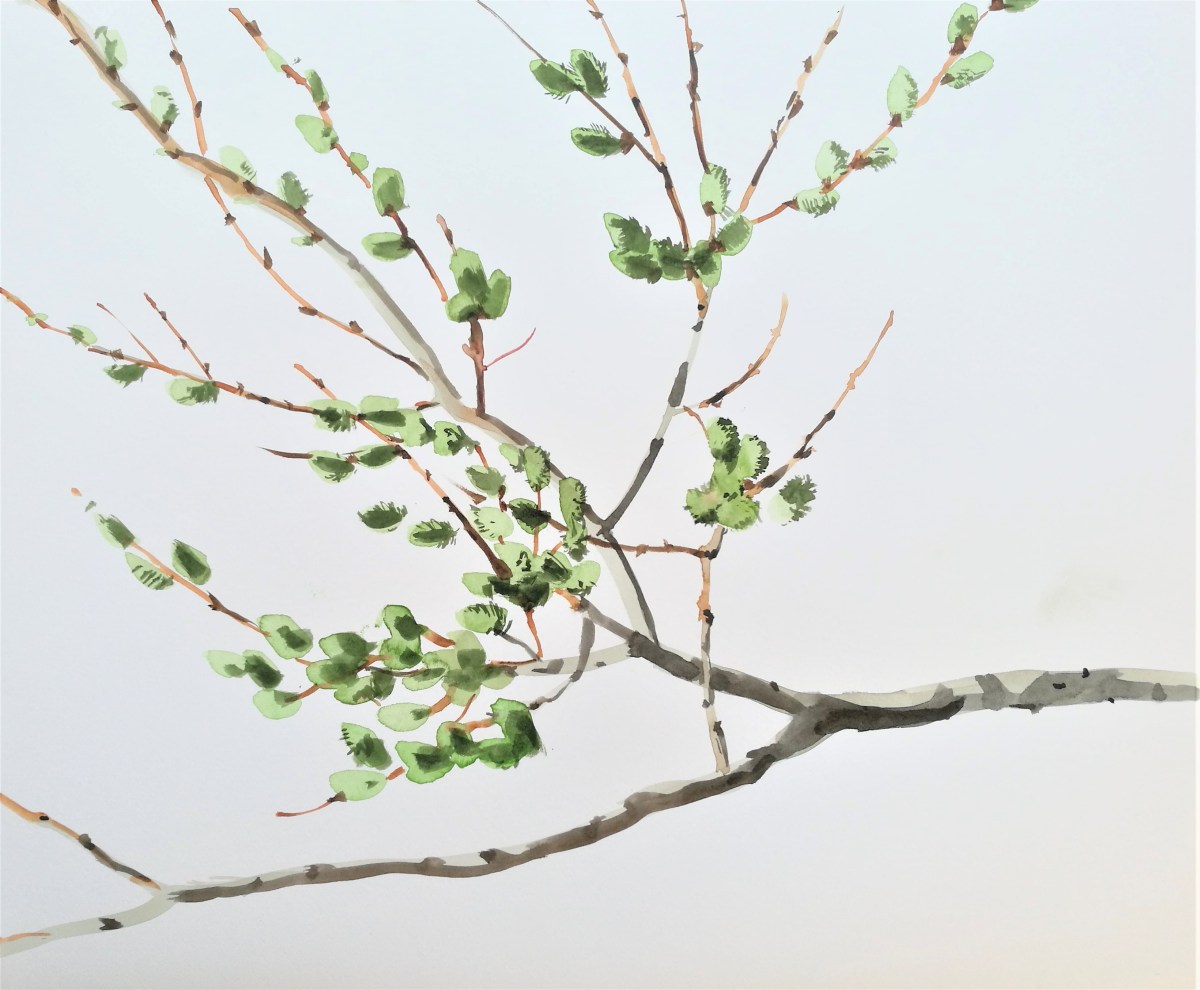
I walked onwards and through a small wooded area where the first white and yellow anemones and violets could be seen poking through a carpet of new waxy wild garlic leaves. Recently arrived blackcaps and lesser whitethroats chirped and burbled while a song thrush fluted from the top of an old ash tree. A little while earlier I had seen my first swallow – it was spring and I had decided then to paint some flowers, or at least some buds or green leaves. I managed to paint a willow (goat willow?) but again, felt too tired to concentrate, and wisely left the flowers for another time.

cof

It was getting late, and I walked on to the day’s endpoint, Store Sandkås, a small sandy beach with a rocky outcrop. I spent a while looking for a good vantage point and eventually sat, exhausted, looking north west across the bay, as the sun set in the cloudless sky just to my left. I tried to capture the metallic pastel shades of the sky and water with the strange cat-shaped ‘ørneklippan’ in the distance, but the painting was another disaster (detail below)

detail.jpg

At the end I sat there waiting for the sun to go down so I could go home… Just above me a group of swarming insects danced and swirled. Suddenly feeling creative again, I quickly unpacked my paper and followed the traces left by the insects with my pencil against the deep blue sky. Guided by the erratic movements of the insects and freed from the need to think myself and the desire to make a ‘good’ picture, I enjoyed drawing and managed to finish the day on a positive note.

cof

KYST 16

Weather report = Sunny for all of the day. Temperature between 8 and 16 °C, perhaps up to 20°C in sheltered spots. Wind between 2 and 6 m/s from the southeast. Visibility: good in the morning, some sea fog over the sea. Hours of sunshine: 14 hours 30 minutes.

Lessons learned – painting in the hot dry sun is just as annoying as painting when it is cold/wet and so on – more comfortable, but not as exciting.

Stops with the M60 = 2

Kilometers walked = 13.5 km

Day lasted = 14 hours, 29 minutes

Birds seen and heard = 43 species (9 new ones = marsh harrier, sand marten, swallow, blackcap, lesser whitethroat, chiffchaff, willow warbler, goldfinch, song thrush = running total 76)

Other stuff = one of the disadvantages of being bird obsessed is that you miss all of the other stuff going on. The plants and flowers are a bit of a blank slate for me.

People talked to = 3 ( 2 + 1)

In my head = not much, mostly feeling ill.

2018-04-21.2


KYST 15 – from Kongeskær to Knuds Næs, 13/04/18

For at læse denne KYST 15 blog på Dansk, se her

See here for an introduction to the KYST project

KYST 15 Disturbed at my arrival, a group of eiders silently abandoned the shelter of the rocky shore and launched themselves into the boiling surf. A blood-red sun began its meteoric rise through the day while the foaming sea crashed and tumbled over and into the granite outcrops. Alone and awestruck I began the day’s first painting in the teeth of the cold onshore wind.

cof

After a while the sun was covered by some clouds and I carried on, past the school and into a small park-like area. Here I wandered around listlessly, eventually settling down and looking southeast to the distant smoke house chimneys of Allinge.

cof

I walked on a little and turned and looked northeast where I had just been, with the returning sun now behind me, and tried to capture the energy of the waves rolling in.

cof

Frustration started creeping in and I was tired and underslept. The constant roar of the waves and the buffeting wind I found irritating rather than invigorating, so I took a detour away from the shore to Madsebakke, a nearby archeological site where Bronze Age Bornholmians had carved symbols and pictograms into the smooth granite outcrops. Despite – or perhaps because of – being painted red, the pictograms were slightly underwhelming, and it took me a while to connect to the significance of the site.

Eventually I returned to the coast, where a flock of eiders frolicking on the waves brought me back into familiar territory and brightened my mood somewhat.

cof

I continued to the small harbor at Møllerende, where I visited some friends and enjoyed a wonderful coffee and home-made bread in their garden. Refreshed I returned to the harbor where I spent some time observing a nearby rookery. There was a bit of nest swapping but otherwise they were quite subdued. In the shelter of the M60 I felt drowsy and warm, and – for the very first time since KYST began 15 weeks ago – I took my gloves off.

Here I also made a sketch of ‘Domen’ the new building that is the focus of ‘Folkemødet’ – Bornholm’s political festival and one of the island’s biggest events. It was difficult to imagine that this area would be heaving with thousands of tourists in just a couple of months.

dav

I walked on, past the harbor at Allinge, and onwards to the grassy area at Kærenæs, where I watched a huge flock of long tailed ducks and common scooters tumbling in the huge waves. Onwards I trudged to the next bay, just south of Gulehage, where I eventually managed to find shelter from the wind behind my M60 brolly on a grassy area just in front of the beach.

dav

I sat down for a late lunch and got talking to a friendly local gentleman who soon popped back to his house to grab a bottle of schnapps. Wonderfully fortified and refreshed, I started to draw a pair of shelducks who were resting in the distance, their rusty coppers and greens harmonizing wonderfully with the backdrop of lichen covered rocks and ultramarine rock pools. As so often happens, however, my eye through the telescope seemed to disturb them, and they soon disappeared.

cof

I walked onwards past the small sandy beach to my destination Knudsnæs, another rocky outcrop with fine views in all directions. I was exhausted now, but decided to walk around and explore for a while rather than sit still. The wind had abated a little, but the sun had disappeared and it was getting cold. The huge waves continued to crash into the shore and the common gulls yelped and screamed. White wagtails flitted around amongst the rock pools. Though it felt like a spring day, there was still only a little growth and the birdlife and birdsong was still rather stilted.

I found a sheltered spot and painted the rocks and the view to the north in ‘strips’ every half an hour or so, as the day slowly fell away and the sky darkened to a deep violet blue.

dav

KYST 15

Weather report = A little light rain in the early evening. Sunny or hazy for most of the day. Temperature between 6 and 9 °C. Wind between 9 and 13 m/s from the east. Visibility: hazy. Hours of sunshine: 10 hours.

Lessons learned – do not drink tea just before you go to bed. Get some new paintbrushes. Maybe time to ditch the thermals?

Stops with the M60 = 3

Kilometers walked = 11.2 km

Day lasted = 14 hours, 3 minutes

Birds seen and heard = 33 species (0 new ones = running total 67)

Other stuff = I watched a cormorant swimming in some huge waves just off shore. As the waves built up in size, one after the other, he decided it was all getting a bit much. He turned and swam into a huge 3 or 4 metre wave and, just as it was about to break, he opened his wings and the momentum of the wave tossed him up like a rocket. Amazing.

2018-04-14