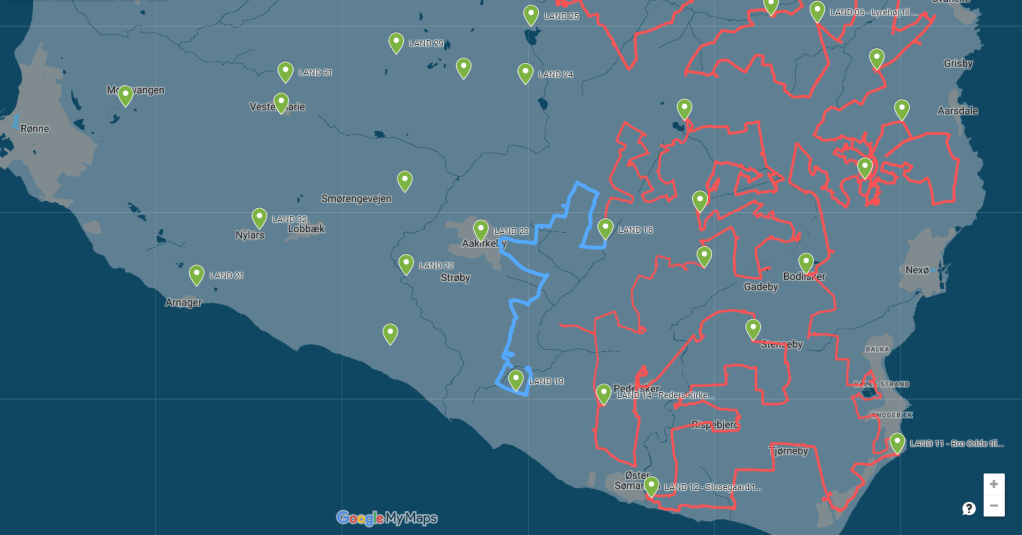
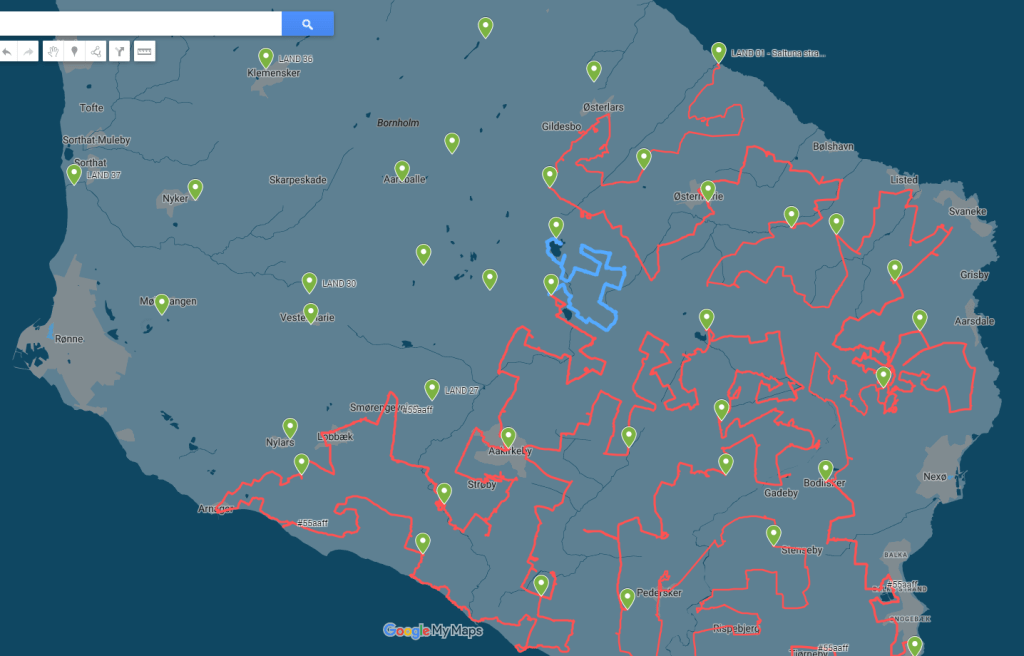
LAND 25 – from Bastemose to Ekkodalen, 23.06.23

Denne side på dansk

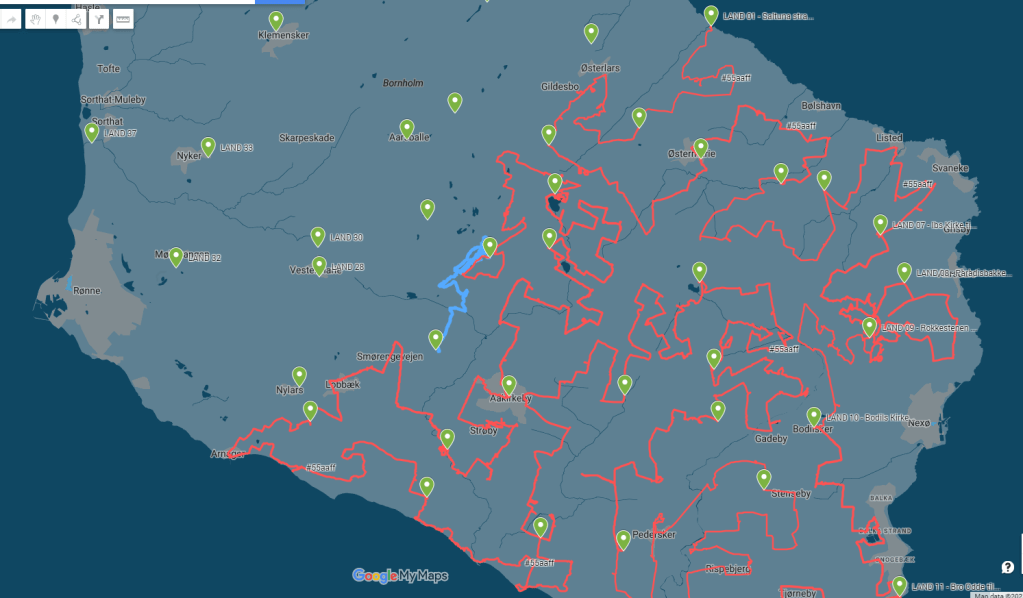
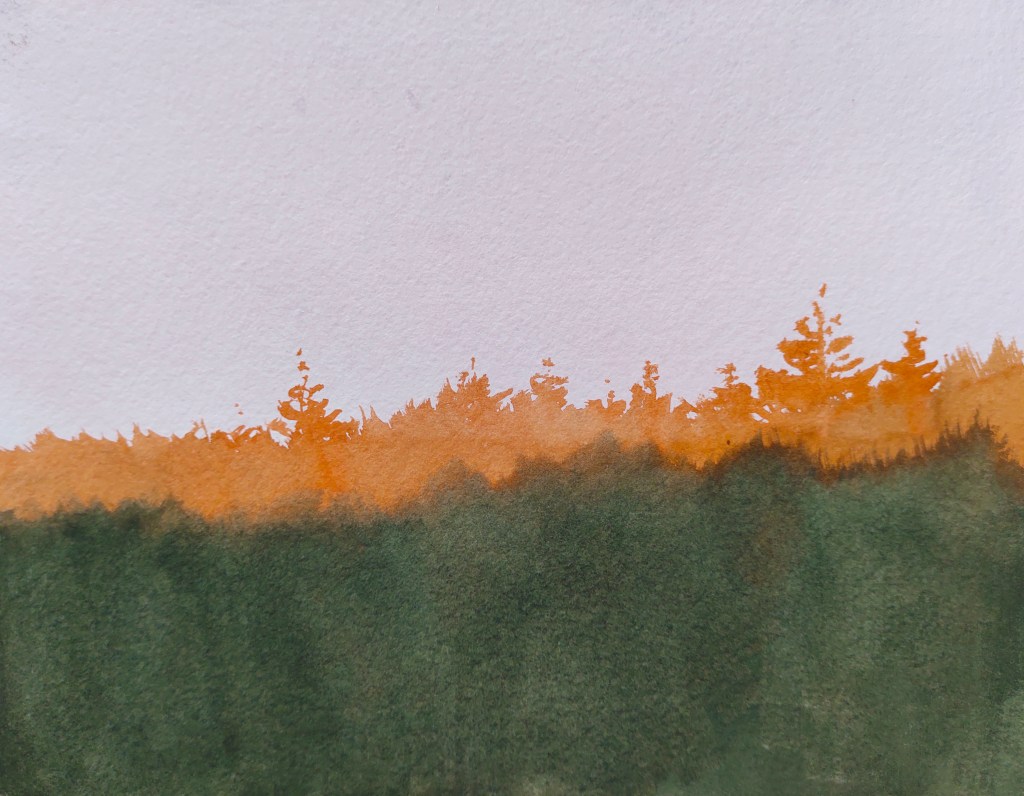
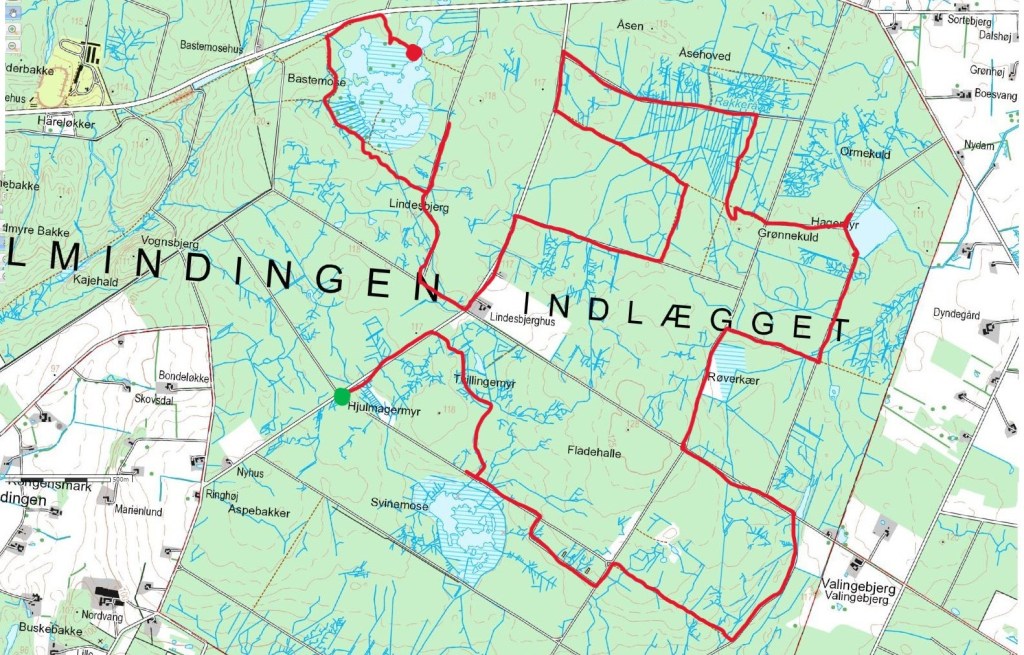
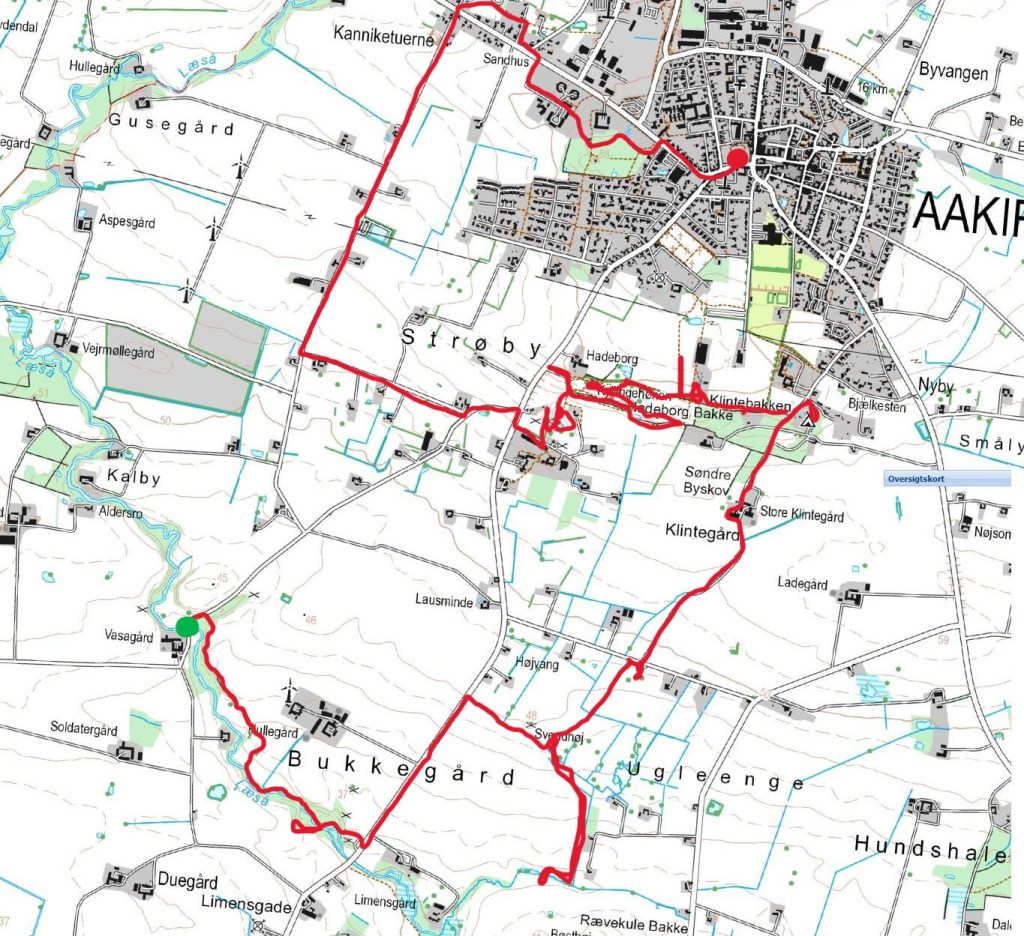
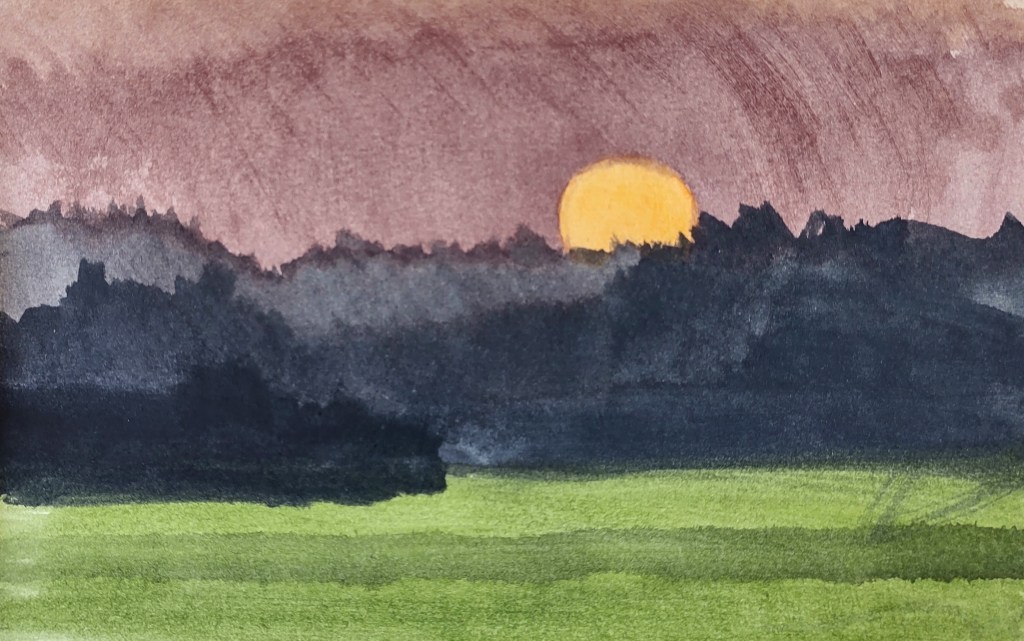
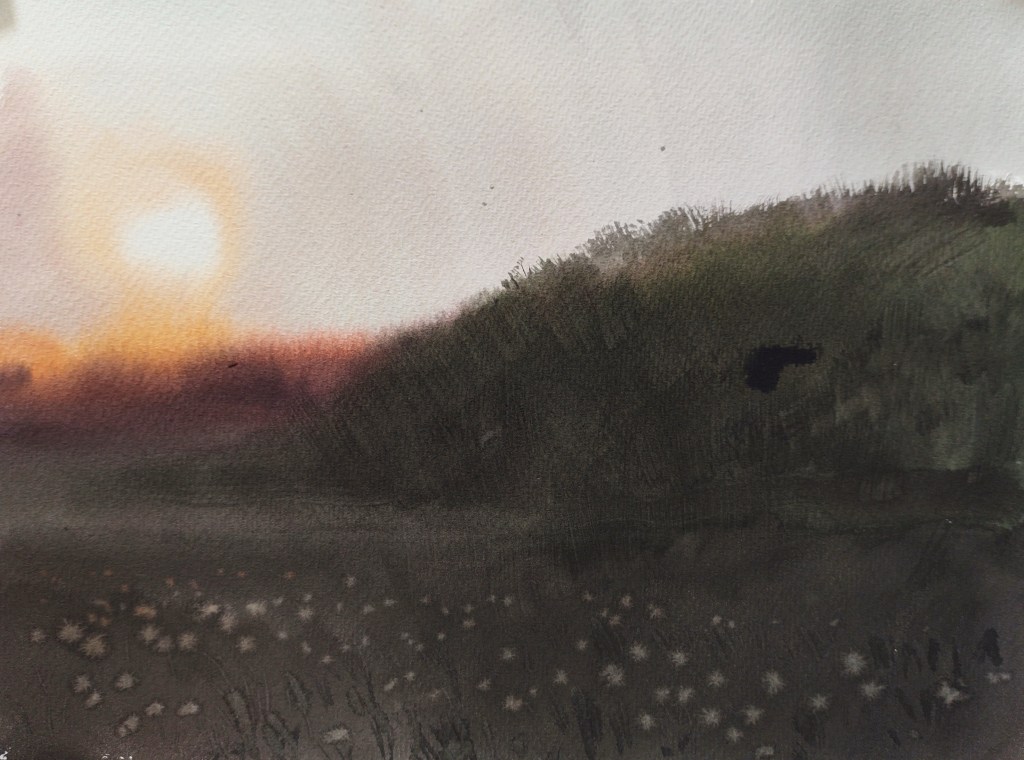
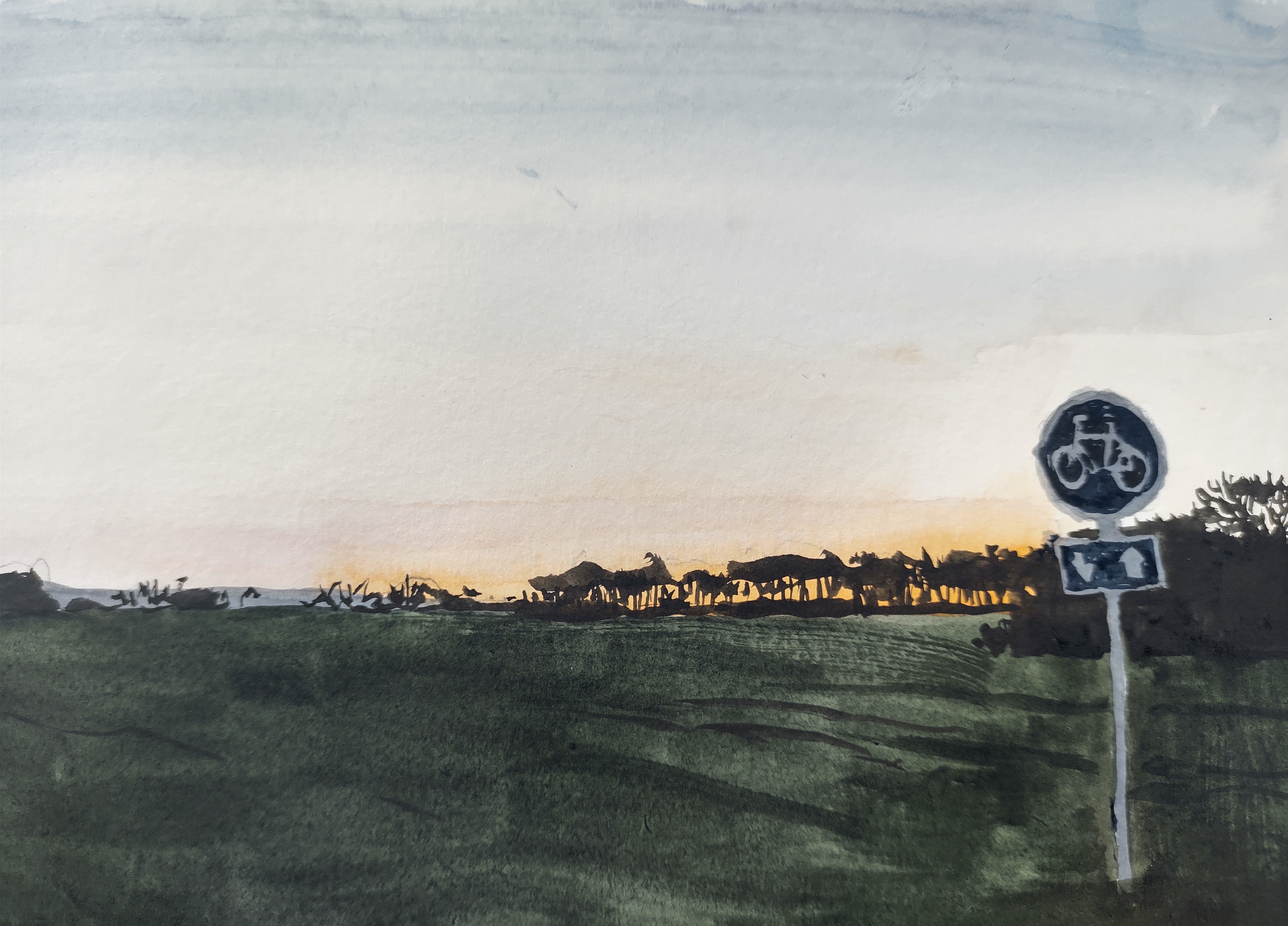
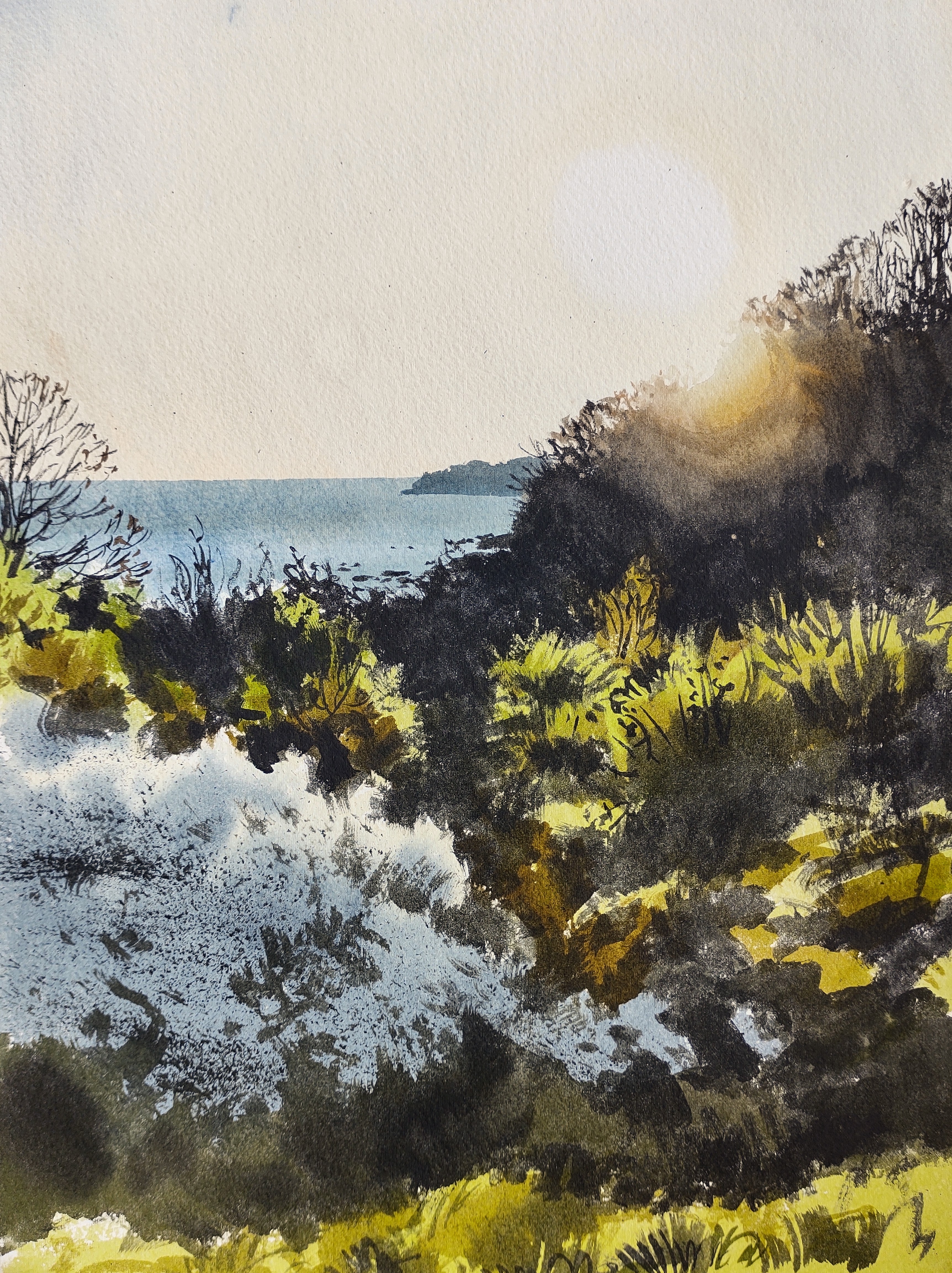
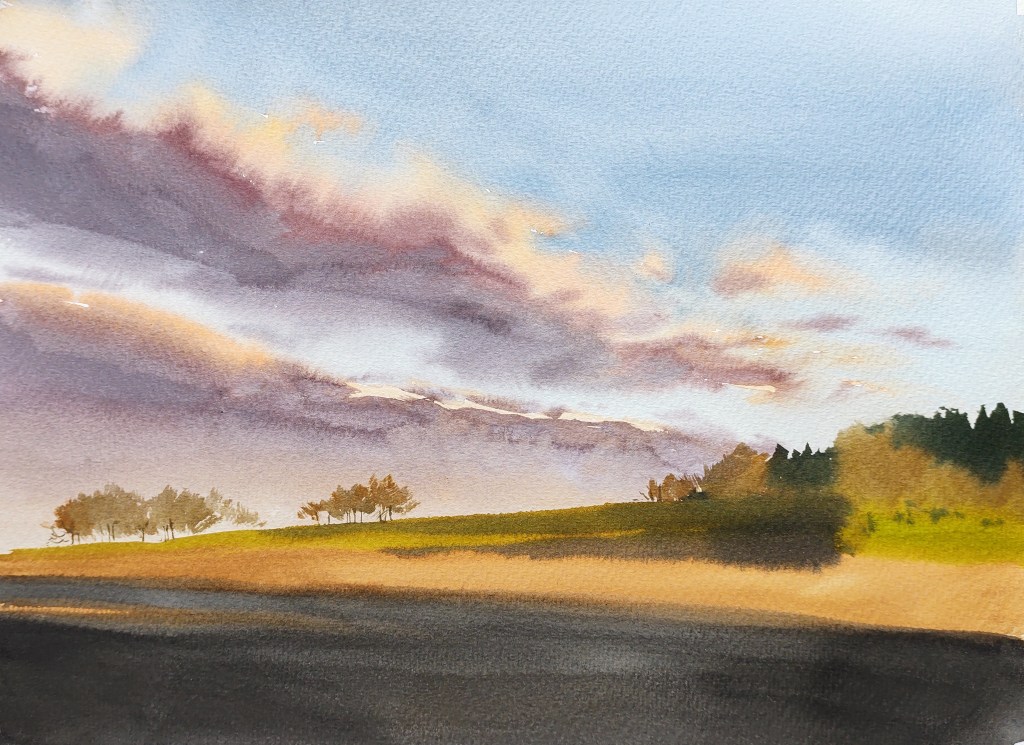
LAND 25 The longest LAND trip of the year. From the top of the lookout tower at Bastemose I gazed out over the marsh, easing myself into the emerging day and the alternative reality of a LAND trip. It was warm and overcast, a little muggy, and for a moment the rising sun shone through a gap in the clouds and lit into the tops of a distant stand of trees a fiery orange, before disappearing again.

Sunrise, Bastemose

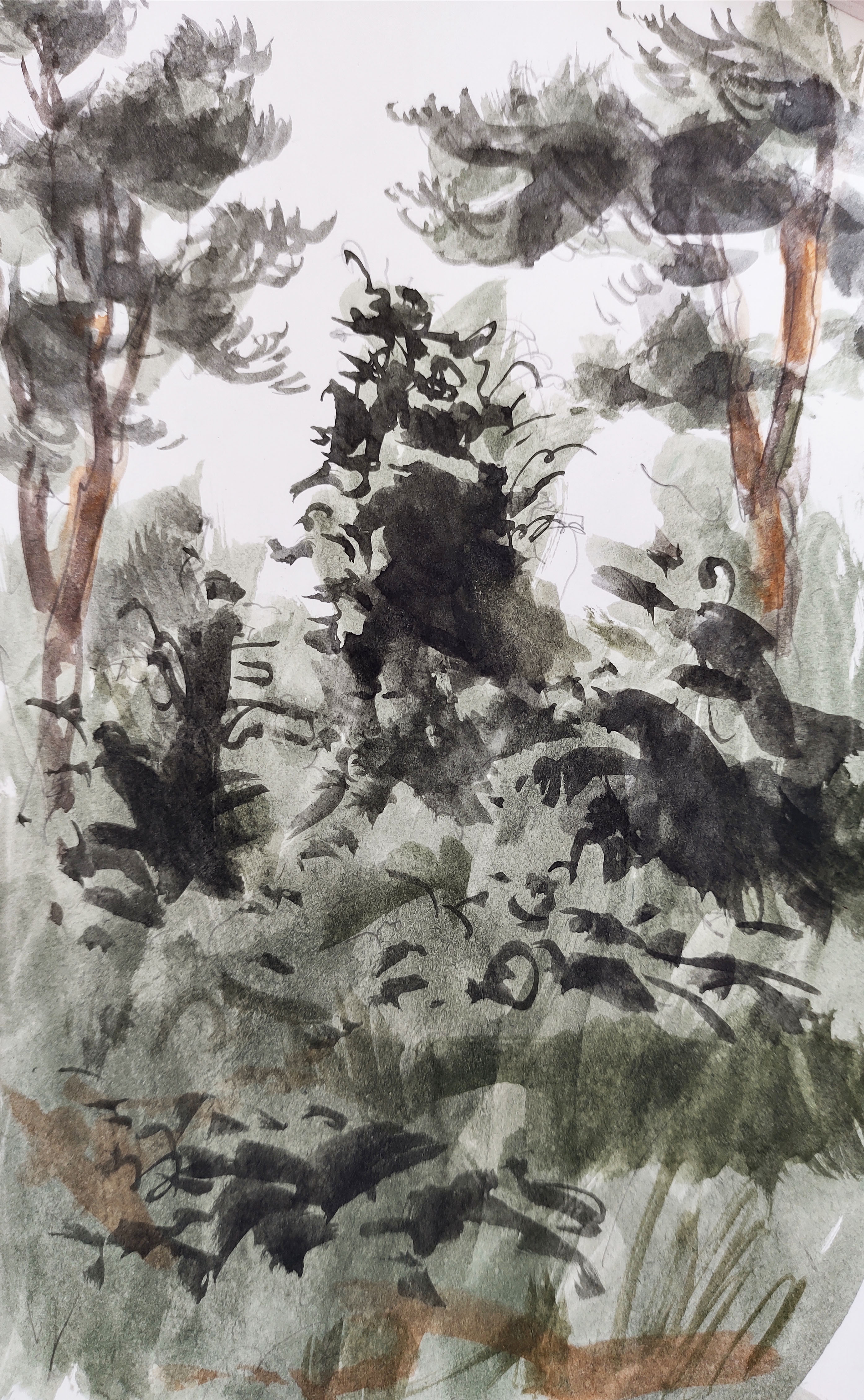
After a good deal of contemplation and reflection, I stumbled around the edge of the marsh, along an overgrown path that was fast being reclaimed by nature. I ended up back on the main road, and then headed into the northern part of the central forest. Paths that I knew from only a few years ago existed no more with new ones in their stead. I took an alternative route through the wood, bent over and swatting mosquitos and cobwebs out of my face. Eventually I arrived at one of Bornholm’s many forest shelters, where I rested for a while.

Iglemose

On the road again, I passed by the juniper wood, a small fenced off area grazed by livestock, which resembles how much of the central area of Bornholm would have looked before the plantations were established in the 19th century. Here was more space and a welcome respite from the mosquitos.

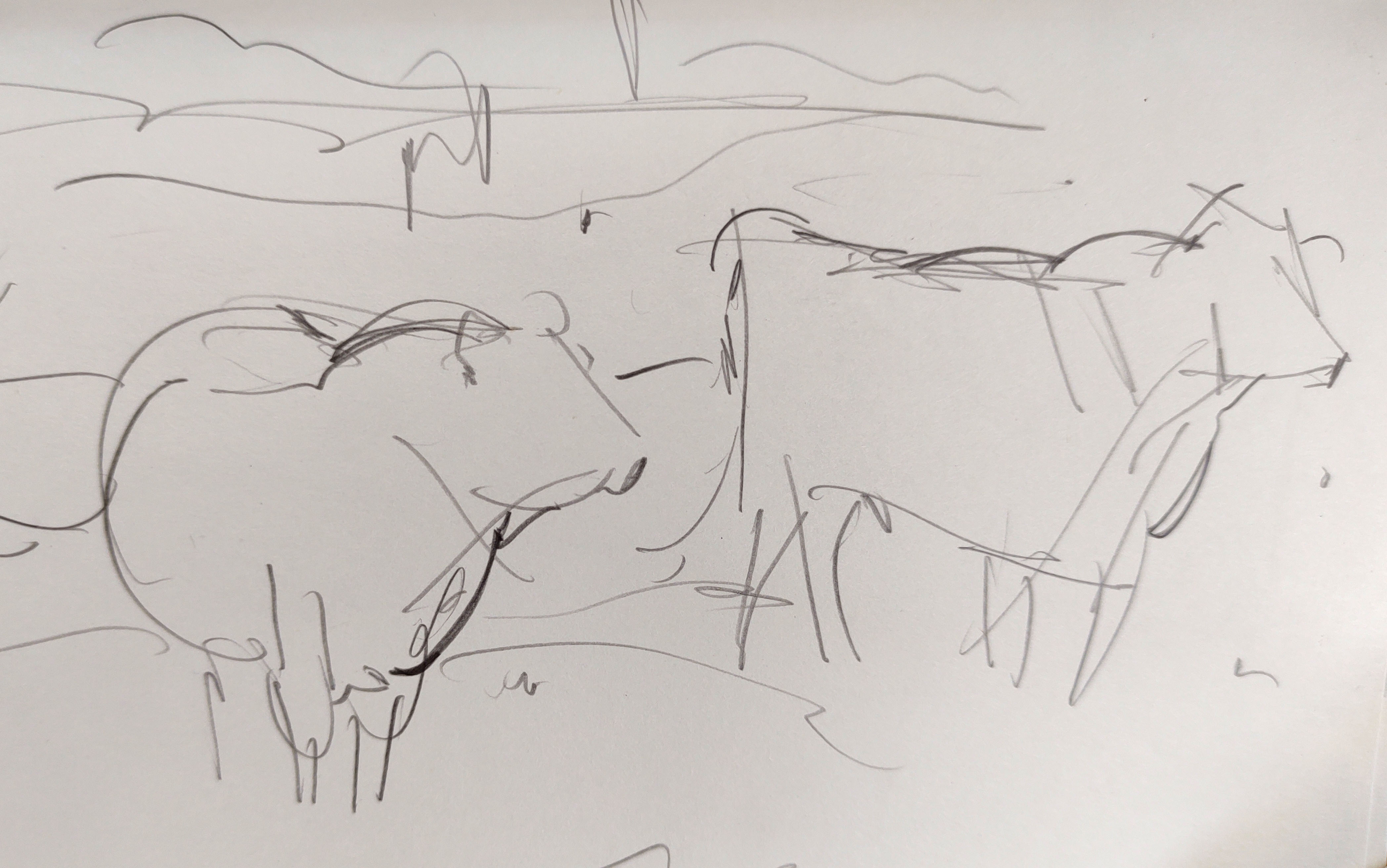
I walked on through the forest, but I struggled to connect with my surroundings. I felt burned out and lacked enthusiasm. I tried not to fight it, but instead just enjoy the walk. I met some cows.

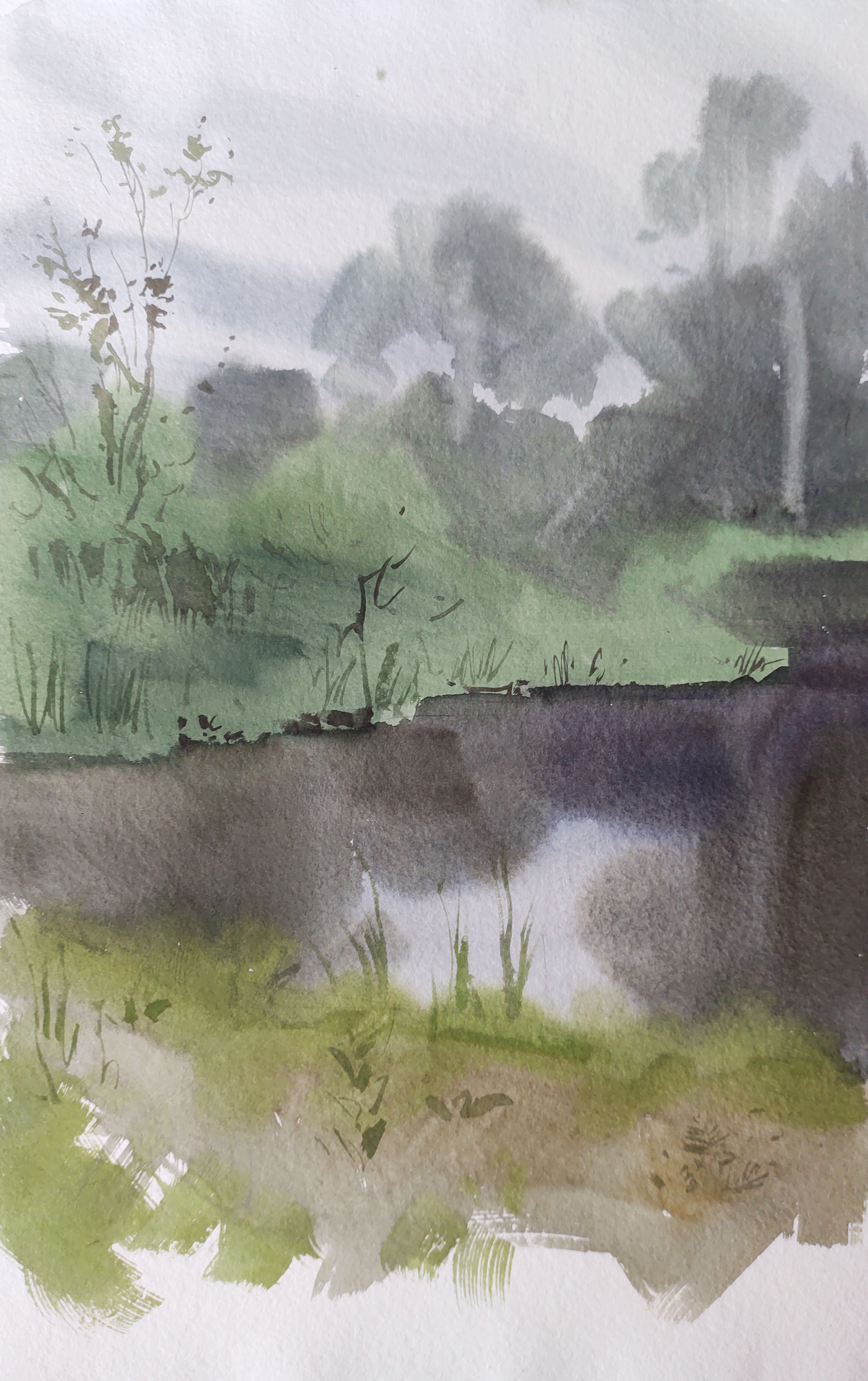
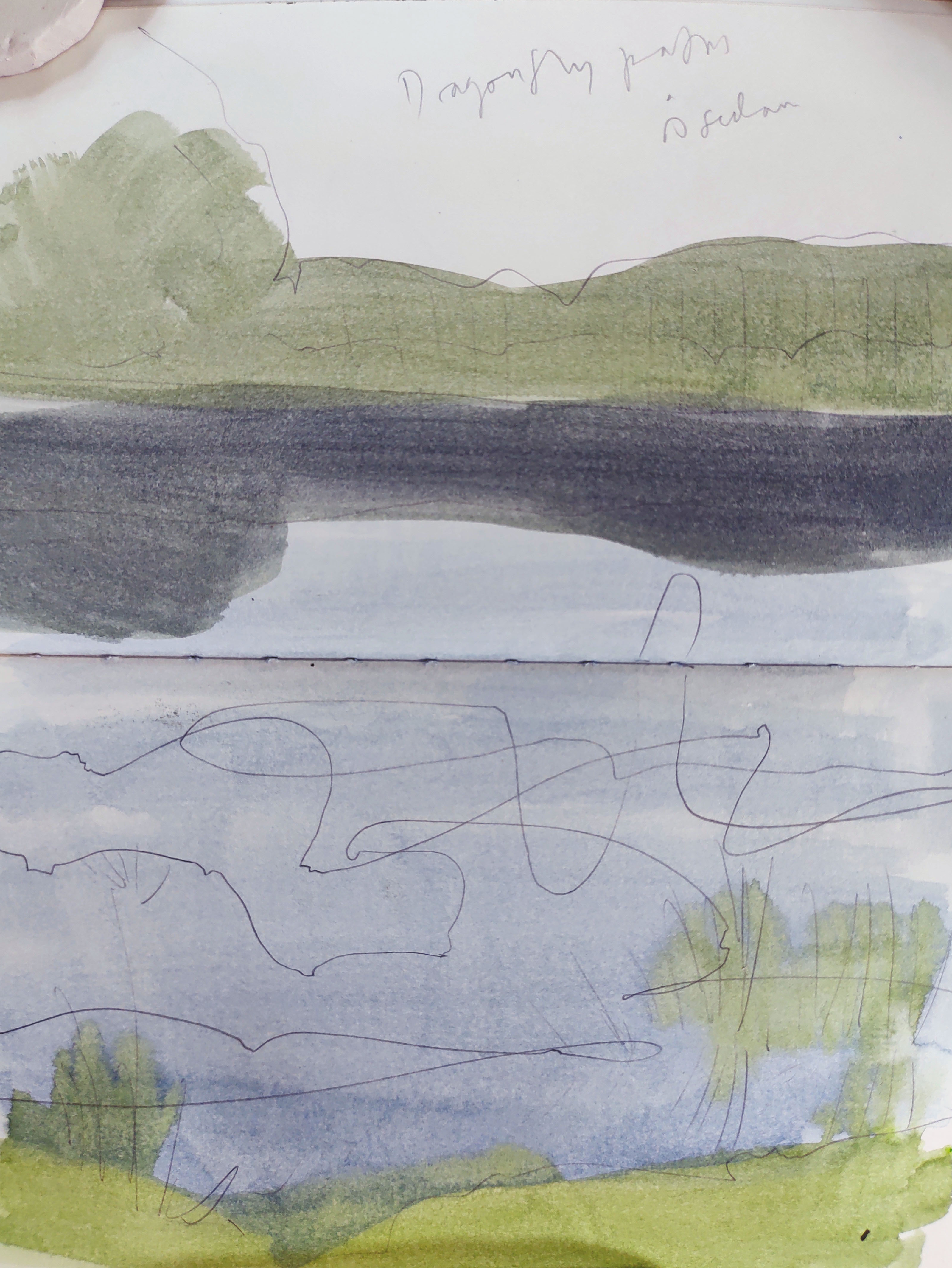
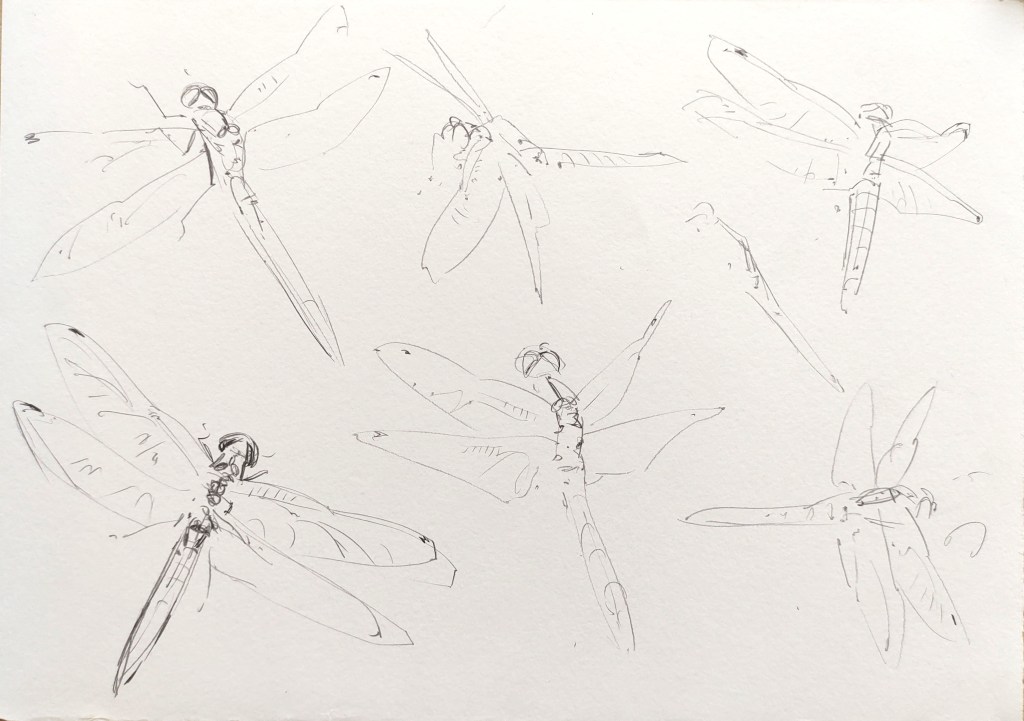
I stopped for lunch by the side of Åsedamme, a small handsome lake popular with fishermen. On the margins dragonflies of all shapes and sizes whizzed about.

Åsedamme
Dragonfly tracks, Åsedamme

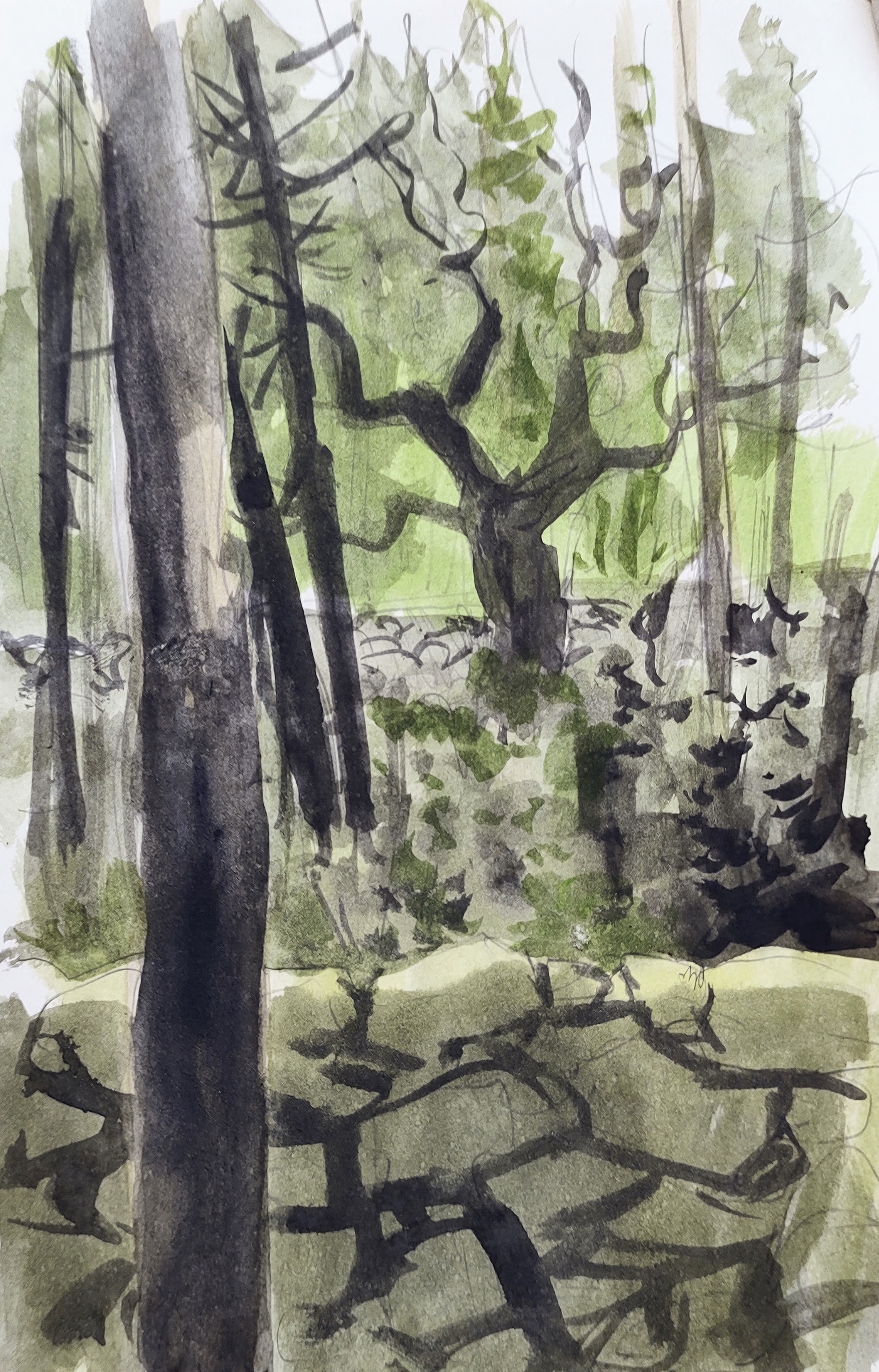
More contemplation and reflection. The day felt dreamlike – as if everything was paused. Not too hot, or too cold, with just a little wind. I carried on through the woods, passing through the playground where I had spent so much time with the kids when they were still young. I was very aware of how much things had changed – how trees had grown, ponds had dried out, and paths had been swallowed up.

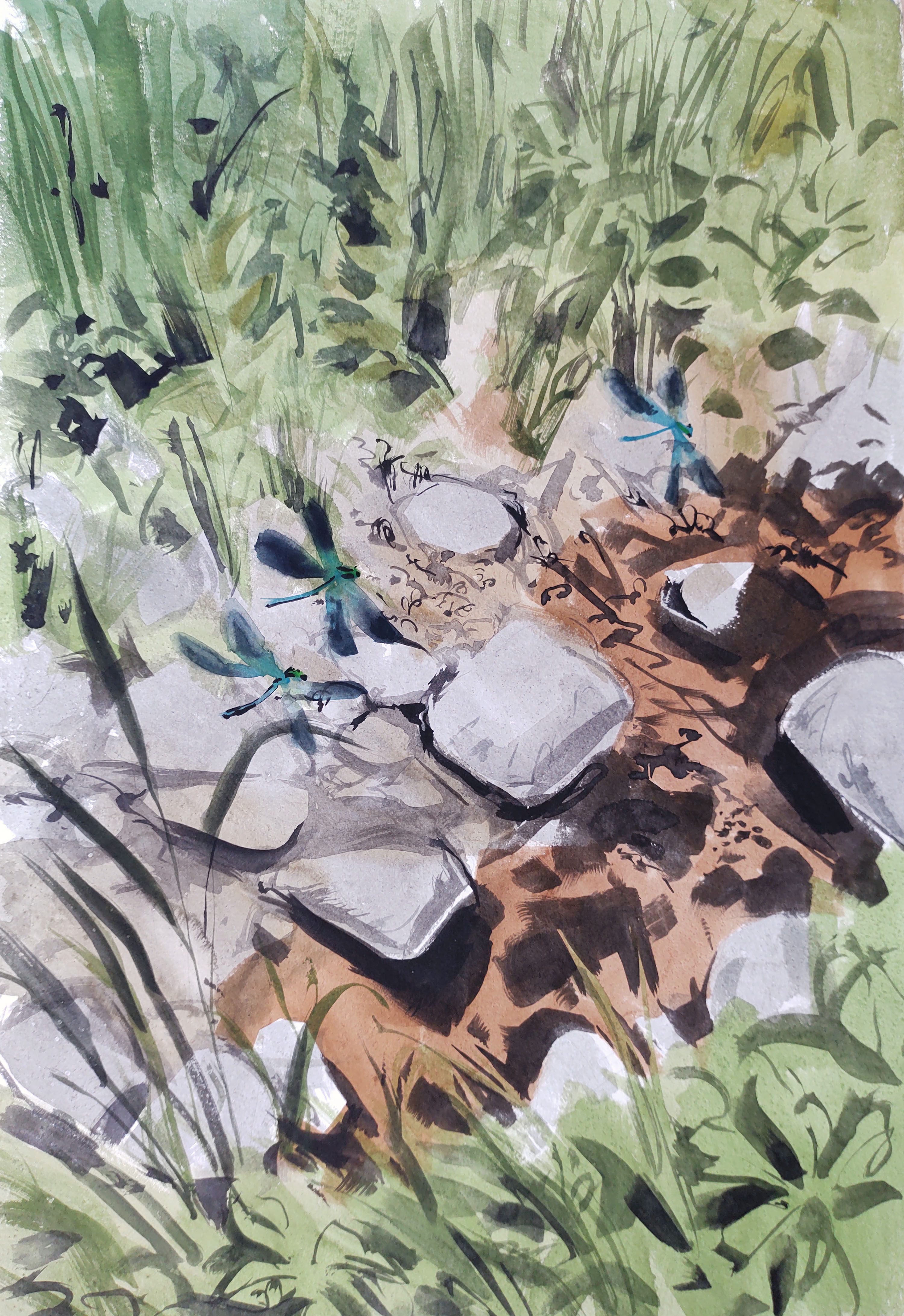
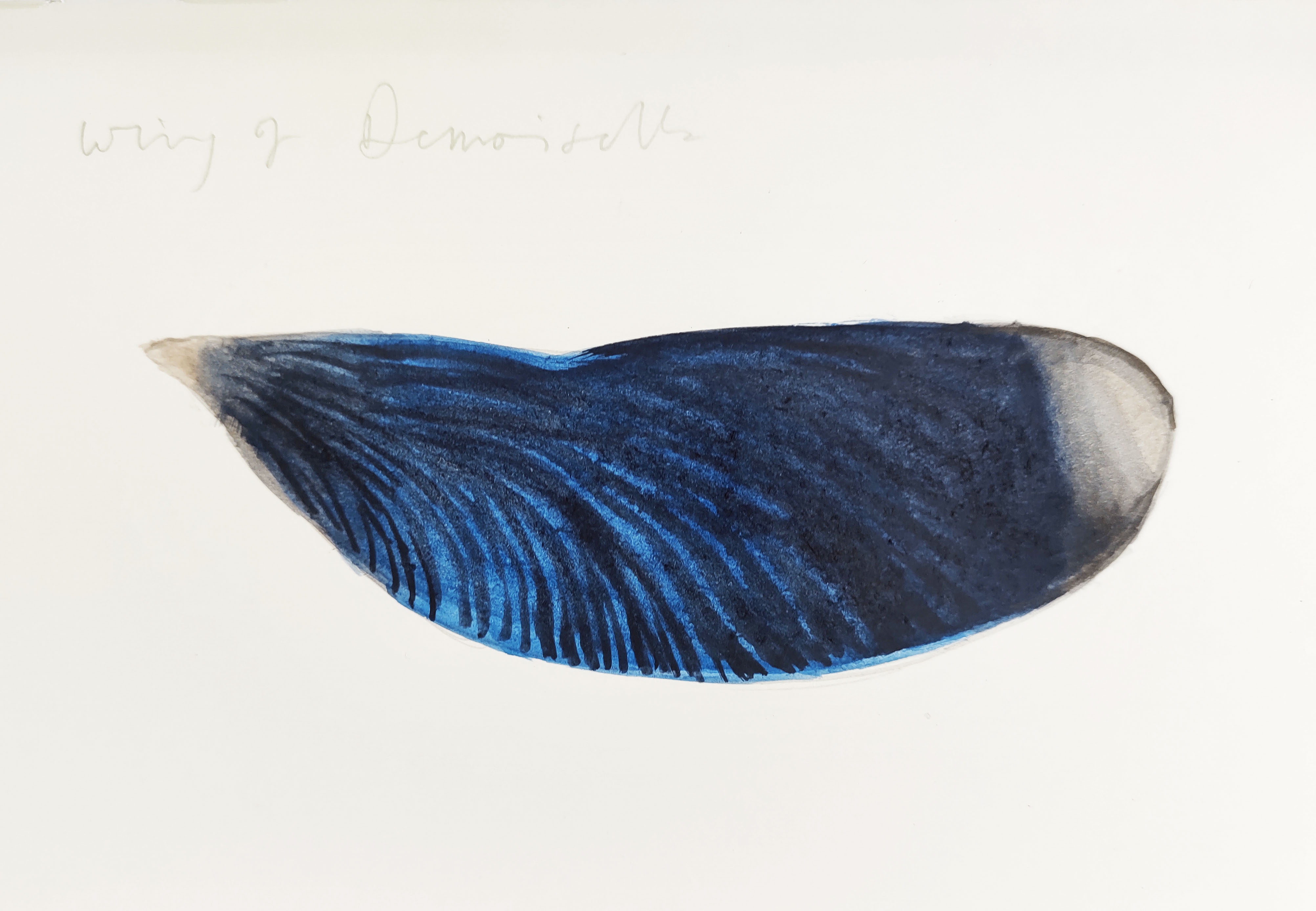
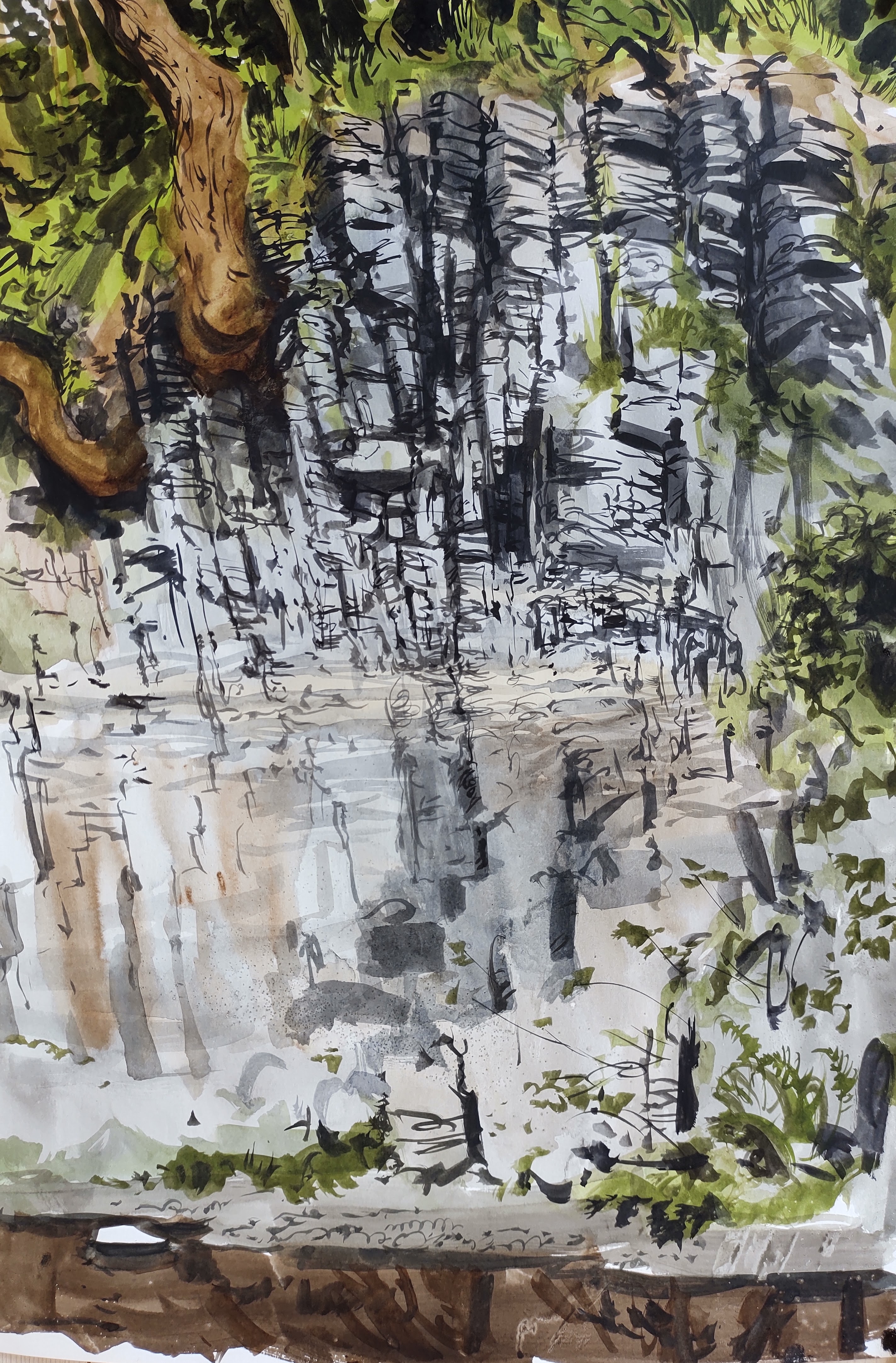
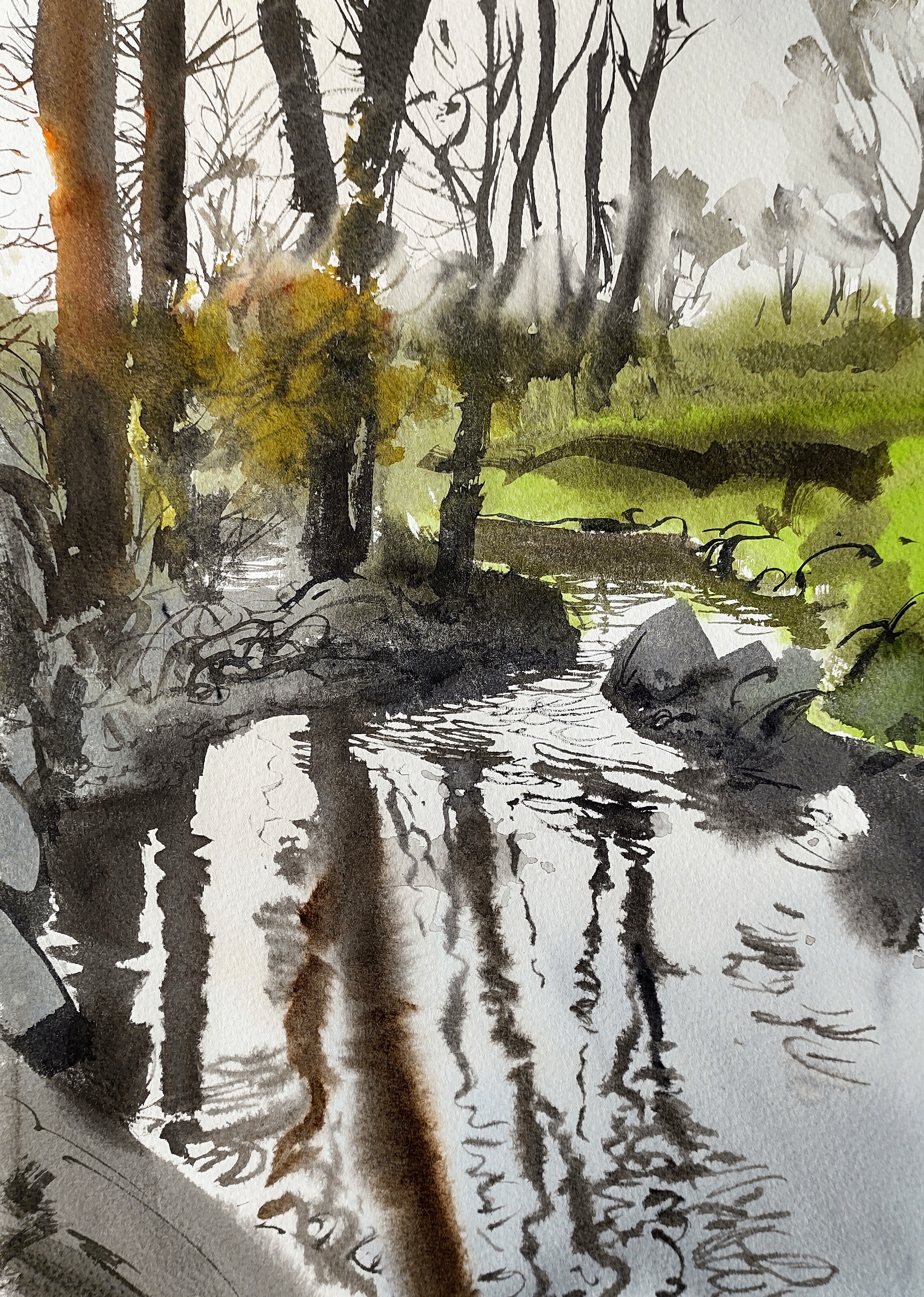
I followed the Læs stream down through Grønnevad, just a trickle now. For a long while I was captivated by a group of Beautiful Demoiselle, the gaudy metallic blue and green males flitting around flamboyantly, chasing and displaying to the more soberly attired females. 

Demoiselles

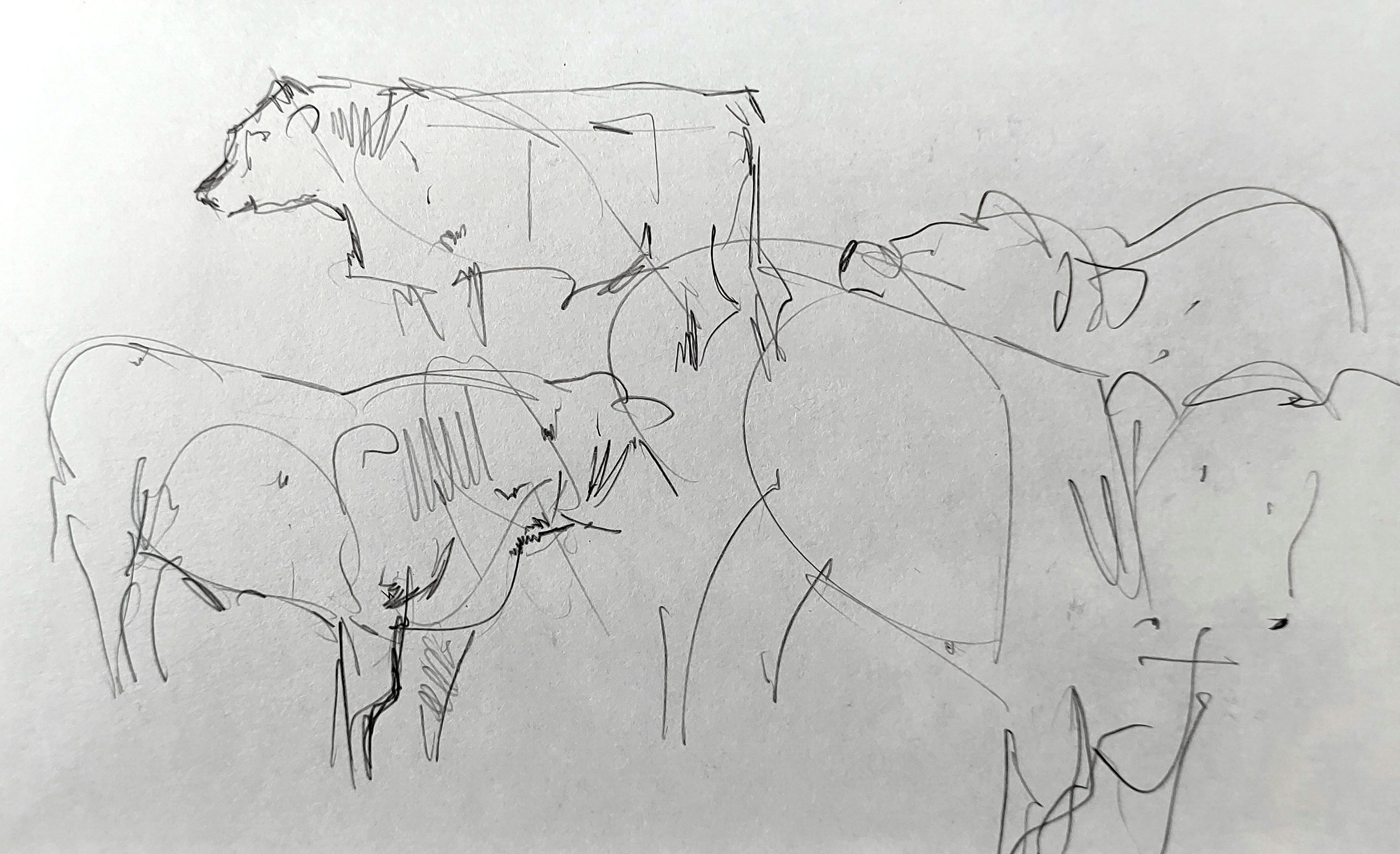
I trudged on, glad to meet some friendly faces and emerge from the woods into the fieldscape again.

Cows, Grønnevad

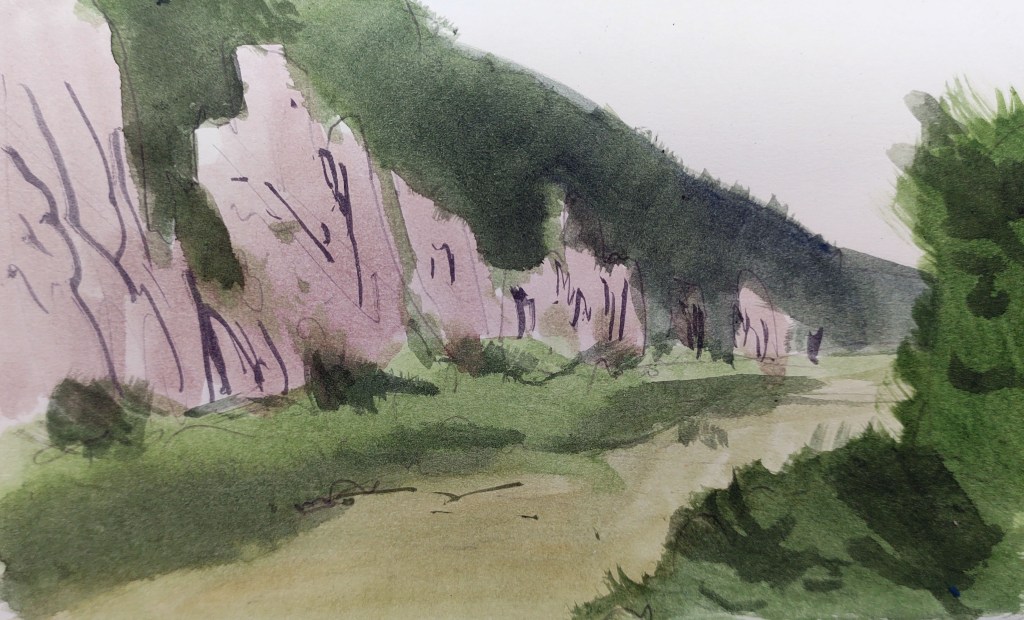
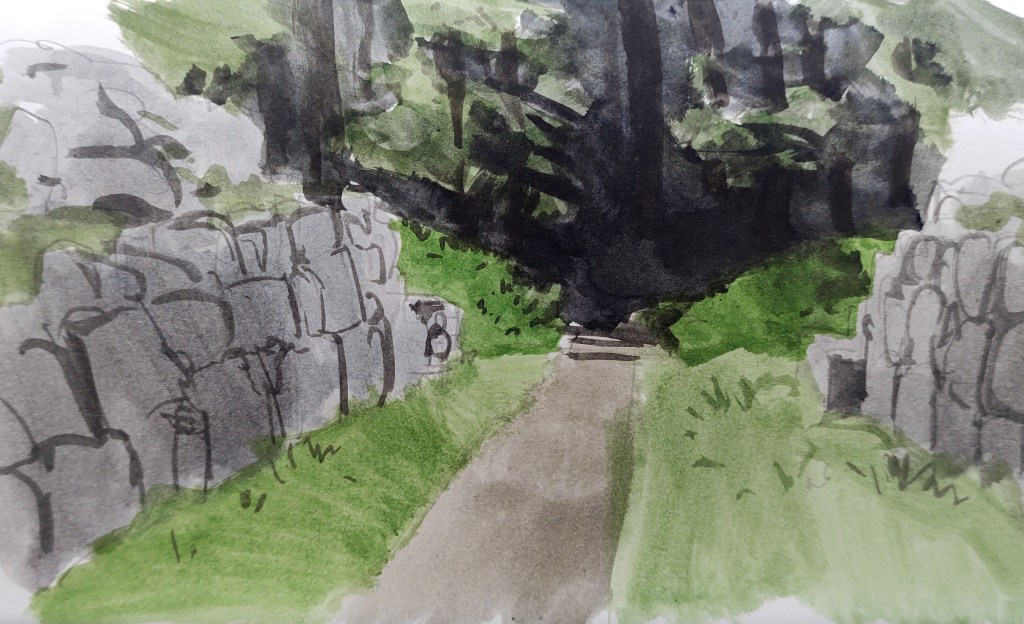
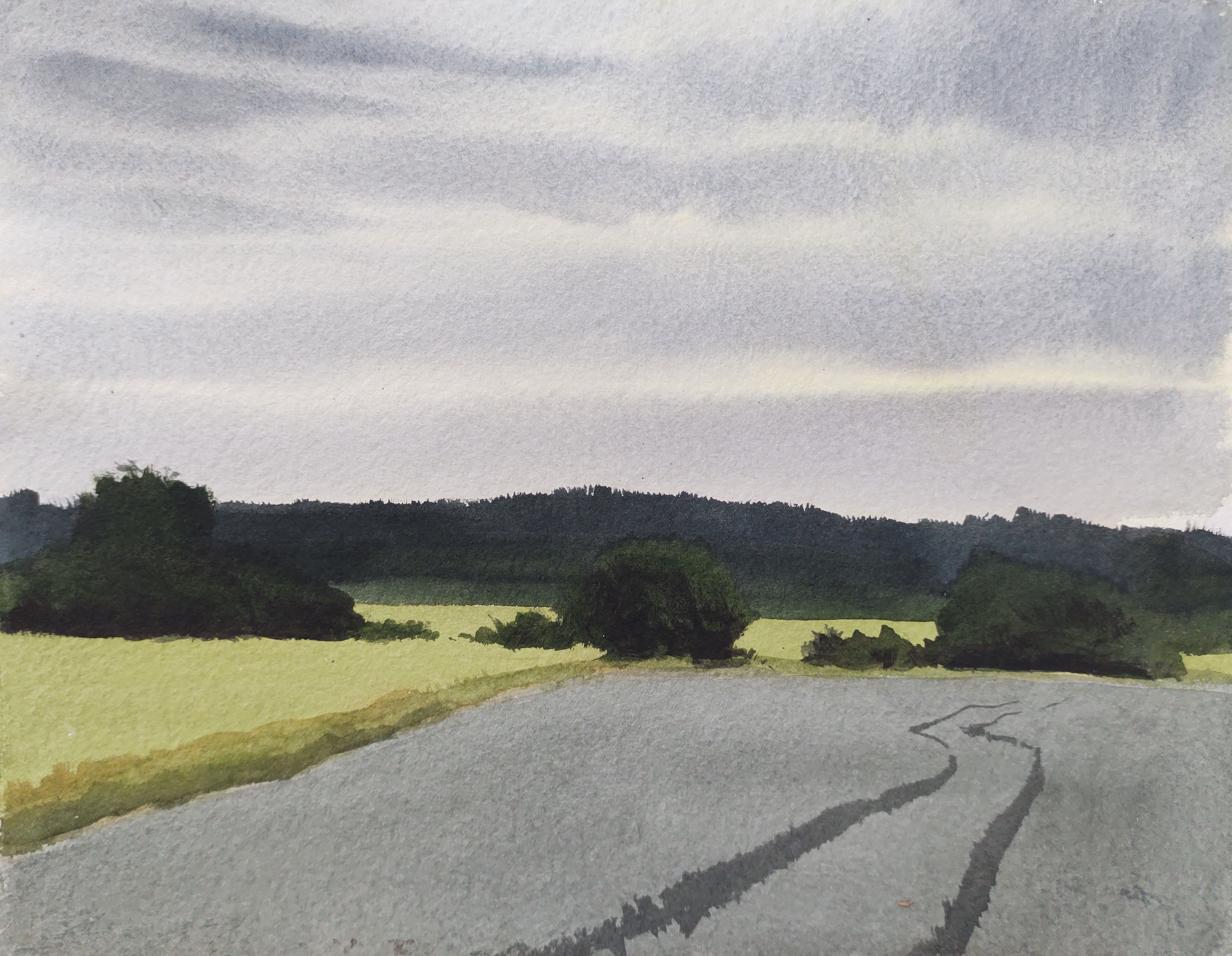
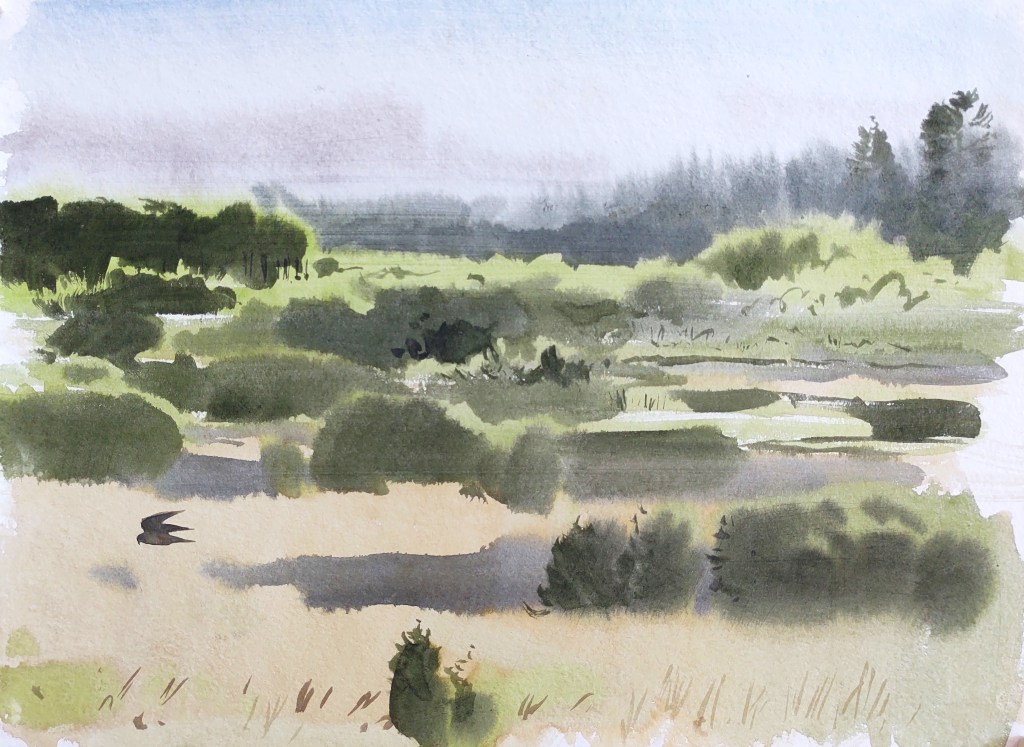
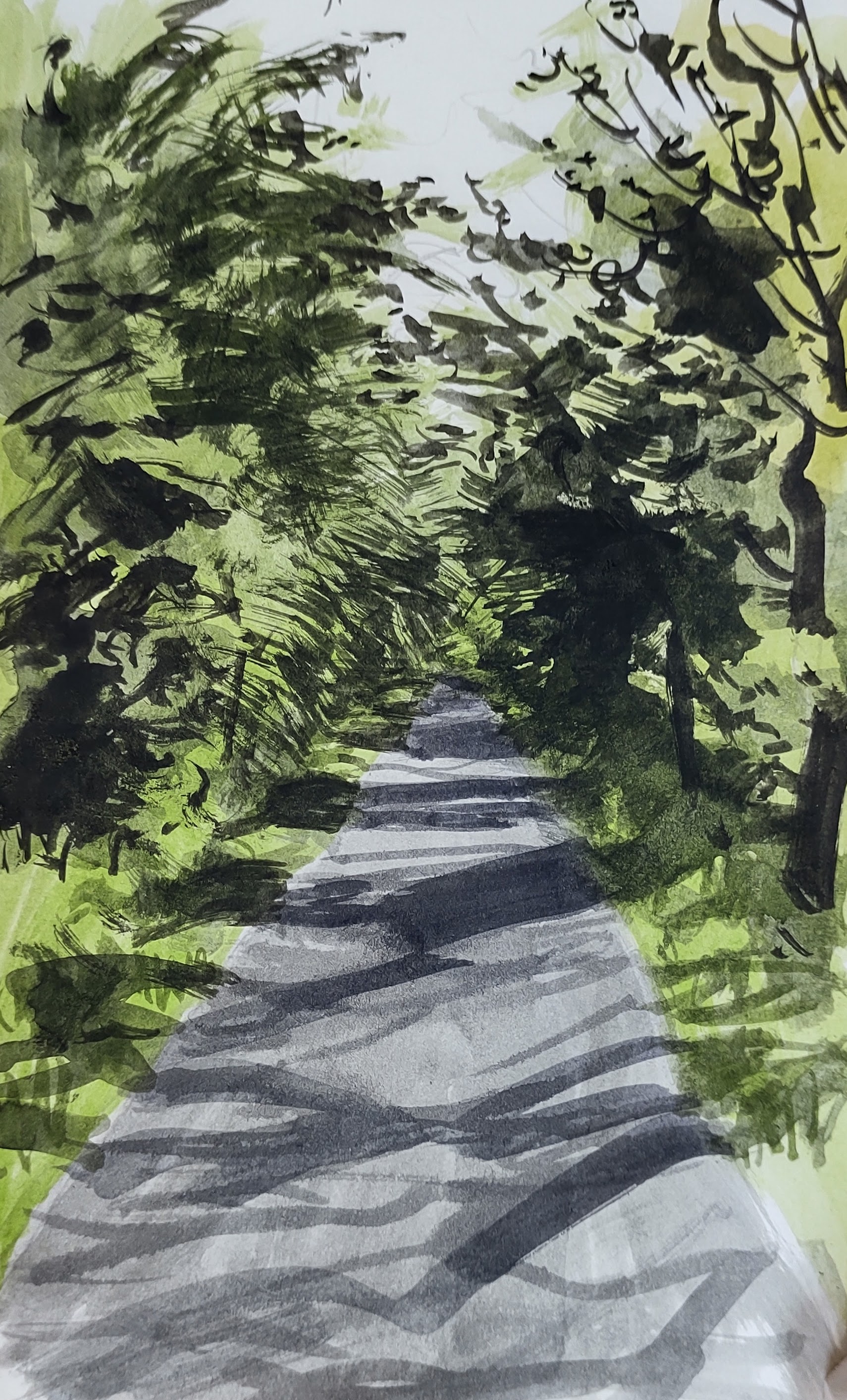
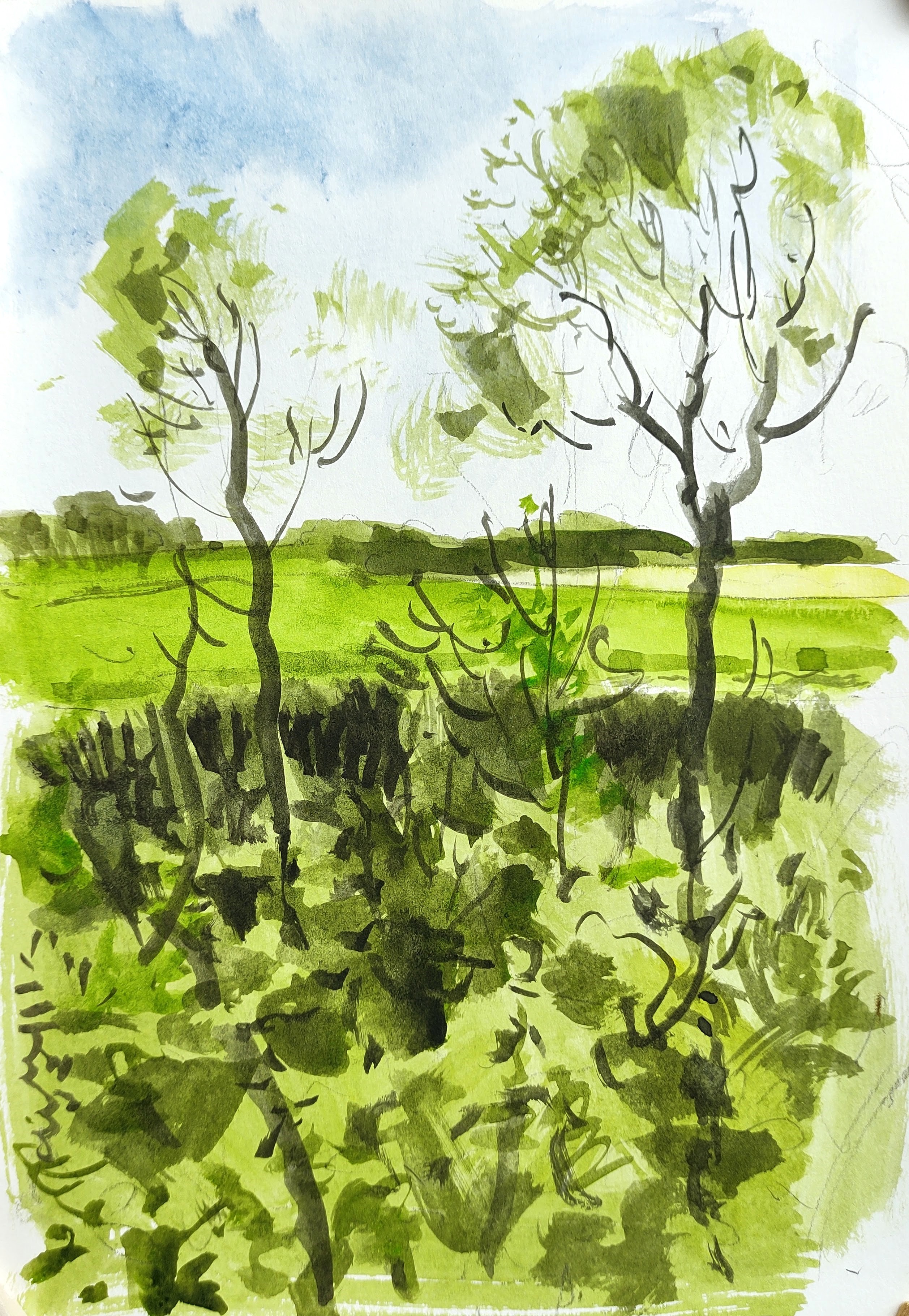
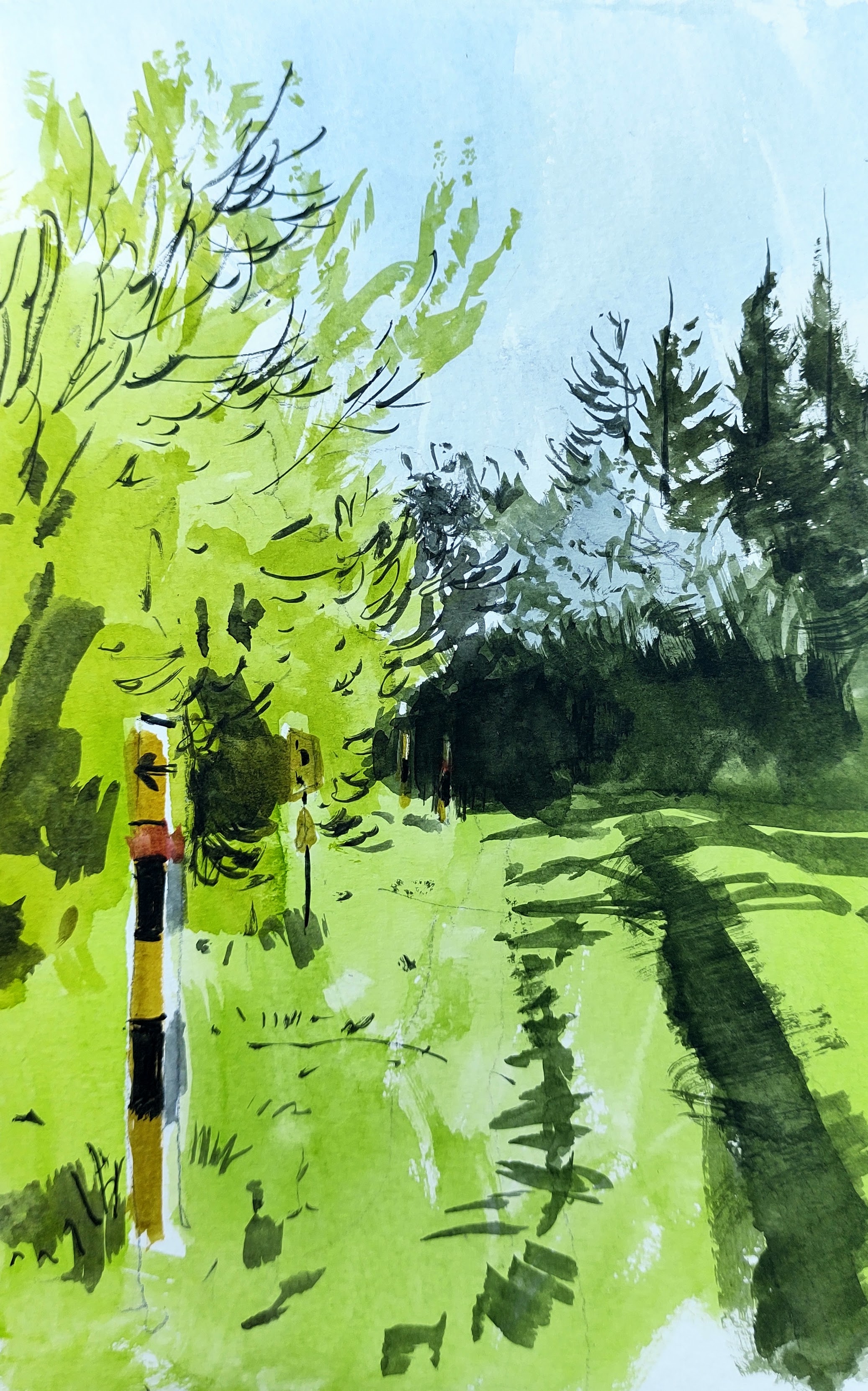
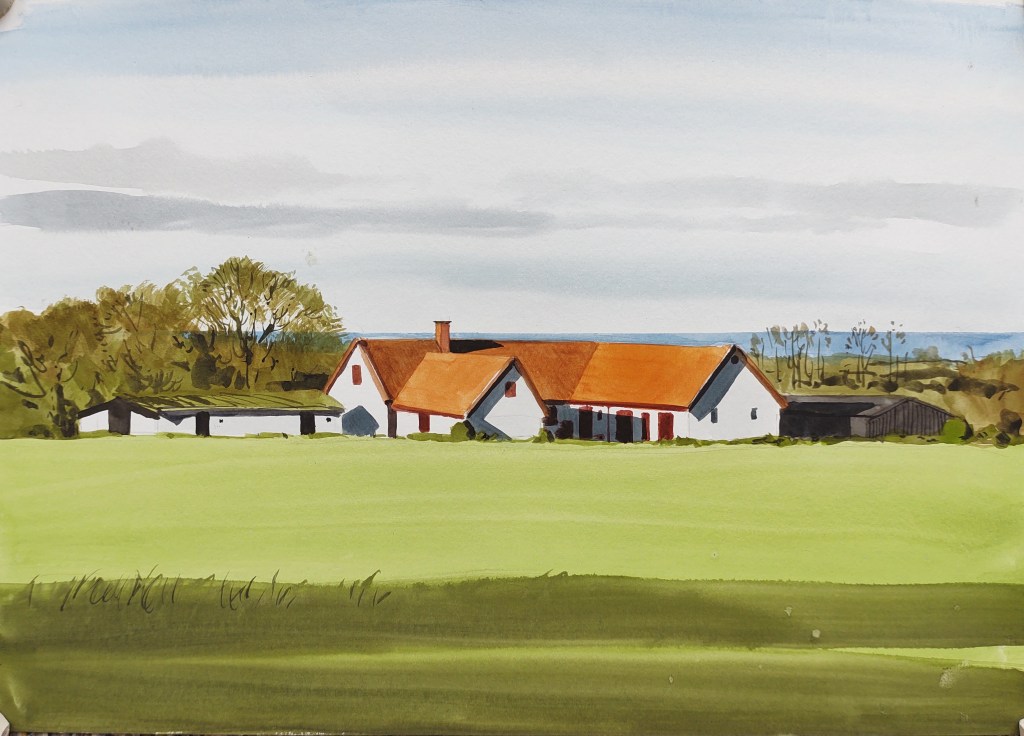
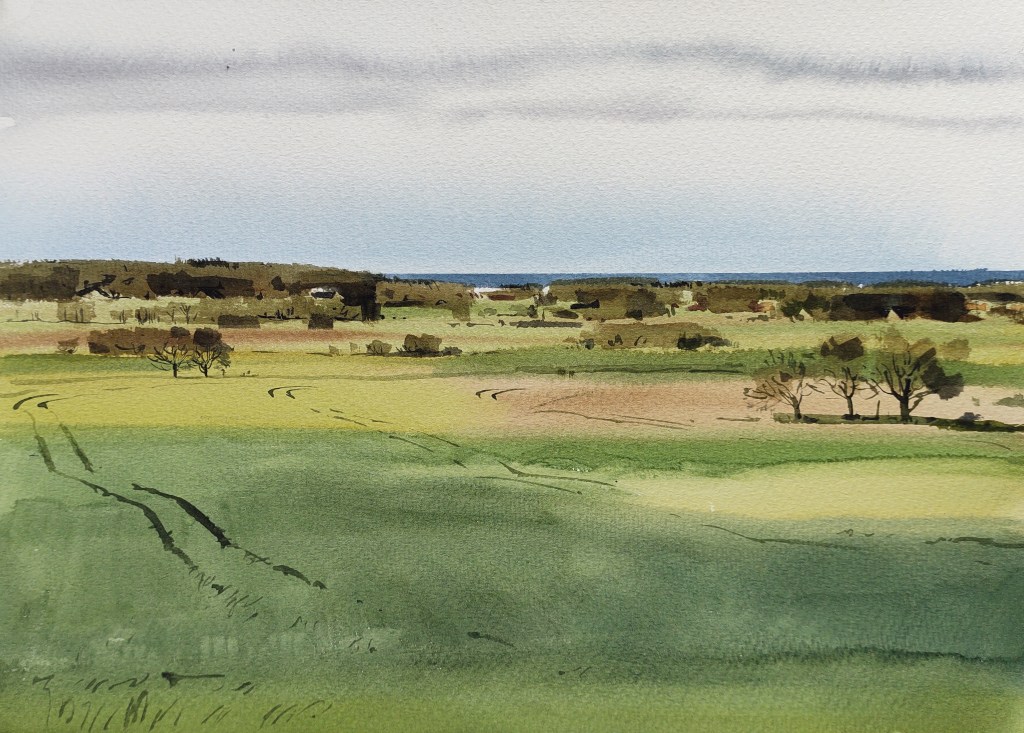
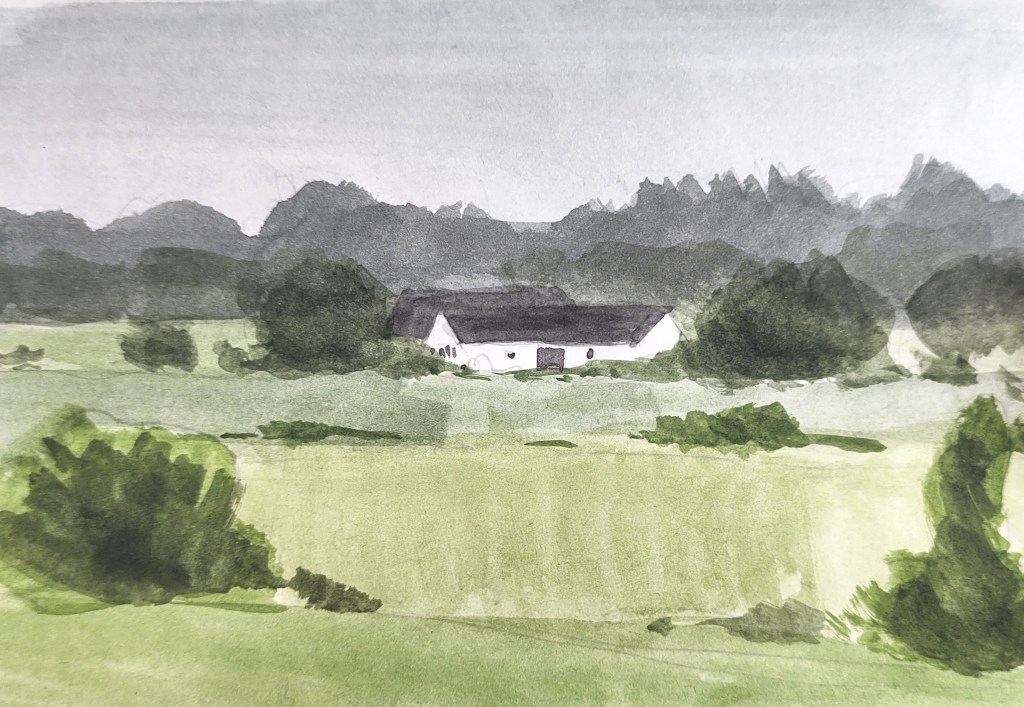
I walked along a small road towards Ekkodalen. I Looked back towards the forest and all the greens.

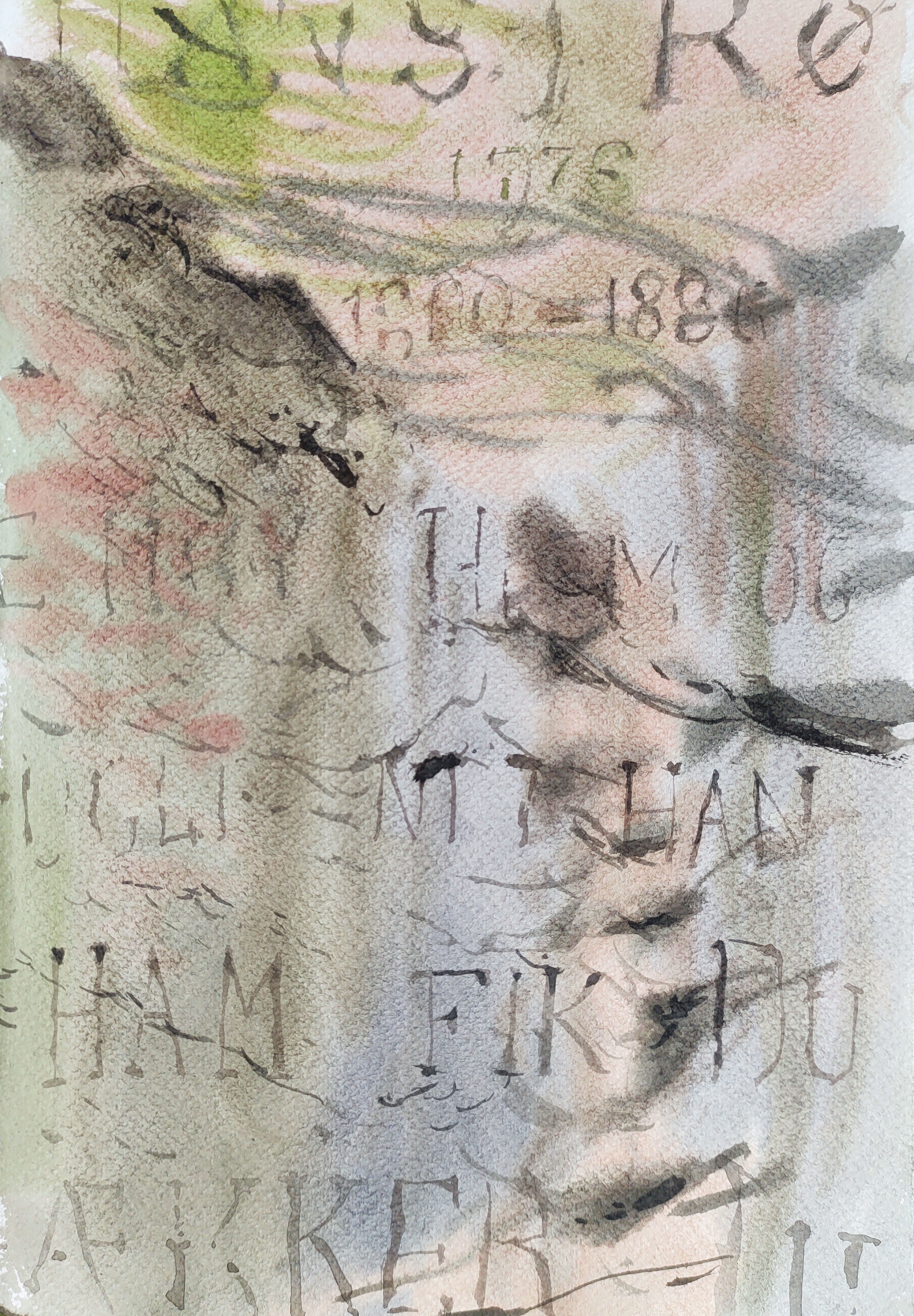
The last few hours were spent rather listlessly, my mojo well and truly absent. As dusk approached, I found myself in the old hunters’ cottage in Ekkodalen, where for some unknown reason I embarked upon a painting of a window. An utterly hopeless end to the day.

Window, Hunters’ lodge, Ekkodalen

Next week (Saturday) I walk in the wonderful Ekkodalen and end the trip at my home – the halfway point of the LAND year.

LAND 25

WEATHER REPORT – overcast most of the day. Temperature 18 – 21 degrees. Wind 1 – 5 m/s, changeable. Hours of precipitation: 0 hours. Hours of sunshine: 4 hours.

STOPS with the BIVVY – 0

KILOMETRES WALKED – 18.37 km

DAY LASTED – 17h and 26 m

PEOPLE TALKED TO – 5

BIRDS SEEN and HEARD – 44 species: 0 new, running total = 117 species

LESSONS LEARNED – Getting better at organising my new rucksack

IN MY HEAD – times past, kids and family, bad dreams, Højskole teaching ‘Blackwater’ (DR series)…

LAND 24 – Svinemose to Bastemose, 16.06.23

Denne side på dansk

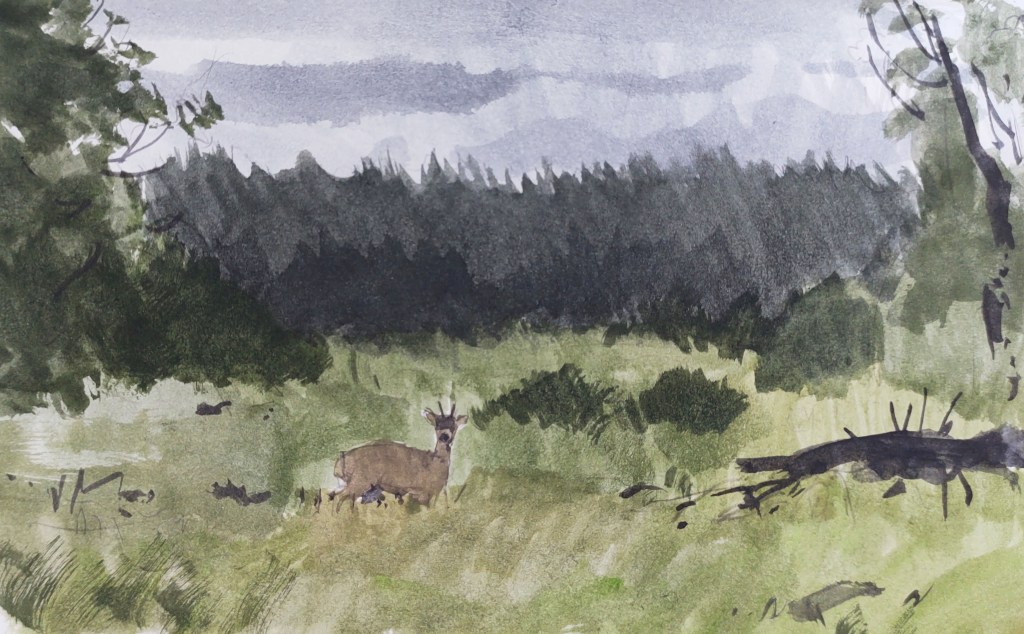
LAND 24 Warm, but not too warm, and next to no wind. Perfect conditions for a LAND trip. I walked into the woods along a well-trodden path. A startled roe deer scream-barked in alarm as I approached.

Roe deer at dawn

I was in the bison enclosure again. After my daughter dropped me off, I watched as she paused the car to let a bison cross the road in front of her. It was to be the first and last bison I saw all day, but their presence was both seen and felt. Many tree trunks bore scars where bison had scraped off their bark, and the forest itself was being trimmed and shaped by their activities. Though unseen, the forest and the paths buzzed with the possibility of their being, and my eyes constantly scanned every shadow and shape in between the trees.

In other areas of the forest, trees had been purposefully damaged or felled by the forestry commission to encourage biodiversity, and this transition from a commercially viable plantation to a recreative/biodiverse forest was to be a theme of the day. My route took me through some of Bornholm’s most diverse forests and wetlands – an area that will soon be given the elevated status of a National Park.

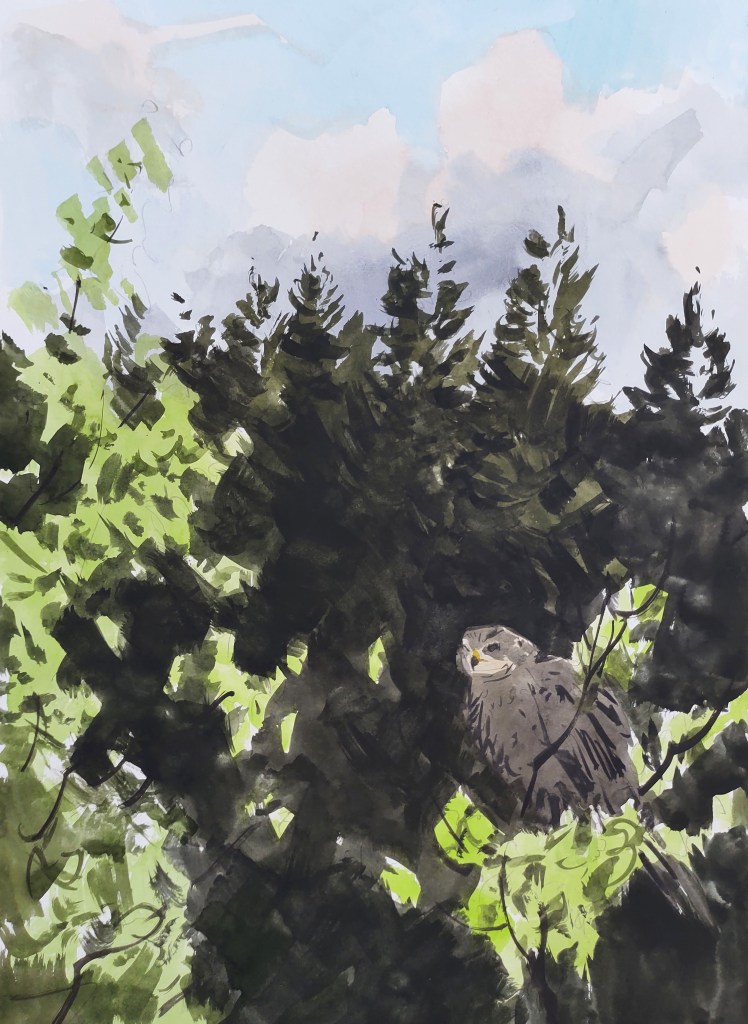
Marsh harrier, Svinemose

I left the enclosure and continued my route through the forest, sometimes walking along narrow roads and tracks, sometimes following neglected pathways – wading through waist-high grass and ducking under the boughs of fallen trees. For hours and hours, I was completely and utterly alone, bathed in dappled sunlight and surrounded by bird song and the heady aroma of hot pine needles and elderflower blossom. Heavenly indeed.

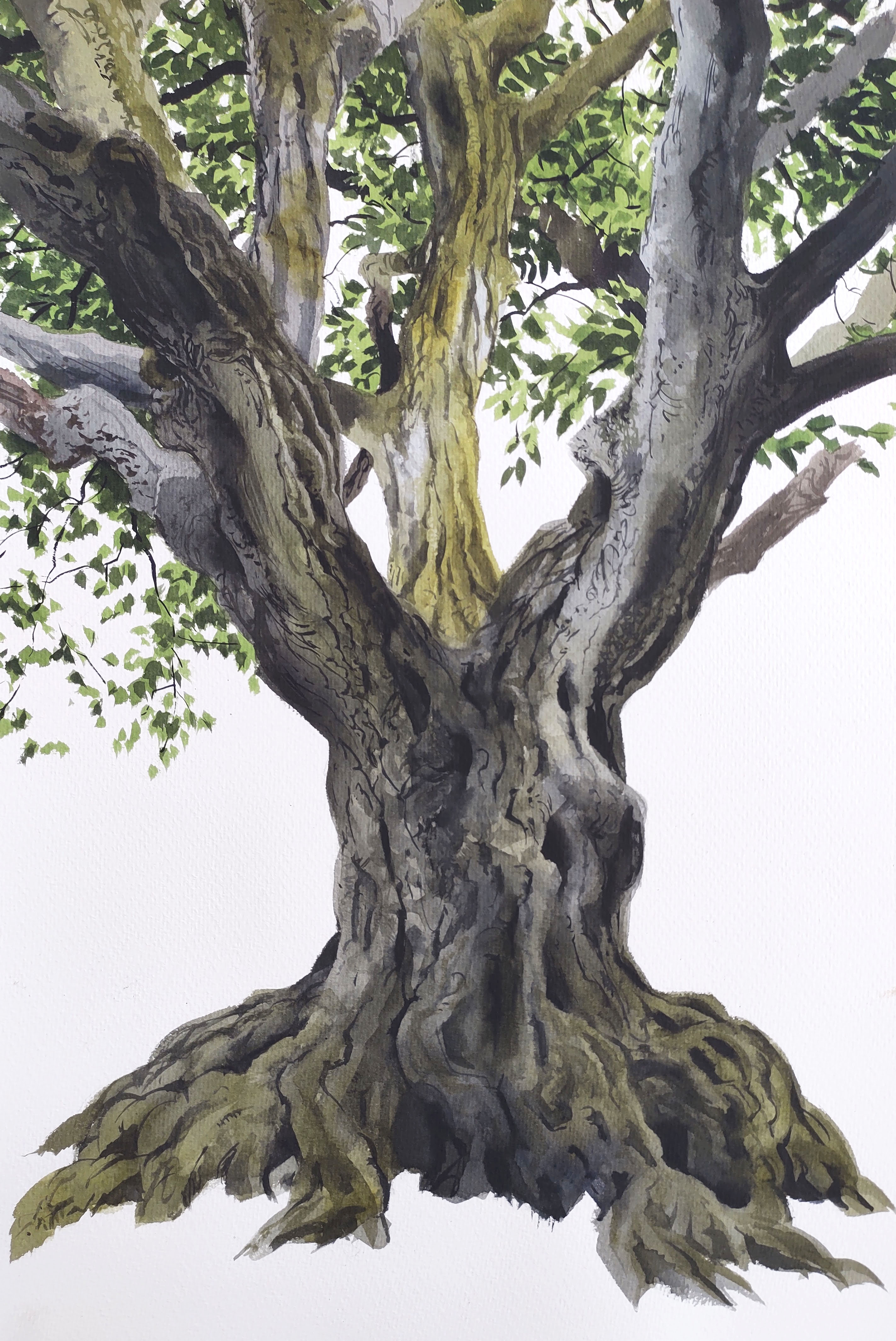
I stopped for a while by ‘Karl Hansens Bøg’ a wonderfully gnarled and twisted hornbeam tree well known to Bornholm’s walkers and cyclists.

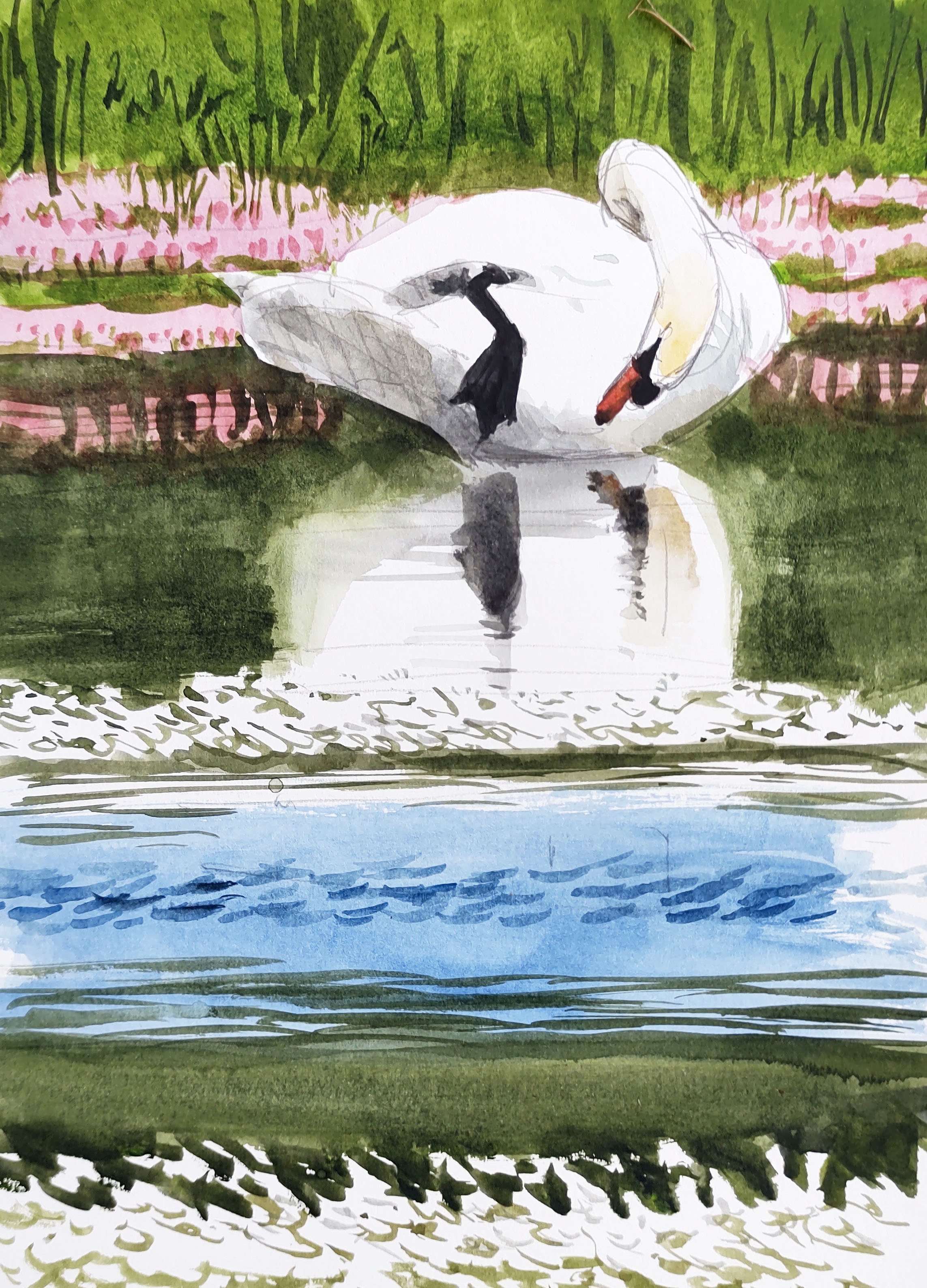
I continued to Hagemyr, a recently restored wetland area. In less than 10 years this area has been transformed and is now home to breeding pairs of red-necked grebe, little grebe, common crane, and red-backed shrike – amongst others. A mute swan preened itself in the shallows close to the reed beds.

Mute swan, Hagemyr

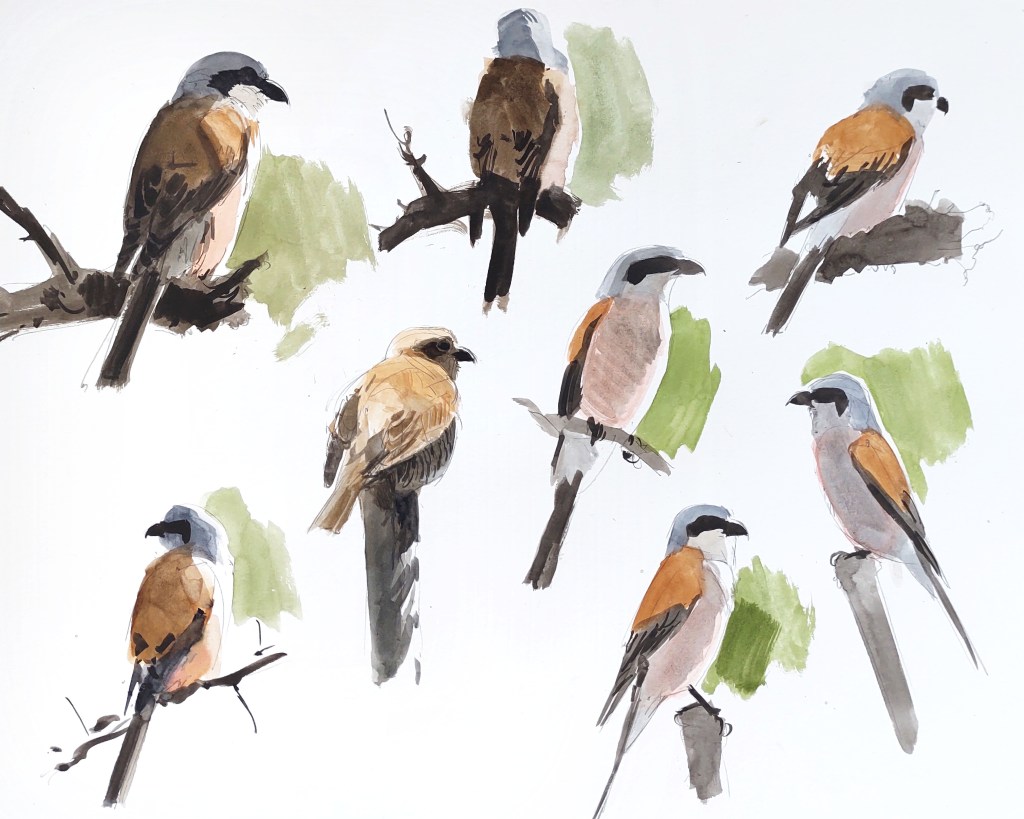
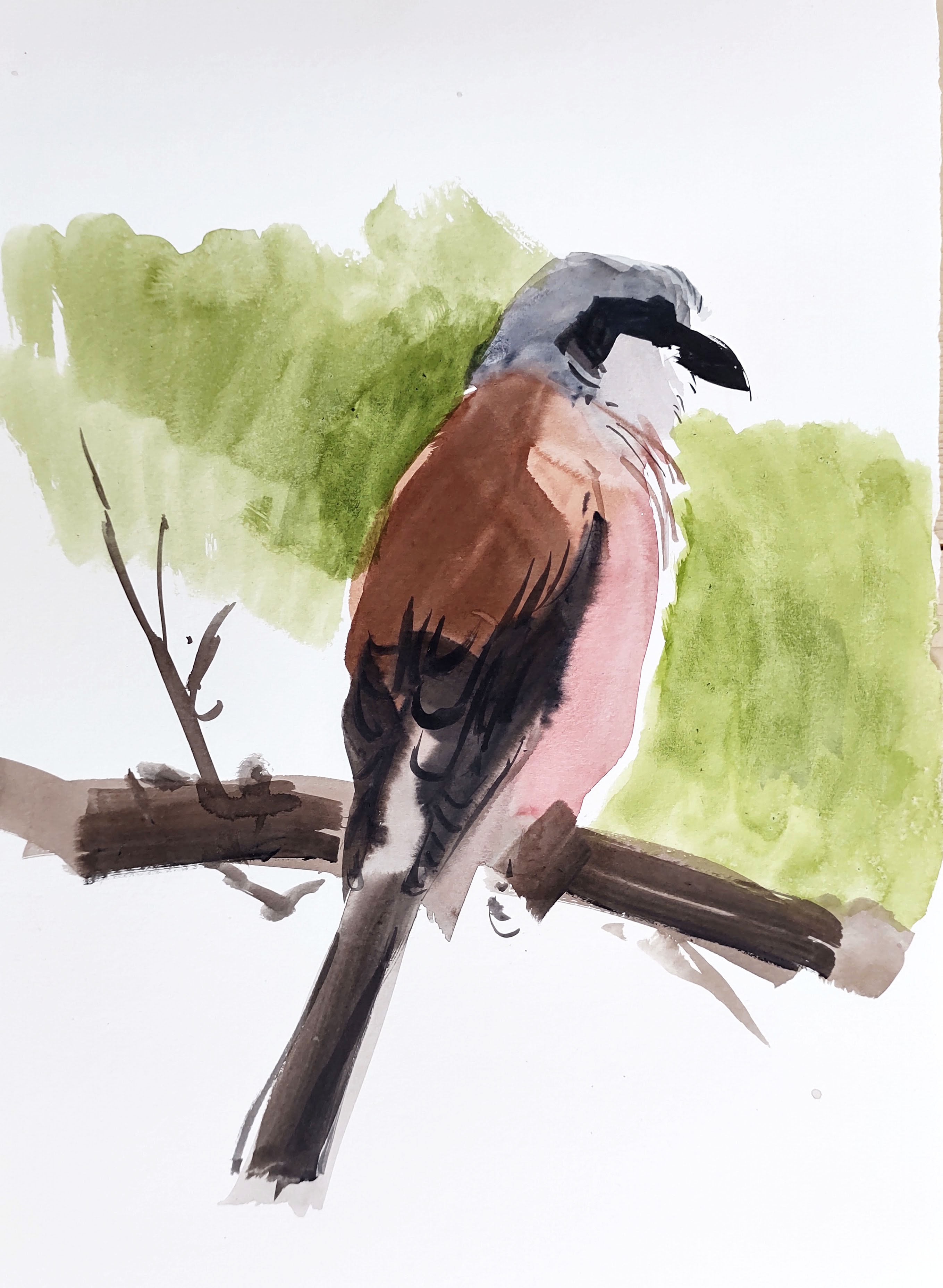
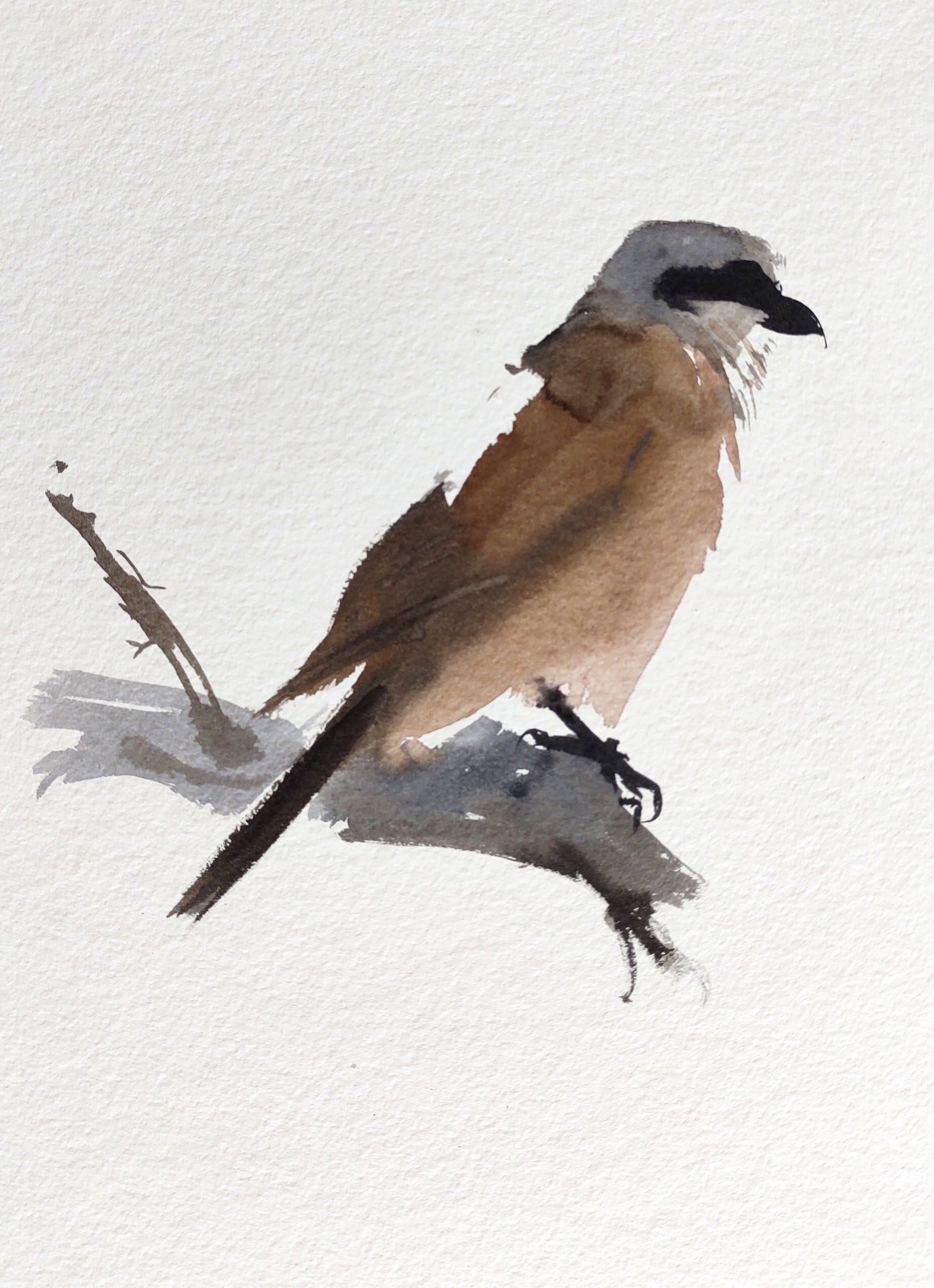
Nearby, a pair of red-backed shrike flitted back and forth feeding their recently fledged young. They were very obliging and completely disregarded my presence.

Shrike studies

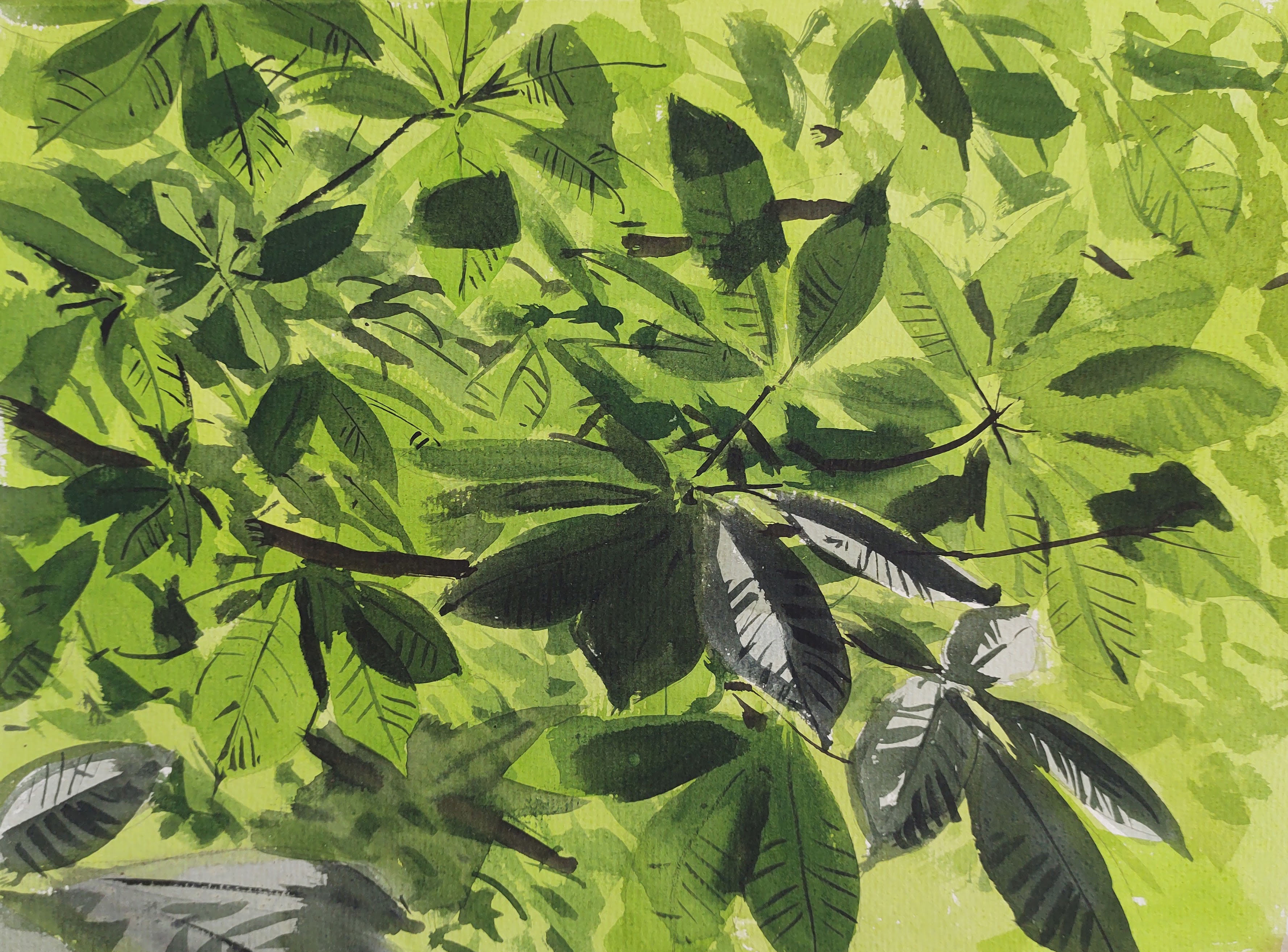
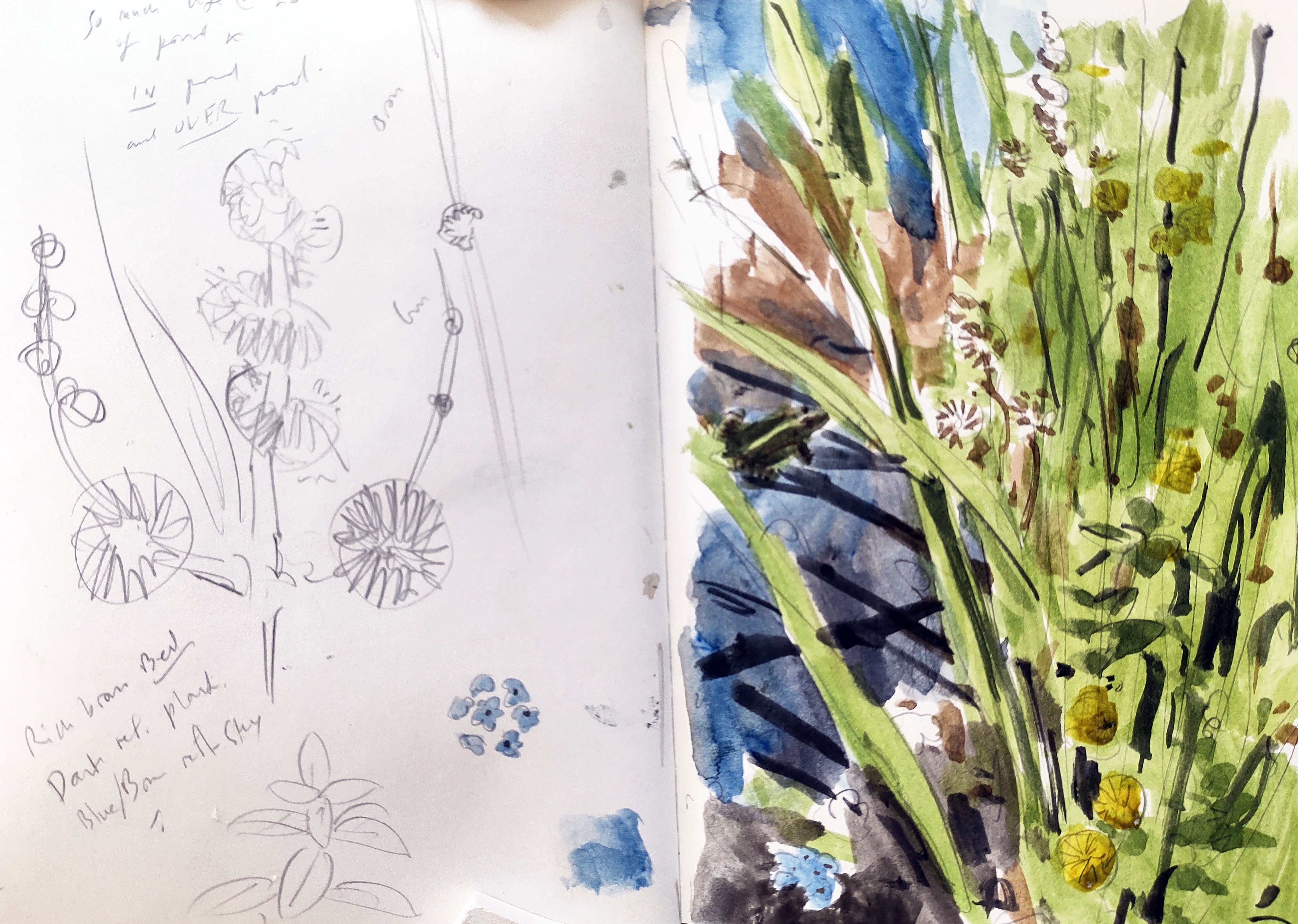
I had to drag myself away from such perfect birds and compelling models, but time was getting on. I stopped a couple of times to paint, hypnotised by the dappled sunlight on the leaves, and the complex profusion of life at the edge of a newly dug pond, but I was tired and dehydrated now, and the mosquitos were relentless.

Refreshed by a well-situated water tap, I marched on. Bastemose was today’s destination, one of Bornholm’s best birding sites and a place dear to my heart. I know this wetland area very well and have so many memories entangled along its paths and I felt very much on home ground. Just three or four weeks previously I had watched red-footed falcons and hobbies swooping after dragonflies but today, alas, all was quiet.

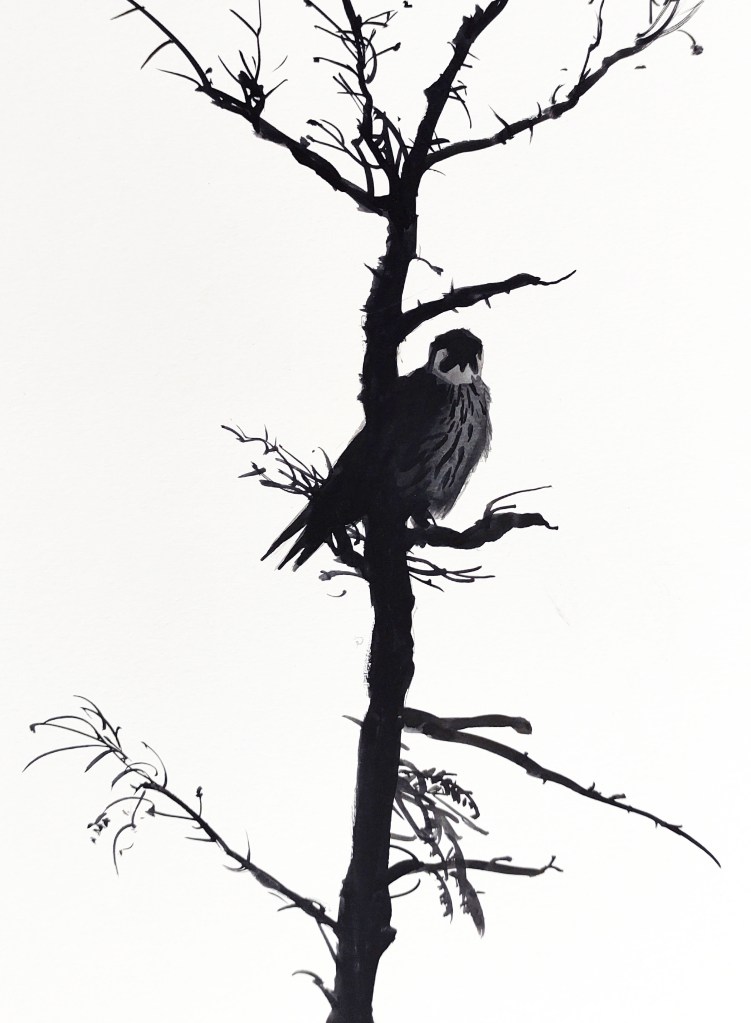
However, with a little patience and a little time, things will aways start to happen. Suddenly a hobby shot out of the woods – it was chasing a swallow and for a second or two it followed every twist and turn of its quarry, before aborting the attack and gliding nonchalantly off. Incredible.

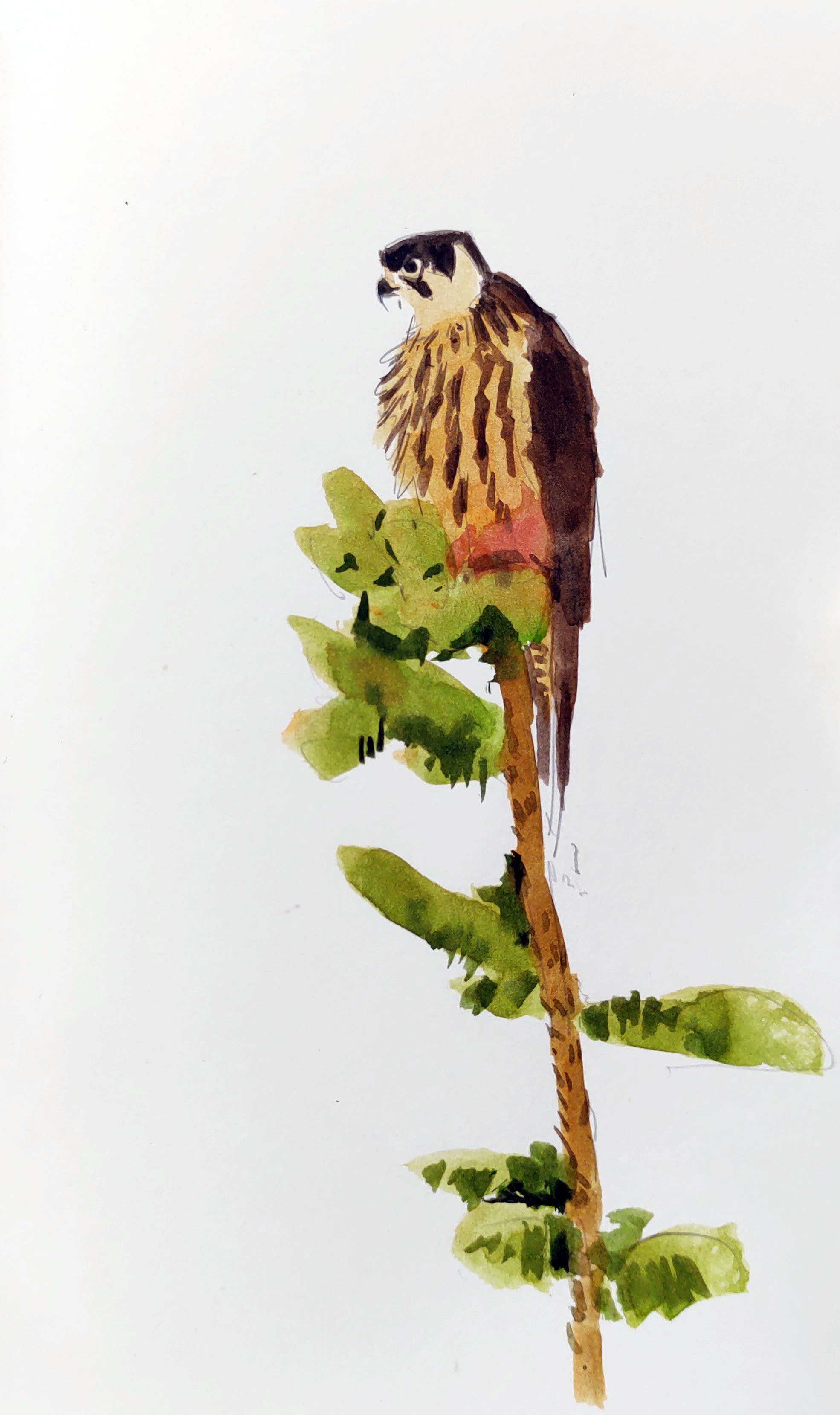
Hobby, Bastemose

Three hobbies were now hunting over the marsh – starting high, then pulling back their wing tips and swooping down at great speed, low over the water, then sailing up again into a great lazy arc, sometimes with a dragonfly in their clutches. At one point, one of the hobbies rested in the top of a pine tree, silhouetted against the light.

Sunset hobby I, Bastemose

Later, as the sun was setting the hobby rested in another tree on the opposite side of the marsh – this time bathed in the golden light of the evening. It had been an unforgettable day full of light and life.

Sunset hobby II, Bastemose

LAND 24

WEATHER REPORT – Sunny periods most of the day. Temperature 14 – 19 degrees. Wind 1 – 4 m/s, changeable. Hours of precipitation: 0 hours. Hours of sunshine: 11 hours.

STOPS with the BIVVY – 0

KILOMETRES WALKED – 15.71 km

DAY LASTED – 17h and 20 m

PEOPLE TALKED TO – 0

BIRDS SEEN and HEARD – 45 species: 4 new (little grebe, hobby, reed warbler, spotted flycatcher) running total = 117 species

LESSONS LEARNED – I tried a new rucksack today, so learned lots about how to use it

IN MY HEAD – I thought about how the forest is constantly growing, plants fighting for dominance and constantly eradicating our ephemeral attempts to create order and control.

I thought about biodiversity and the 17 bison that pull in over 100,000 tourists to the forest every year – and the 600,000 Bornholmian pigs hidden in giant sheds on the island.

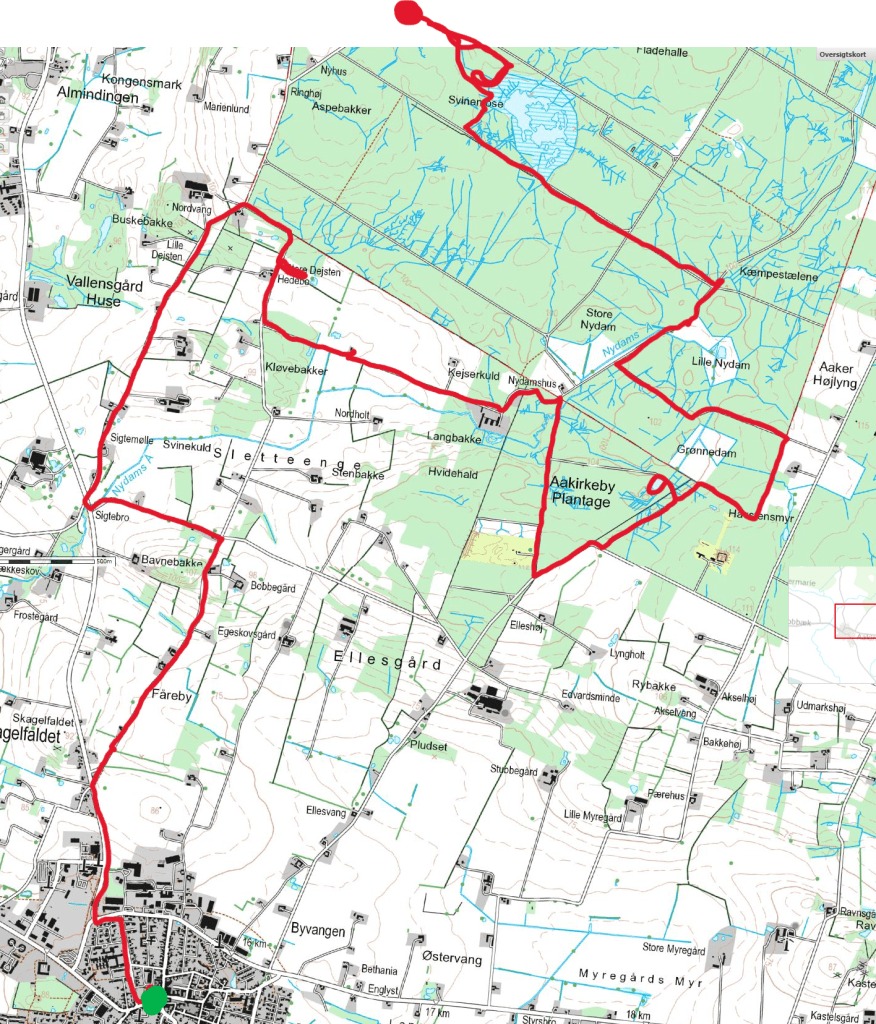
LAND 23 – Aa Kirke to Svinemose, 09.06.23

Denne side på dansk her

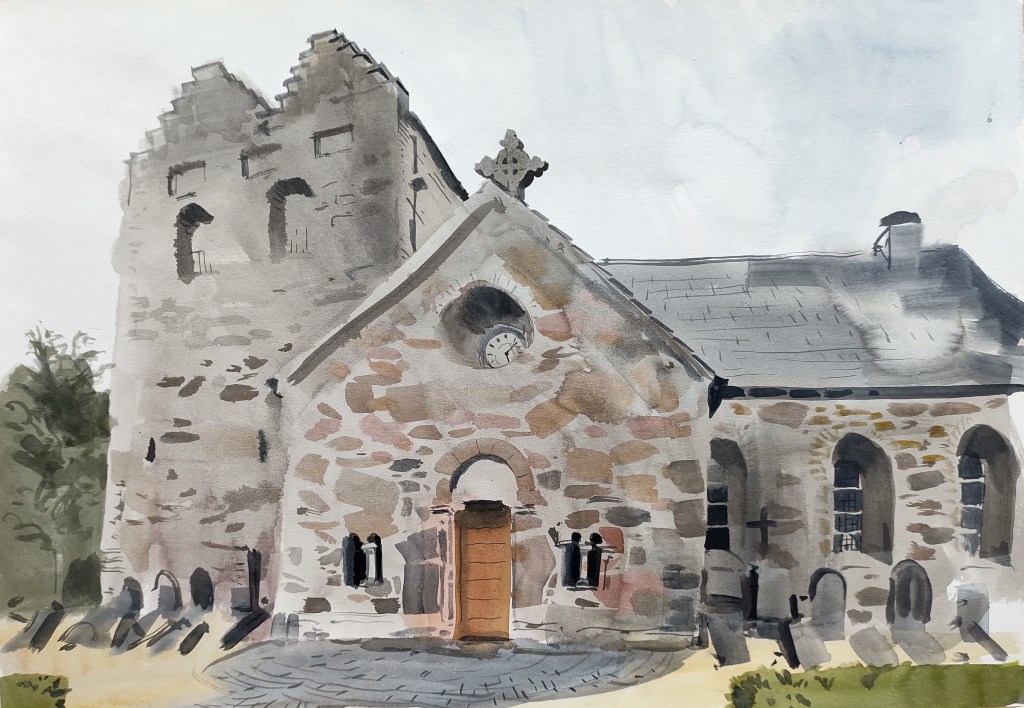
LAND 23 The Aa church sits like a beacon in the middle of the village, close to the middle of the island. Solid and unpretentious, its thick walls are made from granite, sandstone, and limestone, all sourced from local quarries. A physical manifestation of the island’s geology and culture, it is easy to imagine how Aa church was the spiritual and social hub of its surrounding community. I walked around the immaculately maintained graveyard, reading the inscriptions detailing lives long past – many grouped together according to the local farm they came from.

Aa Church, Aakirkeby

These were my thoughts as I wandered around, while around me the village slept. The dawn started off clear, but as I headed north away from Aakirkeby, the wind picked up and a cold fog settled over the lush green fields. I quickly regretted not taking more clothes.

Looking east from Sigtemøllevej

My route took me up into central forest again, along roads and tracks mostly unknown to me. This area felt remote and somehow old. I thought of borders, visible and invisible, and had the sense that I had crossed into a new part of the island – or maybe I had crossed into a new season? The birdsong was tailing off, and squadrons of starlings and their newly fledged young were everywhere. It felt different.

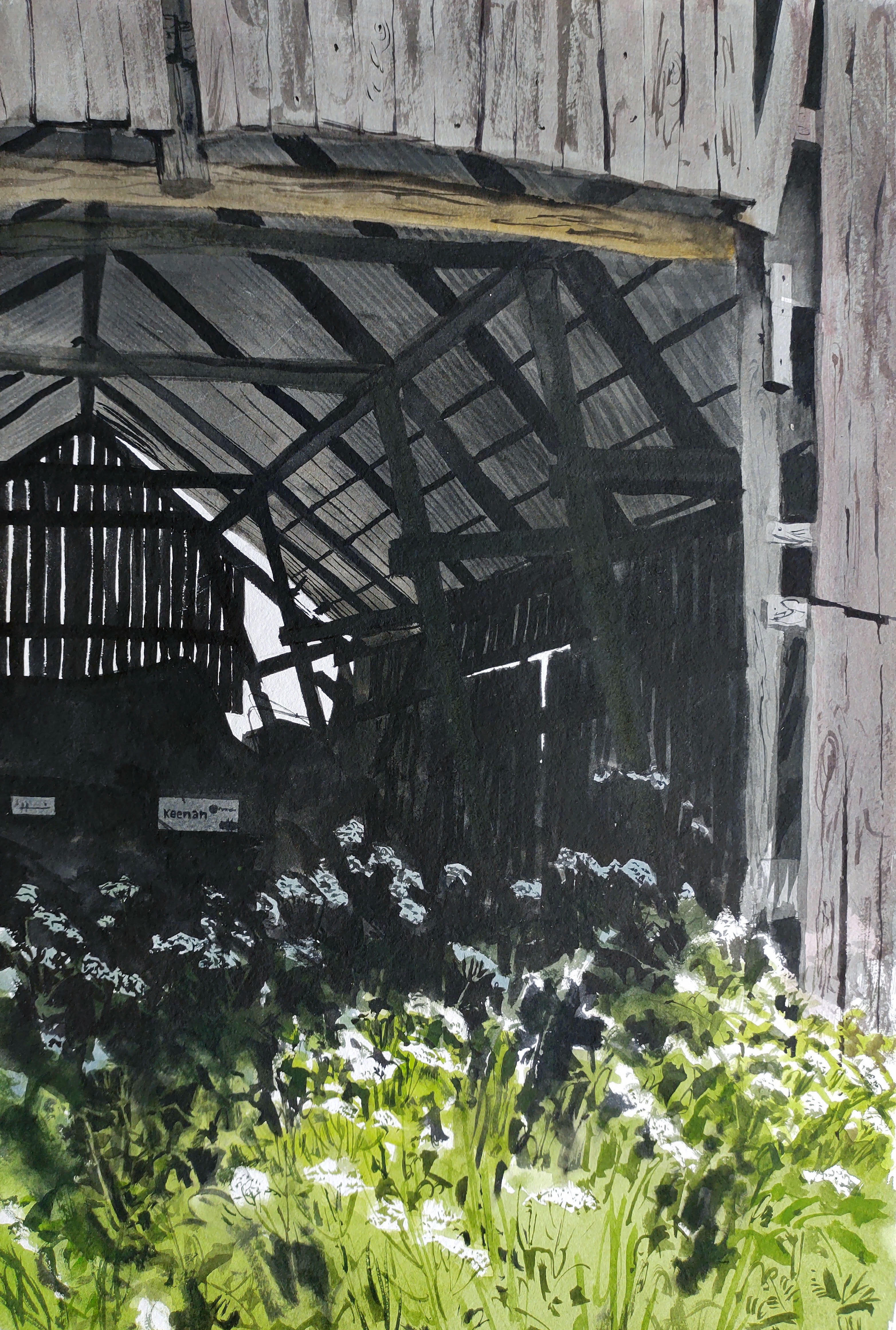
At the edge of the forest, I stopped by a neglected barn standing alone beside a farm track. The sun was out now, and I spent far too long painting every detail, glad to be out of the wind.

An old barn, Fårebyvejen

I continued into the forest, passing briefly through the houses, vegetable gardens and workshops of a large eco-commune, and then past a huge motocross track. Both of which seemed empty of people, and both of which were completely new to me.

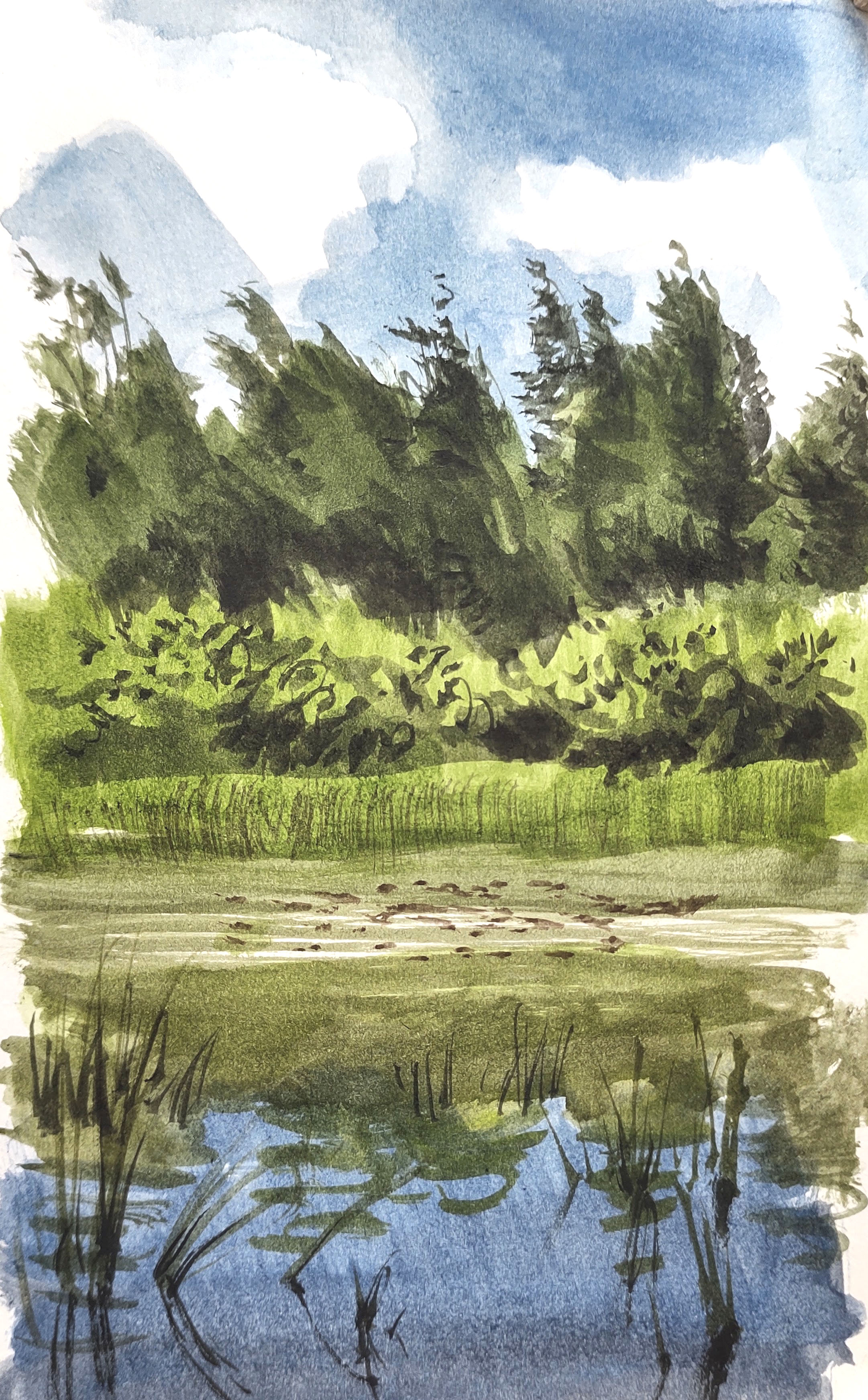
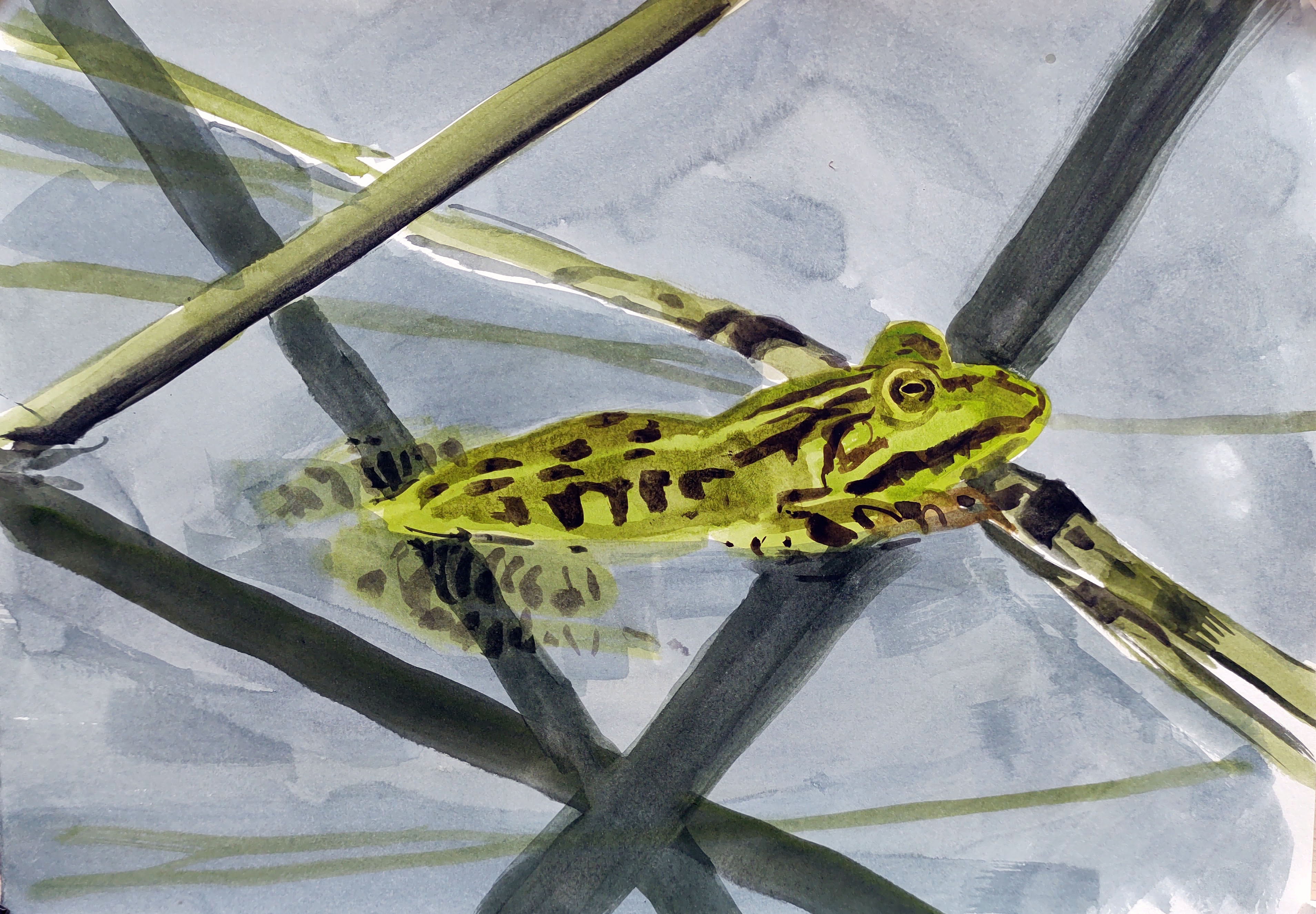
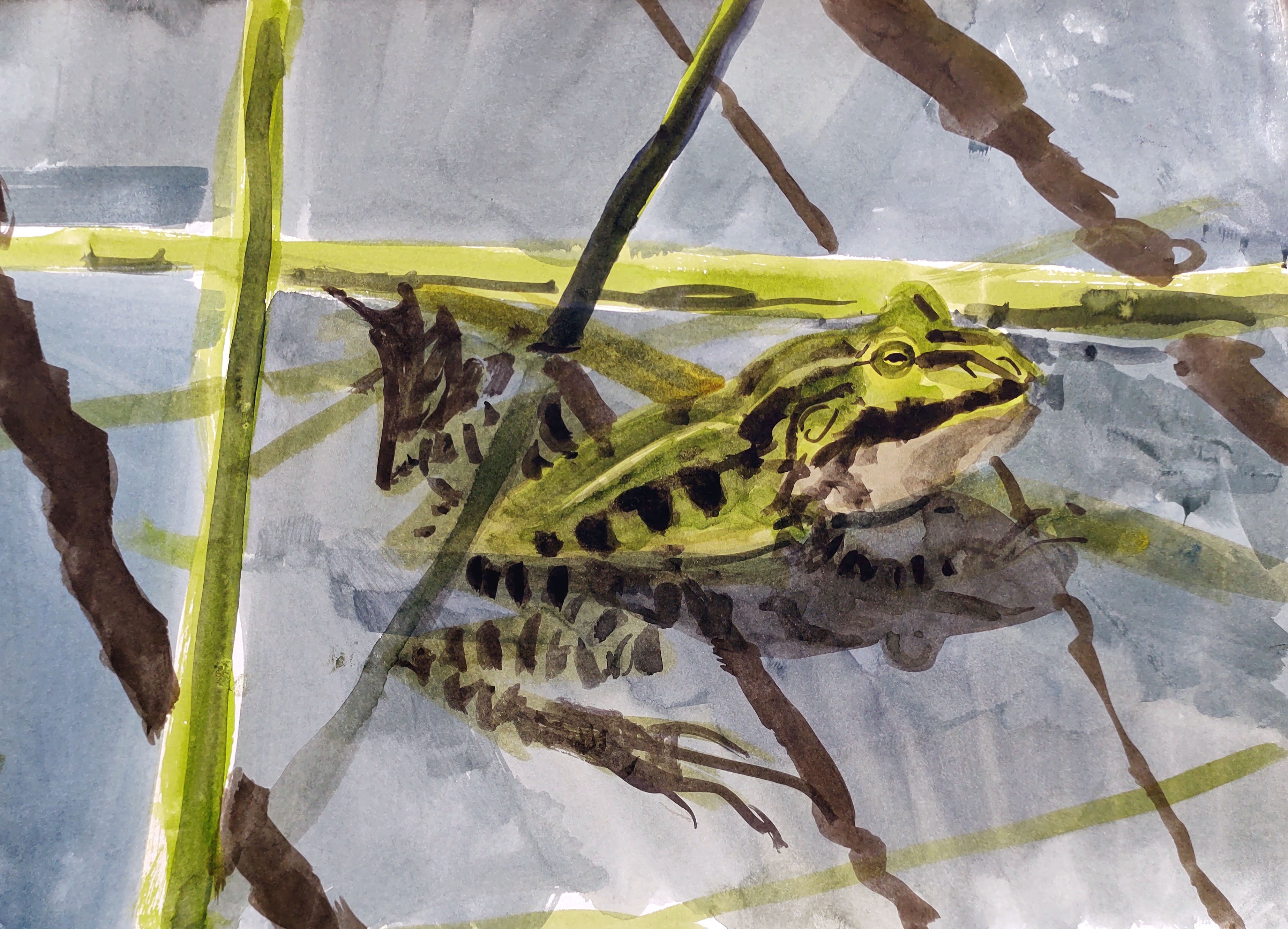
I carried on through the forest – sometimes monotonous plantations of fir, sometimes more diverse with newly dug ponds. I stopped by the edge of one pond for lunch, sheltered from the wind and serenaded by a non-stop chorus of croaking marsh frogs. They were scores of them in the centre of the pond, battling for the best spots, bashing into each other, and sometimes kicking jets of water into the air.

On the margins, smaller frogs waited their turn. Some stayed still long enough for me to try to capture their green brilliance, the reeds and their reflections and shadows.

I carried on through the woods. At one point following an old drystone wall – the old parish boundary. At a corner of the wall/boundary a large dead oak tree perhaps once stood alone and visible from afar – before the plantation was planted around it.

Parish boundary wall, near lillemyregårdsvej

After more wandering I arrived at the entrance of the ‘bison wood’. In 2012 seven wisent (European bison) were released into a fenced enclosure of 200 hectares – partly to contribute to the survival of this threatened species, and partly to increase biodiversity in the forest. Since then, their numbers have increased, and they are one of Bornholm’s most popular tourist attractions. Firstly, however, I was fixated on smaller prey – the dragonflies sheltering from the wind along the forest pathways.

Dragonfly studies I

Drawing dragonflies is always incredibly rewarding – the intensity of following them, waiting for them to land, madly focusing the telescope and then getting to work before they fly off again.

Dragonfly studies II

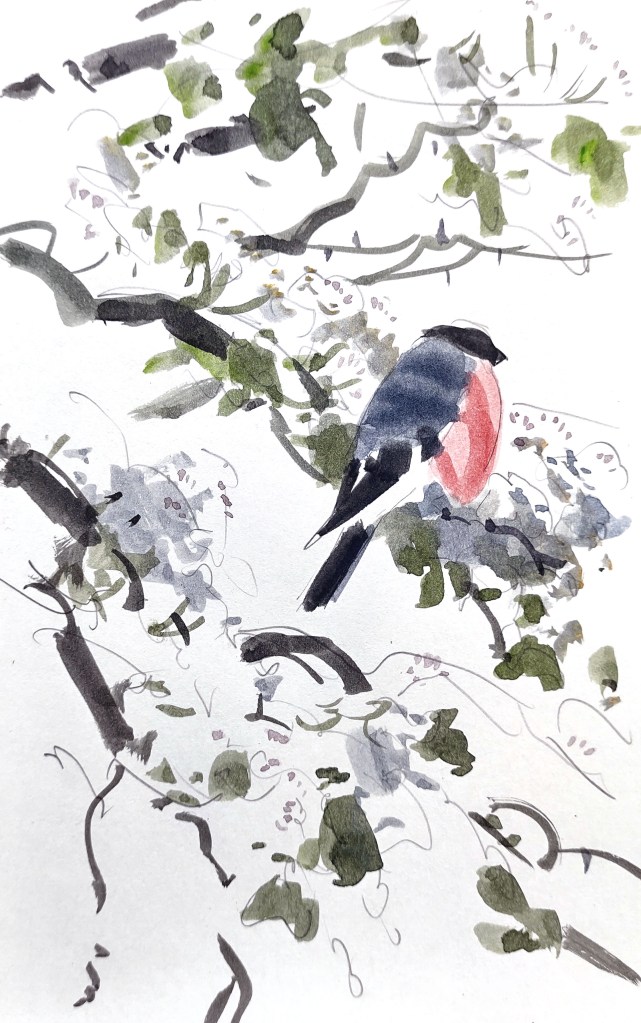
I continued through the woods and then along the edge of Svinemose – a small marsh and wetland. No bison and in fact very little bird life. By now I was tired and the wind was really aggravating me. I had reached my destination early and I was too cold. A bullfinch cheered me up momentarily, but no matter how many star jumps I did, I just couldn’t warm up.

Bullfinch in Hawthorn

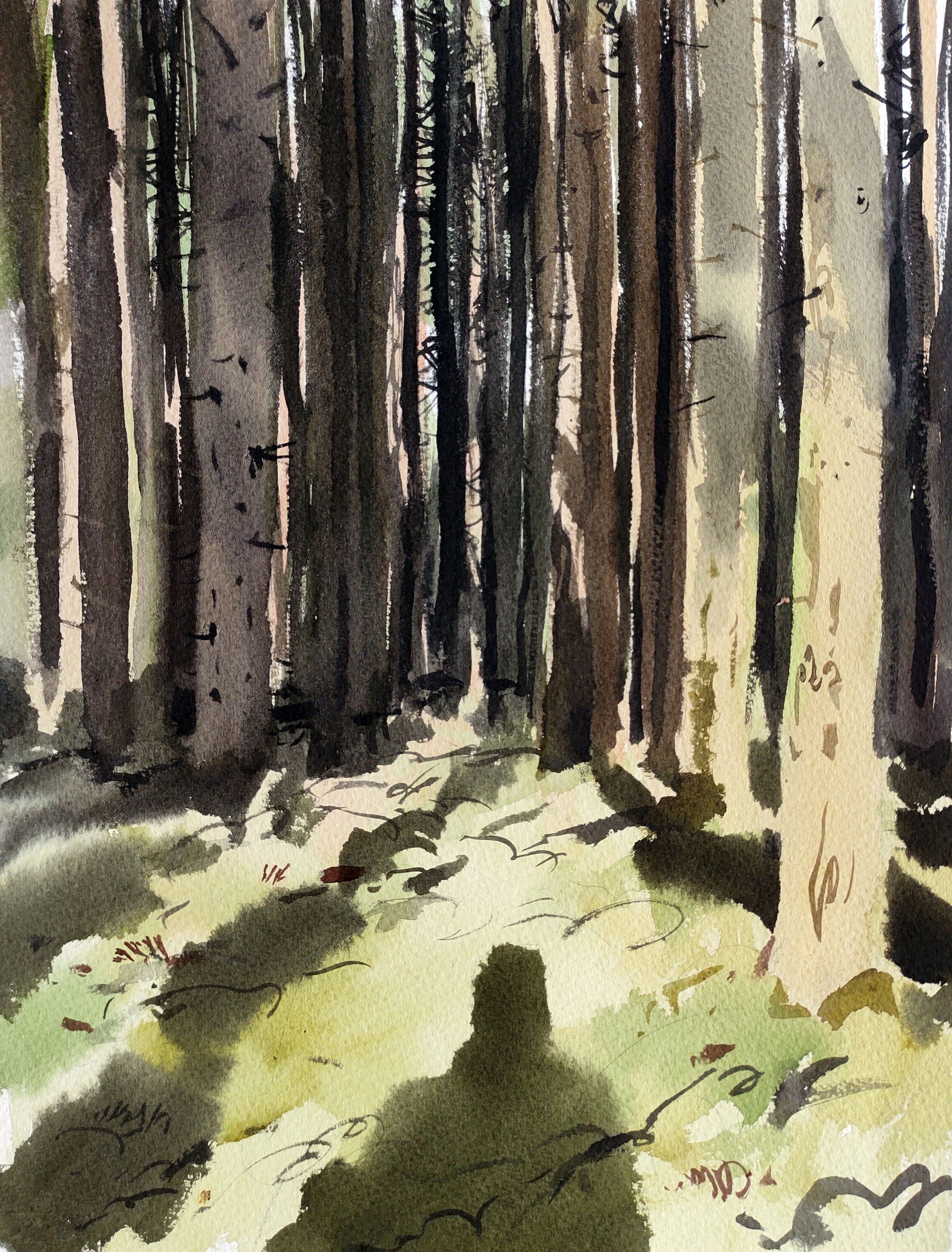
Still over two hours to go, I walked back into the forest as the low sun glowed on the fir tree trunks.

Self portrait in the wood

In the forest mosquitos attacked. Out on the paths, the wind blew the mossies away, but it was cold.

Myg

A red-necked grebe sat on its nest in the marsh. I came close to quitting early.

Red necked grebe, Svinemose

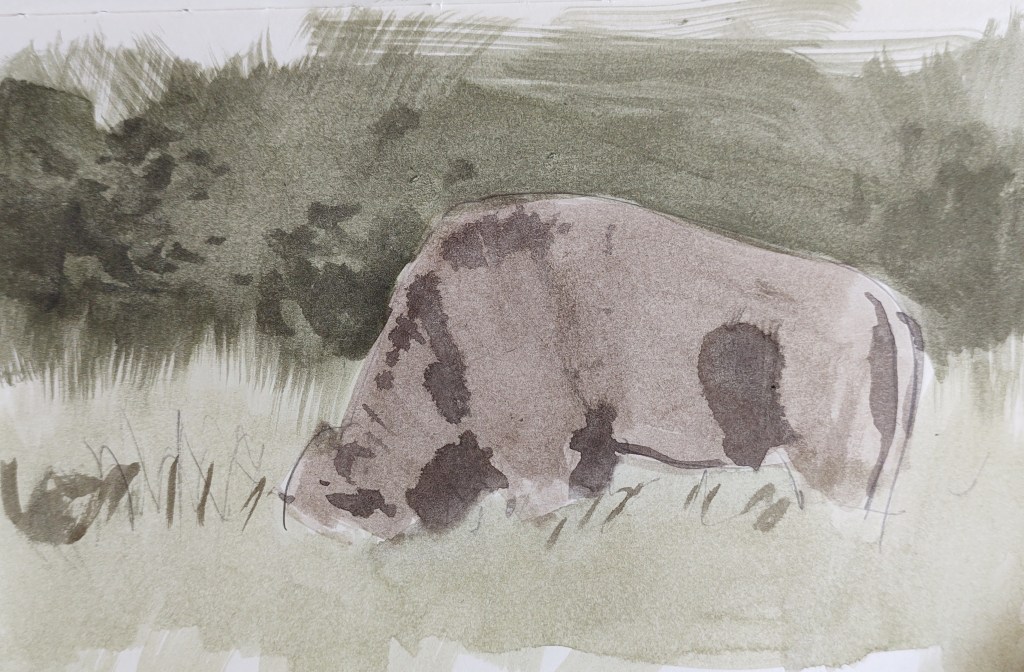
Eventually, the day ended and I walked towards the car park where I was being picked up. There, in the gloom, a bison grazed at the edge of the wood. I managed to get one quick sketch done before jumping into the car and turning the heating up to full.

Feeding bison

LAND 23

WEATHER REPORT – Sunny periods most of the day. Temperature 10 – 17 degrees. Wind 8 – 11 m/s from the east. Hours of precipitation: 0 hours. Hours of sunshine: 10 hours.

STOPS with the BIVVY – 0

KILOMETRES WALKED – 19.60 km

DAY LASTED – 17h and 19 m

PEOPLE TALKED TO – 1

BIRDS SEEN and HEARD – 47 species: 1 new (red-necked grebe) running total = 113 species

LESSONS LEARNED – Take much much more clothes than you think, if the wind is over 6 m/s

IN MY HEAD – keeping warm, finding shelter…

LAND 22 – Vasagaard to Aa Kirke, 02.06.23

Denne side på dansk here

LAND 22 The dry sunny weather on Bornholm continues. Bleary-eyed and underslept I continued along the path following the Læså downstream. The cool morning air was bursting with wren song and the heavy scent of wild garlic. The first golden beams of light from the rising sun glowed ember-like on the twisted tree trunks and branches.

Wood, Læså

To my left, the fields and to my right, the densely wooded valley down to the stream – now appreciably lower since last Friday. 

I arrived at Limensgadebrud, an overgrown quarry where layers of slate and limestone meet. I basked in the sun, trying to warm up. A white wagtail flitted about.

White wagtail

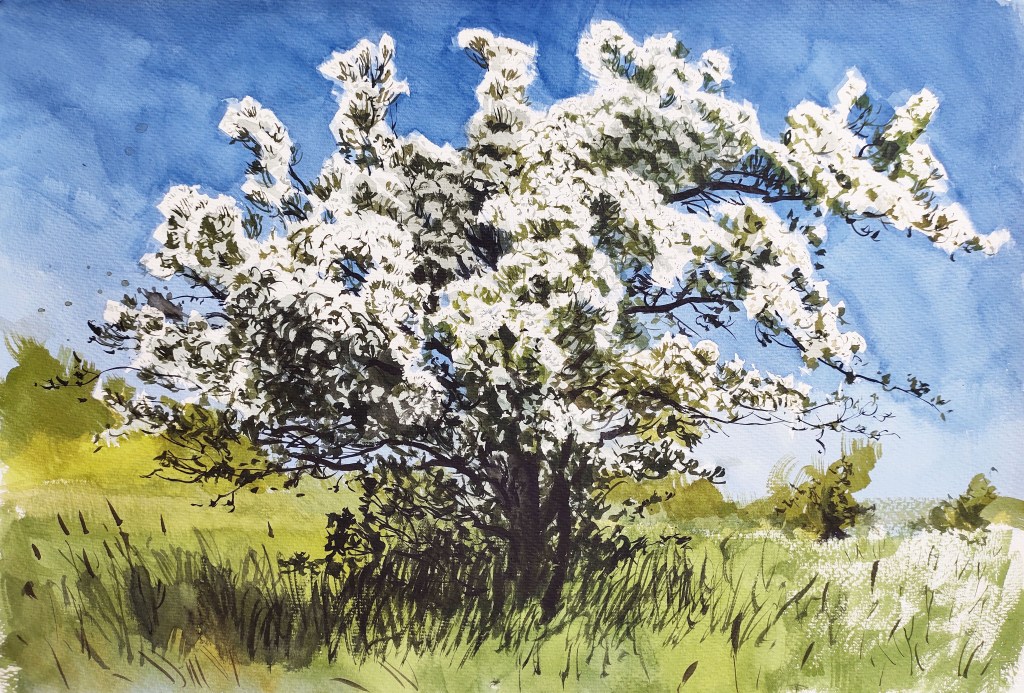
I headed north and then east, headed towards the pastures of Ugleenge, where horses grazed, surrounded by dense swathes of cow parsley and blossoming hawthorns. I tried to walk to Bosthøj, but the path ended suddenly. Returning to Ugleenge, I tried to capture the dizzying abundance of the blossoming hawthorn bushes. The hypnotic and rather grating song of whitethroats filled the air.

Peak spring: Hawthorn Tree, Ugleenge

Close to the road I stopped by another small and overgrown quarry – sandstone this time. The view south, all the way to the sea, encompassed the site where an army of Bornholmians had fought against their Lubeckian overlords in 1625. This area is also botanically significant – the thin soils have meant it has never been ploughed – but I was not able to find any orchids in the tall grass.

View south from Ugleenge

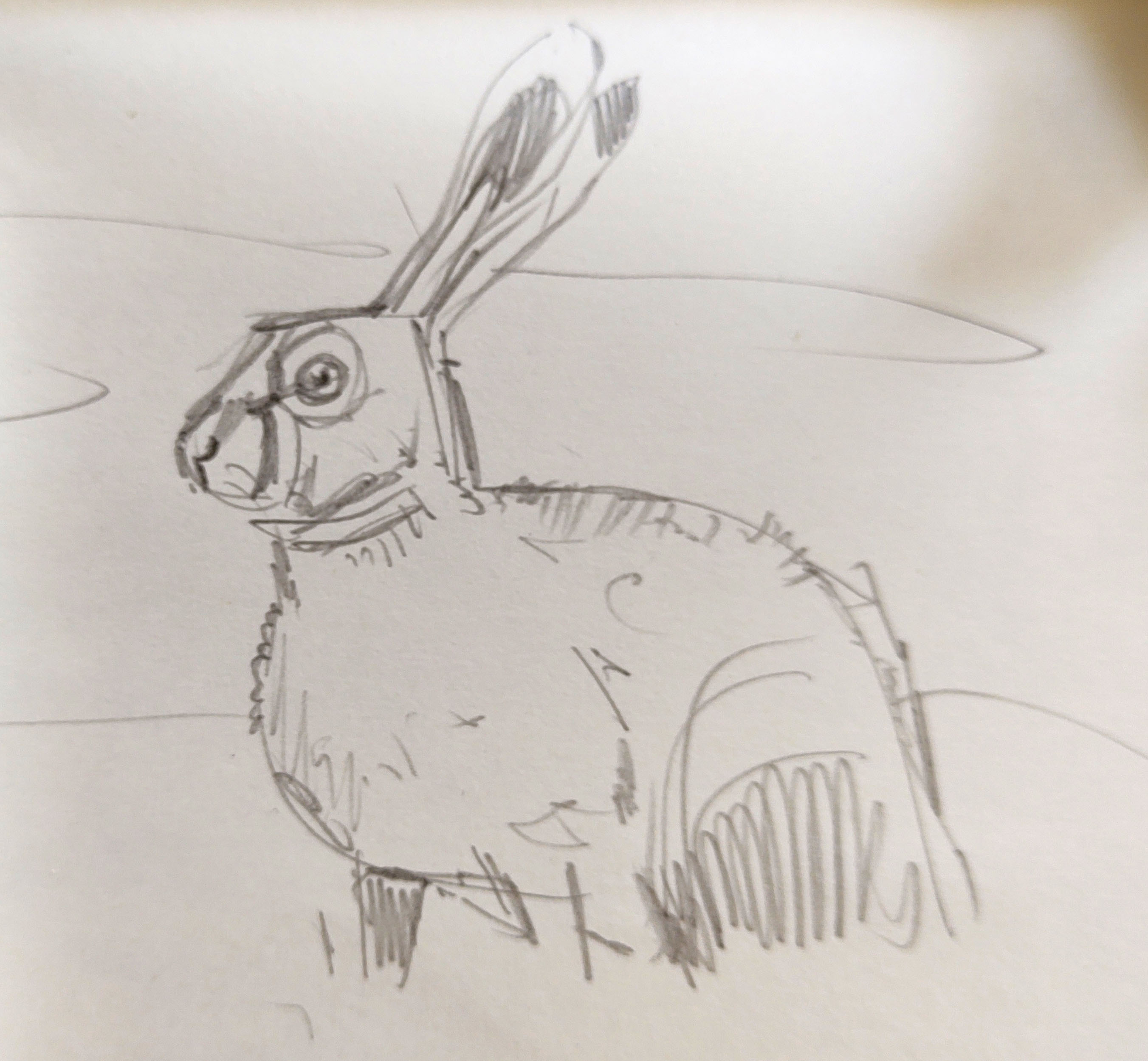
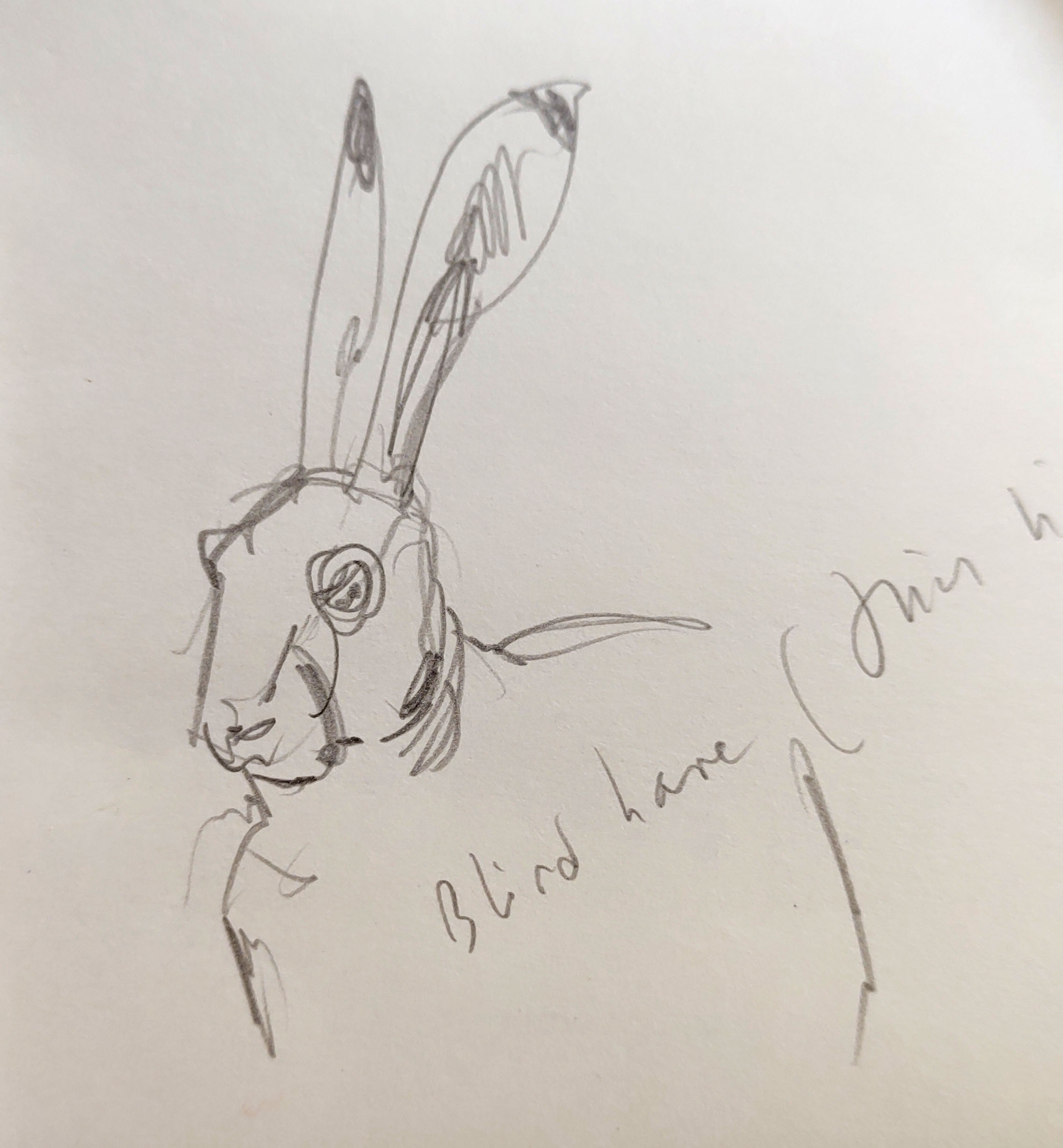
Heading north on a track through an oilseed rape field I crossed the old railway track – completely erased now, with only a small line of trees betraying its presence. In front of some overgrown farm outbuildings, I saw a hare nibbling on some weeds. Instead of hunkering down or bolting as I approached, it carried on eating. Through my binoculars I was close enough to see that it was blind in one eye.

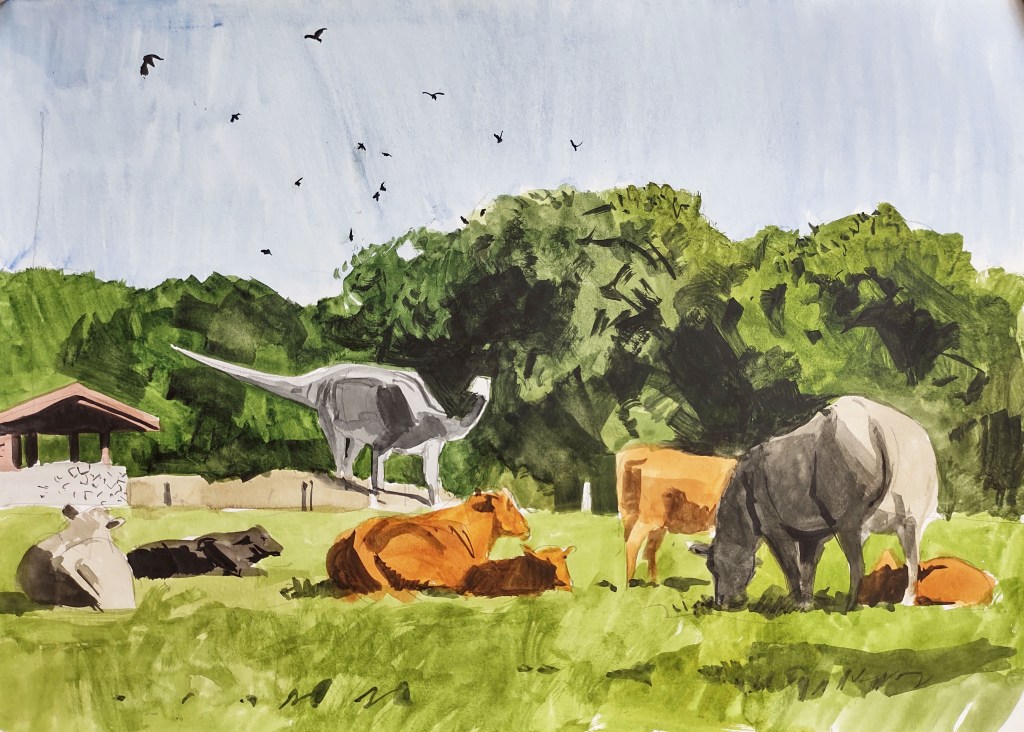
I had reached Klintebakken, one of the areas on Bornholm where the geological fault zone running through the island is particularly obvious. Here granite and sandstone, divided by 1.2 billion geological years, meet. This is fittingly the site of ‘NaturBornholm’, the island’s Discovery, Science and Nature centre. In their small pond I watched smooth and great-crested newts swimming and cavorting in the water like tiny dragons. In front of the visitor centre even larger dragons were lurking.

NaturBornholm

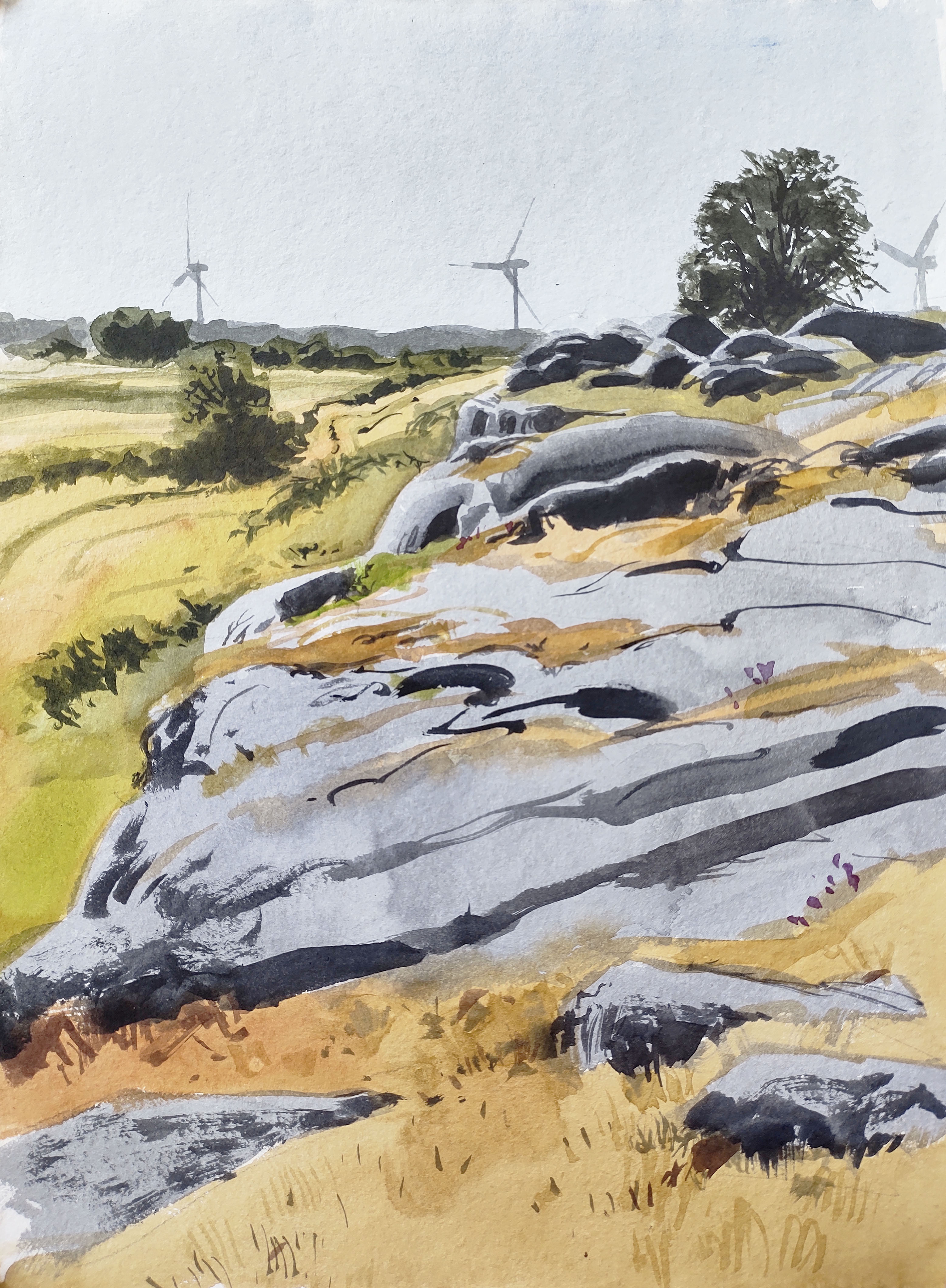
The gneiss bedrock sits high over the flat landscape of Bornholm.

Hadeborg bakke

Layers of Balka and Nexø sandstone have been lifted by powerful forces.

Sandstone layers

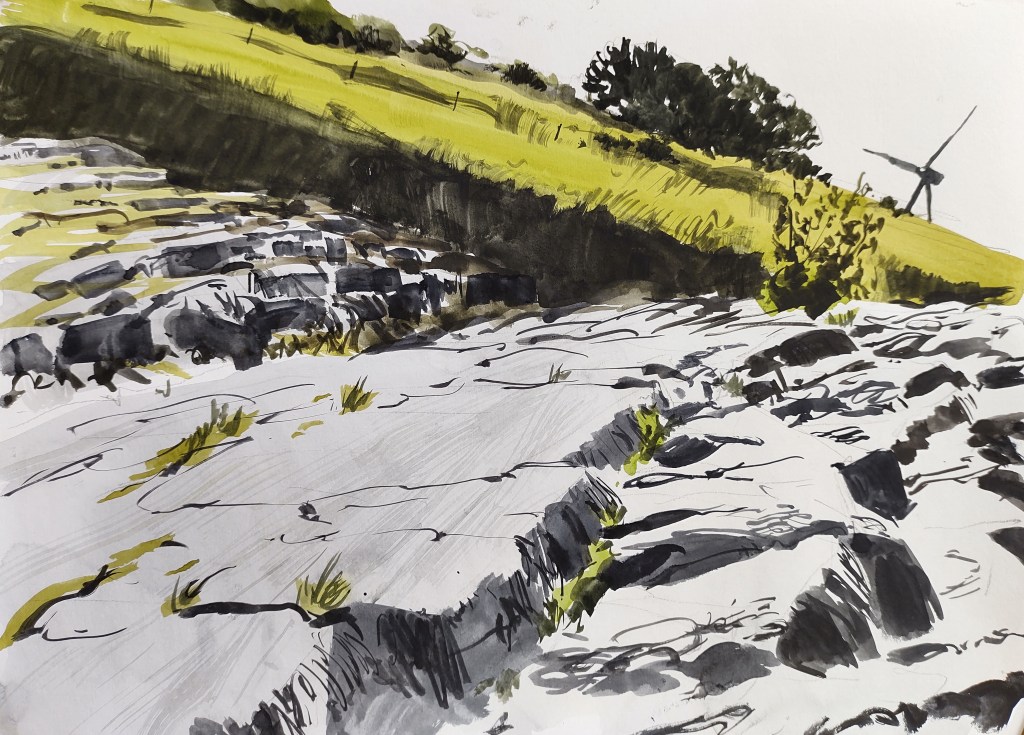
I arrived at the Strøby sandstone quarry, well known for its fossilised seabed, where I had been looking forward to exploring and painting the pondlife – but time was running out. I made a quick sketch of the stony ripples, perfectly side-lit by the low sun.

Sandstone ripples

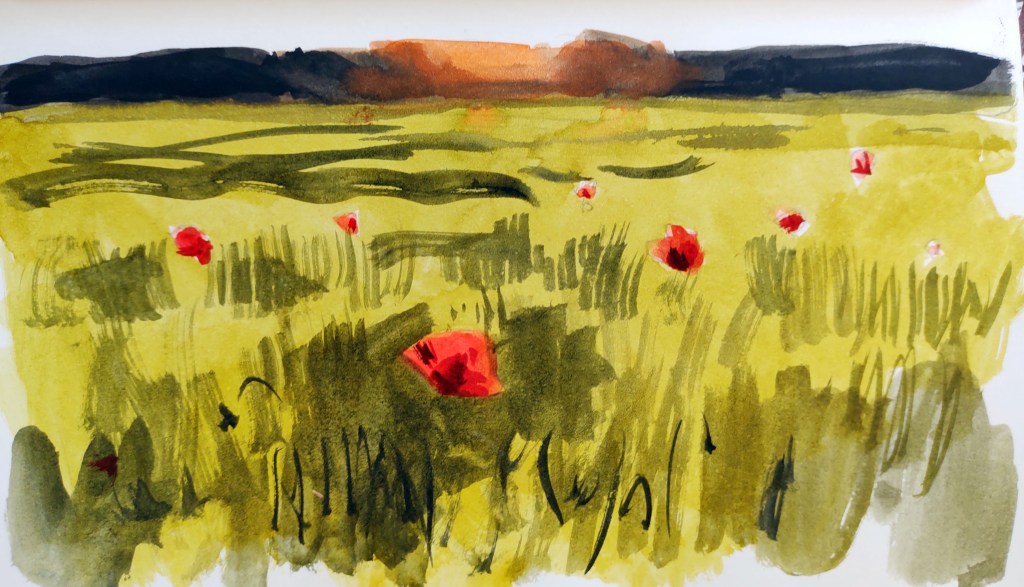
The last hour or so was a delicious brisk evening walk through quiet country roads up towards the village of Aakirkeby. The wind had died down now and the sun cast a golden light. Nightingale song mixed with the heady aroma of hawthorn. Some poppy flowers blushed impossibly bright in a field, but I had only time enough to make a quick sketch.

Setting sun, Kalbyvejen

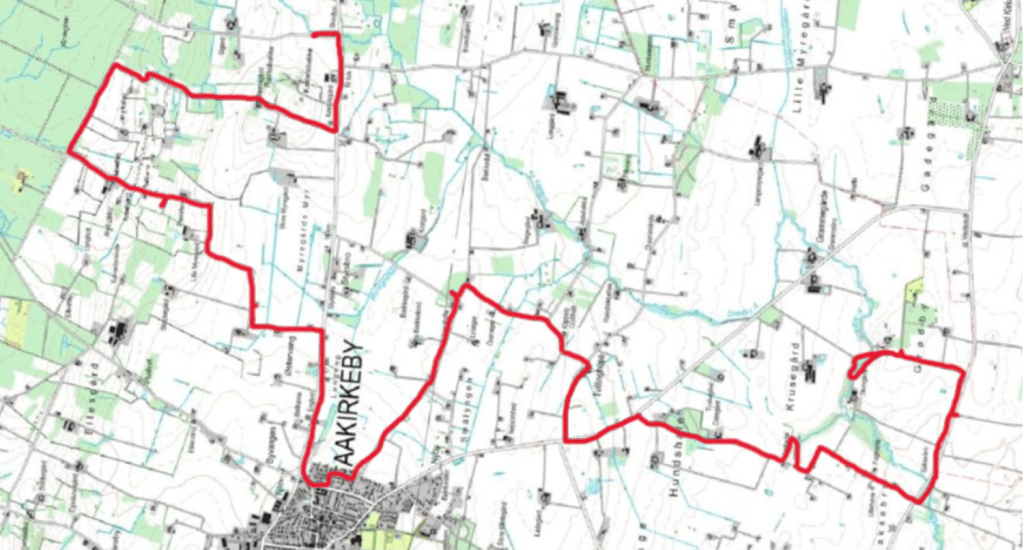
Though I was only a five-minute drive from my house, I’d never walked to Aakirkeby before, and I felt somehow connected to Bornholm-past – walking over the fields towards the church. Just before I arrived at my destination I walked through a small wood where the last rays of the sun were cast – like glowing embers no less – on the twisted trunks and branches of the trees. The day was over and had ended just as it had begun, 17 hours earlier.

LAND 22

WEATHER REPORT – Sunny most of the day. Temperature 7 – 15 degrees. Wind 2 – 6 m/s changeable. Hours of precipitation: 0 hours. Hours of sunshine: 15.5 hours.

STOPS with the BIVVY – 0

KILOMETRES WALKED – 15.92 km

DAY LASTED – 17h and 1 m

PEOPLE TALKED TO – 2

BIRDS SEEN and HEARD – 45 species: 1 new (sedge warbler) running total = 112 species

LESSONS LEARNED – shoes and legs get completely soaked walking through wet grass

IN MY HEAD – newts

LAND 21 – Lundestenen to Vasagård, 26.05.23

Denne side på dansk her

LAND 21 The day began cold and rather breezy. I watched the sun rise behind the trees – a luminous crimson disc, slowly turning orange and then yellow as it began its ascent into the clear blue sky.

Sunrise from Hovedgårdsvejen

I headed north on familiar roads.

Nylars Church from Hovedgaardsvejen

Soon I found myself walking along the bike path towards Lobbæk village. The path was built on the old railway track that connected Rønne with Aakirkeby. Lobbæk was built around a railway station in the early 20th century – at one point boasting several shops, a baker, a dairy and so on – and is still home to several hundred people. I stopped for breakfast by the old station and enjoyed the cacophony of birdsong. A red-backed shrike was an unexpected visitor. Swifts, my first of the year, screamed overhead.

I continued along the bike path for a while, and then headed north into the intensively cultivated fieldscape between Nylars and Vestermarie. The area had once been a mixture of pasture, marsh and heath, and had slowly been drained and cultivated over the centuries. Large dairy and pig farms were strung along the landscape.

Udsigt fra Smørenegevejen

My route took me south again, across the main road and into an area with smaller farms and homesteads, poorer soils, and more variety of vegetation. I headed east until I crossed Læse å, a small stream (though Bornholm’s second biggest) that on account of its unique geology and nature, is protected by law. For several kilometers a public path follows the stream along its heavily wooded valley, with fantastic information panels describing the succession of geological strata the stream flows over.

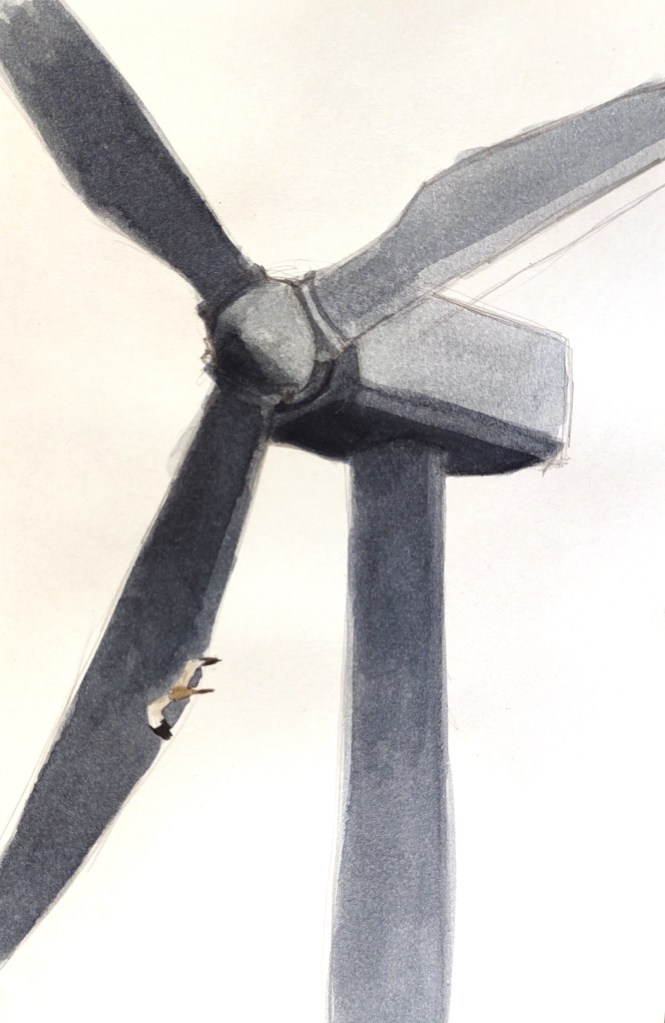
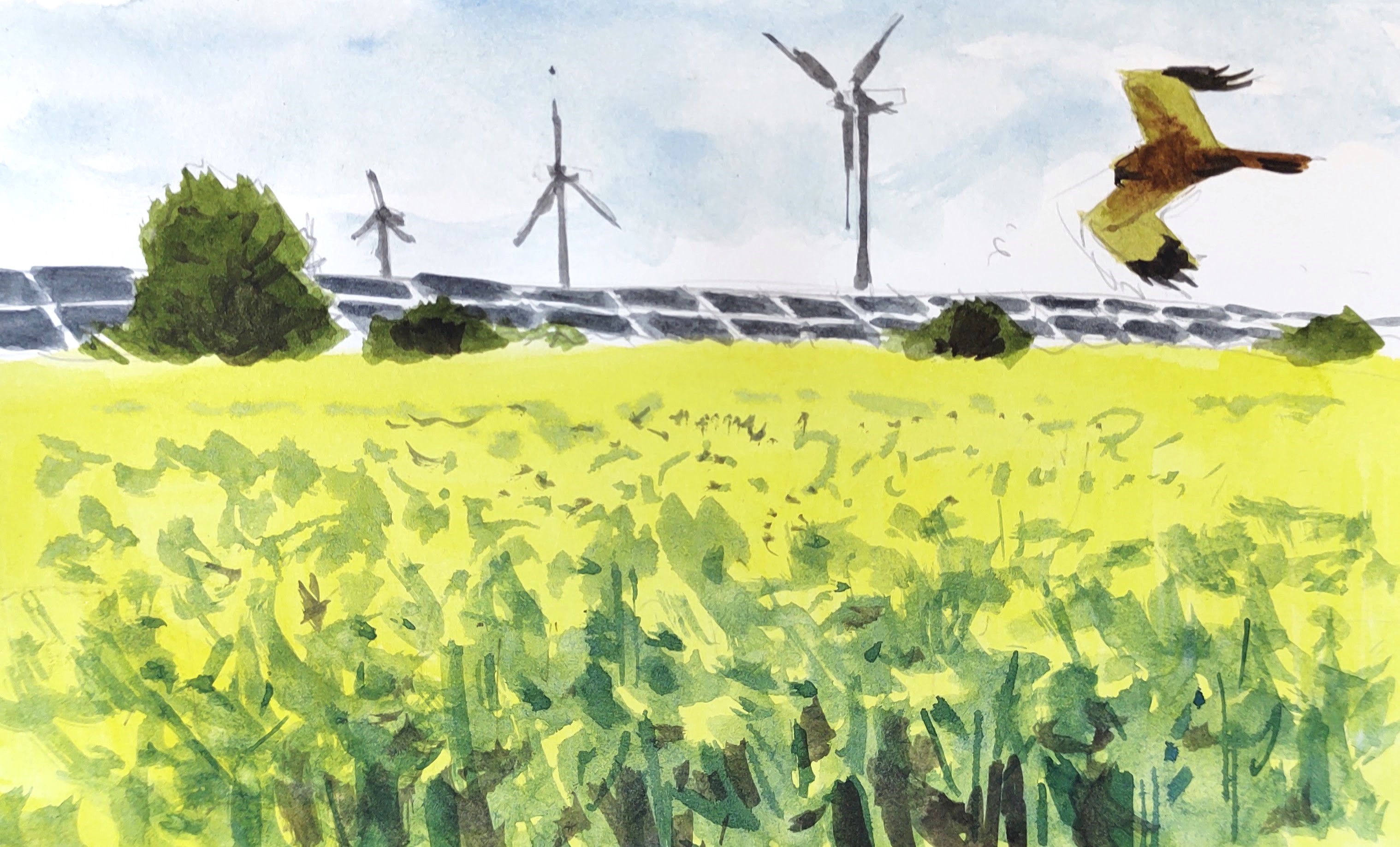
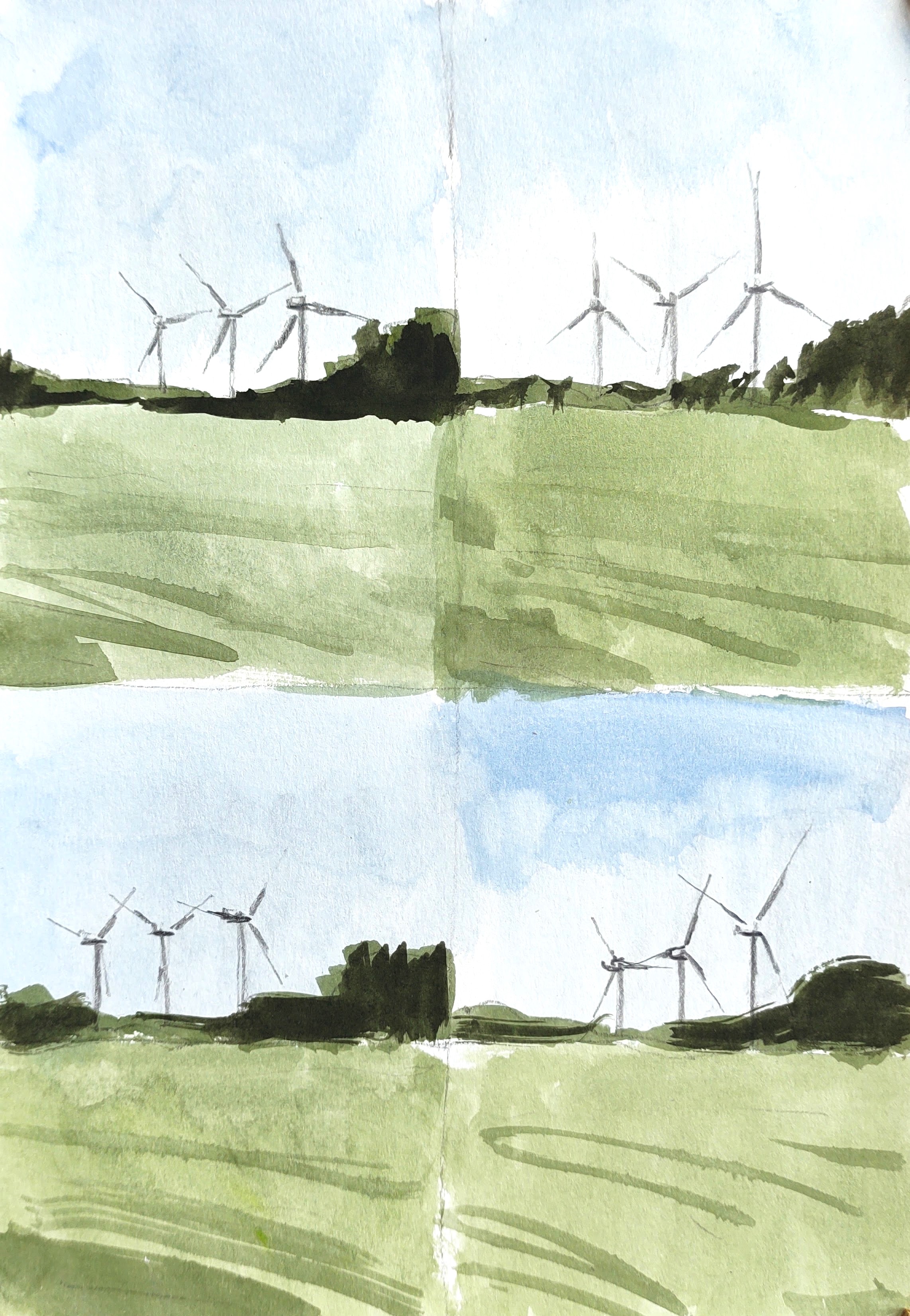
Huge windmills and a giant solar cell park welcomed visitors to the beginning of the path. I watched through my binoculars as a marsh harrier flew close to the huge rotating arms of the windmill.

Marsh harrier and windmill

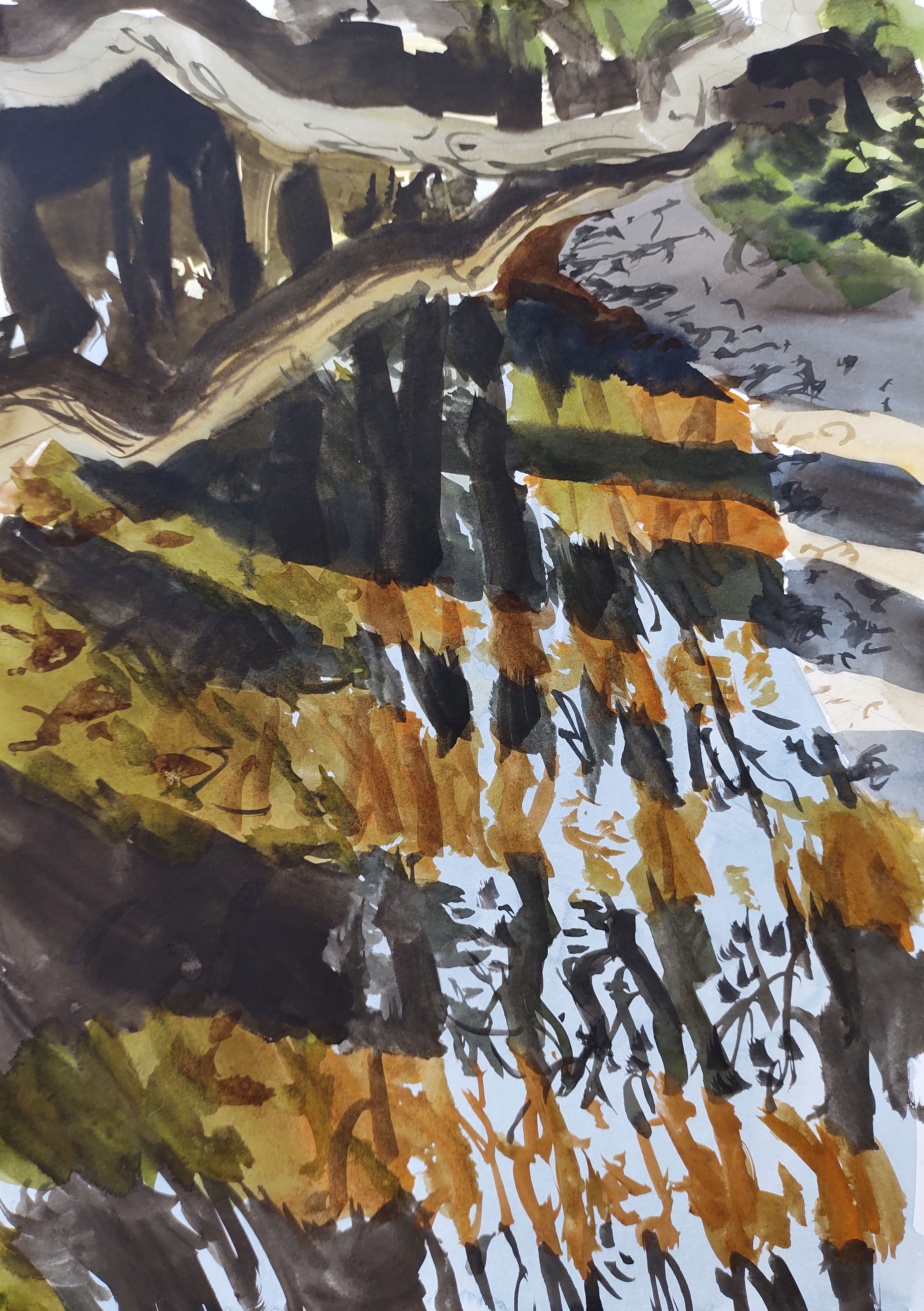
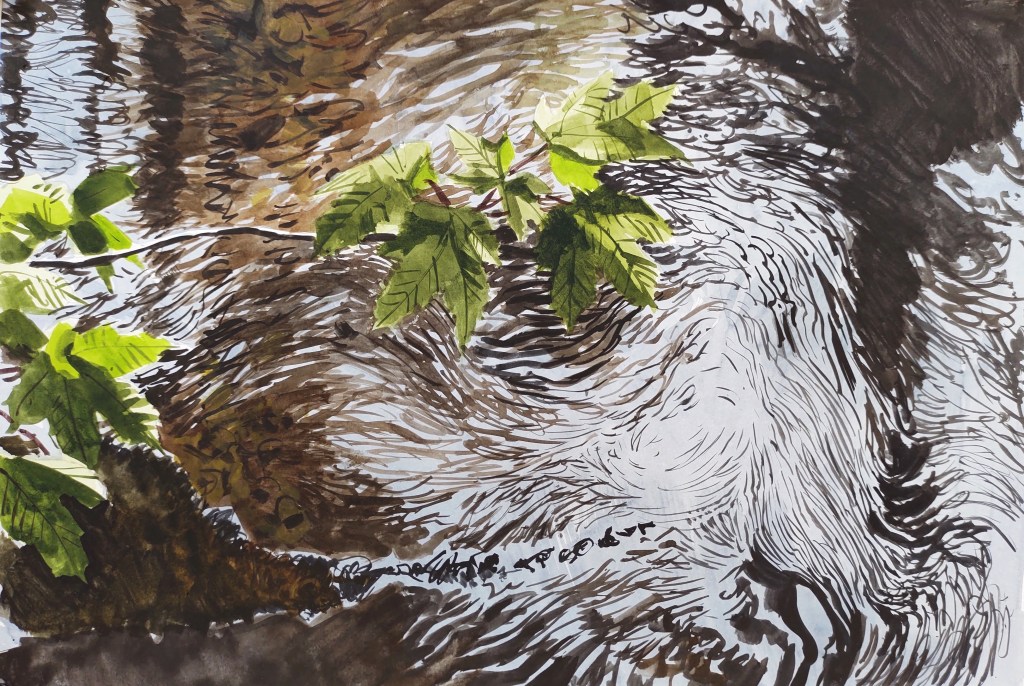
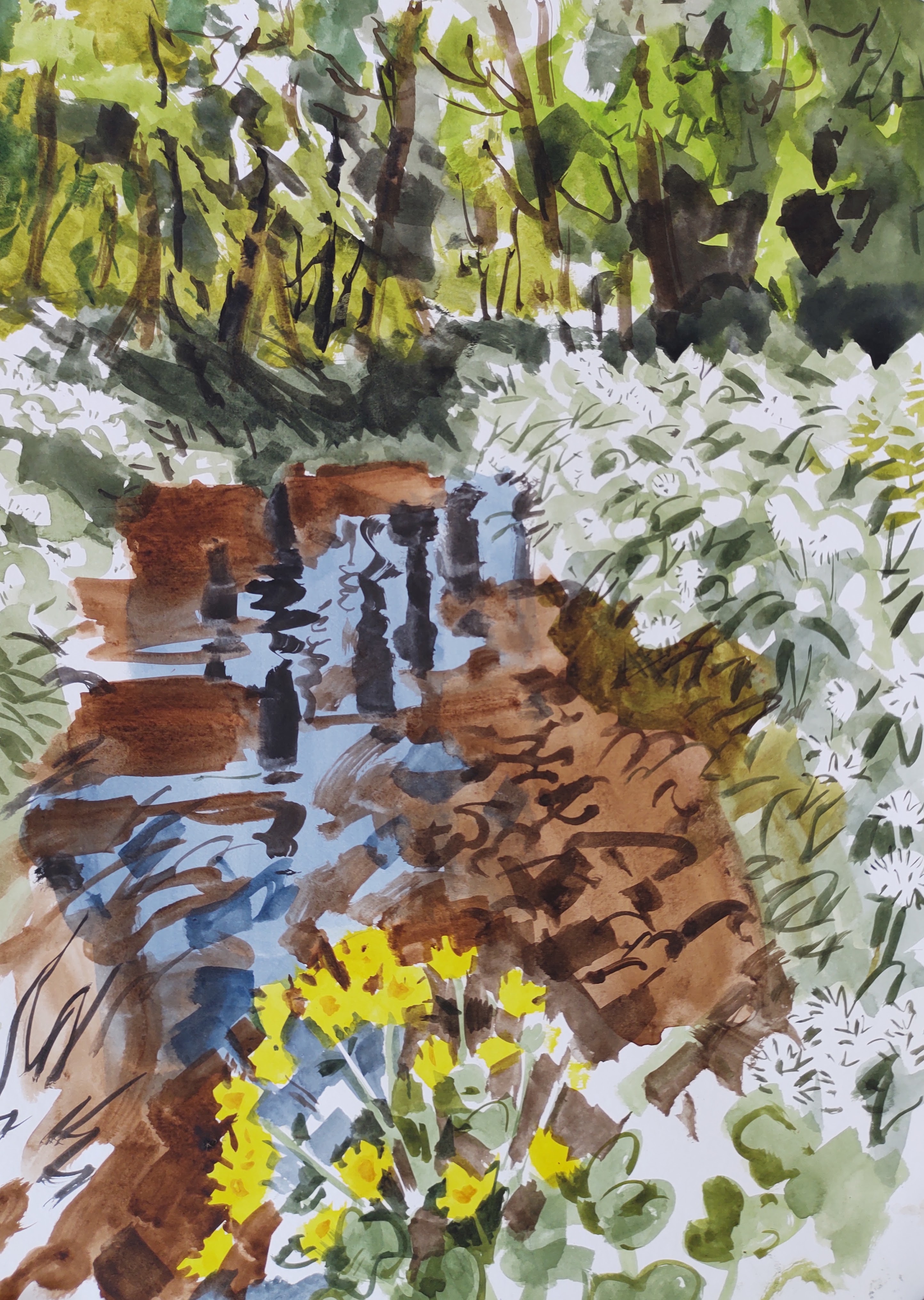
Down by the stream I was sheltered from the breeze, but easy prey for mosquitos. I was entranced by my eye’s ability to see reflections on the surface and stones on the stream bed, but not both simultaneously.

Reflections, Læseå

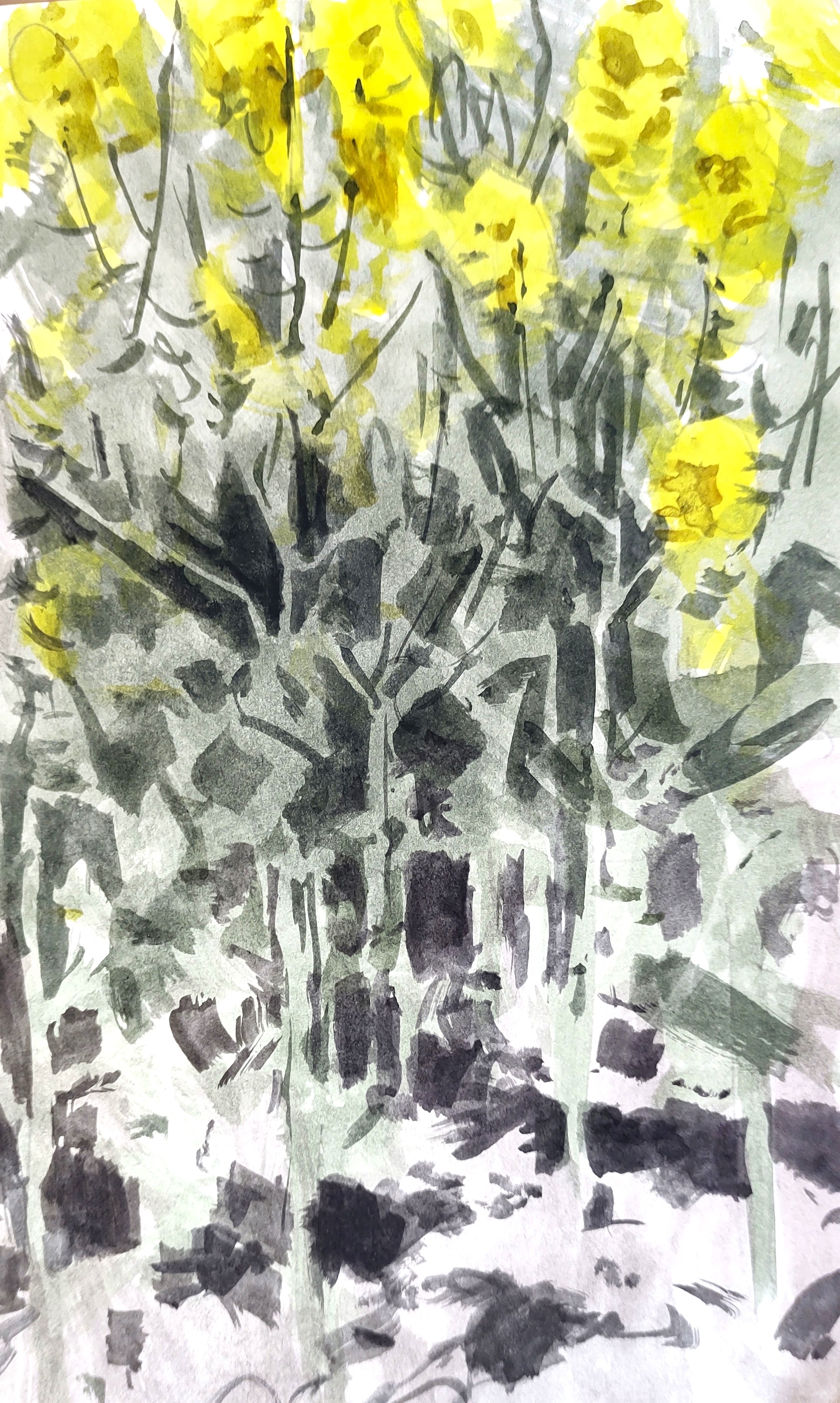
I took a break by the side of an oilseed rape field, now fading a little. A low-flying marsh harrier was lit yellow by reflected light from the flowers.

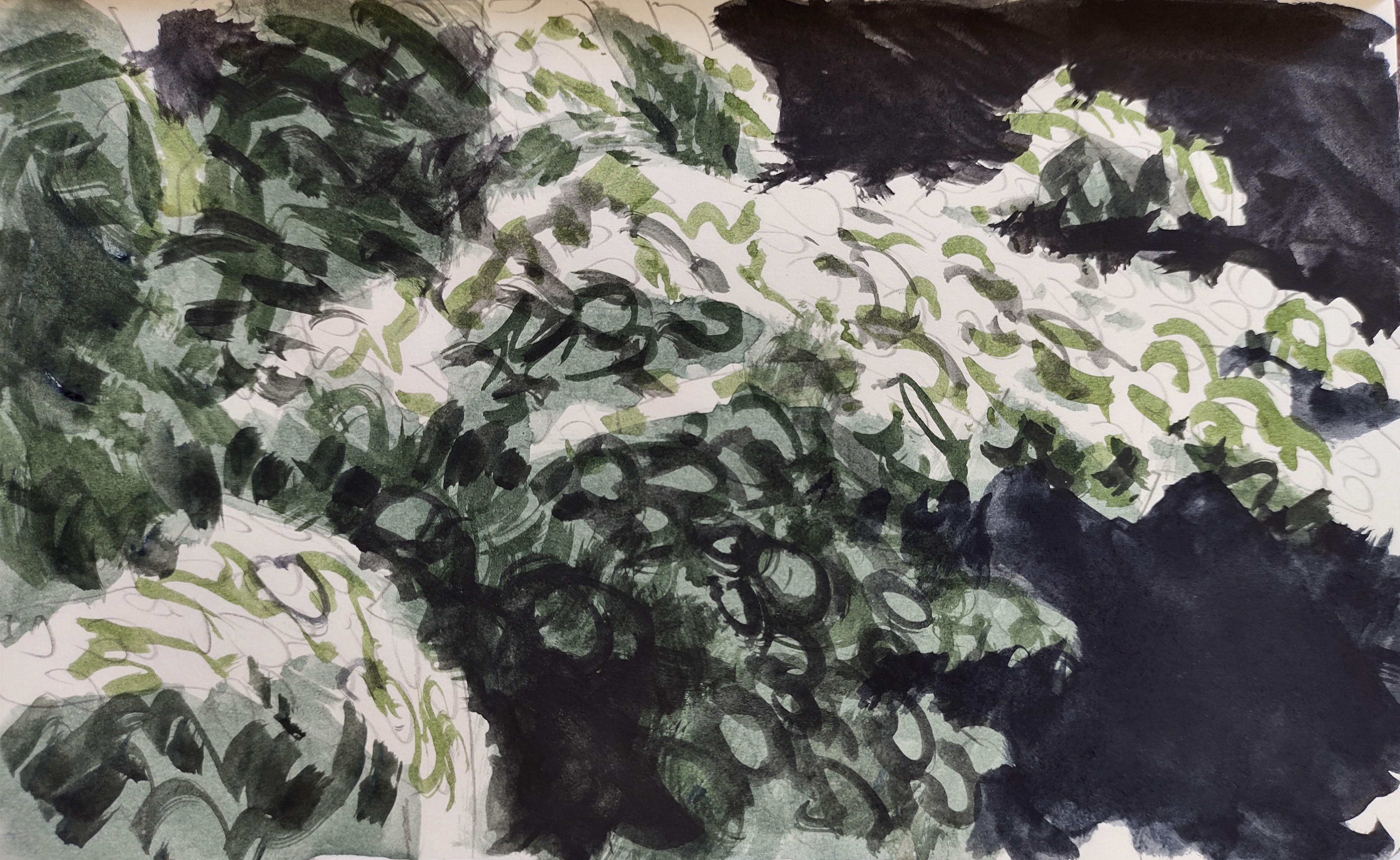
Down in the wooded valley again, I felt overwhelmed by the insane visual complexity of the vegetation and water, by the myriad patches of sunlight and shadow, the colours, patterns, and shapes – all flickering with the wind. I tried desperately to simplify what I saw but to no avail.

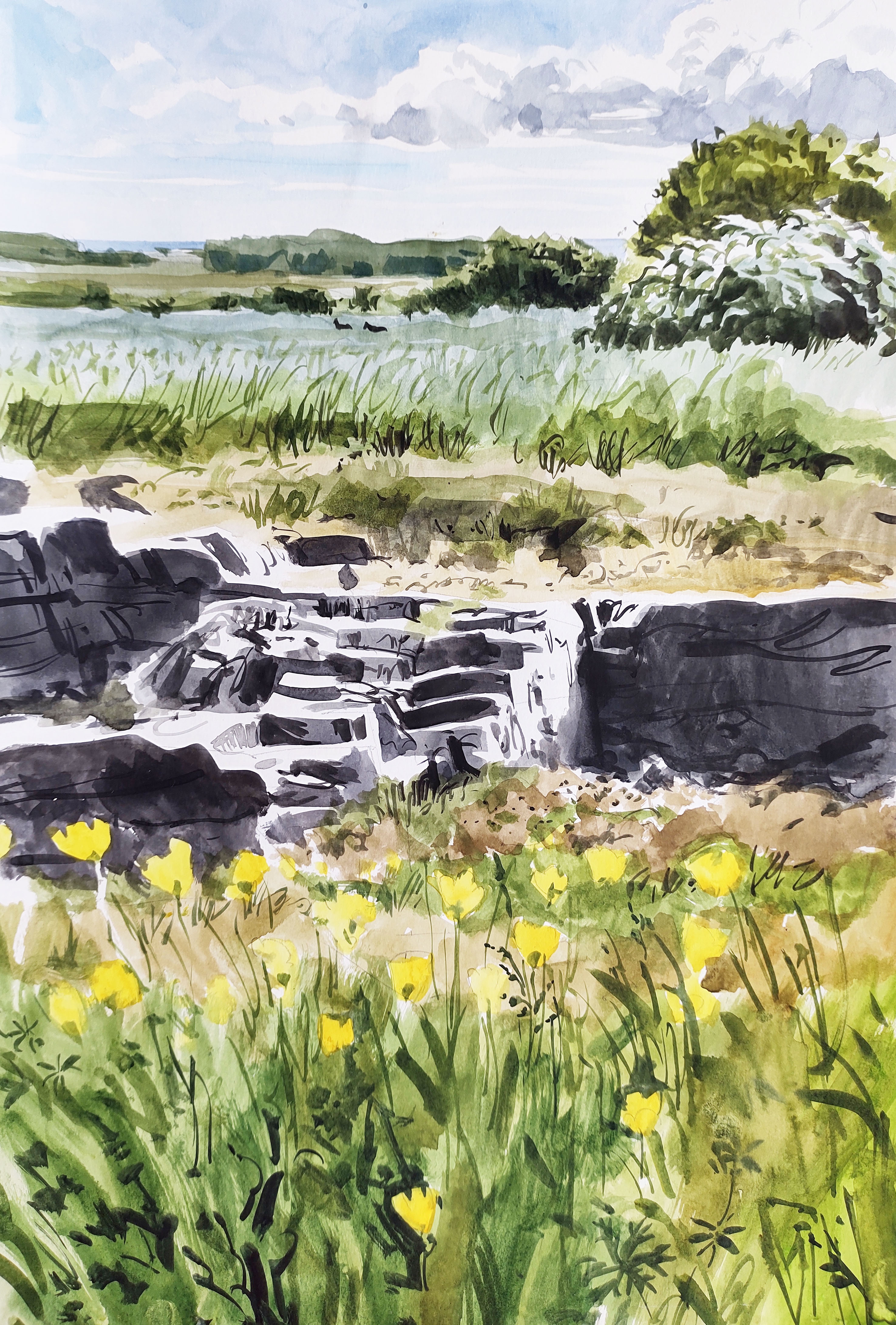
Where the stream bends and meanders through a flower-rich meadow heavy with the scent of wild garlic, I spent a while trying to capture the layers of shale. Curious horses watched my every move. As evening fell, they became skittish and galloped about.

Graptolite shale, with layer of bentonite (volcanic ash)

I followed the path out of the valley into the open fields of Vasagård – one of Bornholm’s, and indeed Denmark’s, most important archaeological sites. A cromlech was built in the early Neolithic period over 5,500 years ago, then a passage grave, and then both were combined into one barrow. Here funerals and other ritual activities have taken place over thousands of years. I crawled inside and along the passage into the pitch-black inner chamber and tried to imagine all that history. Outside again, the sun set behind the mound, with the entrance looking like an eye into another universe.

Langehøj ved Vasagård

LAND 21

WEATHER REPORT – Sunny most of the day. Temperature 10 – 15 degrees. Wind 6 m/s from the northwest. Hours of precipitation: 0 hours. Hours of sunshine: 12 hours.

STOPS with the BIVVY – 0

KILOMETRES WALKED – 15.01 km

DAY LASTED – 16h and 42 m

PEOPLE TALKED TO – 2

BIRDS SEEN and HEARD – 50 species: 5 new (icterine warbler, red-backed shrike, house martin, swift, cuckoo) running total = 111 species

LESSONS LEARNED – more water needed – I ended up boiling water from the stream.

IN MY HEAD – so much. I knew the area well, so I thought often of previous trips and encounters, my kids and so on. I thought a lot about time and impermanence, how things come and go (paths, ponds, railways, fields, barrow graves…)

LAND 20 – Skelbro til Lundestenen, 19.05.23

Denne side på dansk her

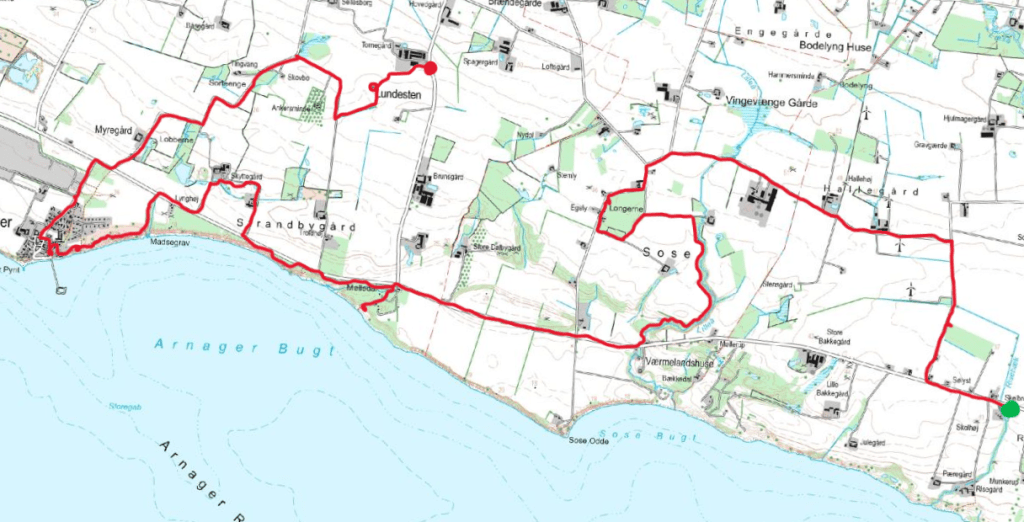
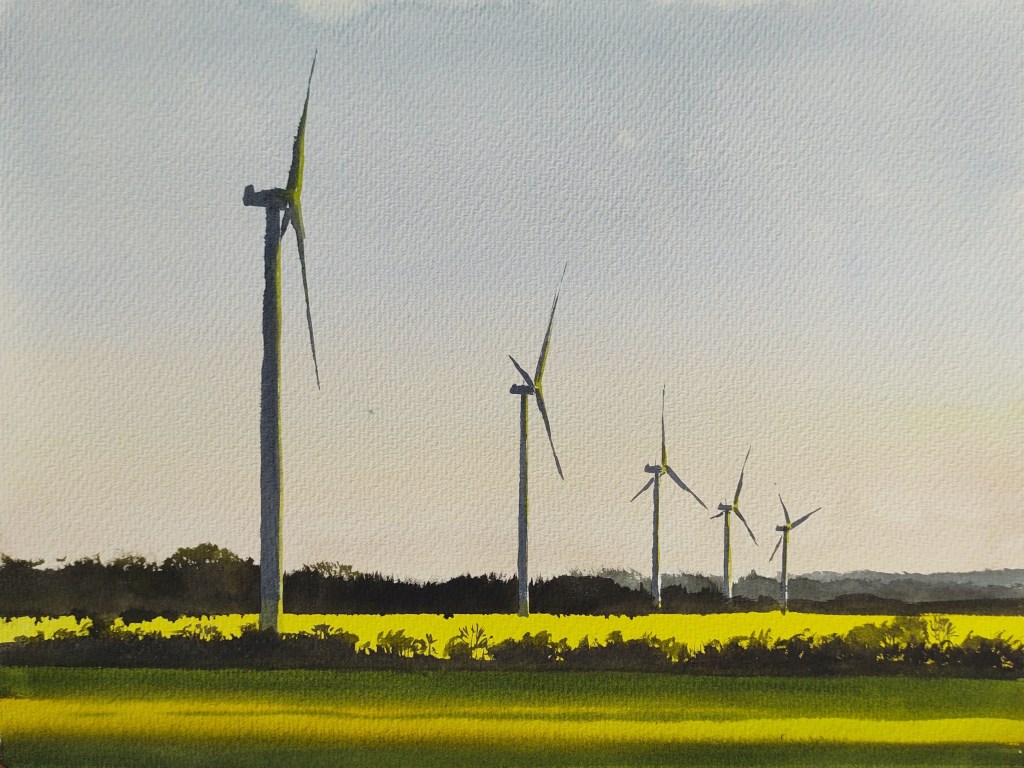
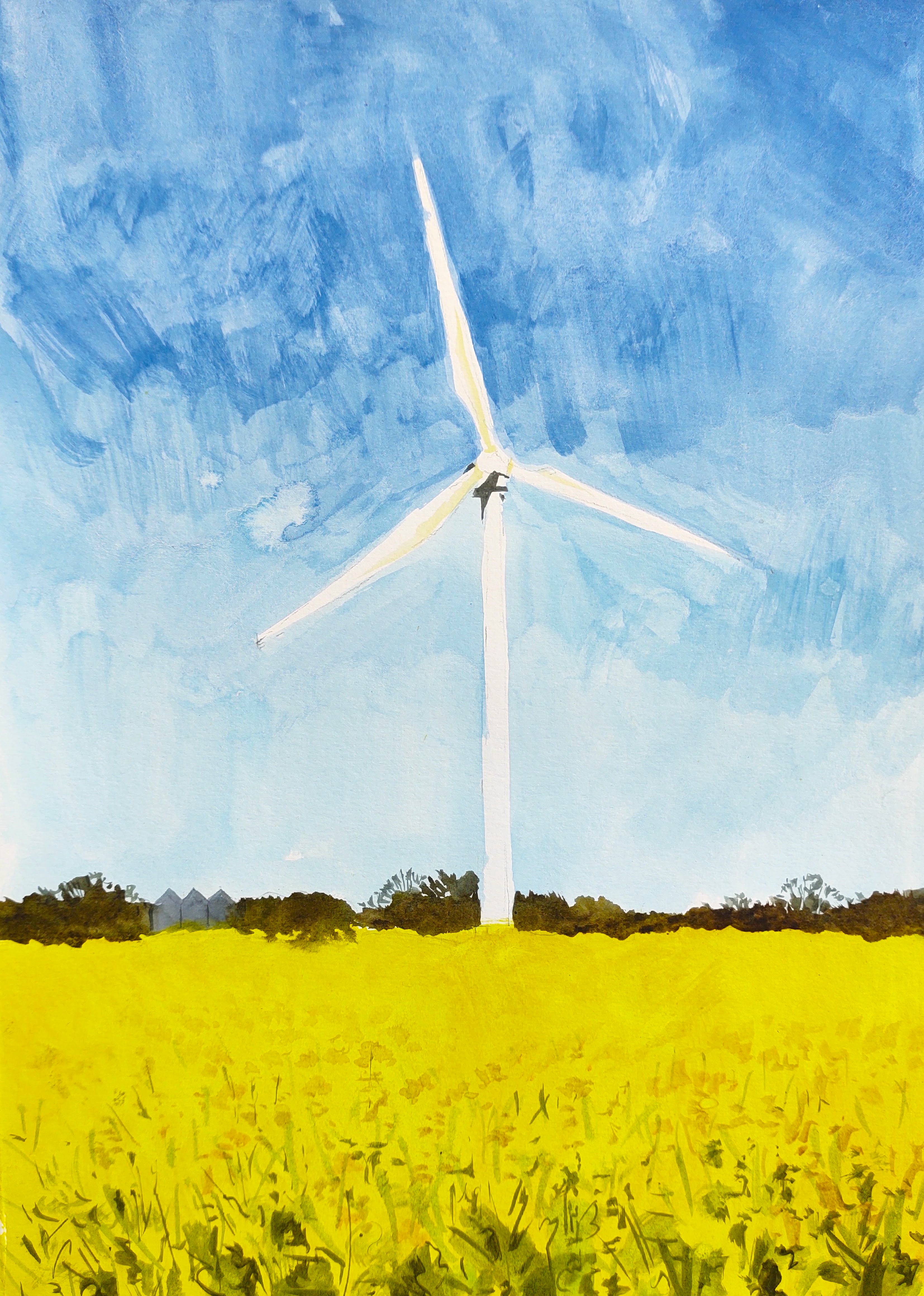
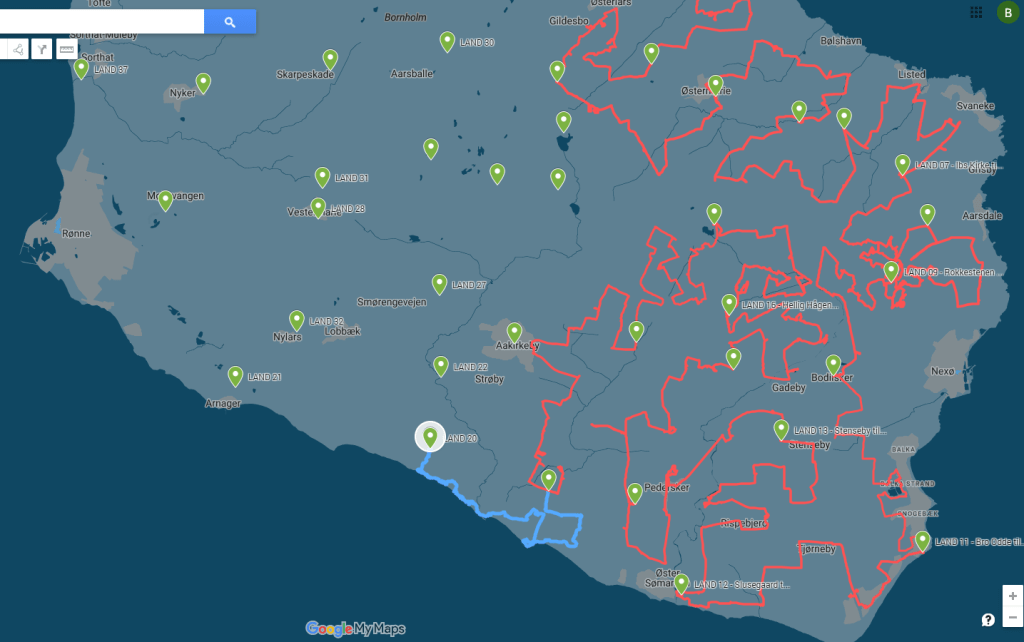
LAND 20 Dawn, 4:45 am. After the drop-off I walked westwards from the Skelbro quarry, and then north into the flat fieldscape of southern Bornholm. It was cold, with a partial ground frost, but clear and still. Embraced by the sound of birdsong and the sickly-sweet scent of the luminously yellow oilseed rape I painted the huge windmills as the sun rose beside me.

Windmills at dawn, seen from Vasagaardsvejen

The area I found myself in has been earmarked by the Danish Government as the site of a huge high voltage transformer station to process energy harnessed from two gigantic offshore windfarms. I tried to imagine the landscape completely transformed. Southern Bornholm is scarred by countless attempts to extract mineral wealth from the landscape in some from or other, but Energiøen is on a completely different scale. At present people living in the area stand to receive no compensation.

I stopped for a coffee with a good friend in Sose, and then walked along the edge of the precipitous and narrow valley of lilleå (‘Little Stream’) that cuts deep through the fields on its way to the sea. In the steep and shaded valley – one of the very few truly ‘wild’ and uncultivated parts of Bornholm – I managed to find a spot to have some lunch. With the light breeze, cherry blossom intermittently floated snow-like down through the tangled mass of knotty boughs, before settling on the narrow stream far below.

Emerging from the valley I walked along the main road. My mood darkened as I struggled to work with the watercolours in the hot sun. Always something to moan about. The day was long, I was underslept and exhausted, my mood swinging pendulum-like with the self-determined success, or lack thereof, of each completed painting.

Looking south from Søndre landevej

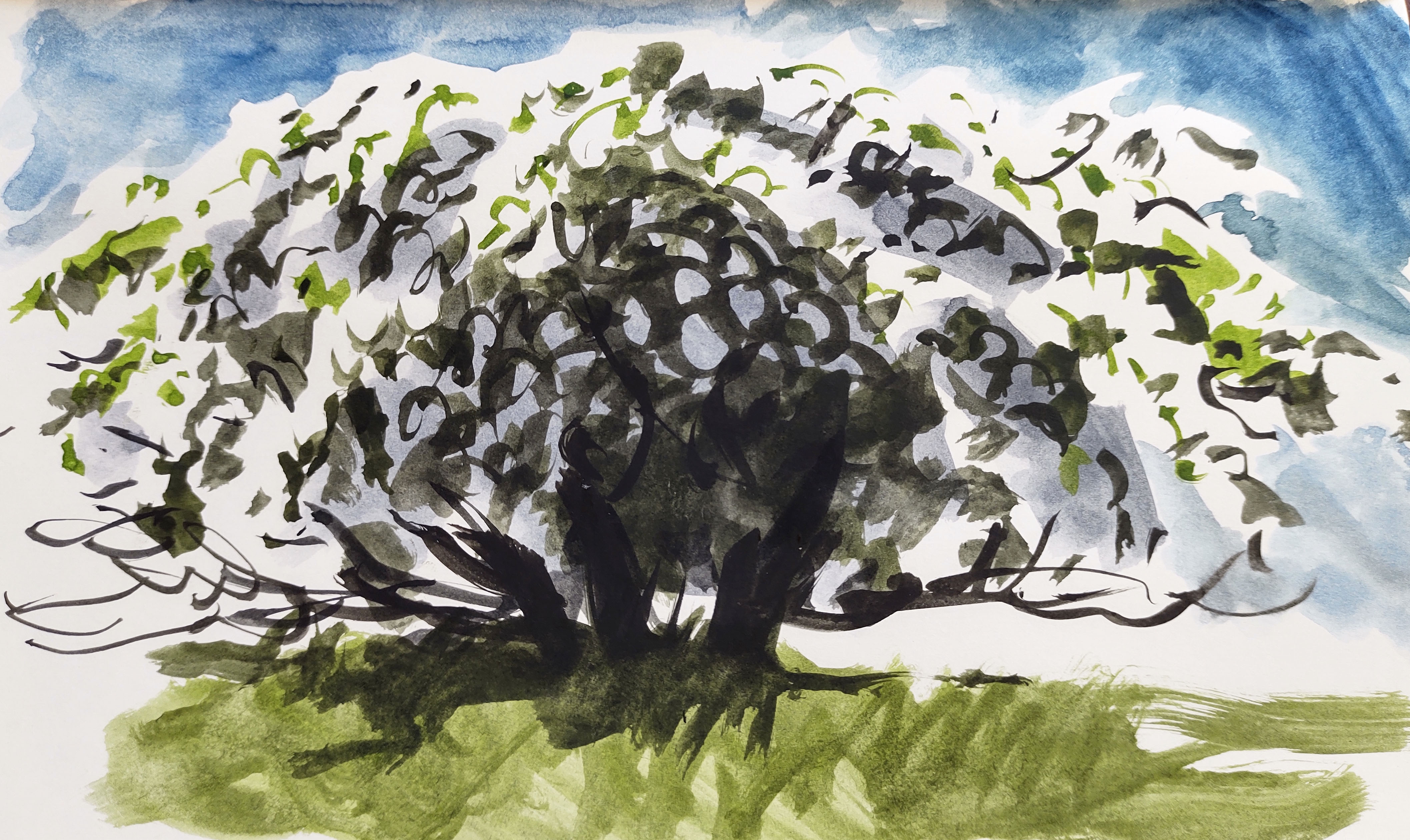
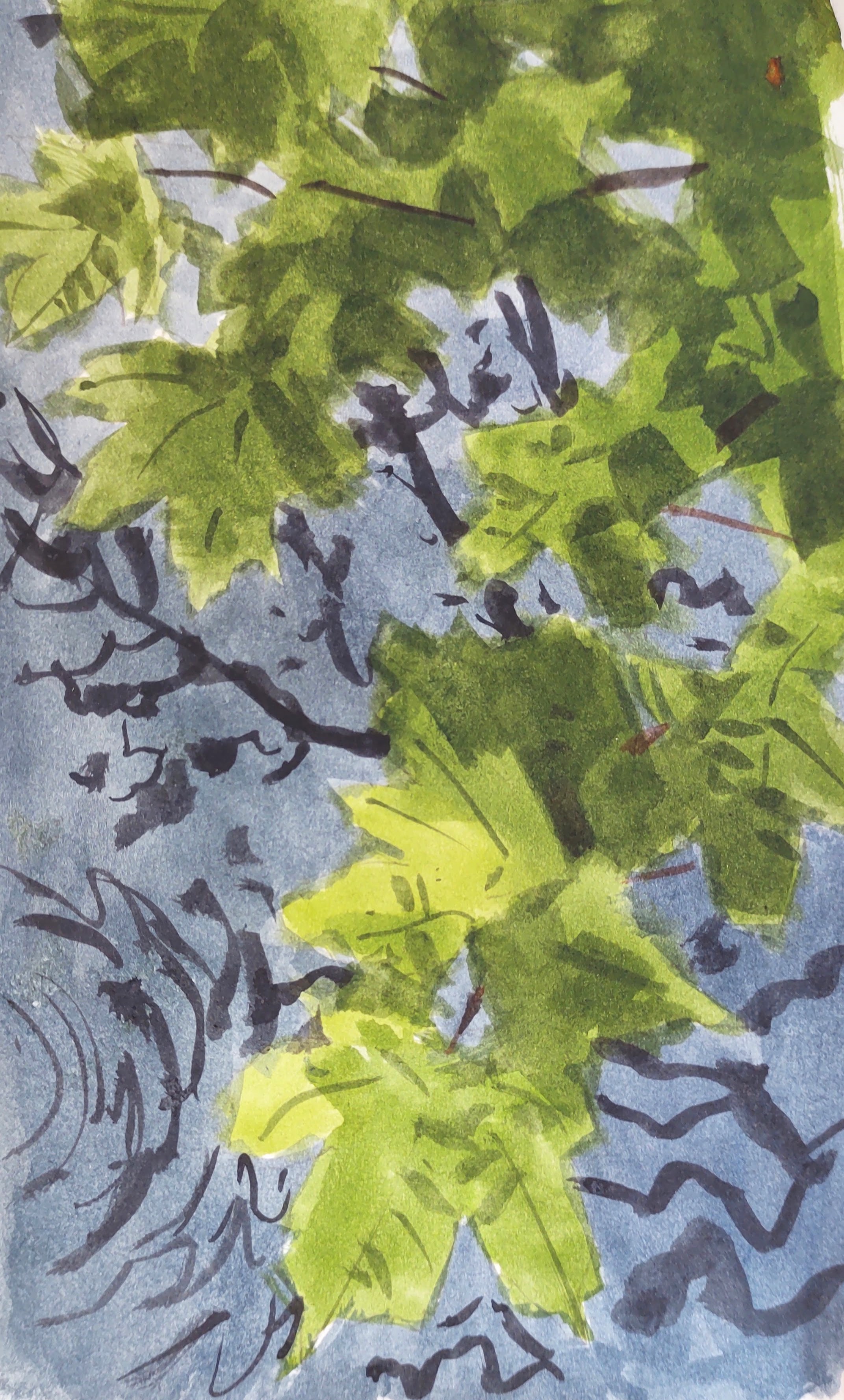
I walked along the coastal path again, parallel to the sea, and tried to capture the kaleidoscope of greens as the sun shone through the leaves of the trees.

Green leaves

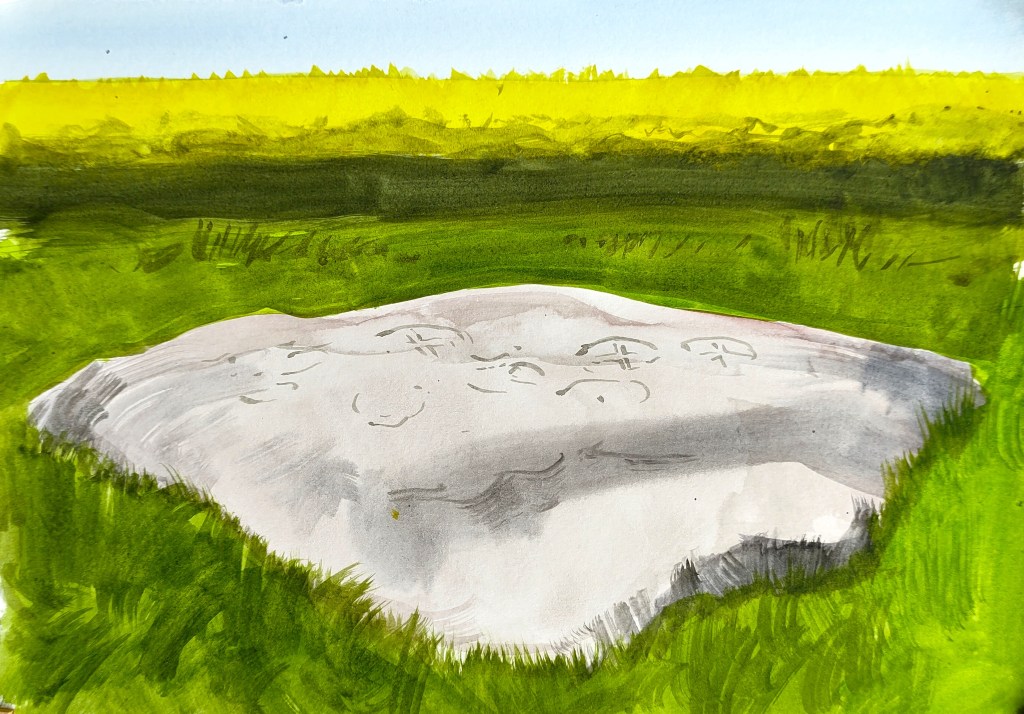
I took a short detour past wonderful old farms to visit a bronze-age rock carved with petroglyphs. Here I rested for a while. I pondered the importance and significance of these archaeological sites – both for my LAND project, and also in general.

Hellerestningsten. Lille Strandbygård

Down towards the coast again, I walked along a well-known path between Sose and Arnager, I was now entering a part of Bornholm I knew rather well.

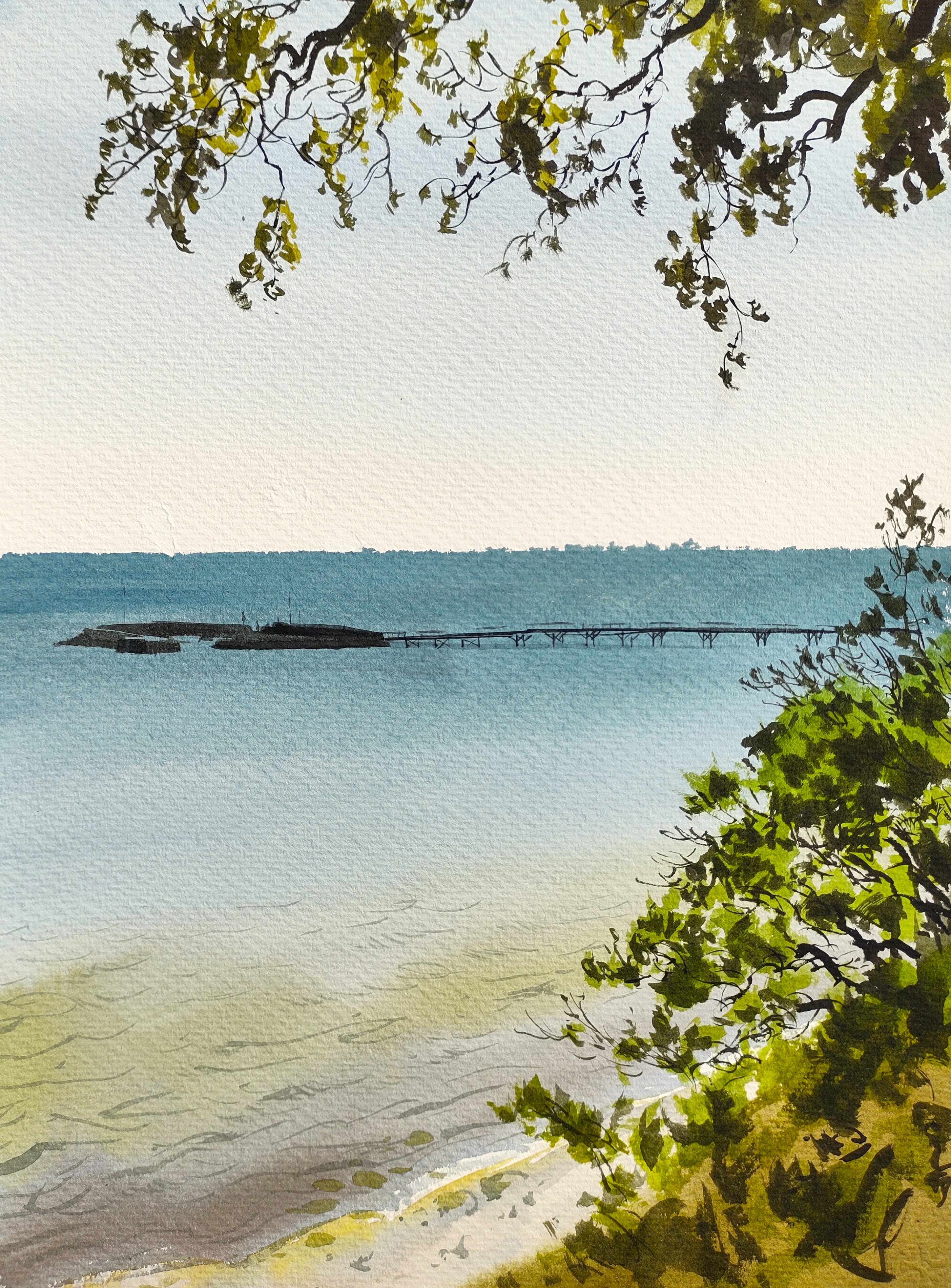
The pier at Arnager

As I walked north again out of Arnager, I was entranced by some billowing white plastic sheets covering a potato field.

Watering potatoes, Arnagervejen

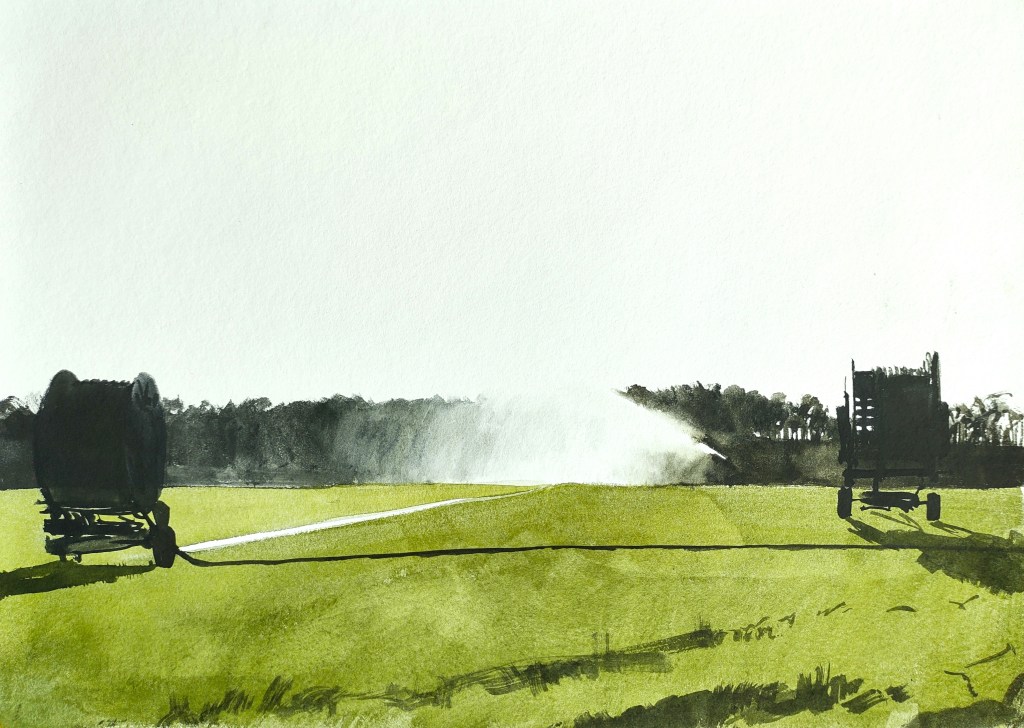
All around this part of southern Bornholm, fields were being watered due to the lack of rain. The evening was delicious now, my mood improved immeasurably. I walked along empty county roads accompanied by nightingale song, as the lowering sun cast a golden light over the fields.

Watering fields, Sorteengevejen

The day’s destination, Lundestenen, was another barrow grave – Bornholm’s largest and finest.  I struggled to find a path, and eventually had to walk across cultivated fields to reach the burial mound, where it sat marooned, like a desert island surrounded by a field of green. The sun slipped behind the trees and the day was done.

LAND 20

WEATHER REPORT – Sunny most of the day. Temperature 3 – 16 degrees. Wind 3 – 5 m/s from the east. Hours of precipitation: 0 hours. Hours of sunshine: 14 hours.

STOPS with the BIVVY – 0

KILOMETRES WALKED – 18.55 km

DAY LASTED – 16h and 27 m

PEOPLE TALKED TO – 7

BIRDS SEEN and HEARD – 43 species: 0 new (!) running total = 106 species

LESSONS LEARNED – Remember, it is a very long day. Anything can happen.

IN MY HEAD – energy and growth. Also, I met several old friends and thought a lot about how long I had been on Bornholm, and how much we are invested in the island.

LAND 19 – Grødby to Skelbro, 12.05.23

Denne side på dansk her

LAND 19 For the first time: no hat, gloves, scarf, or thick jacket. The sun rose into a clear steel blue sky, and from my start point surrounded by fields of yellowing rapeseed, I was completely covered by joyous peals of skylark song. As I slowly headed towards the woods of Raghammer, the skylark song was gradually replaced by the repetitive and overpowering rattle, chack and whistle of the newly arrived thrush nightingales.

I was to spend the first half of the day in the Raghammer Military exercise area. Covering over 300 hectares of forest, dune, and heathland, much of the area is protected on account of its diverse fauna and flora. I headed east and followed the outer boundary along a well-mown and signposted path, through a mixture of scrub and open woodland and accompanied all the way by an intoxicating cacophony of bird song and cherry blossom.

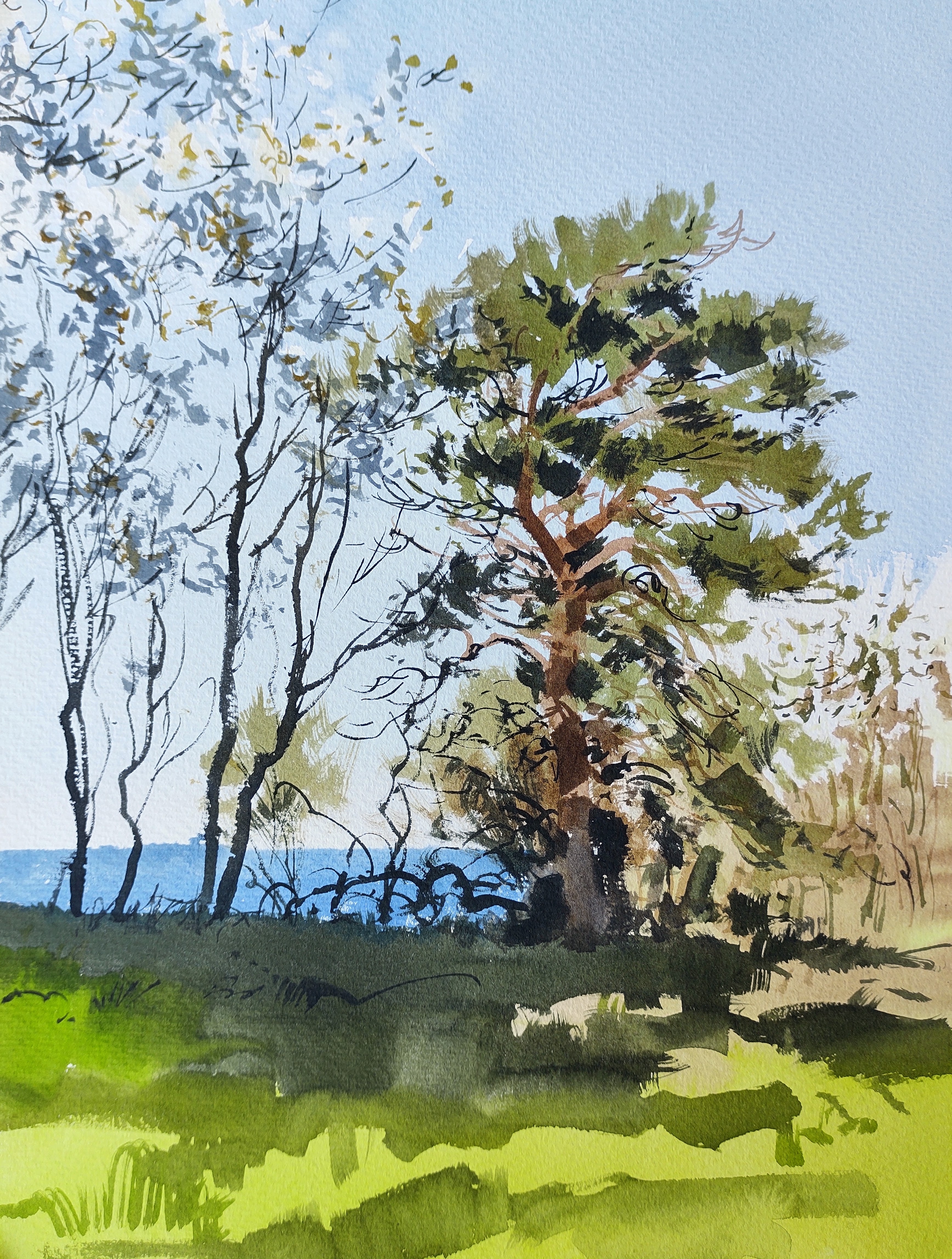
Wild cherry and pine, Raghammer

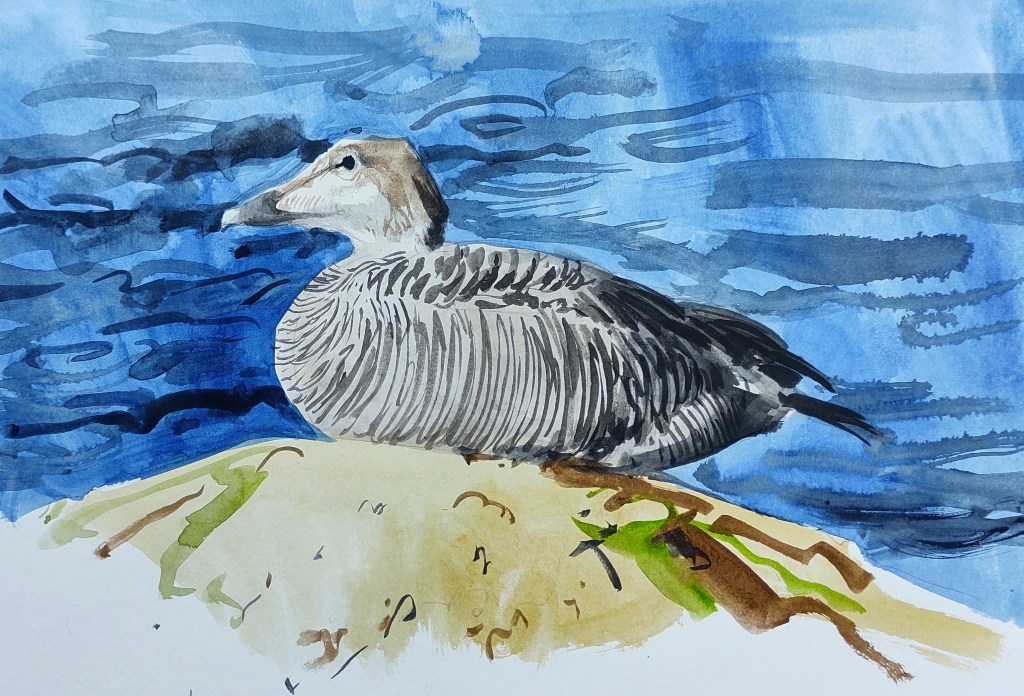
Eventually I arrived at the coast. Bathed in the morning light, the completely deserted beach was nothing less than paradisical. I was glad to meet the sea again and was reminded of my visit during the KYST project, in the autumn of 2018.

Eider duck, Raghammer Odde

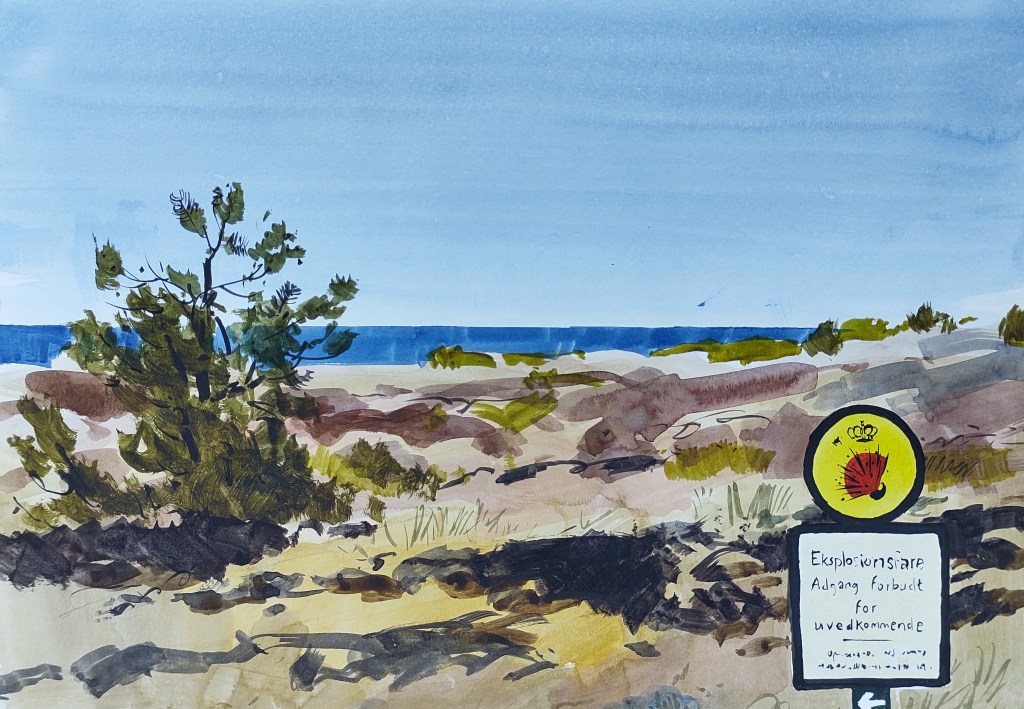
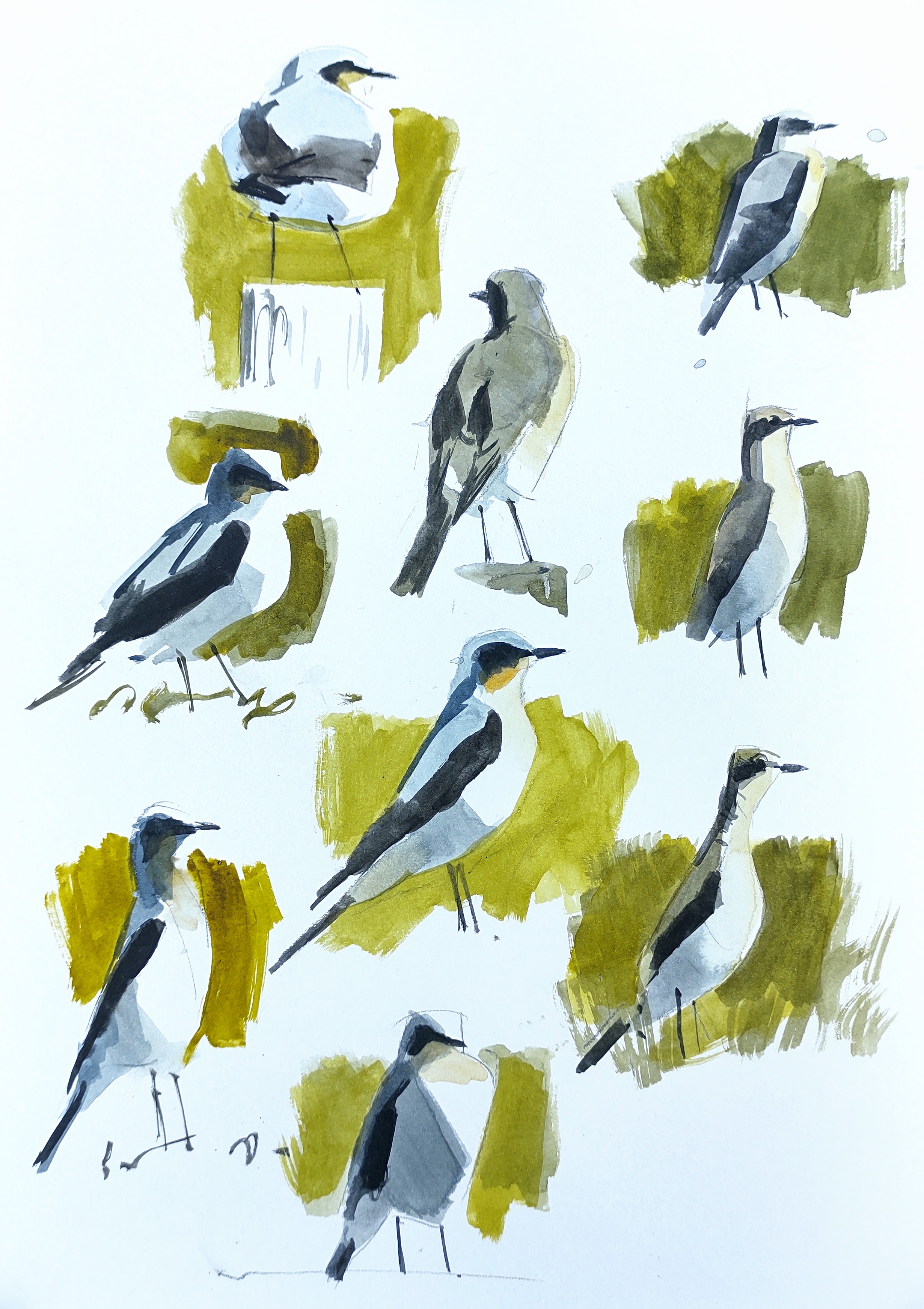
I walked around Raghammer Cape, and then doubled back inland into the open heathland where meadow pipits, yellowhammers, and wheatears flitted about.

Raghammer skydeterræn
Wheatear studies

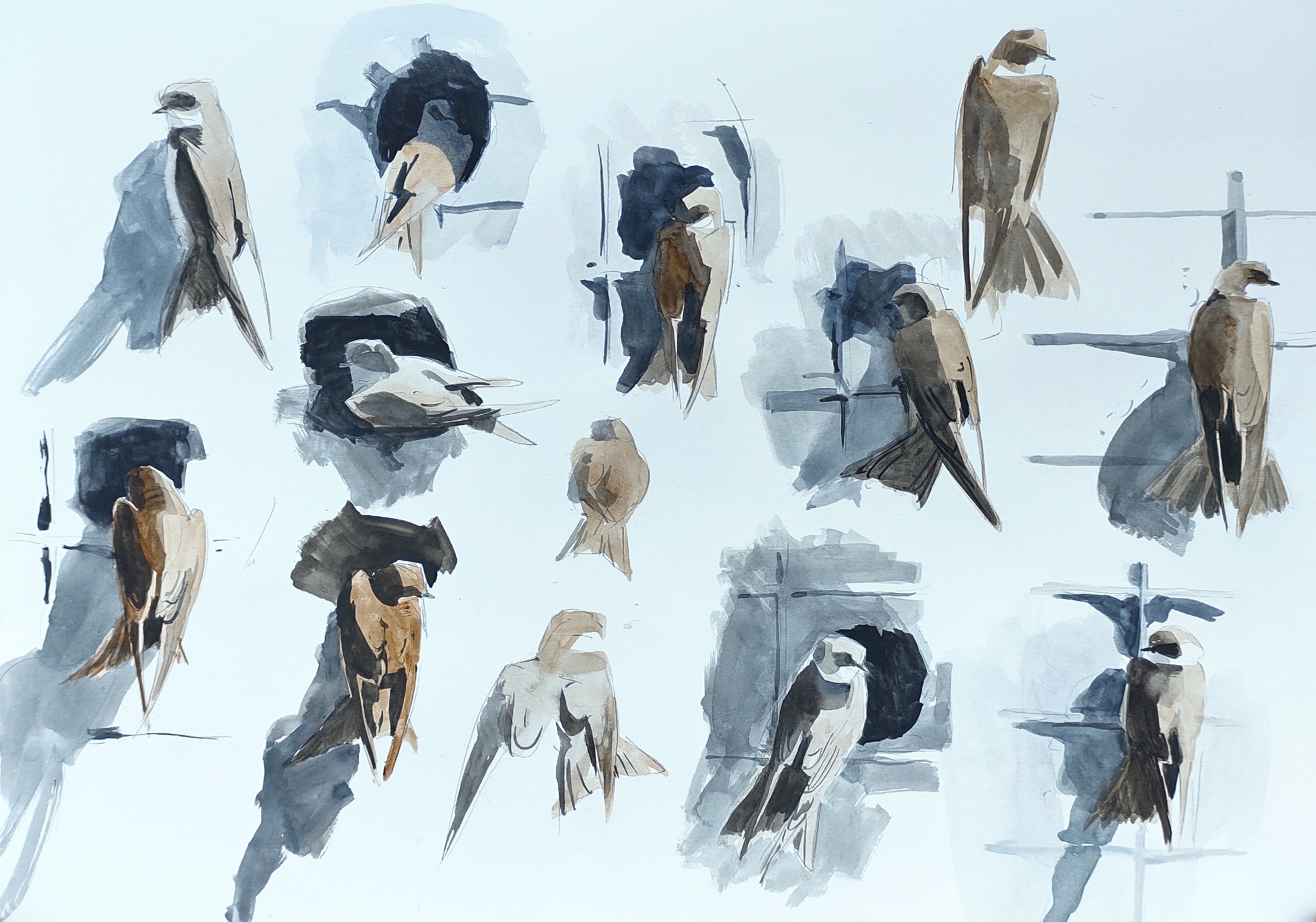
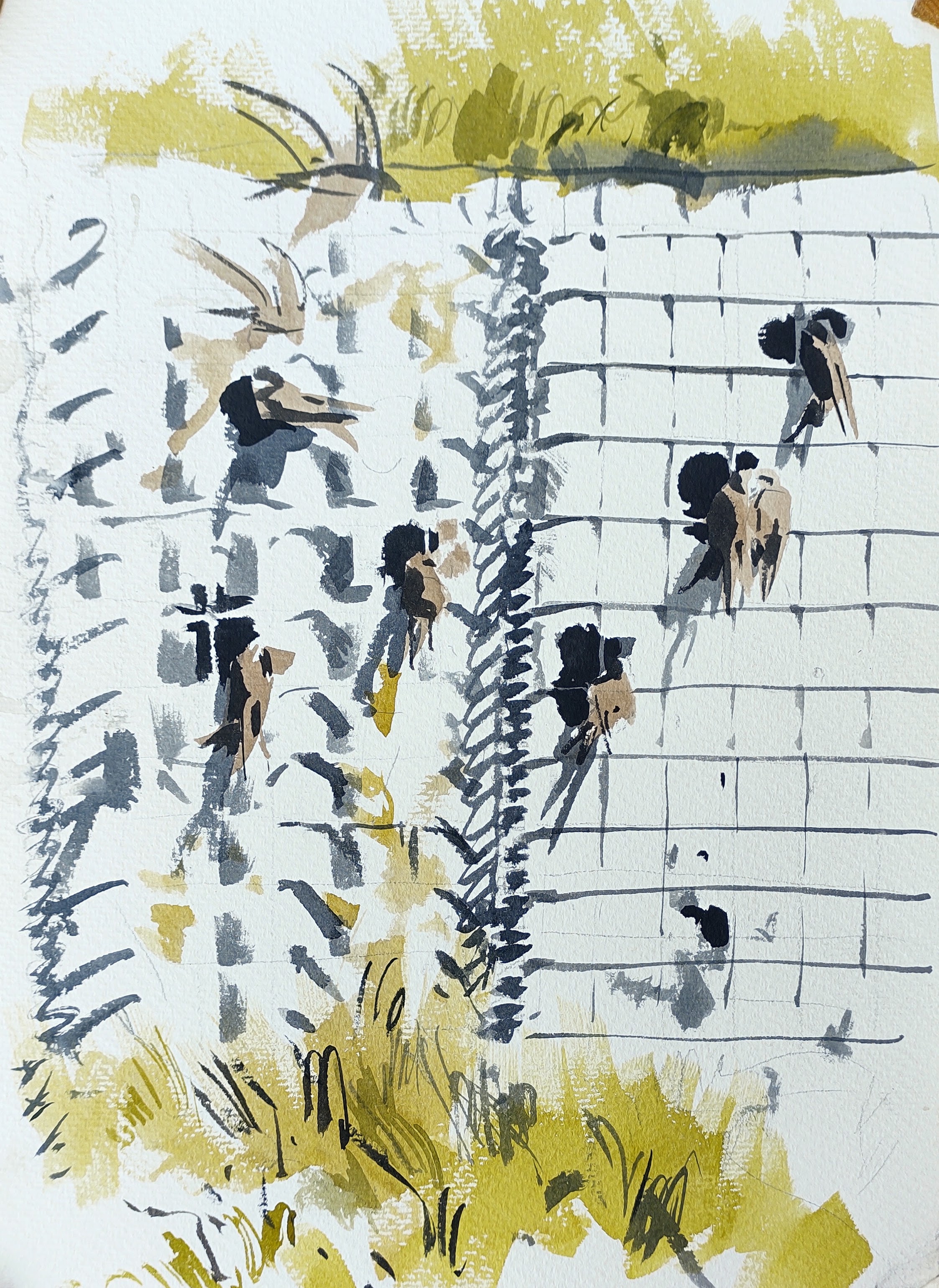
Overhead a honey buzzard and later a black kite. Huge areas of Bornholm once looked like this, but little heathland remains. A large flock of noisy chattering sand martins were busy excavating their nests in some huge sand bunkers – I was drawn to the light and flickering shadows, but they were seldom still for long enough and I struggled.

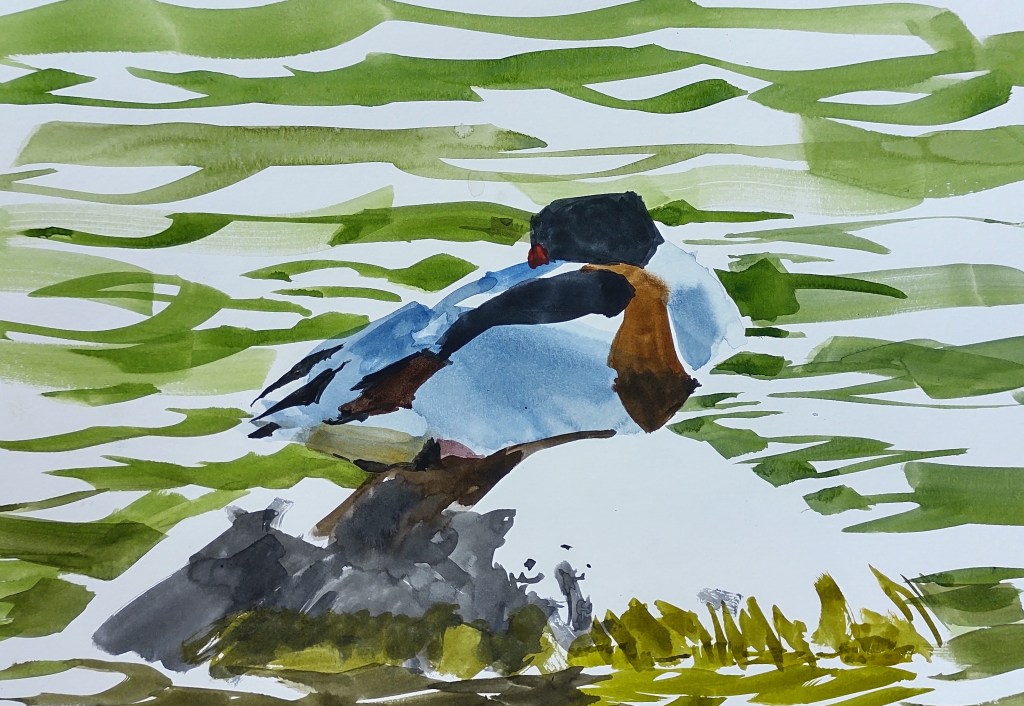
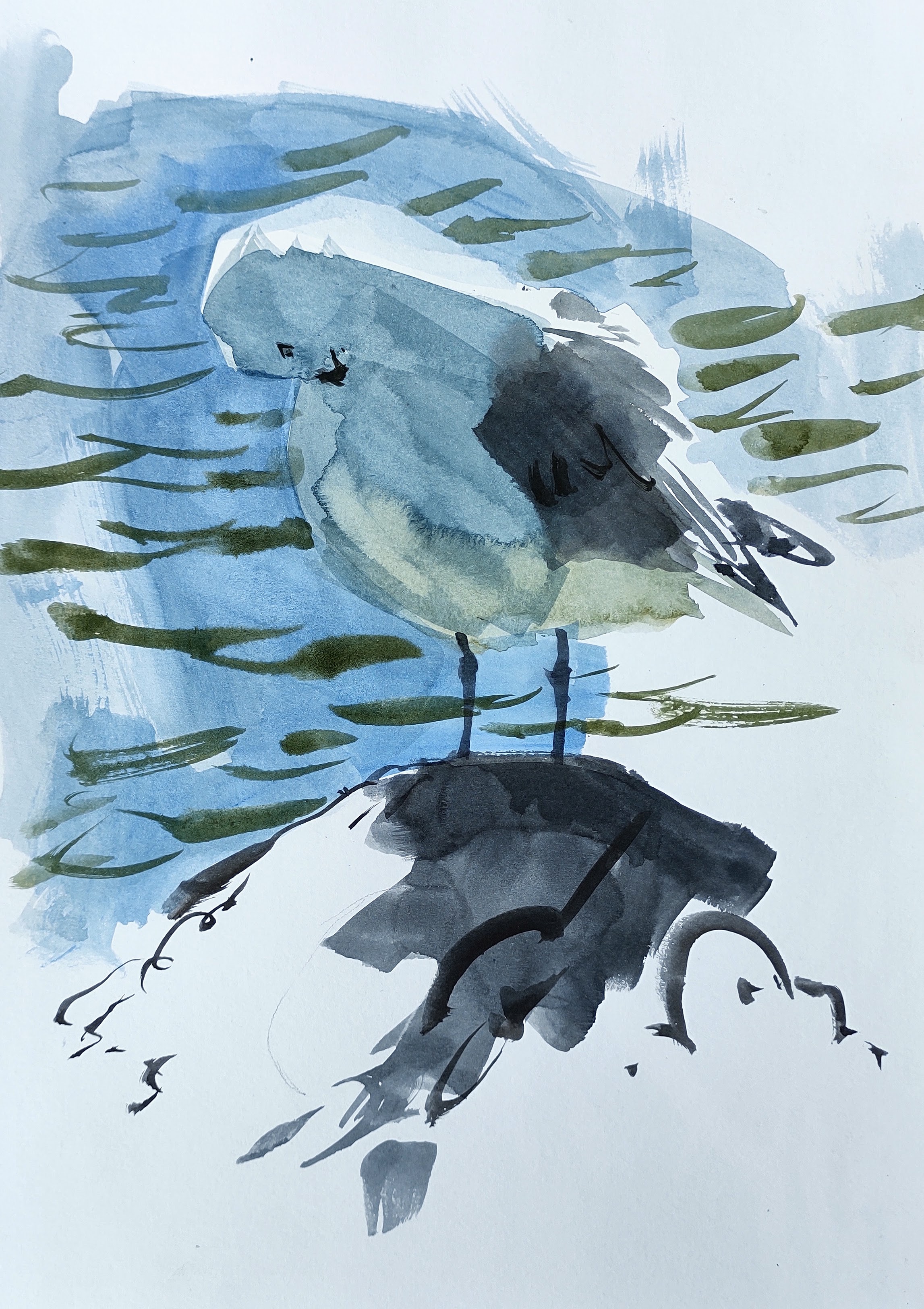
The day was long, but I still had a way to go. I was overheating and running out of water, my pack heavy. I headed west through a twisted and sleepy pine forest, and eventually arrived at the small seaside village of Boderne. Passing quickly through, I then followed the coastal path running atop the sandy ridge, parallel to the coast and the route of my KYST walk five years earlier. I was glad for the opportunity to paint some shelduck and a herring gull bathed in the strong reflective light of the sea, familiar and comfortable subjects for me.

Shelduck study, Vester Boderne
Herring Gull study, Vester Boderne

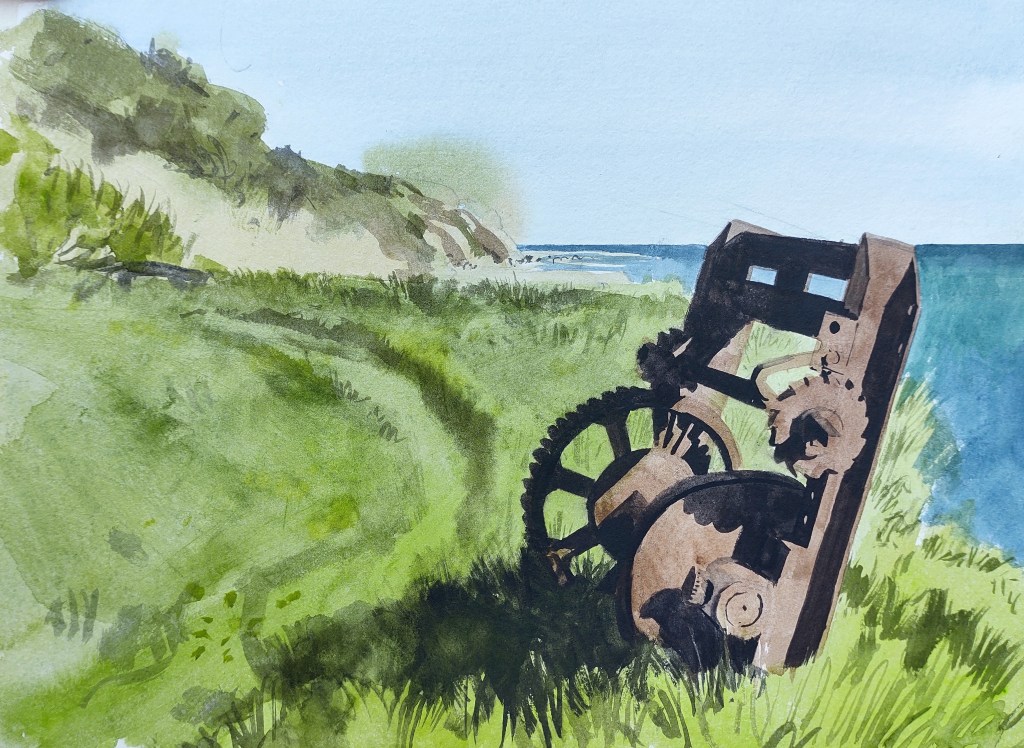
My route took me through wild scrubby meadows and blossoming cherry woods. At places the ridge had slipped towards the sea, exposing the red and green clays that were now cracked and dry because of all the dry weather. A rusty winch was possibly a remnant of the clay extraction industries that had been established here during the 19th and early 20th centuries.

Winch, Munkerup

Just before the mouth of the small Rise stream, I arrived at a natural amphitheater grazed by sheep, and here I paused to admire frothy blackthorn blossom caught by last rays of the setting sun.

Sunset. Gryden, Risestrand

Time was getting on, and I followed the steam inland back towards the main road and my destination, the old limestone quarry of Skelbro.

LAND 19

WEATHER REPORT – Sunny all day. Temperature 11 – 20 degrees. Wind 4 – 7 m/s from the east. Hours of precipitation: 0 hours. Hours of sunshine: 15 hours.

STOPS with the BIVVY – 0

KILOMETRES WALKED – 14.93 km

DAY LASTED – 16h and 02 m

PEOPLE TALKED TO – 0

BIRDS SEEN and HEARD – 57 species: 14 new (Black-throated diver, Common eider, Goldeneye, Red-Breasted merganser, Kestrel, Common Sandpiper, Sand Martin, Yellow Wagtail, Meadow Pipit, Thrush Nightingale, Wheatear, Garden Warbler, Whitethroat, Wood Warbler) running total = 106 species…incredible to see so many birds in one walk!

LESSONS LEARNED – I need to have a soft water bottle, so I can fill up in small sinks.

IN MY HEAD – despite the amazing weather, I fought against a bad mood and the symptoms of a cold all day

LAND 18 – Kastelsbakke to Grødby, 05.05.23

Denne side på dansk her

LAND 18 Kastelsbakke – ten past five in the morning. I hunkered down in the shelter of some trees and got to work, swaddled in layers and layers of thick clothing to protect me from the bitterly cold east wind.

The view from Siegårdsvejen

I headed back up into the forest, partly to find shelter, but also because my planned route in Raghammer had been postponed due to military exercises. Some of the younger beech trees were already in leaf with wild cherry and plum trees in blossom, but it was difficult to stop and paint because of the gusting wind. A striking male pied flycatcher brightened my mood somewhat.

View from Højlyngsvejen

Despite the sun, my mood was soon darkened again by the constantly gusting wind. The painting board strapped to my rucksack caught the wind like a sail and I tacked and stumbled along the exposed country roads, heading south again towards the southern flatlands.

Looking south from Lille Myregårdsvejen

I passed quickly through the bungalows and well-kept gardens of Aakirkeby village, feeling like a stranger from another time and space. Back into the fieldscape, the first green shoots were emerging in smart green rows.

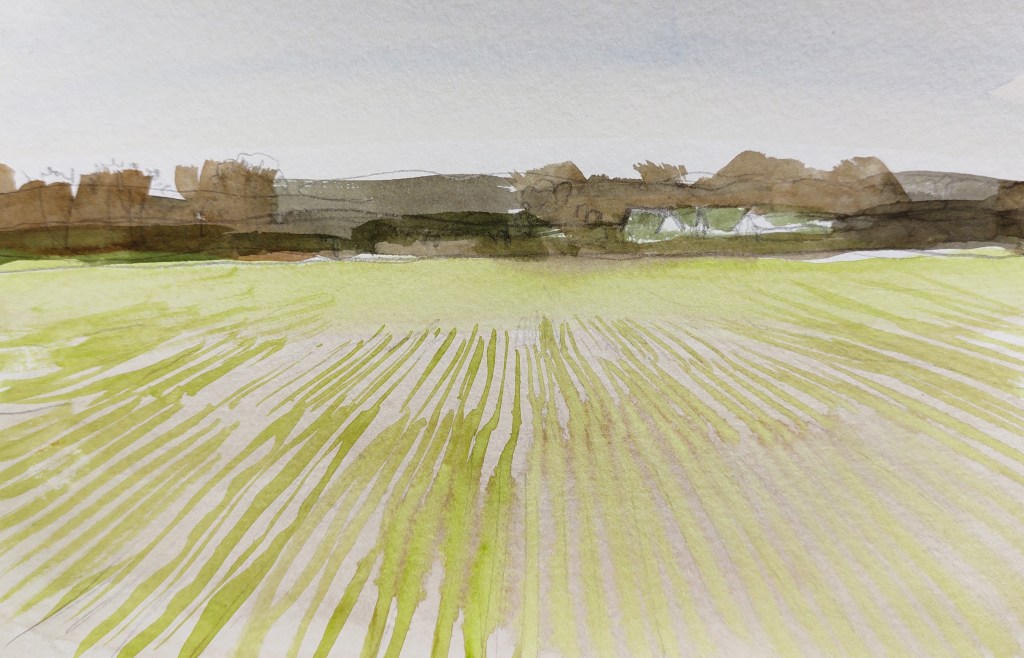
A field, Kratgårdsvejen

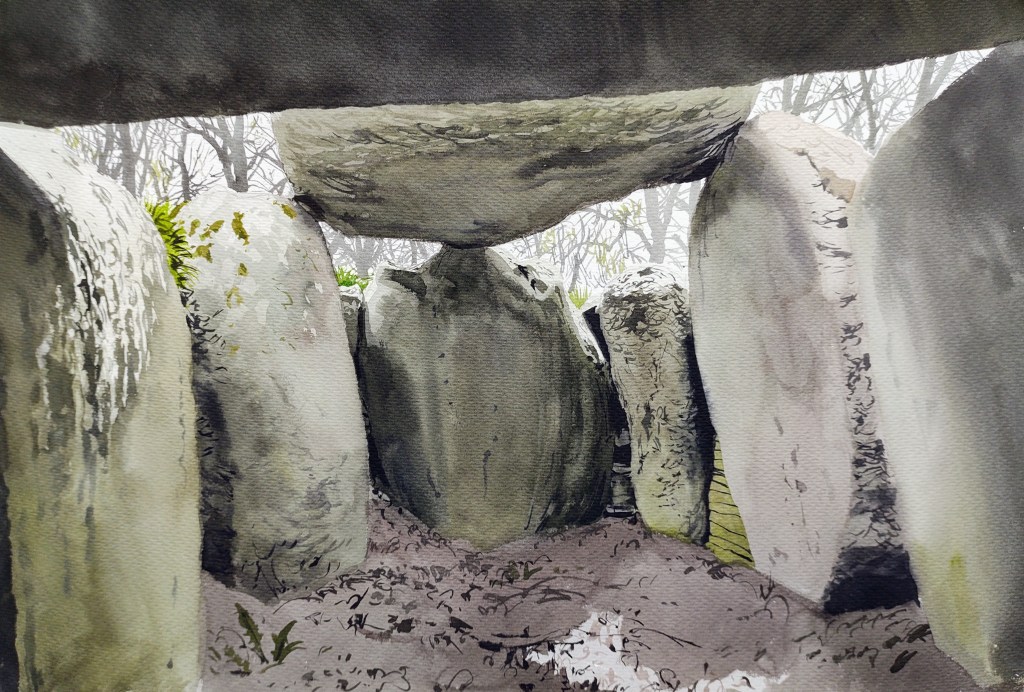
The wind, if anything, was increasing in severity. I arrived at Jættedal, a passage grave built in the late stone age over five thousand years ago, and first excavated in 1883. On my hands and knees I crawled inside and here in the womb-like inner chamber, I was somewhat protected from the wind.

View from inside Jættedal

Eventually, like a reluctant newborn baby, I crawled back out and faced the wind. Later, I found shelter in a small wood and even managed to catch forty winks, lying on top of an electricity box. The newly restored Saxebro Windmill looked fantastic in the late afternoon light.

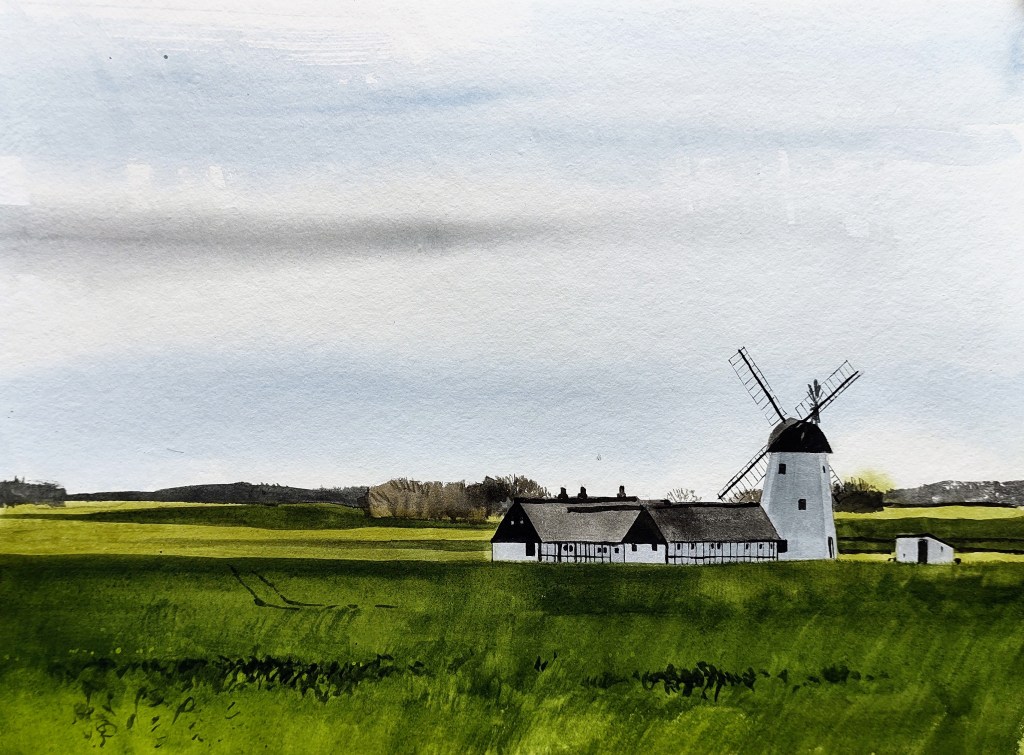
Saxebro Windmill

I was flagging but still had many hours to go. After a long search I manged to locate Grødby menhir, hidden close to the banks of Grødby stream in some thorny scrub. According to the faded information panel, the site should have been accessible to the public, but there were no signs or paths, and the panel was almost hidden behind brambles and hawthorn.

Grødby Menhir

To finish off, I sat by the bridge and looked towards the setting sun and the meandering stream – completely windblown and exhausted, but glad to have made it through the day.

Grødby å, from the bridge

LAND 18

WEATHER REPORT – Sunny morning, hazy then cloudy in the afternoon. Temperature 5 – 7 degrees. Wind 10 – 14 m/s from the east. Hours of precipitation: 0 hours. Hours of sunshine: 10 hours.

STOPS with the BIVVY – 0

KILOMETRES WALKED – 19.57 km

DAY LASTED – 15h and 29 m

PEOPLE TALKED TO – 0

BIRDS SEEN and HEARD – 42 species: 2 new (pied flycatcher, lesser whitethroat, running total = 90 species)

LESSONS LEARNED – I hate wind even more that I hate rain (maybe?).

IN MY HEAD – I had just spent four days with a group of artists, working on September’s Klippekroppe project. Ideas, conversations and images were rattling around in my brain.

LAND 17 – Ølene to Kastelsbakke, 28.04.23

Denne side på dansk her

LAND 17 Dawn found me perched on the bird tower again, overlooking Ølene marsh. The drive had been spectacular, with shrouds of low mist floating delicately over the landscape. The denizens of the marsh slowly awoke from their slumber and soon I was surrounded by a cacophony of birdsong.

Dawn.View from North tower, Ølene

As the sun rose behind and flooded into the marsh, I noticed several marsh harriers perching on dead trees, enjoying the warming rays. I was still in shadow, and for a while the bird tower was enveloped in mist and my paints froze on the paper.

Frozen marsh harriers warming up

Soon the sun rose high enough to warm my back, and I was happy I had bought my telescope and could enjoy the stunning lapwings and smart reed buntings.  The winter thrushes had now moved on and for the first time, willow warblers and blackcaps dominated the soundscape. Sap was rising.
Eventually, it was time to move on, I headed south and then west, skirting the edge of the marsh. An old birch tree and a beech tree had grown together, fused in an eternal embrace. It was difficult to see where one started and the other ended.

Beech/Birch

From the southern bird tower, I had great views over the marsh. Several marsh harriers drifted overhead sometimes engaging in aerial mating flights.

View from the South tower, Ølene

A pair of cranes were very wary – then I noticed the fluffy crane baby.

Cranes and baby

I pulled myself away from the marsh and walked back into the forest. An old hunting lodge had recently been converted into a shelter/gathering place for walkers, with information panels describing how this part of the island had been transformed from common grazing heathland into parish-owned forestry plantation over the previous hundred and fifty years or so. In the forest, it was still just about possible to make out the impressions of the old ‘Holloway’ tracks over the heath. The old way markers – piles of stones – still existed deep in the forest.

I walked on, crisscrossing between dark plantations and more open areas. I came to a large shallow pond, where I spent several hours gazing into the water and losing myself. I saw sticklebacks, agile frog tadpoles, smooth and great-created newts, water boatmen, diving beetles, and dragonfly larva. I could have spent all day there – far from everyone and everything.
Pond, Siegårdsvejen

Back on the path, I headed into the forest. At times following paths, sometimes walking randomly through the trees. I stopped to draw an oblivious hedgehog, and some anemone.
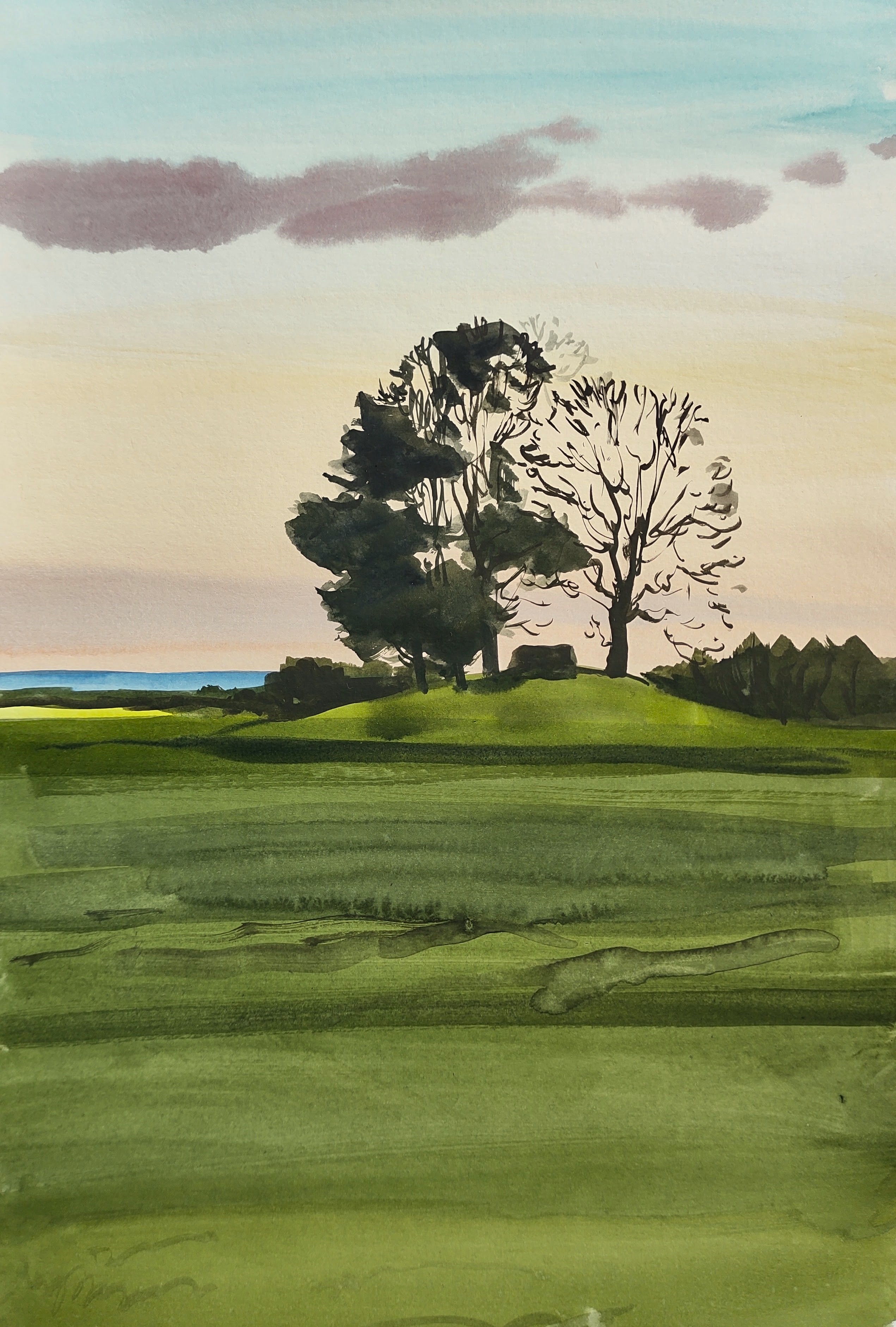
By the afternoon, the sun was hidden behind clouds, but in a ditch, some fantastic marsh marigolds did their best to compensate.

Marsh Marigolds

It had already been a fantastically long day – I was exhausted but far from the day’s end point. I stumbled out of the forest and headed south, down from the old ‘high heath’ and towards the fields and farms of southern Bornholm again. Looking back up to the plantation, I watched a line of red kites gathering in the gloom, to roost in some secret place deep in the forest.

Red kites, Bedtime. Siegårdsvejen

LAND 1

WEATHER REPORT – Sunny morning, hazy then cloudy in the afternoon. Temperature 0 – 11 degrees. Wind 0 – 4 m/s changeable. Hours of precipitation: 0 hours. Hours of sunshine: 8 hours.

STOPS with the BIVVY – 0

KILOMETRES WALKED – 16.62 km

DAY LASTED – 15h and 30 m

PEOPLE TALKED TO – 3

BIRDS SEEN and HEARD – 52 species: 6 new (wigeon, redstart, whinchat, blackcap, willow warbler, reed bunting, running total = 88 species)

LESSONS LEARNED – Bring more water next time. I had run out by early afternoon.

IN MY HEAD – My pond. My kids. Chimpanzees. Biodiversity.