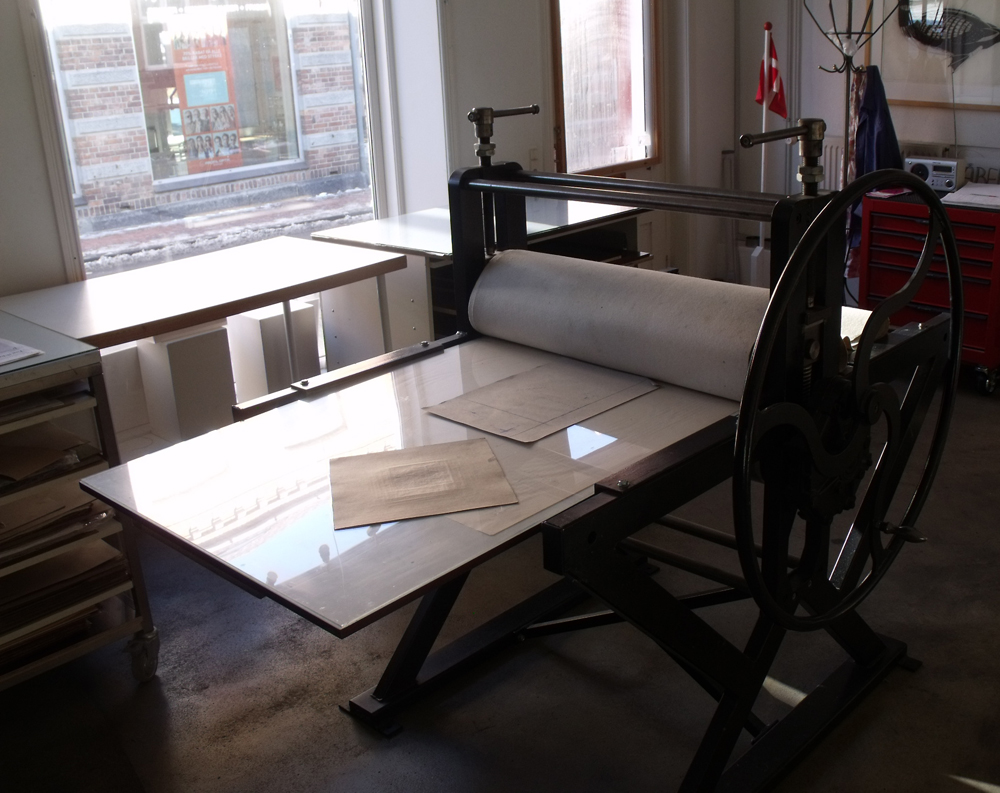
I’ve been working on a new project – ‘Bird of the Month Lino Prints’ (for want of a better title) since December of last year. The idea behind the project is the creation of 12 two-colour reduction lino prints – one for each month of the year – depiciting a Bornholmian bird, or group of birds, in a Bornholm setting.
Actually I’ve been thinking about doing this for years, and my head has been full of ideas about which bird and which place on Bornholm. Self-enforced and ‘proactive’ projects like this are a much needed counterpoint to my usual working practice – ‘reactive’ responses to ephemeral changes in the environment. The self-enforced structure of the project, together with the somewhat methodical nature of printing, gives me an different way of working which I find both challenging and refreshing.
As such, the project is driven by the following (informal) objectives/rules
- Each print will be small and identical in format (approx 12 x 12cm)
- The print run for each month will be between about 20 or so
- Each print will depict a bird that is ‘classic’ for Bornholm for that particular month
- Each print will depict the birds in a recognizable place on Bornholm – one where they can be seen
- Each print will be a reduction linocut – in most cases with just two reductive stages (=white paper, plus two colours)
- Each print will be nearly colour neutral, with an emphasis instead on tonal contrasts and a simplified graphic approach. Groups of birds, strongly lit and blending in and out of their background, will be the order of the day.
I am now more than half way through, and hope to be finished some time in Spring. I’m hoping they will be ready for the exhibition in Sweden, and perhaps even for Kunstrunde here on Bornholm.in April.
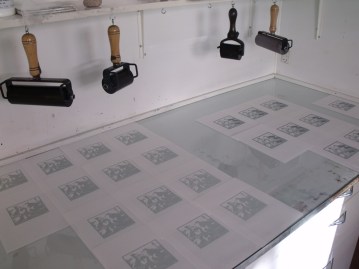
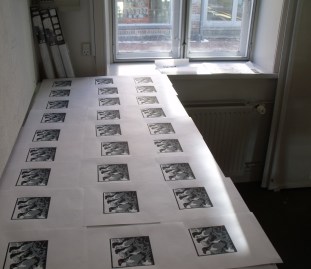
All the printing has taken place at Tryk2, the fantastic printing workshop in Åkirkeby, Bornholm. I cannot recommend this place highly enough. Anyone interested in Bornholm and printing should book it for a few weeks in the summer (it comes with a flat). It is very well equipped and affordable – check out their website (*new website currently under construction, will update link soon…).
Here is one of the prints I’ve been working on. Black headed gulls for August (this is actually three colours/levels of reduction, so I broke my rule here…).
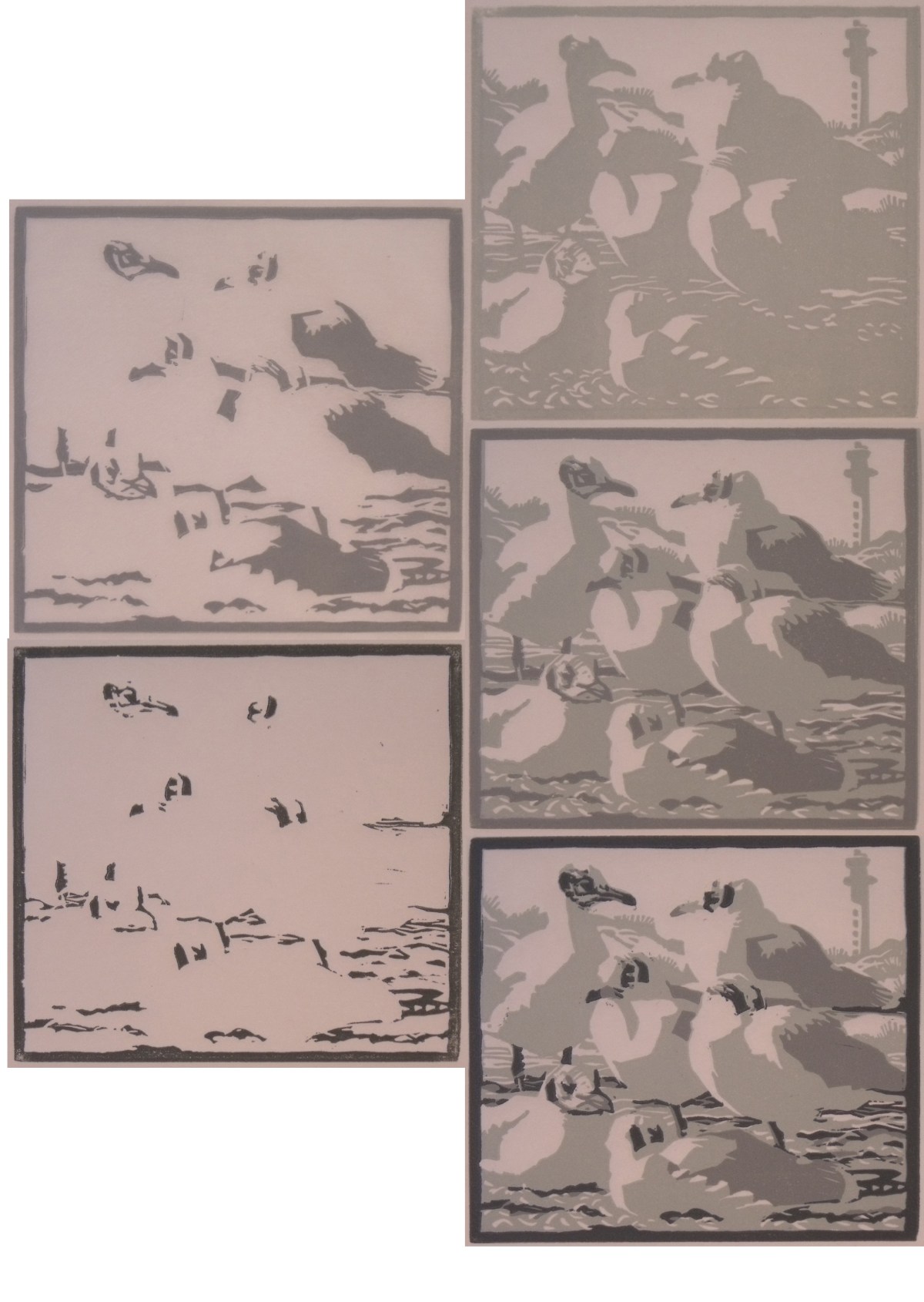
The finished print here…

Anyway, I eventually settled on the following month/bird/place combinations…
- January – Rooks (Råger) – Østermarie Rundkirke
- February – Ravens (Ravner) – Rytterknægten
- March – Lapwings (Viber) – Udkæret
- April – Shelduck (Gravænder) – Salthammer
- May – Ederfugle (Eider ducks) – Christiansø
- June – Vandrefalke (Peregrines) – Vang
- July – Razorbill (Alke) – Hammerknuden
- August – Black Headed Gulls (Hættemåge) – Dueodde
- September – Cranes (Traner) – Bastemose
- October – Greylags (Grågæes) – Nexø Sydstrand
- November – Fieldfares (Sjagger) – Svaneke
- December – Long Eared Owls (Skovhornugle) – Rønne
The list is more a reflection of when and where I get my inspiration from during the year, rather than an attempt to showcase rare or exciting birds that you find on Bornholm. There were lots of ‘honorable mentions’ that didn’t make it onto the final list – but who knows, maybe I could do another round in a few years?
I’ll update my progress on this blog… until then, back to work…
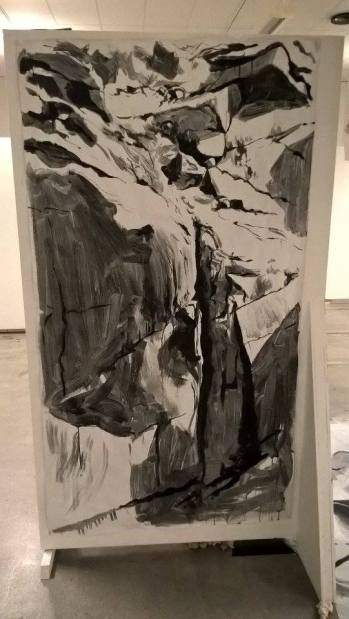 ‘Brud i Gennem’ came about when I was invited to have an exhibition during Bornholms Kulturuge (‘Culture Week’) in September 2016, by Galleri Rasch in Rønne Bornholm. The theme for 2016 was ‘Brud’, an interesting word in Danish that has multiple meanings and idiomatic uses. In Spring of this year I did an art week with some students from a school in Nexø that explored some of these themes, and some ideas relating to the refugee crisis and the use of the anamorphic technique began to fly around in my mind.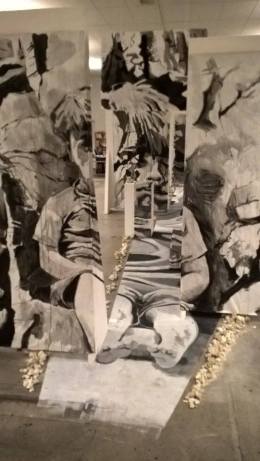
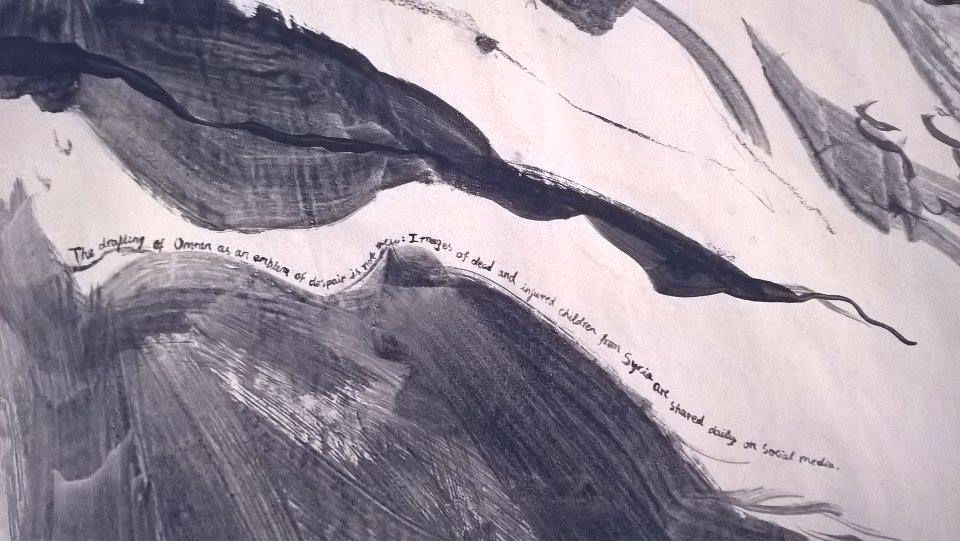
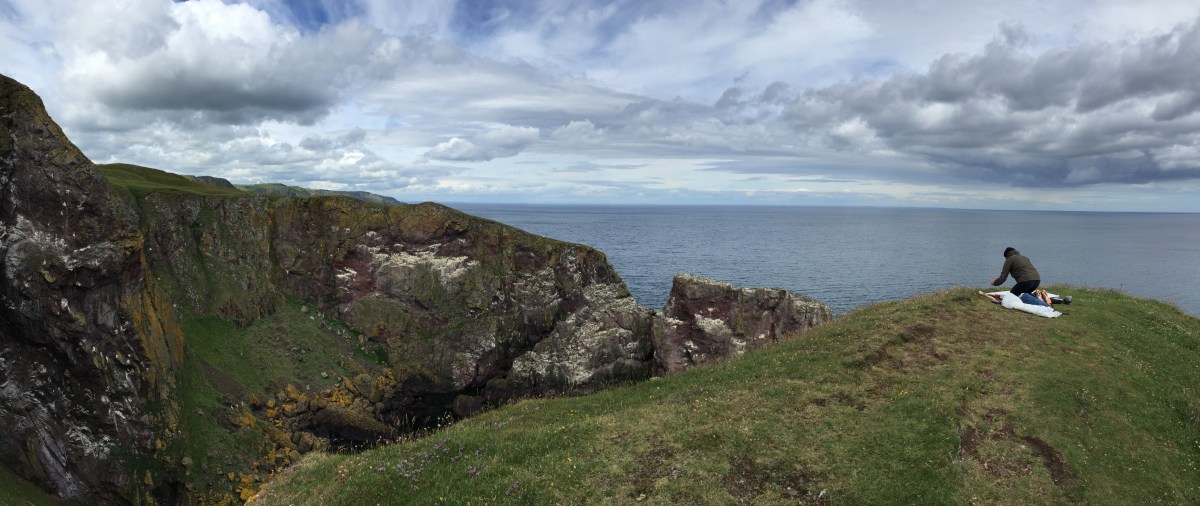
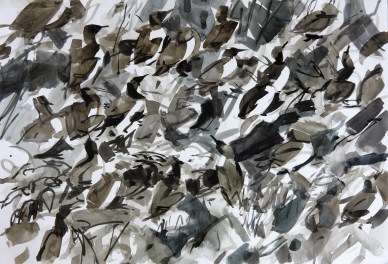
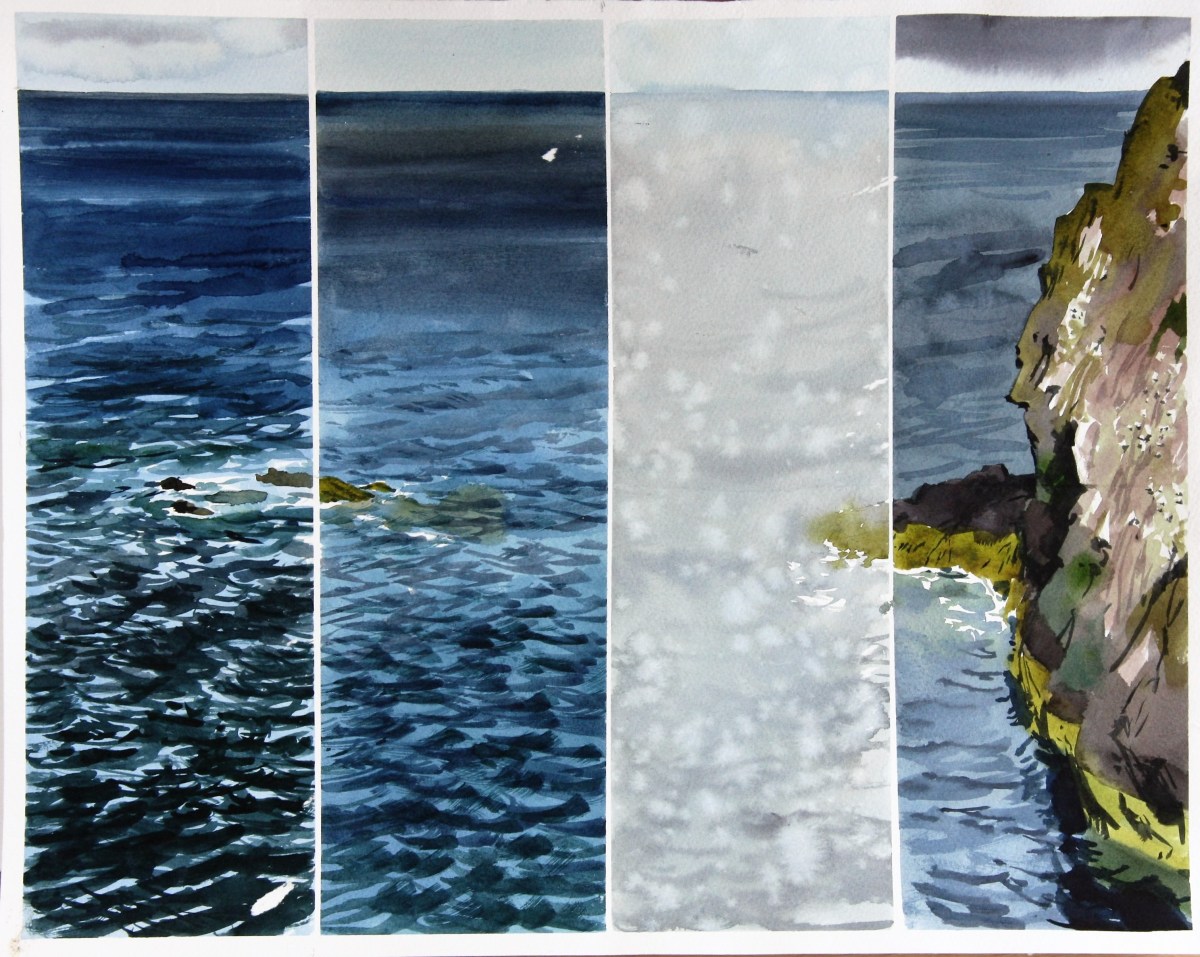
 Landscapes split into different sections throughout the day, some under the sun, others rained upon. Row upon row of 10 second, 20 second sketches of the same bird. I really feel as though I am going somewhere with this sort of stuff, and I look forward to mining this more and more – I think it is a rich seam.
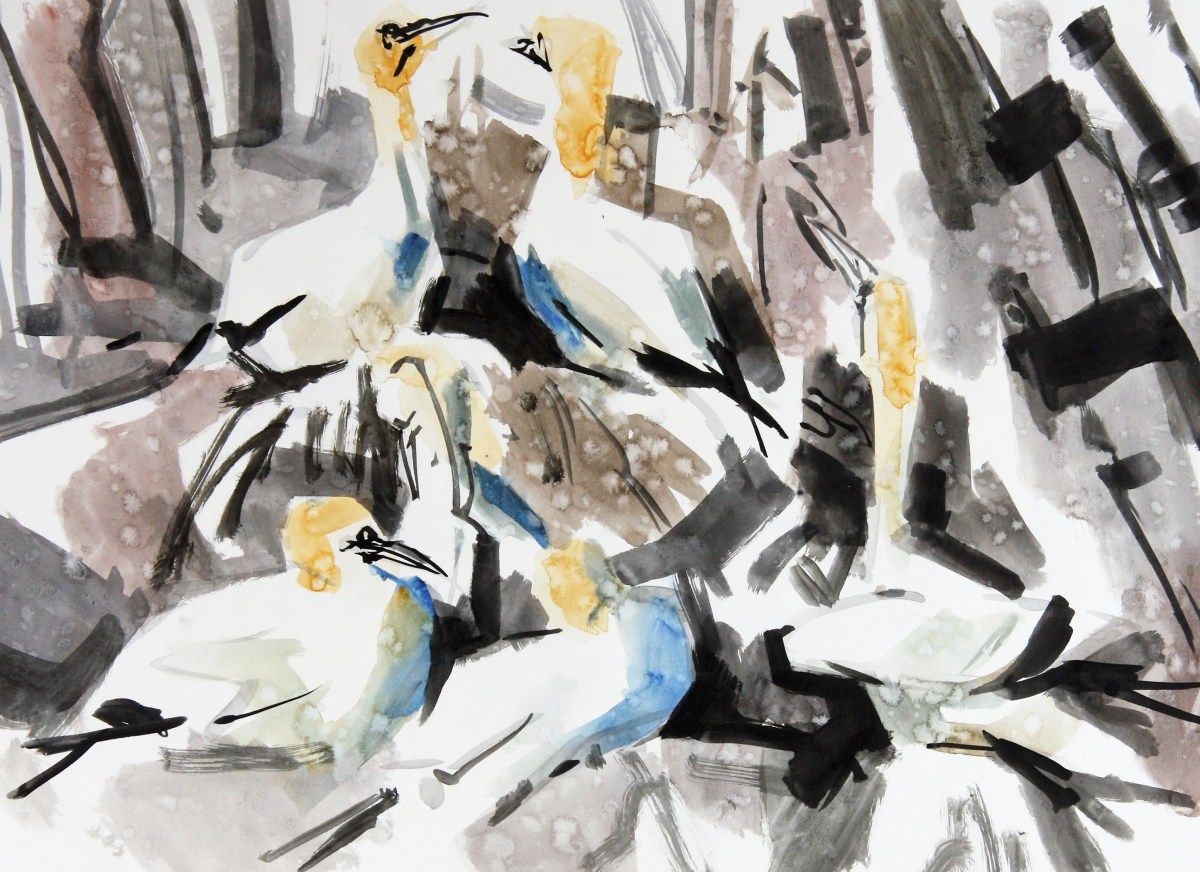
 In the lee of the wind, we made countless small circles in the shadow of the gigantic cliff, drawing and painting a moving – but returning – target. An incredible and moving (ahem) moment, as tutors and students alike scribbled away in total concentration, wordlessly, under the din of the squabbling gannets. Unforgettable.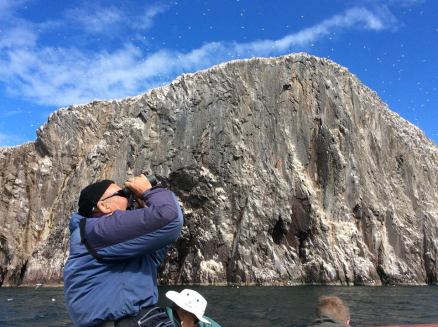
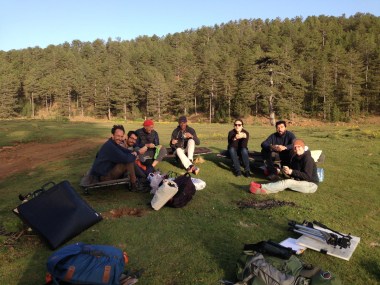
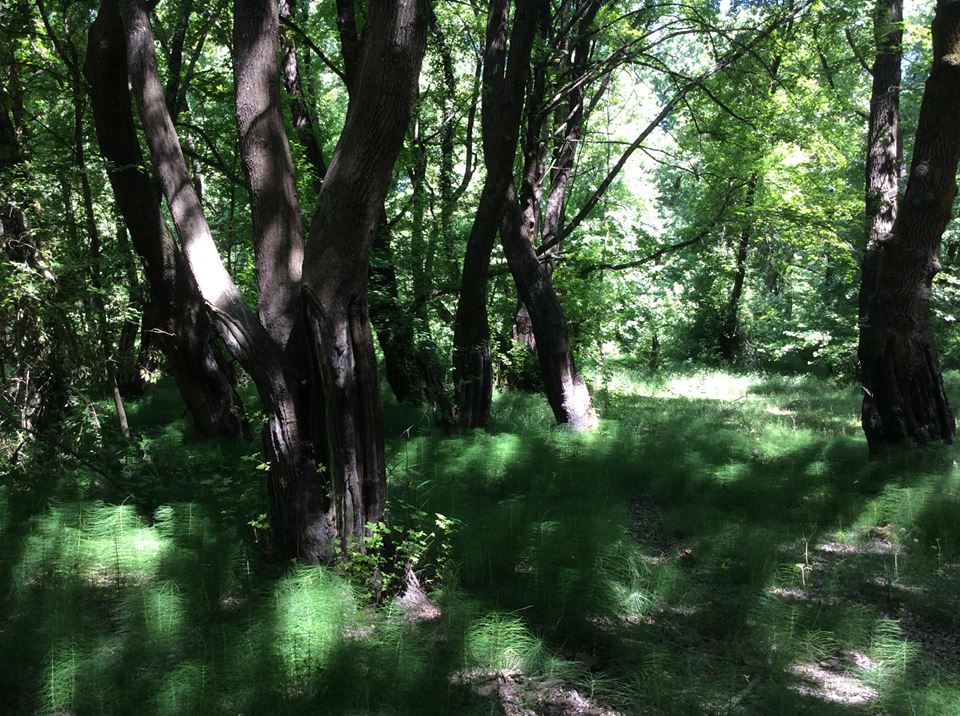 Earlier in June I was lucky enough to be one of four SWLA (Society of Wildlife Artists) artists invited to take part in an EU funded partnership with Doğa Koruma Merkezi (DKM), a Turkish environmental NGO. Working under the expert stewardship of an administrative team, the four tutors (myself,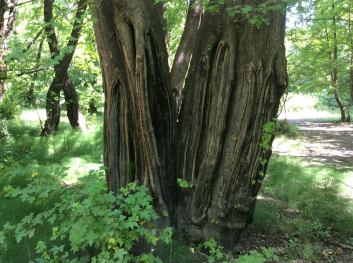
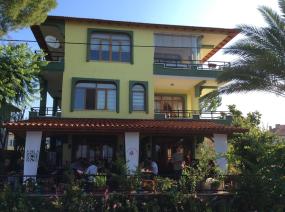 DKM had booked the entire hotel for the project team, and the following day the students and invited Turkish artists started to arrive. After an informal ‘ice breaking’ session I had a much better idea about the professionalism of the project, the passion of the SWLA artists and the enthusiasm of the Turkish students.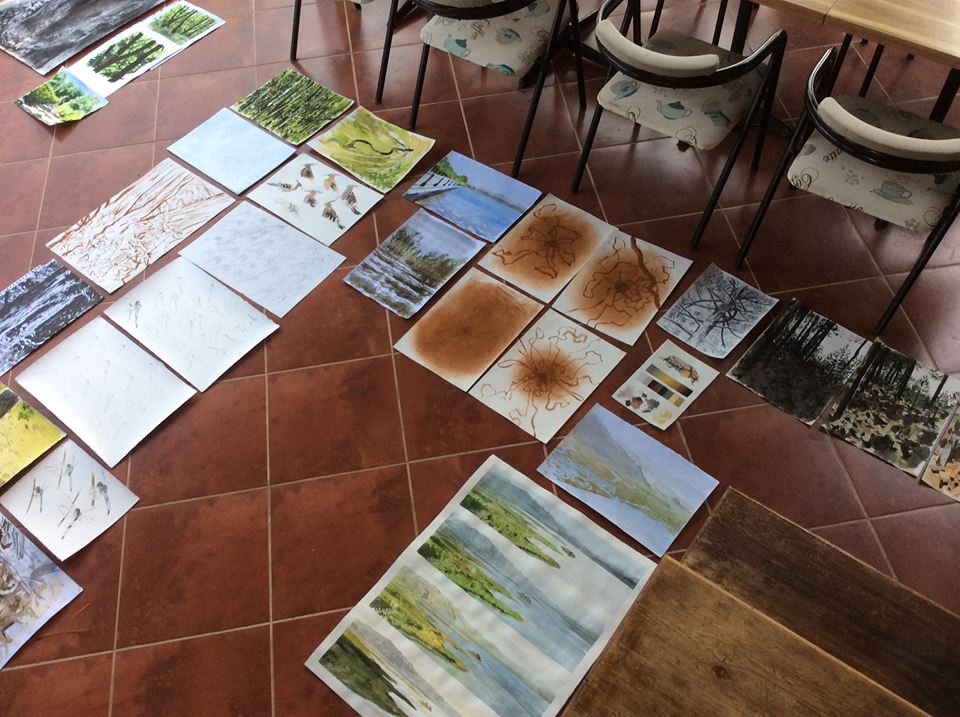


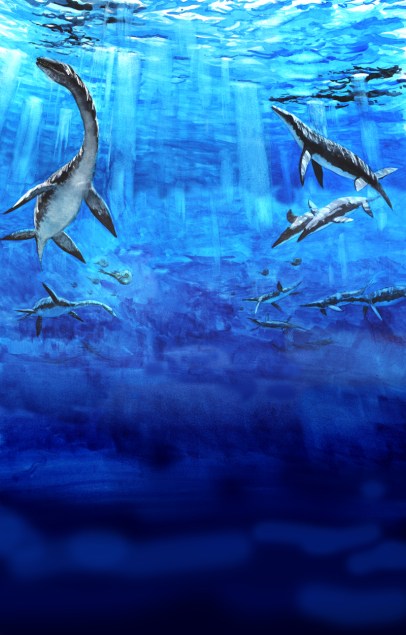 I recently worked on an illustration commission for
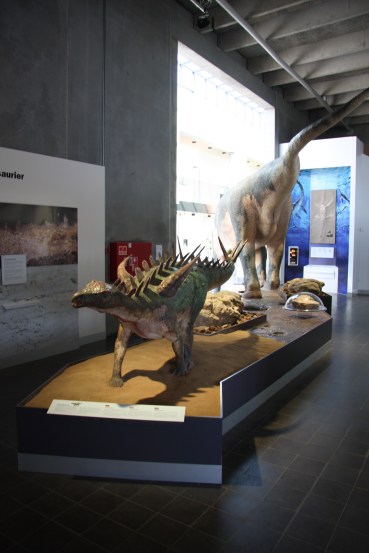
 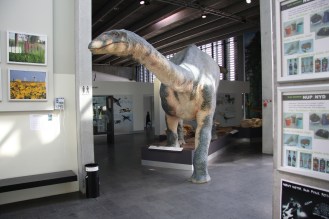 Without the ‘wow factor’ of huge skeletons, NaturBornholm decided to commission some really quite incredible dinosaur models from a Copenhagen based company called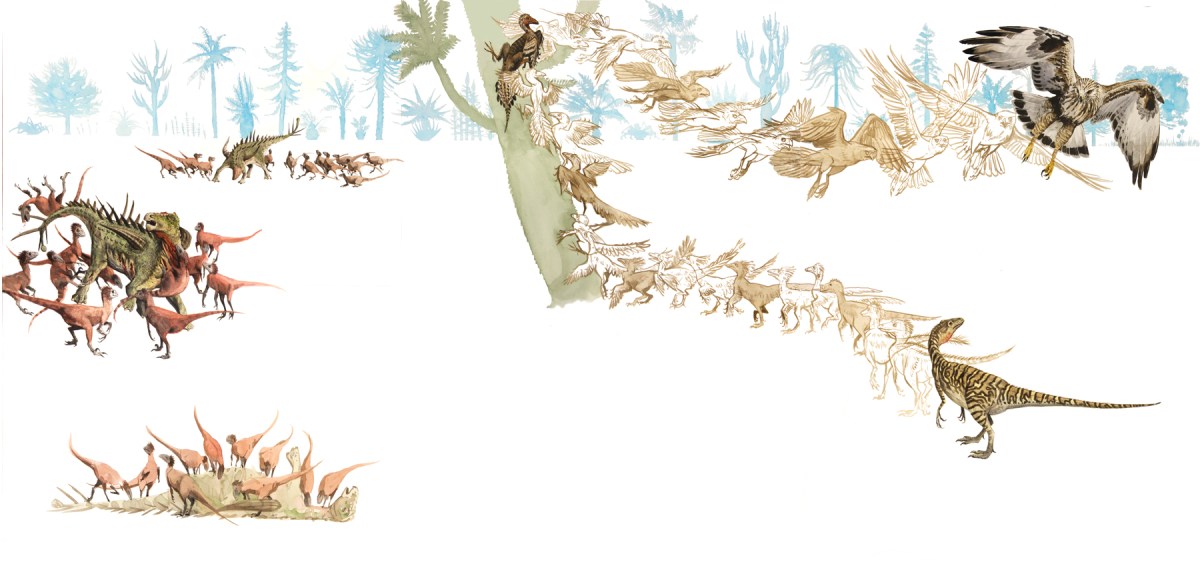
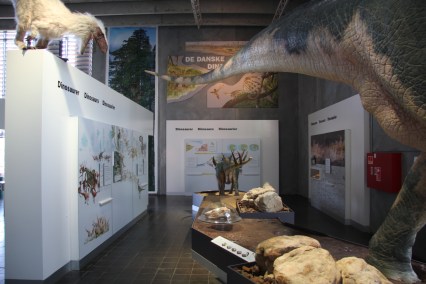 A bit of a dream commission really… but pretty much everything I do is rooted in ‘live’ observation in some way or other, so I was a little out of my comfort zone. But, as everyone knows now, birds are dinosaurs, and this fact – together with a childhood spent perched on the kitchen table drawing innumerable prehistoric creatures – meant that I felt confident enough to take on and complete what turned out to be quite a large commission. My watercolours and drawings were blown up and printed on 2m high partition walls, together with the text and some of the objects.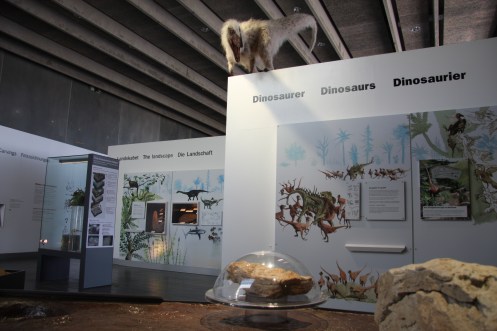
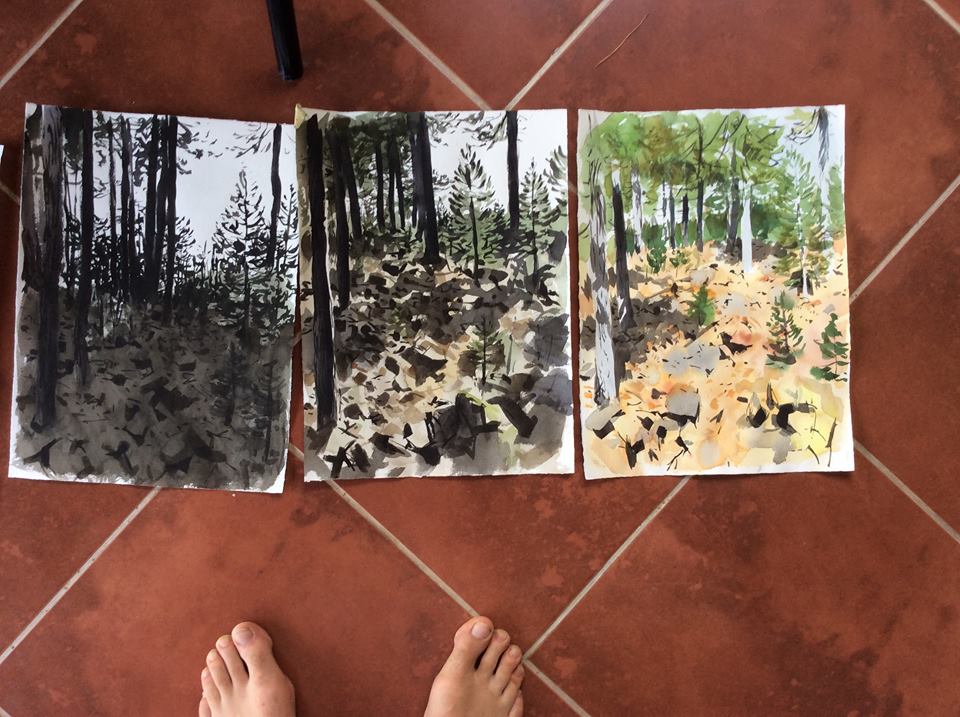
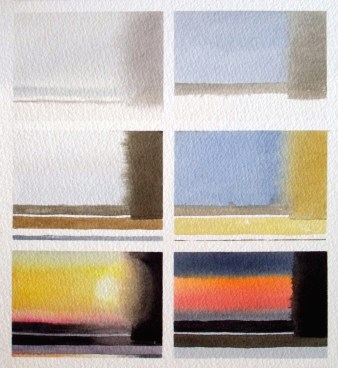 ‘Earthbound’ the exhibition is opening in about four weeks (Thursday the 5th of May, Gudhjem Museum, Bornholm) and I am busy working on the paintings I will be exhibiting. I will be showing ‘time-based’ work, where I am looking at changes (in light, colour, form, vegetation, etc) at specific locations on Bornholm through time (minutes, hours, weeks, months, the year).
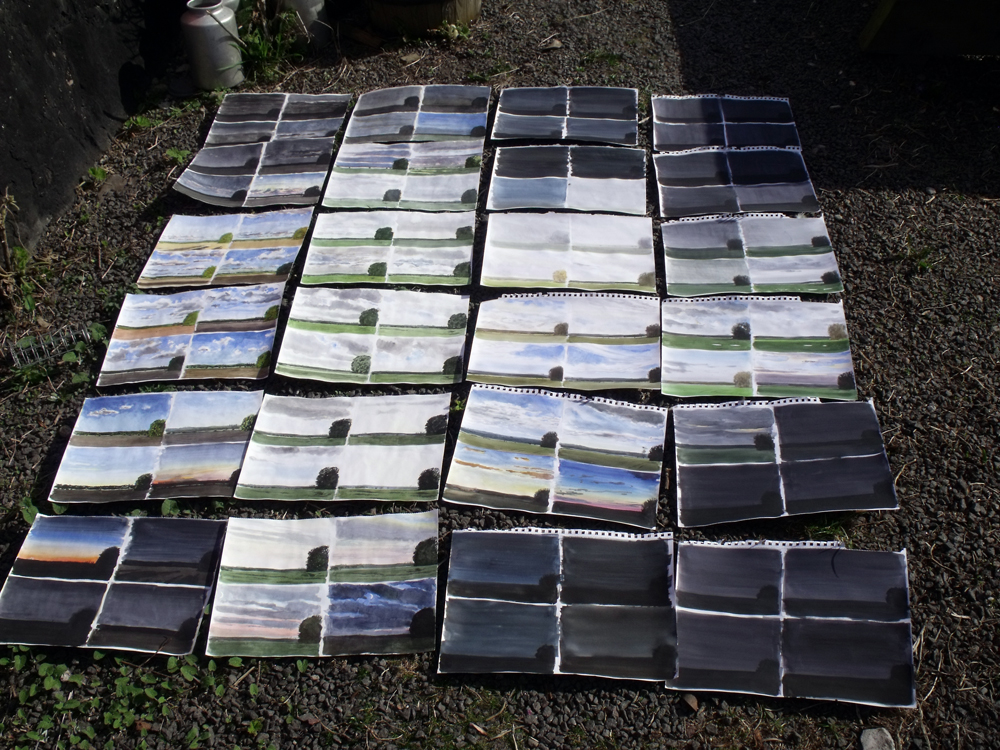 So while some of my paintings will be immediate (for instance sketches of a preening gull done every five minutes for half an hour) others will be more ‘processed’. This whole area really fascinates me and underpins everything I do… observation, interpretation…
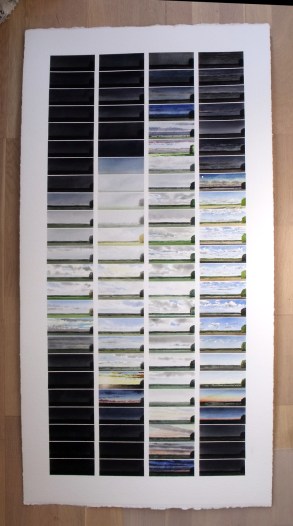 My main source of inspiration has been the view from my studio – a field, some trees and a band of trees a little further away. For once, there will be very few birds in this exhibition – at least from me… Lone Schiøtz will be exhibiting some of her wonderful birds. Barbara Sørensen, Eva Brandt and Hans Henning Pedersen make up the rest of the ‘Earthbound’ artists, all of whom take their inspiration from Bornholm’s natural environment in one way or another.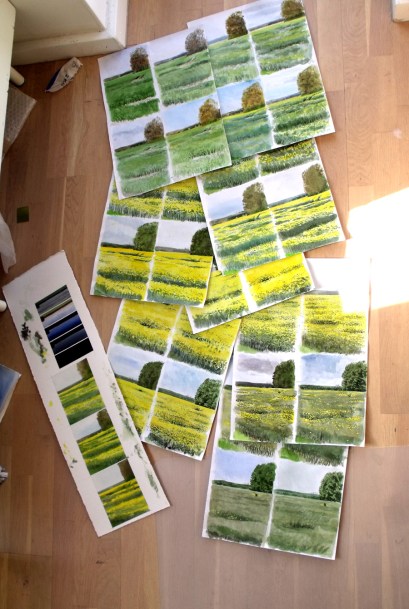
 Wallasea Island lies in the Thames estuary on the River Crouch in Essex and is the site of one of the most exciting habitat creation projects in western Europe. The RSPB is creating a landmark new reserve here using waste spoil from London’s Crossrail Project which is deposited on the island in order to raise the ground level by several metres across 1,500 acres. Controlled breaches of the existing sea wall will then create new saltmarsh, lagoons and islands.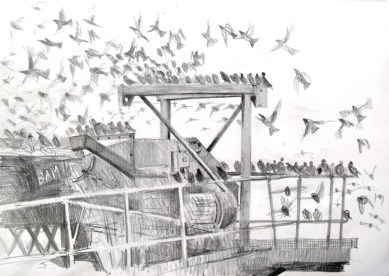
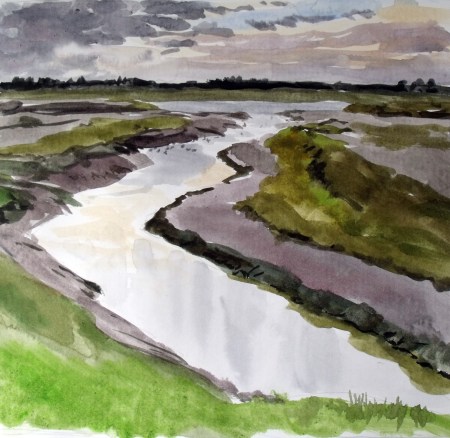 The weather was…English and the first day was spent under an umbrella trying to sketch and not get too wet. The weather improved over the next few days and I managed to fill half a sketchbook. As everything was new, I found myself rushing around trying to record and get to grips with everything (=not getting anything done). I felt like I needed to ‘connect’ more deeply with the landscape, and on the second day I decided to limit myself to recording the rise and fall of the tide on one particular creek.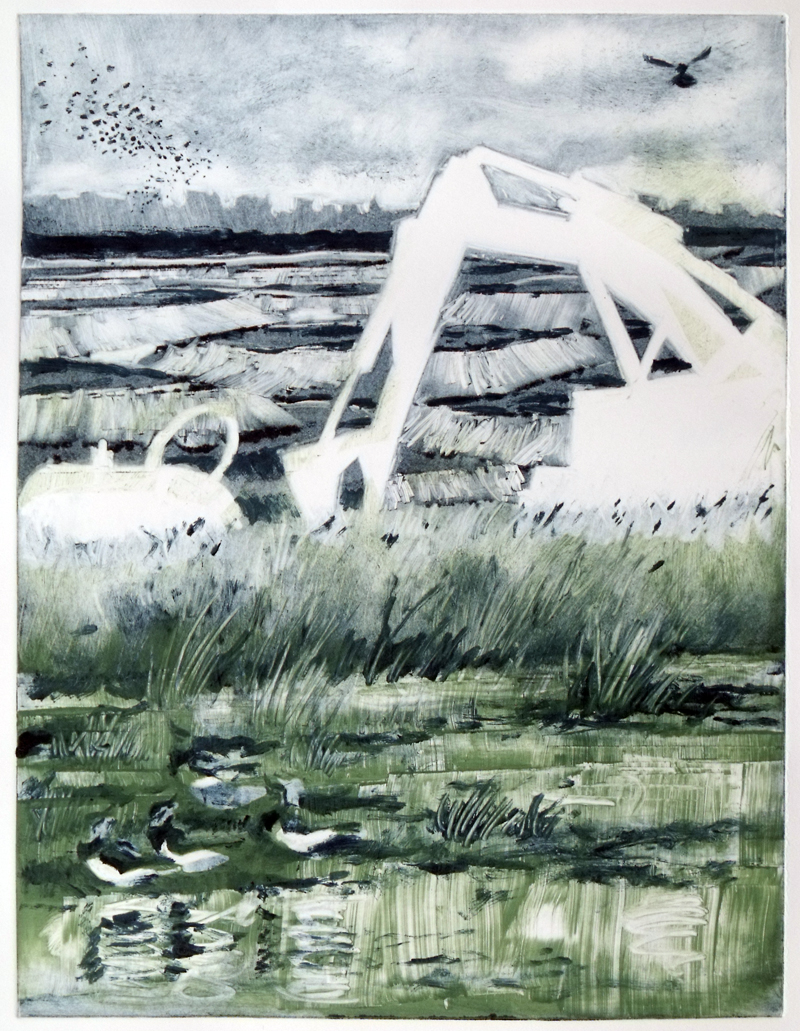

 www.benwoodhams.com