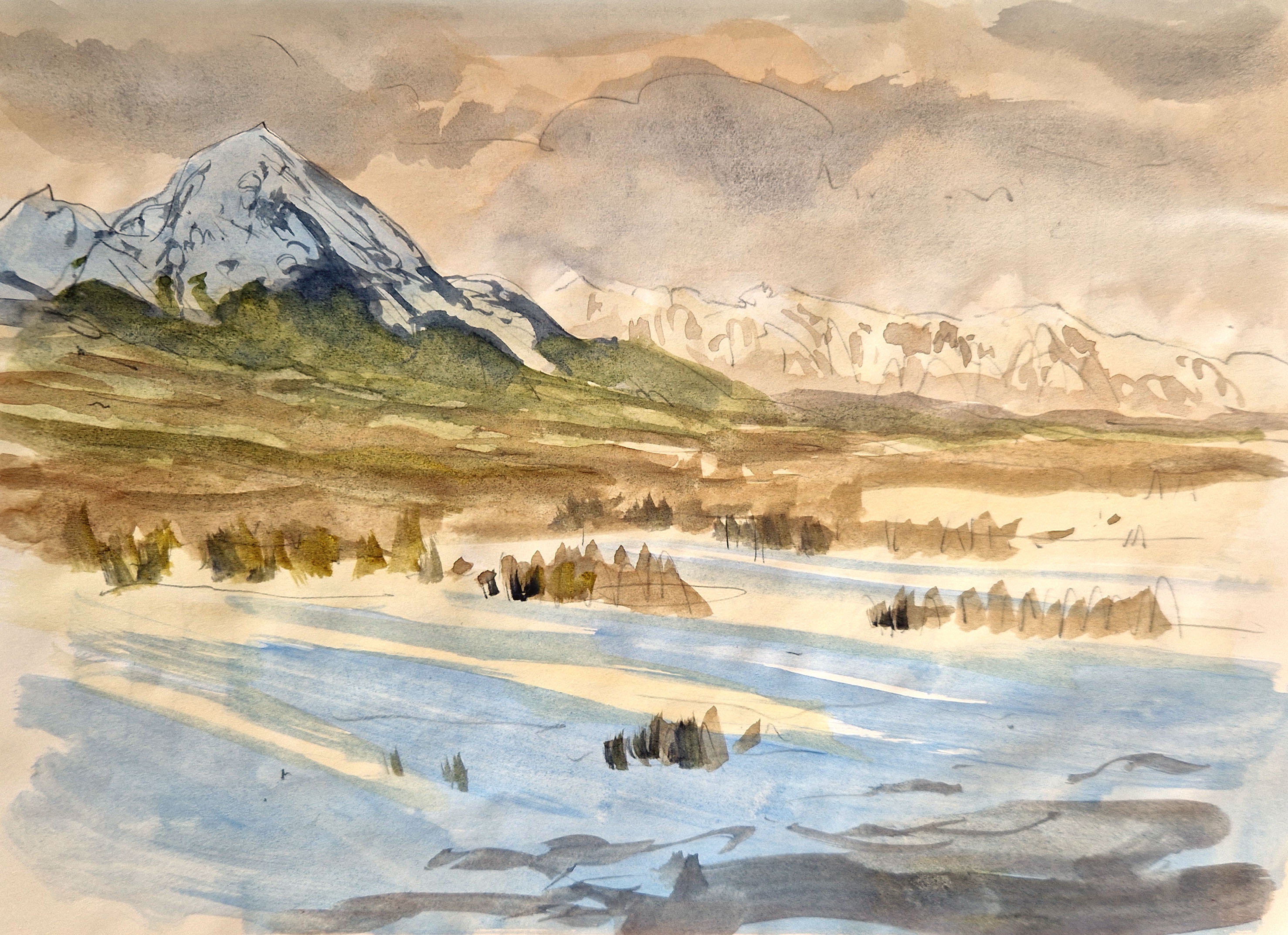
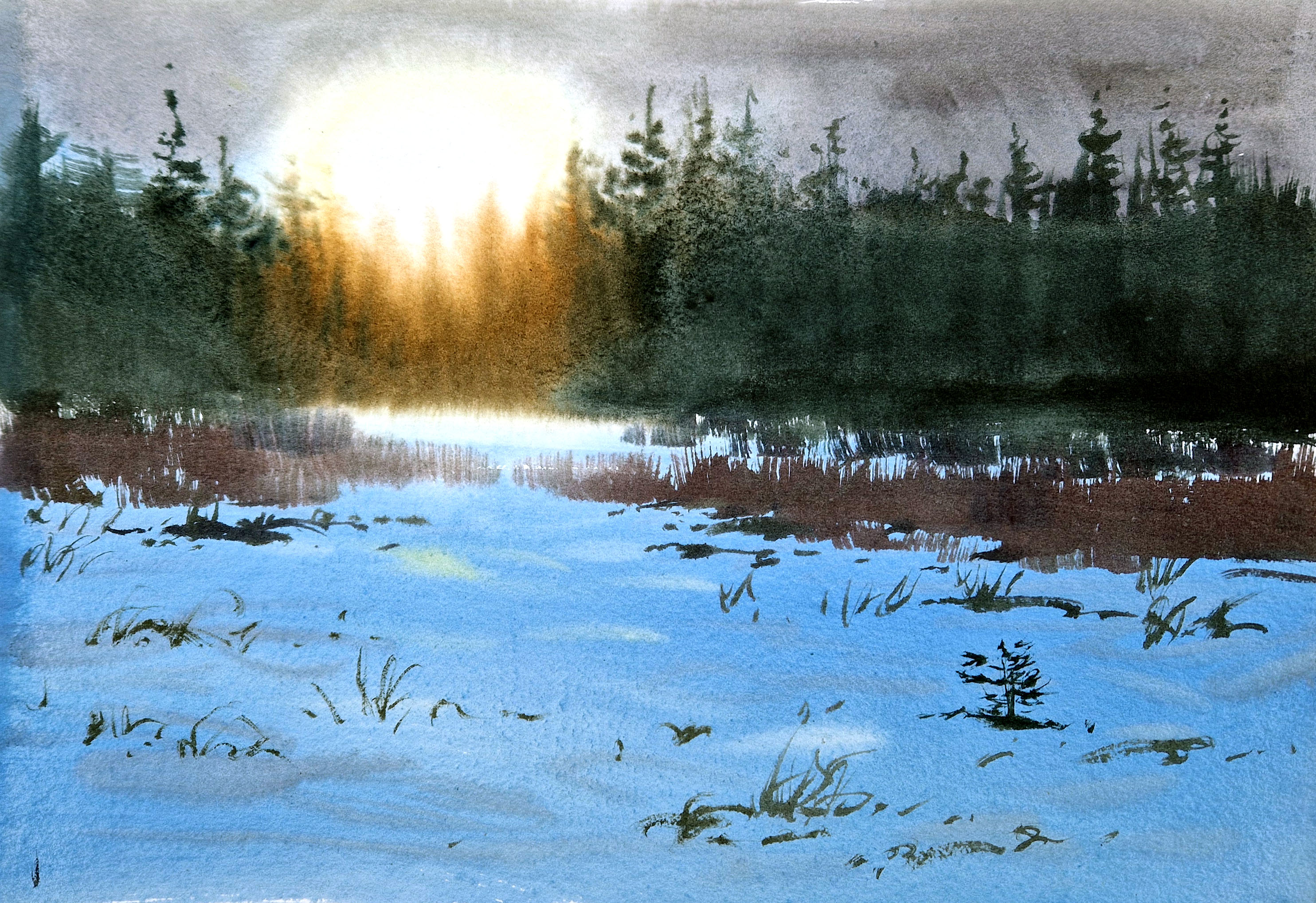
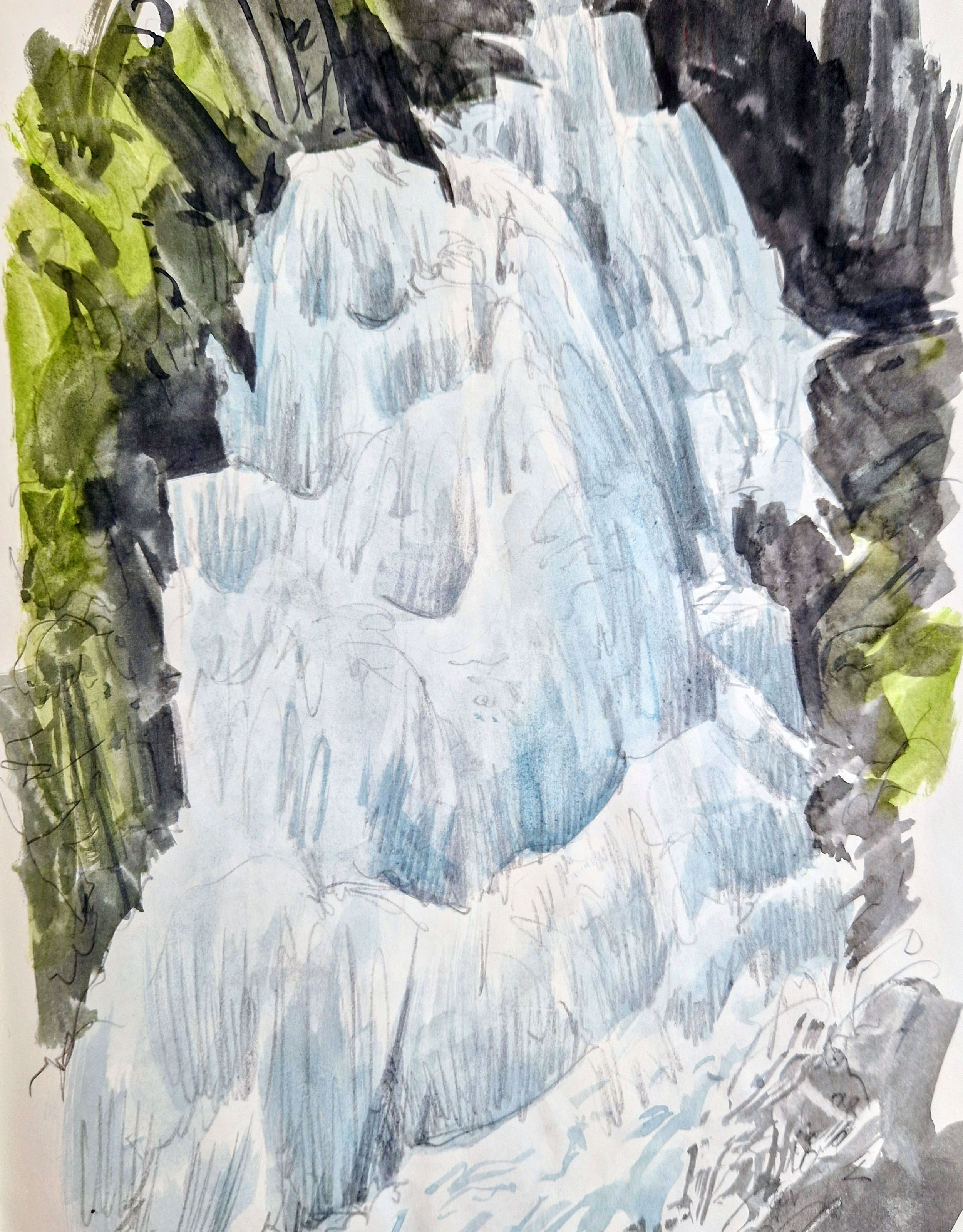
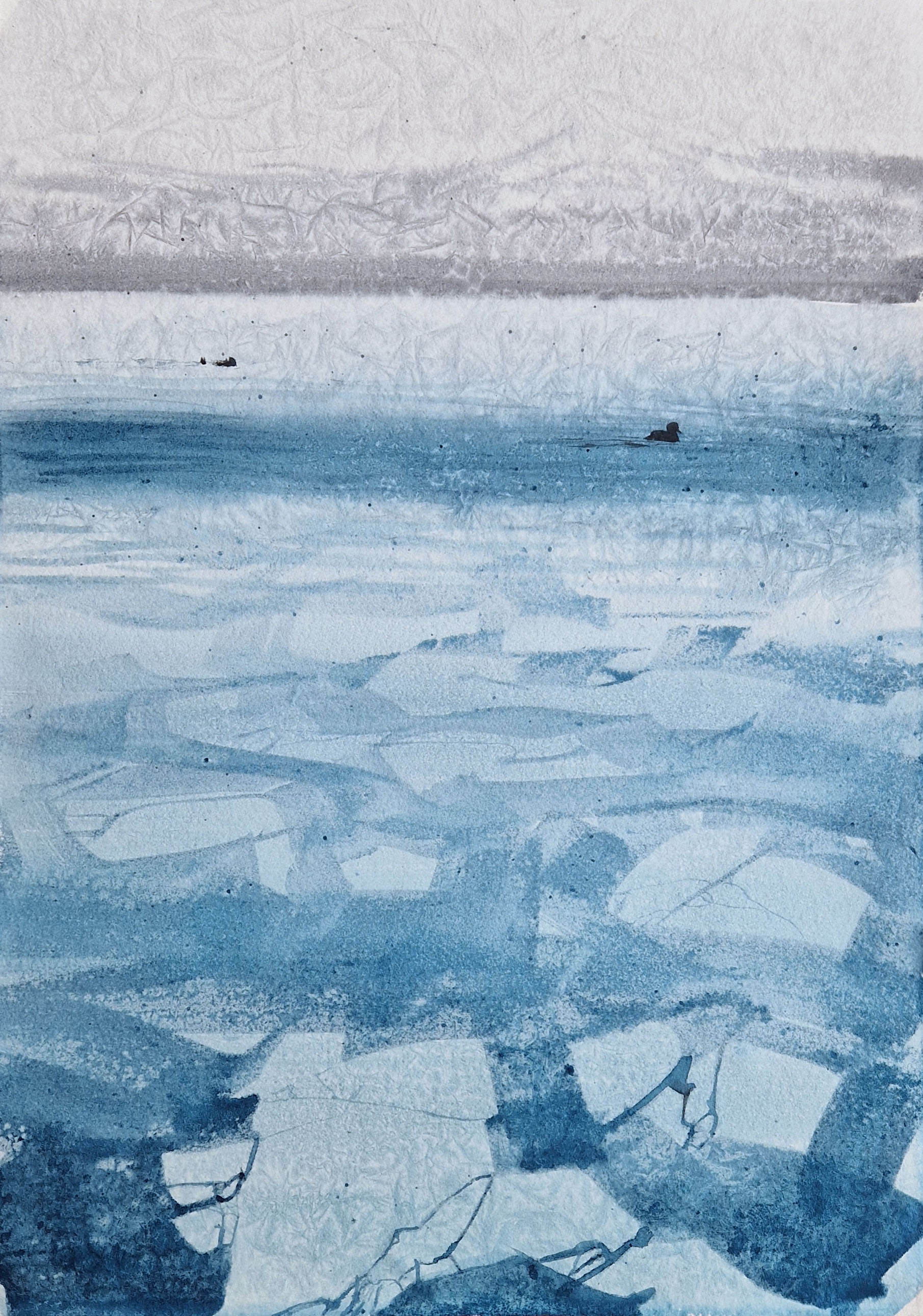
LAND 45 – Østre Borregaard til Olsker, 10.11.23

Denne side på dansk

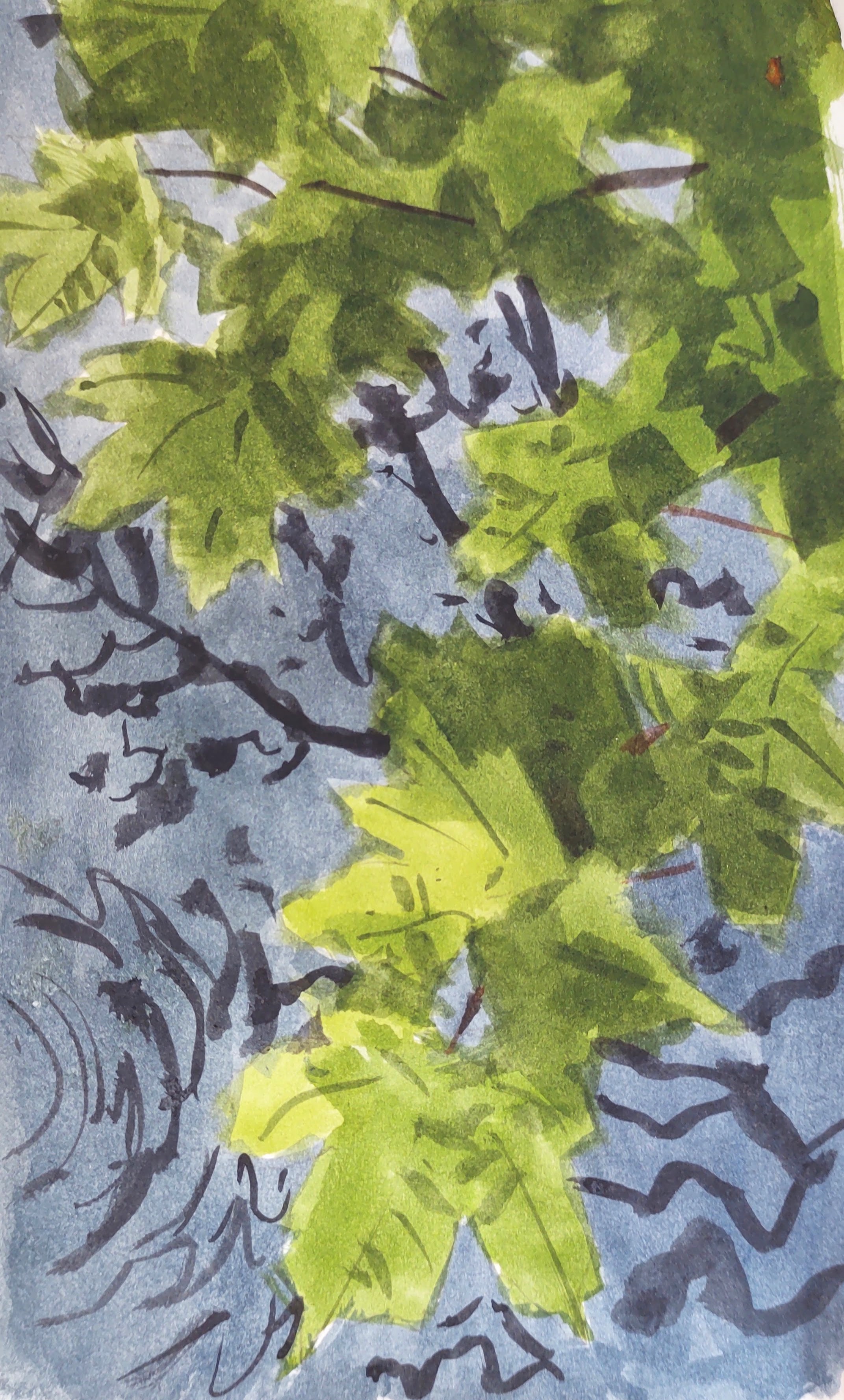
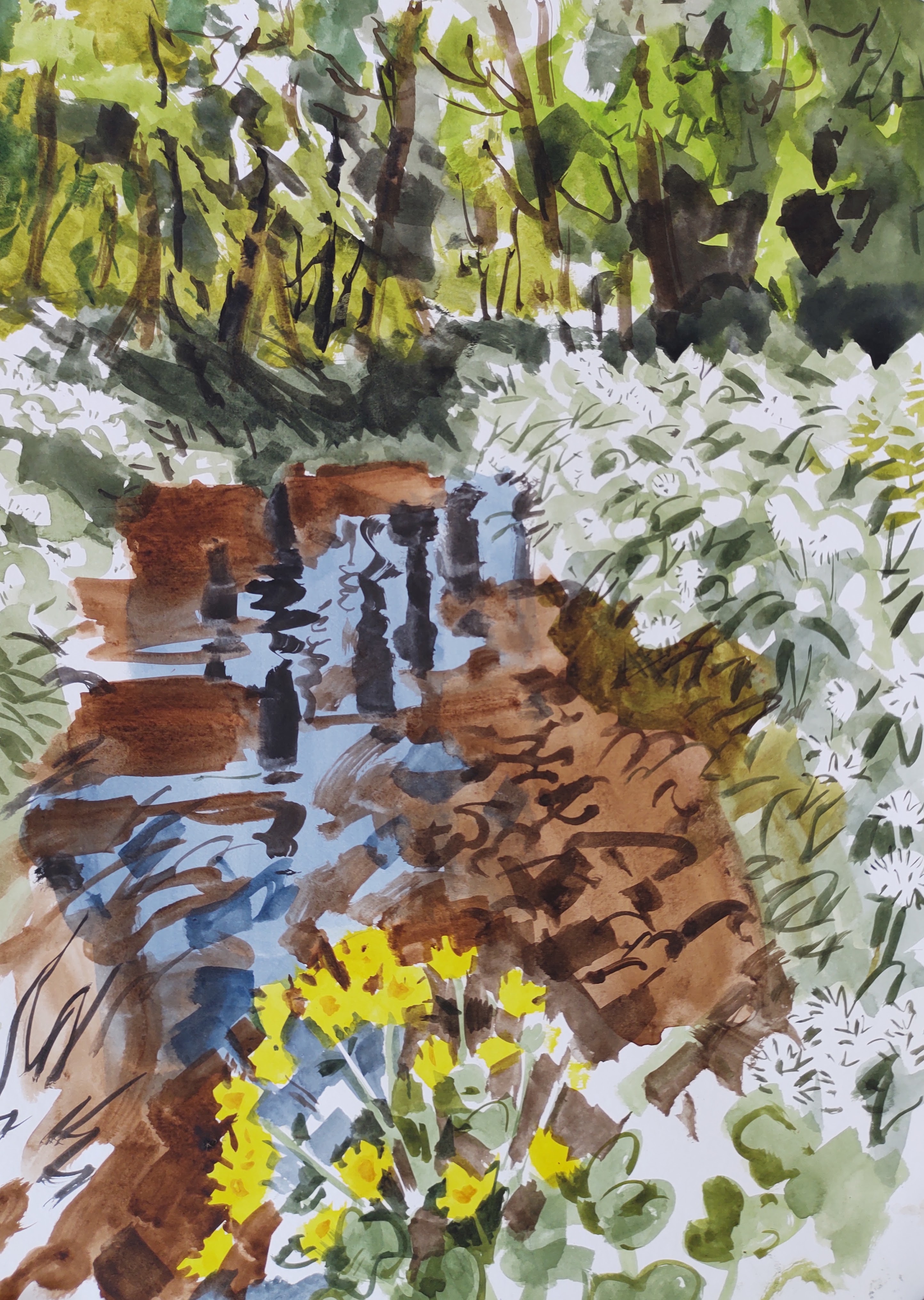
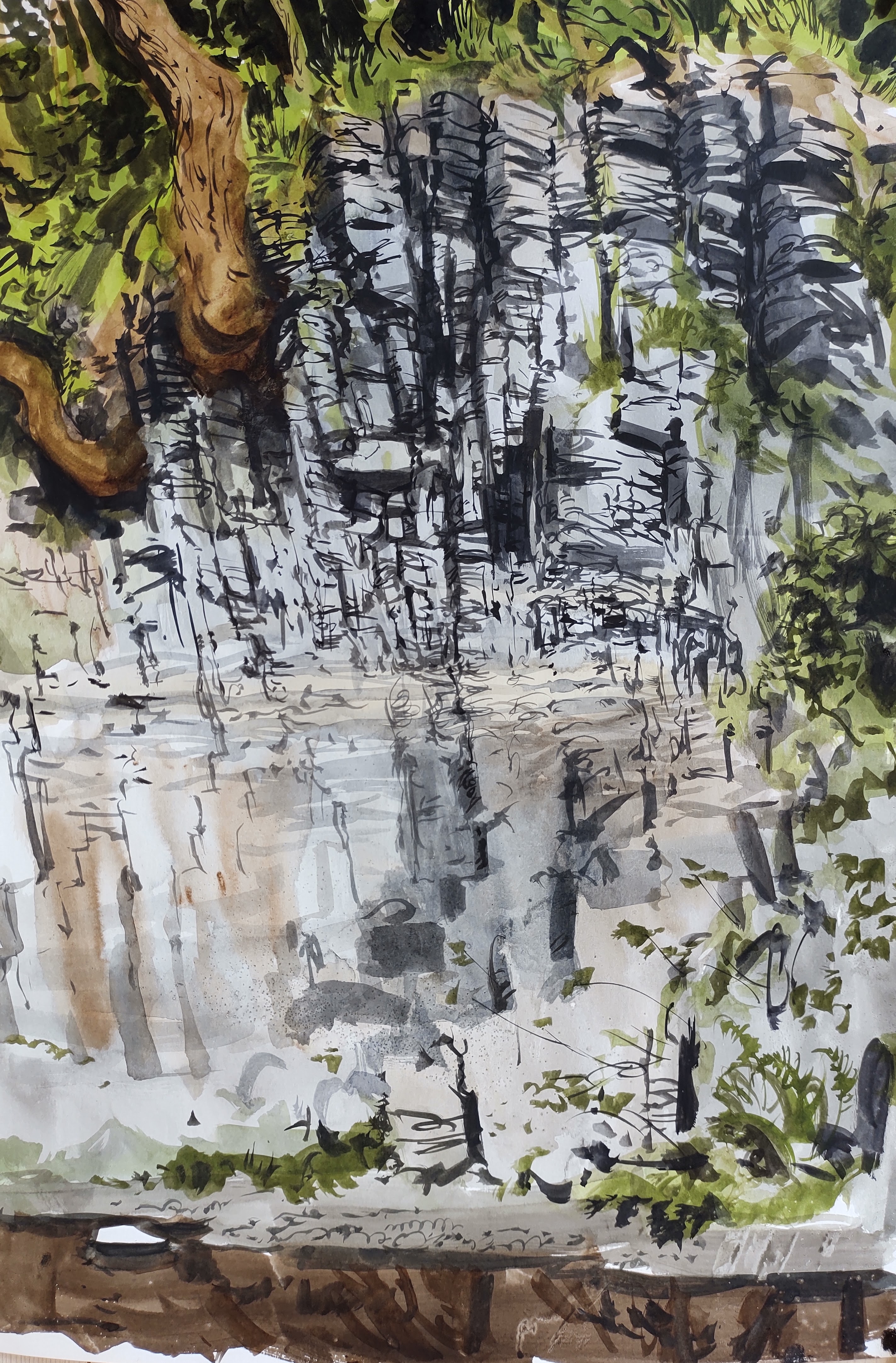
LAND 45 A little late, I left the car by the museum and headed straight towards Hestehaven, a large lake deep in the woods, choked with reeds and difficult to approach.

Hestehaven

I continued through the dense woodland along a barely detectable path that took me over a ridge and back down into Ravnedal. I emerged wet, muddy and disoriented from the forest, and enjoyed the great view across the valley. Here I sheltered from the light drizzle under my tarp and painted the burnished golds and yellows of the beechwoods.

Ravnedal and Stenløsevej

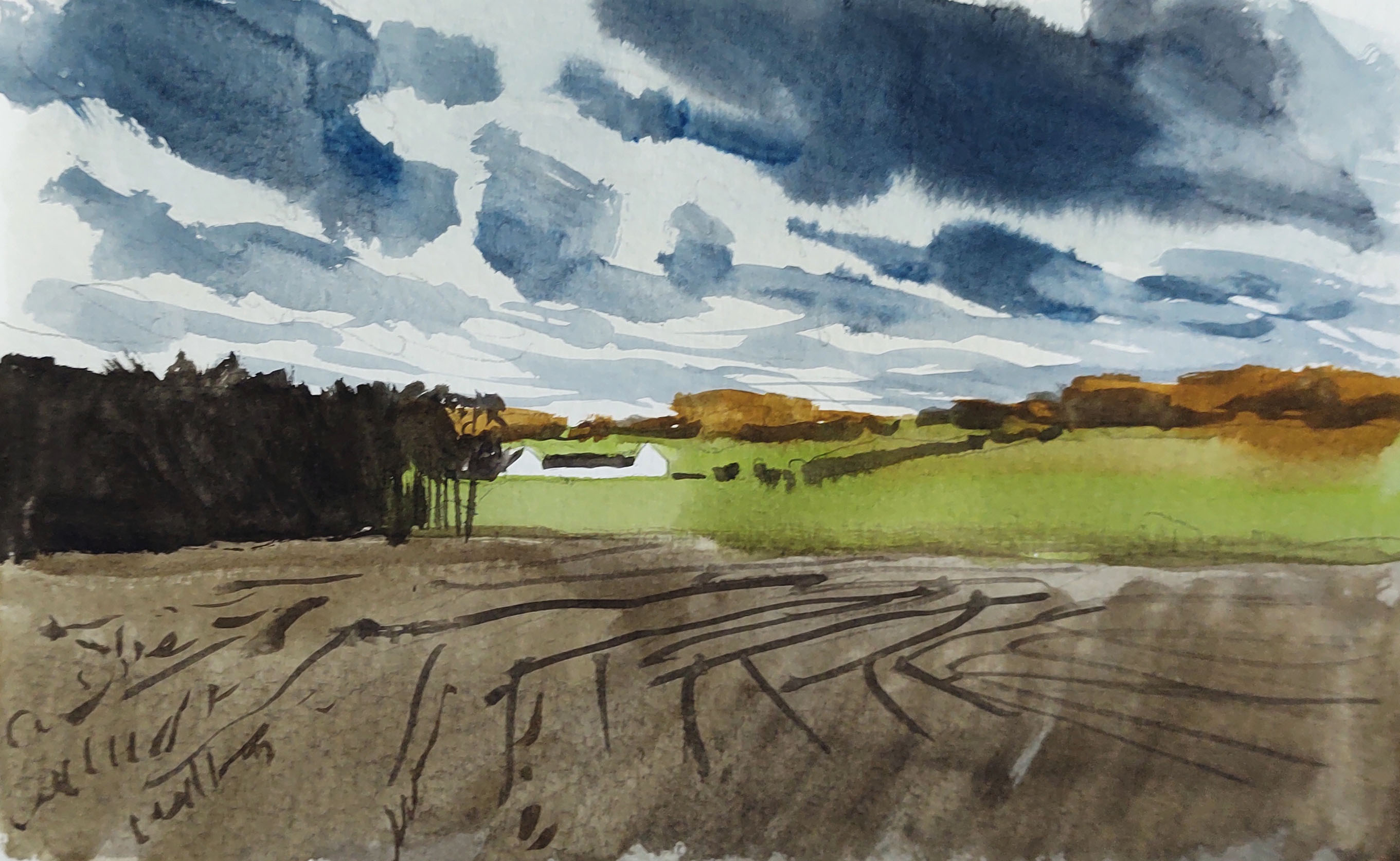
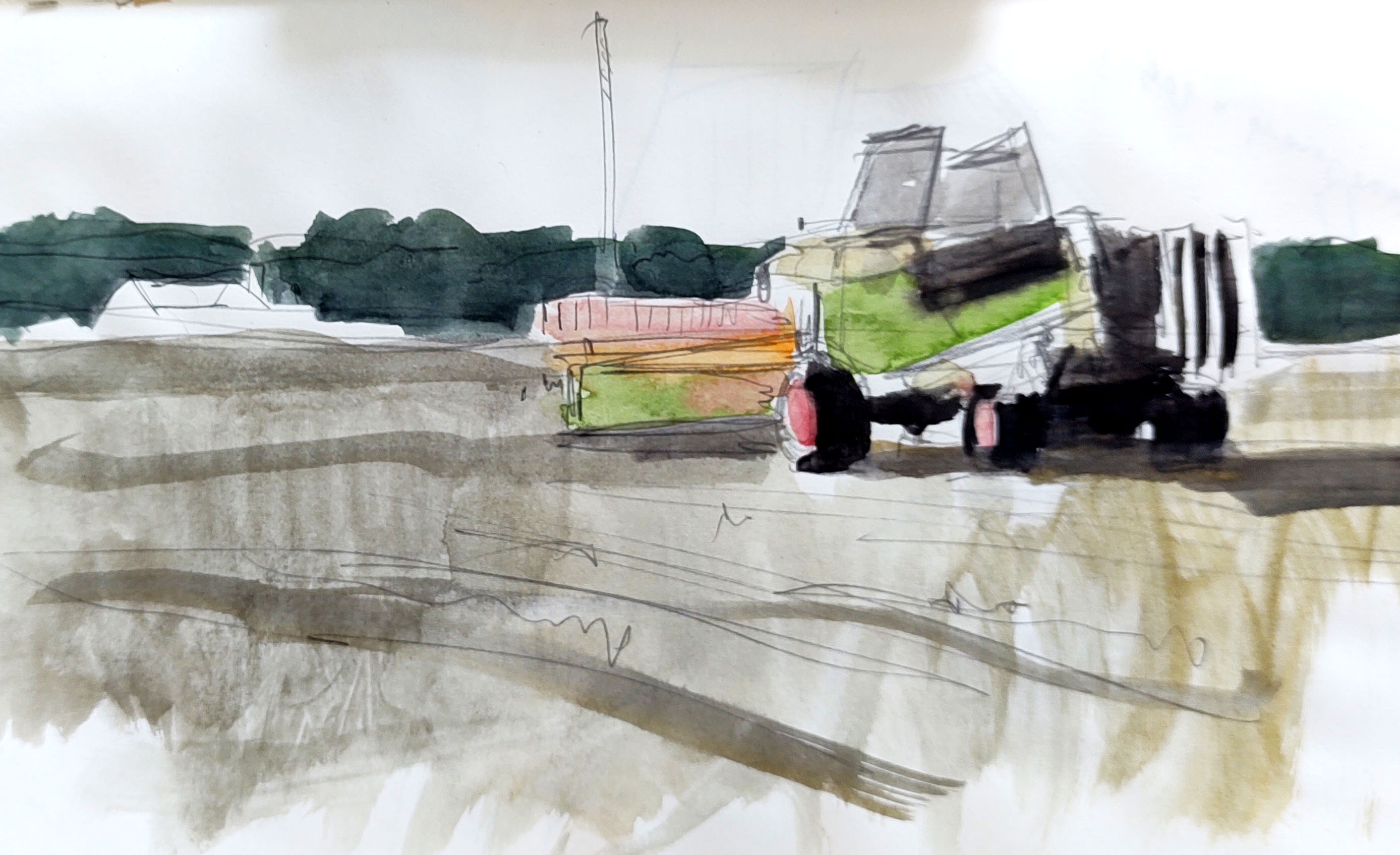
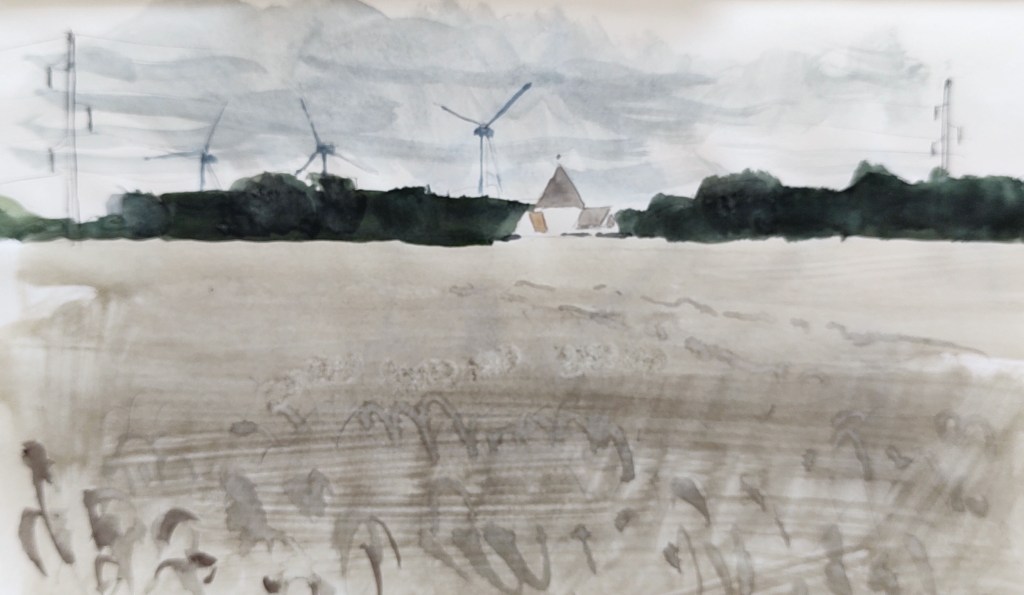
The rain soon abated and I continued, zigzagging through an undulating agricultural landscape along narrow country roads, surrounded by waterlogged loamy fields and patches of woodland. The weather was changeable, the sky dynamic, and there was a pleasing energy to the day. I made several small landscape studies in my sketchbook.

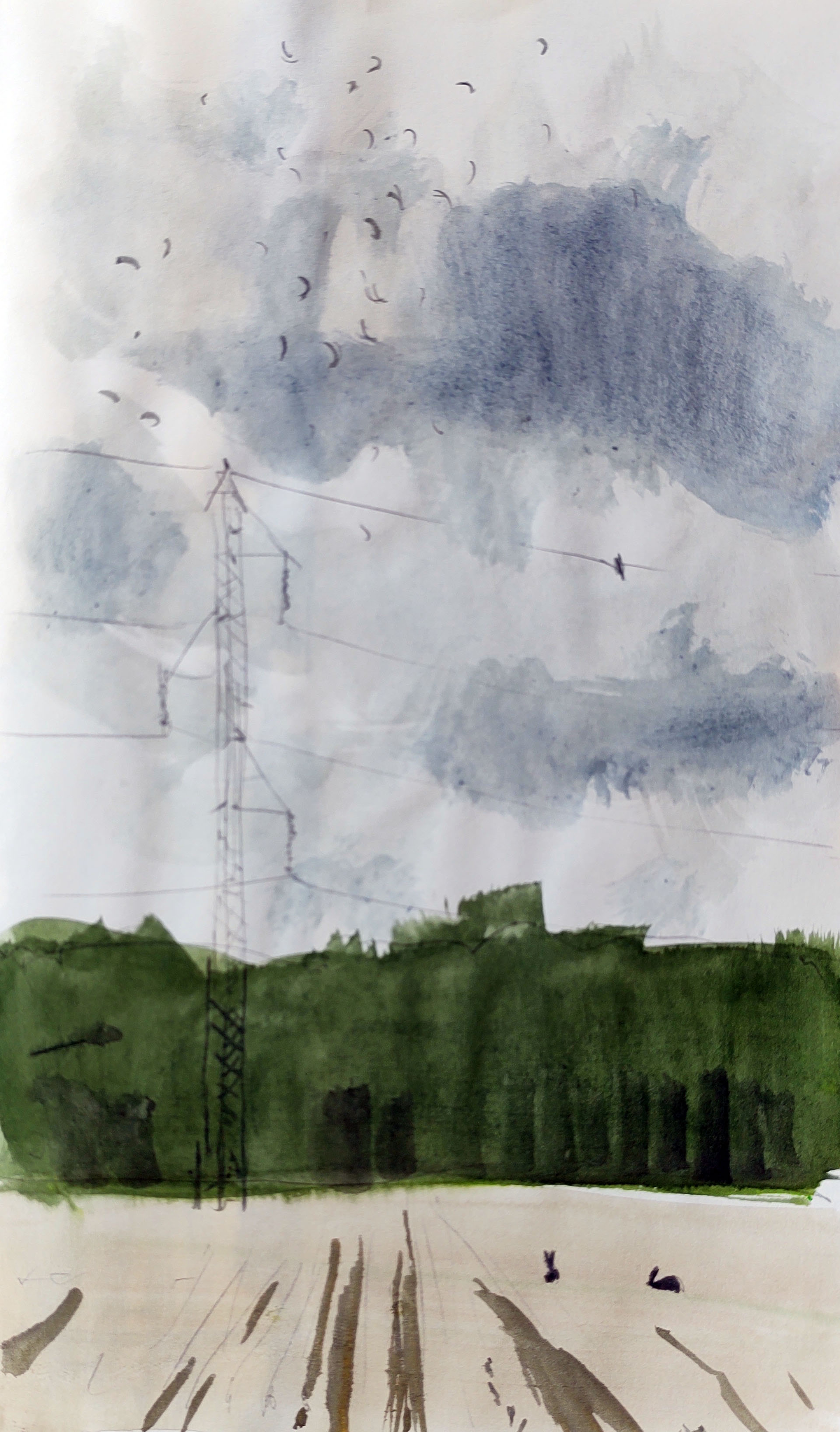
I walked along a busy road for a while, walking briskly as cars raced by. I paused briefly to sketch some Rooks feeding amongst the stubble.

Rooks

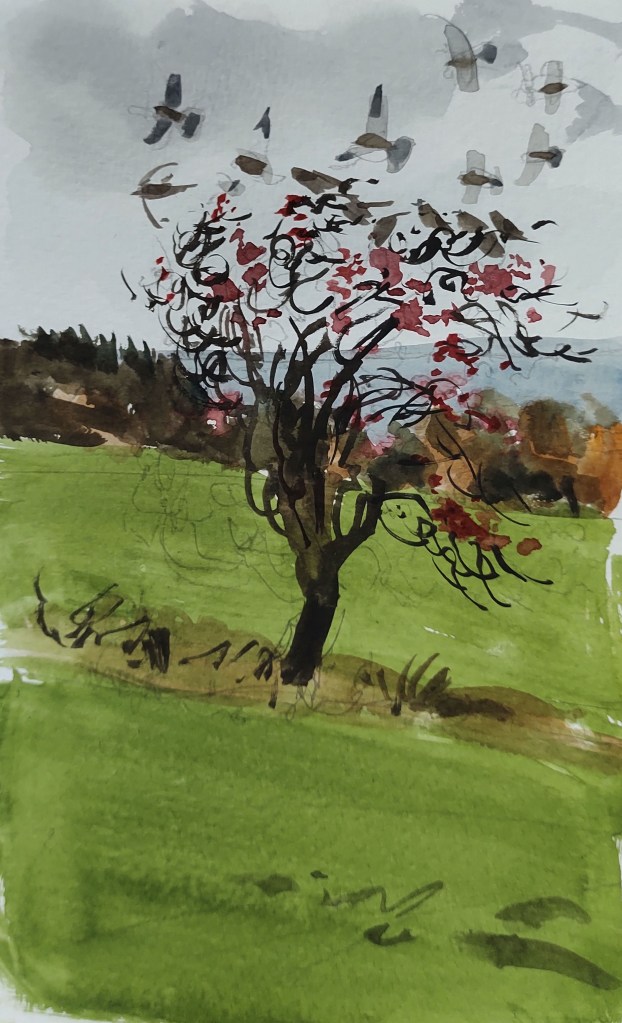
Taking a quick detour to some Iron Age rock engravings, I sheltered from the wind behind some low blackthorn bushes. Nearby, a rather flamboyant wind-sculpted hawthorn was accosted by a rowdy gang of fieldfares.

Hawthorn and fieldfares

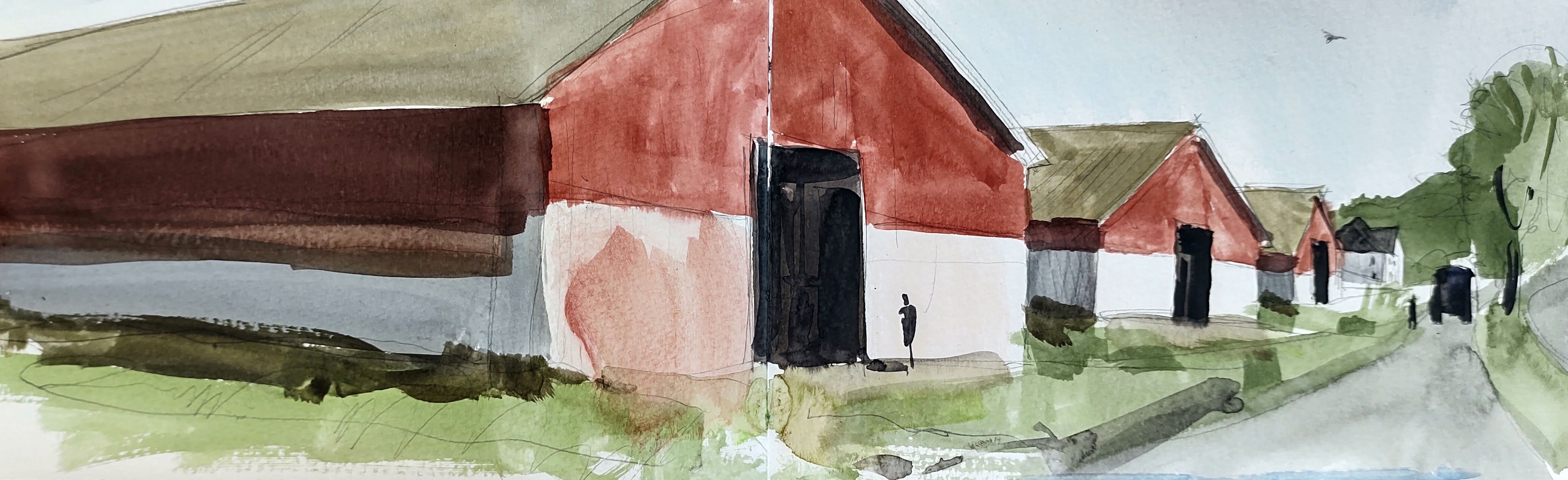
I walked parallel to the main road along an unmetalled track connecting a long row of farms, with great views of the sea beyond. A chance encounter with a pair of twite, my first for many years, cheered me up immeasurably. For the first time on the LAND trip, I had the sensation of returning to the beginning – the undulating landscape with views east to the sea, the cold and windy weather, the bare trees and barren fields – all conspired to remind me of the first LAND trips many, many months previously, and of the circular nature of the LAND project, and indeed of the year.

Bækkegård

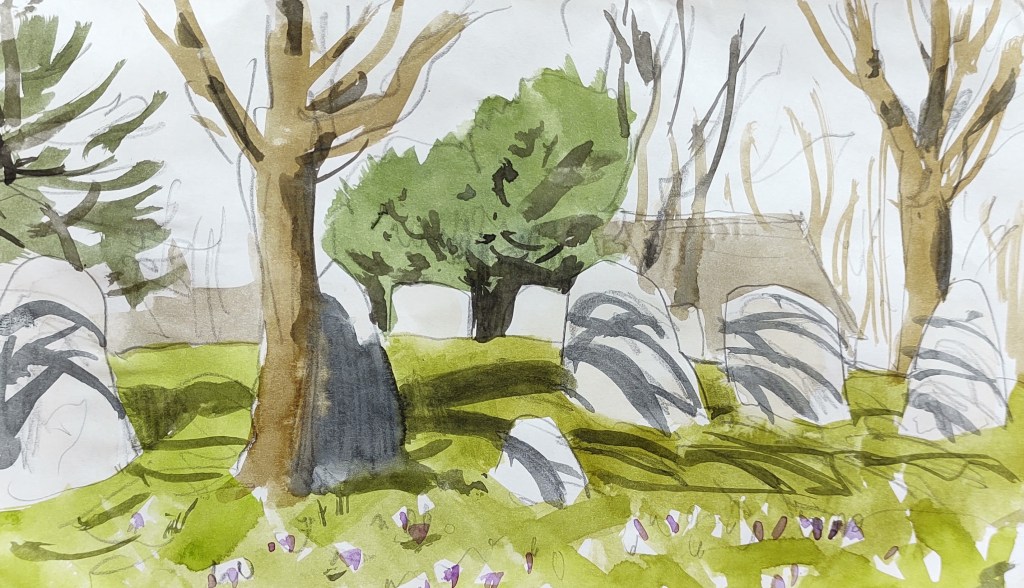
The day was slipping away, and I still had a way to go. I headed west along a small road, then dived back into the woods, following a new walking route, the ‘Højlyngsstien’, for a while. Deep in the woods, I arrived at the Ole Christiansen’s sculpture park – scores of organic granite forms standing in the grass. I started to draw each sculpture, aquatinting myself with the soft and convoluted shapes of each and every sculpture, quickly feeling a stronger and deeper bond with the artworks, and indeed the artist. I was reminded of the transformative nature of the act of drawing – the power of really looking.

Ole Christiansen sculptures

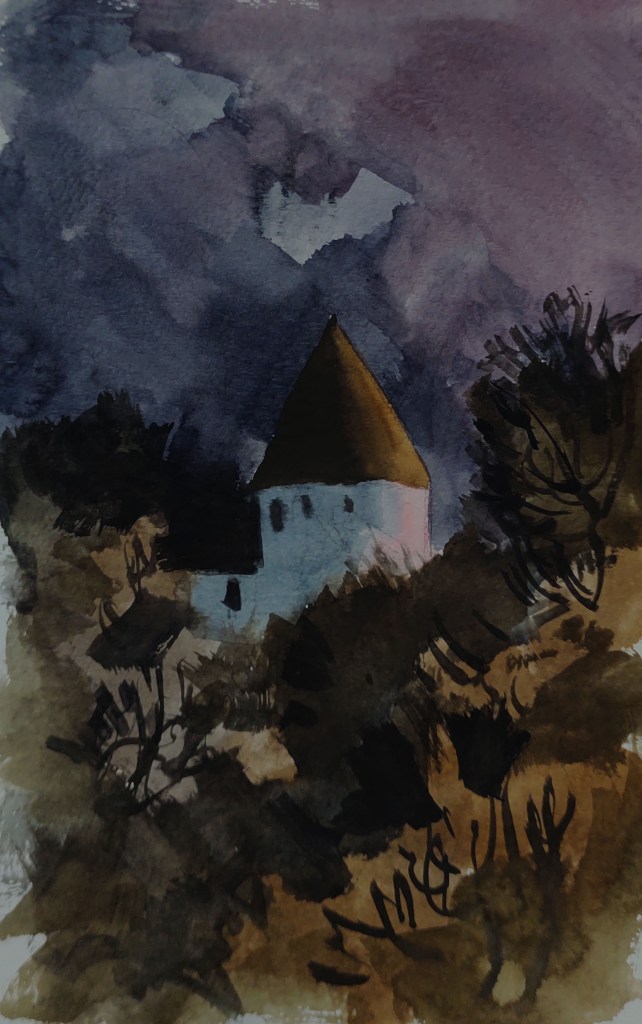
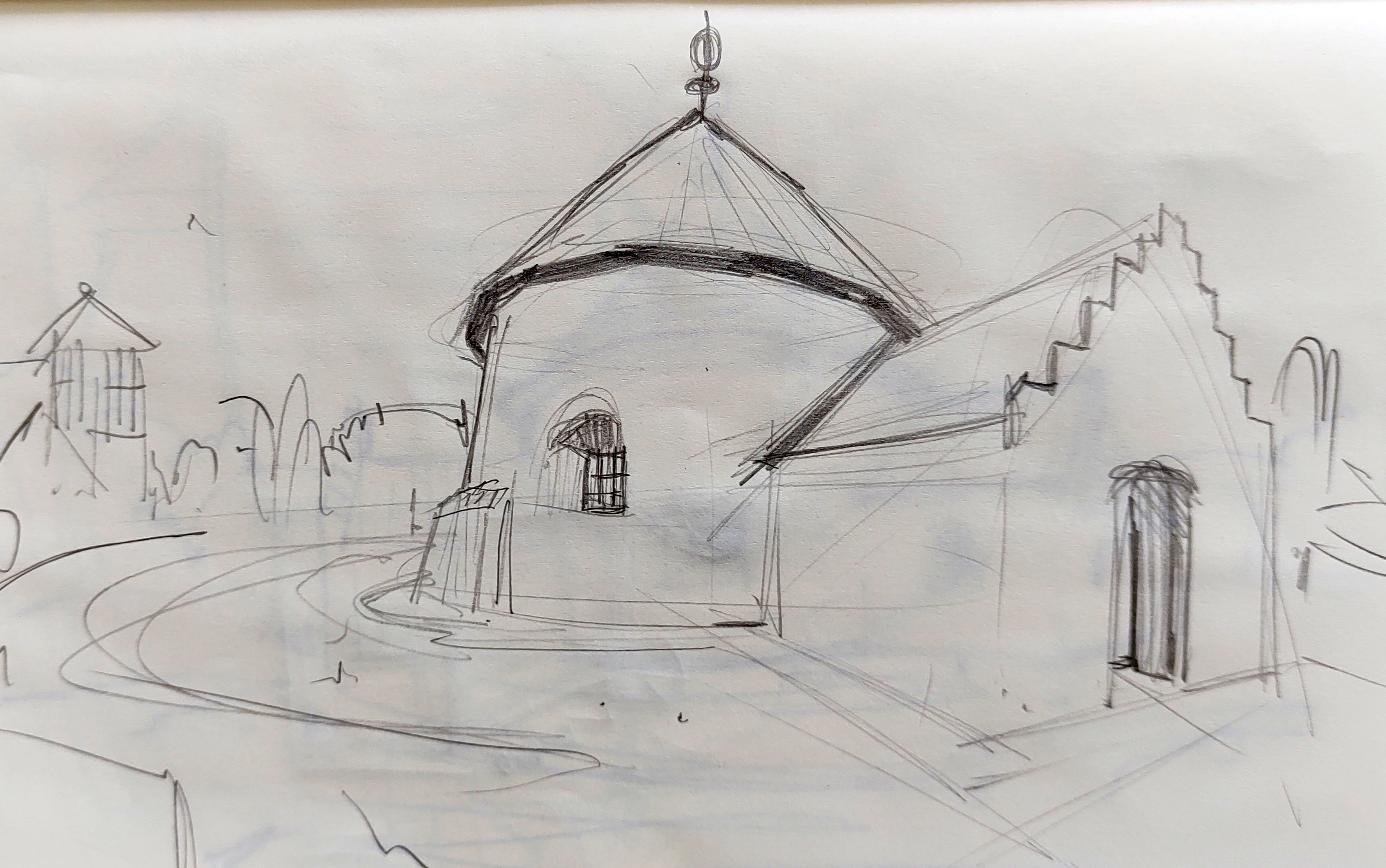
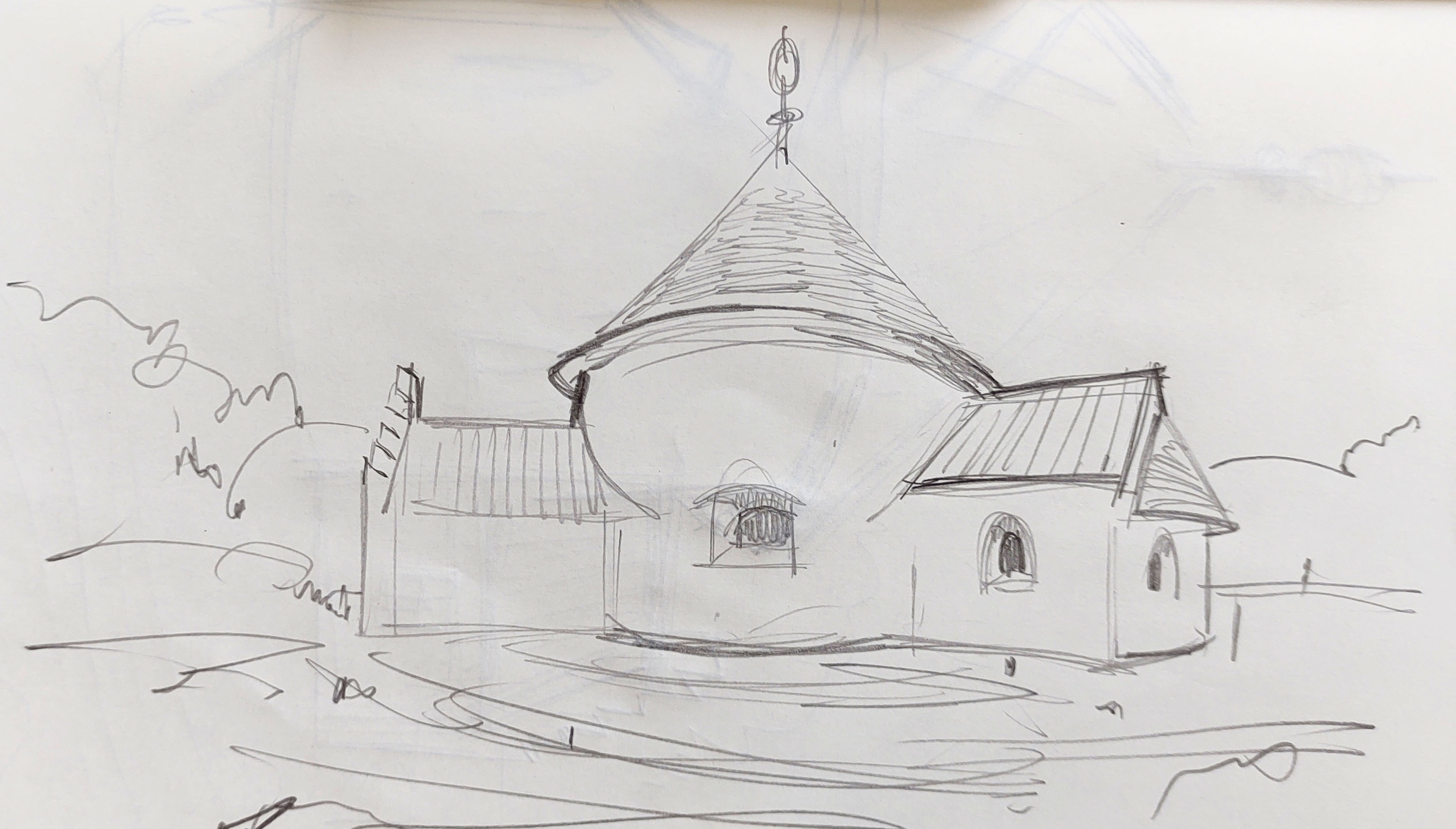
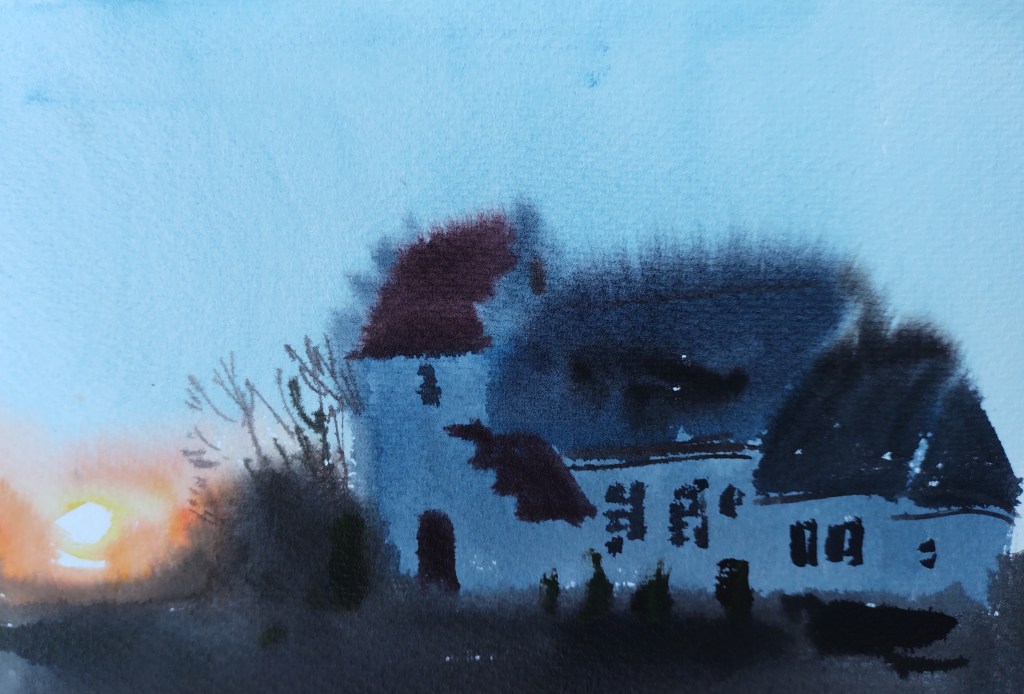
I took a side path into Krubbedal, a dark and overgrown rift valley with steep granite sides and a mass of fallen rotten trunks. The path slowly disappeared, and I found myself trapped in a brambly, thorny dilemma. It took me far too long to find my way out and there was no time to make it all the way to the day’s destination, Olsker round church – lit in the distance by the last rays of the setting sun.

Olsker round church

The day was done, but I still had to walk all the way back to the car, through the woods again, only this time in the dark.

LAND 45

WEATHER REPORT – Overcast majority of day, some brief sunny spells and light rain. Temperature 7 – 9 degrees. Wind 5 – 6 m/s, from the southwest. Hours of precipitation: 0.5 hours. Hours of sunshine:  0.5 hours.

STOPS with the BIVVY – 1

KILOMETRES WALKED – 13.96 km

DAY LASTED – 8h and 41 m

PEOPLE TALKED TO – 2

BIRDS SEEN and HEARD – 36 species (1 new, twite) = 134 species in total.

LESSONS LEARNED – I often collect seeds as I walk, and I found out that the seeds of Norweigan angelica in my pocket had an incredible citrusy smell.

IN MY HEAD – Impending biogas meeting, the awful film I watched last night, ‘Sådan er det’ by Supebandet, Panama.

LAND 38 – Brogaardssten to Ruts Church, 21.09.23

Denne side på Dansk

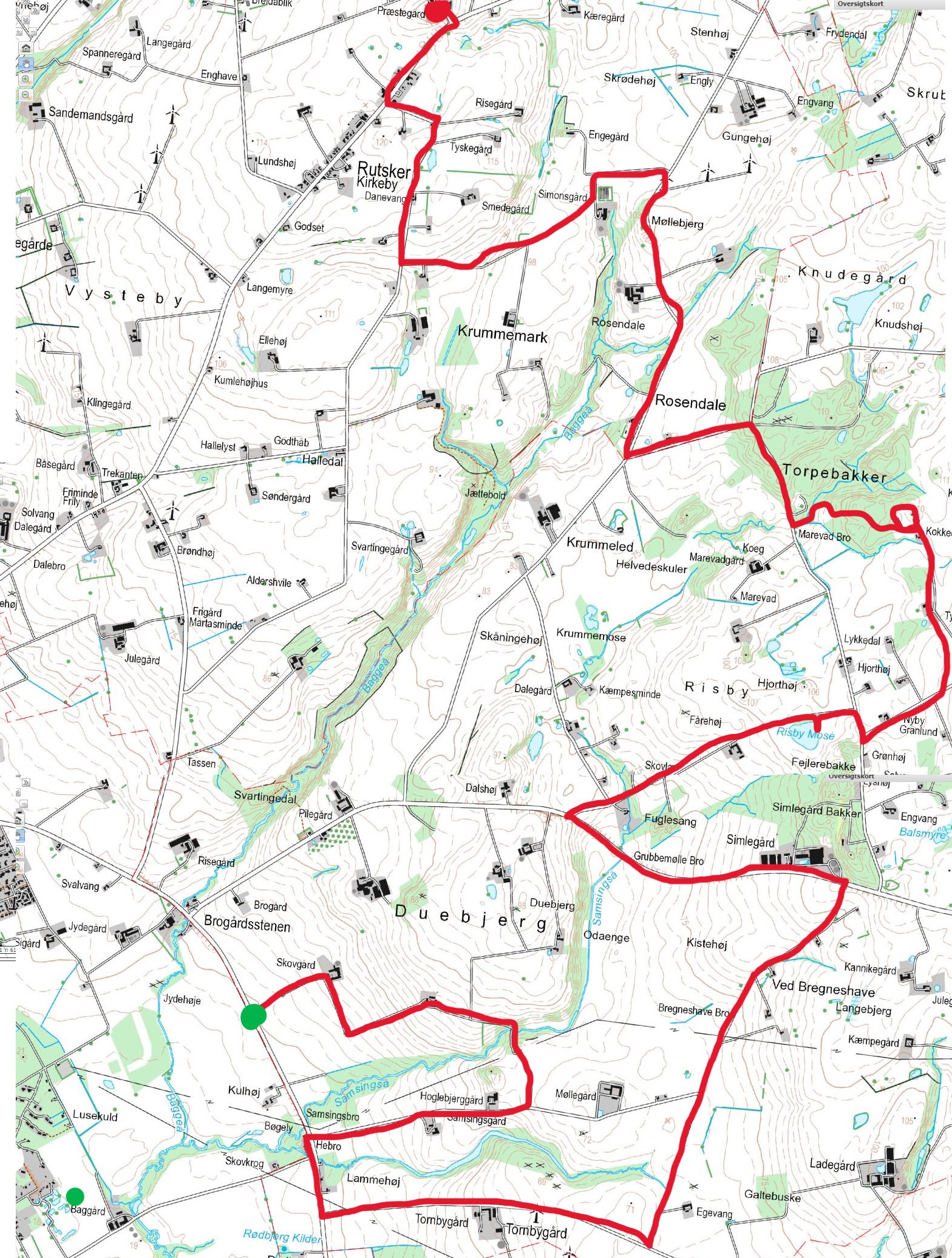
LAND 38 From my starting point on the main road I headed east and uphill, away from the flat fields and forests between Rønne and Hasle. The day was still and clear, the sunrise golden.

Sunrise from Duebjergvej

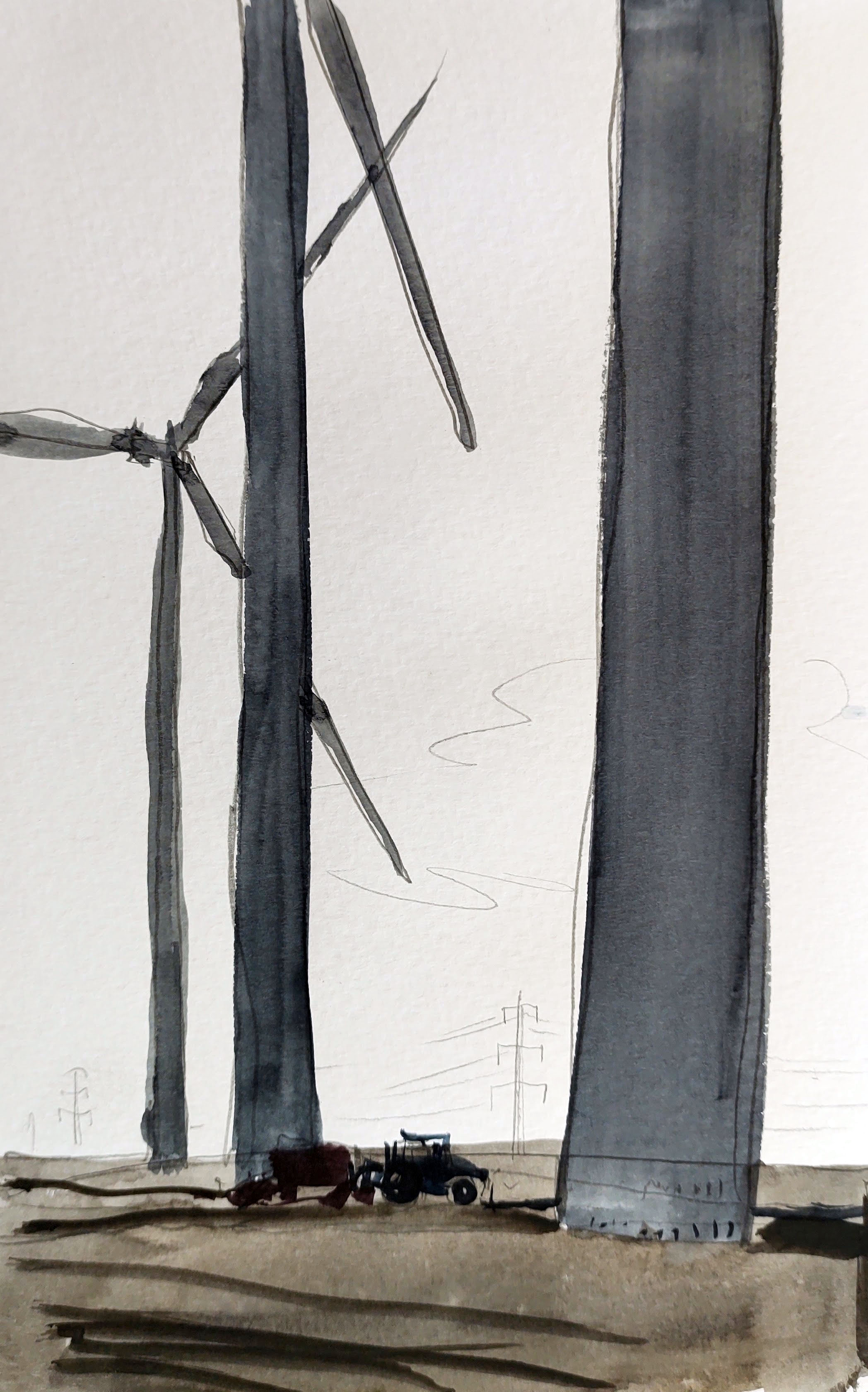
My meandering path switched direction several times, down towards the coast and then uphill again. A tractor passed between two of the huge windmills dominating the skyline.

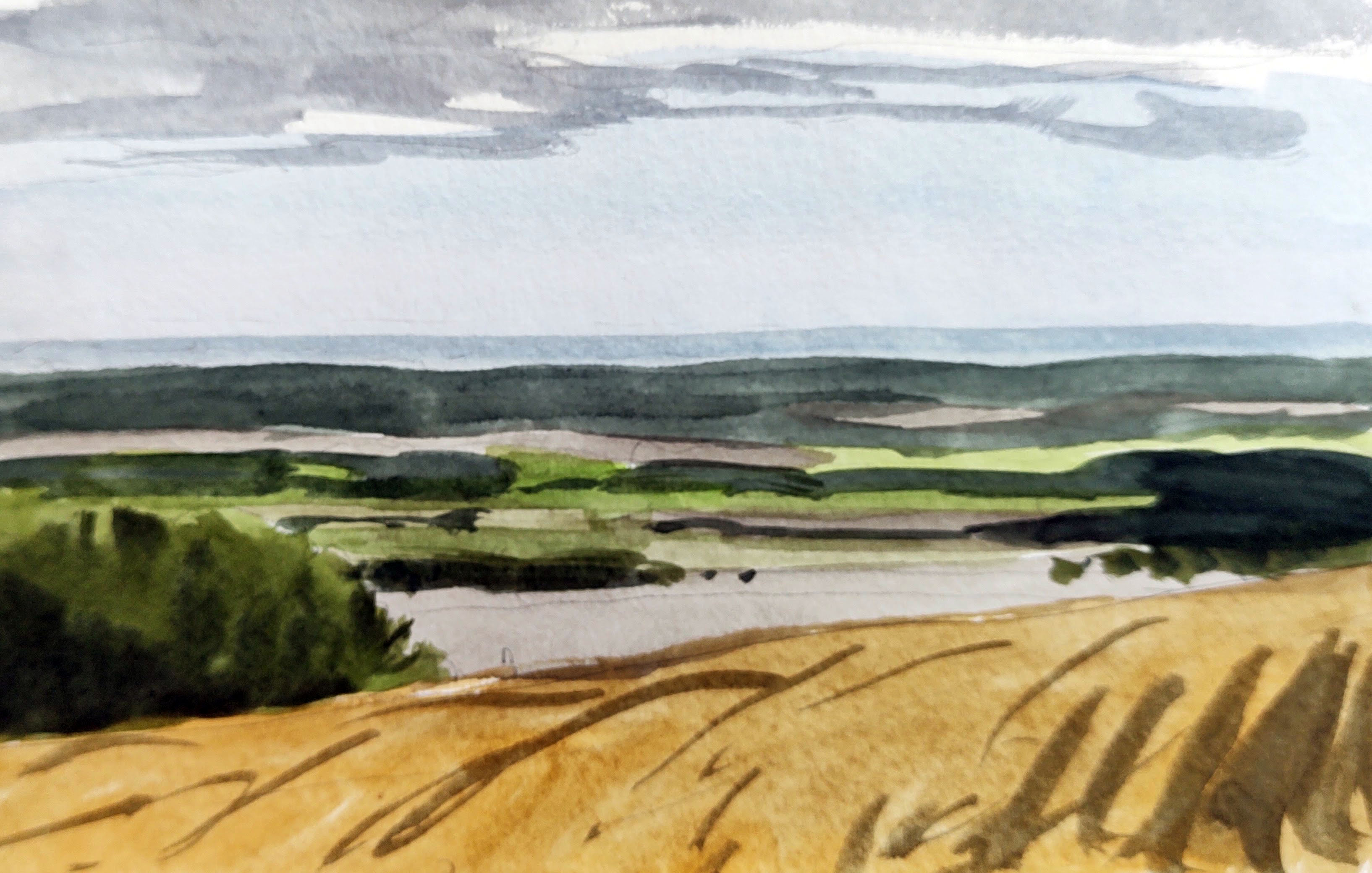
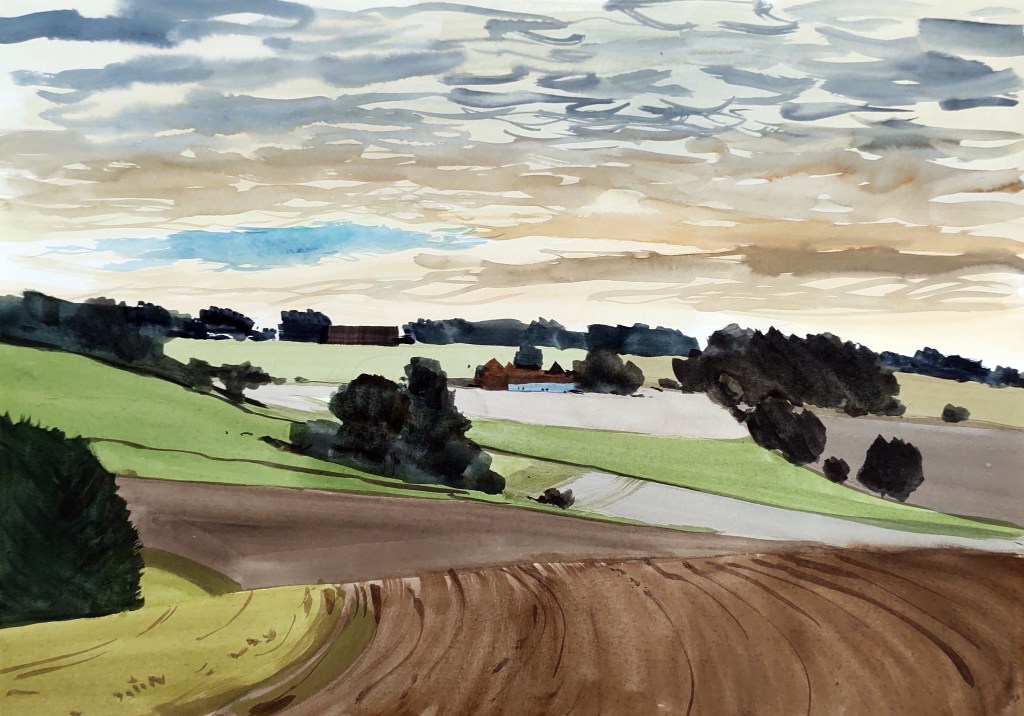
I continued northeast into a gently undulating cultivated landscape with a patchwork of fields, small woods, farms and homesteads.

View from regnehavesvej

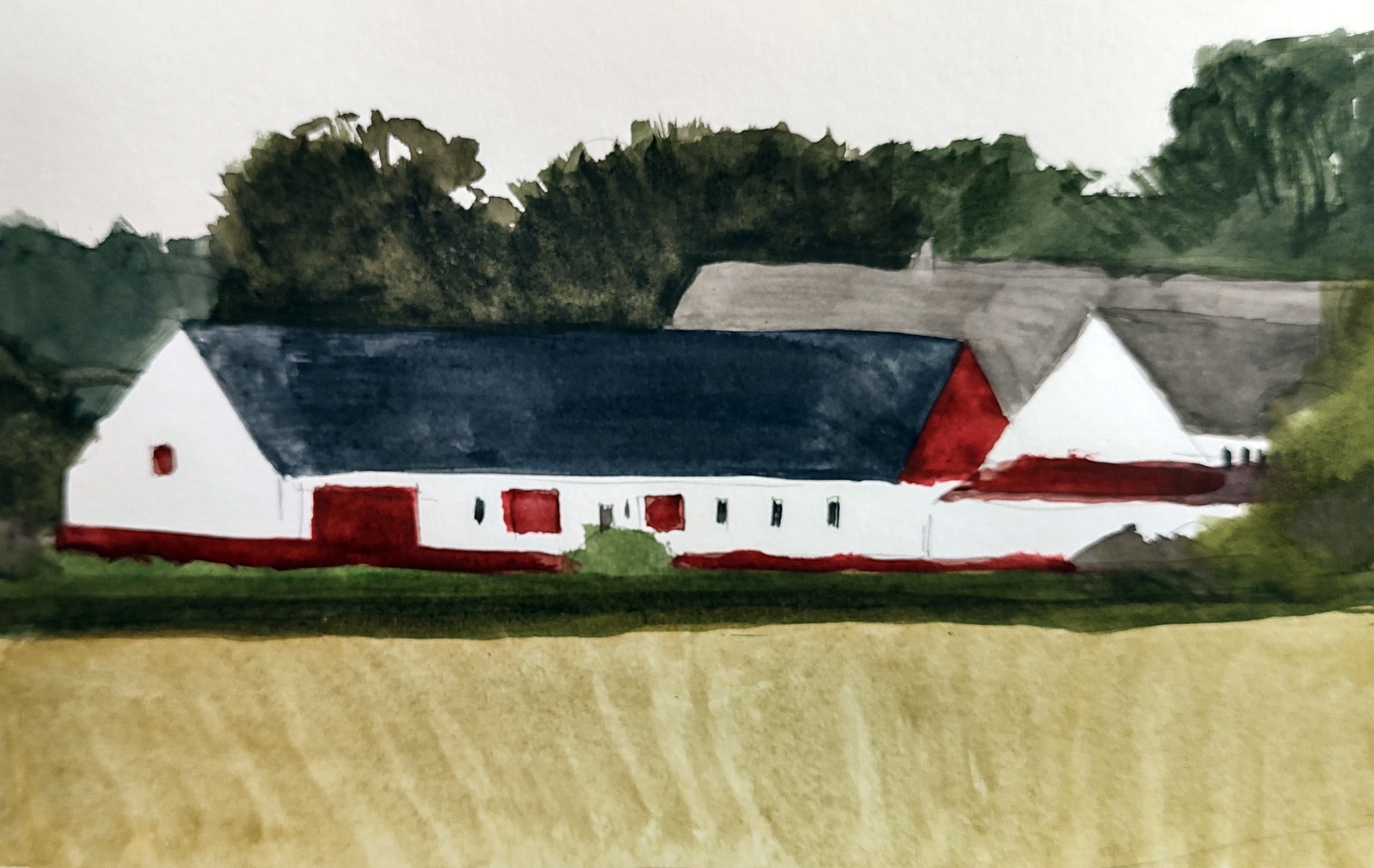
Later I reached a large and impressive-looking farm, Simlegaard. A sign or plaque on the farm proudly described how former farm proprietor Lieutenant Colonel Michael Ekstein had been instrumental in ending the Swedish occupation on Bornholm in 1658.

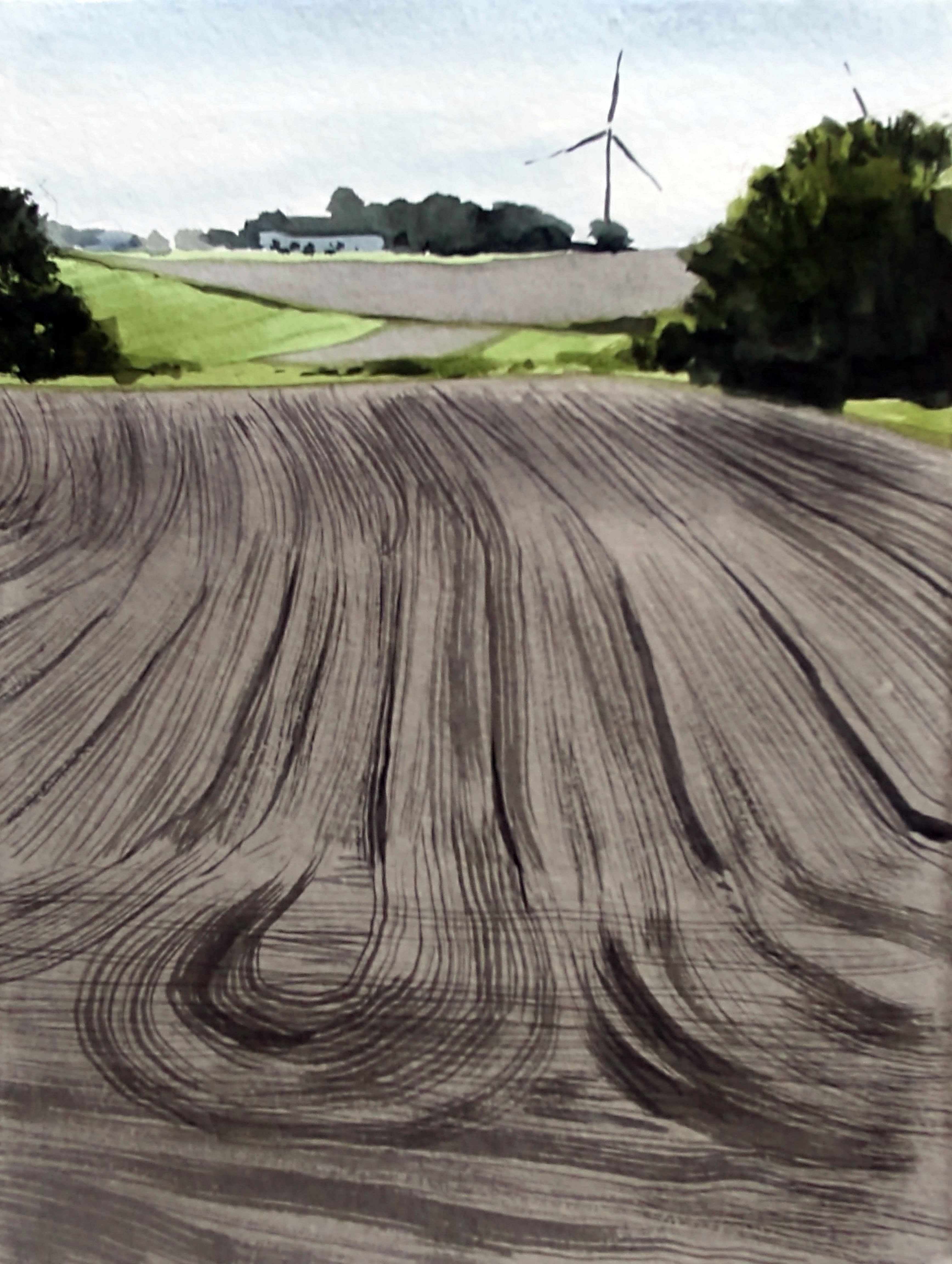
I saw very few people or cars, the only signs of activity were the tractors working on the fields. Immaculate lines looped and followed the contours of the fields.

Simblegårdsvej, looking East

I walked around Bolbybanen, a motorcross track recently opened by a determined group of volunteers. Not for the first time I thought about how Bornholm’s land is changing all the time – granite, sandstone, fault lines, ice ages, forests… and how our use of this land is also in constant change – from agriculture, to forestry, to industry, to recreation – constantly evolving and transitioning. Around the track I found several young sand lizards – a protected species that at one point had threatened the very creation of the racetrack.

Young sand lizard

I continued through a fine oak and pine forest at Torpebakke, and then north through dales and hills towards the church at Rutsker. The church sits high in the landscape and could be seen from many points during the day’s walk. Above me buzzards circled lazily in the thermals.

Buzzard studies

As I approached the church I had a sense of transition – of moving into a new space and time. It was a fine, sunny and warm day, but I could feel autumn waiting in the wings, and the landscape felt different. I looked forward to the turbulent weather of the coming months and the wilder landscape of North Bornholm.

Ruts church

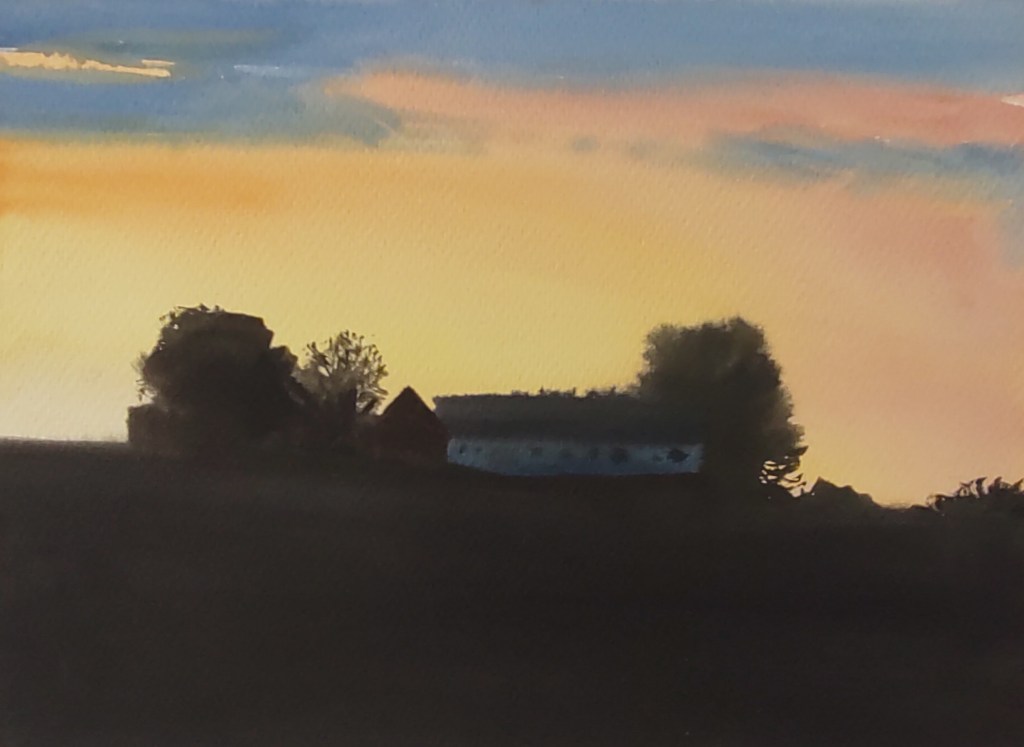
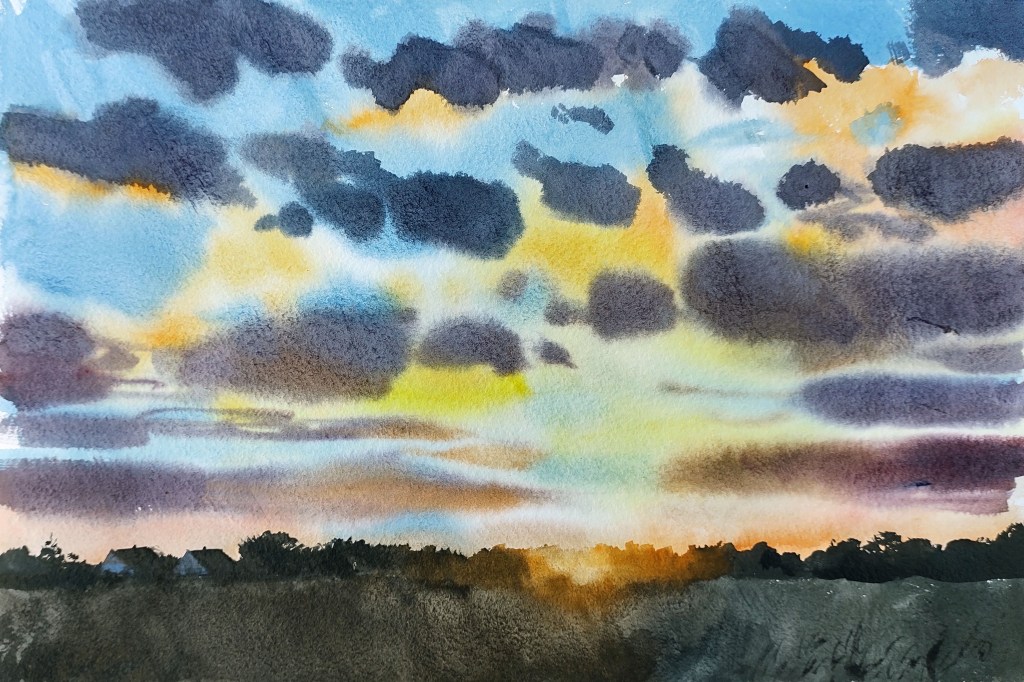
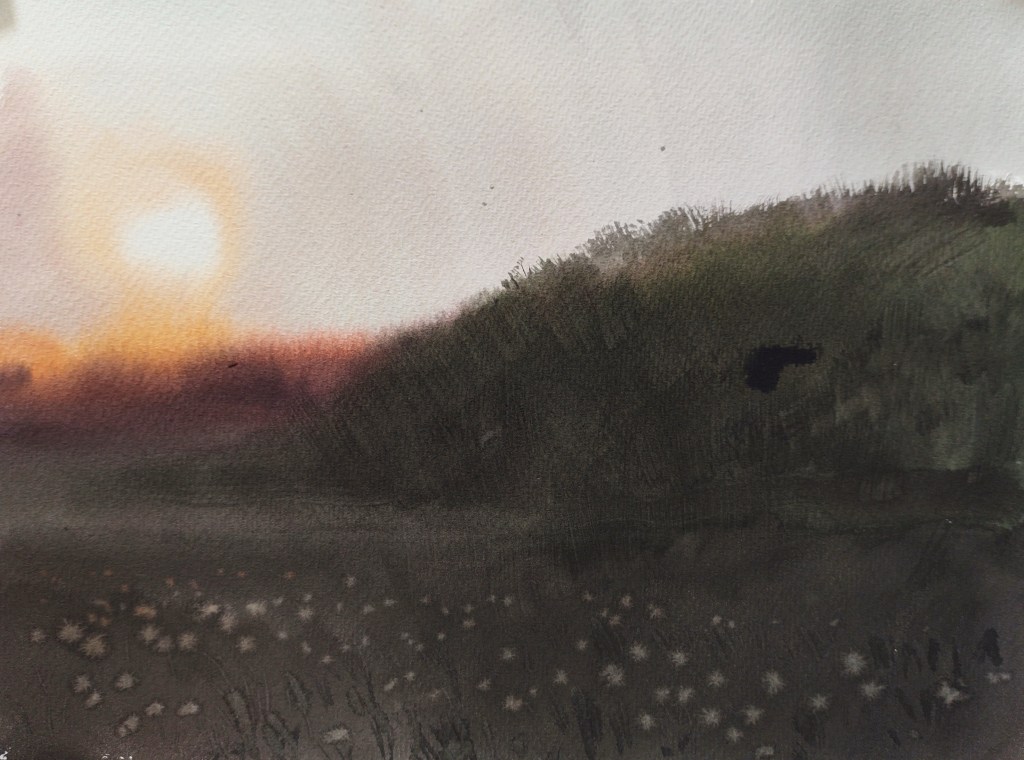
From Ruts church there was a fantastic view down to the sea and the setting sun. It was the day before the autumn equinox. The sun dipped behind a bank of purple clouds and the day was done.

Sunset seen from Ruts church

LAND 38

WEATHER REPORT – Mostly sunny all day. Temperature 17 – 23 degrees. Wind 4 – 5 m/s, from the southeast. Hours of precipitation: 0 hour. Hours of sunshine:  9.5 hours.

STOPS with the BIVVY – 0

KILOMETRES WALKED – 19.44 km

DAY LASTED – 12h and 21 m

PEOPLE TALKED TO – 1

BIRDS SEEN and HEARD – 41 species (0 new) = 129 species in total.

LESSONS LEARNED – I should have spent a bit more money on my new binoculars.

IN MY HEAD – The art project ‘Klippekroppe’ that I was involved in. The creation of the anamorphic land art square I had to make. How little time I had to do everything. Performance art. The SWLA catalogue. Biogas. How to engage the public. Radio and TV interviews.

LAND 33 – Ny Kirke to Aarsballe, 18.08.23

Denne side på dansk

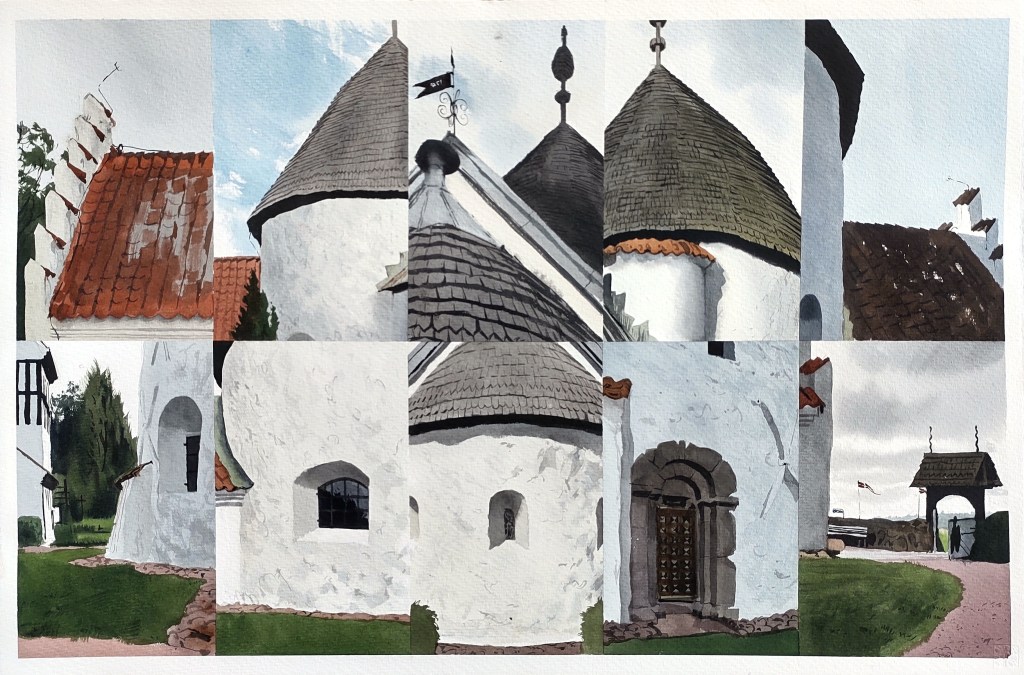
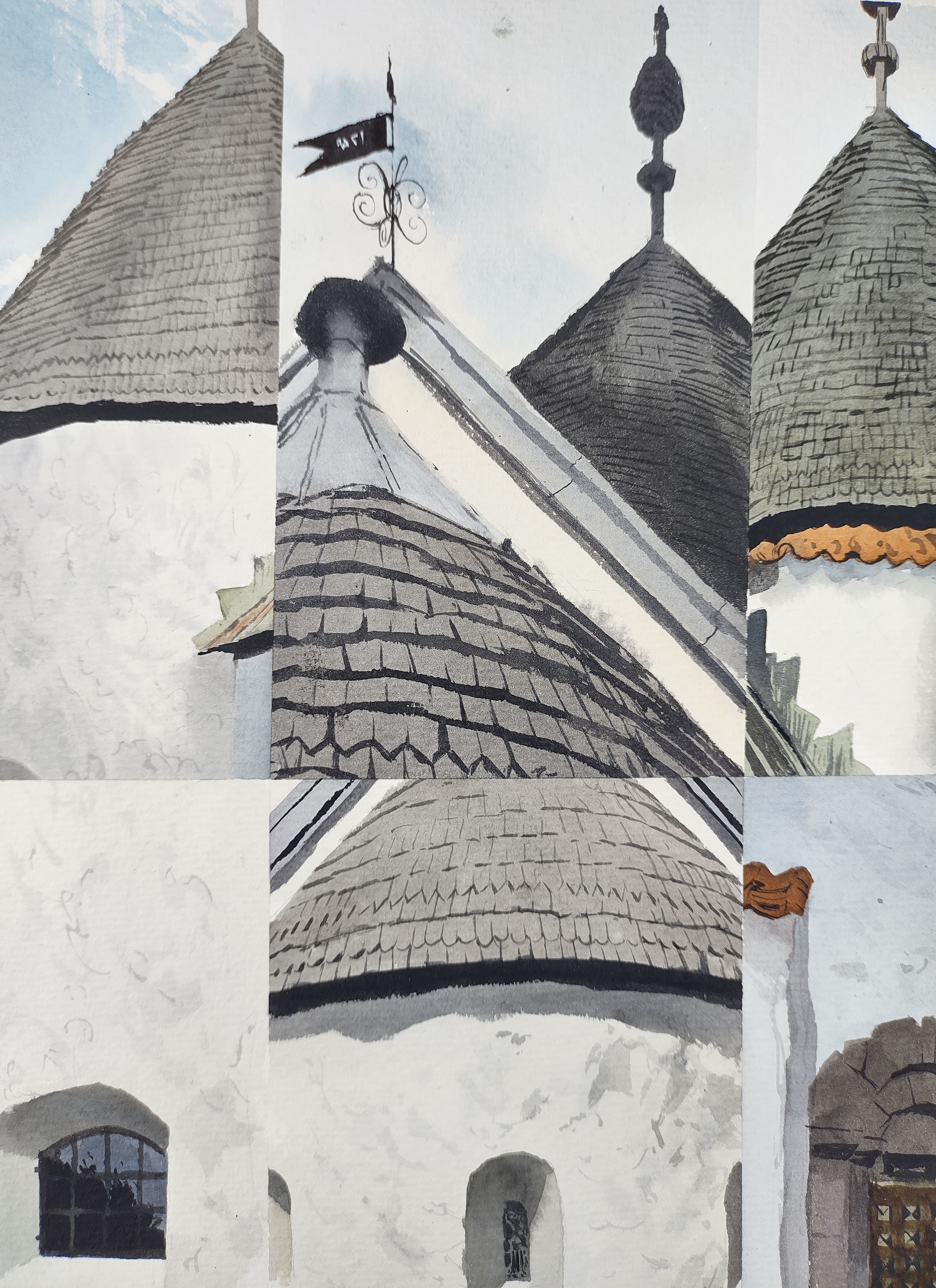
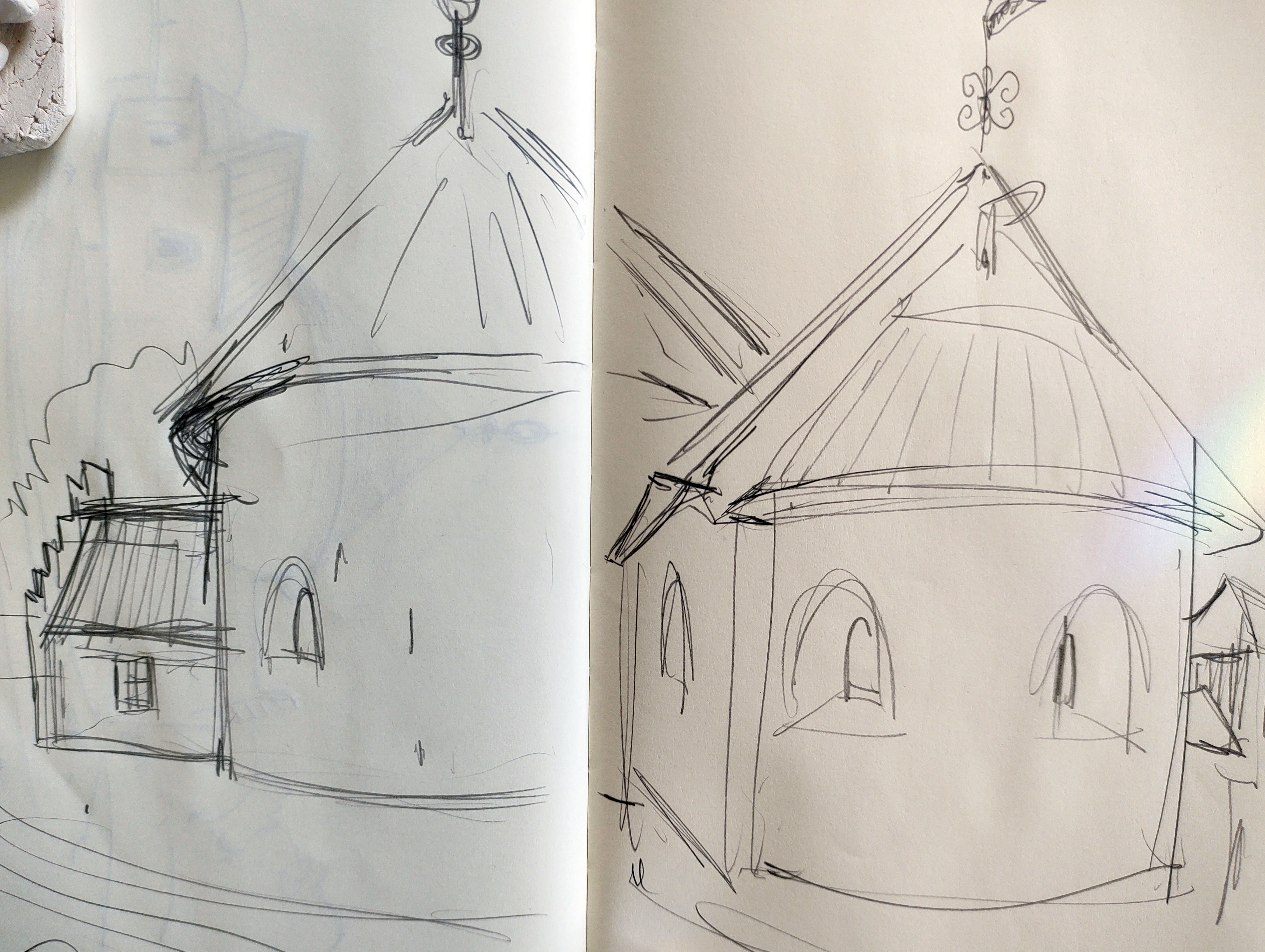
The spectacular sunrise I had hoped for never materialised. Instead, a dull grey blanket of clouds and a blustery east wind. I had wanted to make a ‘slice painting’ of the church, but the light was rather static and unchangeable. Additionally, I found it really difficult to ‘contain’ the shape of the church within the frame of the paper and could not decide on a suitable viewpoint. I decided to walk around the church and make several studies from different viewpoints hoping that in the end the overall effect would be a more faithful reflection of the circular and three-dimensional reality of visiting and looking at the round church.

Ny Kirke

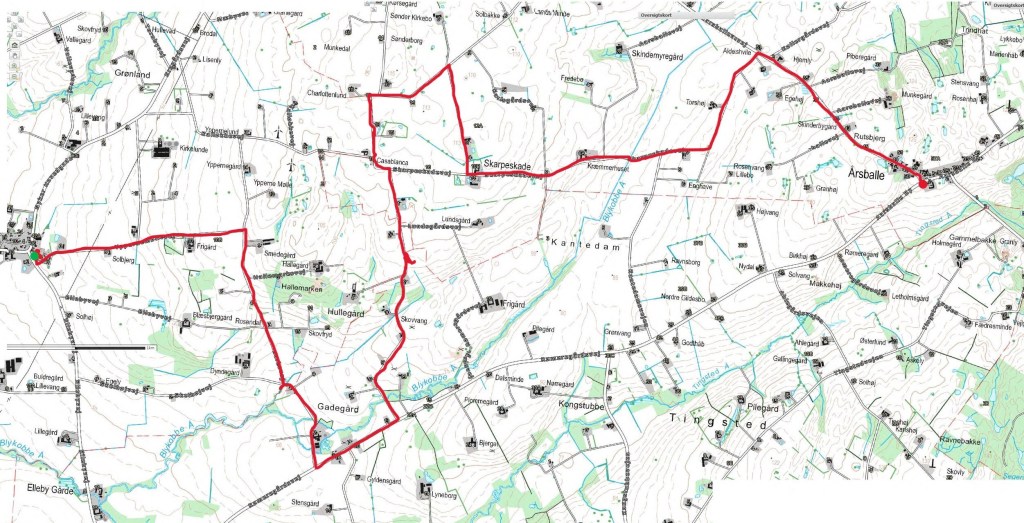
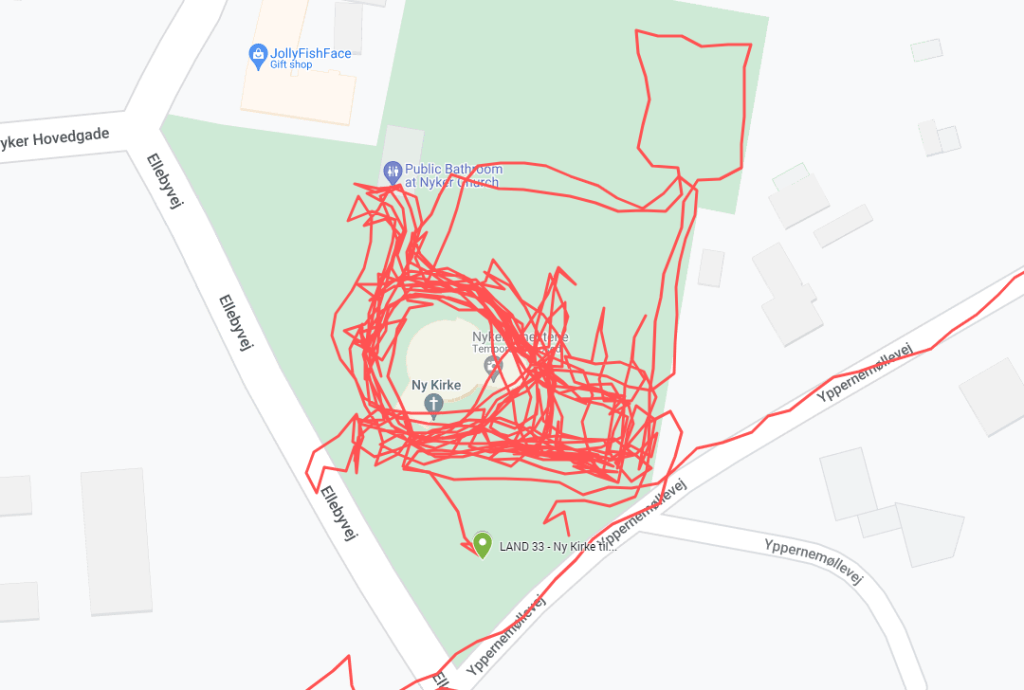
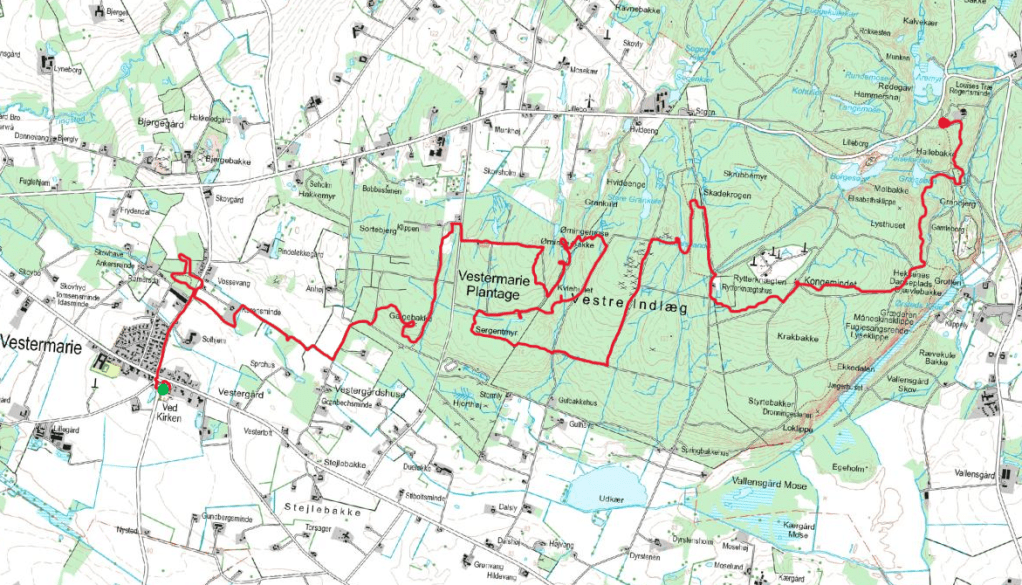
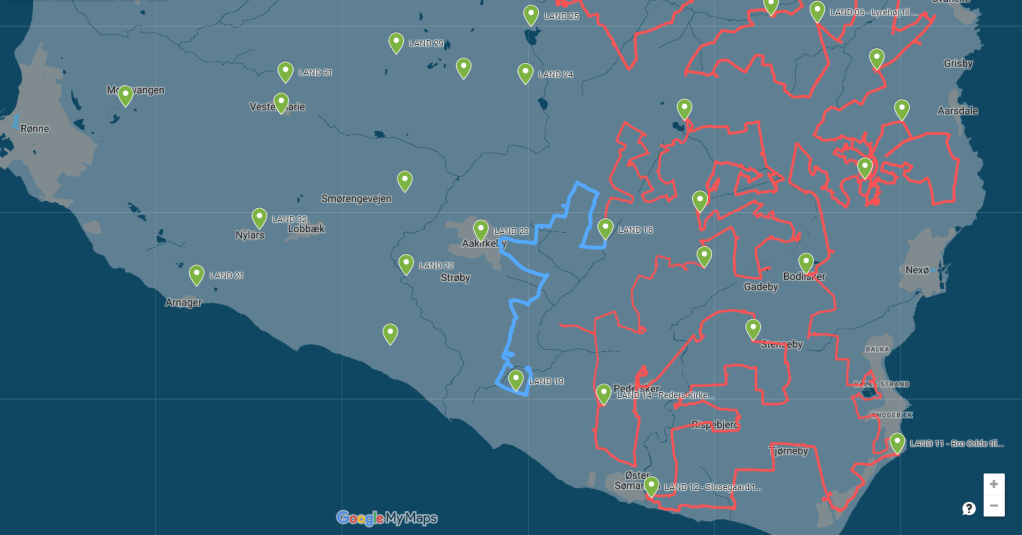
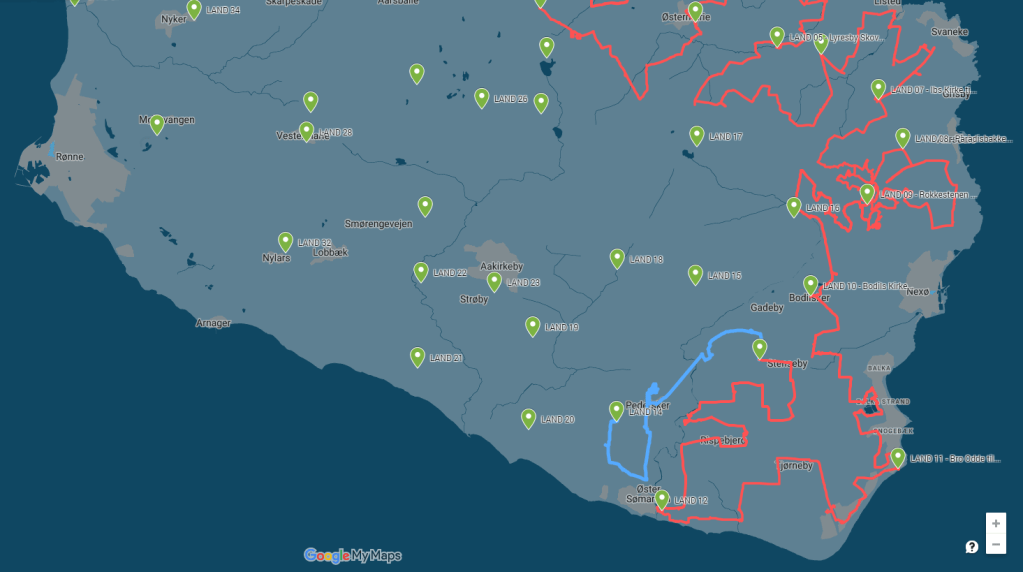
By the time I had finished over half the day was gone and I had already walked over two and a half kilometres according to my GPS.

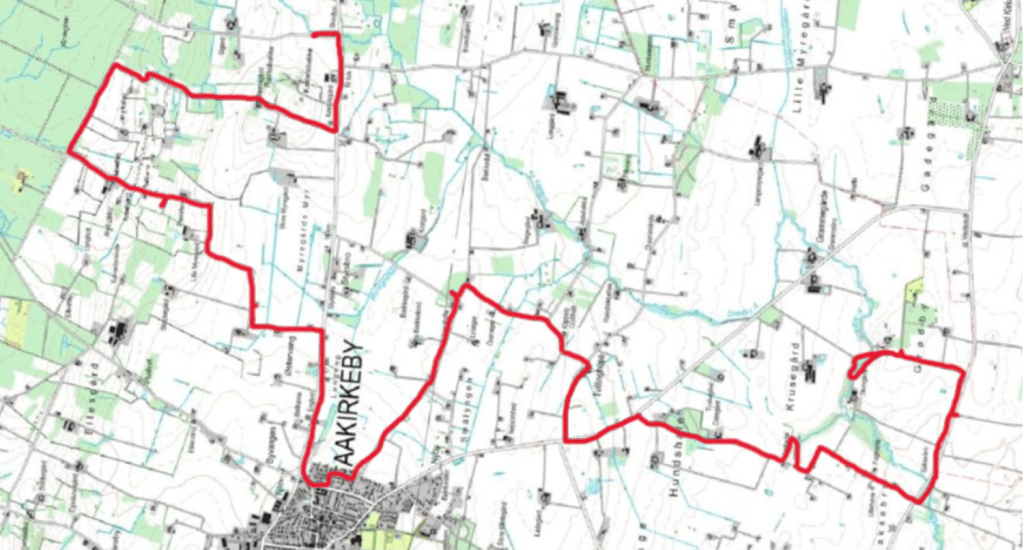
GPS route

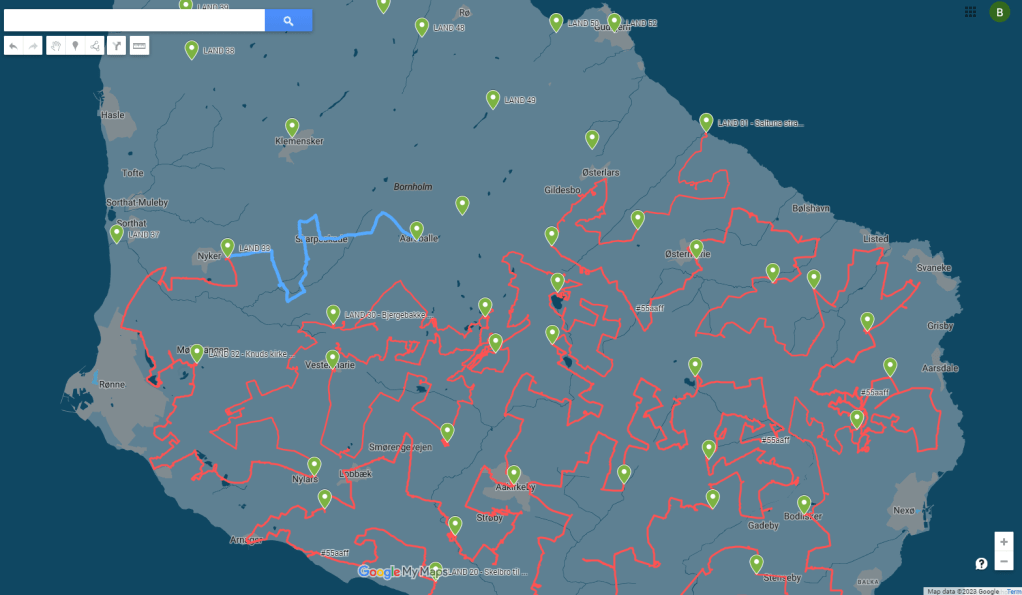
I had a lot of ground to cover, so I got marching – heading east on narrow country roads through the intensively cultivated fieldscape between the villages of Nyker and Aarsballe – an area that I didn’t know very well at all.

As I progressed, I ascended slowly into a gently undulating landscape of wheat fields, small woods and large farms. The land felt different somehow – higher and heavier, as if I could feel the granite under my feet – in contrast to the flatter fieldscape of southern Bornholm.

View from Lille Gadegårdsvejen

Through the day, the visibility slowly worsened, first a fine mist and eventually a thick fog – a real pea souper. The roads were almost empty, save the intermittent rumbling of tractors and combine harvesters. Apart from a few gurgling skylarks, there was no birdsong.

View from Karlsgårdsvej

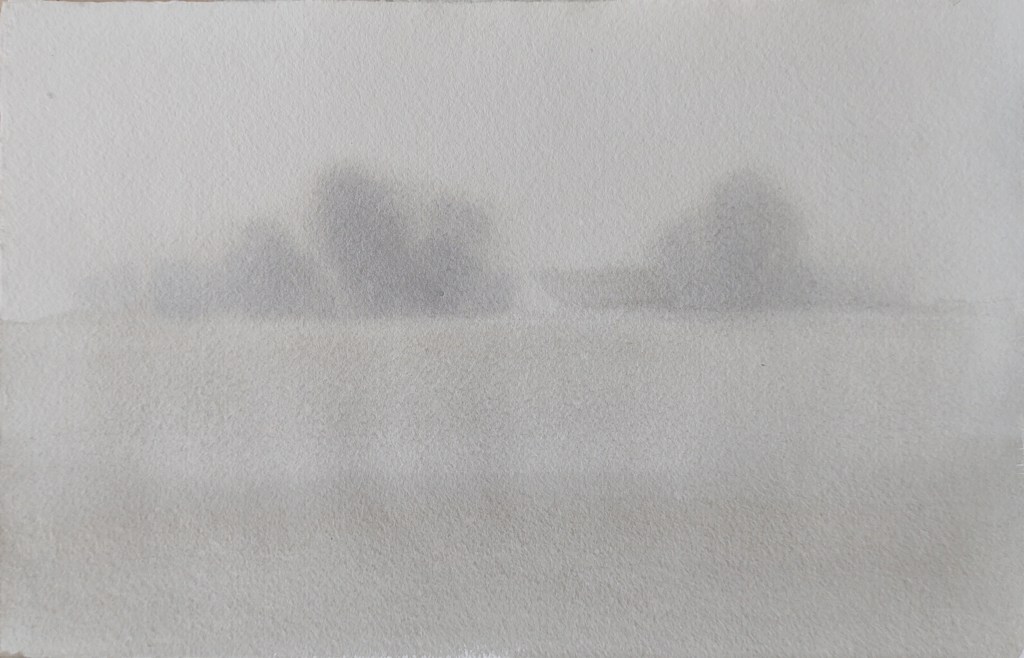
The landscape was hidden from me, and I walked alone through the milky mist, stopping every now and then to try to paint the ghostly shapes. In comparison to the morning’s hyper-detailed painting, these could not have been more different both in execution and result.

View from Karsgårdsvej

Cold and windswept I arrived at Aarsballe, glad for the lift home and the opportunity to be released from the rather claustrophobic clutches of the fog.

LAND 33

WEATHER REPORT – Cloudy with some sunny periods in the morning, mist and then thick fog in the afternoon. Temperature 16 – 17 degrees. Wind 7 – 8 m/s, from the E. Hours of precipitation: 0 hours. Hours of sunshine: 0.5 hours.

STOPS with the BIVVY – 0

KILOMETRES WALKED – 15.65 km

DAY LASTED – 14h and 41 m

PEOPLE TALKED TO – 8 (all visitors to the church)

BIRDS SEEN and HEARD – 28 species! (0 new) = 125 species

LESSONS LEARNED – I find it really difficult to paint fine details without my glasses now.

IN MY HEAD – ‘Mr Rat Face’ by Superbandet, Bornholms billedskole, the busy few months ahead and all the things I need to do.

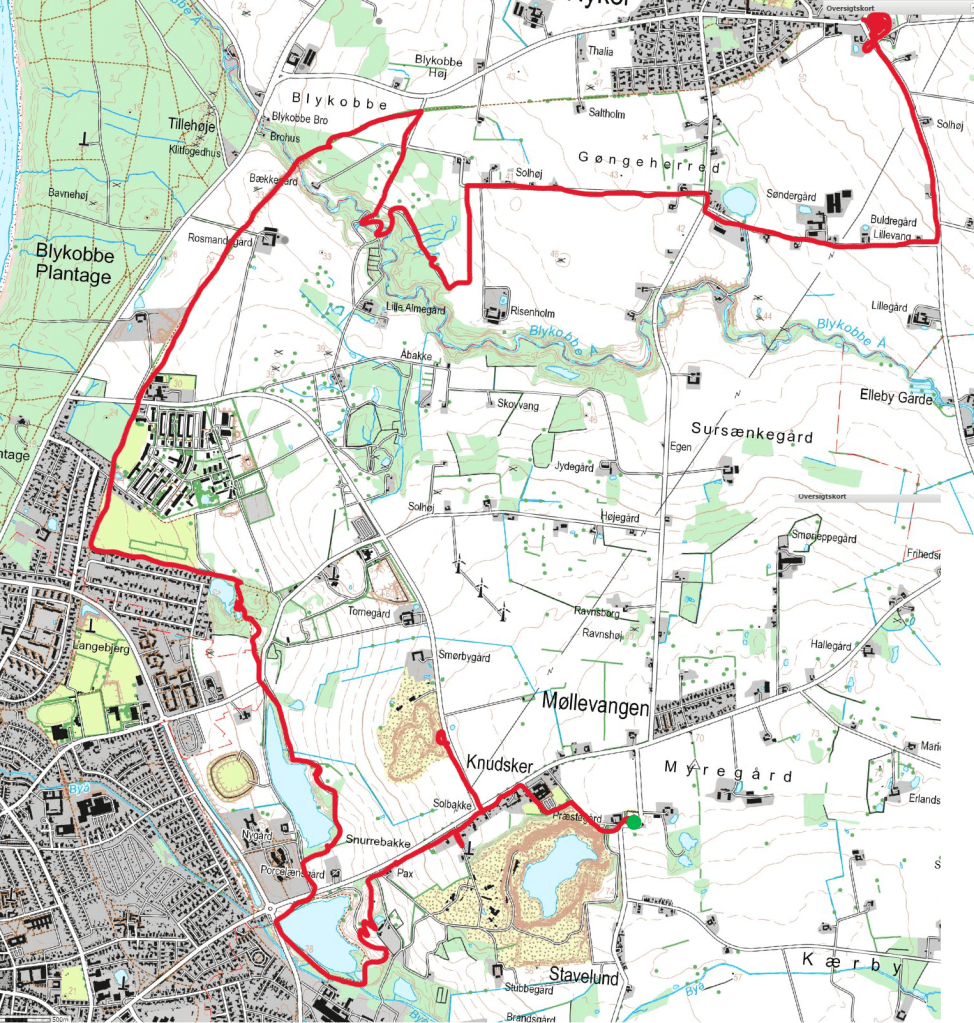
LAND 32 – Knuds Church to Ny Church, 11.08.23

Denne side på dansk

LAND 32 Crimson and orange flecks in the highest cirrus clouds promised an exciting sunrise as I arrived back at Knuds church at dawn. It was a little chilly, but I found some shelter from the wind and tried to capture the kaleidoscope of colours as they continually altered in hue, value, and intensity.

Sunrise from Knuds kirke

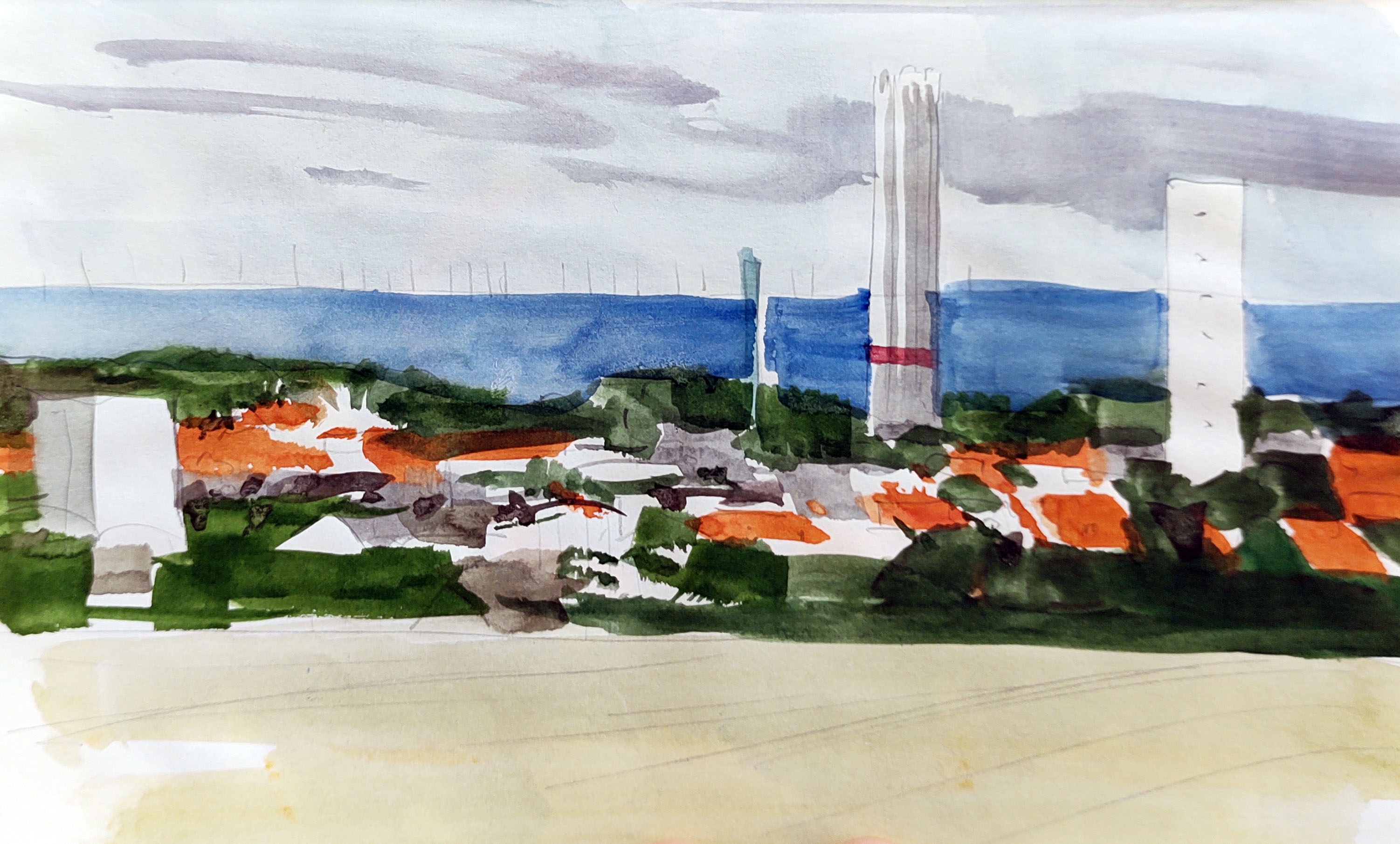
It was such an intense and colourful beginning to the day that the white daylight felt rather ordinary and bland in comparison. From the top of the hill ‘Snurrebakken’, I looked down towards the town of Rønne. It was a very familiar view; the red roofs of the old town mixed together with trees, industrial buildings, and the gigantic offshore windmill elements standing in the harbour.

I walked along the crest of the hill, and then down towards one of the many lakes that surround Rønne. These were once huge clay pits where kaolin was extracted – first for porcelain and then for other products, and some of them were still in use as recently as the 80s. Since filled with water and now covered in greenery, they form part of the ‘Green Ring’ encircling Rønne and are used for recreation: fishing, jogging, dog walking and so on.

Snorrebakke Lake and Rønne

The day soon warmed up. Exhausted, I enjoyed a quick snooze on the damp grass. For several weeks Bornholm’s weather has been atrocious with storms and flooding and I felt very thankful that the wind had dropped and the sun finally came out again on a LAND Friday. I continued walking around the lakes, noting how the high-water level had submerged the sandy ‘beach’ around the lake’s shore.

Reeds and the beach at Kaolin lake

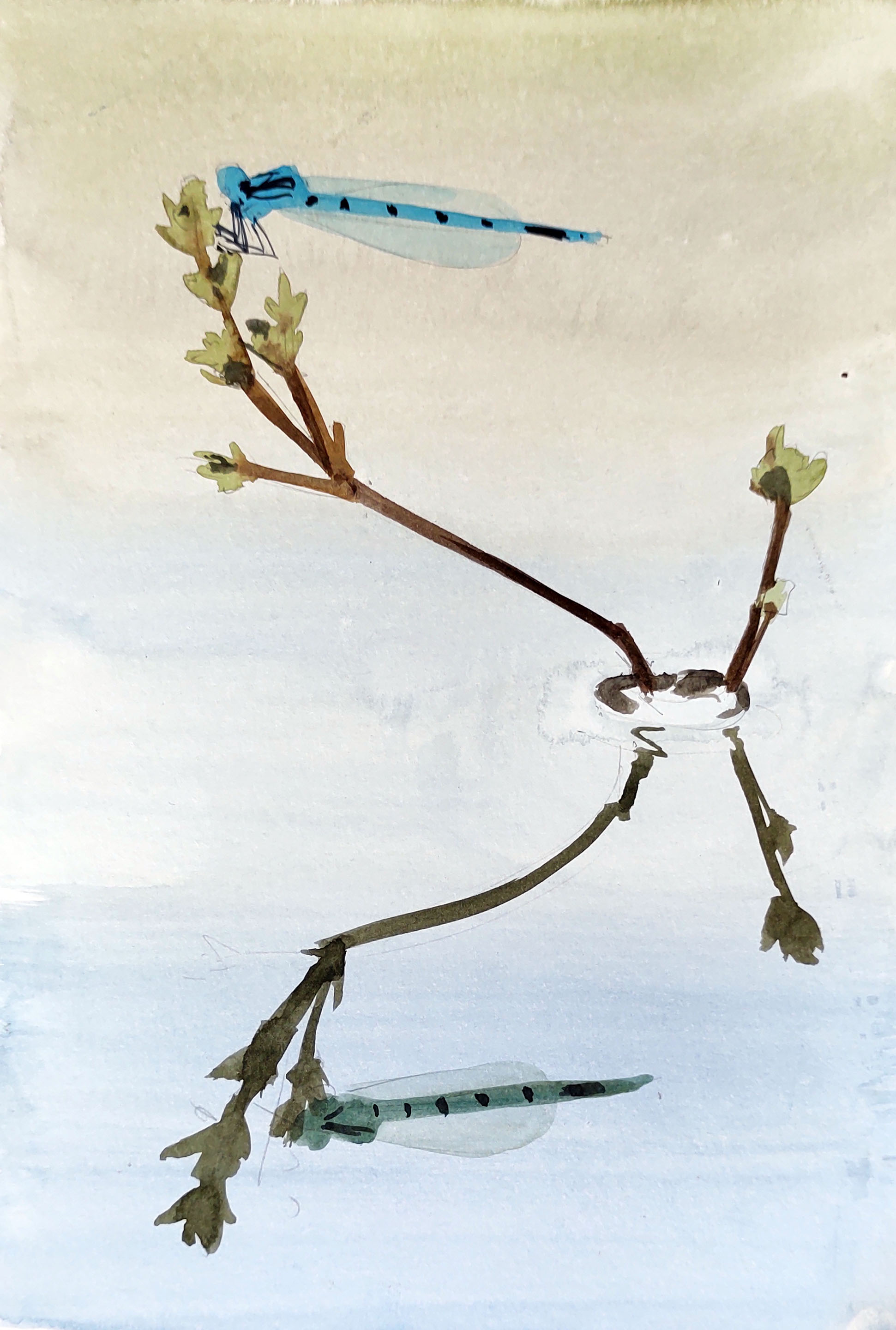
By the northernmost lake, I enjoyed the rich habitat around the lakes – it never ceases to amaze me how quickly nature returns once given the opportunity. A fat sand lizard sunning itself in the scrub was a lucky find.

Damselfly and reflection

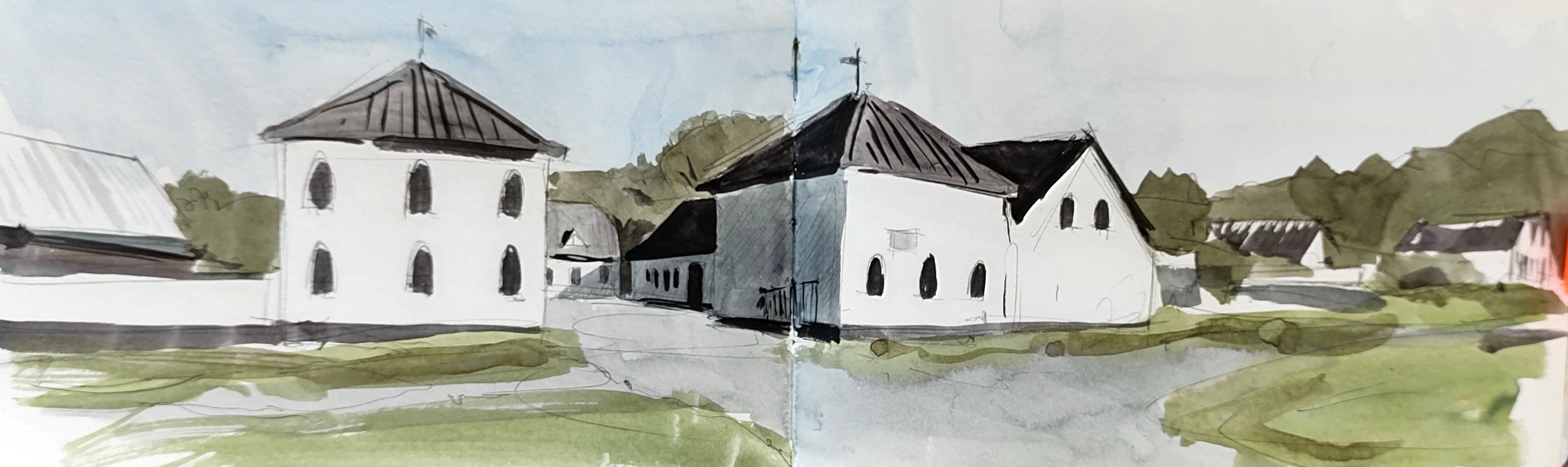
I carried on northwards, following the cycle path, which had once been the Rønne to Allinge railway line. As the path swept eastwards it passed through the Almegaard military area, which I decided to explore a little – once I had checked that there was public access. I had never been there before and enjoyed tramping around the mixed woodlands and incredibly insect and flower-rich meadows, bisected by the Blykobbe stream and the deep rutted tracks of military vehicles. Definitely a place I will be returning to.

Wild flowers, Almegaards øvelsesplads

For the remaining few hours, I walked along the narrow roads towards the town of Nyker. The drone of combine harvesters and tractors mixed with the sweet smell of straw, while overhead a turret of screaming swifts twisted and coiled furiously.

Ny kirke from Buldregårdsvej

When I eventually arrived at Ny church, another of Bornholm’s round churches, I managed only to make a few quick pencil sketches before my lift arrived. Next week I’ll be crossing my fingers for another spectacular sunrise.

LAND 31

WEATHER REPORT – Mostly sunny but cloudy in the afternoon. Temperature 14 – 17 degrees. Wind 2 – 4 m/s, from the W. Hours of precipitation: 0 hours. Hours of sunshine: 9 hours.

STOPS with the BIVVY – 0

KILOMETRES WALKED – 17.85 km

DAY LASTED – 15h and 16 m

PEOPLE TALKED TO – 2

BIRDS SEEN and HEARD – 46 species (1 new: moorhen) = 125 species

LESSONS LEARNED – That moorhens are incredibly good at hiding themselves

IN MY HEAD – Funeral, the song by Phoboe Bridges.. Dropping my daughter off at Kastrup Højskole. Raskalnikoff and Razoumihkin…

LAND 28 – Vestermarie Church to Christianshøj, 14.08.23

Denne side på dansk

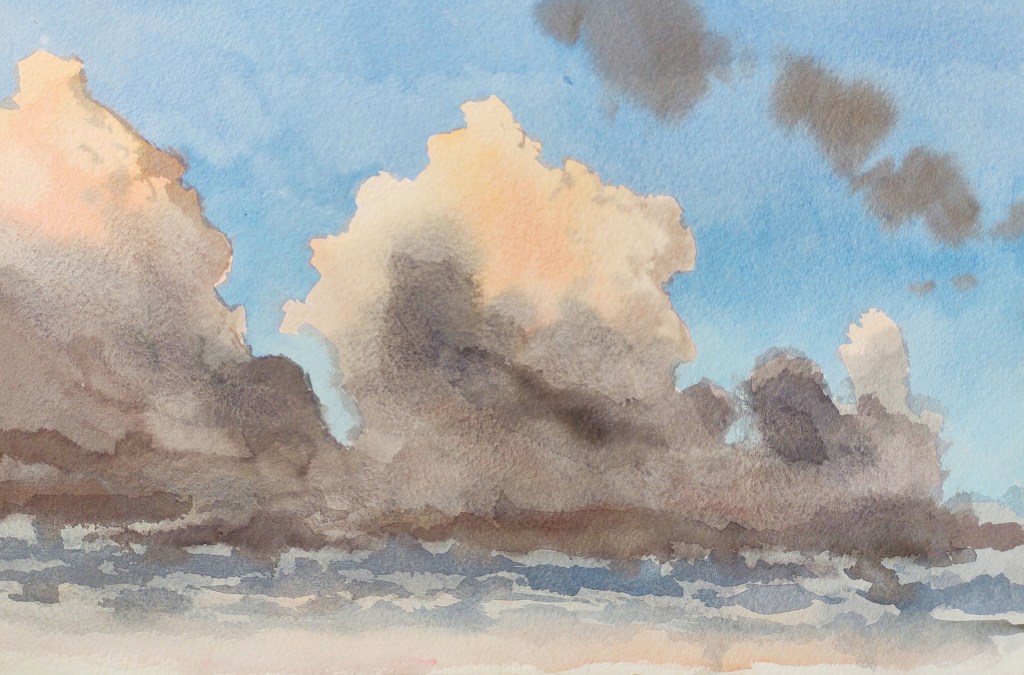
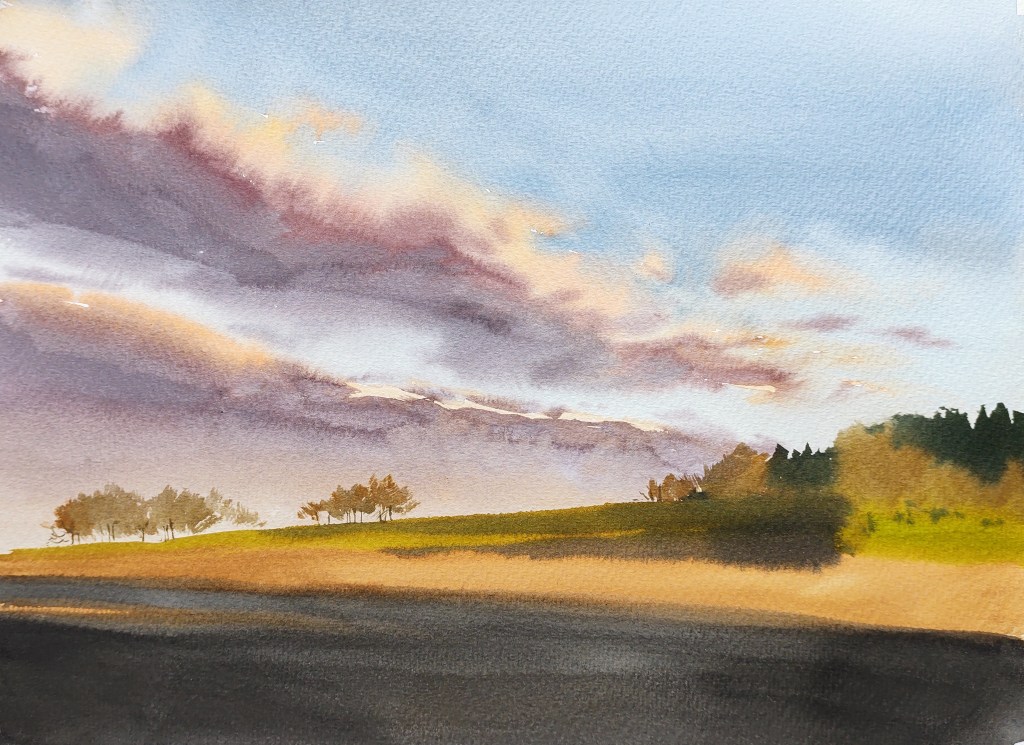
LAND 28 Dawn at Vestermarie. I walked slowly around the church’s graveyard, rubbing my eyes and preparing mentally and physically for the day ahead. Three hares, unused to such an early visitor, looked at me with surprise before gambolling off along the immaculately maintained paths. I tried to capture the salmon-pink light from the rising sun hitting the top of the distant cumulus clouds.

Dawn skyscape from Vestermarie church

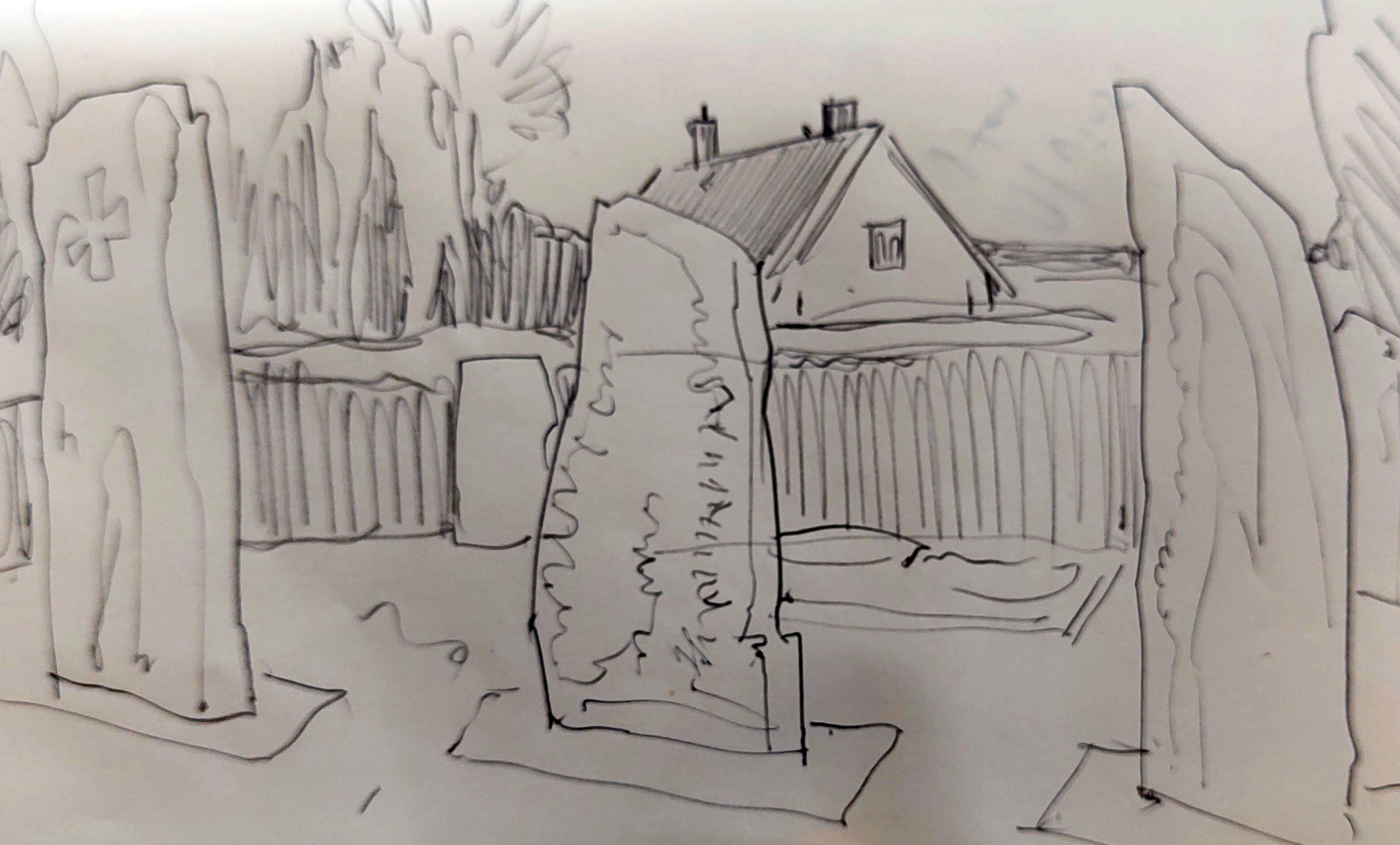
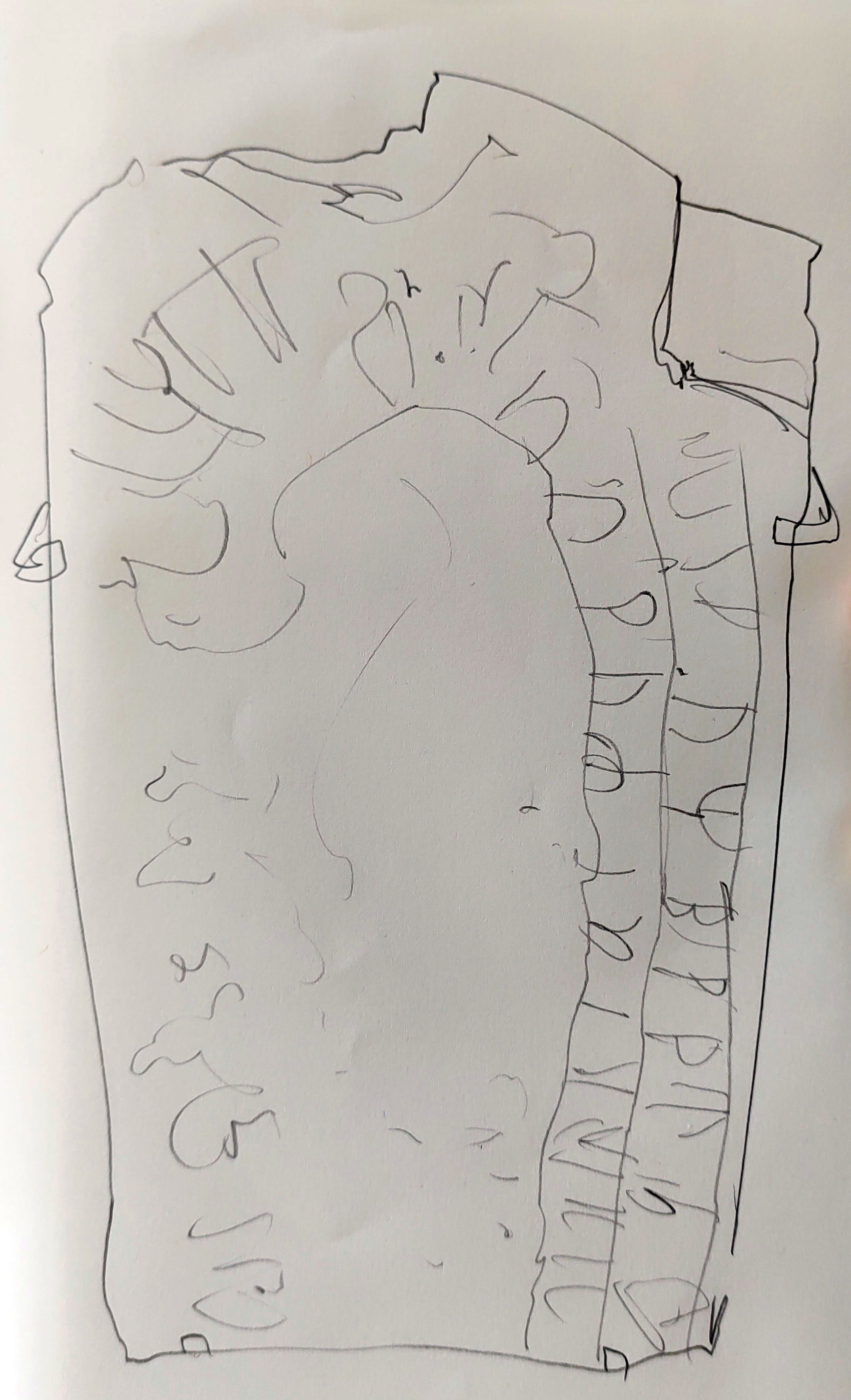
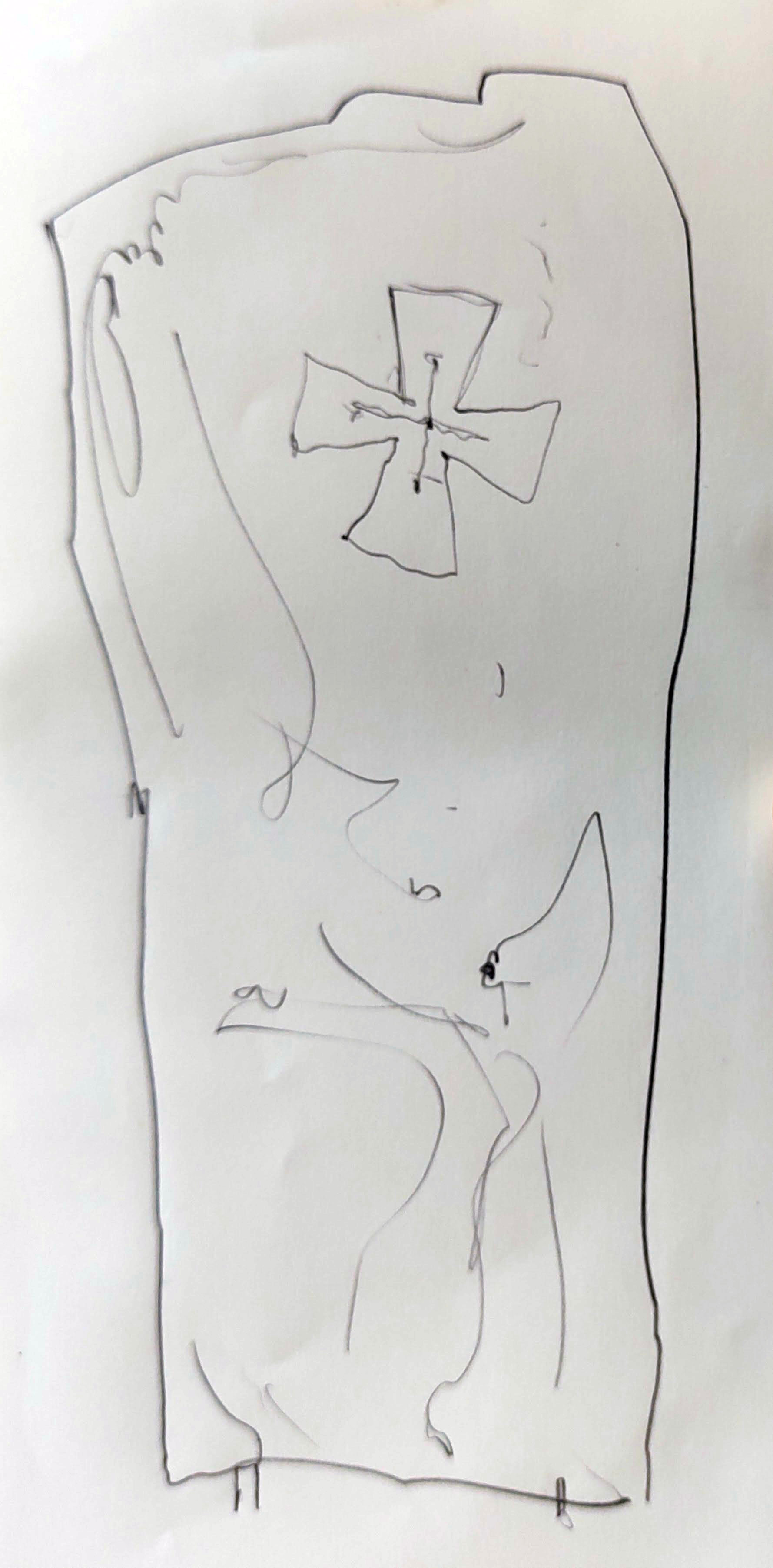
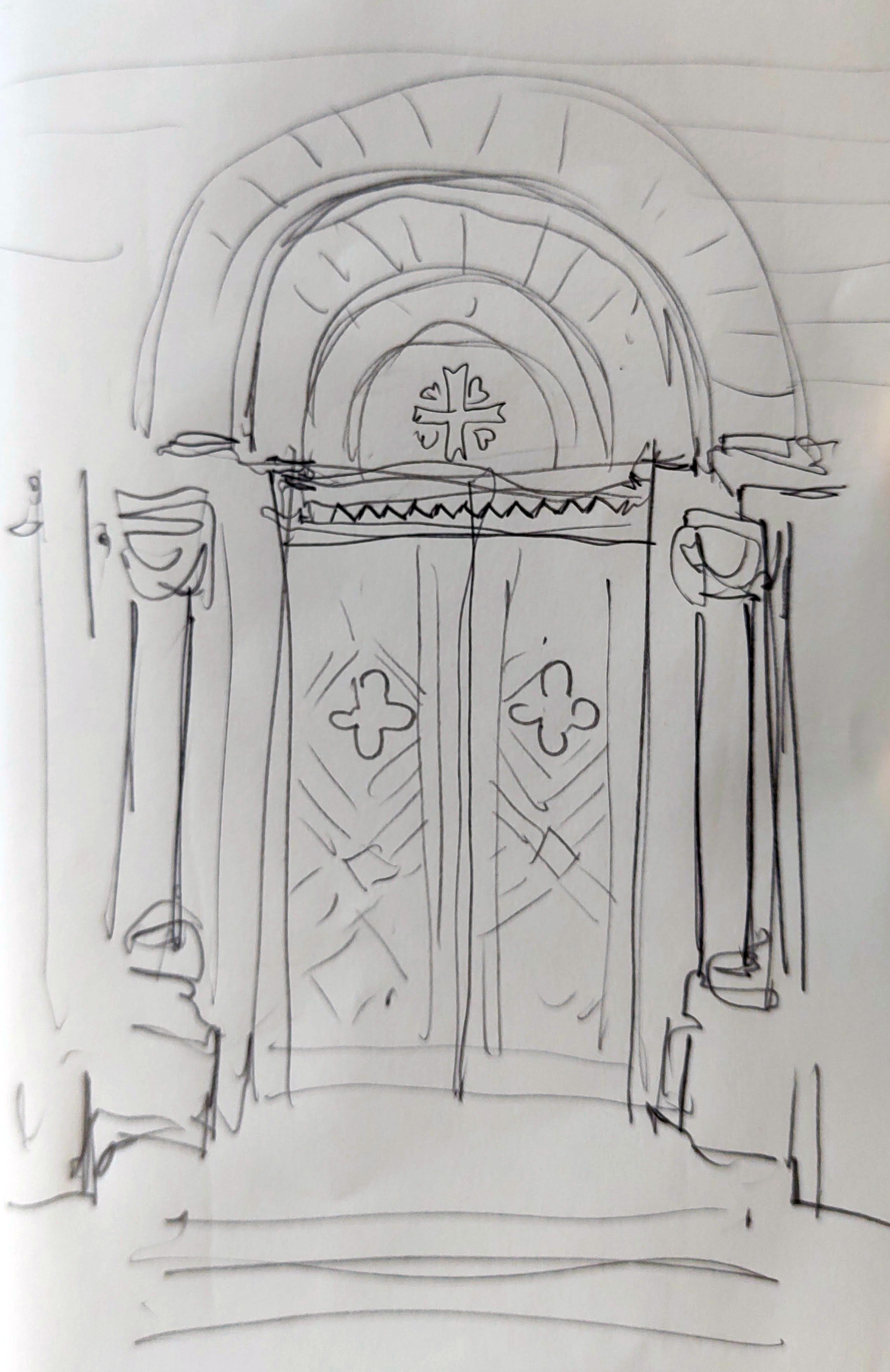
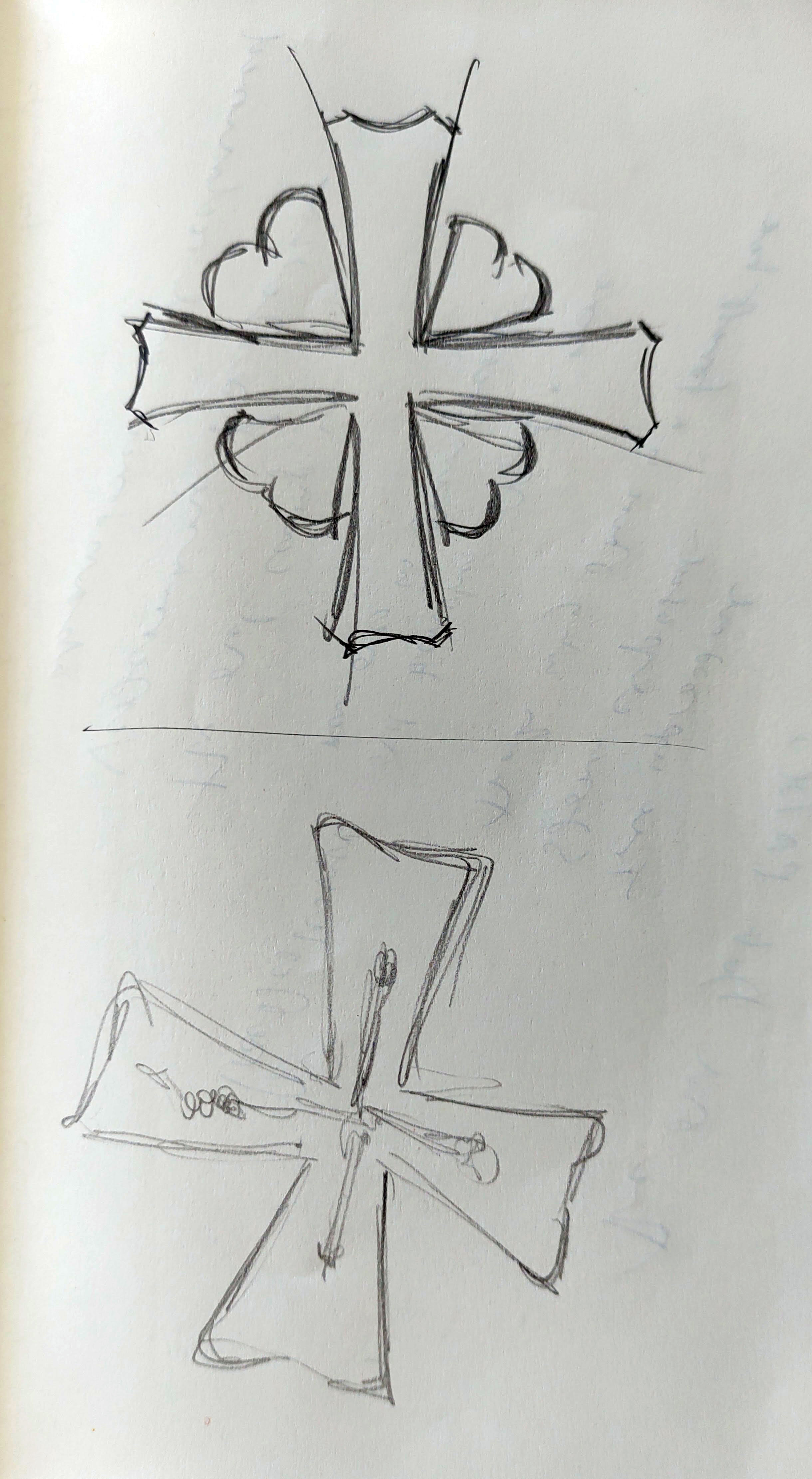
The church was built in 1885, replacing the original church dating from at least the 1300s. In the graveyard stood six runic stones, with a short description of their provenance. Some had been rediscovered during the building of the new church, and others had been found in nearby farms. They dated from the 11th century or so, just as Christianity’s arrived on the island, and all were written in the old runic script of the Vikings. I made some quick drawings, noting the similarity between the cross on one of the stones and the cross above the smart new door of the church.

I walked on to a small wood on the edge of the village – a trip made hundreds of times when I lived here. It felt very familiar but different. Old benches had rotted away, replaced by new ones. The old camp that my kids had used was being consumed by the forest. I continued walked along a narrow bridle path that snaked along the edge of fields towards Almindingen, the central forest.

Almindingen seen from Anhøjvej

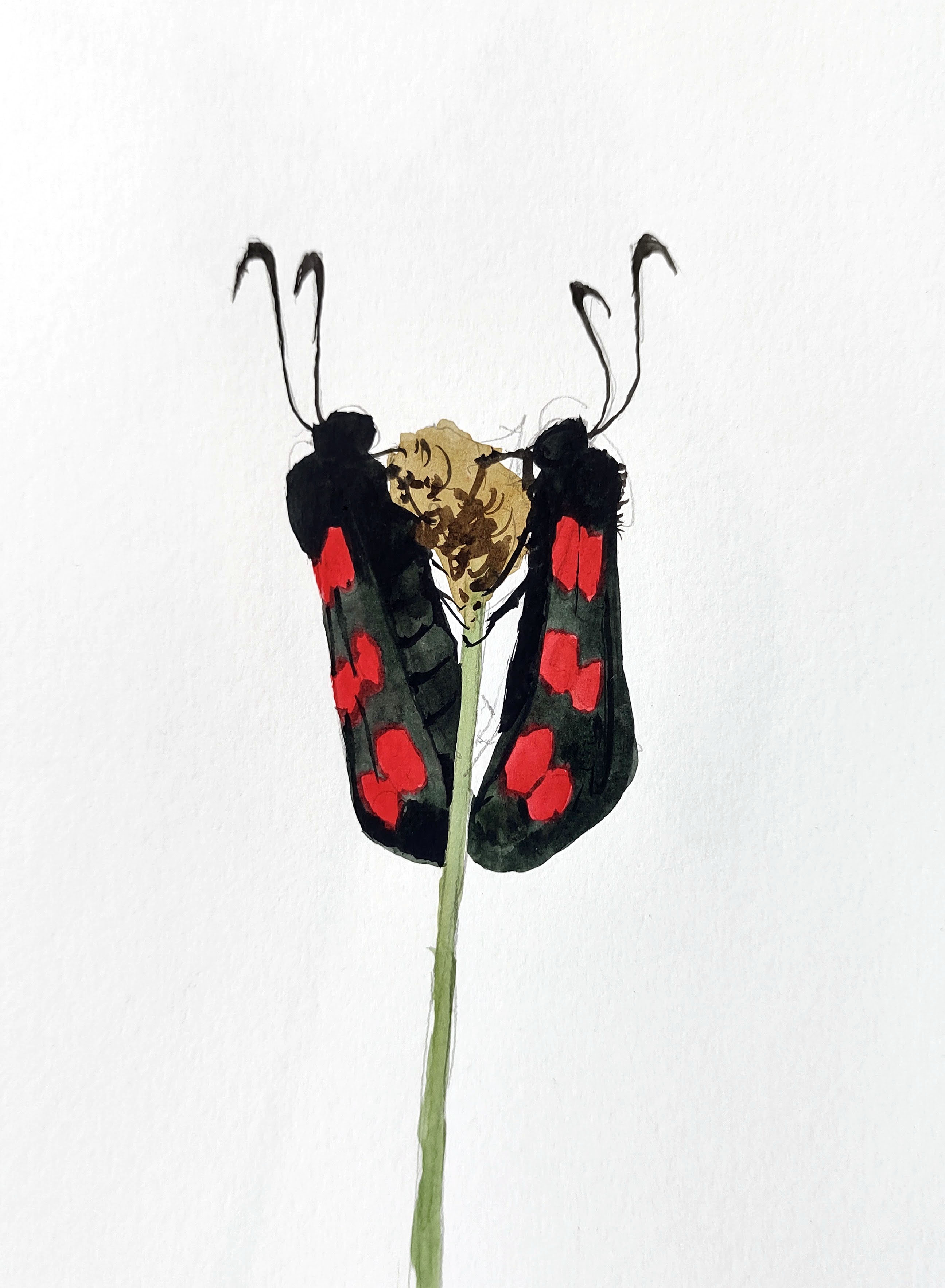
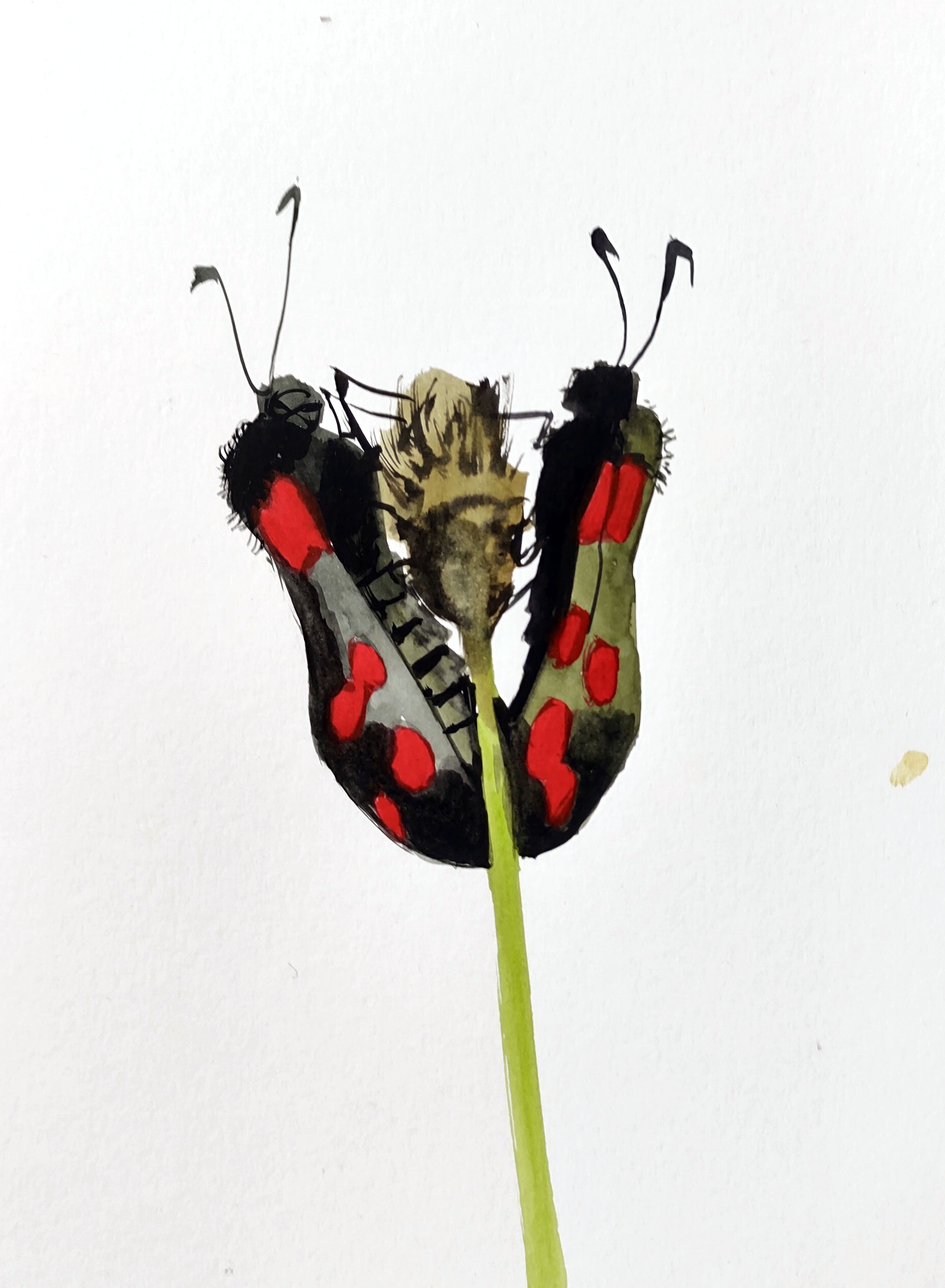
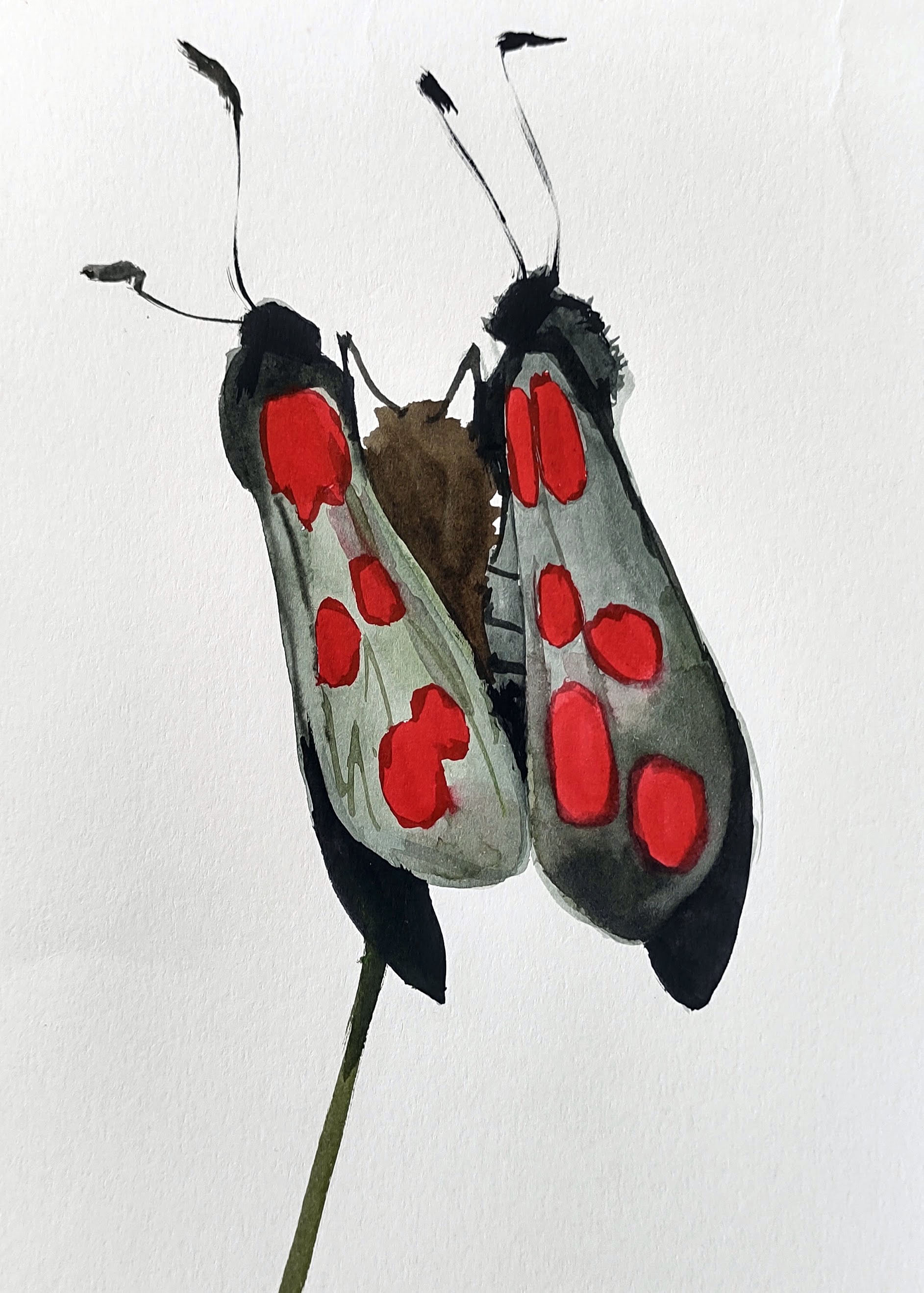
In the forest again, I walked along my old running route, reminiscing about times gone past. By the old running club, I stopped and painted a pair of six-spot burnet moths – obliging models that thankfully sat still, gazing into each other’s eyes, for a long while.

I left the clubhouse, walked past the shooting club, and ambled along the new mountain bike paths snaking through the forest, pausing by one of the forest shelters for lunch. People jogging, cycling and dog walking – the whole area was a mecca for recreation. The weather was fantastic but artistically I felt somewhat insipid and uninspired. I forced myself instead to enjoy the walk.

I tried to capture the light shining through the plantation. I vowed to myself to stop painting trees for a while.

Fir plantation

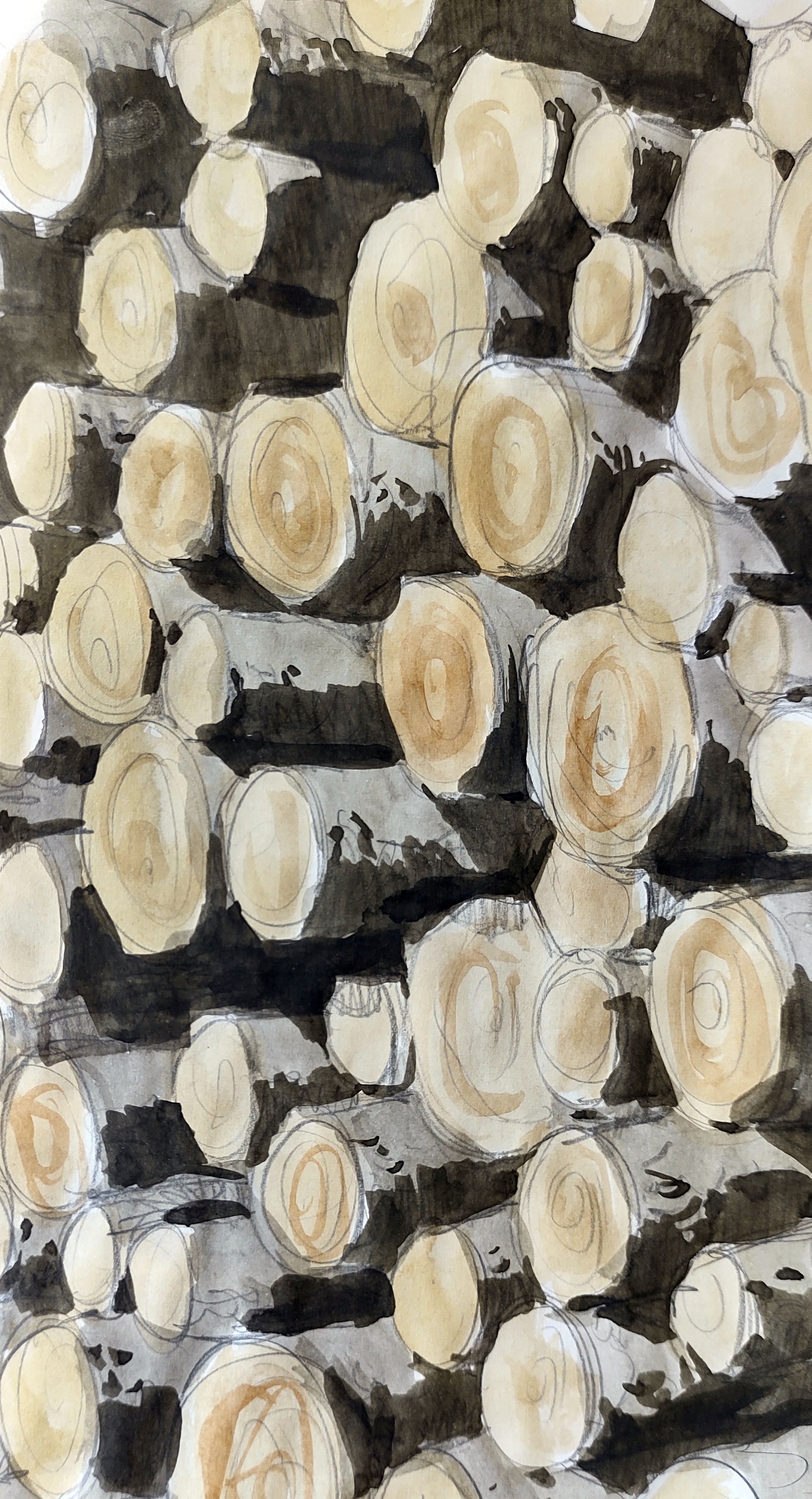
Despite all the recreational activities, the forest is large enough with many paths and I saw very few people. I stopped for a snooze in a sunlit glade by the side of a small lake, drifting off to the sound of the wind in the trees and the distant mewing of a buzzard. Later I stopped by one of the many piles of timber, drinking in the intoxicating scent of pine and warm sunlight.

Pile of logs

The NATO radar station loomed rather ominously from behind the trees.

NATO radar

I trudged on, annoyed with myself for not producing more, but glad to be in the forest. Eventually I reached the island’s highest point, Rytterknægten, where the observation tower was unfortunately closed for restoration.

Kongemindet

Somehow time was running out and I rushed a little to get to the end point in time.

Near Christianshøj

My last painting was near Christianshøj, where some of Bornholm’s oldest trees can be found. At last I felt as if my painting was flowing, but the sun was setting and the day was over.

Christianshøj

LAND 28

WEATHER REPORT – overcast then mostly sunny. Temperature 17 – 19 degrees. Wind 4 – 6 m/s, from the W. Hours of precipitation: 0 hours. Hours of sunshine: 10 hours.

STOPS with the BIVVY – 0

KILOMETRES WALKED – 16.50 km

DAY LASTED – 17h and 00 m

PEOPLE TALKED TO – 4

BIRDS SEEN and HEARD – 42 species: 0 new = 123 species

LESSONS LEARNED – I didn’t print a map as I knew the paths so well, but I ended up walking over a previous path (LAND 27) which really annoyed me. Next time, bring a map!

IN MY HEAD – The Fanø trip, family visitors and plans, the bathroom and bedroom renovations, preparations for next week’s højskole teaching, citizenship paperwork, tax self-assessment, KYST books reprint and send out, party trip to UK, why I didn’t feel like painting – also thinking of times past in the forest.

LAND 21 – Lundestenen to Vasagård, 26.05.23

Denne side på dansk her

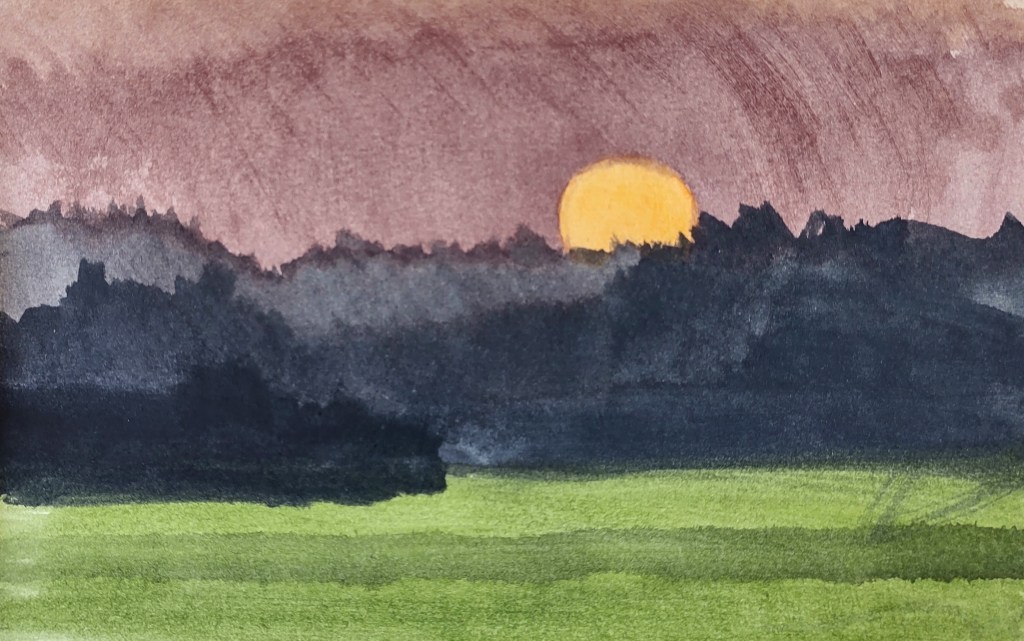
LAND 21 The day began cold and rather breezy. I watched the sun rise behind the trees – a luminous crimson disc, slowly turning orange and then yellow as it began its ascent into the clear blue sky.

Sunrise from Hovedgårdsvejen

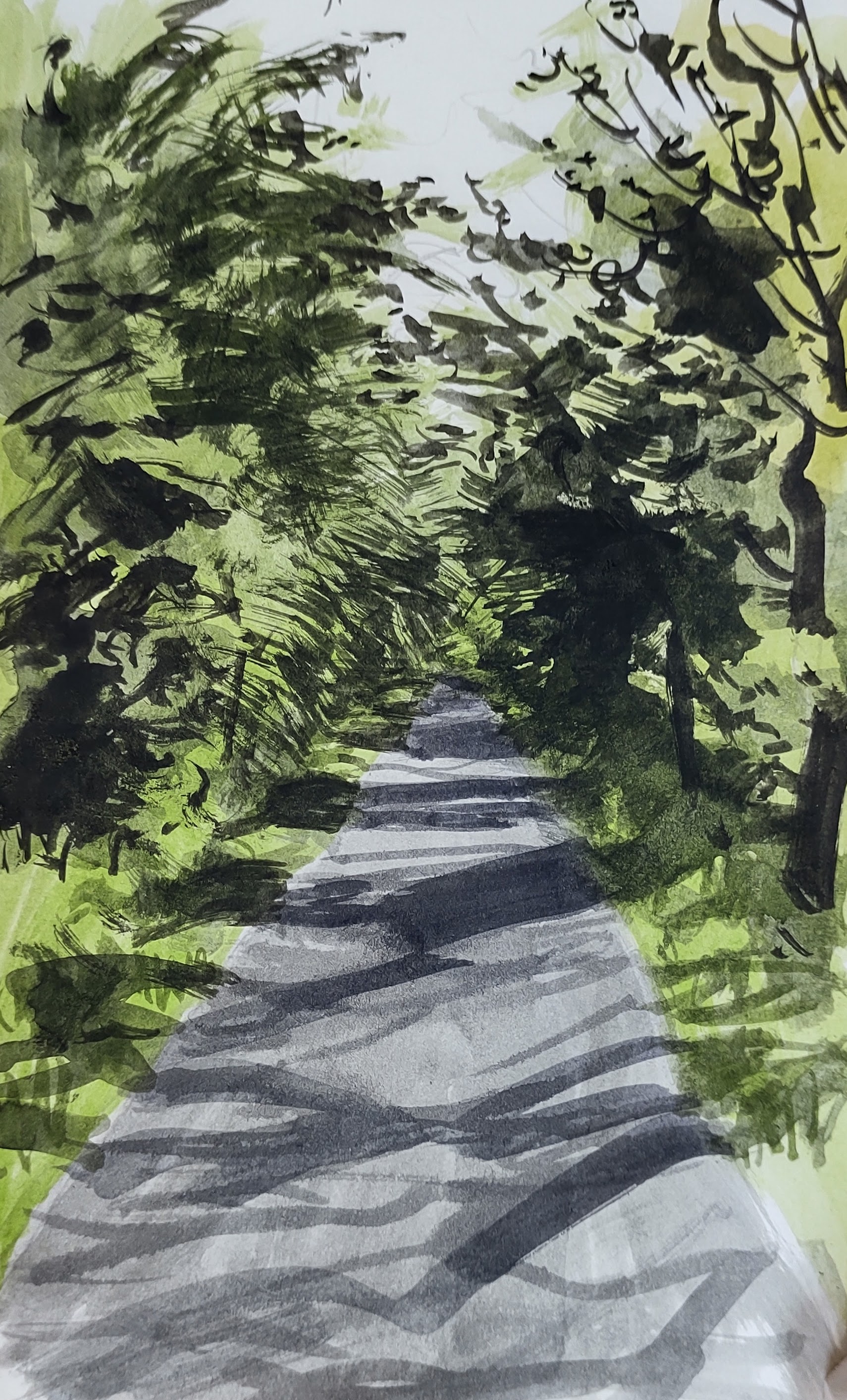
I headed north on familiar roads.

Nylars Church from Hovedgaardsvejen

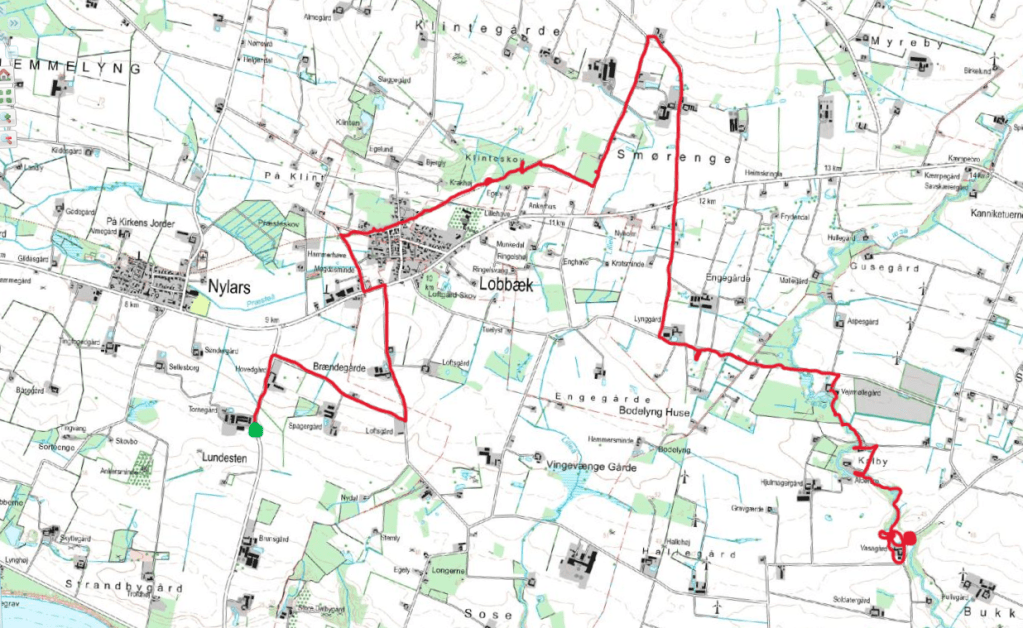
Soon I found myself walking along the bike path towards Lobbæk village. The path was built on the old railway track that connected Rønne with Aakirkeby. Lobbæk was built around a railway station in the early 20th century – at one point boasting several shops, a baker, a dairy and so on – and is still home to several hundred people. I stopped for breakfast by the old station and enjoyed the cacophony of birdsong. A red-backed shrike was an unexpected visitor. Swifts, my first of the year, screamed overhead.

I continued along the bike path for a while, and then headed north into the intensively cultivated fieldscape between Nylars and Vestermarie. The area had once been a mixture of pasture, marsh and heath, and had slowly been drained and cultivated over the centuries. Large dairy and pig farms were strung along the landscape.

Udsigt fra Smørenegevejen

My route took me south again, across the main road and into an area with smaller farms and homesteads, poorer soils, and more variety of vegetation. I headed east until I crossed Læse å, a small stream (though Bornholm’s second biggest) that on account of its unique geology and nature, is protected by law. For several kilometers a public path follows the stream along its heavily wooded valley, with fantastic information panels describing the succession of geological strata the stream flows over.

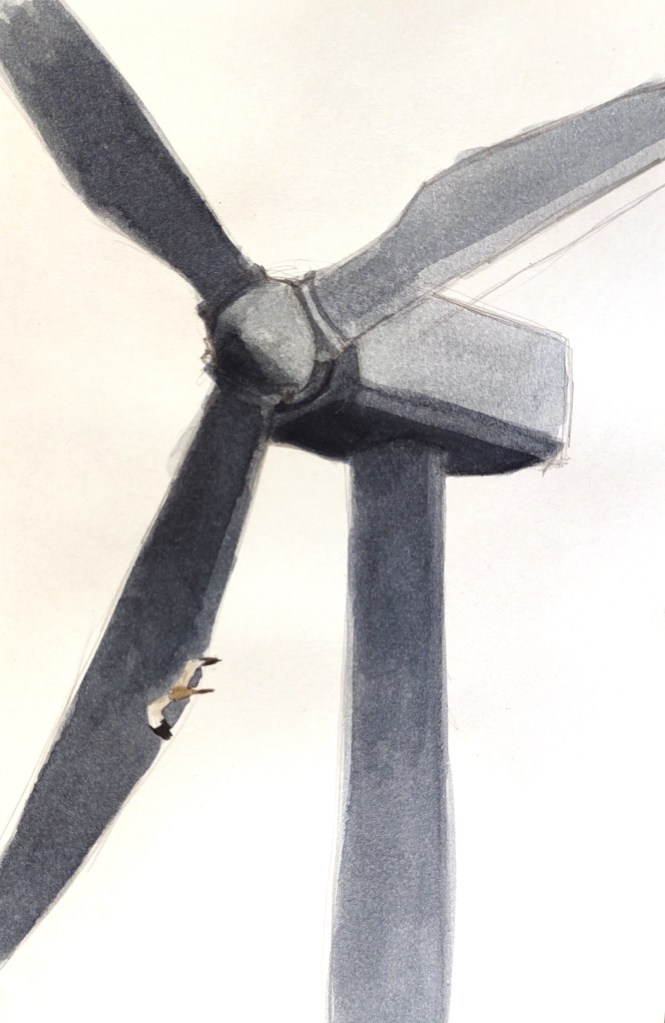
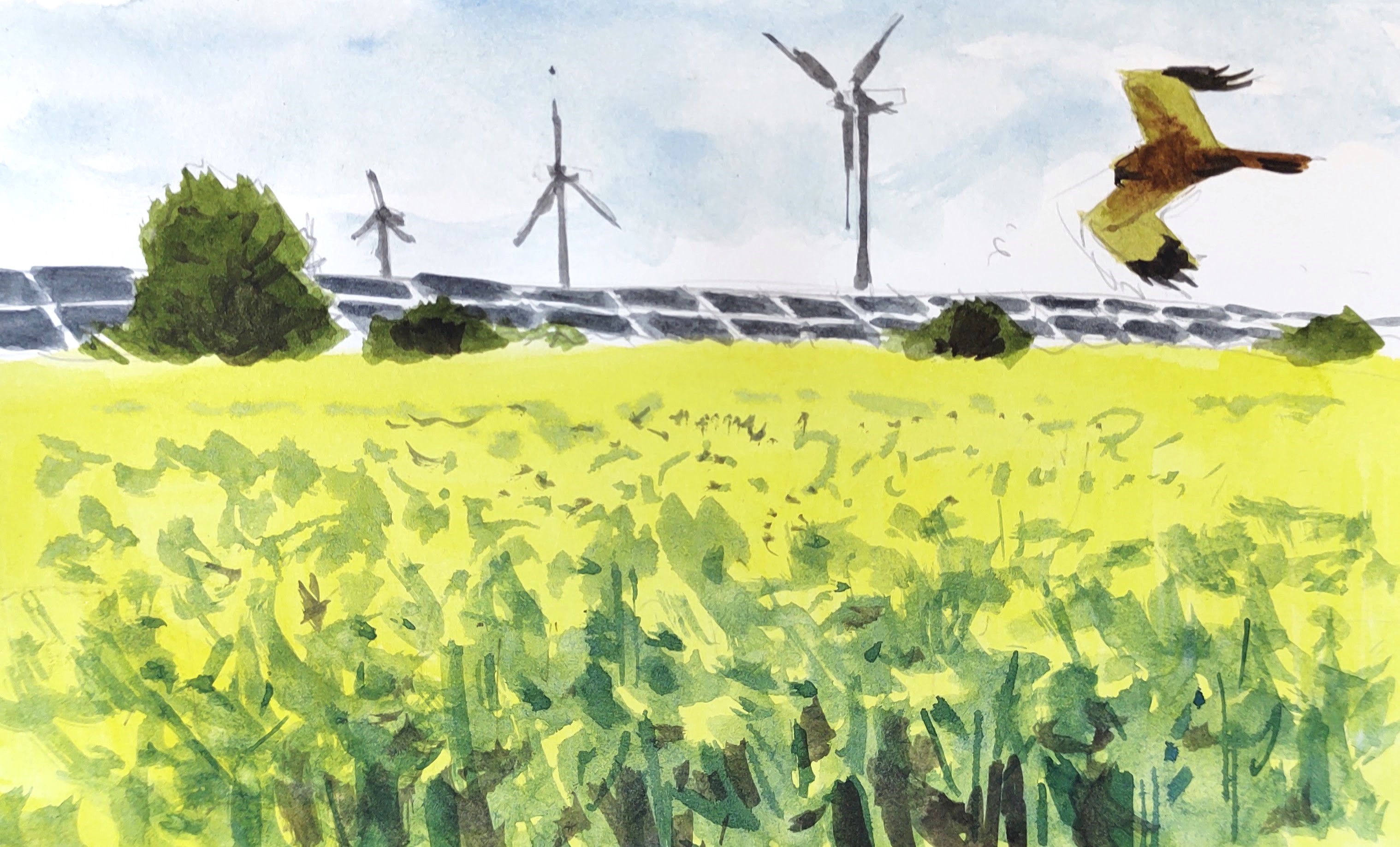
Huge windmills and a giant solar cell park welcomed visitors to the beginning of the path. I watched through my binoculars as a marsh harrier flew close to the huge rotating arms of the windmill.

Marsh harrier and windmill

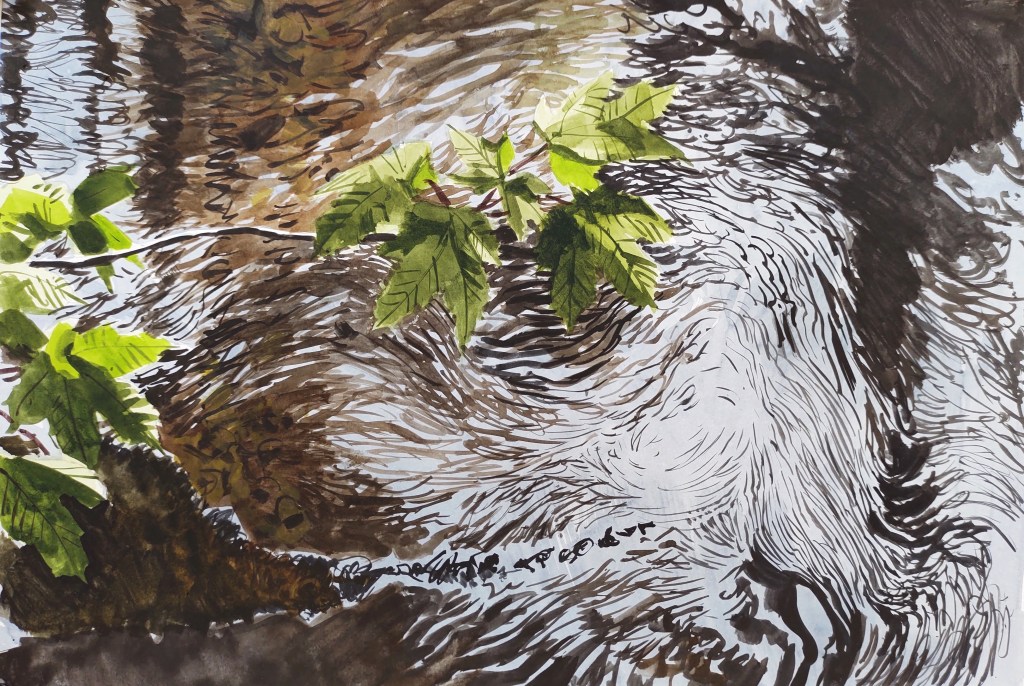
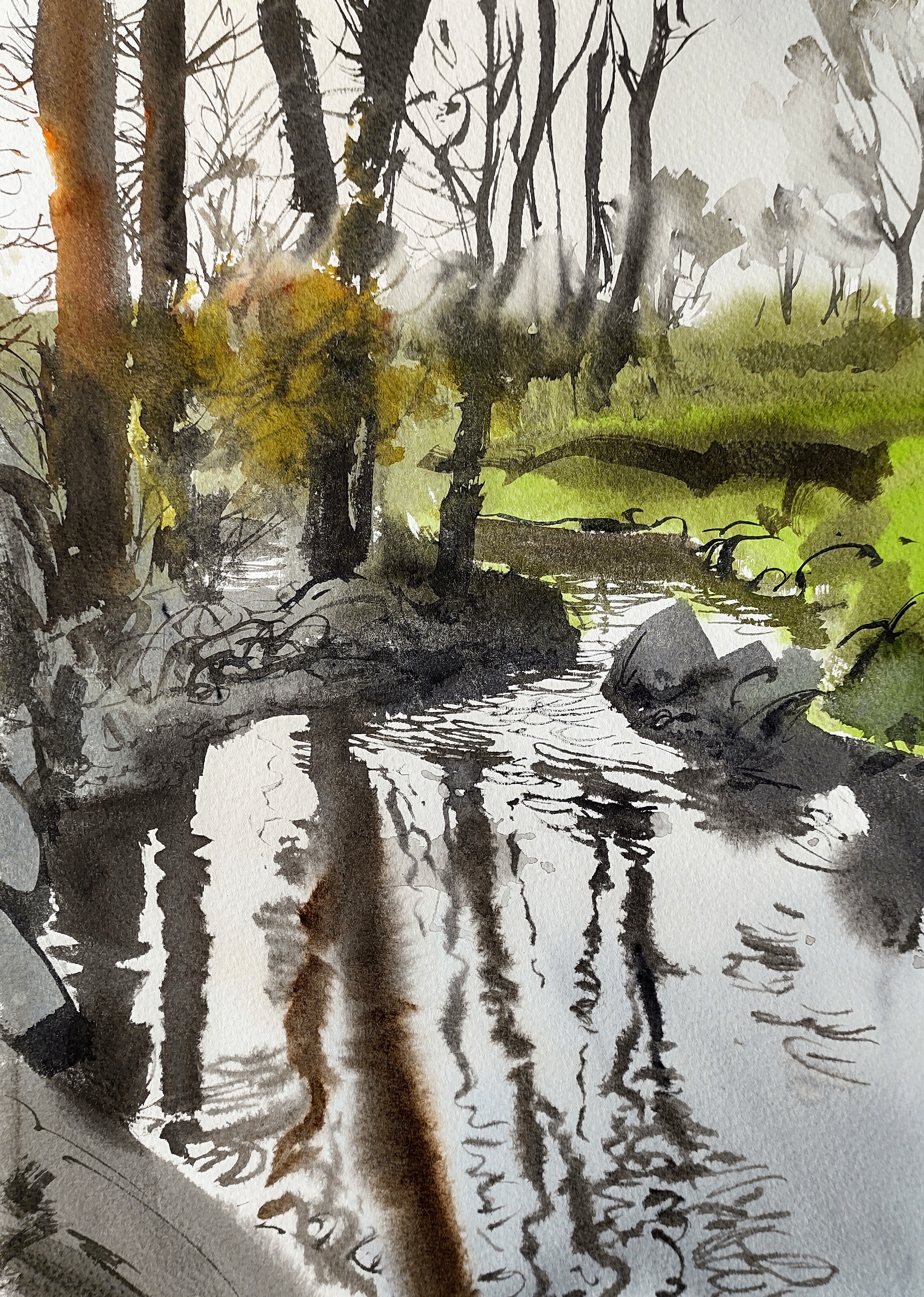
Down by the stream I was sheltered from the breeze, but easy prey for mosquitos. I was entranced by my eye’s ability to see reflections on the surface and stones on the stream bed, but not both simultaneously.

Reflections, Læseå

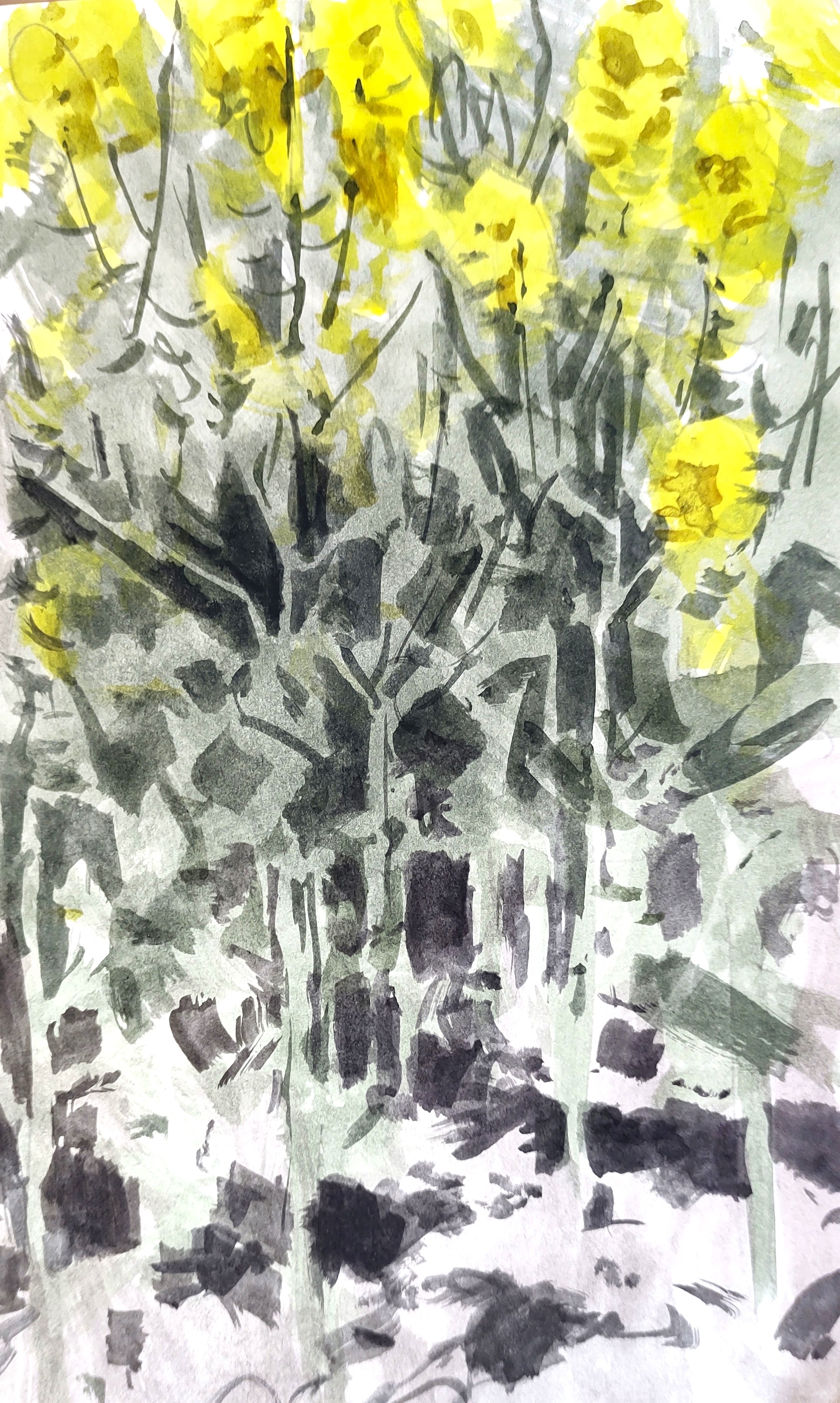
I took a break by the side of an oilseed rape field, now fading a little. A low-flying marsh harrier was lit yellow by reflected light from the flowers.

Down in the wooded valley again, I felt overwhelmed by the insane visual complexity of the vegetation and water, by the myriad patches of sunlight and shadow, the colours, patterns, and shapes – all flickering with the wind. I tried desperately to simplify what I saw but to no avail.

Where the stream bends and meanders through a flower-rich meadow heavy with the scent of wild garlic, I spent a while trying to capture the layers of shale. Curious horses watched my every move. As evening fell, they became skittish and galloped about.

Graptolite shale, with layer of bentonite (volcanic ash)

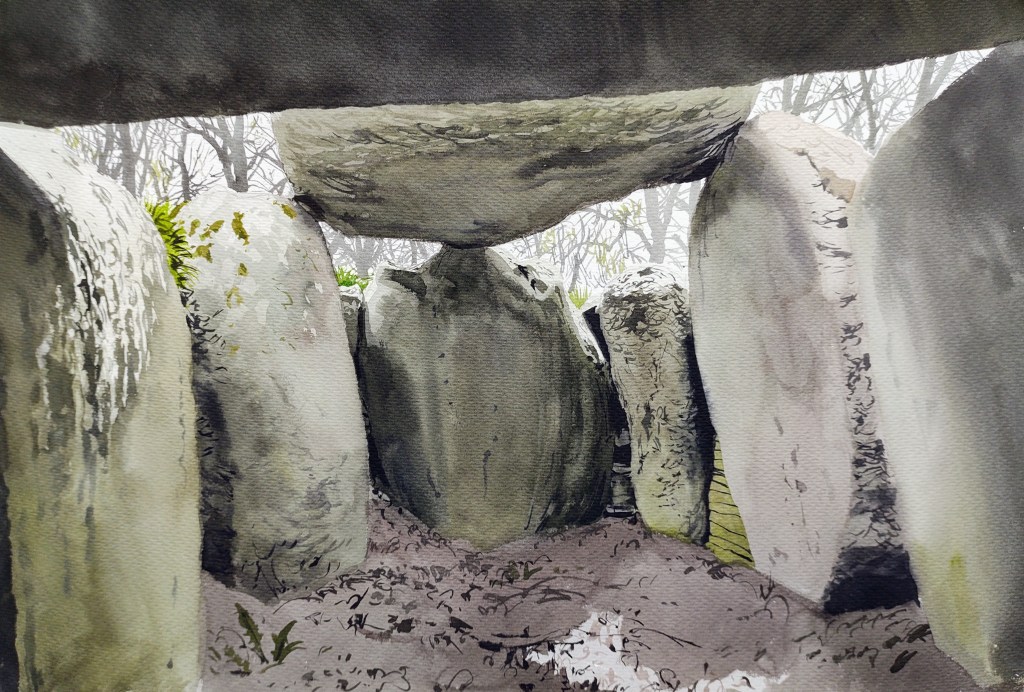
I followed the path out of the valley into the open fields of Vasagård – one of Bornholm’s, and indeed Denmark’s, most important archaeological sites. A cromlech was built in the early Neolithic period over 5,500 years ago, then a passage grave, and then both were combined into one barrow. Here funerals and other ritual activities have taken place over thousands of years. I crawled inside and along the passage into the pitch-black inner chamber and tried to imagine all that history. Outside again, the sun set behind the mound, with the entrance looking like an eye into another universe.

Langehøj ved Vasagård

LAND 21

WEATHER REPORT – Sunny most of the day. Temperature 10 – 15 degrees. Wind 6 m/s from the northwest. Hours of precipitation: 0 hours. Hours of sunshine: 12 hours.

STOPS with the BIVVY – 0

KILOMETRES WALKED – 15.01 km

DAY LASTED – 16h and 42 m

PEOPLE TALKED TO – 2

BIRDS SEEN and HEARD – 50 species: 5 new (icterine warbler, red-backed shrike, house martin, swift, cuckoo) running total = 111 species

LESSONS LEARNED – more water needed – I ended up boiling water from the stream.

IN MY HEAD – so much. I knew the area well, so I thought often of previous trips and encounters, my kids and so on. I thought a lot about time and impermanence, how things come and go (paths, ponds, railways, fields, barrow graves…)

LAND 18 – Kastelsbakke to Grødby, 05.05.23

Denne side på dansk her

LAND 18 Kastelsbakke – ten past five in the morning. I hunkered down in the shelter of some trees and got to work, swaddled in layers and layers of thick clothing to protect me from the bitterly cold east wind.

The view from Siegårdsvejen

I headed back up into the forest, partly to find shelter, but also because my planned route in Raghammer had been postponed due to military exercises. Some of the younger beech trees were already in leaf with wild cherry and plum trees in blossom, but it was difficult to stop and paint because of the gusting wind. A striking male pied flycatcher brightened my mood somewhat.

View from Højlyngsvejen

Despite the sun, my mood was soon darkened again by the constantly gusting wind. The painting board strapped to my rucksack caught the wind like a sail and I tacked and stumbled along the exposed country roads, heading south again towards the southern flatlands.

Looking south from Lille Myregårdsvejen

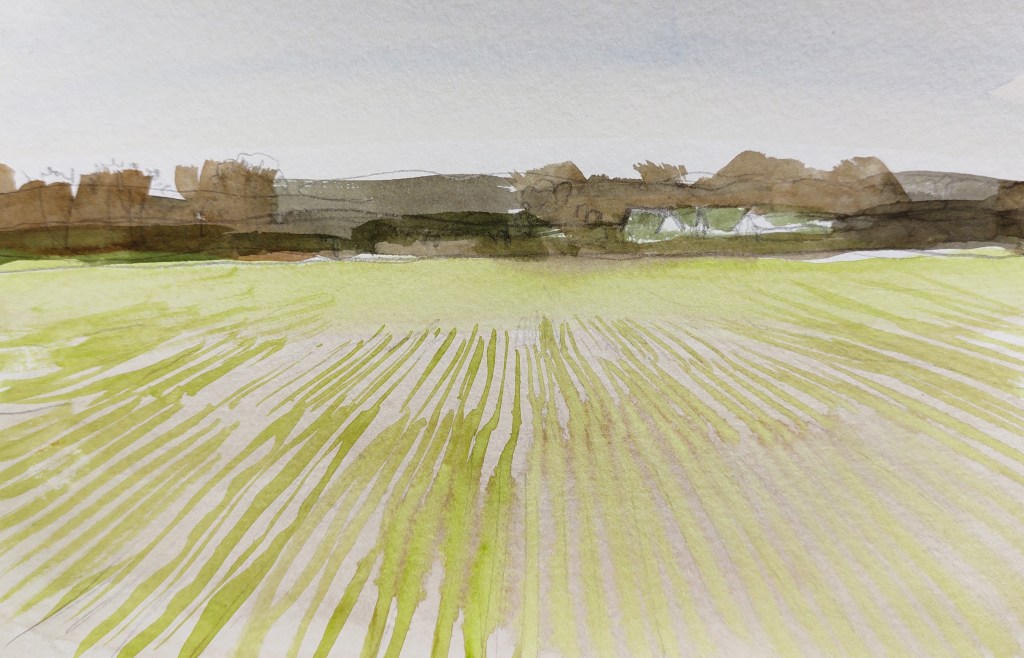
I passed quickly through the bungalows and well-kept gardens of Aakirkeby village, feeling like a stranger from another time and space. Back into the fieldscape, the first green shoots were emerging in smart green rows.

A field, Kratgårdsvejen

The wind, if anything, was increasing in severity. I arrived at Jættedal, a passage grave built in the late stone age over five thousand years ago, and first excavated in 1883. On my hands and knees I crawled inside and here in the womb-like inner chamber, I was somewhat protected from the wind.

View from inside Jættedal

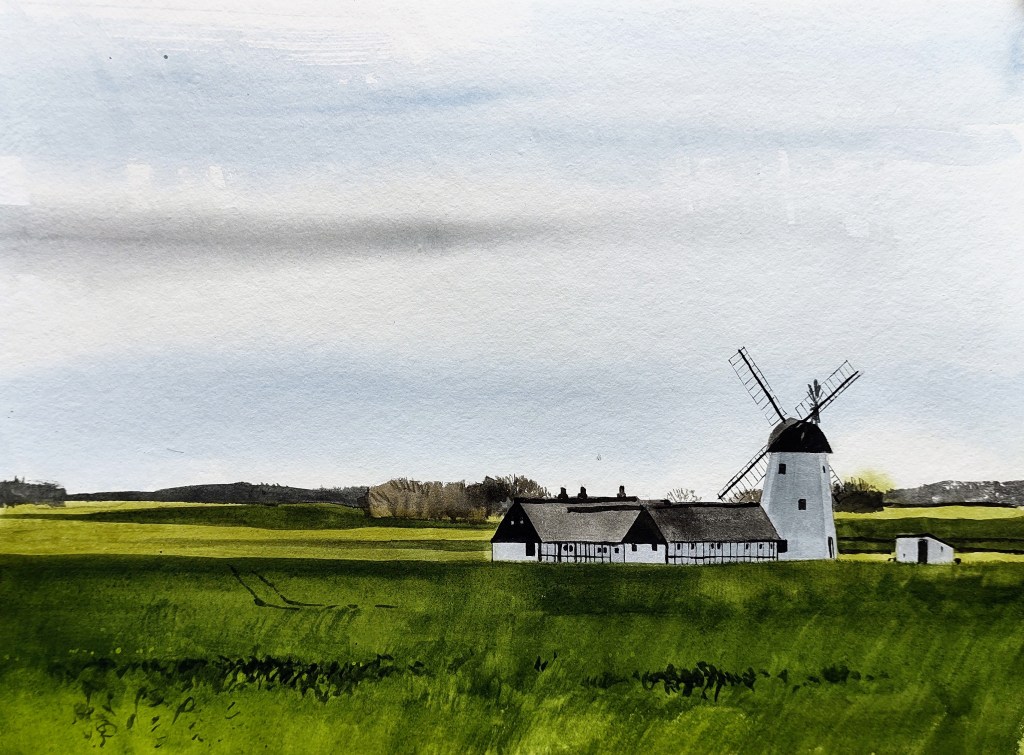
Eventually, like a reluctant newborn baby, I crawled back out and faced the wind. Later, I found shelter in a small wood and even managed to catch forty winks, lying on top of an electricity box. The newly restored Saxebro Windmill looked fantastic in the late afternoon light.

Saxebro Windmill

I was flagging but still had many hours to go. After a long search I manged to locate Grødby menhir, hidden close to the banks of Grødby stream in some thorny scrub. According to the faded information panel, the site should have been accessible to the public, but there were no signs or paths, and the panel was almost hidden behind brambles and hawthorn.
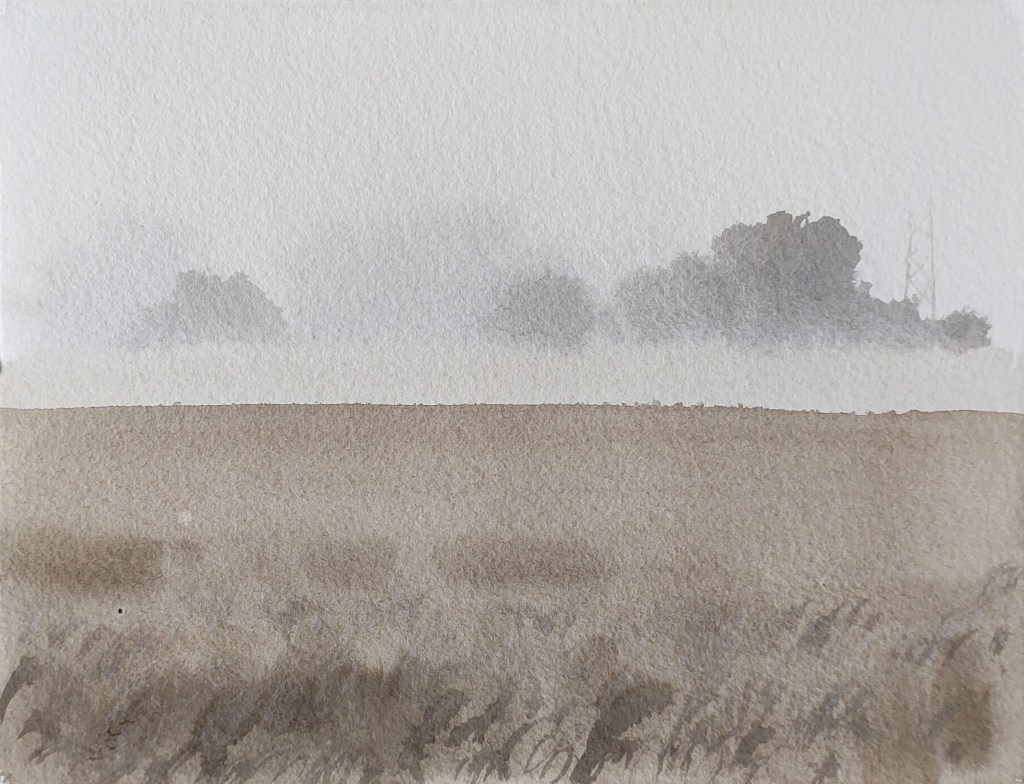
Grødby Menhir

To finish off, I sat by the bridge and looked towards the setting sun and the meandering stream – completely windblown and exhausted, but glad to have made it through the day.

Grødby å, from the bridge

LAND 18

WEATHER REPORT – Sunny morning, hazy then cloudy in the afternoon. Temperature 5 – 7 degrees. Wind 10 – 14 m/s from the east. Hours of precipitation: 0 hours. Hours of sunshine: 10 hours.
STOPS with the BIVVY – 0

KILOMETRES WALKED – 19.57 km

DAY LASTED – 15h and 29 m

PEOPLE TALKED TO – 0

BIRDS SEEN and HEARD – 42 species: 2 new (pied flycatcher, lesser whitethroat, running total = 90 species)

LESSONS LEARNED – I hate wind even more that I hate rain (maybe?).

IN MY HEAD – I had just spent four days with a group of artists, working on September’s Klippekroppe project. Ideas, conversations and images were rattling around in my brain.

LAND 13 – Stenseby to Peders Church, 01.04.23

Denne blog på dansk her

LAND 13 Overcast, with a bitterly cold wind. Tired and underslept, and definitely not ‘feeling it’, I trudged off into the Bornholmian landscape.

From Fredenlundsvej, looking East

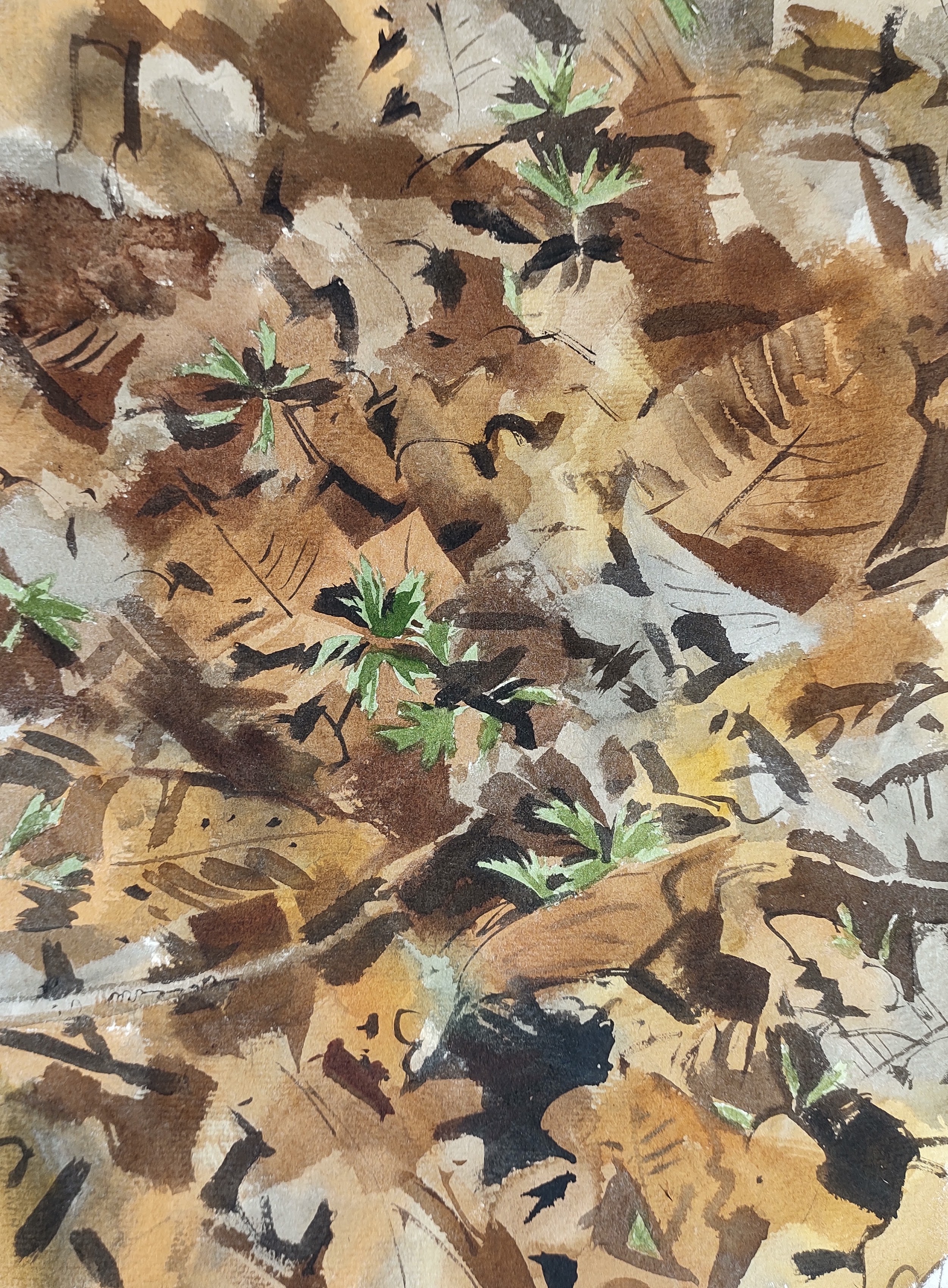
Just being outside, however, soon worked its magic and my mood lightened. I walked into a small beechwood for a breakfast stop and was cheered by the sight of the small shoots of anemone leaves breaking through the leaf litter.

Anemone shoots

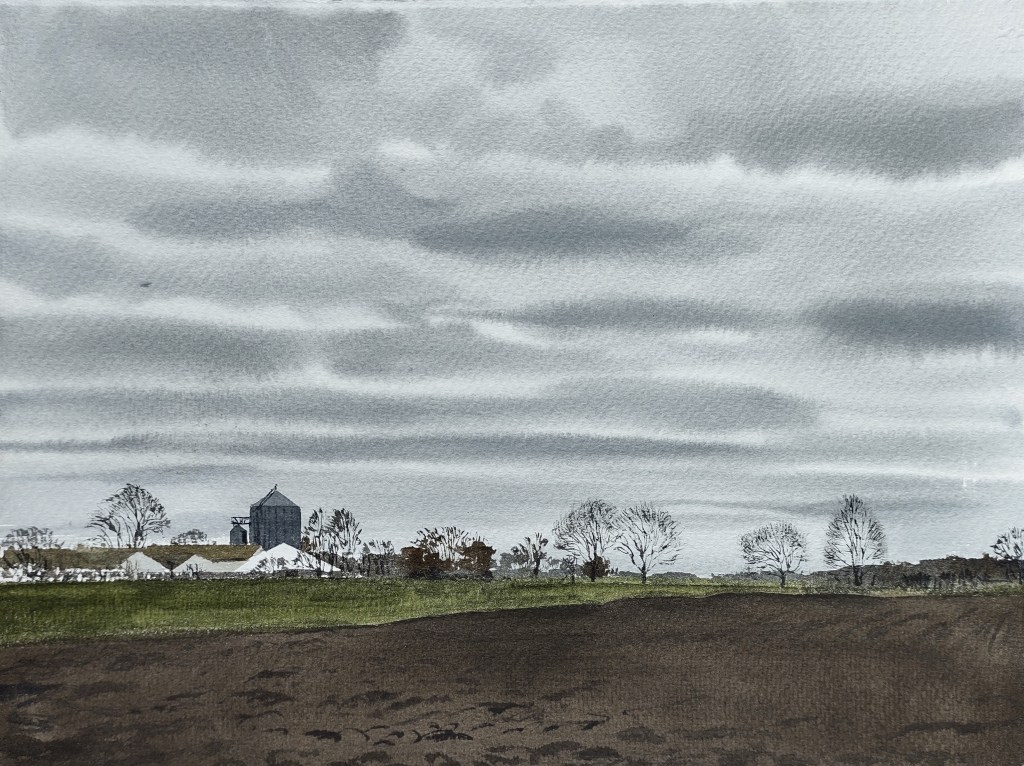
I walked onwards on a narrow winding road through a part of Bornholm I had never visited before. Again, I took shelter in the lee of a wood and again I painted the leaden sky, the heavy soil, the bare trees, the farms and silos.

Nørregaard, seen from Brandskov

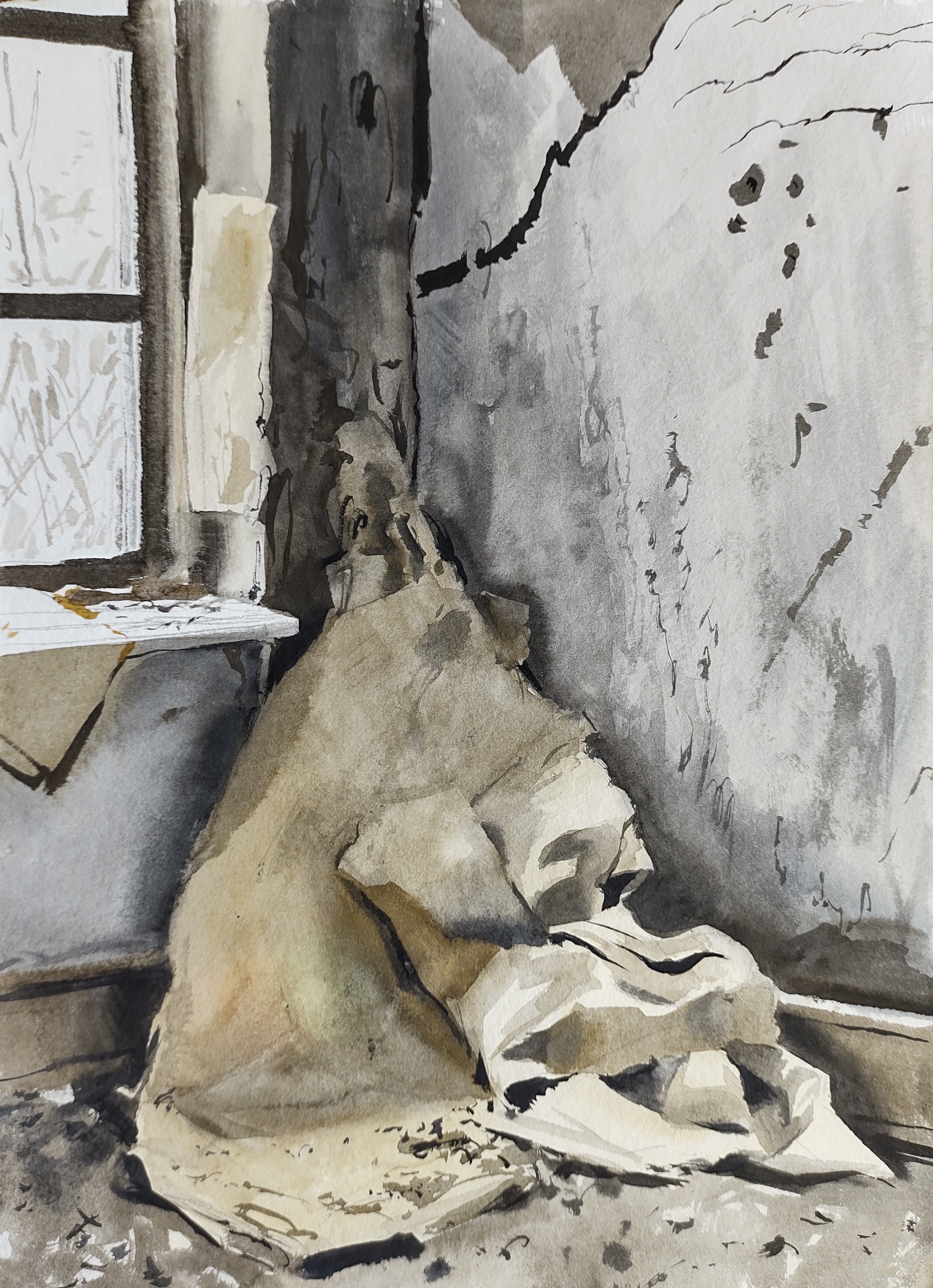
I stumbled on, buffeted by the gusting wind on my back, and saw what looked to be a small abandoned farm along an unkempt track. Inside the dilapidated and crumbling farmhouse, a blackbird nest lay on a shelf in the old kitchen. Glad to be out of the wind I set up camp and spent a while trying to capture the rather flamboyant heap of folded wallpaper in the corner of the old living room.

Stuen, Åvang

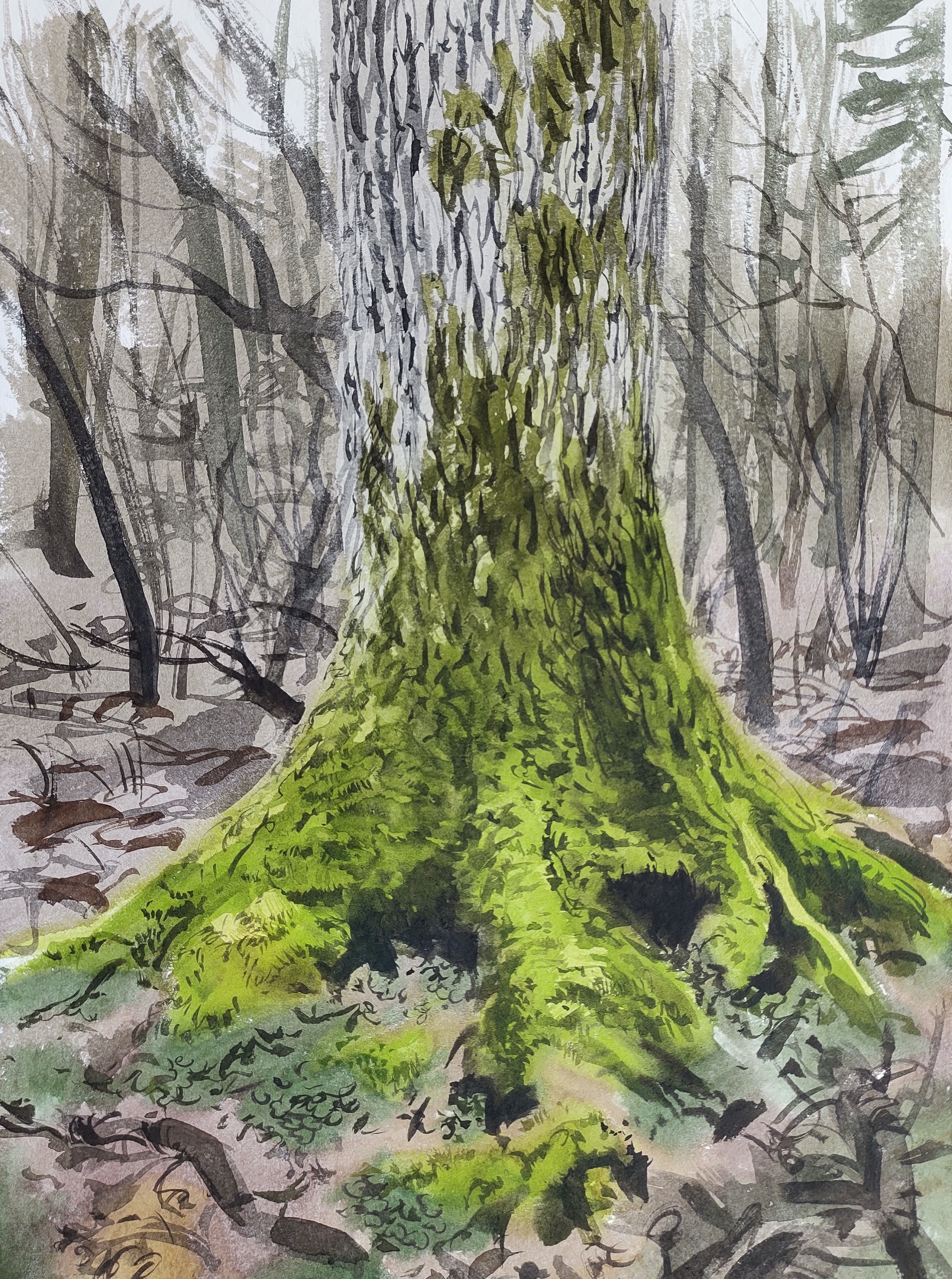
I continued and passed through the small village of Pedersker, where some of the houses sit quite grandly along the main street. Not so long ago there would have been several local shops, a dairy, train station and a largely self-sufficient rural economy.

Glowing moss from Pedersker Skov

Heading south again I paused by the archaeological site of Stenebjerg, a charmingly unspectacular dolmen dating from over five thousand years ago.

Stenebjerg

By the mid-afternoon, the sun finally broke through. Sheltered from the wind with the sun on my face I actually felt rather…warm.

Lille Loftsgaard, seen from Østre Sømarksvej
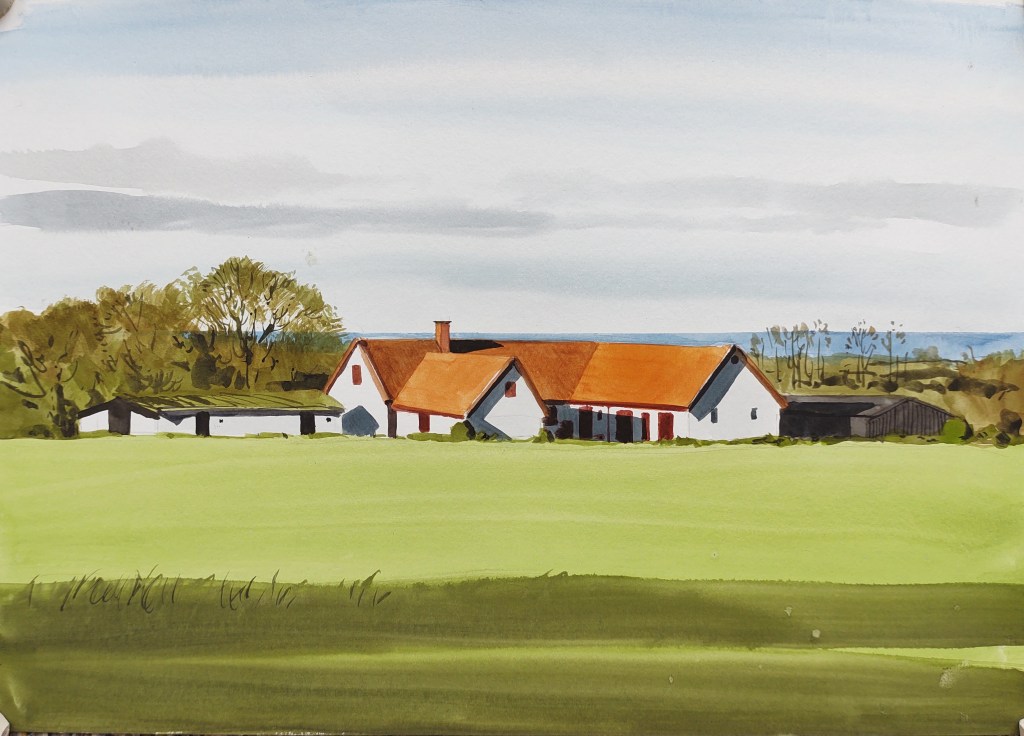
The last leg of the journey took me down closer to the sea again. An area by Strandmarksvejen had been left fallow or rewilded, and it was brimming with wildlife. Cranes fed alongside roe deer and hares, to a chorus of energetic skylark song. My first marsh harrier of the year, recently arrived from warmer climes, flapped overhead.
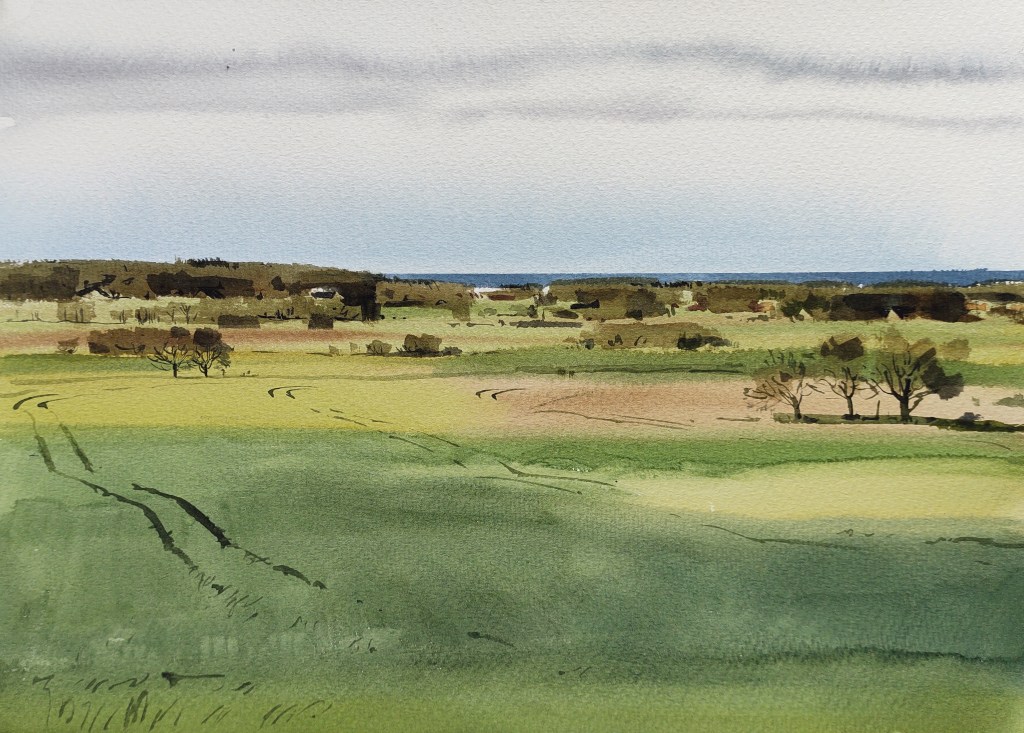
View east from edge of Baunevej

Eventually I made it to Peders Kirke and another wonderful Bornholmian church, sitting exposed in the flat landscape. Frozen by the frigid wind I struggled to capture the last rays of the setting sun. It had been a good day.

Peders Church, sunset.

LAND 13

WEATHER REPORT – Overcast in the morning, sunny in the afternoon. Windy. Temperature 3 degrees. Wind 10 m/s from the northeast. Hours of precipitation: 0 hours. Hours of sunshine: 3.5 hours.

STOPS with the BIVVY – 1

KILOMETRES WALKED – 14.99 km

DAY LASTED – 11h and 50m

PEOPLE TALKED TO – 0

BIRDS SEEN and HEARD – 41 species: 2 new (brambling and marsh harrier , running total = 71 species)

LESSONS LEARNED – I found a new way to put up my tarp

IN MY HEAD – thankfully I managed to leave biogas behind and enjoy the day. I looked forward to an evening of wingers with my family.

LAND 09 – Rokkestenen to Bodils Church, 03.03.23

Denne blog på dansk her

LAND 09 Windstill and frosty at dawn, the tips of the tallest pine trees burned orange with the rising sun. Marley and I walked from the car park through the forest and up to Rokkesten, the day’s start point – Marley being my dog and enthusiastic fellow traveller for the day.

Rokkesten and Shoemakers Lake

We continued on the rocky and twisting path, down through muddy dells and over granite outcrops worn smooth thousands of years ago by the retreating glaciers. We eventually arrived at a more open area with an expansive view over the southern part of the island, where the blue frost on the grass was burned off by the sun.

View from Skotteklint

Down further still, to Kaasegaard, an attractively undulating landscape kept mostly open by grazing cows, sheep and…alpaca. In the past, ‘Klippeløkke’ such as this – hilly or rocky areas with thin soil used for pasture – were a significant element in Bornholm’s landscape, but very few remain today. Having never been ploughed or fertilised, they support a rich and diverse plant and animal life.

We carried on, past Slingesten and Linkisten and onwards to Gamleborg. Here I sat with a view over the valley and soaked in the warm sun while a pair of buzzards circled lazily overhead. In the far distance, I could hear cranes calling, mingling with the soporific droning of a chainsaw. Closer still, sporadic and hesitant sounds – the mesmeric song of the yellowhammer, drumming of the woodpecker, and bark of the pheasant – confirmed the sense that the forest was cautiously awakening from a deep sleep.

We marched on – past the Altersten and through a huge fir plantation, recently harvested. Heading south again, with the sun long gone and the wind increasing, we took shelter by the side of the Øle Stream.

Øle å

Both rather tired now, we walked up and over ‘Slamrebjerg’, a small hill with fine views over the flat agricultural landscape towards Nexø. Winter had returned, the sunny and warm morning a distant memory. Walking down the hill again, we crossed the invisible ‘Tornquist zone’ that divides the older granite and gneiss of Northern Bornholm, from the much younger sedimentary rocks of the south – a significant boundary.

View east to Nexø

We arrived cold, windswept and exhausted at Bodils Church, our destination. From there, once I had finished painting and the sun had officially set, it was another hour’s walk through the dusk back to the car.

Bodils church

LAND 09

WEATHER REPORT – Sunny in the morning, overcast in the afternoon. Temperature 1 – 4 degrees. Wind 3 – 8 m/s from the west. Hours of precipitation: 0 hours. Hours of sunshine: 5 hours.

STOPS with the BIVVY – 0

KILOMETRES WALKED – 13.03 km

DAY LASTED – 10h and 49m

PEOPLE TALKED TO – 1

BIRDS SEEN and HEARD – 27 species: one new (lapwing, running total = 53 species)

LESSONS LEARNED – I am a cat person.

IN MY HEAD – the song ‘Southern Cross’ by Nine Black Alps.