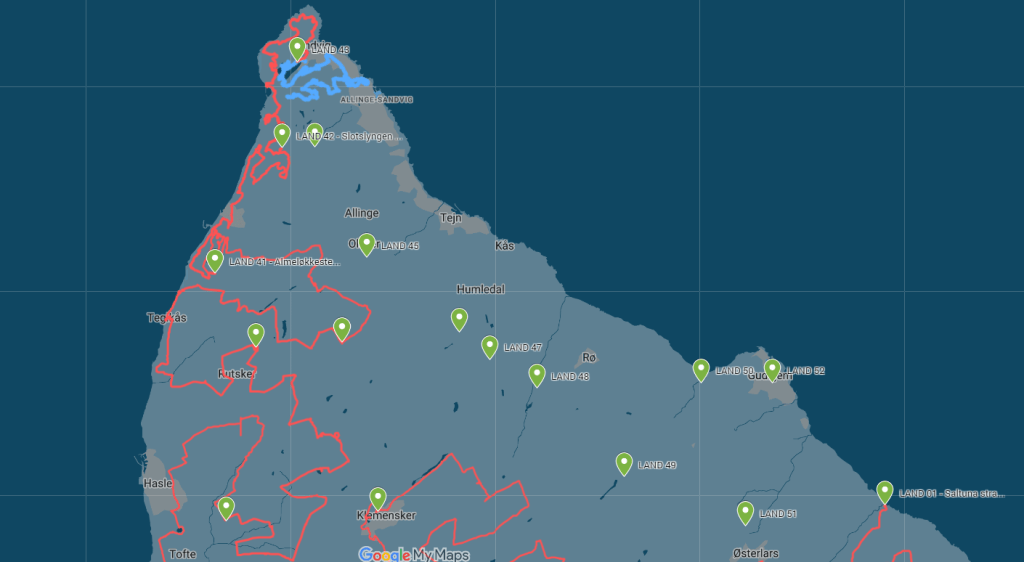
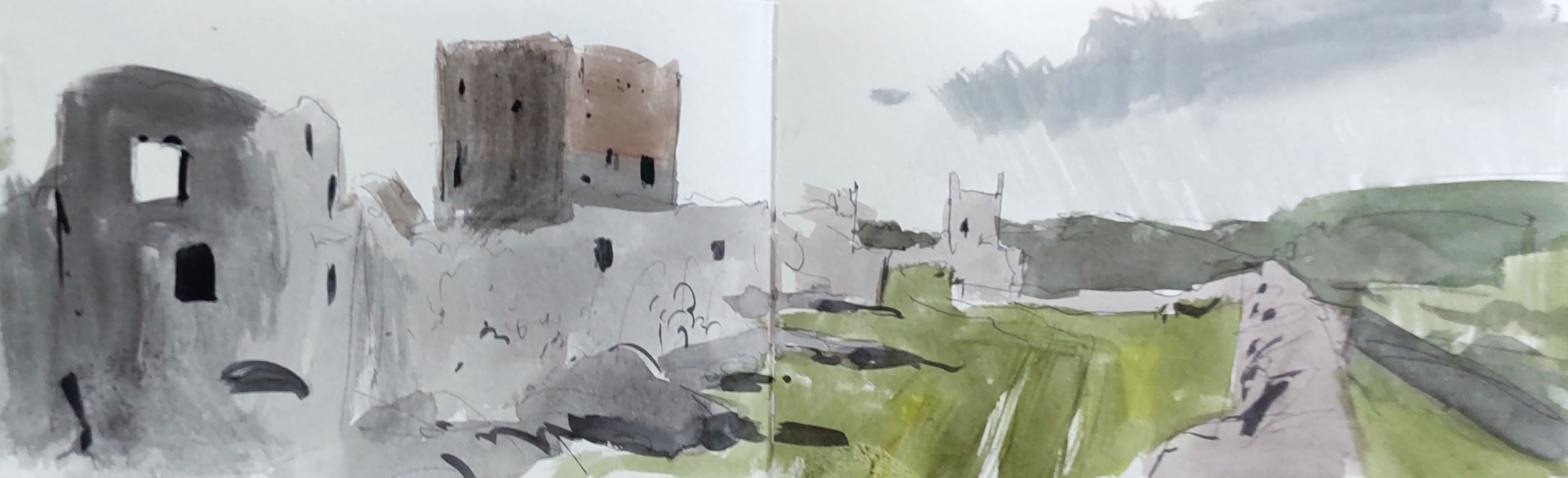
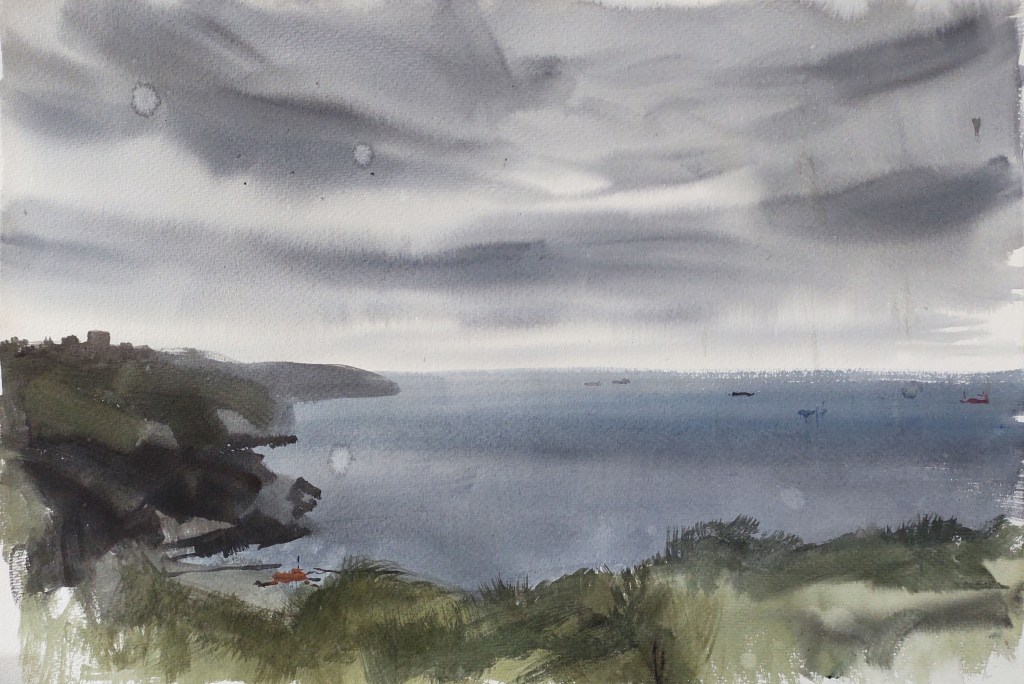
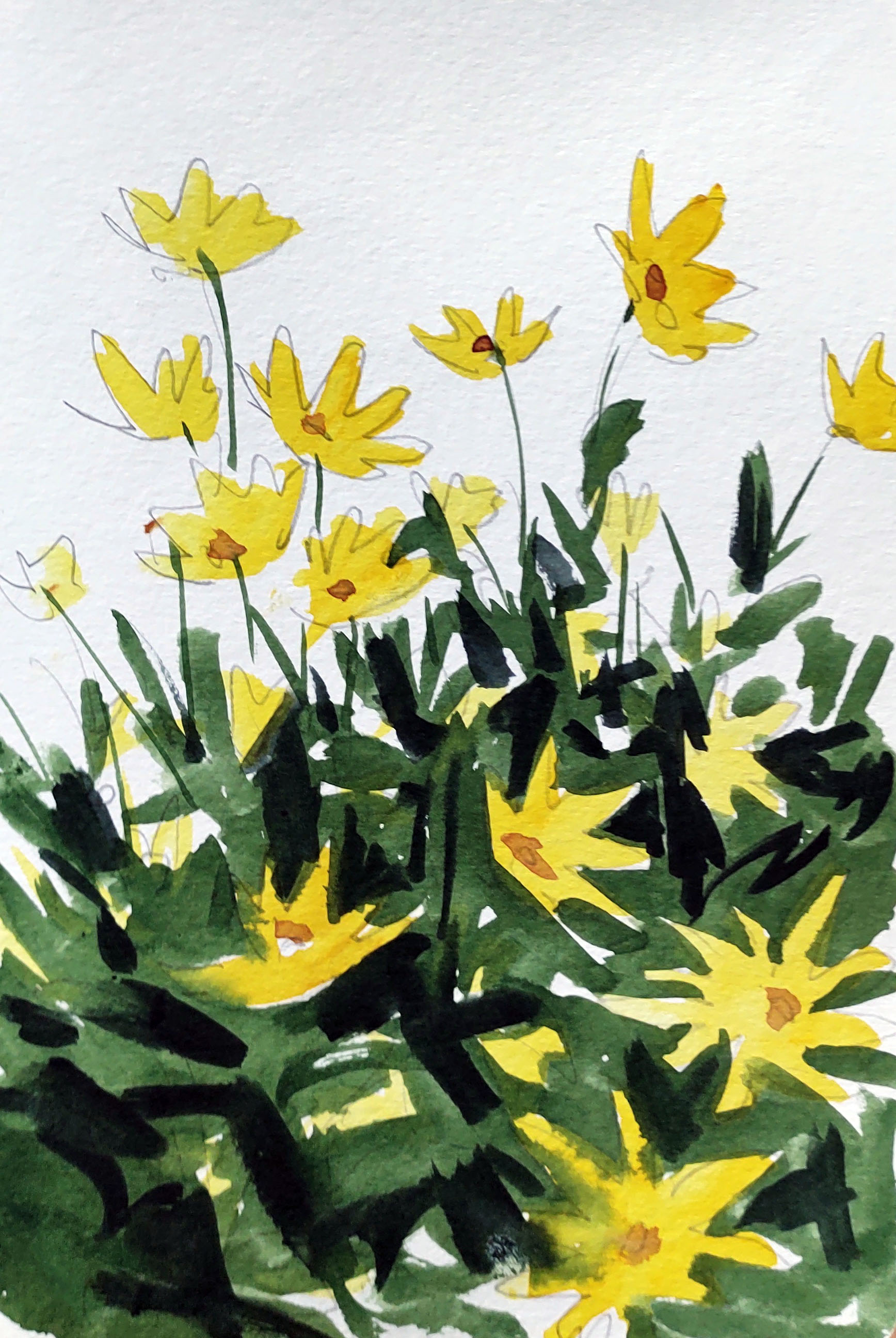
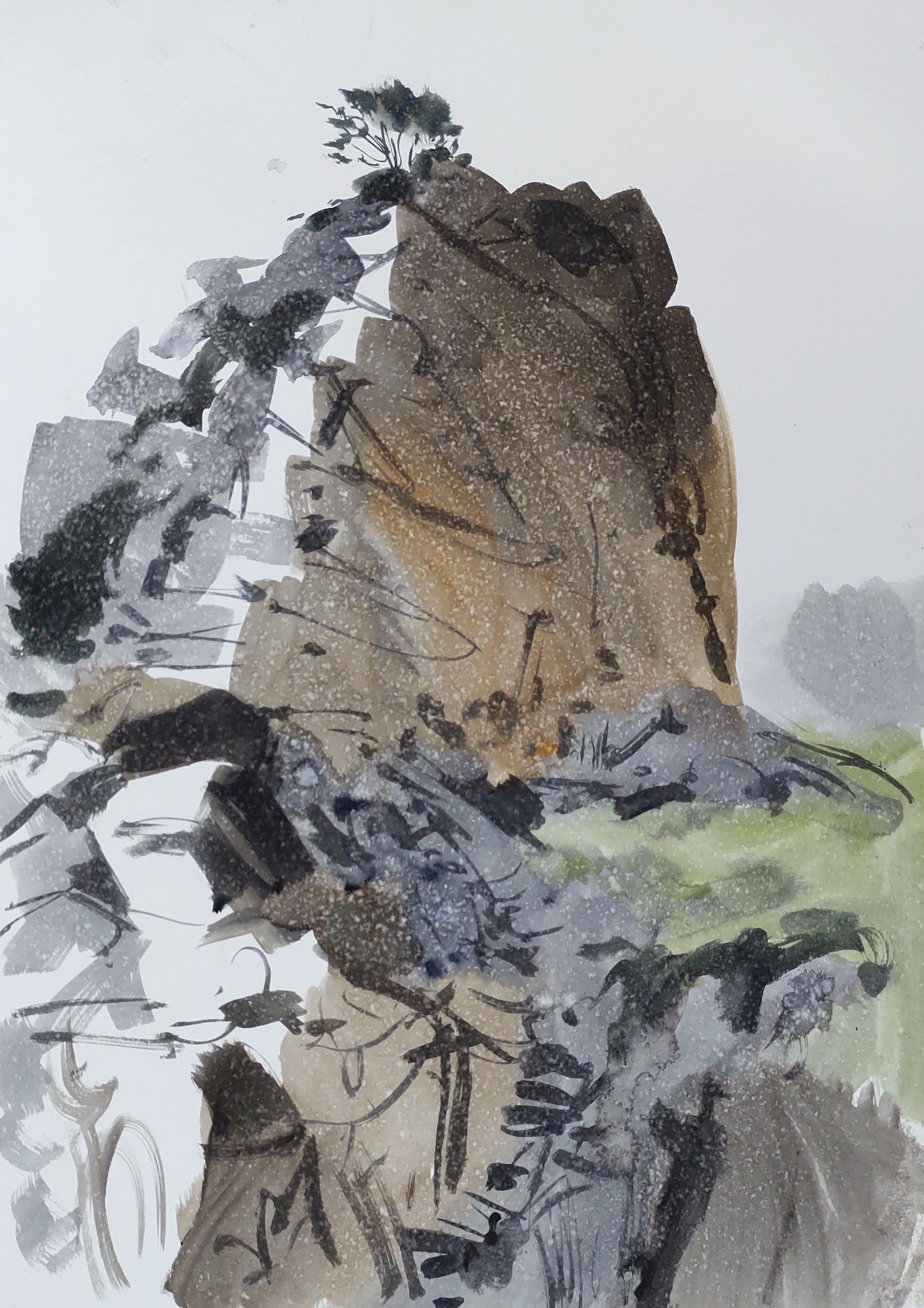
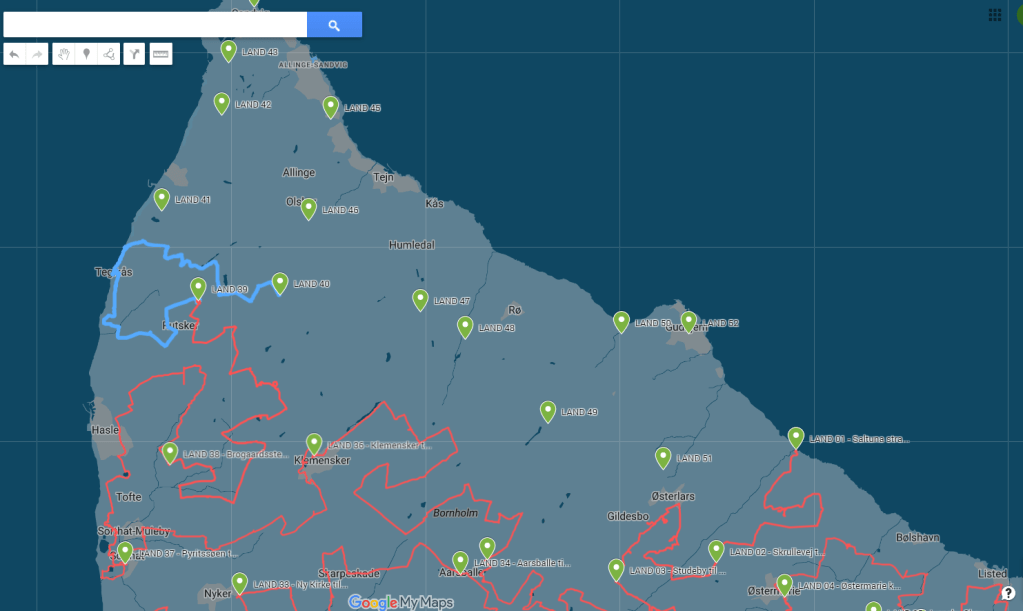
LAND 44 – Hammersholm to Østre Borregaard, 03.11.23

Denne side på dansk

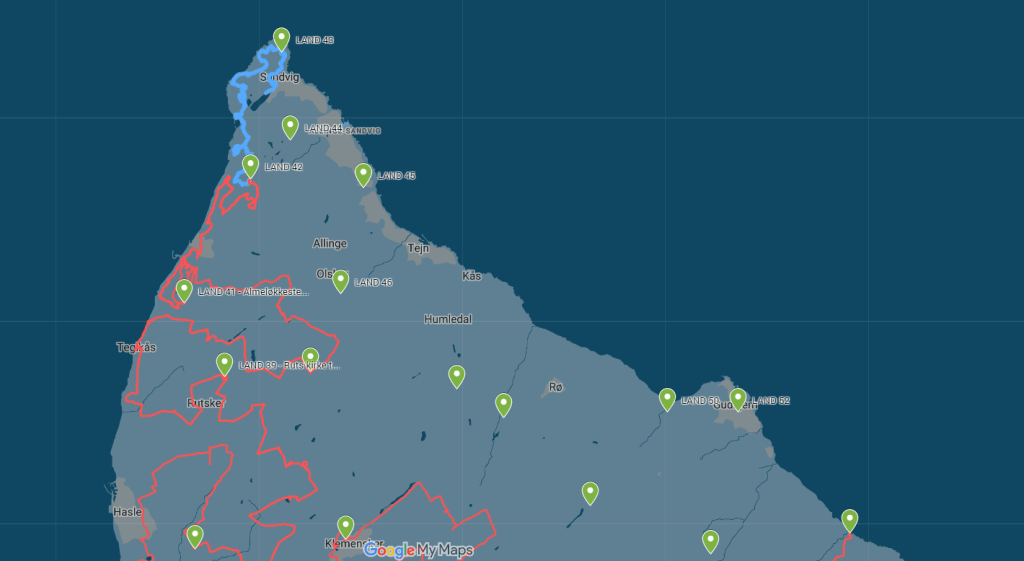
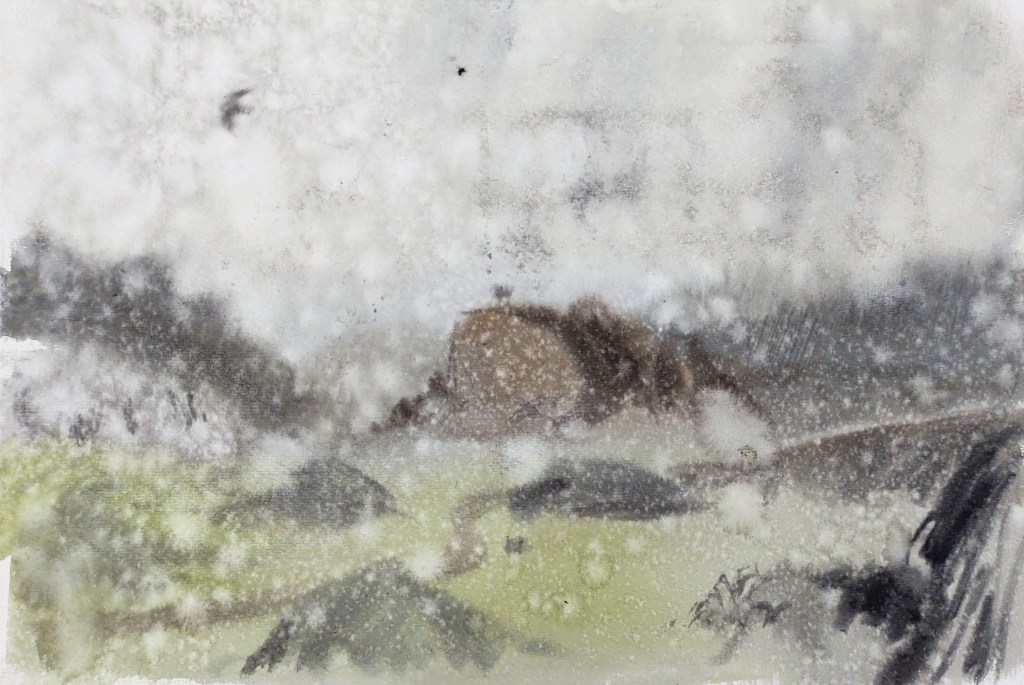
LAND 44 Yet another impenetrable blanket of grey cloud greeted me at dawn, but the forecast rain had thankfully failed to materialise. I walked from Hammersholm and soon arrived at Moseløkken granite quarry, just as a thick fog descended.

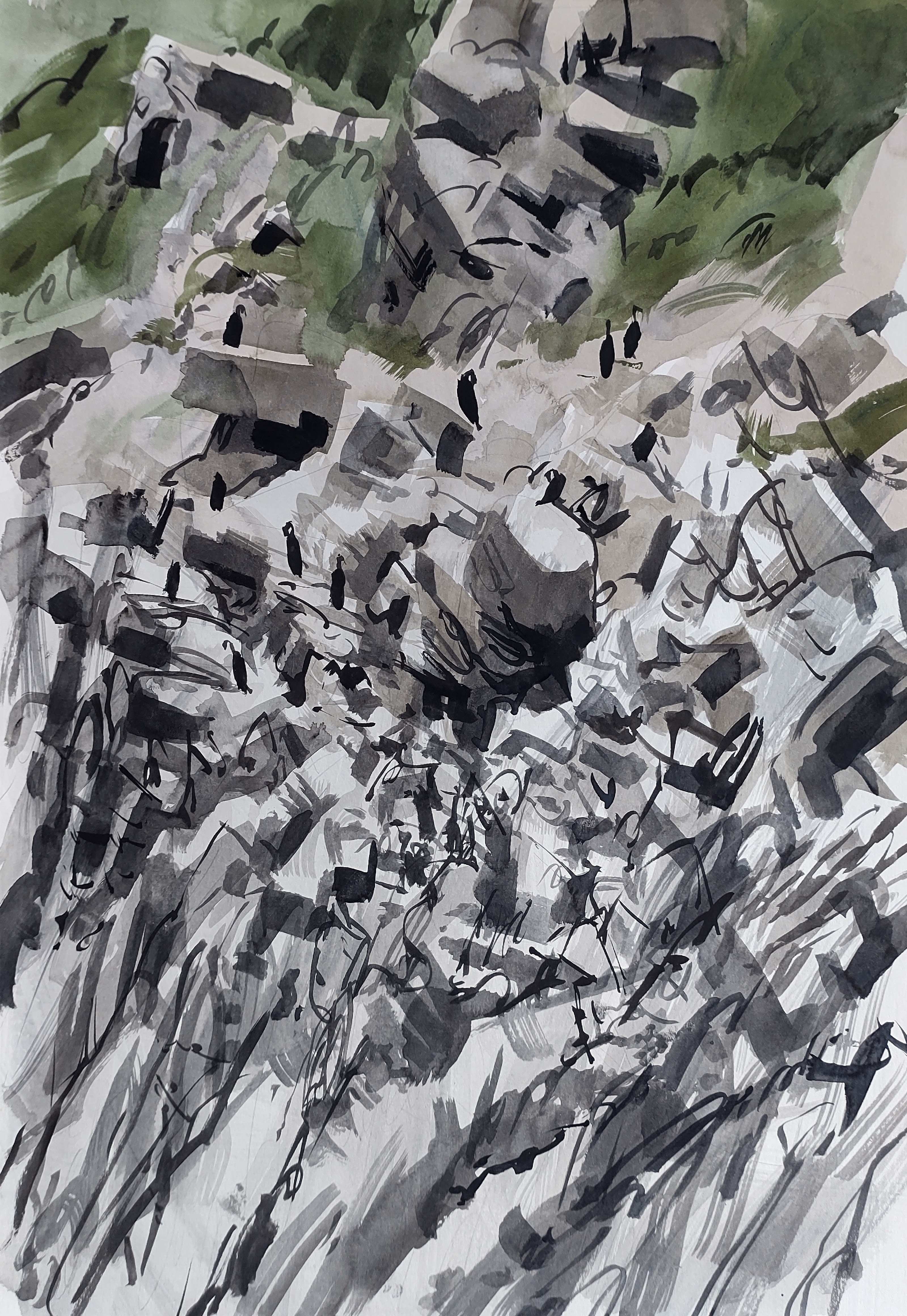
Moseløkken I

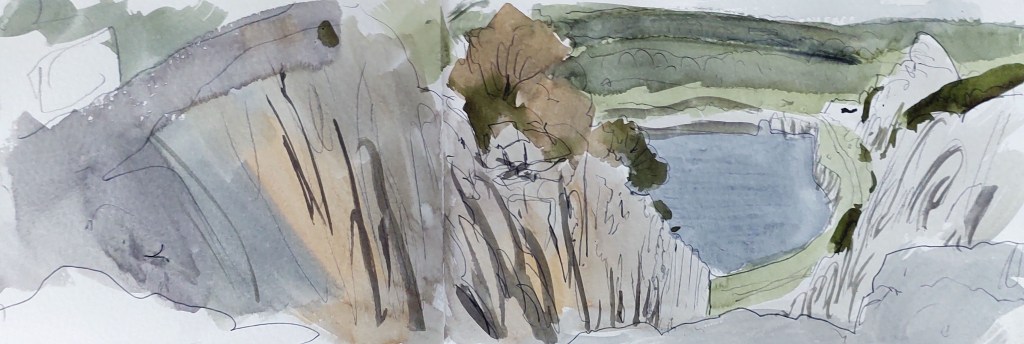
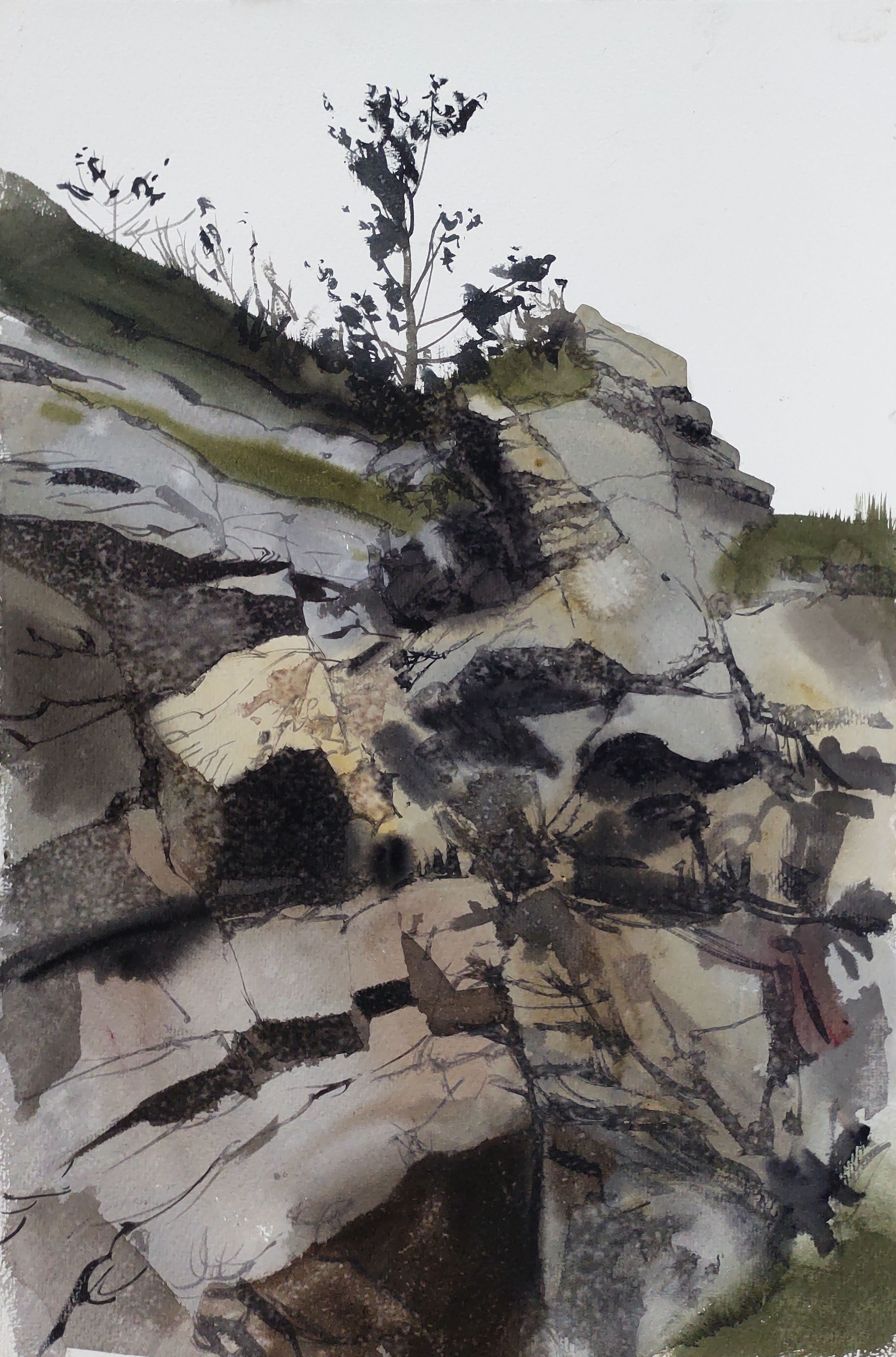
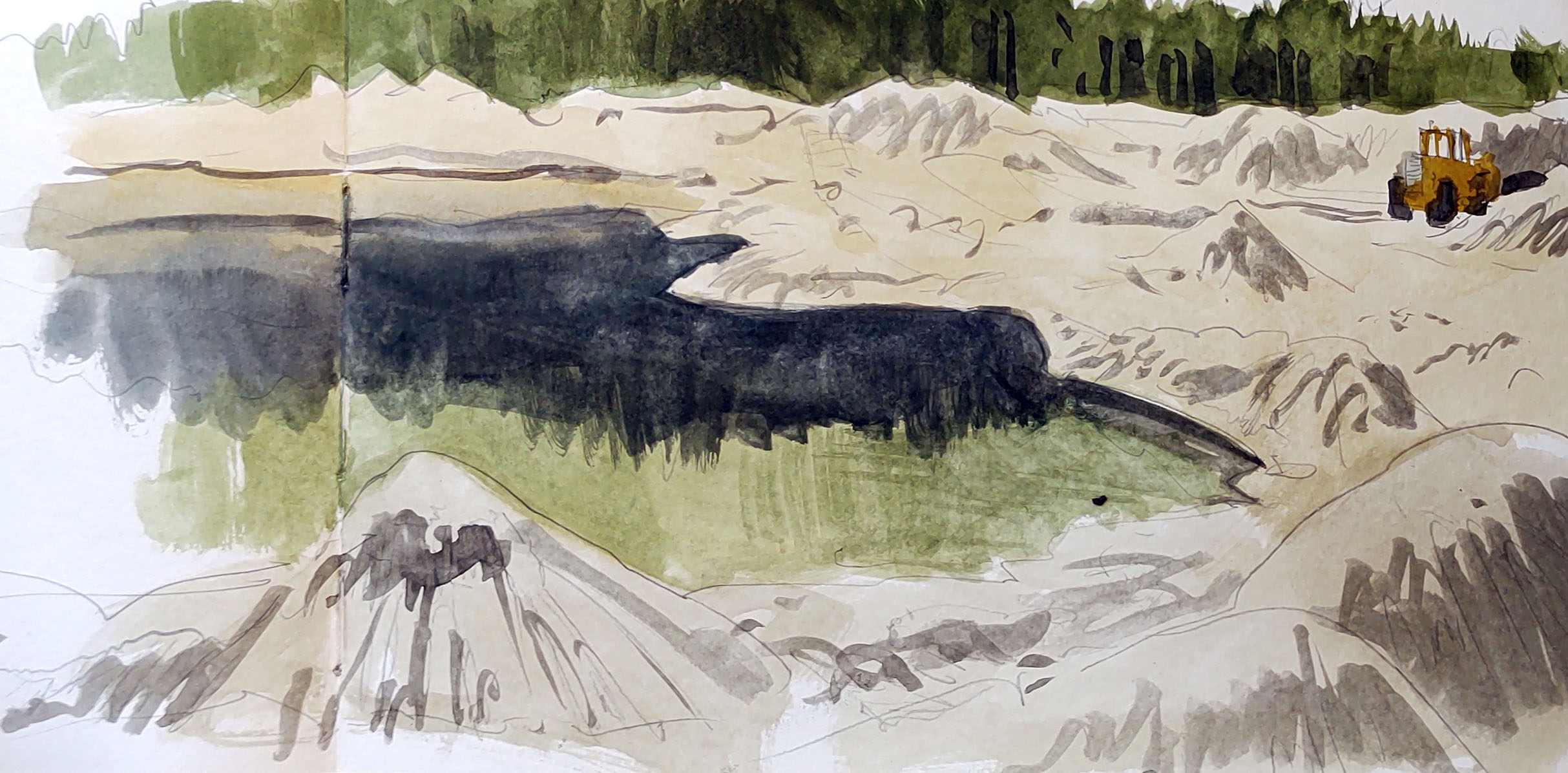
The fog slowly cleared, revealing the deep scar of concentric vertical terraces of dark granite with a deep green pool at the very bottom.
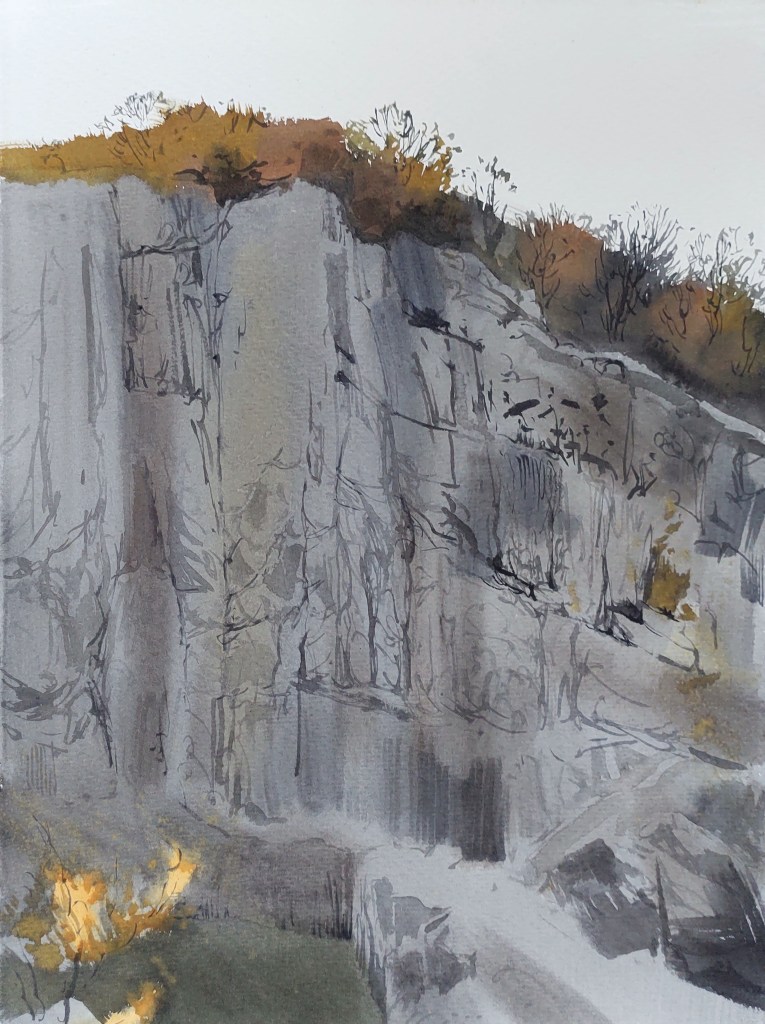
Moseløkken II

Moseløkken is still in operation, the last active granite quarry in North Bornholm – though in a vastly reduced state with little activity. The site is however still used, with a fantastic volunteer-run museum and regular rock-climbing activities. In the museum’s yard there were lots of fascinating granite objects and quarrying tools to explore.
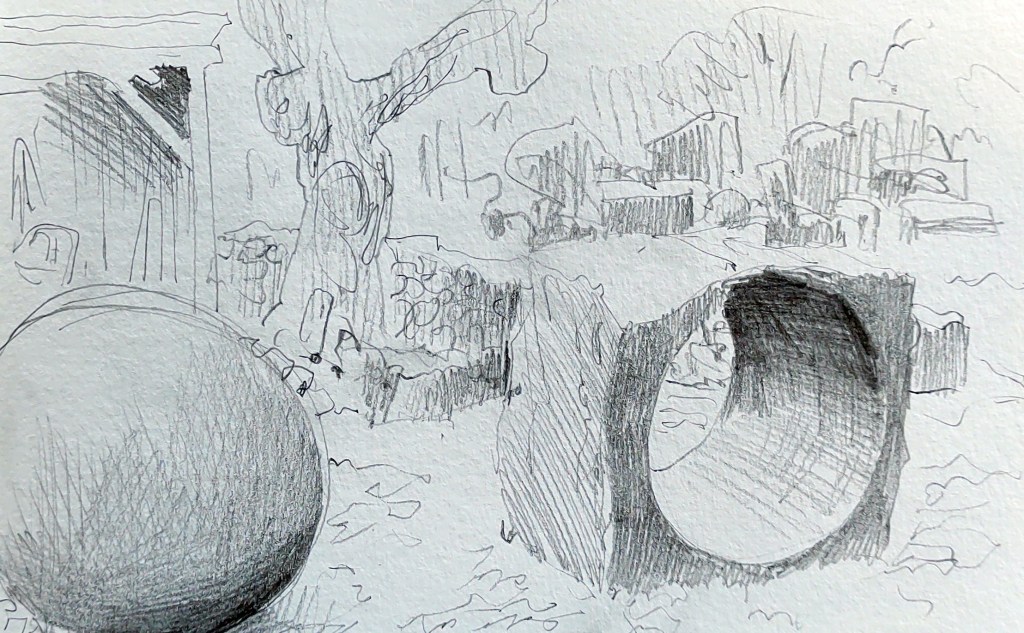
Granite museum

I descended into the quarry, the savage walls of granite looming over me, while the metallic chuckling of jackdaws echoed overhead. It was an awe-inspiring place, a violent meeting point where nature and culture, bedrock and machinery, collide.

I could have spent the whole day at Moseløkken, but time and the LAND project set me on a path out of the quarry and into the surrounding woodland. The burnished golds and yellows of autumn were at their peak, made even more intense by the wet weather. The ever-present peeping of goldcrest and fluting calls of bullfinches carried clear through the still damp air.

I entered Ravnedal, a broad and shallow rift valley managed by the forestry commission and grazed by livestock. Here, the classic north Bornholmian landscape of granite, heather, and juniper was made even more scenic and picturesque by fiery birch, cherry, and oak trees, scattered amongst the heather. I had an appointment with the local TV station and we marveled at the delicious beauty of autumn at its finest.

Ravnedal

I walked on through the valley and into a more open landscape, before diving back into the woods.

Looking east from Ravnedal

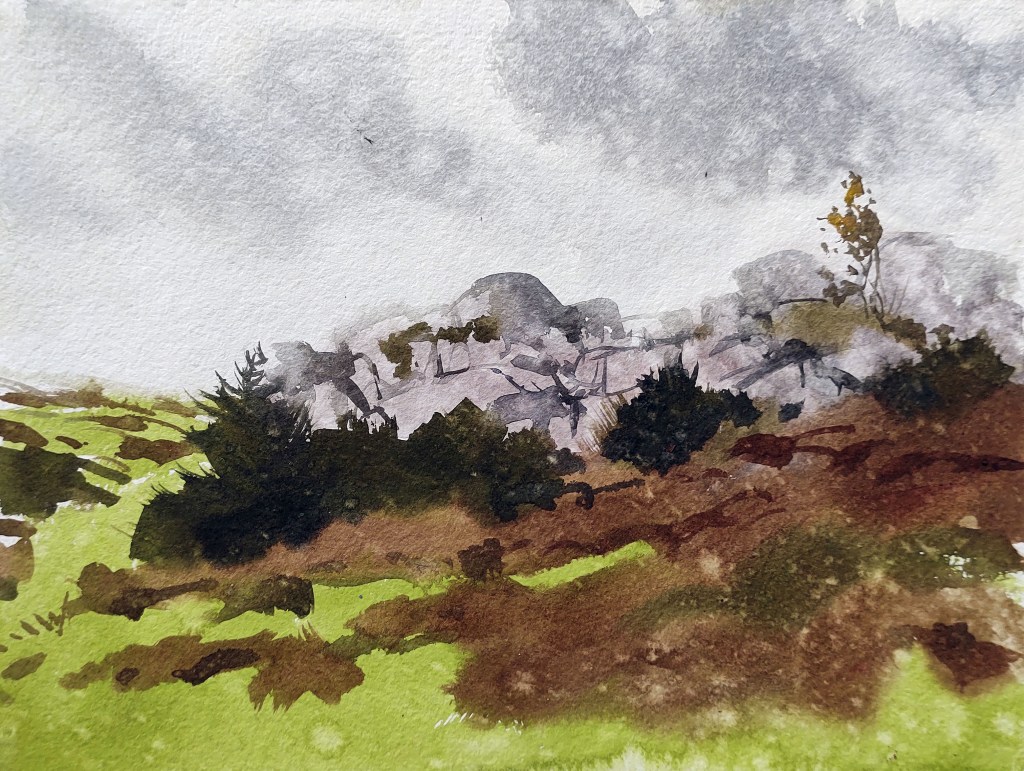
I walked up to Børrelyngen – an open heathland with exposed granite, heather and birch. There were no paths up here, and I felt completely alone. I tried to capture the intoxicating patchwork of colours – the emerald moss and limey lichen, the pink and bruise-grey granite, the purples, greens, ochres and golds of the vegetation.

Børrelyngen

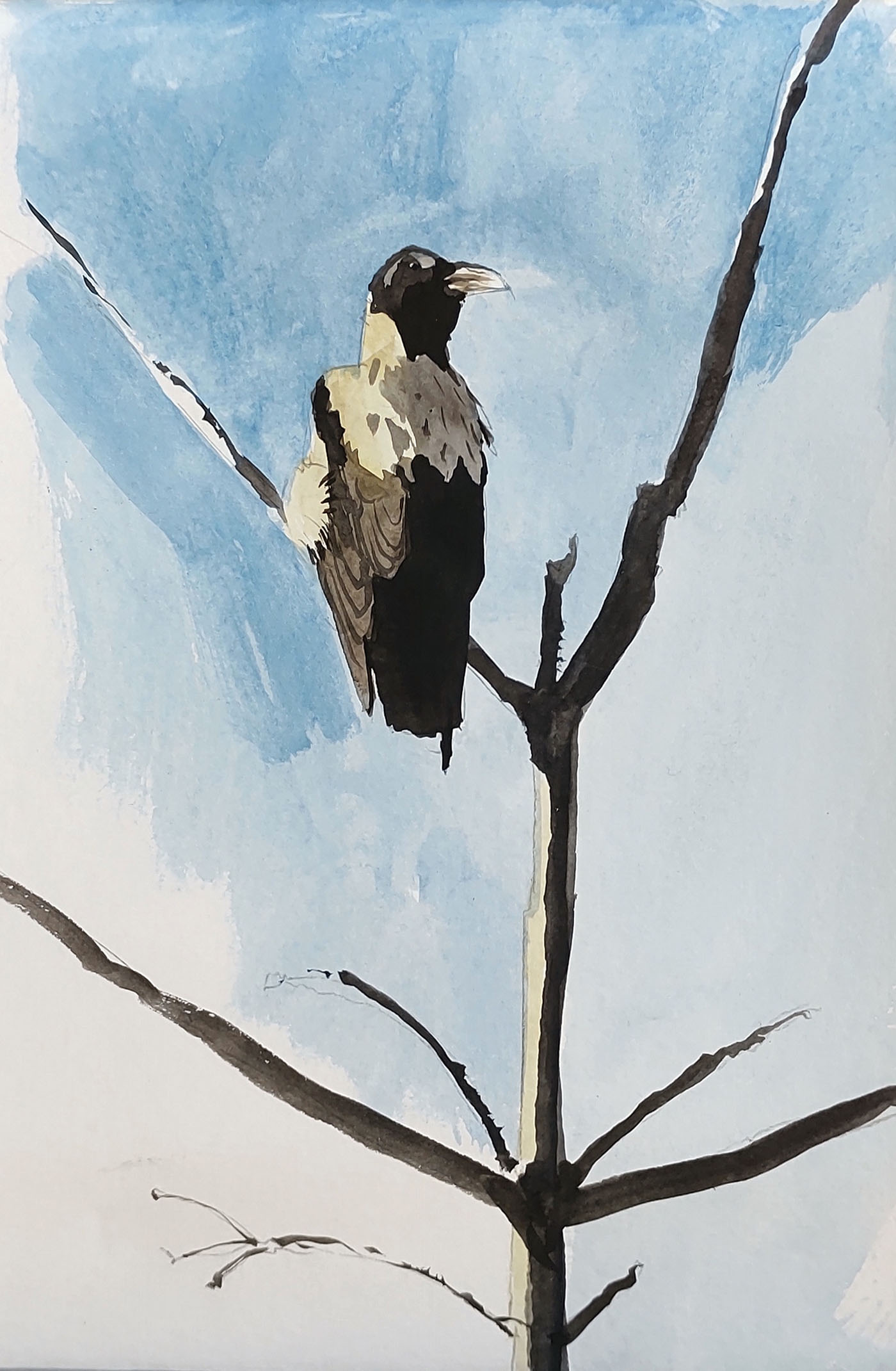
From here I continued eastwards down into an area of untouched woodland, almost impenetrable, before skirting along the edge of some fields. A small group of goldcrest fed amongst the maize stubble, dwarfed by the stumps.

Firecrest among the stubble

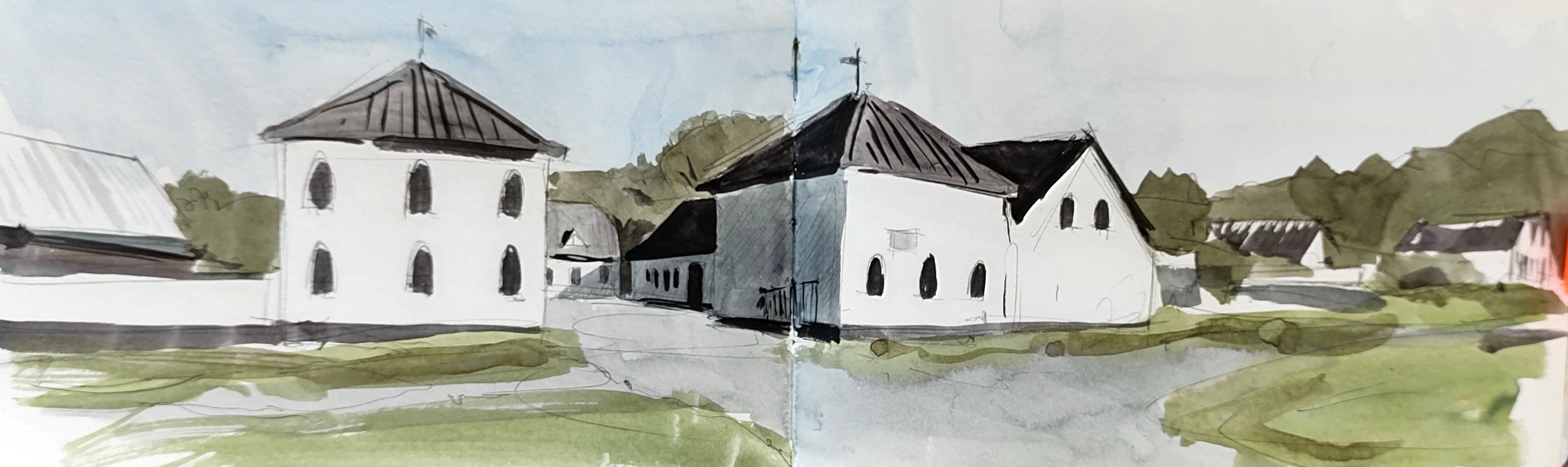
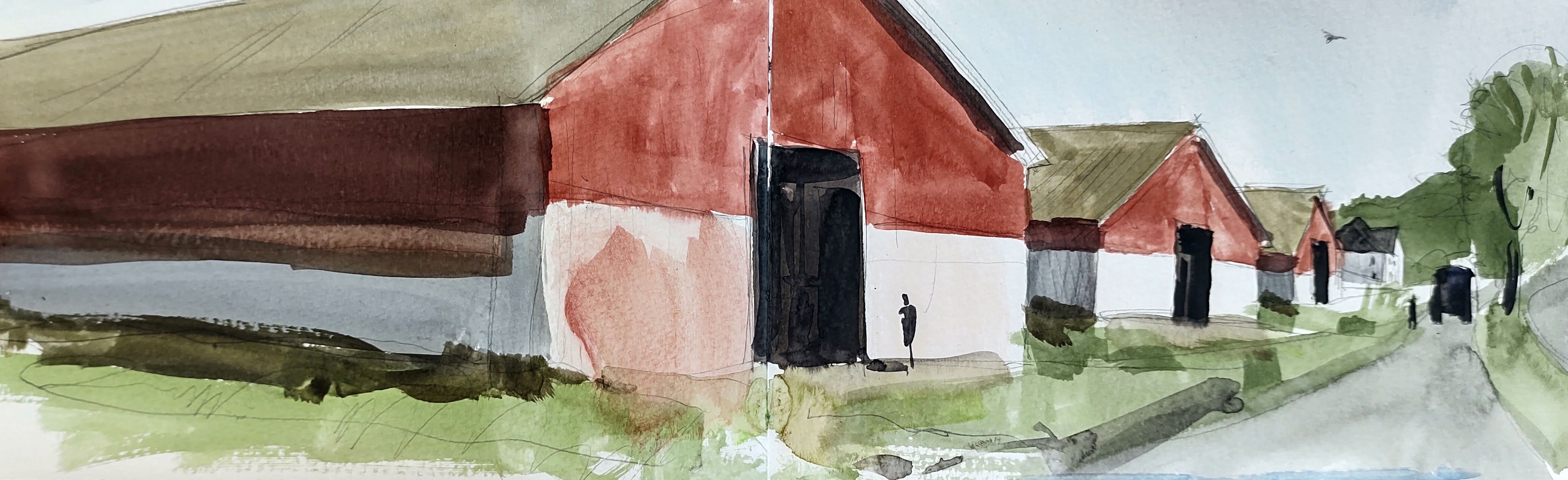
I arrived at the day’s destination – Østre Borregård farm, where Bornholm Museum’s vast collection of domestic and agricultural implements is housed in a series of buildings and storage sheds.

Bornholms Tekniske Samling, outside

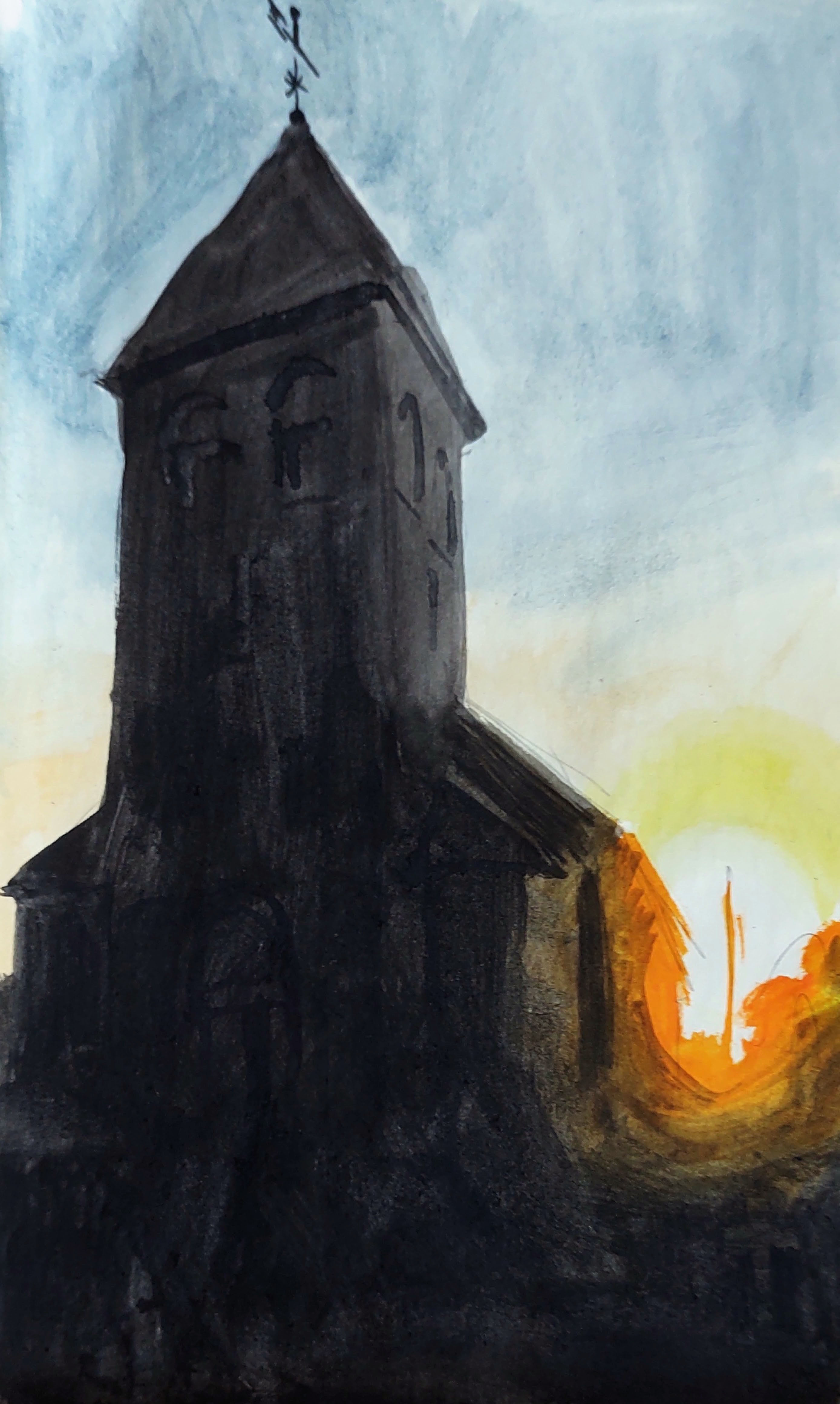
Outside, there was a bewildering array of vehicles and implements – some in open garages, some rusting away on the edge of the wood. As the day drew to a close I painted a pair of old steam rollers that seemed to be disintegrating back into the earth, just as the setting sun dipped below the layer of clouds for the first time, and lit fiery, luminously orange the tops of the larch trees, before quickly disappearing again below the horizon.
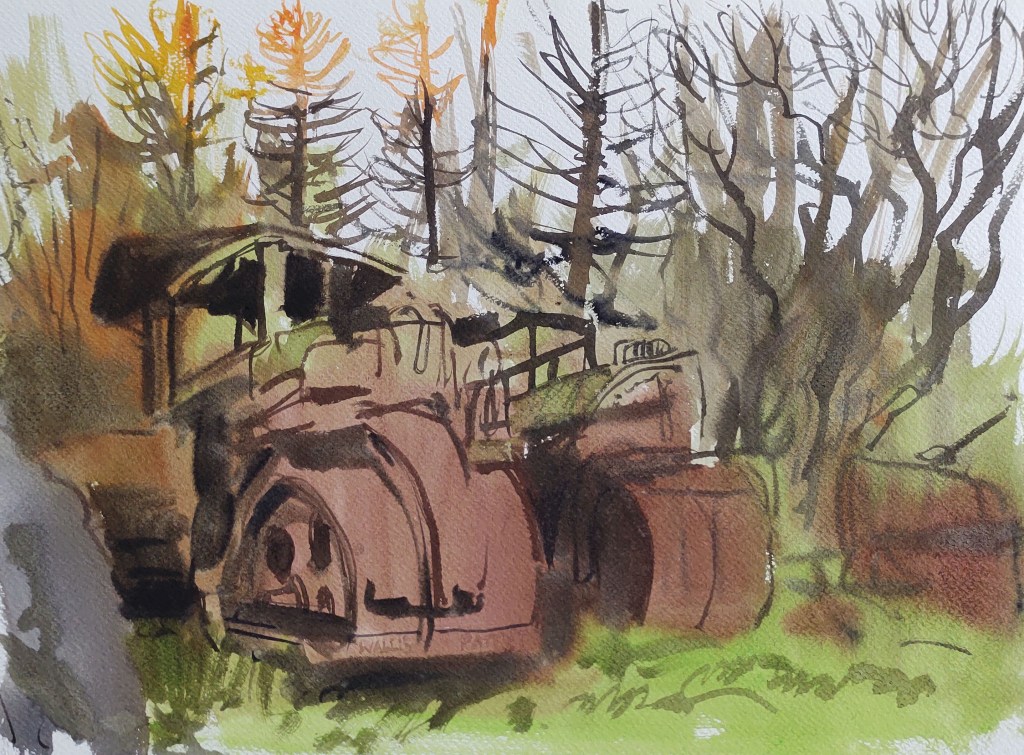
Steamrollers

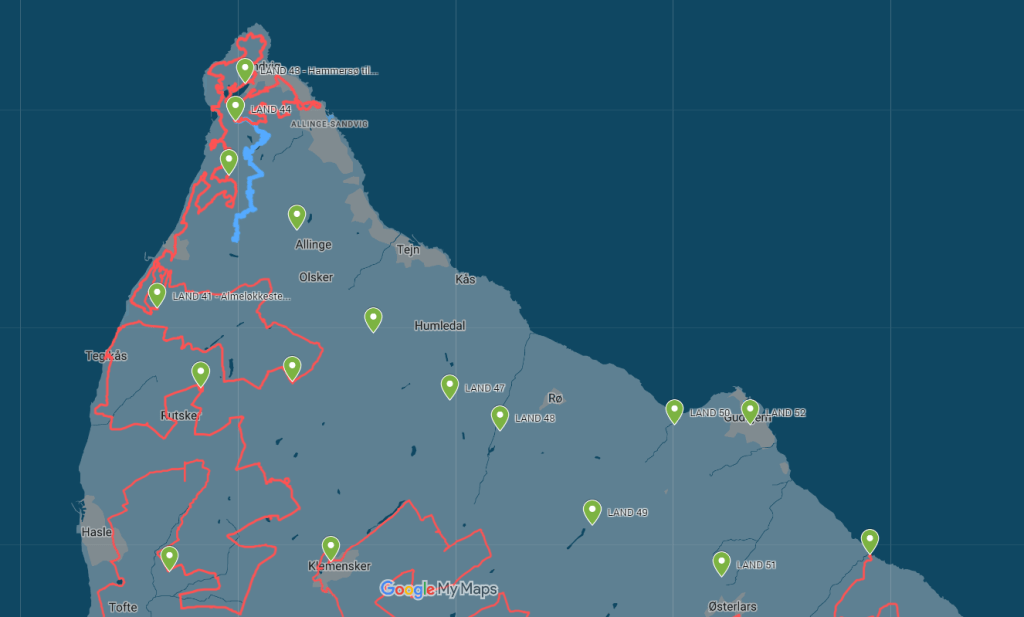
LAND 44

WEATHER REPORT – Overcast all day. Temperature 8 – 11 degrees. Wind 3 – 5 m/s, from the southwest. Hours of precipitation: 0 hours. Hours of sunshine:  0 hours.

STOPS with the BIVVY – 0

KILOMETRES WALKED – 9.03 km

DAY LASTED – 9h and 11 m

PEOPLE TALKED TO – 2

BIRDS SEEN and HEARD – 26 species (0 new) = 133 species in total.

LESSONS LEARNED – nothing springs to mind

IN MY HEAD – I was mostly in the moment again. Joni Mitchell. Battle.
LAND 43 – Hammersø to Hammersholm, 27.10.23

Denne side på dansk

LAND 43 Yet again, a gloomy start to the day, the smothering cloud-blanket was impenetrable and dark pewter-grey. I started off by heading west, walking along the northern shore of Hammer Lake.

Looking southwest across Hammersø

On the opposite side, the angular and boxy shapes of the lakeside hotels contrasted with the exposed ice-weathered granite bedrock, worn smooth by retreating glaciers during the last ice age.

Looking west from Hammersø

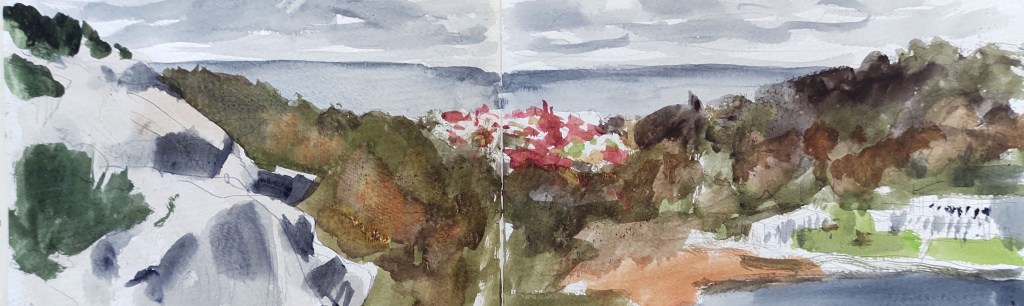
I continued along the new ‘stonemasons path’ zigzagging up into the old quarry ‘shelves’, where there were fantastic panoramic views over Bornholm, the Hammer peninsular, Hammershus castle, and the village of Sandvig. On the horizon to the southeast across the wind-battered Baltic, lay the tiny rocky islands of Christiansø, and to the northeast, the distant blueish stripe of southern Sweden.

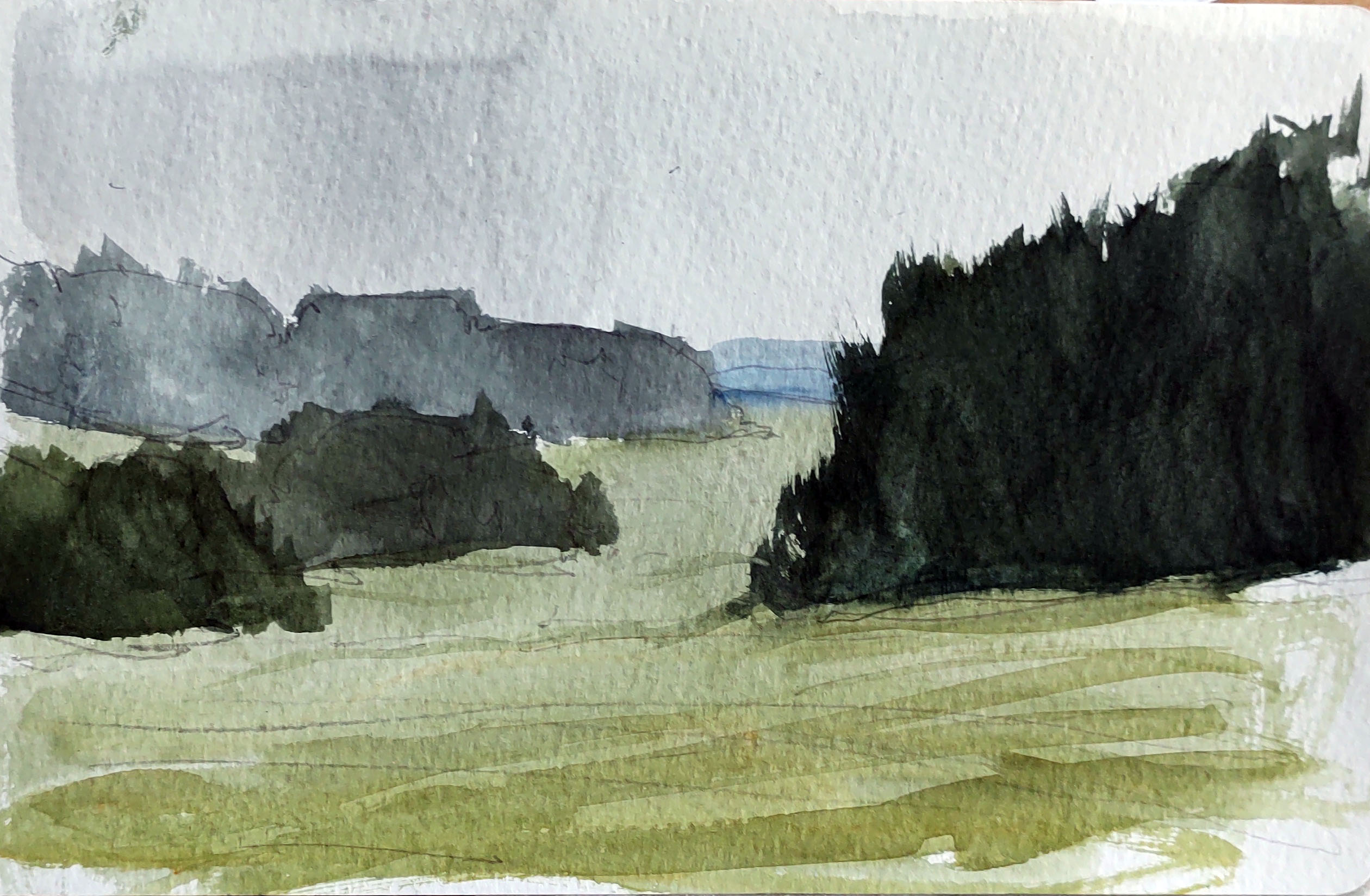
I followed the path down into mixed cherry and oak woodland and stopped to paint the view across Opal lake. Birch trees, early colonists to the quarry, were yellowing wonderfully.

Opal lake with Hammershus and Vang harbour in the distance

From here I walked along the western edge of the lake and back into ‘Bornholm proper’. The wind was picking up, and agitated flocks of winter thrushes and geese passed overhead.

I spent some time exploring ‘Langebjerg’, a granite ridge with great view of the Hammer peninsula and the surrounding farmland. The area is grazed by gangs of friendly goats, which keep the bracken, bramble and juniper in check, and encourage orchids and other wildflowers – some of which are found nowhere else on Bornholm. I had my telescope with me, and from the top of the ridge had great views of a trio of roe deer resting in a field. I struggled for a while with the strange boxy shape of their heads.

Roe deer studies

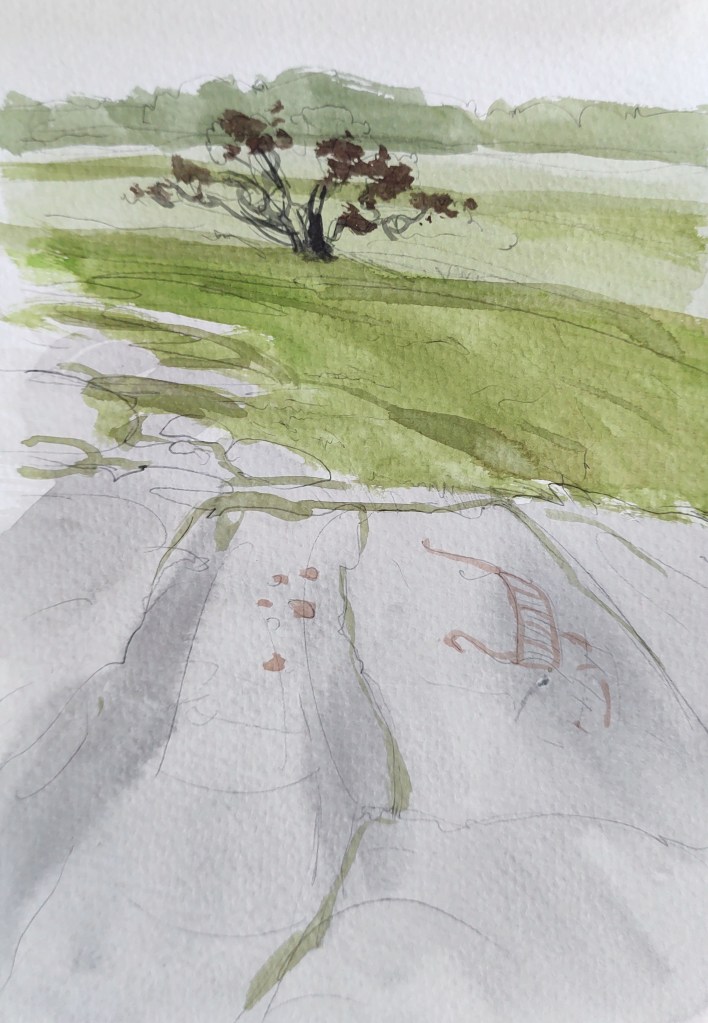
Somewhat regretfully, I departed Langebjerg and headed onwards, past wonderful summerhouses with great views of the swelling sea. I eventually arrived at Madsebakke, one of Bornholm’s better-known attractions, where there are scores of rock carvings from the Bronze and Iron age – a plethora of ships, cup marks, and symbols all hammered or chiselled into the smooth granite bedrock.

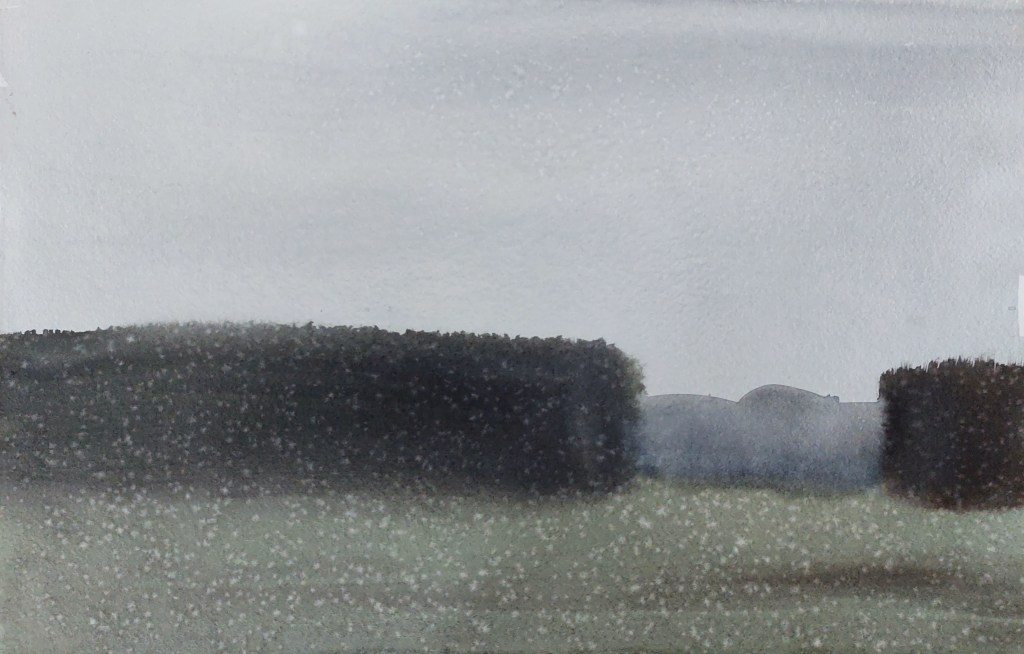
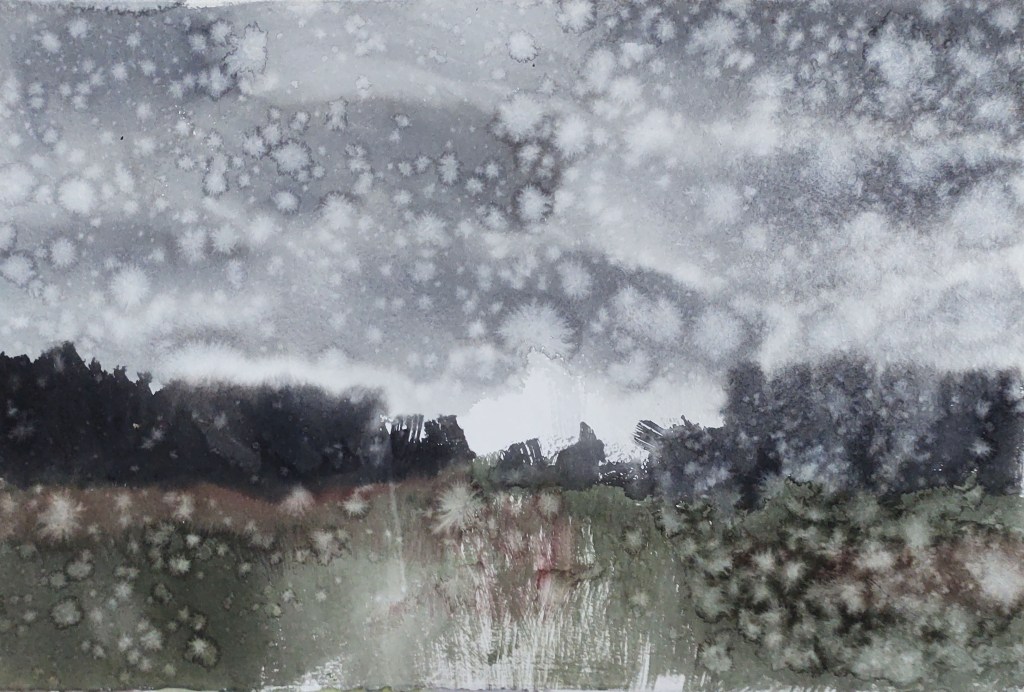
The shorter days are acutely noticeable now. Speeding up, I followed a path back east through an area where organic farming practices that benefit wildlife are being demonstrated (trialled?). I perched for a while on one of several circular wooden platforms and tried capture the play between the rich autumnal colours and the heavy grey gloom.

Udsigt fra skoven ved Hammersholm

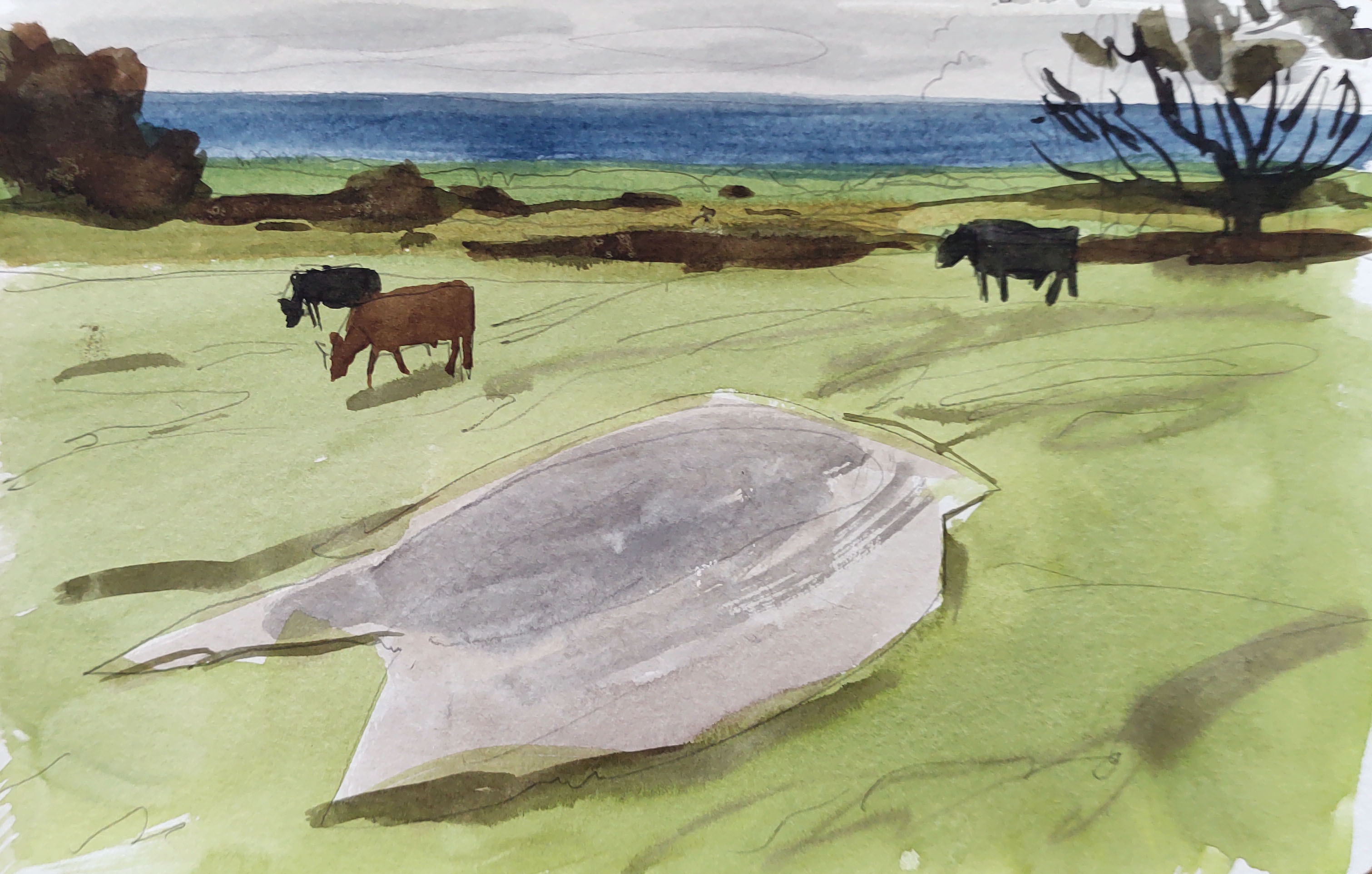
The day concluded with a hasty tour past more iron and bronze age carvings – smooth low islands of granite bedrock almost hidden within the sea of cattle-grazed grass. From here I finished off walking around Hammersholm farm, sadly neglected but still impressive, with commanding views over many the places I had been walking through.

LAND 43

WEATHER REPORT – Overcast all day. Temperature 5 – 7 degrees. Wind 6 – 8 m/s, from the east. Hours of precipitation: 0 hours. Hours of sunshine:  0 hours.

STOPS with the BIVVY – 0

KILOMETRES WALKED – 12.98 km

DAY LASTED – 9h and 55 m

PEOPLE TALKED TO – 9

BIRDS SEEN and HEARD – 33 species (0 new) = 133 species in total.

LESSONS LEARNED – when crossing off the list, do it properly… I forgot my gas canister, meaning a long quick detour to beg for some boiled water from a friend – the thought of a day outside without hot tea and noodles too horrible to contemplate.

IN MY HEAD – I was mostly in the moment, painting, planning the route, dealing with the weather, and so on

LAND 42 – Slotslyngen to Hammersø, 20.10.23

Denne side på dansk

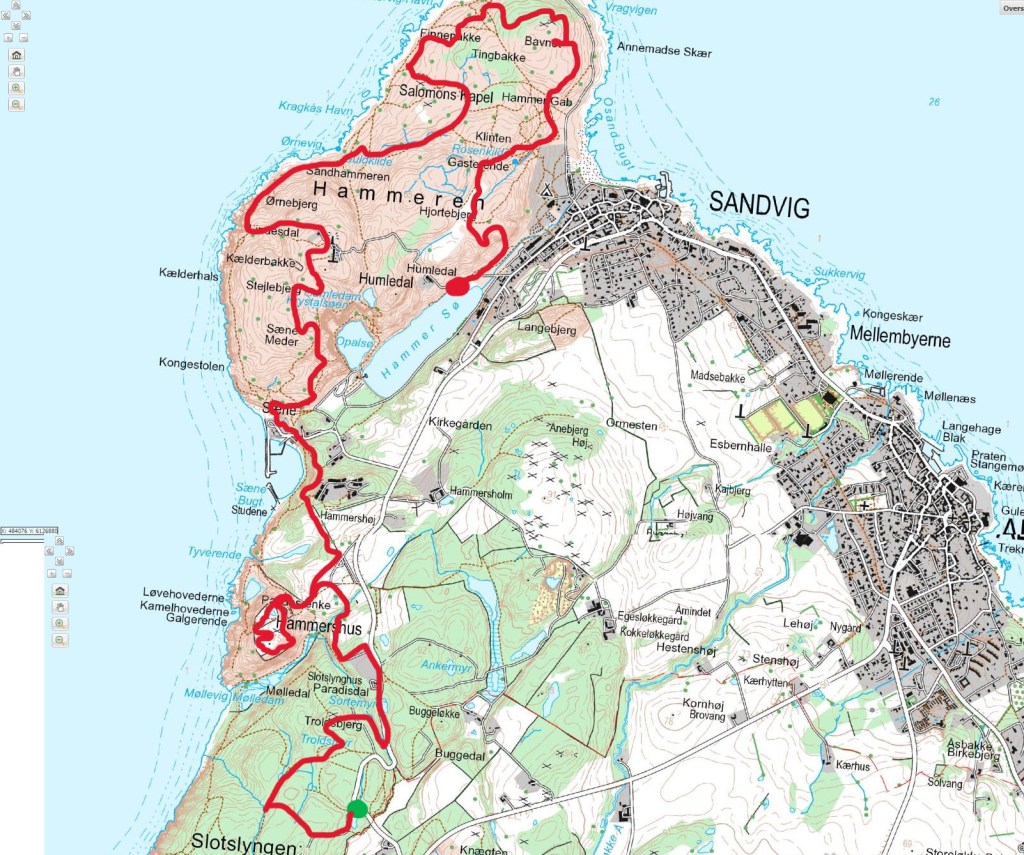
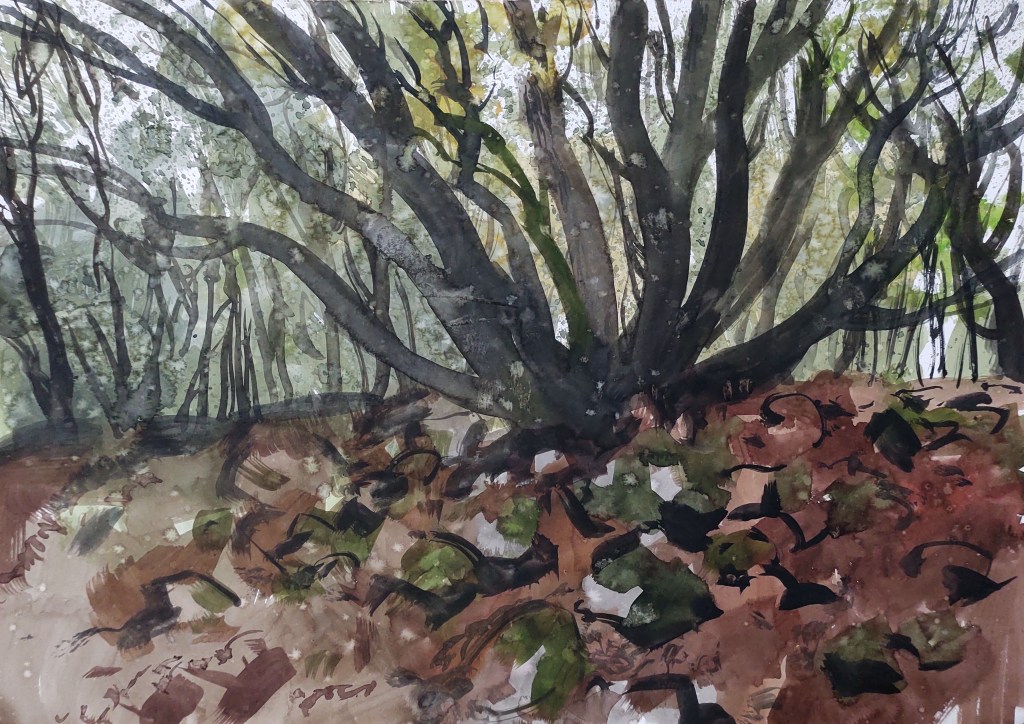
LAND 42 The wind was already picking up, but I was protected from the worst of it in the gloom of Slotslyngen wood, full of twisted oak, dark granite, and wet moss. For the first time in many months I was wearing gloves, and had all my waterproofs in readiness for the stormy day ahead.

Great spreading oak, Slotslyngen

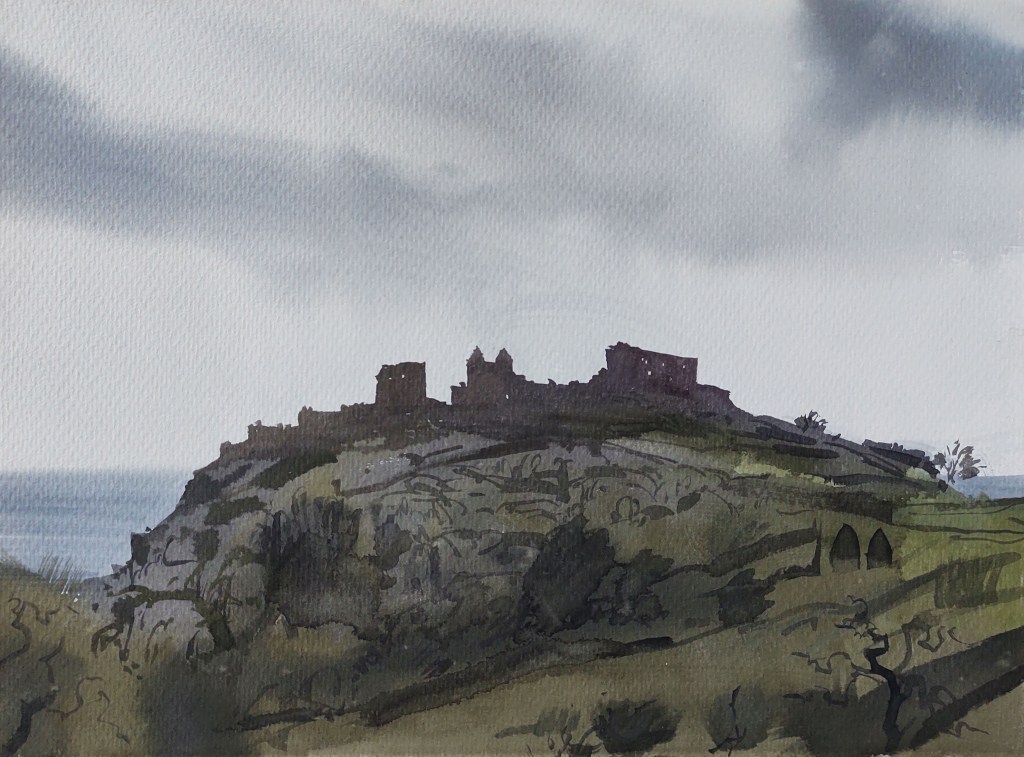
I headed north through the woods, eventually emerging close to Hammershus, a huge castle ruin dating from the 13th century and once the centre of power on Bornholm.

Hammershus

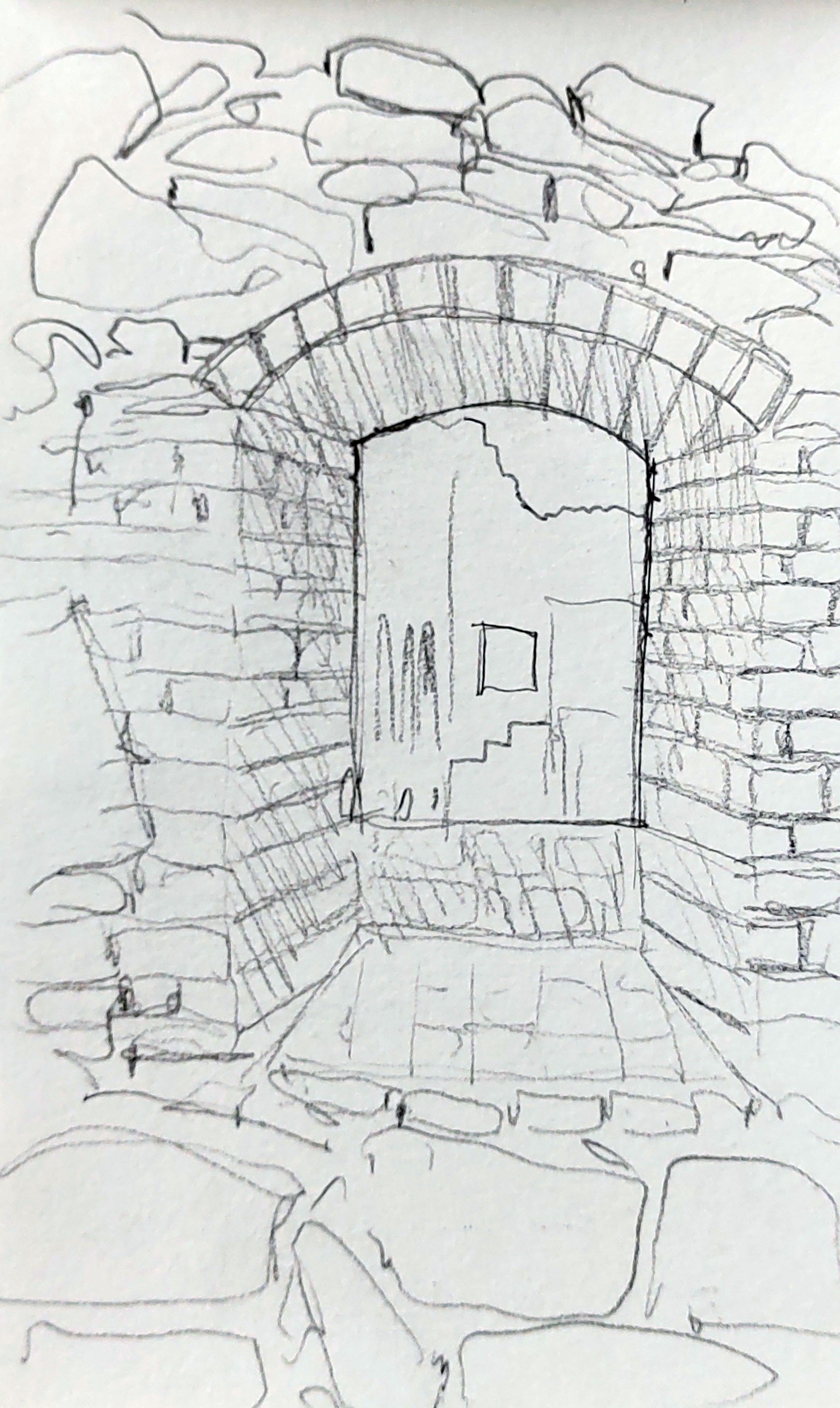
Passing through the new visitor centre, I walked up amongst the ruins, trying to imagine the lives of the soldiers, peasants and nobility that once lived here. The castle sits atop a granite outcrop with commanding views of the Baltic and felt very exposed to the powerful wind howling across the island from the east.

I was glad to continue northwards and was even more glad when a small flock of snow buntings accompanied me for a while – pushing against the wind, their wings flashing white.

Snow buntings

In the lee of the West-facing Hammer Harbour I sheltered behind a hut and under my umbrella. Here, a jackdaw befriended me for a while, and again I was glad for the company. The storm had raised the sea level significantly and a rolling swell crashed into the harbour.

I headed towards ‘Hammerknuden’, a granite outcrop or peninsula almost separated from the rest of the island. I looked back down to the harbour where I could see an orange lifeboat preparing to sail out. In the sea beyond, I could see several large tankers sheltering from the storm in the wind shadow of the island. It was very difficult to control the paper, brushes, and paints in the wind.

Hammershus and Hammerhavn

Coincidentally, following the great storm surge of 1872, this area was sold by the state to German prospectors to raise money for the local populace, subsequently paving the way for the significant granite extraction industry and later German tourism that followed. Today the quarries are filled with water, surrounded by mountain bike paths and traversed by zip lines, and the area is one of Bornholm’s most popular beauty spots.

Looking down to Opal Lake

I spent many hours wandering around the peninsula, following small paths inland and trying to shelter amongst the small stands of juniper and birch and as much as possible. Goldcrest seemed to be sheltering in almost every bush, above me a kestrel zipped and zoomed above, somehow gracefully maintaining control in the gusts and blasts of the storm.
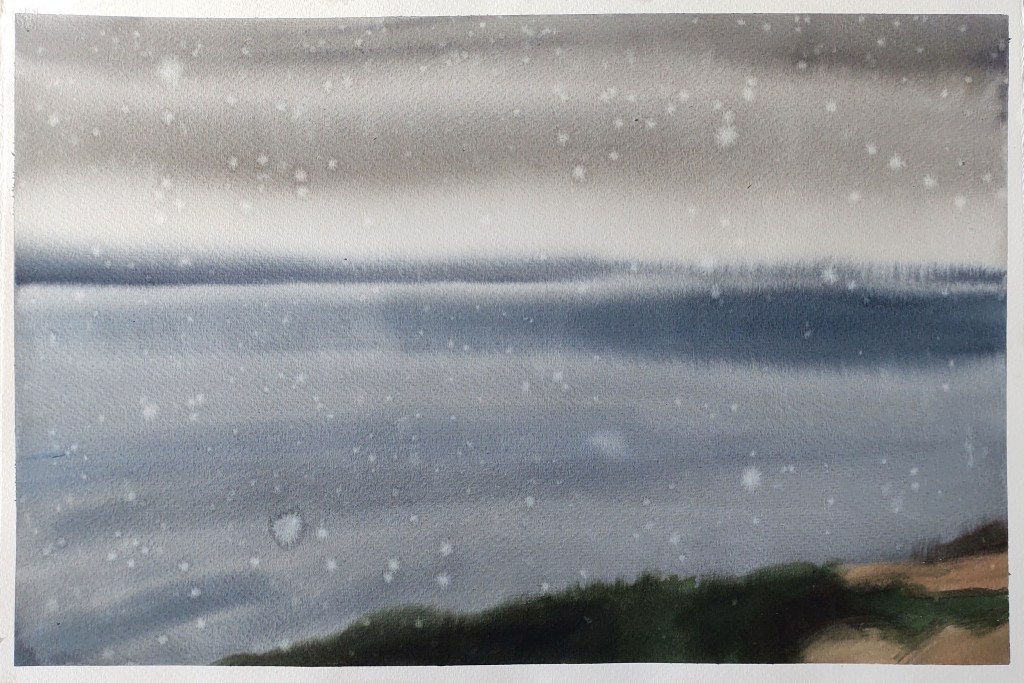
Looking North

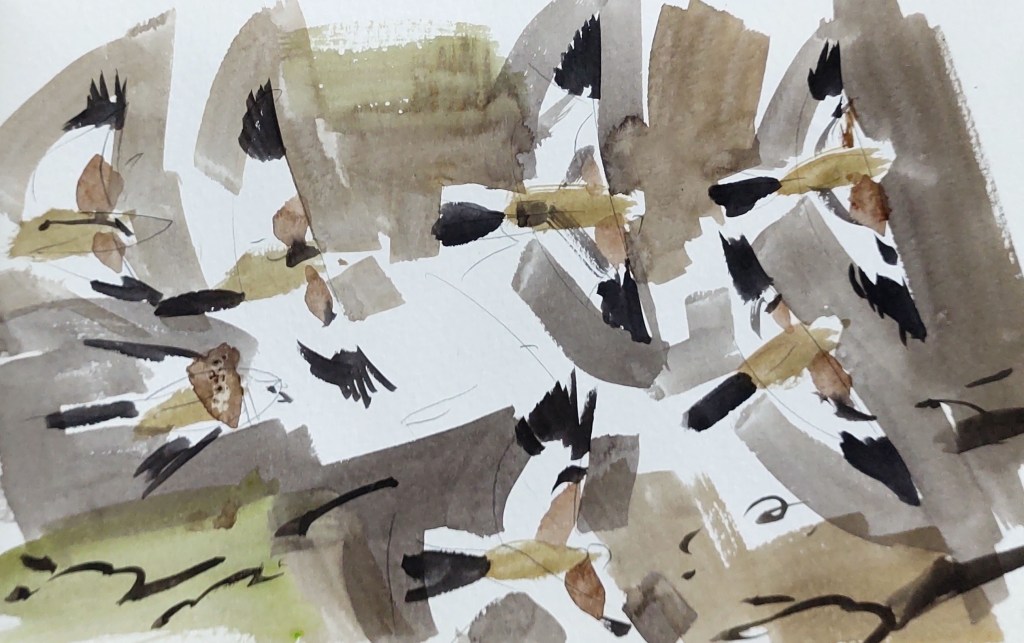
I tried to let the wind determine the direction of the watercolours, by holding a painting into the gale.
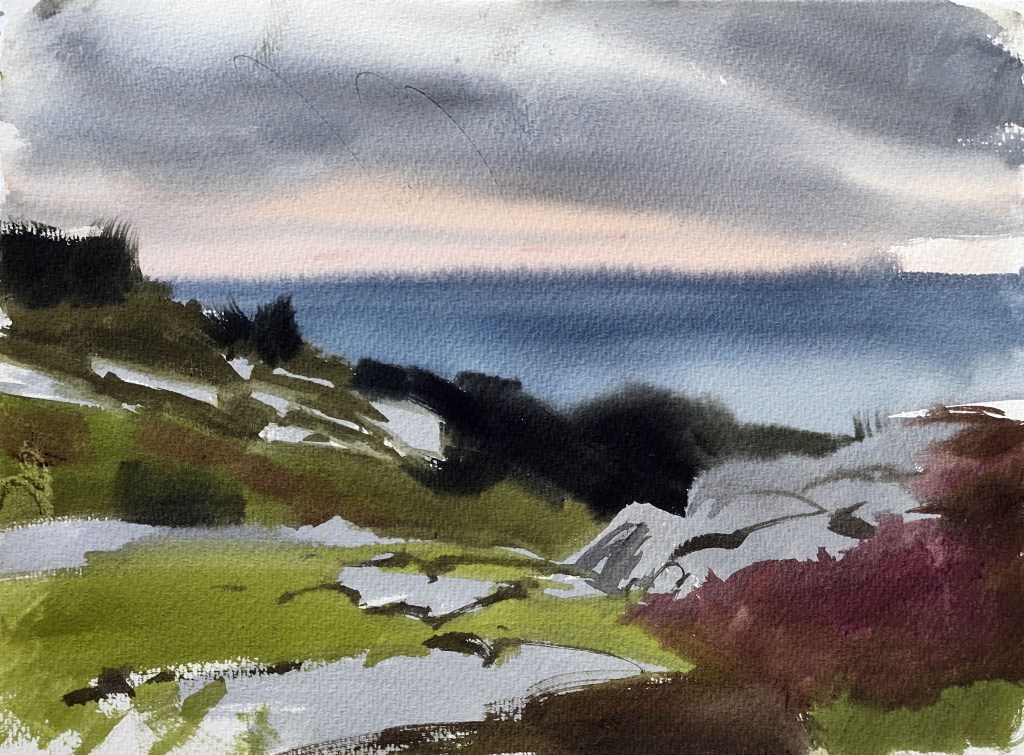
Wind painting

The day passed and, weather beaten and wind addled, I made my way down to Hammer Lake for the pick up.
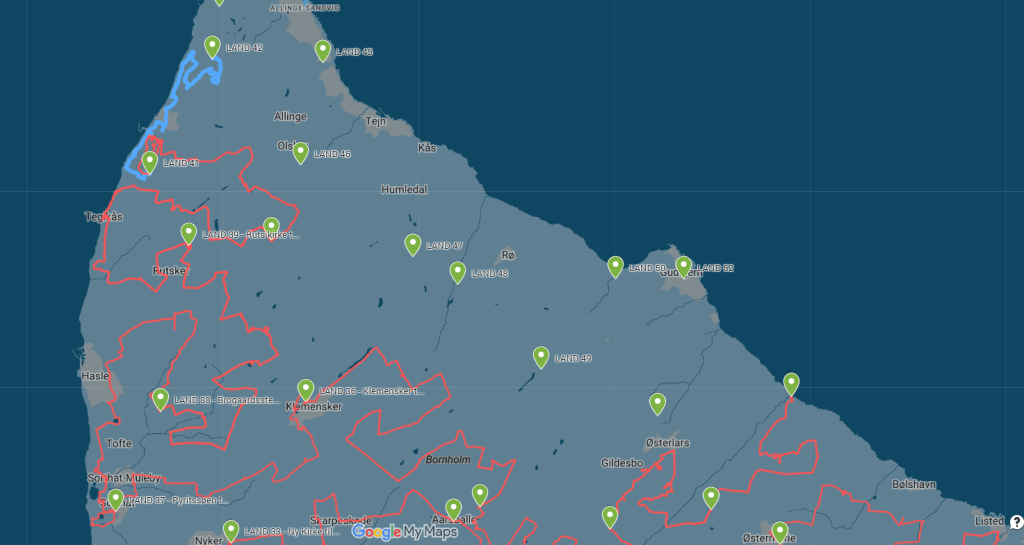
LAND 42

WEATHER REPORT – Very windy, spitting in the morning. Temperature 5 – 8 degrees. Wind 12 – 18 m/s, from the east. Hours of precipitation: 1 hours. Hours of sunshine:  0 hours.

STOPS with the BIVVY – 0

KILOMETRES WALKED – 13.23 km

DAY LASTED – 10h and 10 m

PEOPLE TALKED TO – 1

BIRDS SEEN and HEARD – 33 species (2 new, Bean goose, Snow bunting) = 133 species in total.

LESSONS LEARNED – Fix or tuck loose straps into rucksack, so they don’t whip you in the face in the wind.

IN MY HEAD – I was very busy with dealing with the wind and planning my route

LAND 41 – Almeløkke Quarry to Slotslyngen, 13.10.23

Denne side på dansk

LAND 41 Driving to the start point, the dawn was fine and still, the sky ablaze with intricate patterns of golden, orange and yellow – the rain and gale force winds forecast for the afternoon seemed impossibly pessimistic.

Instead of enjoying the expansive sky, my route took me straight away into the shadowy, tangled, overgrown rift valley of Blåskinsdalen. Here it was dark and silent, a jumble of ivy, fallen boughs, fern, moss and granite.

Blåskinsdalen

I emerged close to the sea cliffs and headed north along the coastal path. I had walked this very route during the KYST project on a very cold and sleety day in March five and a half years previously, and my mind was full of memories and reminiscences of that time. Soon, I arrived back at the Vang quarry, close to where I had been last week.

Vang quarry, with yin yang

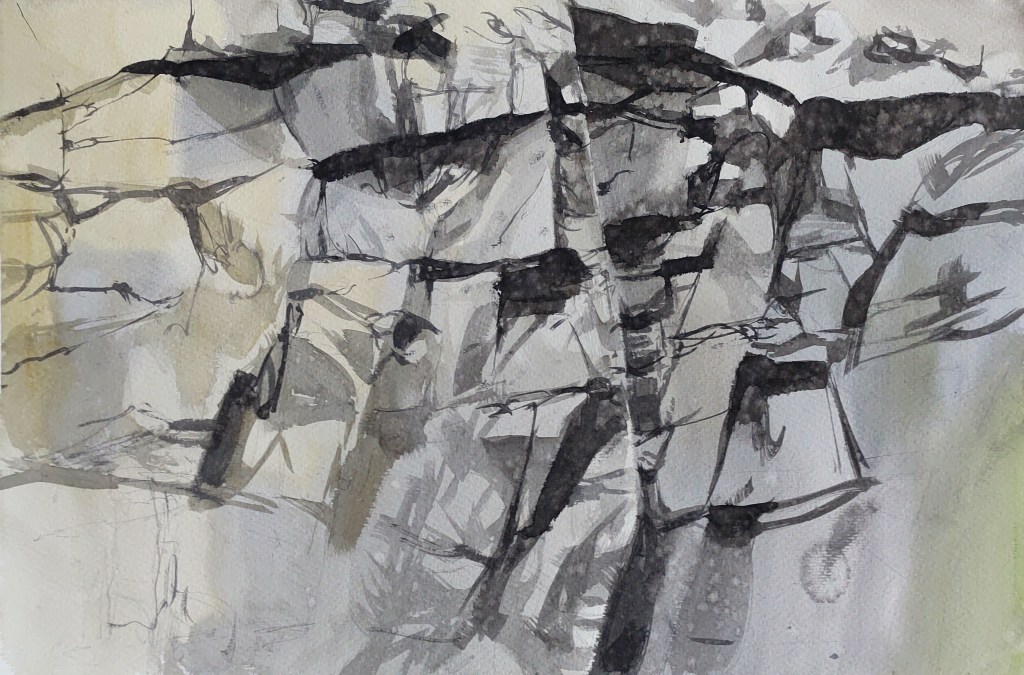
Again, I was seduced by the intricate and savage shapes and structures of the vertiginous granite quarry walls and decided to really get into them, although I knew time was already running away from me. After an hour or so, however, the wind started to pick up, and before long it started spitting. I tried to cover the paper as best I could but was ultimately forced to seek refuge in an old quarry building, recently converted into a fine shelter.

Granite wall

The rain increased in severity, and I was trapped. I tried looking through the rain and painting the quarry. Birch trees were already changing colour to yellow.

Vang quarry II

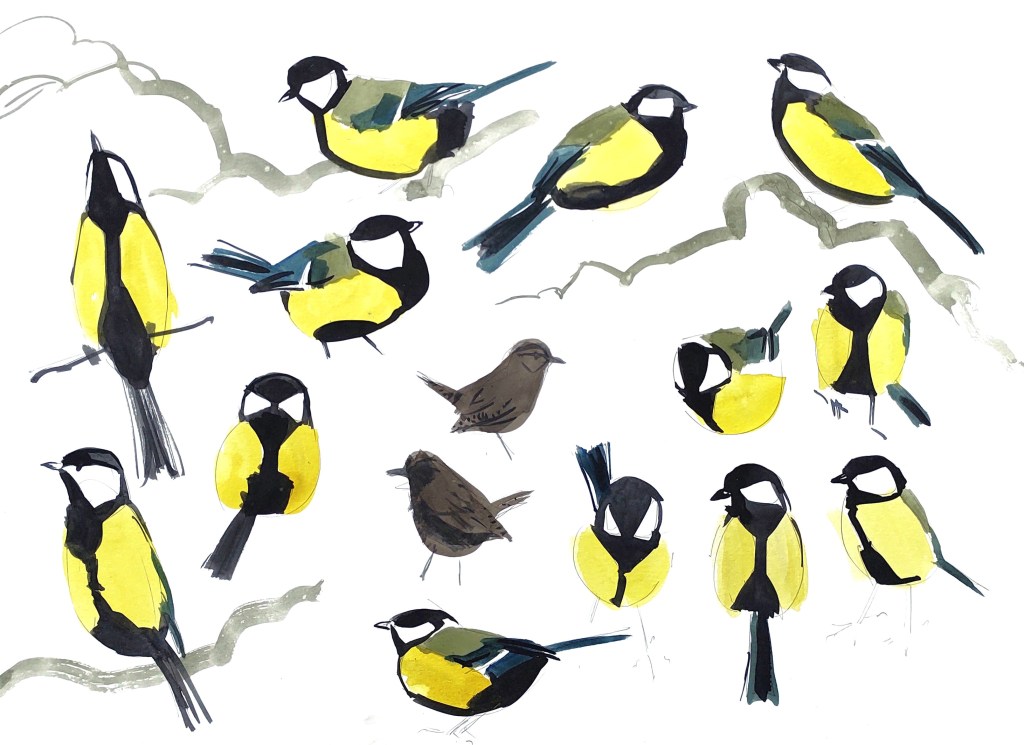
My unhappy and gloomy musings were thankfully interrupted by the joyous sight of a great tit and a wren, also seeking shelter from the rain.

Great tit and Wren

Eventually the rain lessened in intensity, and I walked on, through the village of Vang and onward to Finnens Top and Slotslyngen. I had long been looking forward to wandering around and painting in this area, but the weather had other plans. Once again, I was forced to take shelter, this time under my tarp, as the wind and rain built up again. I tried to paint the exposed granite, heather, and juniper typical of the region, but was buffeted and beaten by the wind and rain and soon everything was a wet soggy mess.

Finnens Top from the coastal path

Soaked through, I continued along the coastal path for a while with wonderful views over the sea, where menacing bands of rain bruised the sky and cast dark shadows on the sea.

View from Finnens Top

I walked on, over the open exposed heathland and into the enchanting forest of Slotslyngen, full of twisted oaks and grotesquely twisted birch and pine, glad to be out of the howling wind. The rain had mostly stopped now, and I headed south again, out into the open heathland. In the teeth of the gale, my mood switched back and forth between desperation and exhilaration.

View from Finnens top, looking Southeast

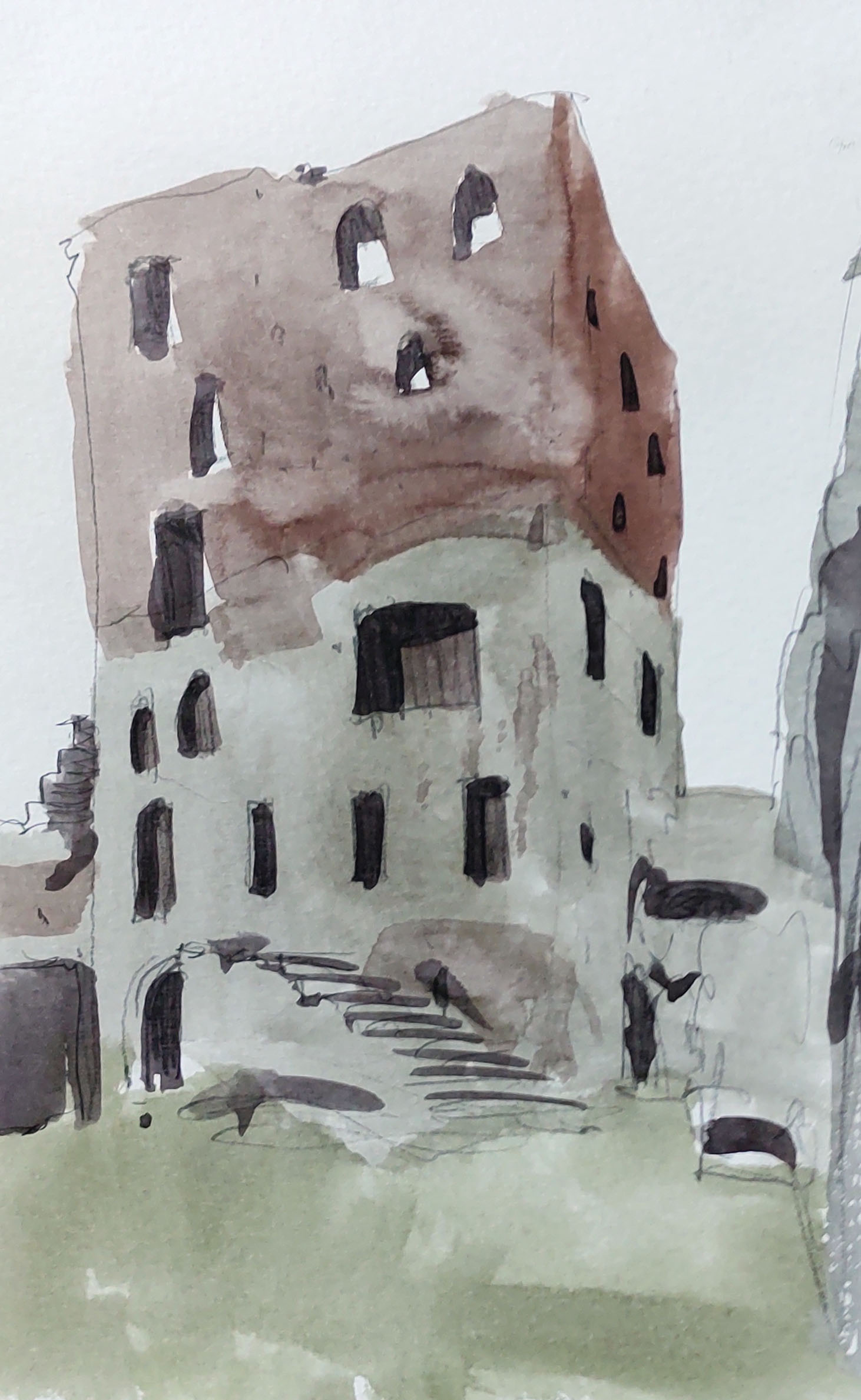
Back into the cover of the forest again, and completely exhausted now, I headed north and east along overgrown forest paths. This was a new area for me, a beautiful nature paradise with a patchwork of forest, open meadows, small flooded quarries and a generous scattering of deer hunting towers (see top).

The days are so much shorter now, and after having spent so much time under cover, I never made it to the day’s end point. I was equally exhausted and overstimulated, and the day was over.

LAND 41

WEATHER REPORT – Spitting or raining most of the day. Temperature 9 – 17 degrees. Wind 5 – 11 m/s, from the southwest. Hours of precipitation: 5 hours. Hours of sunshine:  0 hours.

STOPS with the BIVVY – 1

KILOMETRES WALKED – 12.04 km

DAY LASTED – 10h and 42 m

PEOPLE TALKED TO – 1

BIRDS SEEN and HEARD – 26 species (1 new, Brent goose) = 131 species in total.

LESSONS LEARNED – Take a lighter instead of a matchbox on wet days

IN MY HEAD – I thought a lot about the structure of the LAND project – about how it can be both a blessing and a curse to create rules and frames within which to work creatively.

LAND 40 – Egeshøje to Almeløkke Quarry, 06.10.23

Denne side på dansk

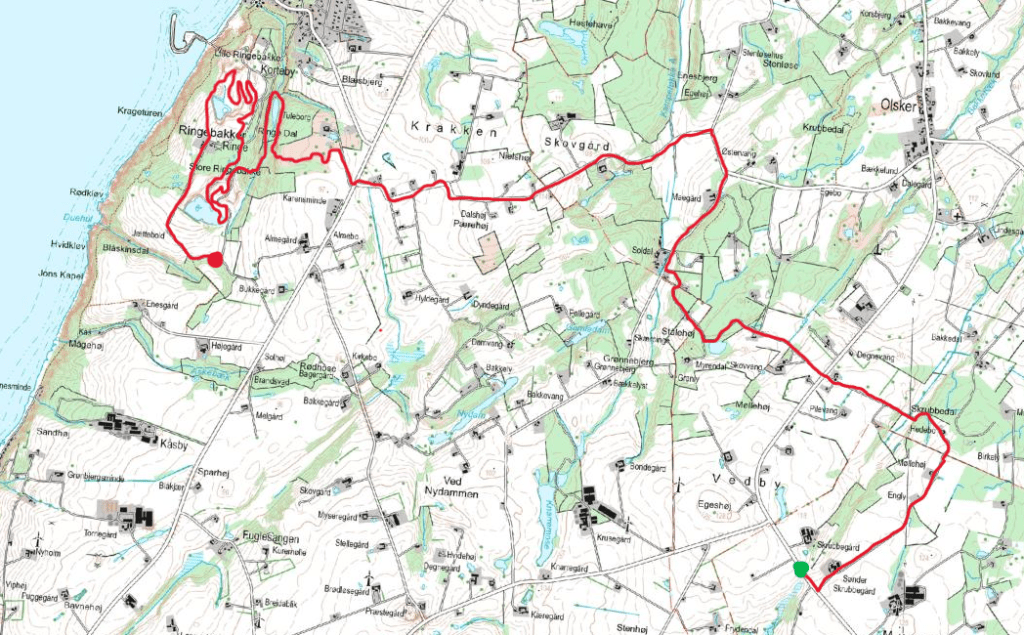
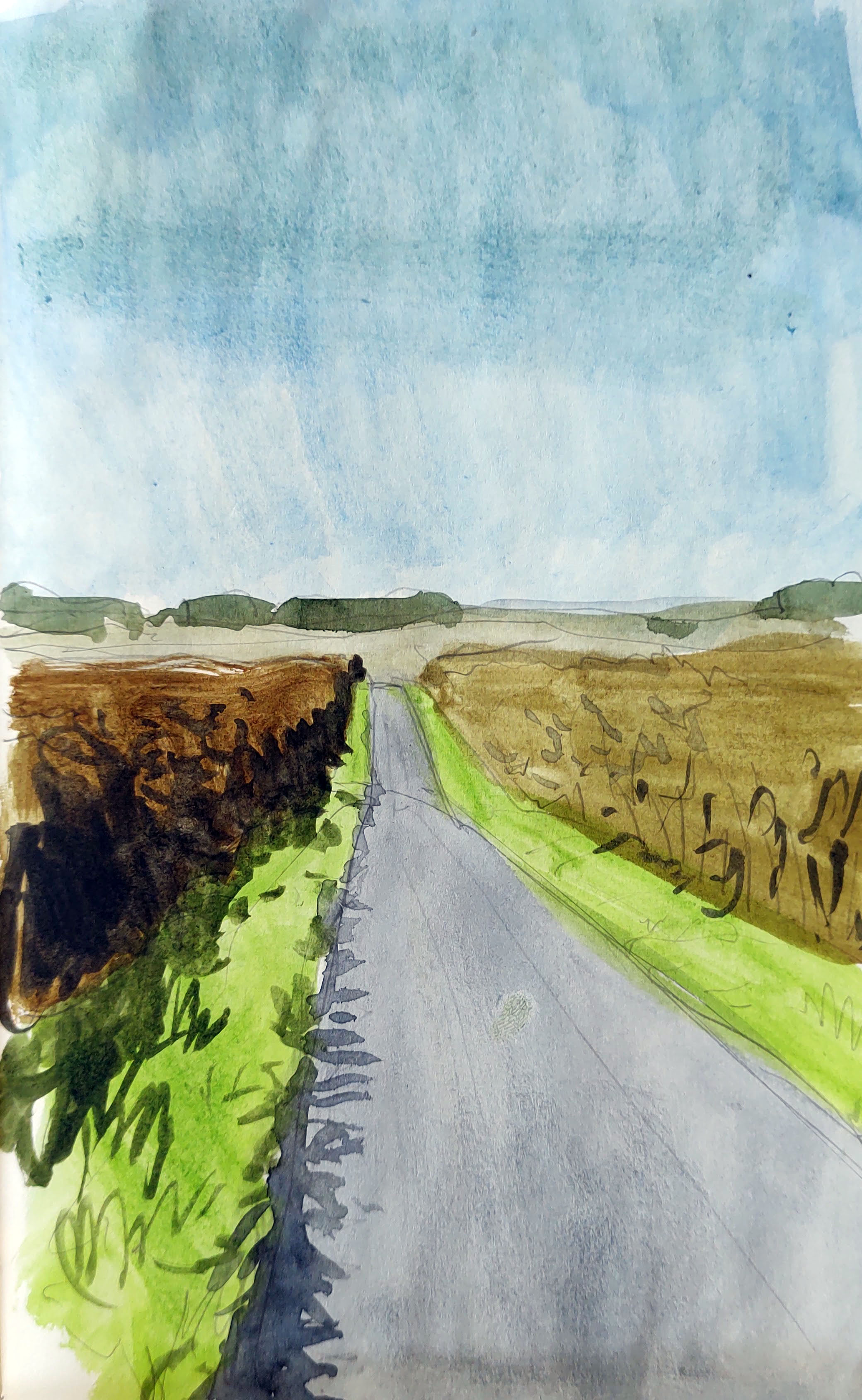
LAND 40 Drizzle and wind. A heavy pewter grey sky. I left the main road and walked along a narrow track connecting a series of farms and homesteads. I thought about how many of Bornholm’s smaller tracks and roads connecting farms have been erased, as fields have become larger and people inhabit the landscape in a different way.

Bedegadevej

Some of the farms and homesteads were large, hidden behind gigantic sheds and silos, others were derelict, others still were summer houses. By the side of one empty house, a Goldilocks moment: two chairs and a table under an awning, promising welcome protection from the rain.

On narrow roads, I continued slowly meandering westwards towards the sea through an attractive landscape of small fields and oak, beech, and birch woods. I was soon soaked and struggled to keep paper and paints dry. I followed flocks of small birds drifting excitedly between field and forest. All colours were saturated and intensified. Flowers and berries stopped me in my tracks.

After the fine Indian summer, it felt invigorating to have a bit of weather, something to bite into.

From the top of Ringedal

I perched on the edge of Ringe Valley, a deep, heavily wooded rift valley cut into the fieldscape. At the base of the valley a narrow lake fringed with bright green duckweed, where a flock of wigeon sheltered from the storm.

Looking down to Ringedal

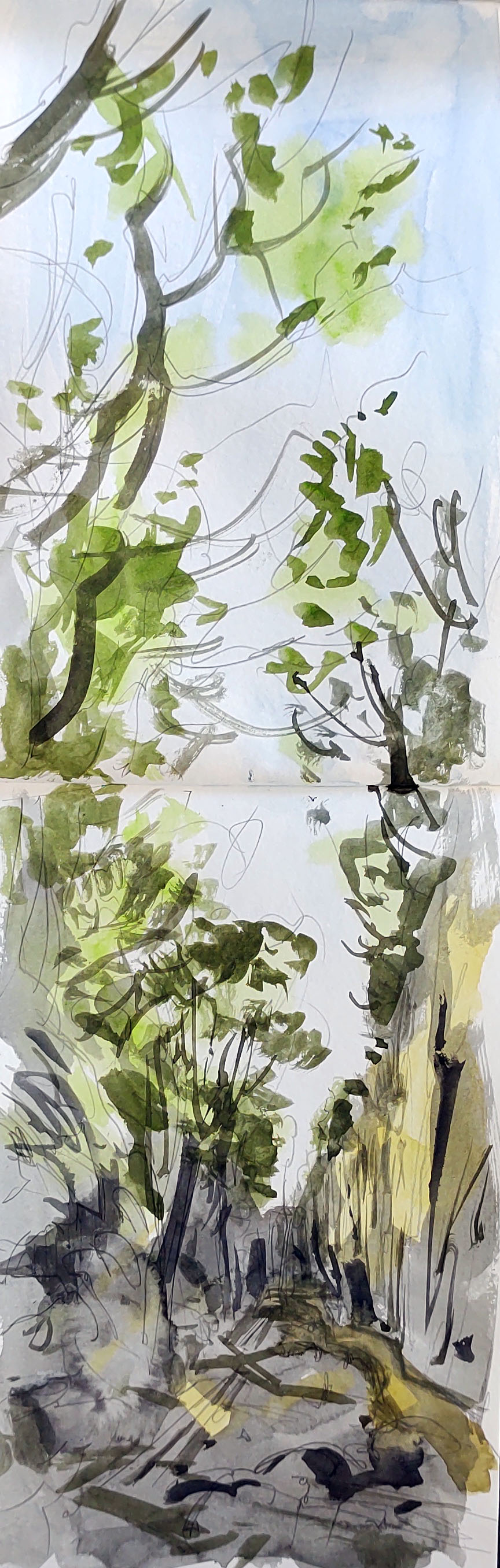
I walked down into the valley and up the other side through a dense oak, pine, and cherry wood typical of North Bornholm. Ivy, twisted roots, slippery granite underfoot, fallen tree trunks, moss covered stone fences long forgotten and the continual tinkling of goldcrest overhead.

I emerged from the forest into huge caldera of the Almeløkke quarry. Terraces of savagely scarred purple and ochre granite battered by the wind and rain.  In drier pauses I tried paint as best I could. When the rain got too much I walked around and explored, all the way to the neighbouring Vang Quarry.

Almeløkke Quarry

These quarries were retired as recently as 20 years ago. In the final decades of their operation, they became a site of contention between the nature conservancy groups trying to protect the unique nature of the region, and the business and political lobbyists advocating the economic and labour benefits of the operation. Rather ironic then, that in the short time since their closure, the site has been rebranded as a nature recreation park, with climbing, mountain biking and trail walking.

‘Nevada Cliff’, Vang Quarry

Peregrine falcon, Stock Dove and Jackdaw nest in the exposed granite cliffs, while Little Ringed Plovers nest in the margins of the many lakes and ponds. Birch trees are already springing up everywhere, and it will be fascinating to witness the area’s evolution over the coming decades.

I tried to paint the incredible view over the quarry, with the boiling sea and Hammershus Castle in the distance, but a new wave of rain arrived, just as Peregrine jetted past overhead, and I had to pack up again.

Peregrine, Vang Quarry

I wandered around a bit more, then headed back south to the pickup point and the end of the day.

LAND 40

WEATHER REPORT – Spitting or raining most of the day. Temperature 13 – 15 degrees. Wind 7 – 17 m/s, from the west. Hours of precipitation: 8 hour. Hours of sunshine:  0 hours.

STOPS with the BIVVY – 0

KILOMETRES WALKED – 15.54 km

DAY LASTED – 11h and 8 m

PEOPLE TALKED TO – 0

BIRDS SEEN and HEARD – 33 species (0 new) = 130 species in total.

LESSONS LEARNED – Good to have my map in plastic folder.

IN MY HEAD – I enjoyed struggling in the wind and rain. The Apprentice Series 16, Superbandet song 4. Happy Valley. Wii. Daughters.

LAND 39 – Ruts Church to Egeshøj, 29.09.23

Denne side på dansk

LAND 39

Post autumn equinox, I perched under the bell tower at Ruts Church, with commanding views all around. I made a couple of quick sketches of the sun rising in the east.

After the extended Indian summer, the day felt a little cooler. Ragged flocks of small passerines bounced over the fields. Overhead, my first fieldfare of the autumn.

I had expected flocks of goldfinch to feed in the field in front of the church – full of teasel and other wildflowers – but a sparrowhawk hid in a nearby tree and only one finch briefly turned up before quickly departing. 

I headed south down the hill towards the coast, pausing to look back towards the church.

Ruts church seen from Fuglesangsvej

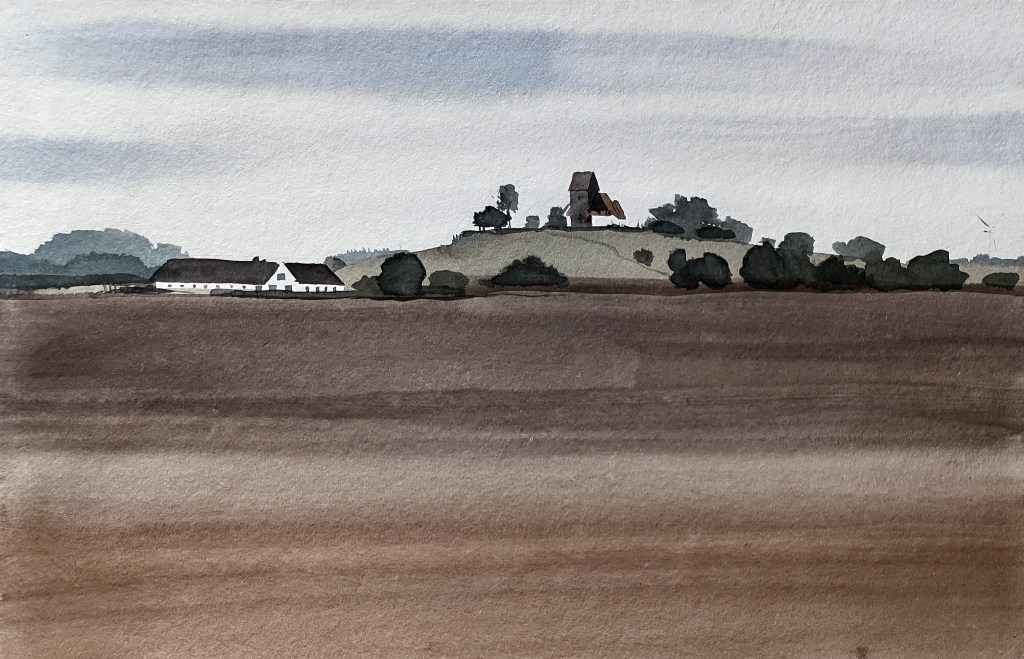
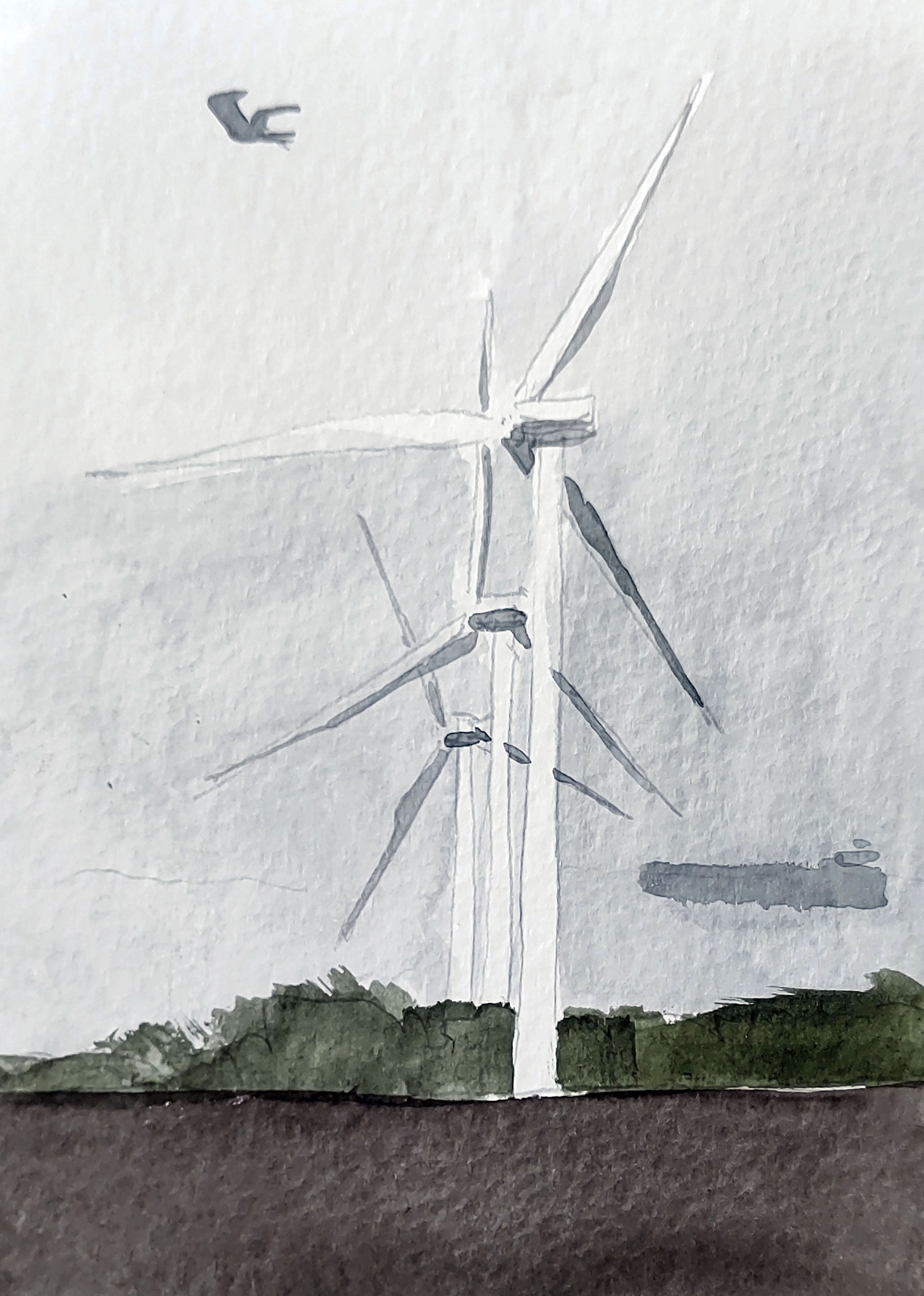
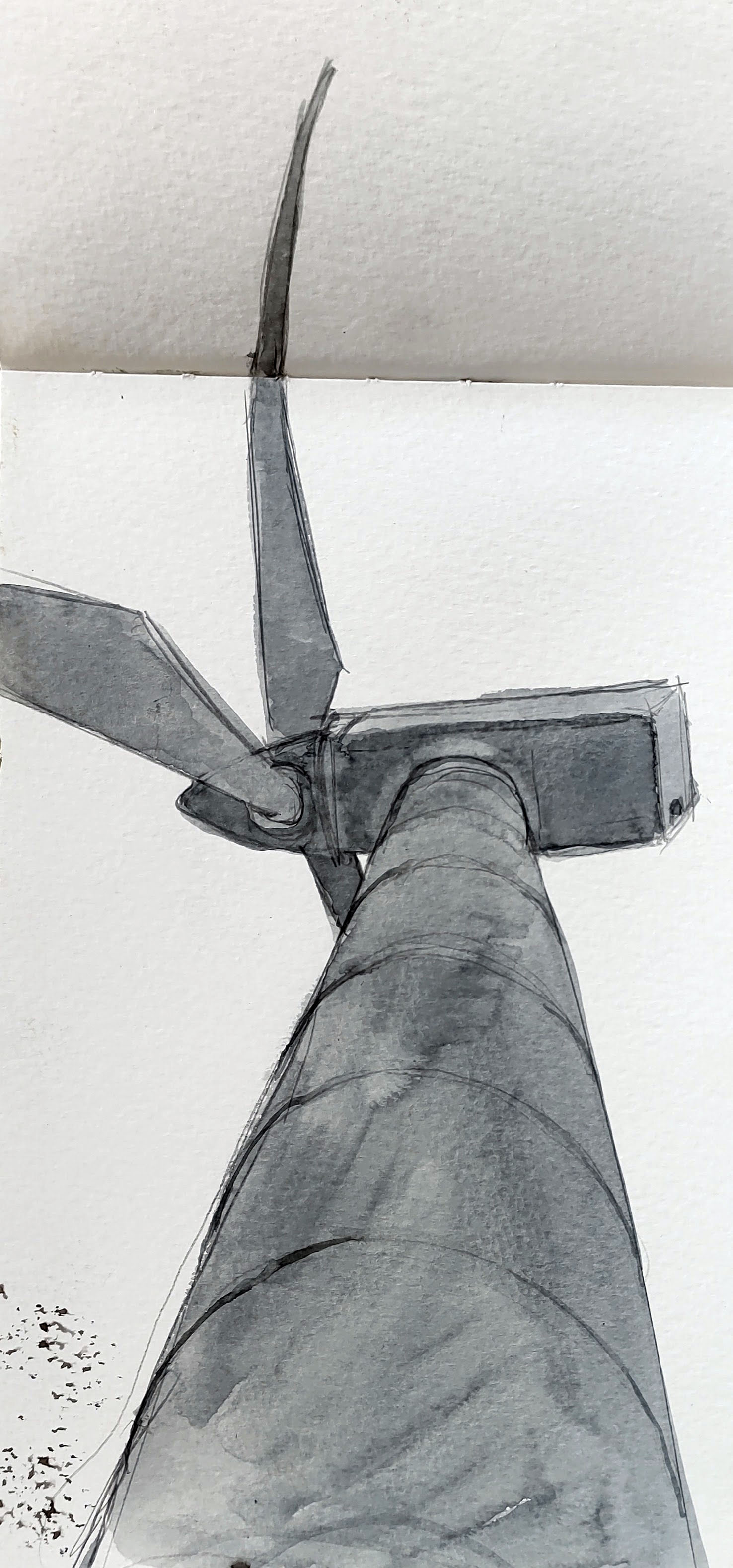
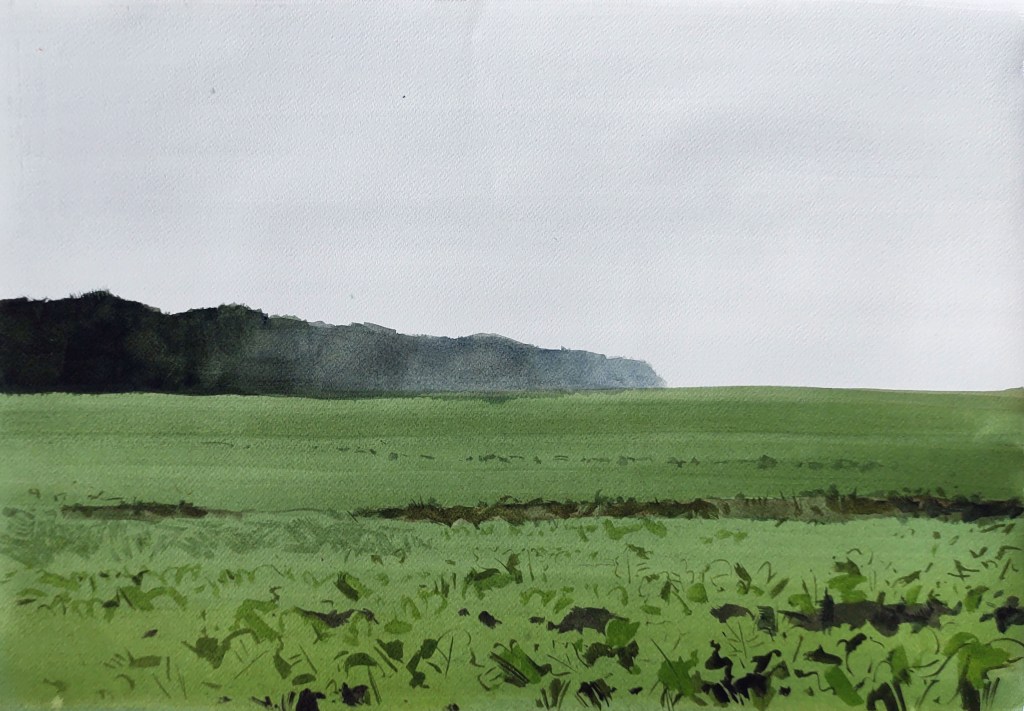
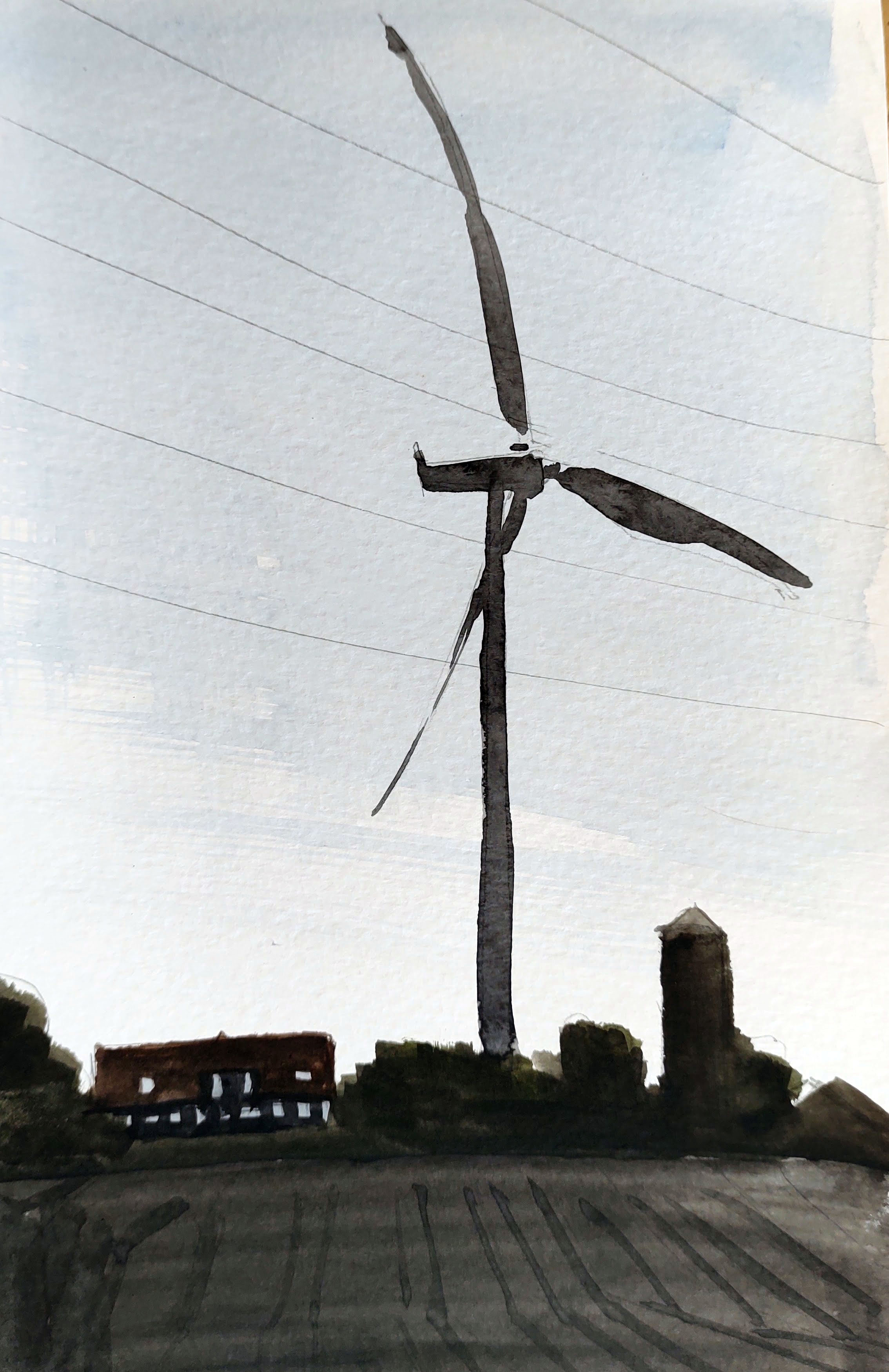
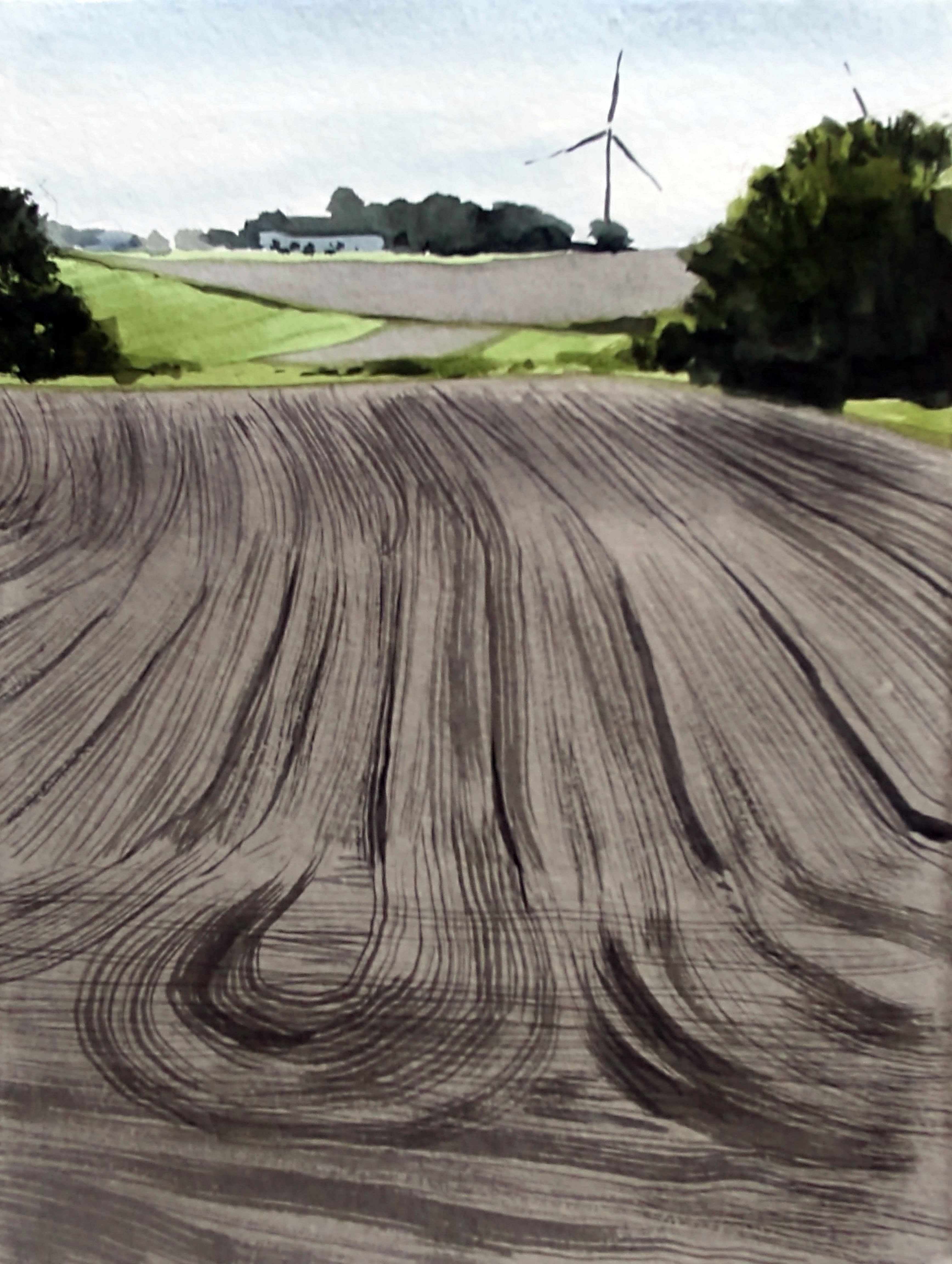
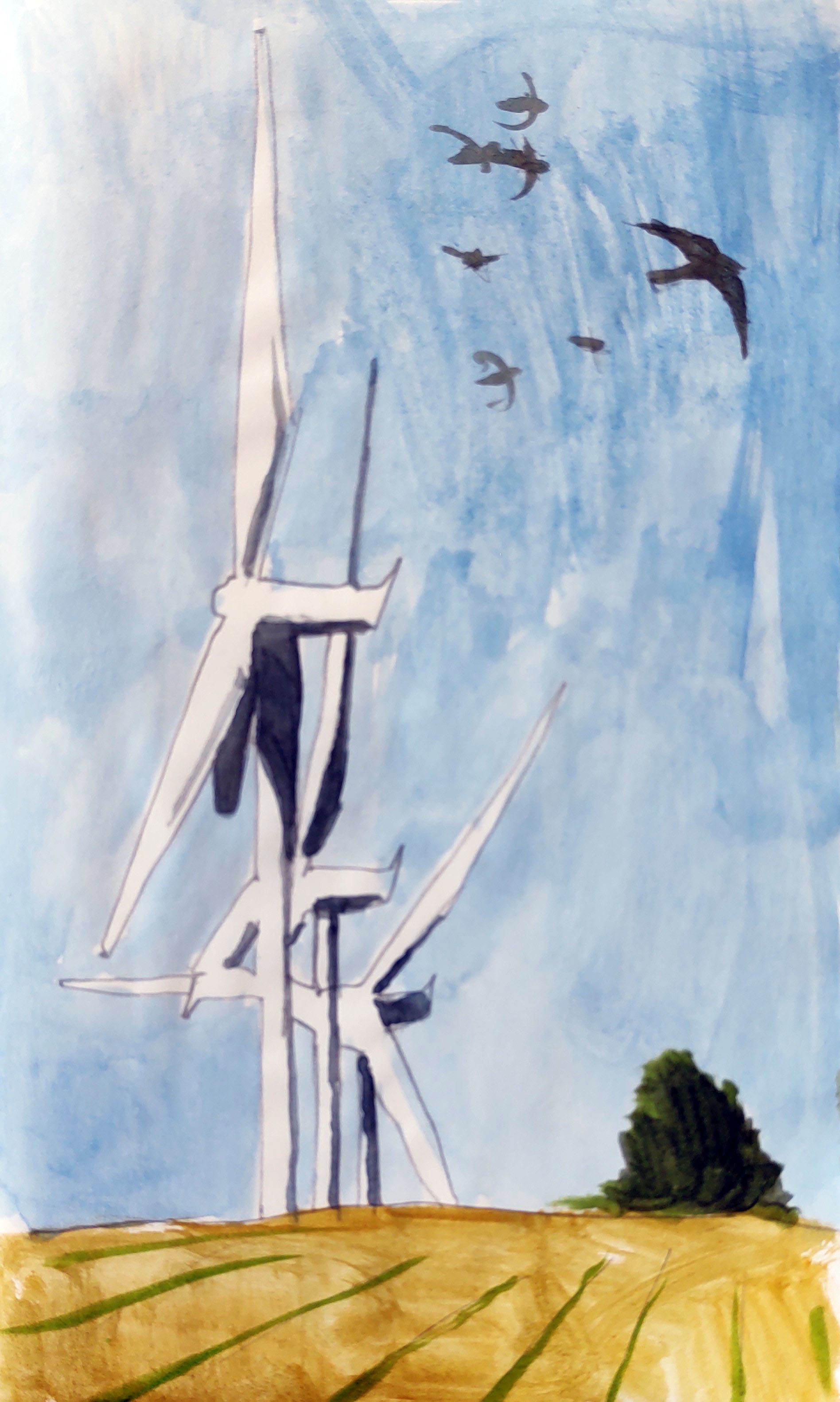
The area was gently undulating with large fields, recently tilled and planted. The landscape was dominated by the whoosh and grind of several huge windmills. The sea blended invisibly into the sky, and a distant oil tanker seemed to float in the sky.

Eventually I made it down to a narrow and seldom-visited road passing north and parallel to the coast. I paused for a while on a well-positioned bench and painted the grey sea and sky.

View from Udmarksvej

Rain threatened but never arrived. I carried on down to the beach at Gines Minde, as ever glad to be by the sea. I looked north with my telescope at the cormorants gathered on the white granite cliffs of Hvidkleven.

Hvidkleven

Heading north again I took a shortcut along a field edge and paused to paint the new rapeseed growth.

Field between Melgaard and Bakkegaard

From here I walked on very quiet and secluded roads. Nydam, a narrow and picturesque lake was sheltered in a narrow valley. Above me a kestrel, sparrowhawk and buzzard sparred playfully in the updraft.

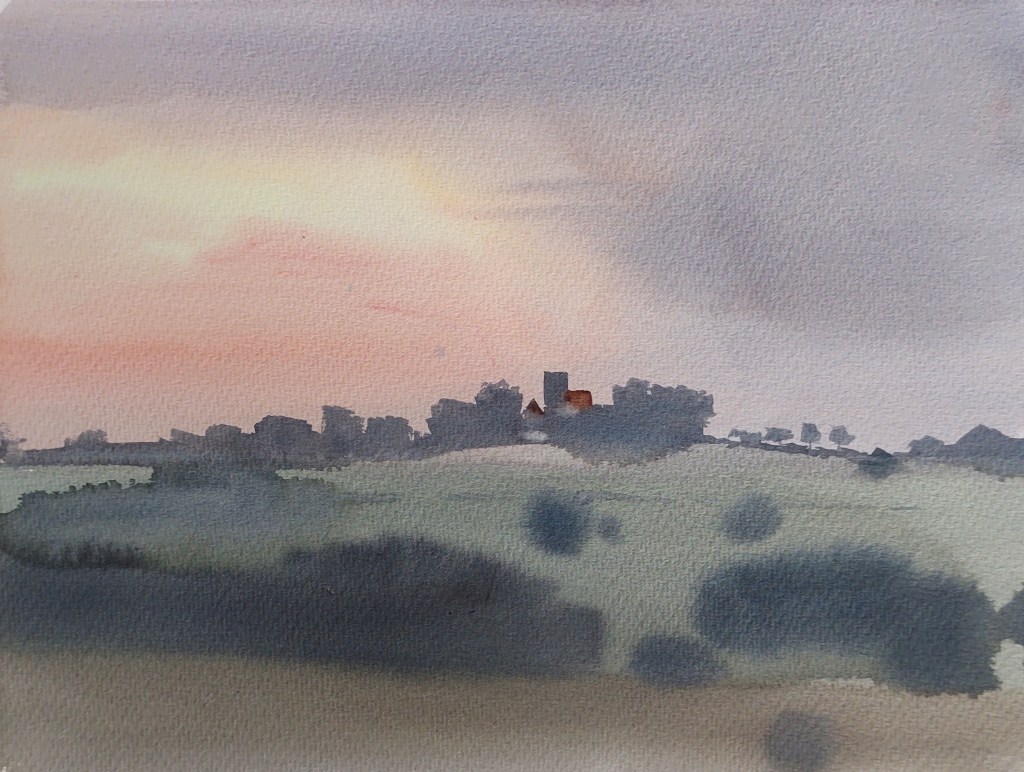
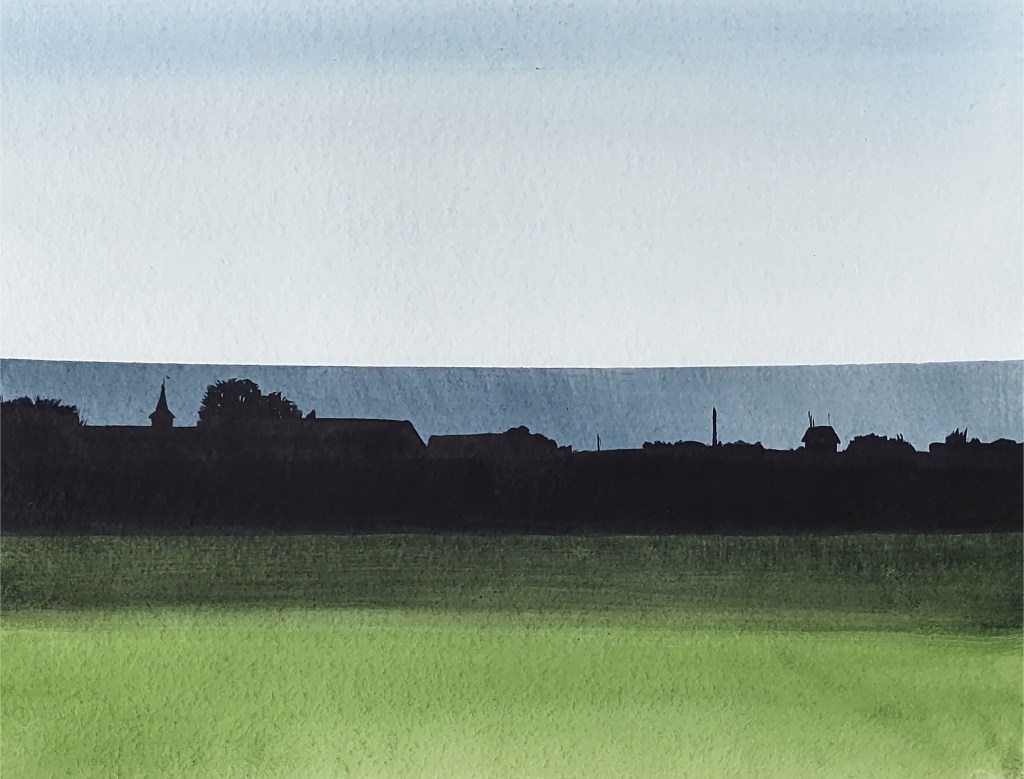
I carried on through the intensely cultivated land east of Ruts Church. By now I was tired and lacking inspiration. At the day’s end I made one last painting of the distant church through the milky light of the setting sun. The day was done.

Ruts Church seen from Rosendalsvej

LAND 39

WEATHER REPORT – Overcast all day. Temperature 11 – 19 degrees. Wind 3 – 5 m/s, from the south. Hours of precipitation: 0 hour. Hours of sunshine:  0 hours.

STOPS with the BIVVY – 0

KILOMETRES WALKED – 17.14 km

DAY LASTED – 11h and 55 m

PEOPLE TALKED TO – 2

BIRDS SEEN and HEARD – 45 species (1 new, lesser black-backed gull) = 130 species in total.

LESSONS LEARNED – I should have checked my gas. I ran out and was unable to make tea.

IN MY HEAD – Biogas dominated completely.

LAND 38 – Brogaardssten to Ruts Church, 21.09.23

Denne side på Dansk

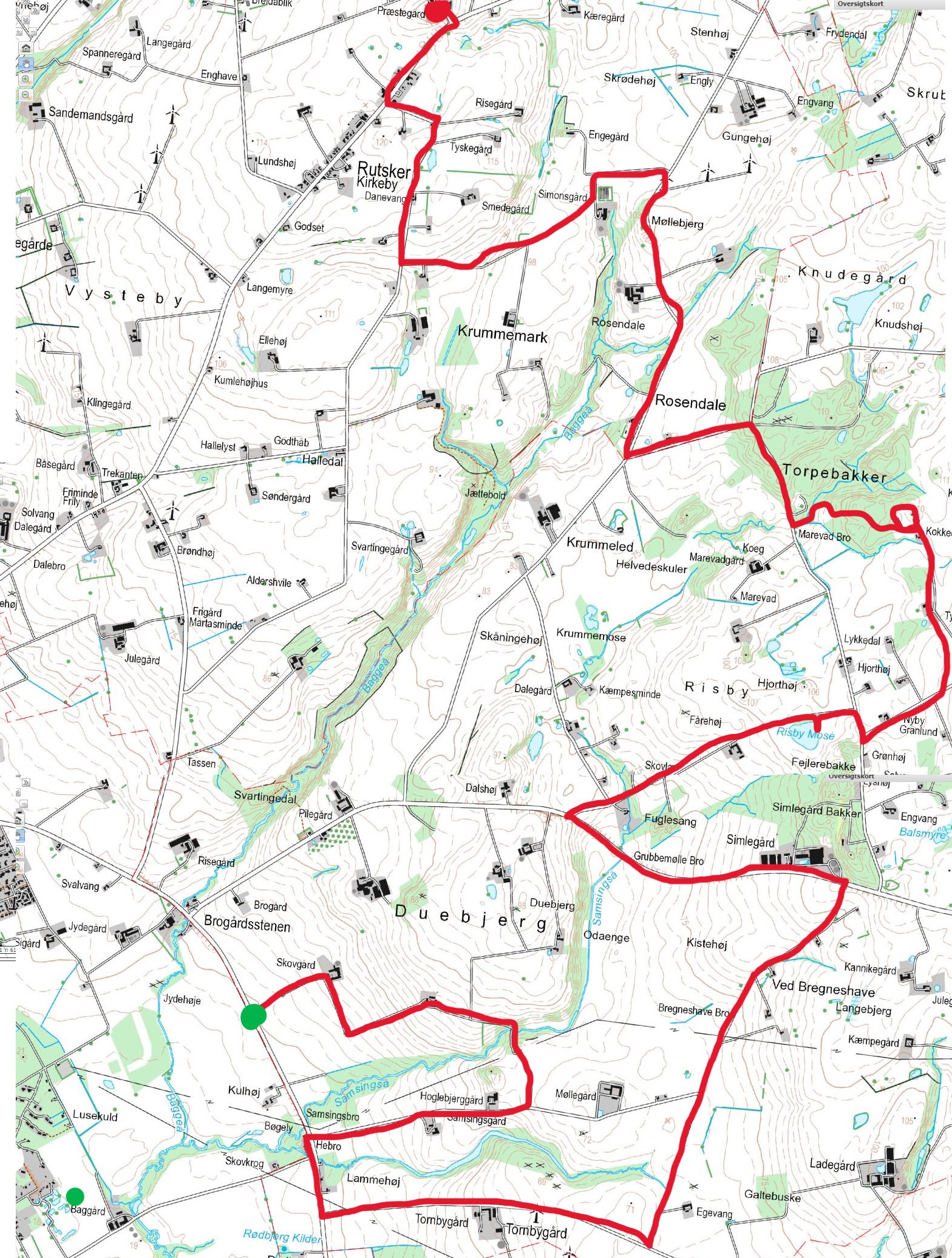
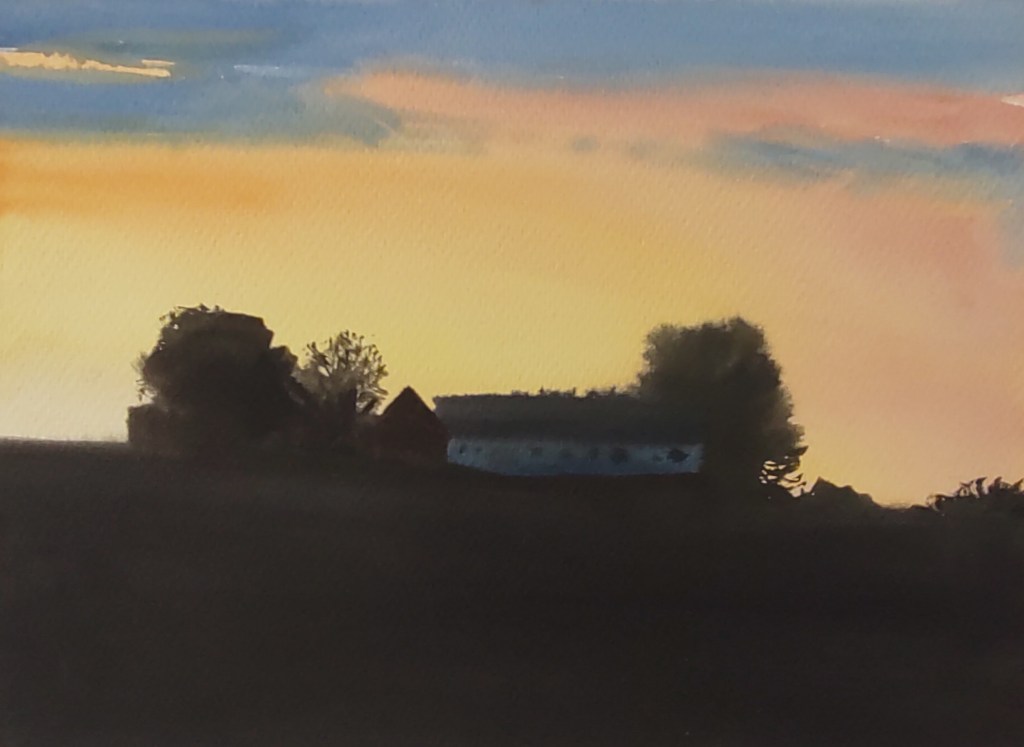
LAND 38 From my starting point on the main road I headed east and uphill, away from the flat fields and forests between Rønne and Hasle. The day was still and clear, the sunrise golden.
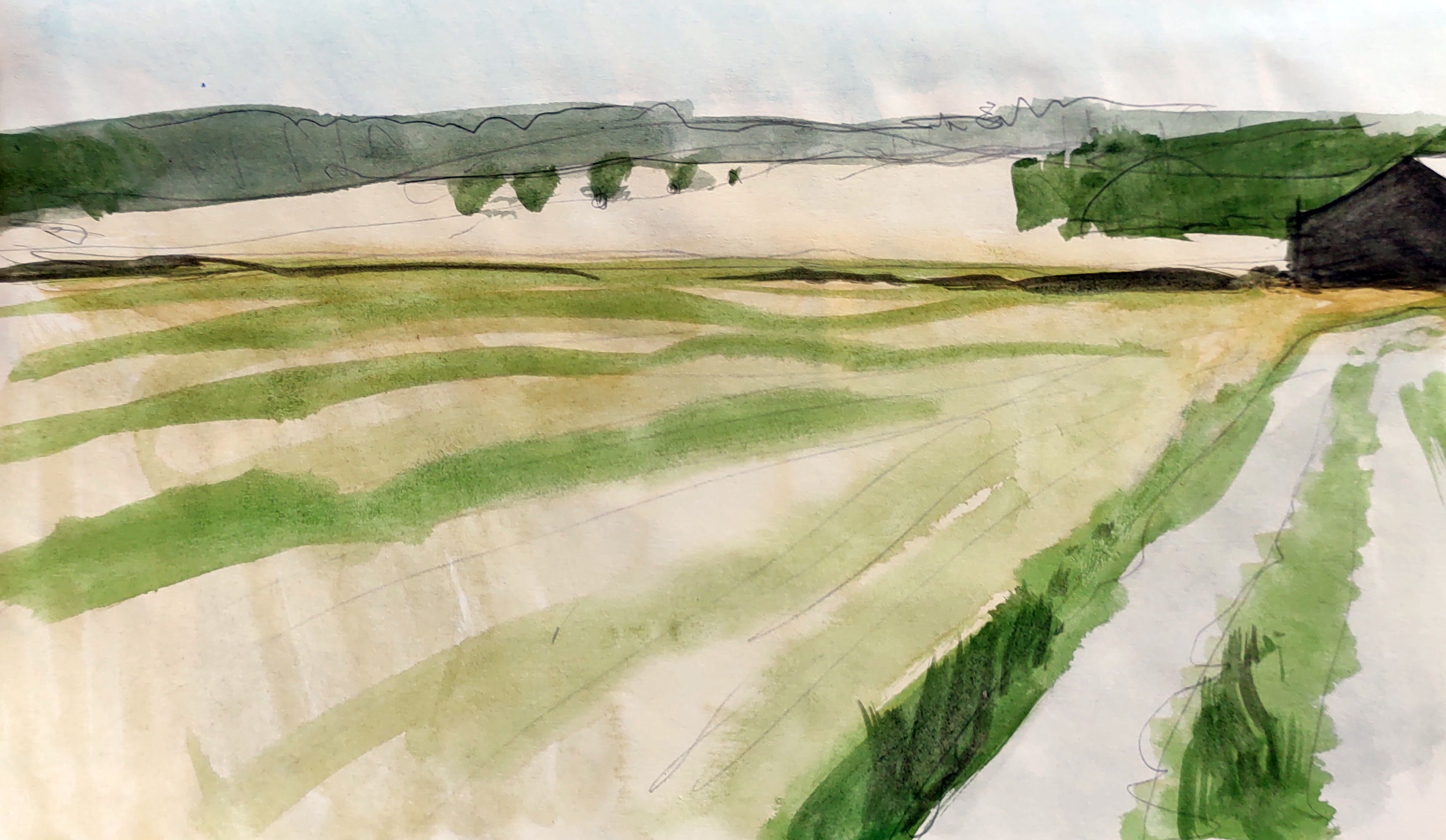
Sunrise from Duebjergvej

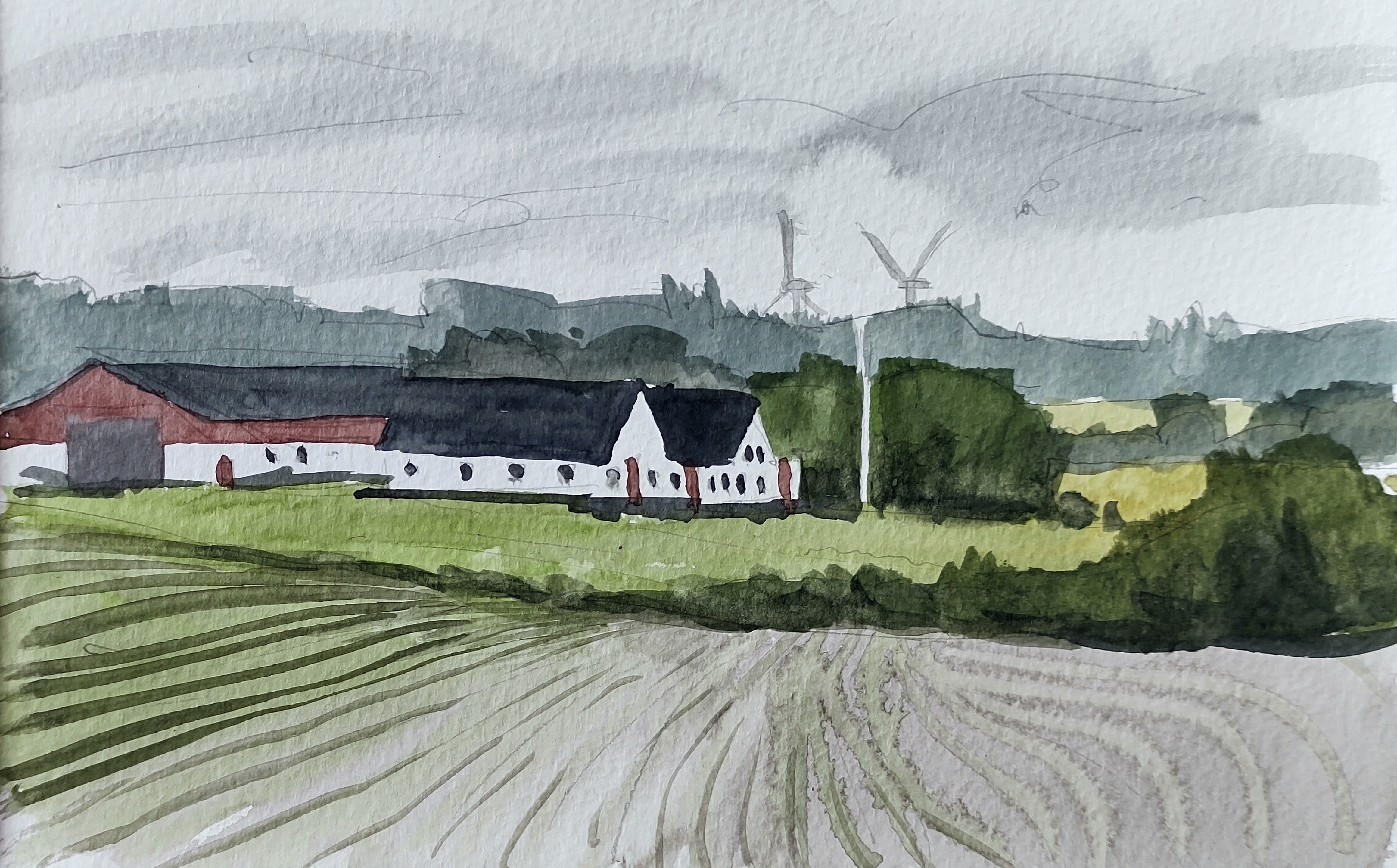
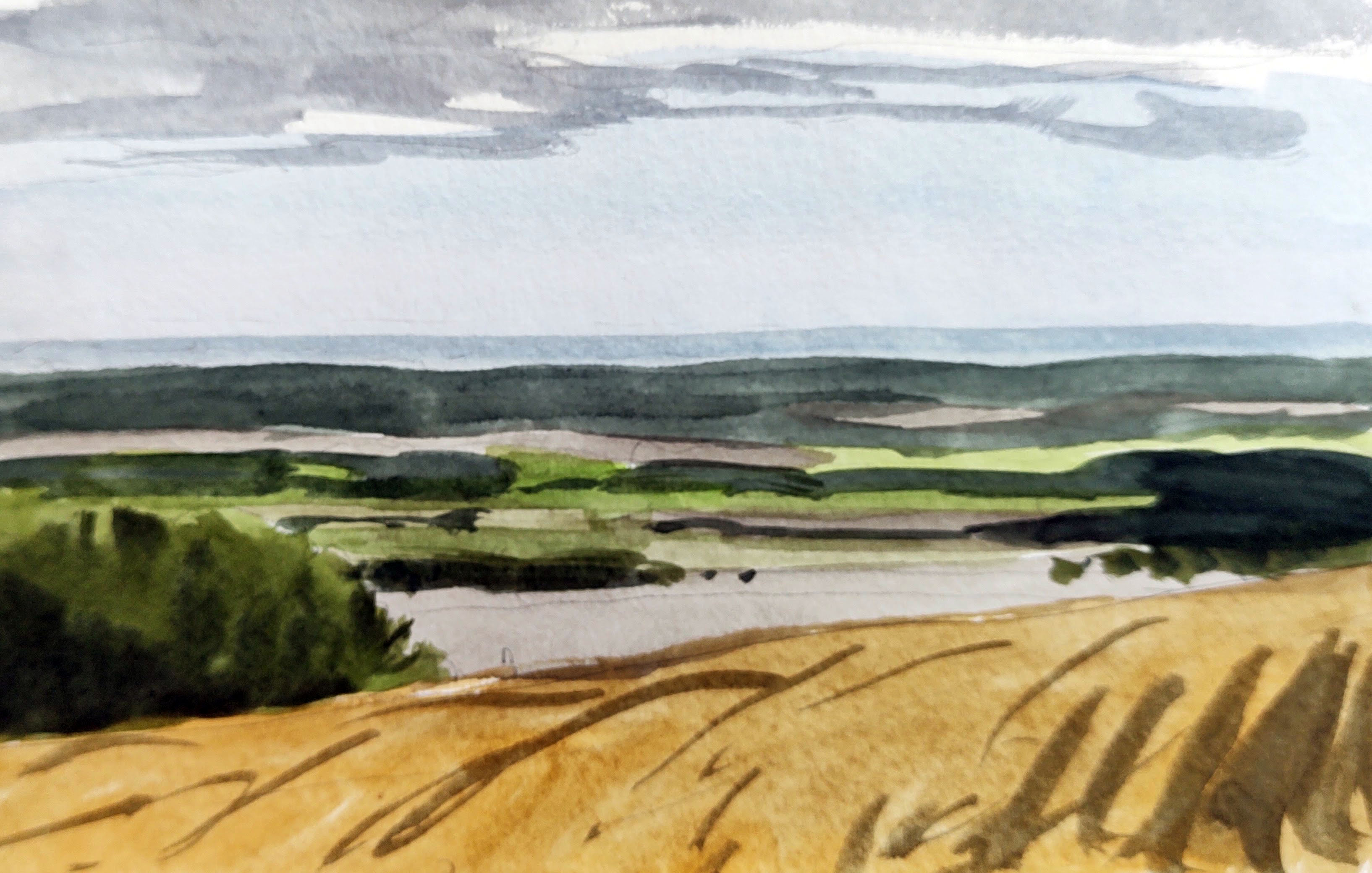
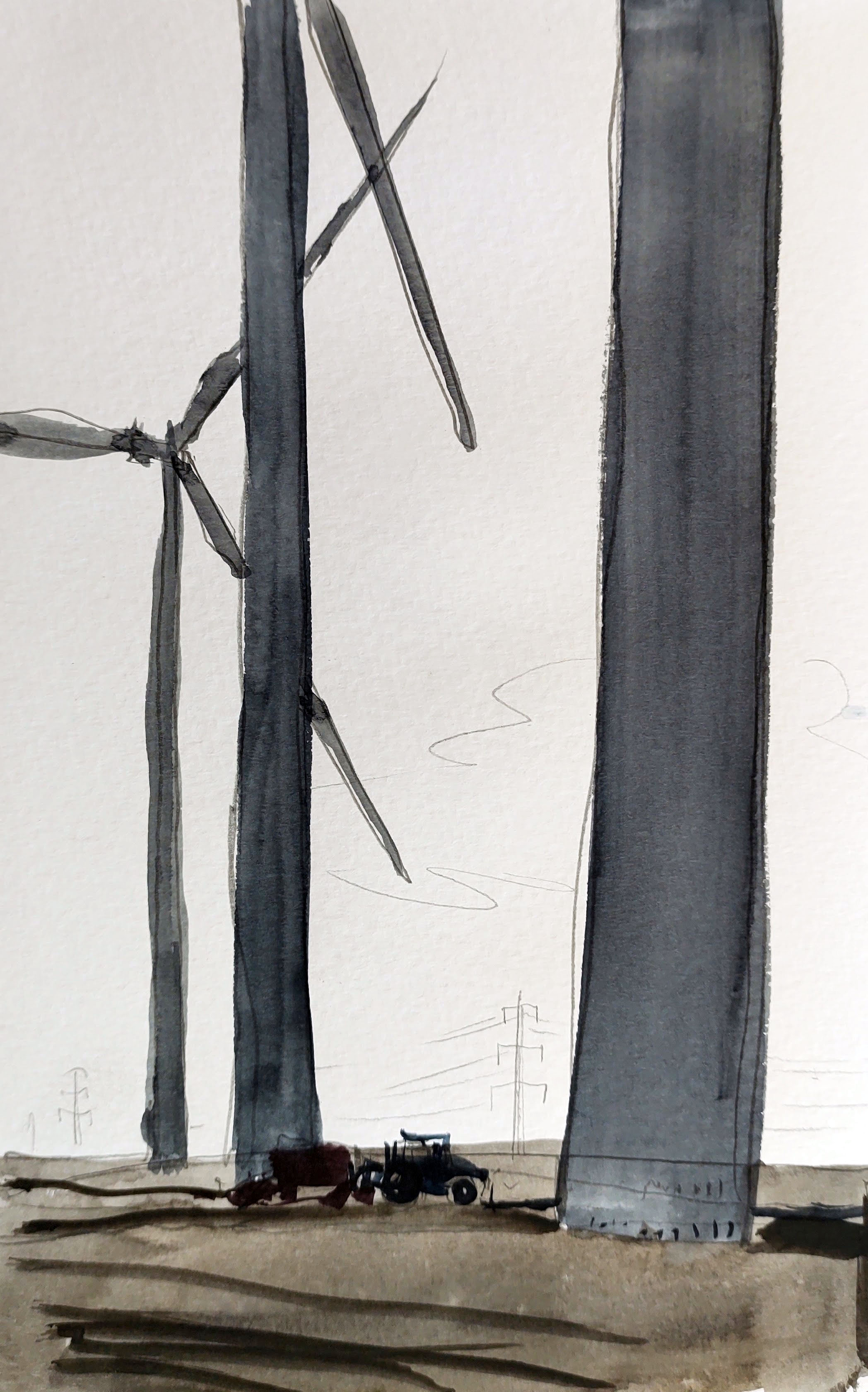
My meandering path switched direction several times, down towards the coast and then uphill again. A tractor passed between two of the huge windmills dominating the skyline.

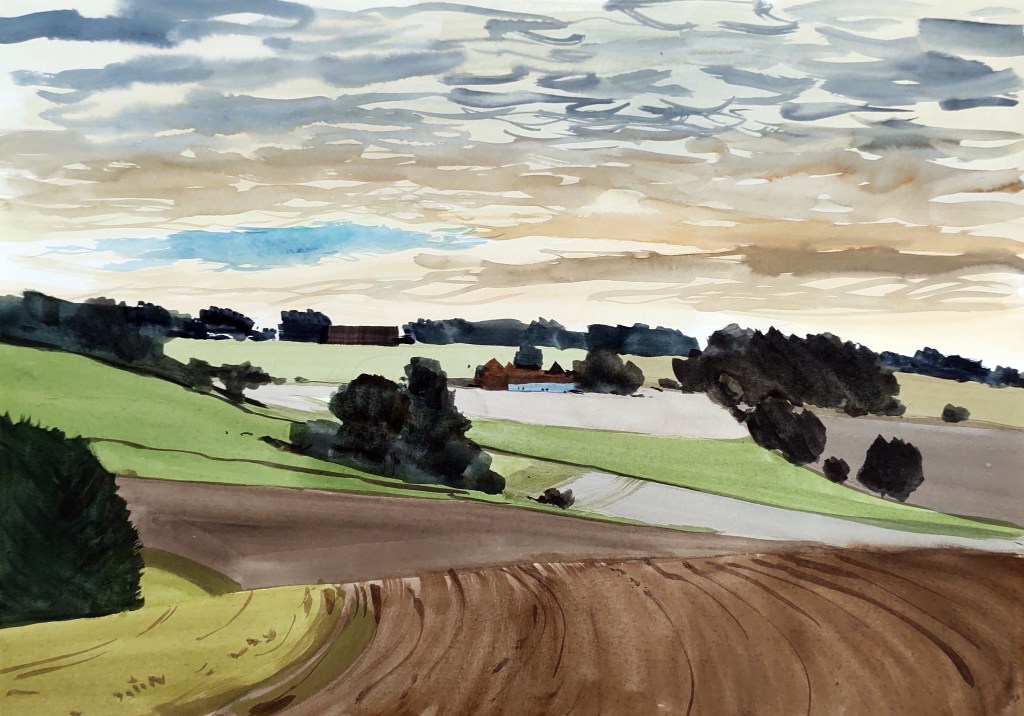
I continued northeast into a gently undulating cultivated landscape with a patchwork of fields, small woods, farms and homesteads.

View from regnehavesvej

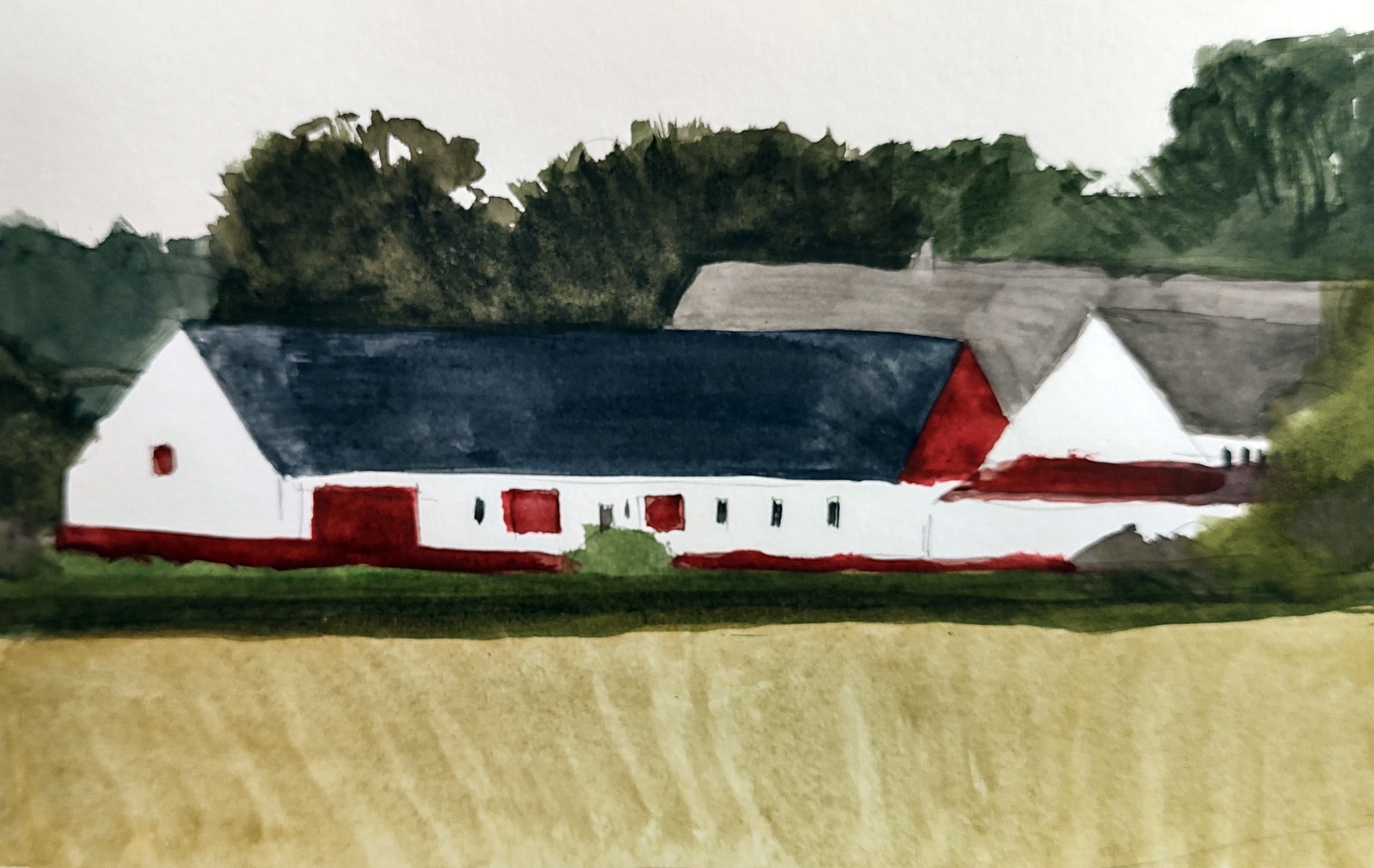
Later I reached a large and impressive-looking farm, Simlegaard. A sign or plaque on the farm proudly described how former farm proprietor Lieutenant Colonel Michael Ekstein had been instrumental in ending the Swedish occupation on Bornholm in 1658.

I saw very few people or cars, the only signs of activity were the tractors working on the fields. Immaculate lines looped and followed the contours of the fields.

Simblegårdsvej, looking East

I walked around Bolbybanen, a motorcross track recently opened by a determined group of volunteers. Not for the first time I thought about how Bornholm’s land is changing all the time – granite, sandstone, fault lines, ice ages, forests… and how our use of this land is also in constant change – from agriculture, to forestry, to industry, to recreation – constantly evolving and transitioning. Around the track I found several young sand lizards – a protected species that at one point had threatened the very creation of the racetrack.

Young sand lizard

I continued through a fine oak and pine forest at Torpebakke, and then north through dales and hills towards the church at Rutsker. The church sits high in the landscape and could be seen from many points during the day’s walk. Above me buzzards circled lazily in the thermals.

Buzzard studies

As I approached the church I had a sense of transition – of moving into a new space and time. It was a fine, sunny and warm day, but I could feel autumn waiting in the wings, and the landscape felt different. I looked forward to the turbulent weather of the coming months and the wilder landscape of North Bornholm.

Ruts church

From Ruts church there was a fantastic view down to the sea and the setting sun. It was the day before the autumn equinox. The sun dipped behind a bank of purple clouds and the day was done.

Sunset seen from Ruts church

LAND 38

WEATHER REPORT – Mostly sunny all day. Temperature 17 – 23 degrees. Wind 4 – 5 m/s, from the southeast. Hours of precipitation: 0 hour. Hours of sunshine:  9.5 hours.

STOPS with the BIVVY – 0

KILOMETRES WALKED – 19.44 km

DAY LASTED – 12h and 21 m

PEOPLE TALKED TO – 1

BIRDS SEEN and HEARD – 41 species (0 new) = 129 species in total.

LESSONS LEARNED – I should have spent a bit more money on my new binoculars.

IN MY HEAD – The art project ‘Klippekroppe’ that I was involved in. The creation of the anamorphic land art square I had to make. How little time I had to do everything. Performance art. The SWLA catalogue. Biogas. How to engage the public. Radio and TV interviews.

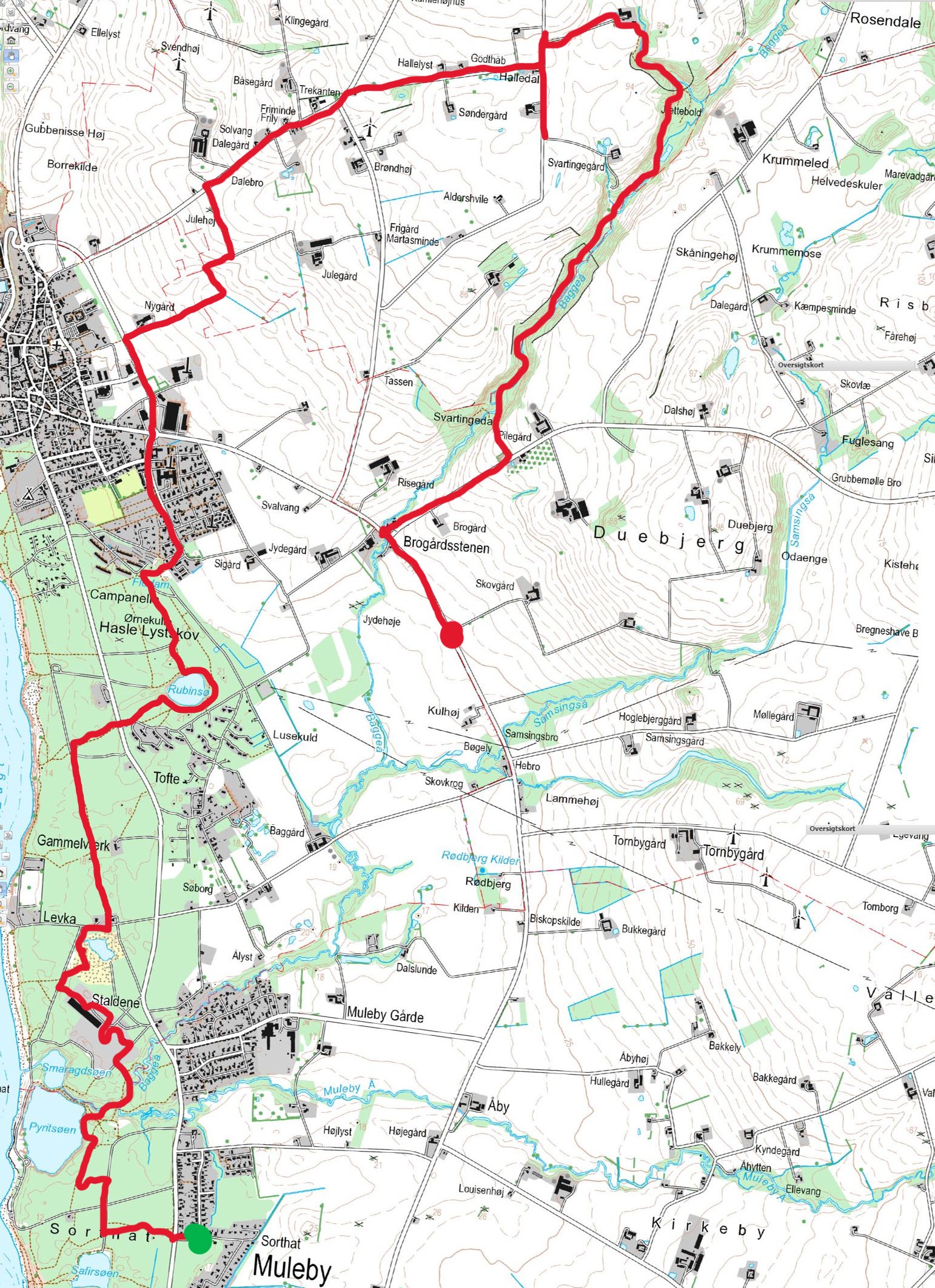
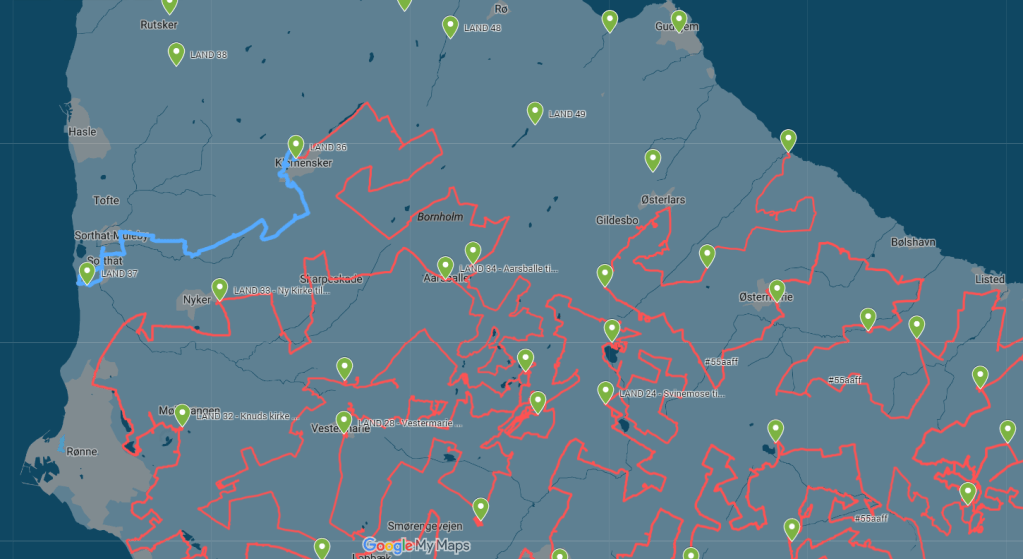
LAND 37 – Sapphire Lake to Brogårdsstene, 15.09.23

Denne side på dansk

Dawn started clear and bright – only 10 degrees Celsius but completely still, so I didn’t feel cold at all. I walked through a forest of pine and then beech, for a while following my path from last week, hoping I would find my missing binoculars.

I ended up by the side of Pyrite Lake, a large water-filled quarry. The sound of the distant sea was reflected or echoed in the trees to my left, creating a peculiar, unbalanced sensation.  A kingfisher streaked by and settled briefly in the reed beds by the lake shore.

Pyritssøen

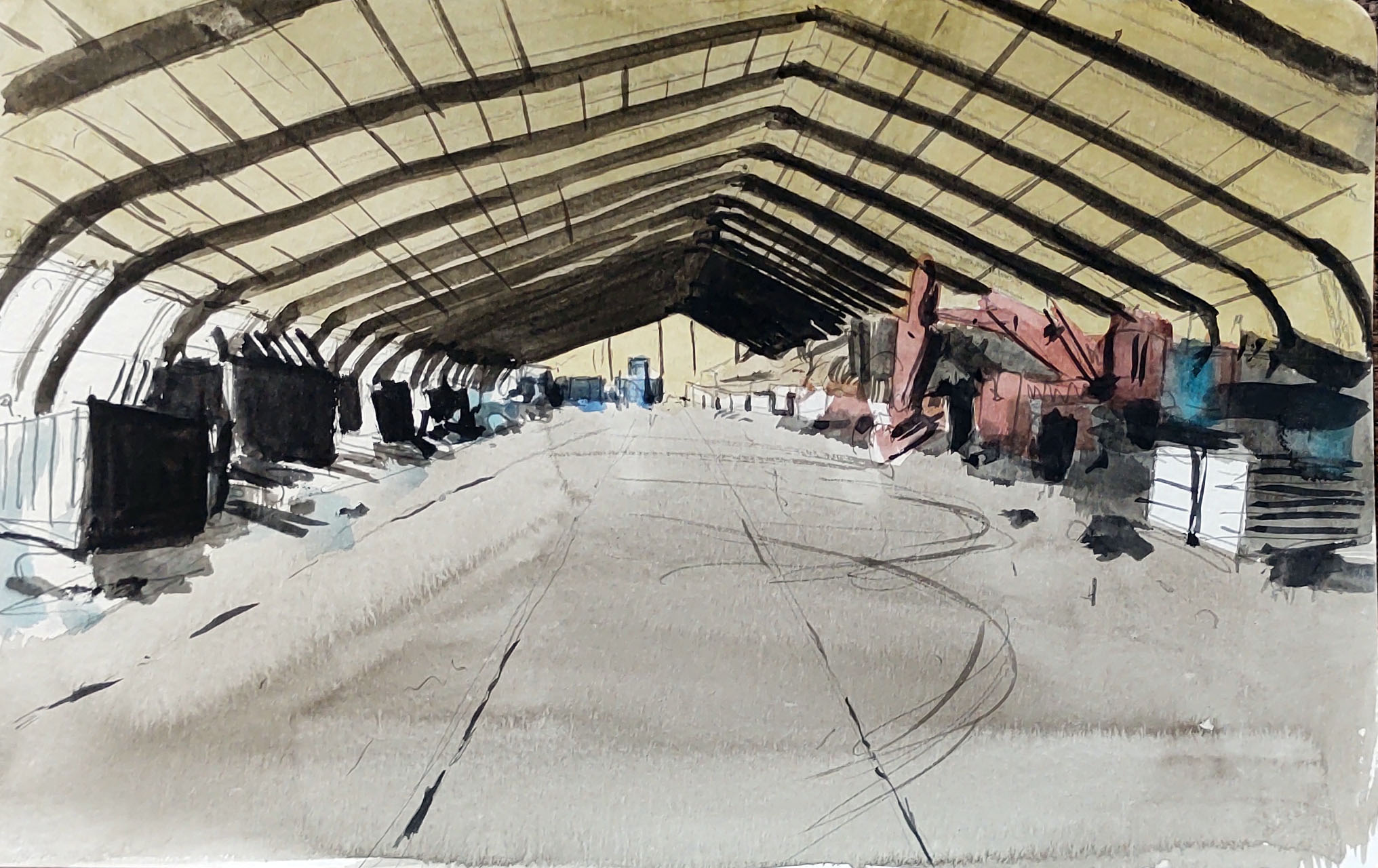
Later I wandered around the ruins of the Hasle Klinker factory, once Bornholm’s largest single employer. Long since dismantled, parts of the area are being reclaimed by nature. Piles of aggregates and various building materials are still stored in the remaining paved areas and the cavernous production hall. In the nearby ‘Quartz lake’, giant piles of gravel and sand are hidden within the forest.

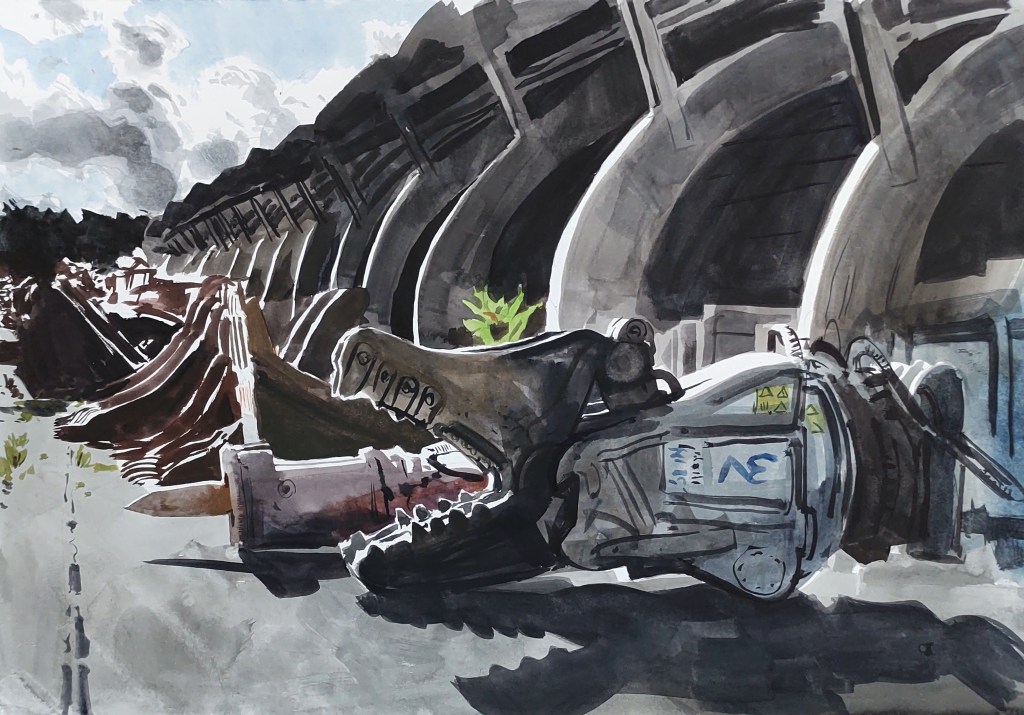
This area between Hasle and Rønne is a testament to the ever-changing relationship between man and nature – a story of shifting sand dunes, pine plantations, huge extraction industries and now, recreational pursuits. Mountain bike paths bisect corroded railway lines. A row of Industrial digging equipment lies rusting and forgotten like a display of long-extinct prehistoric creatures.

Dinosaurs

Eventually I left the coastline and the forest and headed uphill and inland, through the familiar cultivated landscape of rural Bornholm. Looking back I had fantastic views of the town of Halse, the Baltic Sea, and even the distant coastline of Sweden. Above me, raptors and corvids quarrelled and bickered in the clear blue sky.

The view from Julehøj

By late afternoon I reached the start of Svartingedal, a narrow and heavily forested rift valley cut deep into the landscape. I followed the stream down through a tumble of ash, beech and cherry, the valley sometimes widening to a meadow grazed by cattle and goats, sometimes narrowing to a maze of fallen trunks, twisted ivy and bramble.

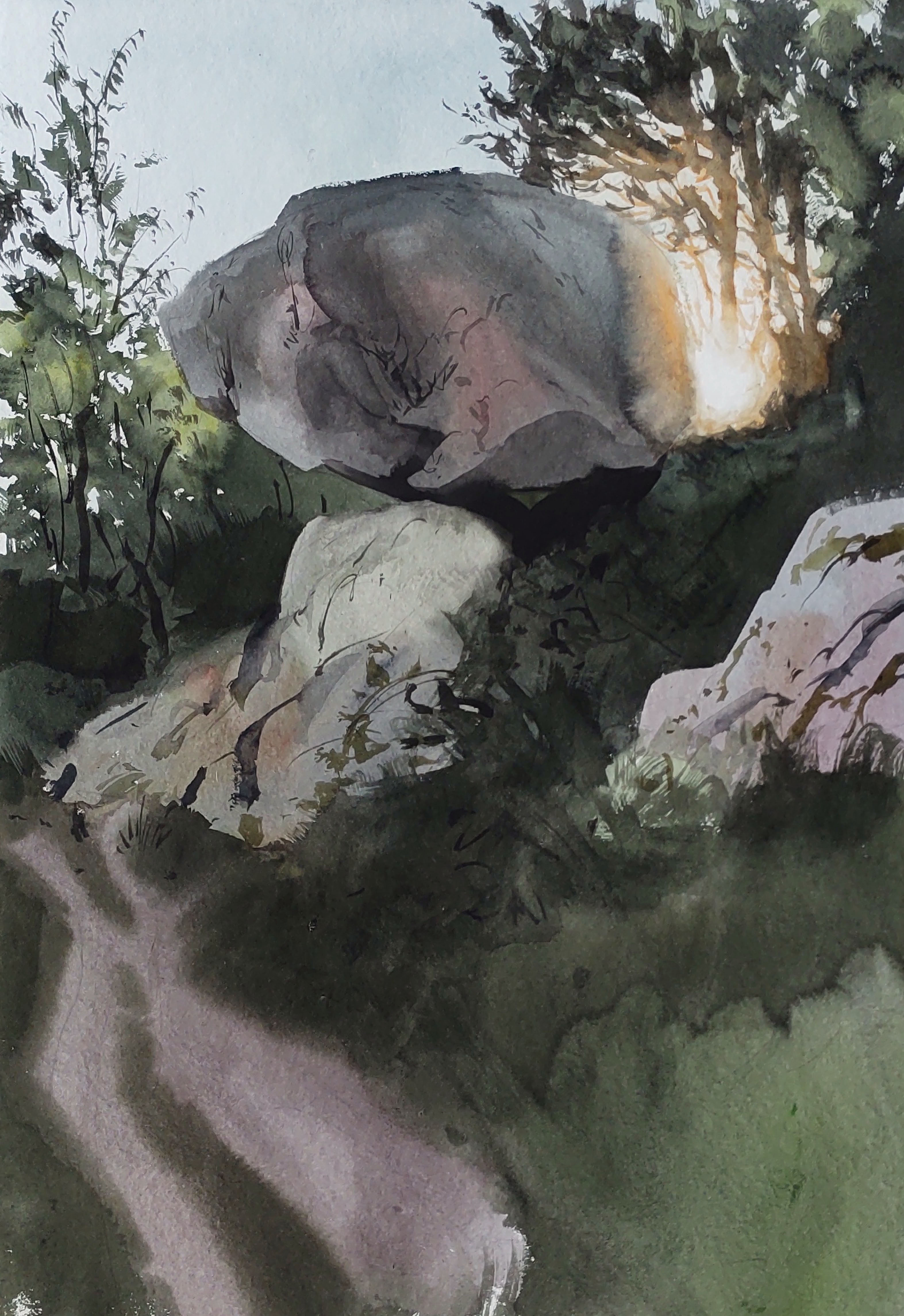
Balanced precariously at the top of the valley lies ‘Jættabujl’, an erratic boulder apparently thrown all the way from Sweden by a troll – aiming for the nearby Klemensker church.

Jættabujl

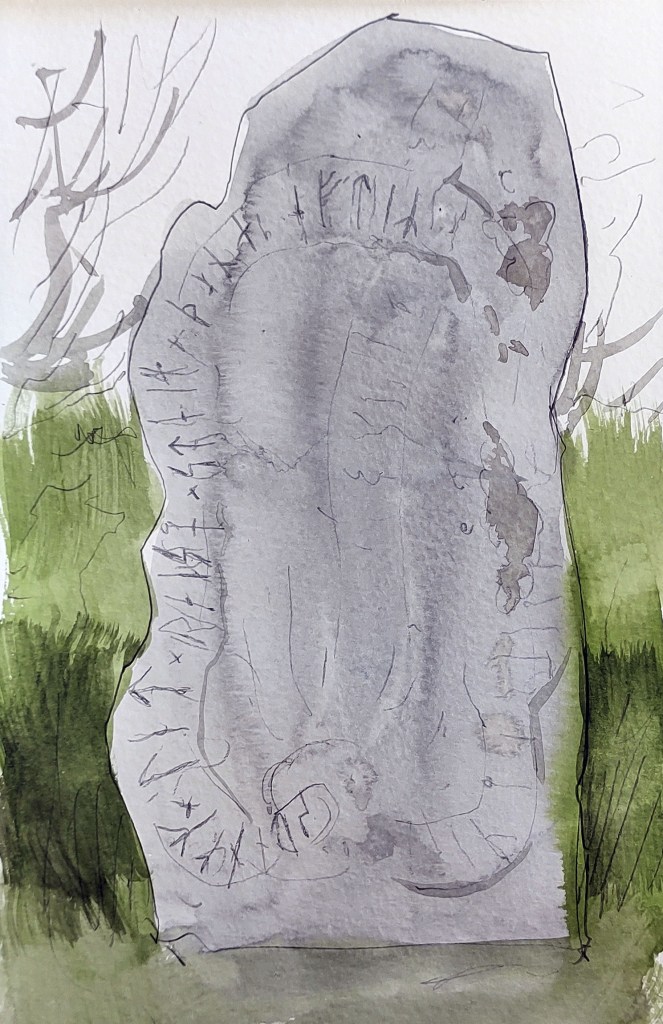
Emerging from the valley I continued down the road to Brogårdstenen. Bornholm’s largest runestone- I could just about manage a last exhausted sketch before the sun slipped below the horizon and the day was done.

Brogårdsstenen

LAND 37

WEATHER REPORT – Mostly sunny all day. Temperature 10 – 20 degrees. Wind 1 – 4 m/s, from the south. Hours of precipitation: 0 hour. Hours of sunshine:  9.5 hours.

STOPS with the BIVVY – 0

KILOMETRES WALKED – 15.86 km

DAY LASTED – 12h and 47 m

PEOPLE TALKED TO – 4

BIRDS SEEN and HEARD – 46 species (2 new – kingfisher, pochard) = 129 species in total.

LESSONS LEARNED – (actually from last week) remember your binoculars when packing up – I left them on the side of Sapphire lake.

IN MY HEAD – The Biogas issue – the political processes involved, and all the energy and effort expended.

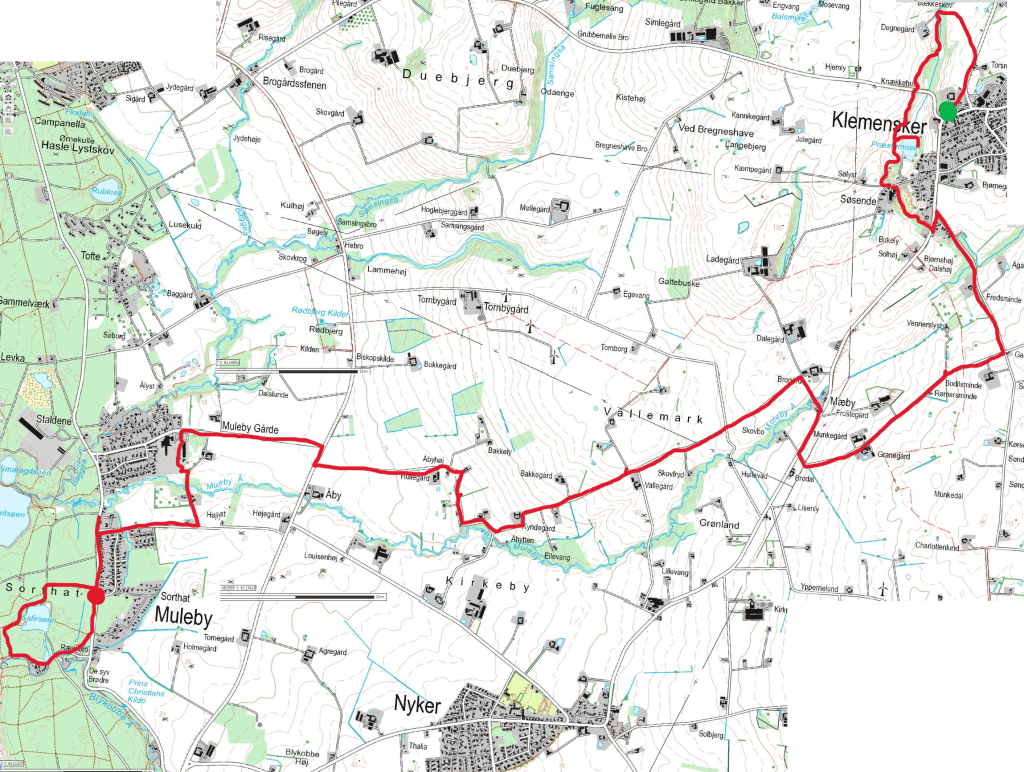
LAND 36 – Klemensker church to Sapphire Lake, 08.09.23

Denne side på dansk

LAND 36 The days are getting noticeably shorter now, and I savour the extra 15 minutes sleep every week – tempered somewhat by the fact that the start point is a little further from my house each time. I started the day refreshed and positive, looking forward to another long day outside.

Klemensker church sits solid, high, and proud in the landscape. The town is also dominated by a huge silo, and both can be seen for miles around. I walked around the graveyard for a while as the sun rose into a cloudless sky, jackdaws and rooks vociferously and vigorously welcoming the day.

From here I followed a lovely volunteer-maintained path that circles the village, walking alongside fields and pastures carpeted with dew-soaked spider webs. I stopped by the side of the picturesque village pond for a while, in the silent company of a few fishermen, dog walkers and joggers.

The village pond, Klemensker

I carried on, past the old cement works and into the intensively farmed fields surrounding the town. Huge maize fields, not yet harvested, dominated the landscape and there was very little bird life. The day was still and already quite hot. I tried to find traces of the old railway line in the fields, closed since the 50’s, but there were none.

There were fine views south all the way to the west coast and the sea beyond.

Looking south from Mæbyvej

I walked on a very quiet road. The landscape was dominated by three huge windmills that waited almost motionless for a breeze. Fortuitously I looked up as an osprey passed overhead. Later, a young cuckoo also, with angry swallows in pursuit.

Continuing downhill and heading due west, I eventually arrived at the forest planted between Rønne and Hasle in the 19th century to stop the drifting sands. The area has a fascinating history of extraction and industry – coal, clay and ceramics, and if felt fitting to visit PL Beton, a company that makes fabricated concrete components. The yard was full of all sorts of interesting shapes and structures, and I sneaked in and explored for a while, before my bottle went and I walked on.

PL Beton

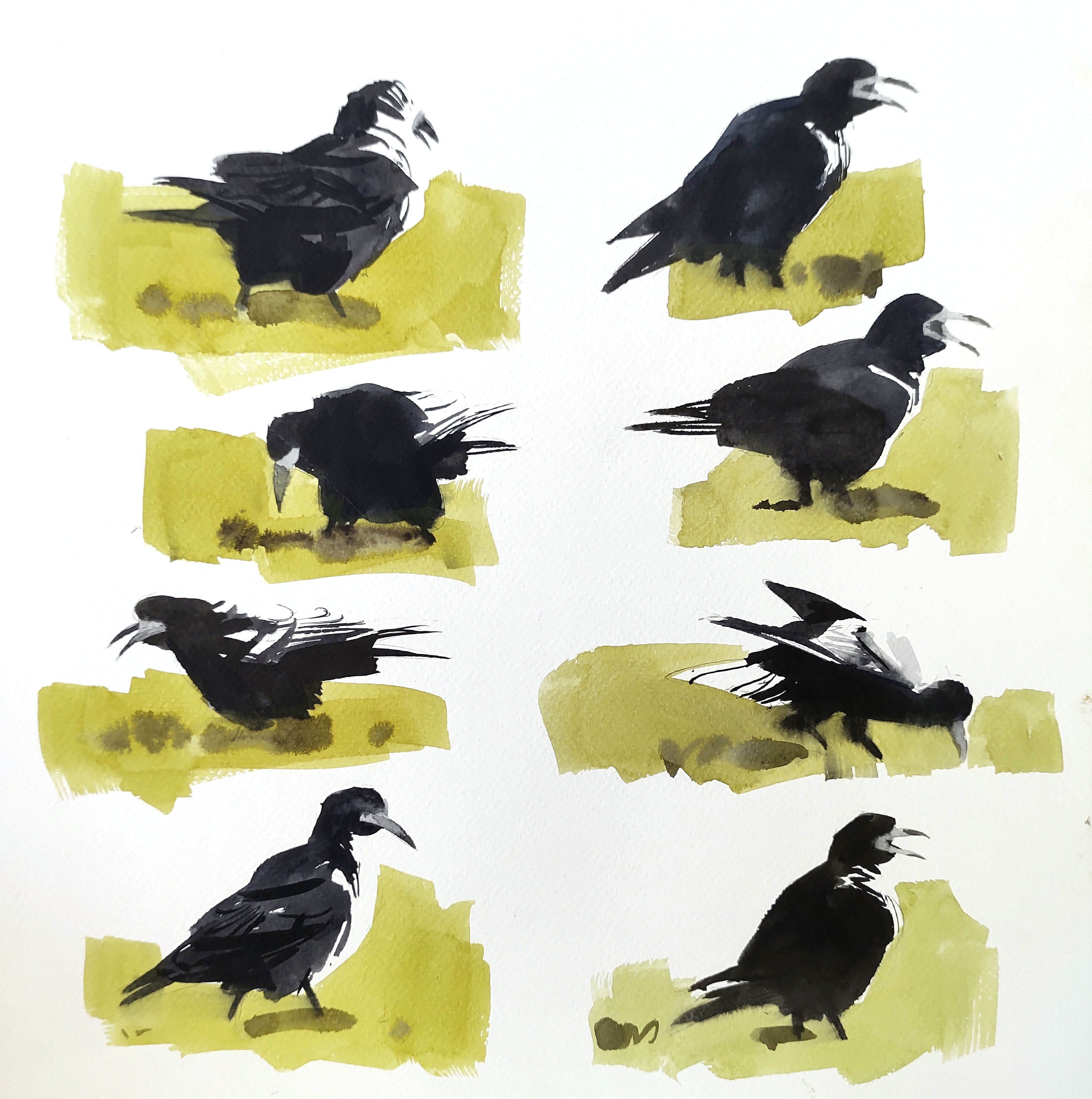
Some rooks in a recently tilled field, beaks gaping in the heat, were a welcome diversion.

Hot shiny rooks

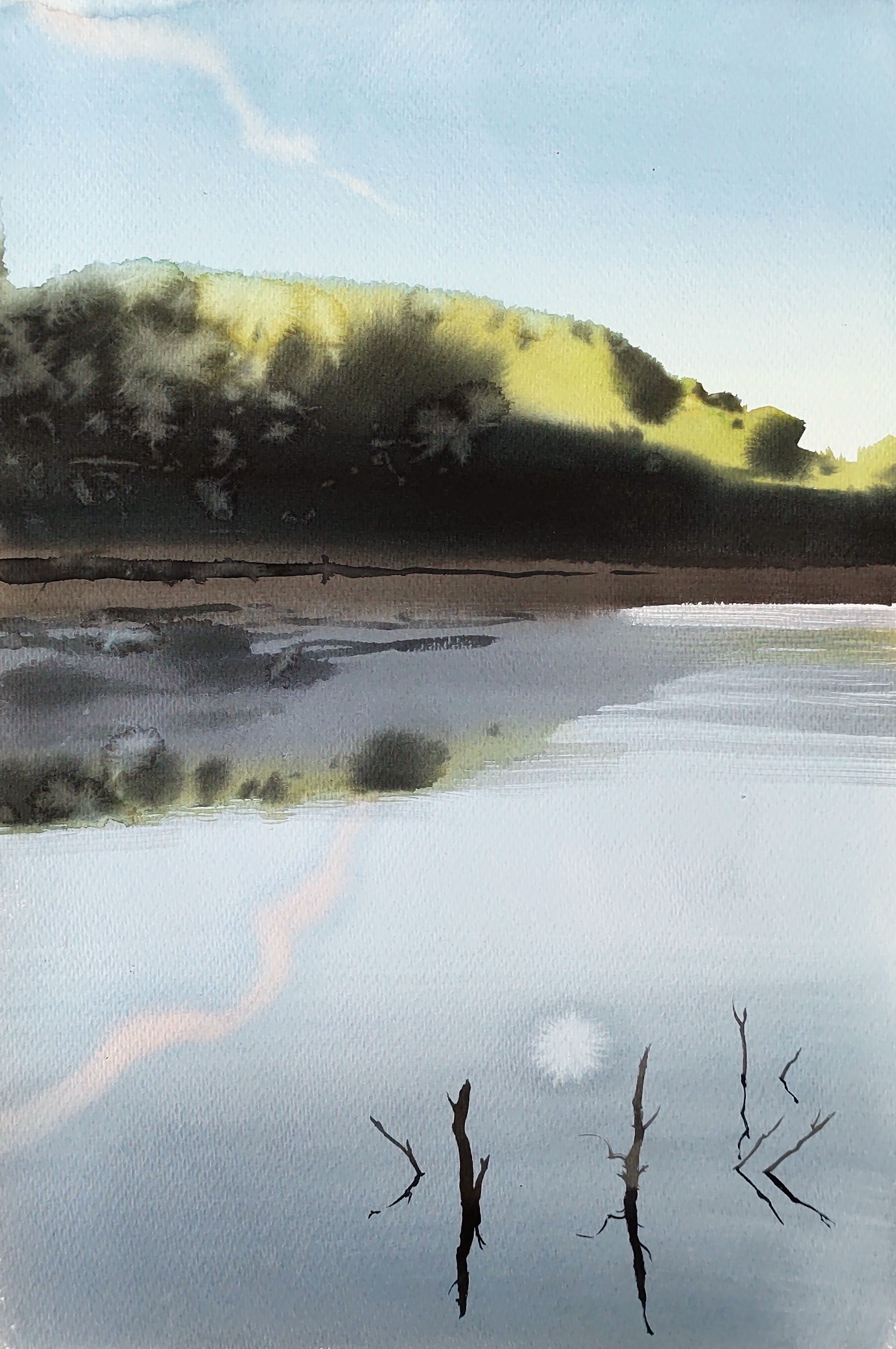
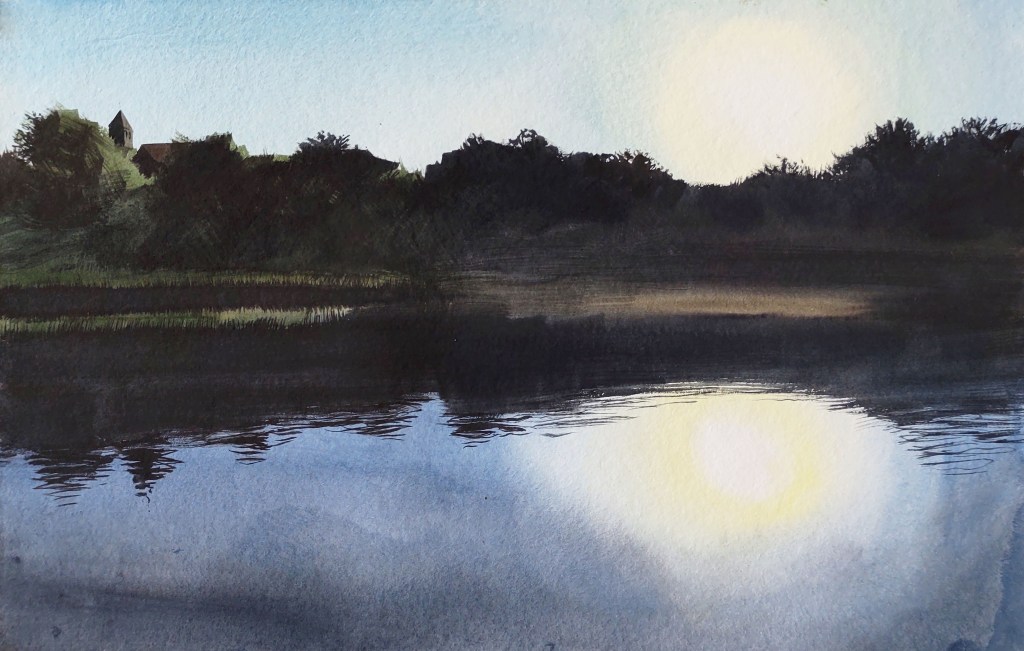
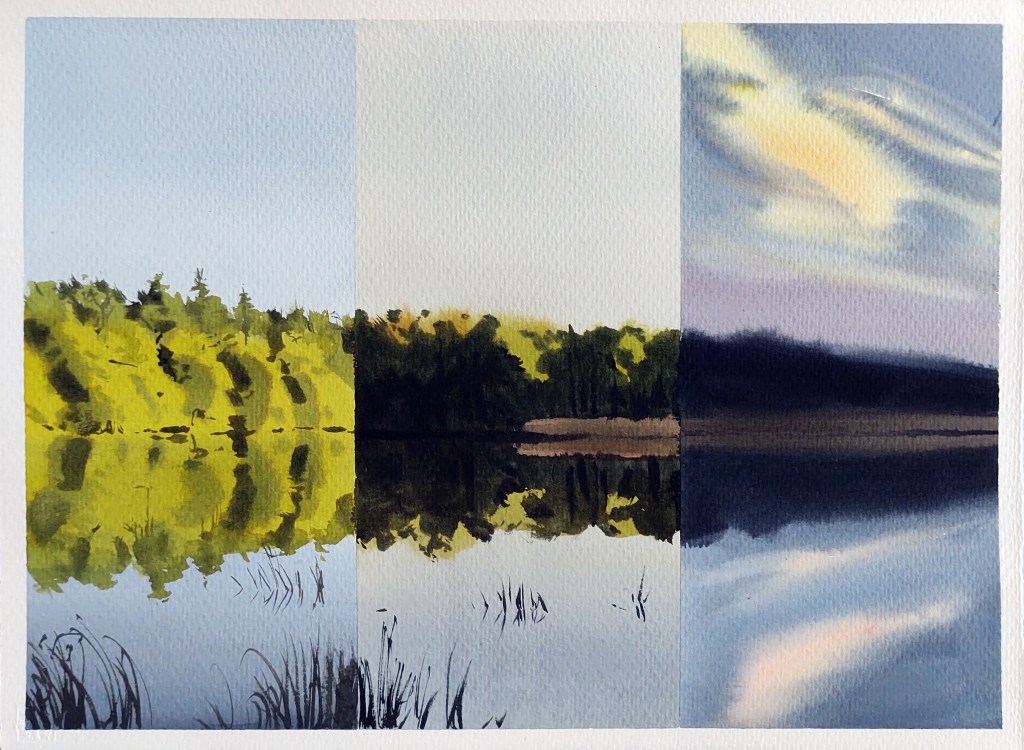
The weather was so delicious, and I was so hot, that I couldn’t resist a quick dip in the sea. The beach was almost deserted, the water mirror-like.  Somewhat regrettably I walked back into the forest to my day’s destination – the evocatively named ‘Sapphire Lake’, a clay pit dug in the 60s and aborted soon after, now reclaimed by the forest.

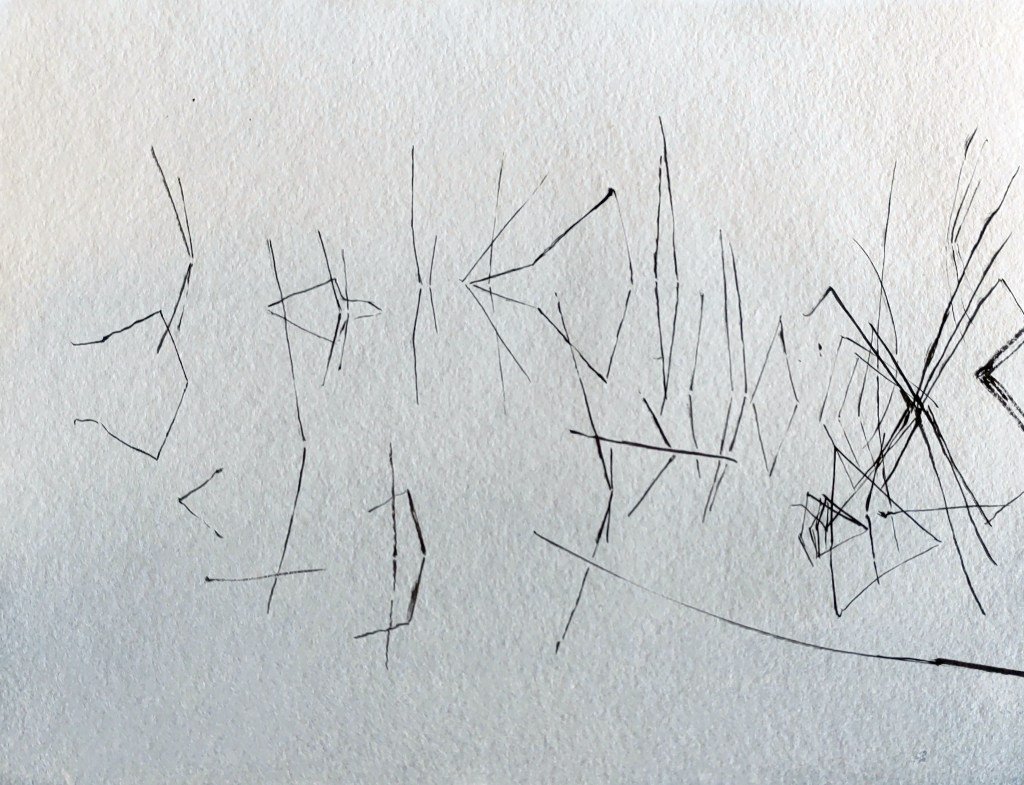
Some reeds and their reflections wrote calligraphic messages in an unknown language.

Reeds

I followed the setting sun as it burned orange on the treetops to be replaced by the inky night.

Sapphire lake

LAND 36

WEATHER REPORT – Unbroken sun all day. Temperature 16 – 23 degrees. Wind 1 – 3 m/s, from the southwest. Hours of precipitation: 0 hour. Hours of sunshine:  13 hours.

STOPS with the BIVVY – 0

KILOMETRES WALKED – 17.68 km

DAY LASTED – 13h and 28 m

PEOPLE TALKED TO – 0

BIRDS SEEN and HEARD – 46 species (1 new – osprey) = 127 species in total.

LESSONS LEARNED – don’t store mosquito repellent in the same bag together with your food

IN MY HEAD – a lot of the same old – biodiversity, how we use the land, global warming, Armageddon.